

Most B2B ecommerce personalization advice starts in the wrong place. It tells teams to add recommendation carousels, dynamic banners, or an AI chatbot, then assumes relevance will follow. In practice, the harder problem is deciding which buyer, which account, which contract, and which stage of the relationship should control the experience.
That's why personalization needs to move beyond front-end merchandising. It must coordinate account data, individual behavior, CRM signals, pricing rules, approvals, replenishment, and support. The same operational discipline also matters when you modernize an existing application with AI. A prompt management system such as Wonderment Apps' administrative toolkit can help teams control prompt versions, parameters, logs, and cumulative AI spend inside software they already operate. You can explore the broader meaning of ecommerce personalization before deciding where that governance layer belongs in your stack.
Why B2B Personalization Is Not Just B2C With Larger Orders
B2B commerce isn't consumer commerce with an extra zero on the invoice. A consumer usually shops as an individual. A B2B account may involve a requester, technical evaluator, procurement manager, finance approver, warehouse team, and executive sponsor. Each person can browse the same storefront with a different responsibility, while the account still needs one coherent commercial experience.
That difference changes the personalization target. A buyer may need technical documentation, a procurement user may need contract pricing, and an approver may need an order summary that fits an internal policy. Showing all three people the same “recommended for you” products can create confusion rather than relevance.

The account is the operating unit
B2B personalization has to reconcile individual intent with account-level truth. An employee might search for a product outside the organization's approved assortment. The storefront shouldn't blindly optimize for that click if the account has negotiated alternatives, restricted categories, or an established replenishment agreement.
The system needs to answer several questions before it changes the experience:
- Who is browsing? Resolve the authenticated user, role, business unit, and permissions.
- Which account owns the activity? Connect the session to the correct customer hierarchy, contract, and buying center.
- What can the buyer purchase? Apply assortment, inventory, geographic, approval, and pricing constraints.
- What does the account need next? Use order history, open opportunities, service activity, and replenishment patterns.
A useful personalization decision may therefore be a suppressed SKU, a reordered category list, a contract-specific price, or a reminder to request approval. Those actions are less glamorous than an AI-generated banner, but they're often closer to revenue and operational reality.
Personalization continues after checkout
Many implementations stop at conversion. That creates a sharp gap in the customer journey. Forrester's report on the state of B2B personalization highlights that personalization is used more heavily before purchase and declines after the sale, even though buyers increasingly expect customized service, support, replenishment, and account management.
Post-sale workflows expose whether the architecture is real or cosmetic. A useful system can help a customer reorder the correct configuration, surface compatible replacements, show delivery clarity, route a support request to the right team, or present an account-specific approval path. It also needs to preserve the shared account context when several users interact with the same relationship.
Practical rule: Treat B2B personalization as lifecycle orchestration. Recommendations are only one decision among search ranking, pricing, approvals, service, replenishment, and account communication.
The Data Architecture That Powers Real Personalization
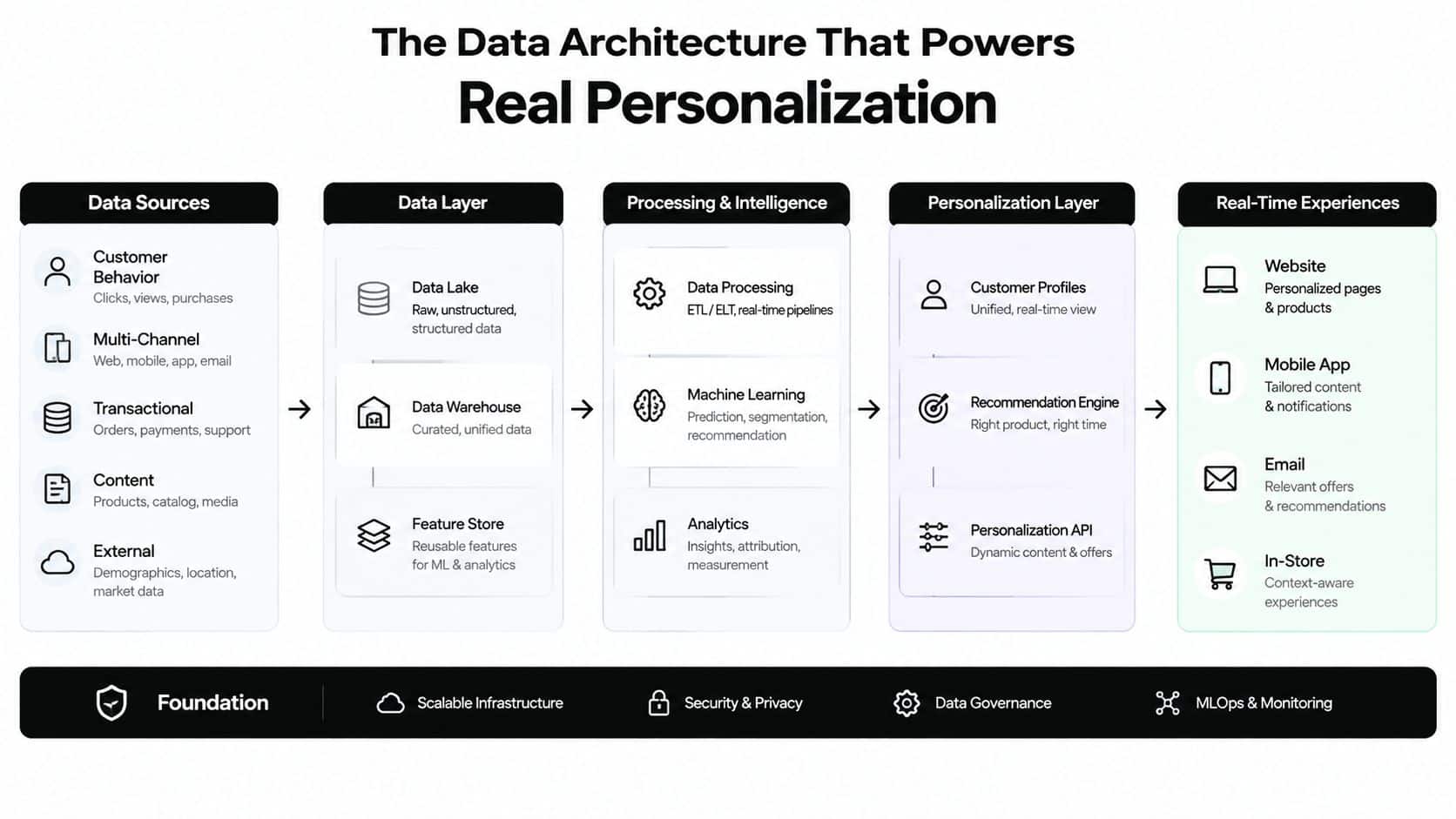
Personalization fails when teams collect signals without giving them a common decision layer. Account intent, individual browsing behavior, and CRM activity each provide useful context, but none is sufficient on its own. A product view might indicate curiosity, while an opportunity in the CRM indicates commercial intent and a contract may determine what the buyer can purchase.
A practical architecture brings those inputs together without forcing every system to become a personalization engine.
Normalize the signals before ranking anything
Start with an identity and profile layer. It should connect anonymous sessions, authenticated users, contacts, account hierarchies, business units, and relevant CRM records. The profile doesn't need to copy every field from every system. It needs the fields that influence a decision and a clear record of their source and freshness.
Useful signal groups include:
- Account intent: repeated visits to a category, quote activity, product-family interest, and engagement from several contacts at the same account.
- Individual behavior: searches, filters, viewed specifications, saved lists, abandoned carts, and recent navigation patterns.
- CRM context: open opportunities, account status, sales-owner notes, service cases, renewal signals, and agreed commercial priorities.
- Operational constraints: contract pricing, approved assortment, inventory availability, delivery promises, regional rules, and approval thresholds.
The decision layer should turn those inputs into actions, not just a larger profile. For example, it might rank a contracted product family first for a procurement user, show technical accessories to an evaluator, and place a reorder shortcut in the account dashboard for an established customer.
Support anonymous and authenticated states
Anonymous personalization can use session behavior, device context, and broad catalog intent. It must remain conservative because the system doesn't yet know the visitor's account, contract, or role. Once the buyer signs in, the experience can safely resolve account-specific rules and replace generic recommendations with authorized pricing, assortment, and workflow actions.
That transition should be explicit. Don't allow an anonymous ranking model to override authenticated pricing or availability. Use a policy layer that runs after behavioral ranking and can suppress, replace, or constrain results.
B2B commerce personalization works best when it augments an existing commerce stack through APIs and event flows rather than demanding a full rebuild. Nosto describes integrations with major commerce platforms and technologies, an approach that reflects a sensible deployment pattern: preserve the commerce engine for transactions and add specialized services for decisioning, search, recommendations, or journey activation. Teams researching implementation patterns can also review data-driven personalization architecture for a broader view of how signals become usable experience decisions.
Design for scale and failure
Separate AI and personalization capabilities into services exposed through REST or gRPC. A scaling pattern using horizontal scaling, load balancers, autoscaling policies, and sharding-capable databases can absorb changing demand without forcing the entire storefront to scale as one unit, as described in this practical guide to applications that scale to millions.
Every decision needs a fallback. If the recommendation service fails, show contract-safe category rankings. If CRM data is stale, preserve account permissions and pricing while reducing behavioral influence. A fast, slightly less personalized storefront is better than a clever storefront that displays the wrong commercial terms.
Choosing Your Personalization Model
The right model depends less on how impressive a vendor demo looks and more on whether your data, governance, and operating teams can support it. A rule engine can outperform machine learning when the business has clear contract logic and limited clean history. An advanced model can underperform when identity resolution is weak or product data is inconsistent.
| Model Type | Best For | Implementation Time | Technical Complexity | Typical ROI Timeline |
|---|---|---|---|---|
| Rule-based segmentation | Contract tiers, buyer roles, regions, approval paths | Short | Low to moderate | Early |
| Collaborative and behavioral models | Discovery, cross-sell, repeat browsing patterns | Moderate | Moderate | Medium |
| Machine learning decisioning | Ranking, propensity, account intent, next-best action | Longer | High | Medium to long |
| Agentic AI workflows | Reorders, service routing, guided purchasing, multi-step tasks | Longest | High, with strong governance needs | Long term |
Rules are a feature, not a failure
Rules work well when the business can explain the decision. “Show negotiated pricing to authorized buyers” is easier to test, audit, and roll back than a model that infers a price preference. Rules also provide the guardrails that more advanced systems need.
Use them for permissions, contract terms, regional constraints, inventory promises, and approval workflows. Don't ask a recommendation model to solve a policy problem.
Machine learning earns its place through feedback
Behavioral and machine learning models become useful when the organization has enough reliable events and a clear outcome to optimize. Search relevance, product ranking, complementary items, and reorder prediction are natural candidates. But the team should be able to inspect inputs, monitor drift, and compare model decisions with a controlled experience.
Agentic AI belongs later in the maturity curve. An agent that creates a reorder, starts an approval request, or opens a service case can reduce friction, but it also acts across systems. Its permissions, tool calls, escalation paths, and audit records need design before launch.
Build the simplest model that can make a measurable decision safely. Complexity should follow operational readiness, not curiosity.
Choose a vendor when the capability is common and speed matters. Build custom decisioning when account hierarchies, pricing, workflows, or proprietary product knowledge create genuine differentiation. In many deployments, the strongest answer is hybrid: buy infrastructure and discovery capabilities, then own the policy layer and account-specific orchestration.
Implementation Roadmap and Technical Decisions
A reliable rollout starts with a narrow commercial problem, not a promise to personalize everything. The first release should have a clear audience, a controlled decision, and a rollback path. That structure lets engineering, merchandising, sales, and compliance inspect the behavior before the system touches sensitive account workflows.
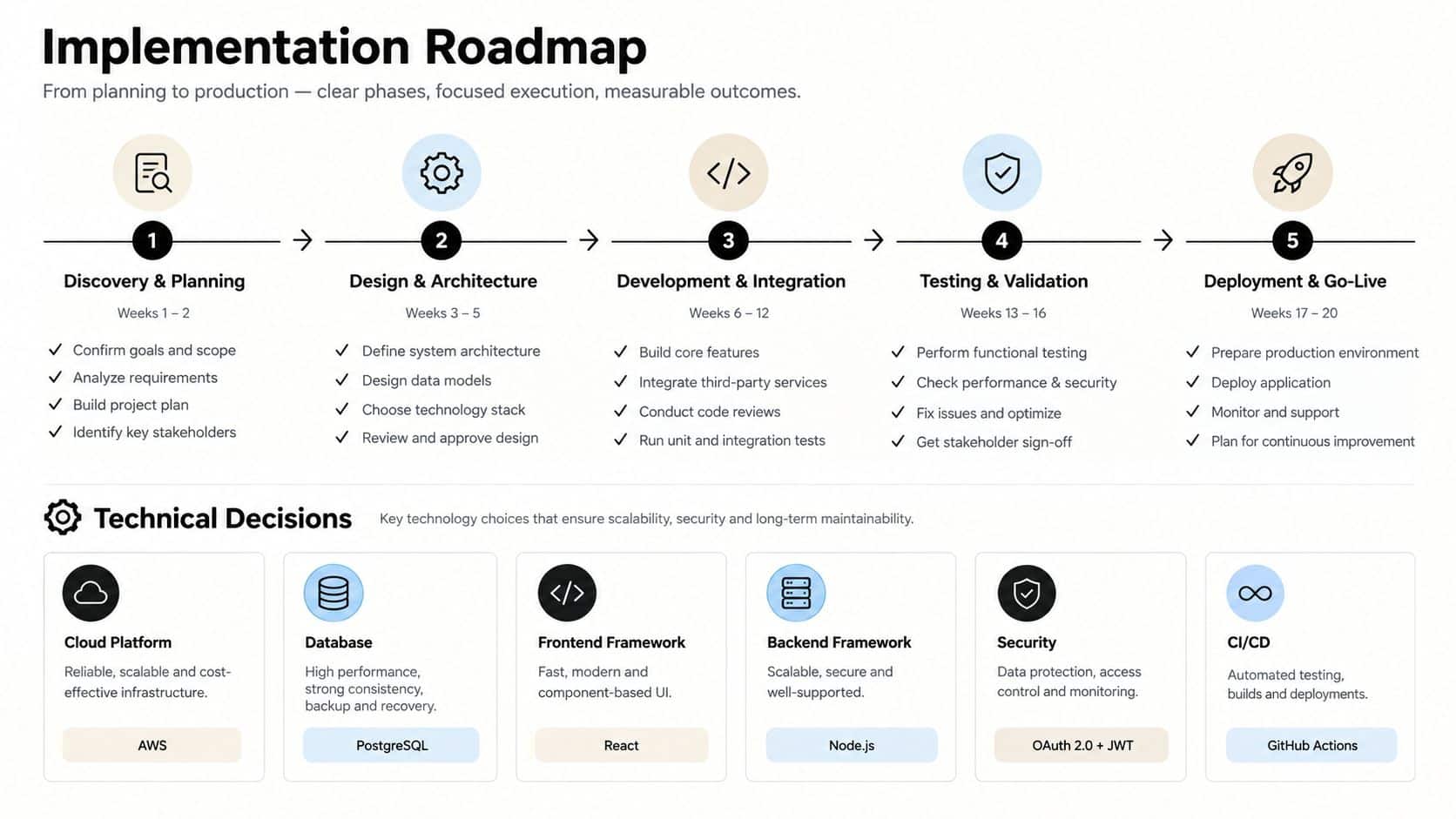
Phase one builds the contract-safe foundation
Inventory the systems that own identity, accounts, products, prices, orders, inventory, CRM activity, and service records. Assign ownership to each field and document which source wins when systems disagree.
Start with an experience where incorrect personalization has limited consequences, such as category ordering or content relevance. Keep contract pricing and permissions in deterministic services until data quality and authorization behavior are proven.
Success criteria: profiles resolve correctly, events arrive with useful freshness, and every decision has a traceable reason.
Rollback: disable the treatment and return to the existing ranking or storefront behavior without changing transactional data.
Phase two introduces a decision API
Expose personalization through a versioned API rather than embedding logic inside page templates. The API should accept context, retrieve eligible signals, apply policy constraints, and return a decision with metadata. Include timeouts and cached defaults so the storefront remains responsive if a downstream service is unavailable.
A service boundary also makes mobile and desktop experiences consistent. Both clients can request account navigation, recommendations, or next actions while the server enforces the same role and contract rules.
Phase three adds controlled experimentation
Test one decision at a time. Separate behavioral relevance from commercial policy so the team can tell whether an outcome came from better ranking, better content, or a pricing change. Keep an audit trail for eligibility, treatment assignment, model version, and fallback behavior.
Don't launch autonomous actions yet. Let the system recommend a reorder or approval route before it executes one, then review exceptions with sales and operations.
Phase four operationalizes AI cost and prompt governance
Every LLM call should be logged with its timestamp, model, input tokens, output tokens, latency, calculated cost, calling team, and use-case tags. A central proxy can attach metadata consistently and feed dashboards that show spend by team or use case, following the controls described in this AI cost optimization guidance.
Prompt governance needs the same discipline as code governance. Record token count and task success rate for each prompt version, then run a monthly optimization review against cost-per-task targets, as recommended in AWS guidance for agentic AI cost management.
Phase five expands only after operational proof
Add post-sale actions, more account roles, and additional channels after the core flow behaves predictably. Monitor latency, stale data, policy violations, fallback rates, human overrides, and support escalations. Each expansion should have an owner and a defined stop condition.
Measuring What Actually Matters
Conversion rate is useful, but it can mislead B2B teams. A buyer may convert after a personalized experience while the account still struggles with reorders, support, approvals, or adoption across other users. A storefront can win the transaction and lose the relationship.
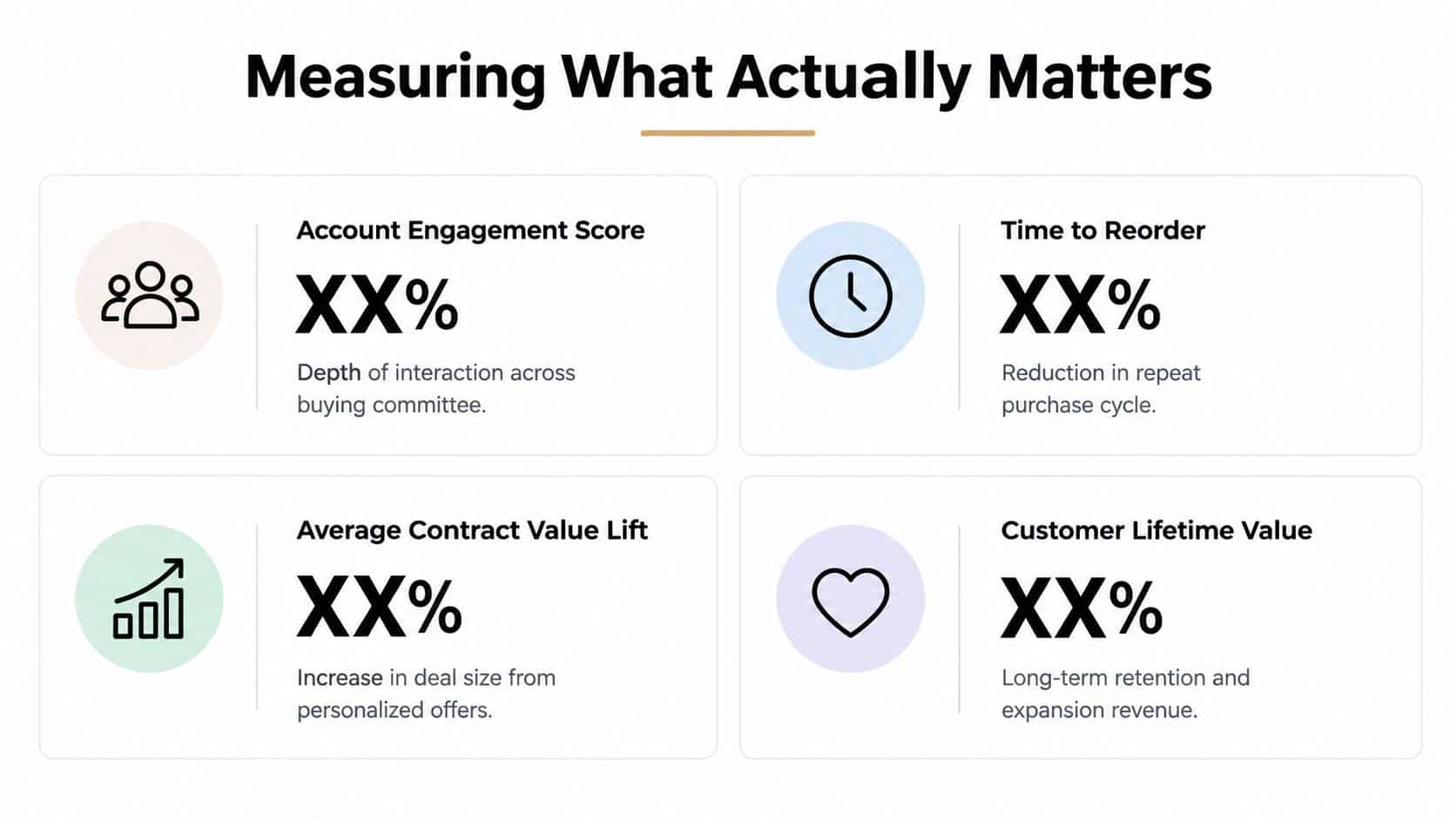
Measure personalization across the account lifecycle. The strongest scorecard connects user behavior to operational outcomes, then separates short-term efficiency from long-term account value.
Use a layered measurement model
Engagement metrics show whether the experience helps people find and understand products. Track relevant search usage, qualified product views, specification engagement, saved lists, quote starts, and participation across the buying committee. Don't treat more clicks as success if buyers still need sales intervention to complete routine tasks.
Efficiency metrics reveal whether personalization removes work. Time to reorder, time from product discovery to quote, approval completion, support routing, and manual sales assistance are more meaningful than raw session depth. These measures help distinguish a pleasant interface from a faster buying process.
Commercial metrics connect decisions to account outcomes. Compare conversion, order value, contract value, margin protection, repeat purchases, expansion activity, and retention between eligible treatments and a suitable control. Keep pricing compliance visible, because higher order value isn't a win if the system violates negotiated terms.
Lifecycle metrics expose the post-sale gap. Monitor reorder timing, product adoption, service resolution, renewal engagement, and the number of active roles within an account. A procurement buyer who converts quickly shouldn't hide the fact that technical users never find the documentation they need.
Attribute carefully across long journeys
B2B buying committees create messy attribution. Several people may interact with personalized search, email, sales content, and account dashboards before an order appears. Use consistent account and user identifiers, preserve treatment metadata, and record the decision context at the time of exposure.
A holdout or controlled comparison is more trustworthy than a before-and-after chart. Segment results by account maturity, role, product family, and purchase type. A model that helps new discovery may hurt repeat ordering if it replaces familiar navigation, so aggregate results can conceal important trade-offs.
The broader commercial evidence supports measuring outcomes, not novelty. Industry summaries report that customized experiences can produce 10% to 15% revenue lifts, and personalized email messages can produce 46% higher open rates than non-personalized marketing messages, as compiled in this personalization statistics overview. Those benchmarks are directional, not promises. Your own measurement should determine whether a decision improves the account experience without weakening trust or margin.
Common Failure Modes and How to Avoid Them
A common failure starts with two employees from the same account seeing different prices for the same contracted item. One user is authenticated and receives the negotiated rate. Another arrives through a campaign link and sees a generic promotion. Both experiences may be technically defensible in isolation, but the account experiences them as a pricing error.
The fix is to separate eligibility from persuasion. Behavioral signals can influence ranking and messaging, but contract, permission, and regional policy must govern price and purchasability. Store the reason for every price decision so customer service can explain it without asking engineering to reconstruct a model output.
The privacy trap
Teams often collect every available click because storage feels cheaper than lost signal. That approach creates unnecessary privacy exposure and weakens trust, especially when several buyers share an account. A technical evaluator's browsing history shouldn't automatically become a sales trigger for every executive at the company.
Use purpose limitation and role-aware access. Collect only signals that support a defined experience, retain them according to policy, and make consent and opt-out behavior meaningful. First-party data can support useful personalization, but “more data” isn't the same as “better decisioning.”
The post-sale break
A customer sees a personalized recommendation for an item that isn't compatible with its installed configuration. Another receives a reorder suggestion for a product that's no longer available. A third is shown a promotion that conflicts with the account's agreement. These failures damage confidence faster than a generic storefront would.
Confidence-first personalization prioritizes:
- Inventory truth: Don't recommend what the system can't fulfill.
- Delivery clarity: Show realistic availability and fulfillment information.
- Contract compliance: Preserve negotiated pricing, assortment, and terms.
- Role relevance: Match content and actions to the user's responsibility.
- Human escalation: Provide a clear route when the system lacks confidence.
Conflicting buyers inside one account
Account coordination needs shared state. A user's saved cart, requested quote, approval status, and reorder list should have explicit ownership and visibility rules. Don't let a private browsing preference override the account's shared catalog or commercial policy.
For newer AI workflows, start with recommendations and require approval for actions that change orders, prices, or service commitments. Agentic commerce can become useful when the system has bounded tools, clear permissions, durable logs, and a human escape hatch. Without those controls, automation turns a small data mistake into an account-level incident.
Build Versus Buy and When to Engage Partners
Build the capabilities that make your business distinct. Buy or reuse the components that are difficult to differentiate and expensive to maintain. Search infrastructure, experimentation, event collection, and recommendation primitives often fit a vendor or managed service. Account policy, contract interpretation, proprietary product relationships, and internal approval logic may deserve ownership.
A practical decision starts with four questions:
- Can your team operate it? A custom model without data engineering, QA, monitoring, and product ownership becomes a permanent prototype.
- Does it protect differentiation? If the capability reflects unique commercial knowledge, outsourcing every decision may weaken your advantage.
- Will it fit the existing stack? Demand stable APIs, identity support, observability, failure handling, and clean data contracts.
- Can the partnership transfer knowledge? Your team should understand the architecture, decision policies, test coverage, and rollback process.
Vendor selection shouldn't stop at a polished demo. Test account hierarchies, contract pricing, anonymous-to-authenticated transitions, stale inventory, shared carts, and post-sale workflows. If a platform only personalizes the homepage, it may not solve the operational problem.
Read ecommerce personalization software considerations alongside your own architecture review, then decide which layer needs specialist support. Wonderment Apps offers AI modernization, custom web and mobile engineering, scalable application delivery, and a prompt management system that can be integrated into existing software to manage prompt versions, database parameters, AI logs, and cumulative spend.
If your B2B storefront needs personalization that respects account roles, contract pricing, post-sale workflows, and AI governance, visit Wonderment Apps to discuss your architecture and modernization goals. Ask for a practical review of the decision layer, integration boundaries, and prompt-management controls before committing to a rebuild or another disconnected personalization tool.