

The riskiest application modernization decision isn't the technology. It's the partner you choose to change software your business still depends on. In Ensono's 2025 survey of enterprise IT and business leaders in the United States and United Kingdom, 95% of organizations were working with at least one third-party modernization partner. Outside help is commonplace. Choosing the right kind is the hard part.
Legacy software doesn't retire itself, and dozens of application modernization companies promise to make it easier to live with. Compare them by engagement fit, modernization approach, AI depth, and industry relevance, not the size of their logo. The recommendations below distinguish hands-on product engineering from enterprise transformation and AI-enabled modernization.
Our own offering includes an administrative AI toolkit for prompt management, integrations, and token-cost control, with more detail near the end. If your architecture is sound but your team lacks capacity, finding specialized IT staffing support may be more appropriate than commissioning a transformation program.
Expect custom quotes, not useful sticker prices. Fit comes first.
1. Wonderment Apps
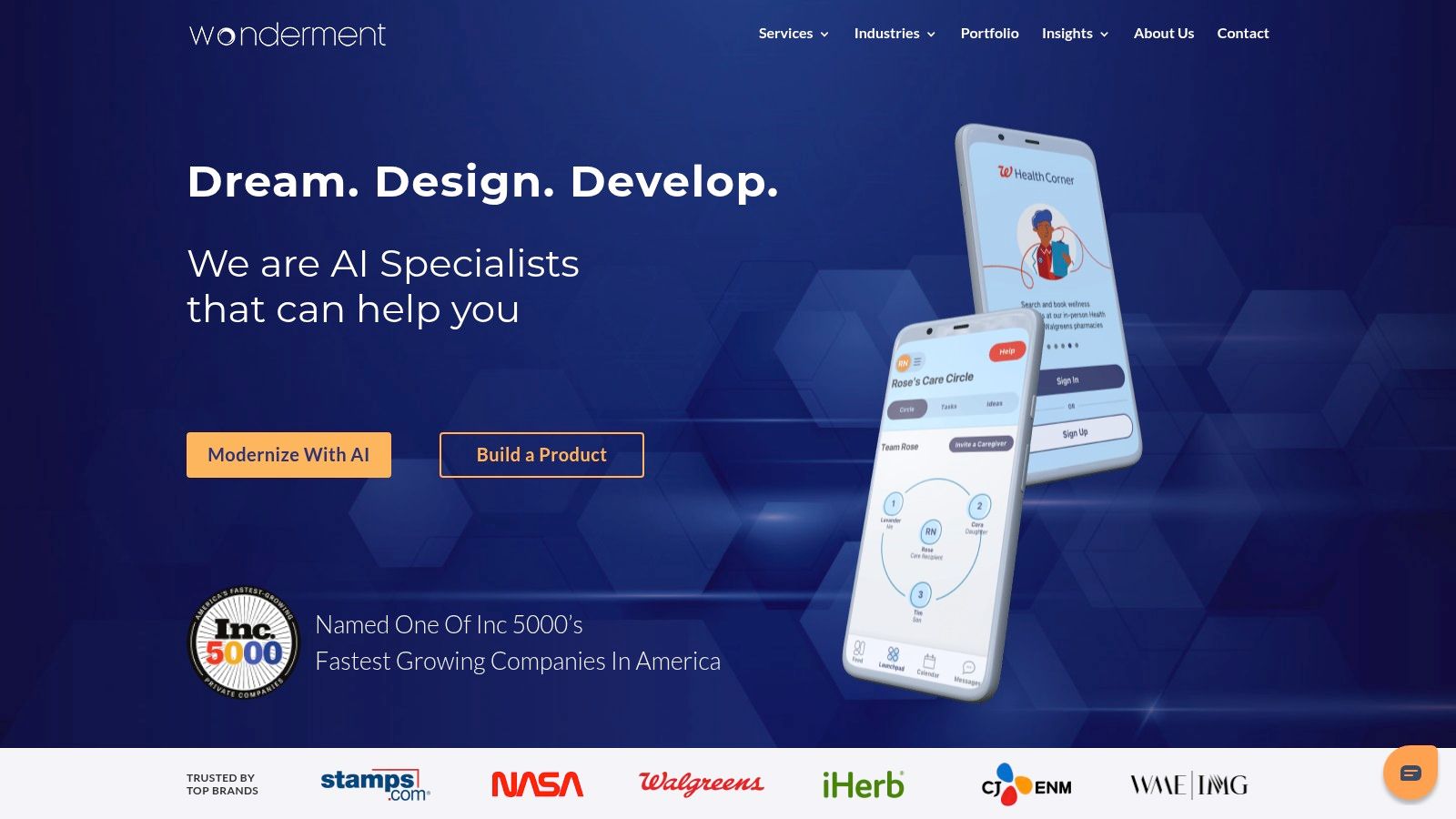
Some modernization projects are really product rebuilds wearing a migration label. We fit organizations that need both: legacy systems connected to AI capabilities and the customer-facing applications around them rebuilt to match. As a full-service digital product and engineering partner, we cover backend architecture, API and database development, frontend interfaces, and manual and automated QA within one engagement.
That scope matters when modernization reaches the experience layer instead of stopping at infrastructure. Custom AI integrations can add personalization, recommendations, demand forecasting, fraud detection, anomaly detection, self-healing, and autoscaling. Our administrative toolkit manages prompts, integrations, model connections, and token costs, with ongoing support as models evolve.
Where Our Delivery Model Fits
Managed Projects assembles right-sized teams across engineering, UX, QA, product management, and technical project management to design, build, and support applications built to scale to millions of users. Launch is the midpoint, not the finish line. We've delivered for more than 75 technology and design clients across ecommerce, fintech, healthcare, media, SaaS, and nonprofit and government organizations, with recognition on the Inc. 5000.
For organizations keeping delivery in-house, curated staffing covers React, .NET, C#, Java, iOS, Android, and WordPress developers, automated and manual QA engineers, product managers, and UX designers.
- Main advantage: Product design, application engineering, AI modernization, and ongoing support sit within the same engagement.
- AI operations: The administrative toolkit keeps model connections, prompts, and token spend manageable after launch.
- Trade-off: Broad capabilities require a tightly defined scope. Separate must-fix modernization from optional product expansion before commissioning work.
- Pricing: Public pricing isn't listed. Scope, staffing, and delivery responsibilities determine the proposal.
Verdict: Choose us when modernization has to improve the underlying software and the user experience at once. Look elsewhere when procurement centers on a standardized infrastructure migration with little custom product work.
2. Thoughtworks
Choose Thoughtworks for incremental architectural change, not a cloud move wearing a transformation badge. Its engineering-led approach connects modernization strategy with product thinking and implementation, including tightly scoped work on a thin slice of an application.
Thoughtworks' legacy modernization services cover legacy, mainframe, data, and product modernization. Its capabilities include AI/works and a partnership with Mechanical Orchard for mainframe modernization. Distinguish AI used to support engineering from AI functionality delivered inside your product. They're different purchases.
Start with a business capability you can isolate, test, release, and reverse. Don't make the entire estate your first deliverable.
Strong Fit for Product-Led Engineering
Say a fintech platform needs to change its account-servicing workflow while preserving transaction processing. Incremental extraction lets engineers improve that capability while keeping the existing system operational. Our guide to legacy system modernization strategies explains how to compare refactoring, API enablement, and selective replacement.
Thoughtworks fits teams willing to participate in architecture decisions and ongoing product prioritization. It isn't a hands-off outsourcing choice where the buyer disappears until acceptance testing.
- Strength: Strategy and implementation can remain connected as engineers uncover dependencies.
- Trade-off: Client alignment and participation are substantial commitments.
- Commercial reality: Pricing is custom-quoted, and minimum engagement sizes aren't published.
Verdict: Shortlist Thoughtworks when maintainability and continuous product evolution matter more than moving servers quickly. Look elsewhere for a straightforward lift-and-shift or a narrow framework upgrade that doesn't need architectural consulting.
3. Slalom
A retailer replacing its customer platform may also need to untangle analytics, identity, cloud infrastructure, and reporting. Slalom fits that interconnected problem better than an isolated coding assignment.
Slalom's application modernization practice combines assessment, prioritization, roadmaps, governance, and implementation across applications, data, platforms, and cloud. Its reported industry experience includes public sector, healthcare, financial services, manufacturing, and retail.
Best When Business Priorities Need Sorting
Slalom's useful distinction is breadth across business and technology decisions. Before authorizing implementation, establish which applications deserve investment, which can remain unchanged, and which should be retired. Otherwise, you can end up modernizing software nobody needs.
Its partner ecosystem suits environments involving multiple cloud, data, and software providers. That breadth also creates a procurement responsibility: identify the actual delivery team, its relevant stack experience, and who owns decisions when platform recommendations conflict.
- Strength: Business prioritization and implementation support can sit together.
- AI fit: Consider Slalom when AI depends on coordinated application, data, and platform changes. Require product-level deliverables rather than accepting a general AI strategy.
- Trade-off: A broad consulting engagement is unnecessary for a small, self-contained application upgrade.
- Pricing: Quotes are custom, with no public standard pricing.
For healthcare and public-sector buyers, evaluate the proposed team's handling of accessibility, sensitive data, and operational approvals. A corporate industry page isn't a substitute for relevant delivery experience.
Verdict: Choose Slalom for cross-functional modernization with competing stakeholders and investment priorities. Look elsewhere when you already have a clear technical plan and need engineers to execute it.
4. 10Pearls
10Pearls is a practical shortlist choice when modernization includes a product redesign. Its combination of engineering, UX, QA, security, and cloud services fits applications whose interface and delivery process need attention alongside their code.
10Pearls' modernization offering starts with technology assessment and includes rehosting, refactoring, rearchitecting, monolith decomposition, database migration, and API integration. It offers project delivery and team augmentation, plus a federal practice focused on citizen-facing services and government modernization.
- Product advantage: UX, testing, security, and DevOps can accompany backend changes.
- Transition planning: Its described approach includes parallel runs and cutover planning.
- Resourcing choice: Project delivery suits delegated ownership; augmentation suits teams retaining technical leadership.
Set Delivery Boundaries Before Signing
Clarify the proposed onshore, nearshore, and offshore mix, including working-hour overlap, escalation ownership, and access to senior engineers. Geography alone doesn't determine delivery quality, but unclear collaboration arrangements make troubleshooting harder.
For a citizen-services application, define how people complete essential tasks during migration. A parallel run should specify how records are reconciled, which system is authoritative, and what triggers rollback. The same discipline applies to ecommerce orders and healthcare scheduling.
Treat AI as a specific workstream: name the workflow, identify permitted data, establish an evaluation method, and define human review. Don't infer production AI governance from a broad engineering capability.
Verdict: Choose 10Pearls when modernization needs UX improvement and flexible resourcing. Look elsewhere if your priority is a specialist legacy platform and the proposed team can't demonstrate that exact expertise. Pricing is custom-quoted; standard rates and minimums aren't published.
5. EPAM Systems
EPAM is the strongest fit here for buyers whose application estate contains several different modernization problems at once. Its coverage includes applications, platforms, mainframes, and midrange systems, supported by assessment, migration, testing, and managed services.
EPAM's modernization services include portfolio assessment, application-disposition planning, data migration, automated testing, and In-Place Modernization. That last option matters when replacement would discard valuable business logic or introduce unnecessary operational risk.
Practical rule: Keep the business behavior you need. Replace the technical constraint that prevents you from changing it.
Portfolio Depth Without Automatic Replacement
An estate-wide program needs different treatments for different applications. Retain a stable component, wrap another with an API, refactor a frequently changed service, and retire redundant functionality. Our application modernization roadmap guide provides a way to sequence those decisions.
EPAM's breadth fits organizations needing engineering across legacy systems and their surrounding platforms. Its managed services also provide a route to continued support after migration, rather than an abrupt handoff.
- Strength: Mainframe, midrange, application, and platform capabilities within a broad engineering offering.
- AI fit: Define whether the engagement uses AI to assist delivery, adds AI features, or prepares data and architecture for later integration.
- Trade-off: A large engineering program can be excessive for a modest application upgrade.
- Pricing: Custom-quoted, with no published standard pricing.
Require application-level acceptance criteria, not just portfolio-level progress reporting. Data reconciliation, regression coverage, rollback readiness, and ownership after release should appear in delivery plans.
Verdict: Choose EPAM for technically diverse estates requiring sustained engineering capacity. Look elsewhere for a small upgrade where a focused product team can manage the dependencies directly.
6. IBM Consulting
IBM Consulting belongs on the shortlist when mainframes and hybrid cloud must coexist. Its modernization options include incremental enhancement, replatforming, refactoring, rearchitecting, and replacement, rather than assuming every application needs the same destination.
IBM Consulting's application modernization services span portfolio strategy, migration, application engineering, and managed services. IBM also describes generative AI and Consulting Advantage for Cloud Transformation as tools supporting modernization work, alongside capabilities across AWS, Microsoft, Google Cloud, Red Hat, and Oracle ecosystems.
Make the Platform Choices Explicit
The purchasing question isn't whether IBM has enough capabilities. It's which capabilities your program needs, which platforms become dependencies, and who operates the result.
Our guide to enterprise application modernization explains why portfolio planning and operational continuity need to precede broad architectural change. For a financial-services estate, preserving transaction behavior and reconciling migrated data should take priority over adopting a fashionable deployment model.
- Strength: Broad coverage for complex hybrid-cloud and mainframe programs.
- AI distinction: AI-assisted modernization doesn't automatically include governed AI features in the finished application. Specify both separately.
- Trade-off: Large-provider coordination can be disproportionate to a small project's needs.
- Commercial detail: Pricing depends on estate size and scope; public standard rates aren't listed.
Require the proposal to distinguish mandatory tooling from optional accelerators. Include documentation, configuration ownership, operational access, and an exit plan in acceptance criteria.
Verdict: Choose IBM Consulting when modernization spans critical legacy platforms, hybrid infrastructure, and sustained enterprise operations. Look elsewhere when your project needs a compact product team rather than extensive program coordination.
7. Cognizant
Some buyers need a transformation partner. Others need a partner that will also run the applications afterward. Cognizant fits the second group, particularly where modernization extends across a large portfolio.
Cognizant's application modernization services combine business-led planning, application-led cloud modernization, migration, engineering, and ongoing application management. Its Skygrade offering supports automation- and AI-enabled cloud-native transformation, with dashboards for modernization programs and estate performance.
Buy Operating Outcomes, Not Dashboard Access
Program dashboards can help teams coordinate work, but migration completion doesn't prove that an application performs better. Set acceptance criteria around deployment lead time, maintenance effort, user-visible failures, and recovery behavior.
For reliability, Google's Site Reliability Engineering guidance recommends request-success measurement for globally distributed services and error budgets to balance reliability with change. Translate that into operating rules: identify critical user journeys, establish service objectives, and pause risky releases when reliability falls outside agreed tolerances.
- Strength: Modernization and long-term application management can remain with the same provider.
- AI fit: Skygrade supports the transformation process. Separately specify any AI capabilities and governance required inside your product.
- Trade-off: Smaller projects need a simpler delivery structure than a portfolio-wide program.
- Pricing: Custom-quoted; typical engagement sizes and public standard pricing aren't listed.
Clarify which Skygrade capabilities the proposal uses, what depends on the platform, and how your team accesses operational records.
Verdict: Choose Cognizant for enterprise modernization tied to ongoing application operations. Look elsewhere if your team wants a narrowly bounded engineering engagement and plans to operate everything internally.
7 Application Modernization Companies at a Glance
| Company | Best For | Core Modernization Focus | AI Capabilities | Vertical Strengths |
|---|---|---|---|---|
| Wonderment Apps | Organizations seeking an end-to-end product and AI modernization partner | Custom web and mobile products, system integration, and ongoing support | Connects systems and business data to AI models; tools for prompts, integrations, and token costs | Ecommerce, fintech, healthcare, media, SaaS, nonprofit, and government |
| Thoughtworks | Teams modernizing applications incrementally alongside product development | Legacy, mainframe, data, and product modernization; strategy through implementation | AI/works platform; AI capabilities not detailed | No specific vertical focus stated |
| Slalom | Enterprises aligning modernization with business priorities and risk | Application, data, platform, and cloud assessment, roadmaps, and delivery | Modernization work alongside data, platforms, cloud, and AI | Public sector, healthcare, financial services, manufacturing, and retail |
| 10Pearls | Organizations combining application modernization with product engineering or team augmentation | Assessment, refactoring, rearchitecting, migration, APIs, UX, QA, and security | No specific AI capabilities stated | Federal and government digital services |
| EPAM Systems | Enterprises modernizing complex, diverse technology estates | Application, platform, mainframe, and midrange modernization, including managed services | No specific AI capabilities stated | No specific vertical focus stated |
| IBM Consulting | Enterprises modernizing hybrid-cloud and mainframe applications | Portfolio strategy, migration, replatforming, refactoring, rearchitecting, and replacement | Generative AI and Consulting Advantage for Cloud Transformation | Enterprise environments with mainframe and hybrid-cloud needs |
| Cognizant | Enterprises seeking modernization with ongoing application management | Business-led planning, cloud migration, application engineering, and management | Skygrade supports automation- and AI-enabled cloud-native transformation and program dashboards | No specific vertical focus stated |
Choosing Your Modernization Partner With a Practical Decision Framework
Inventory before you shortlist. Record business owners, dependencies, sensitive data, release constraints, and the business rules nobody wants to rediscover during an outage. Then choose the engagement shape: incremental engineering, enterprise-scale program management, or AI-native modernization.
Match industry experience to the work, not just the sector label:
- Ecommerce: Test checkout continuity, catalog synchronization, recommendations, and demand forecasting.
- Fintech: Prioritize transaction integrity, authorization, auditability, and controlled fraud-review workflows.
- Healthcare: Examine sensitive-data access, clinical workflow boundaries, accessibility, and human approvals.
- Media: Test content discovery, playback journeys, entitlement checks, and traffic spikes.
- Public sector: Prioritize accessible services, records handling, procurement requirements, and assisted-service alternatives.
Probe AI depth during discovery. Ask who versions prompts, approves model changes, monitors token costs, and handles failed or unsafe outputs. NIST's AI Risk Management Framework organizes oversight around Govern, Map, Measure, and Manage, a useful basis for evaluating production readiness rather than prototype appeal.
A working AI demo proves that an integration can respond. It doesn't prove that your team can govern, afford, or maintain it.
Our prompt management system plugs into existing applications to support AI modernization. It includes a prompt vault with versioning, a parameter manager for internal database access, logging across all integrated AI systems, and a cost manager showing cumulative spend. Request a demo using an actual application workflow so you can assess administration alongside the user-facing feature.
We also build AI-driven applications with advanced analytics, machine learning, and predictive models. Our experience spans ecommerce, healthcare, media and entertainment, fintech, SaaS, and nonprofit and government work, with ongoing expert consultation through the Wonderment Hive.
Shortlist three vendors and run the same discovery questions against each. Compare their proposed first deliverable, delivery ownership, rollback plan, operating responsibilities, and AI controls. Pick the partner whose delivery model matches your team, not the biggest logo.
Wonderment Apps combines AI modernization, custom web and mobile engineering, UX design, and ongoing technical support. Visit Wonderment Apps to discuss your existing application and request a demo of the prompt management toolkit, including versioning, cross-AI logging, and cumulative cost tracking.