

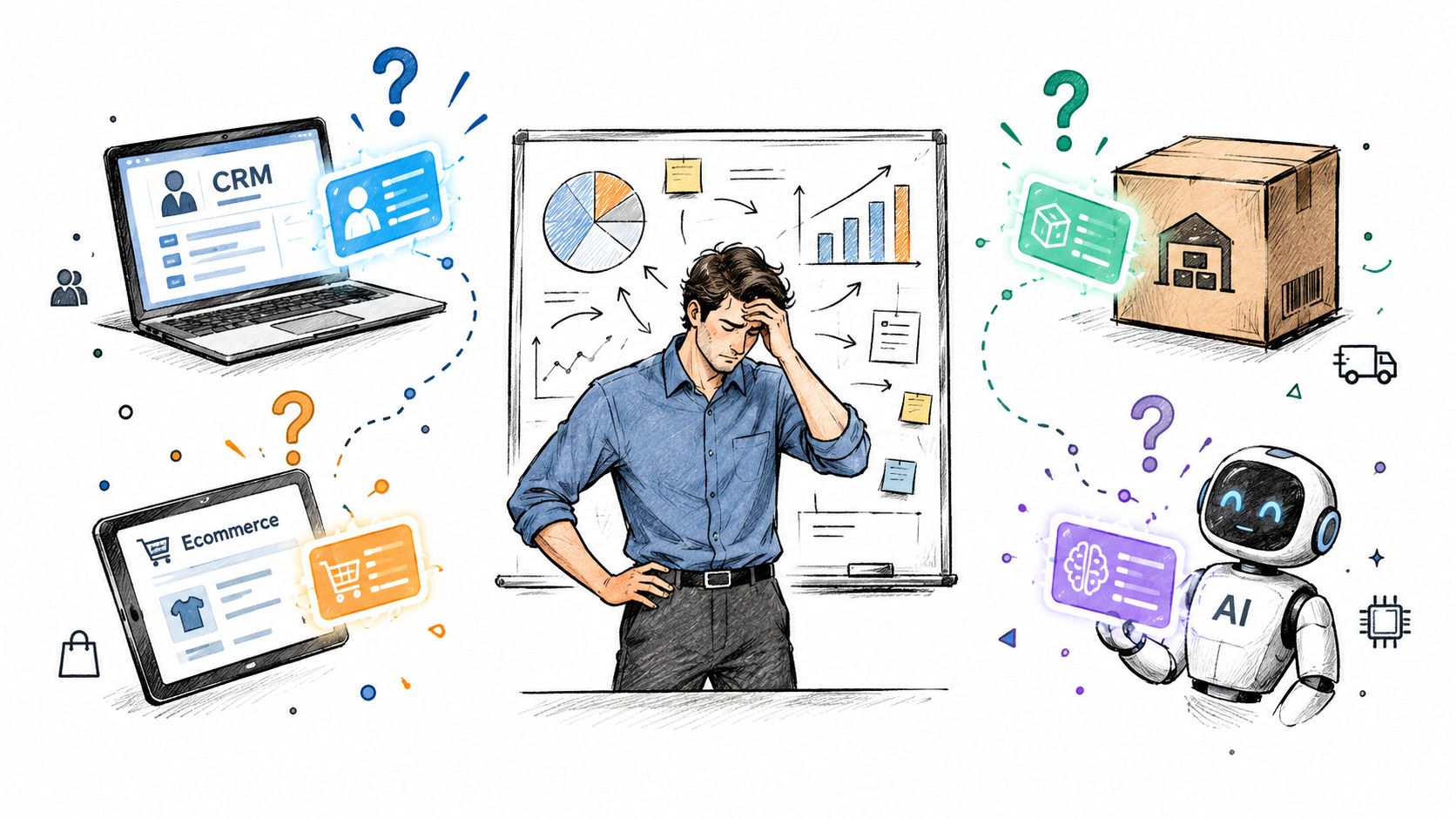
A growing brand's customer record can tell three different stories. The CRM says a shopper prefers email, the ecommerce platform shows a recent purchase, the warehouse still lists the item as available, and an AI assistant answers from an older product feed. Each system may be working as designed. Together, they can still produce a clumsy customer experience, a costly operational mistake, or an AI feature nobody trusts.
That's why data integration solutions are more than connectors and scheduled jobs. They're the connective tissue behind personalization, recommendations, anomaly detection, and services that can scale without losing control of cost or compliance. Wonderment Apps offers a prompt management system that works with existing software to help teams manage prompt versions, database parameters, AI logs, and spend. The right integration foundation makes that kind of AI governance useful, rather than another control panel attached to disconnected systems.
When Your Systems Stop Talking, Growth Stalls
The trouble often starts when a business grows faster than its architecture. Marketing adds a customer platform, operations adopts new inventory software, finance keeps a separate source of truth, and product teams introduce AI features. Soon, teams spend more time reconciling conflicting records than acting on them.
For an ecommerce team, the gap might show up as a recommendation based on an item that's out of stock. In fintech, it could mean a risk model sees an incomplete transaction history. In healthcare, information may move between systems but still fail to land in a form staff can use in their workflow. None of those problems is solved just by adding another connector.
Integration becomes a growth lever when it connects reliable information to an action. A clean event stream can help a retail app update a recommendation as a shopper browses. A well-governed data flow can give an anomaly-detection system context across transactions. A dependable pipeline can also help a product scale compute when demand changes, without making every service query every system directly.
Connectivity isn't the same as usable data
Healthcare offers a useful historical example of what it takes to move from isolated exchange to broader integration. The U.S. Office of the National Coordinator for Health Information Technology tracked hospitals' participation in sending, receiving, finding, and integrating patient information. In 2014, 23% of U.S. hospitals engaged in all four activities; that share reached 46% in 2018 and 70% of non-federal acute-care hospitals in 2023 (ONC's analysis of interoperable exchange). The figures make an important distinction: transmitting a record is not the same as finding it, interpreting it, and incorporating it into work.
For teams dealing with older platforms, the hard part is often preserving meaning while connecting systems that weren't designed to share data. A practical starting point is to identify what must remain authoritative, where updates originate, and how teams will handle conflicts. Wonderment Apps' guide to integrating with legacy systems is a helpful companion when modernization needs to work around existing infrastructure.
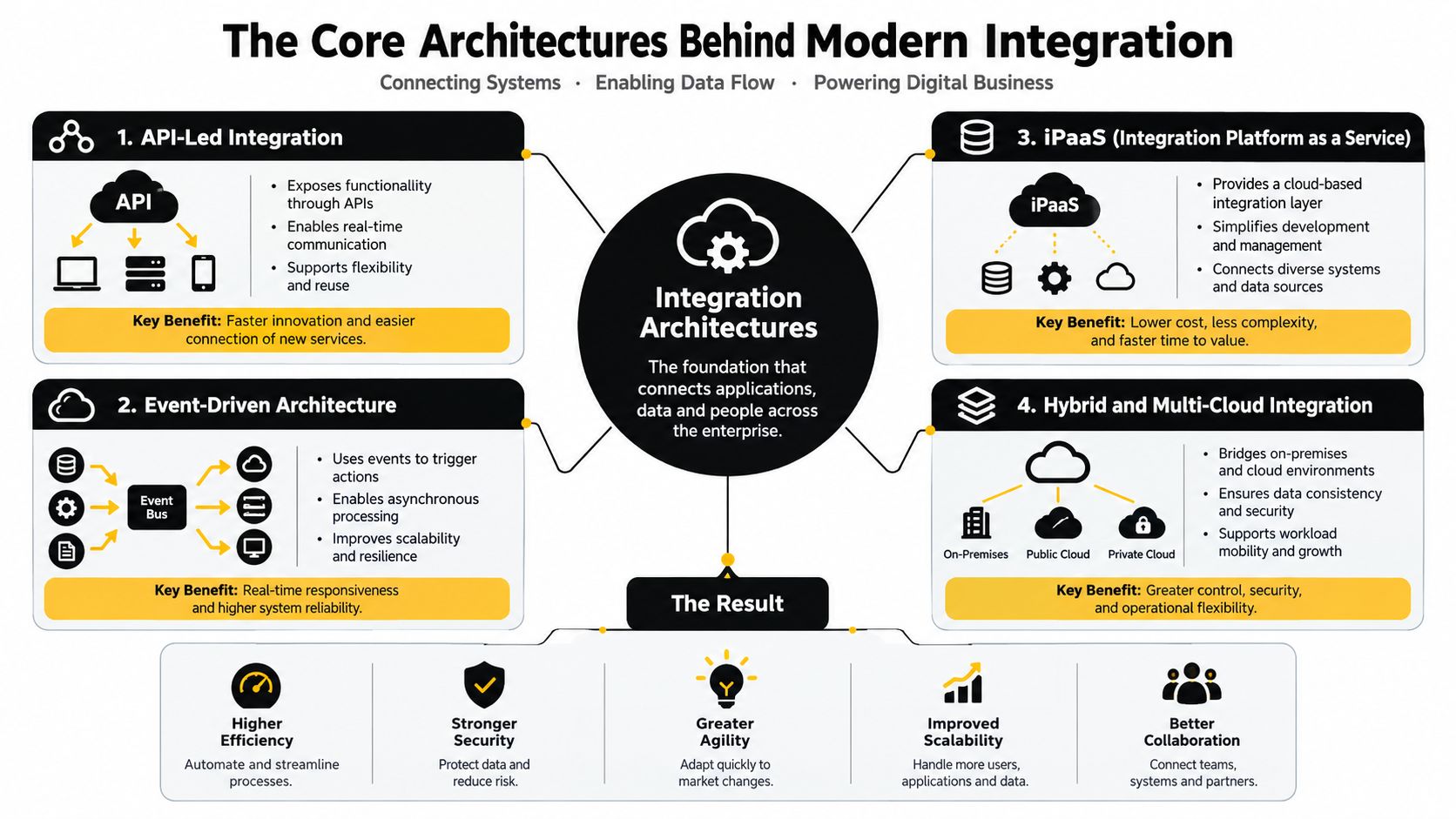
The Core Architectures Behind Modern Integration
A useful architecture conversation starts with the movement and timing of data, not a vendor shortlist. Ask whether the job needs scheduled delivery or continuous updates, where transformations should happen, and which system is responsible for the resulting record.
Choose the right movement pattern
ETL, or extract, transform, load, prepares data before loading it into its destination. Think of packing a suitcase before a trip: you decide what to bring and arrange it for the journey. It suits pipelines where controlled, repeatable transformation matters, though transformation work can become a bottleneck if requirements change frequently.
ELT extracts and loads data first, then transforms it inside the destination, often a data warehouse. That's closer to shipping the whole closet and sorting it after delivery. It gives analysts room to explore source data, but it also requires clear ownership and controls so raw and derived data don't become confusing lookalikes.
Streaming moves events continuously. It's a fit for use cases where waiting for a scheduled batch would undermine the outcome, such as responding to a live shopping session or flagging a suspicious transaction. The trade-off is operational: teams must handle event ordering, retries, backpressure, and failures without losing or duplicating work.
Change data capture (CDC) tracks changes in an operational database and sends them downstream. It can keep a customer or product view current without repeatedly extracting entire tables. But a pipeline still needs to handle schema changes and define how deletions and corrections behave.
APIs provide a contract for applications to request or exchange information. They work well for services and partner ecosystems, provided teams manage authentication, rate limits, compatibility, and clear ownership of each interface.
Data mesh organizes data ownership around business domains, with federated governance and domain-managed data products. It can reduce reliance on a central team for every change. It won't fix unclear accountability, though: distributed ownership only works when teams share expectations for quality, access, and documentation.
A useful mental model: Pick the pattern based on when a decision needs the data, where the transformation belongs, and who is accountable for its meaning.
Comparing Patterns for Latency Cost and Governance
No integration pattern wins every workload. A batch pipeline may be inexpensive and easy to reason about, but too slow for a live intervention. A streaming system can respond quickly, but it adds operational demands that don't make sense for every report. Compare the cost of running a pattern with the cost of a wrong or late decision.
Matching Integration Patterns to Real Workloads
| Pattern | Latency | Best-Fit Workload | Complexity | Governance |
|---|---|---|---|---|
| ETL | Scheduled or batch | Curated feeds and controlled transformations | Moderate; transformation logic runs before loading | Define mappings, validation, and ownership of the output |
| ELT | Usually batch, with flexible refresh schedules | Warehouse analytics and exploratory analysis | Moderate; destination compute and transformation conventions matter | Govern raw, transformed, and consumption layers |
| Streaming | Continuous, event-driven | Fraud signals, live personalization, and operational alerts | Higher; ordering, retries, and consumer scaling need attention | Define event schemas, access, retention, and failure handling |
| CDC | Near-current change propagation | Product databases, customer identity, and operational synchronization | Moderate to high; source logs and schema changes need careful handling | Track provenance, deletes, and source-system authority |
| APIs | Request-based or event-triggered | Application services and partner ecosystems | Varies; versioning, authentication, and rate limits require discipline | Set interface ownership, access rules, and compatibility expectations |
| Data mesh | Depends on each domain's implementation | Large organizations with multiple data-owning domains | High organizational complexity, not just technical complexity | Federate standards while making domain teams accountable |
For batch analytics, ELT often fits because teams can load source data and apply transformations where analysis happens. For ecommerce and fintech systems that need current operational records, CDC can complement the warehouse pipeline by propagating changes from product databases. Pairing patterns is usually more practical than forcing one architecture to serve analytics, customer experiences, and operational services alike.
Streaming can support timely fraud checks or recommendations, but it's not automatically the right choice because a business wants “real time.” If an hourly refresh is fast enough for the decision, continuous processing may create complexity without meaningful value. Conversely, an API request can be a clean fit for a user action, but it shouldn't become a chain of synchronous calls that makes a customer wait while several services respond.
A sound selection process starts with the consequence of delay. Map each use case to its acceptable freshness, expected failure behavior, security boundary, and owner. Teams evaluating real-time data processing should pay particular attention to what happens when a consumer falls behind or a downstream service becomes unavailable. That's where the cost of a fast pattern becomes visible.
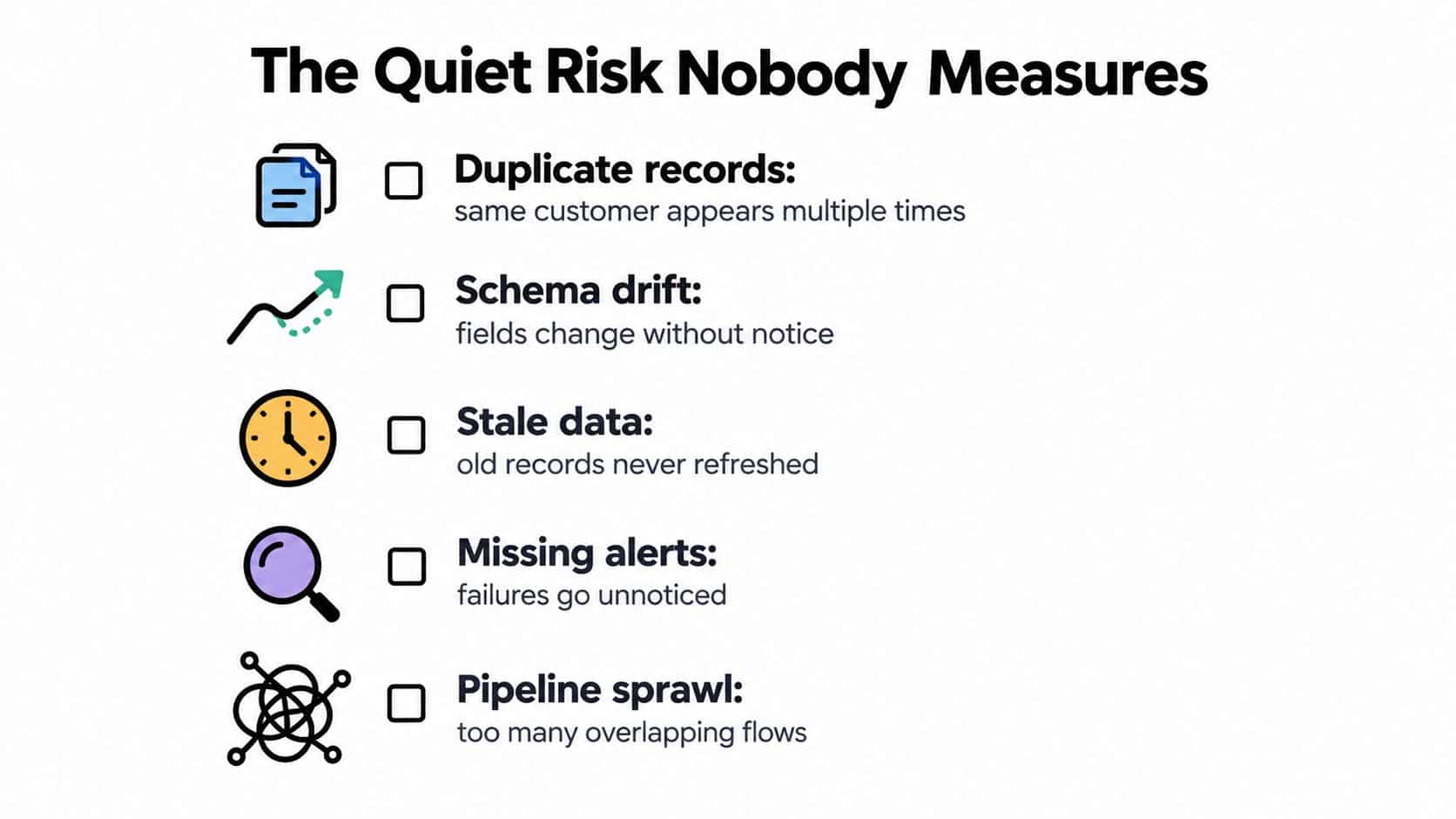
The Quiet Risk Nobody Measures
Adding a pipeline can make data easier to access without making it more accurate. It may even spread duplicates, stale values, and mismatched definitions to more teams. A dashboard that loads quickly can still be confidently wrong.
Recent research identifies data quality as a leading data-integrity challenge: 38% of respondents cited it, while 29% said measuring data quality itself was their biggest obstacle (Precisely's 2026 State of Data Integrity and AI Readiness report). That gap matters. Many integration plans specify how data moves but don't establish what acceptable data looks like before and after the move.
Put quality gates around the pipeline
Measure the dimensions that matter to the decision:
- Completeness: Does an ecommerce identity record have the fields needed to distinguish customers reliably?
- Accuracy: Do financial transactions match the authoritative source used for reconciliation?
- Freshness: Is a record recent enough for the operation that consumes it?
- Uniqueness: Does the same person, product, or transaction appear under multiple identifiers?
- Consistency: Do systems interpret a status, date, or amount in the same way?
- Lineage coverage: Can a team trace a value back through its transformations to its source?
The relevant thresholds depend on the use case. Customer identity matching may tolerate missing optional profile details but not a collision between two people. Financial reconciliation may require clear handling for unmatched entries. A healthcare record needs dependable interpretation in context, not merely successful delivery. For AI, teams also need to question whether labels, source records, and training examples are representative and current. Poor inputs can reinforce model bias rather than correct it.
Treat a pipeline like a product
Give each important flow an owner, a stated purpose, and measurable service-level objectives. Include checks that route exceptions to a queue humans can resolve, plus lineage evidence that shows where data came from. Define rollback procedures before a schema change or transformation error reaches customer-facing features.
Integration can increase confidence without improving truth. Measure the data, not just the successful run status.
Organizations building a data governance framework should connect governance rules to operational checks. If a pipeline fails a quality gate, the team needs to know who can pause it, who investigates, and how corrected data gets replayed without creating duplicates.
Best Practices for Scalable Secure AI Ready Pipelines
A pipeline that works in a development environment can still struggle under production load or expose more information than its users need. Scalability, security, and AI readiness should be designed into the flow, not added after a feature ships.
Scale without making every part scale together
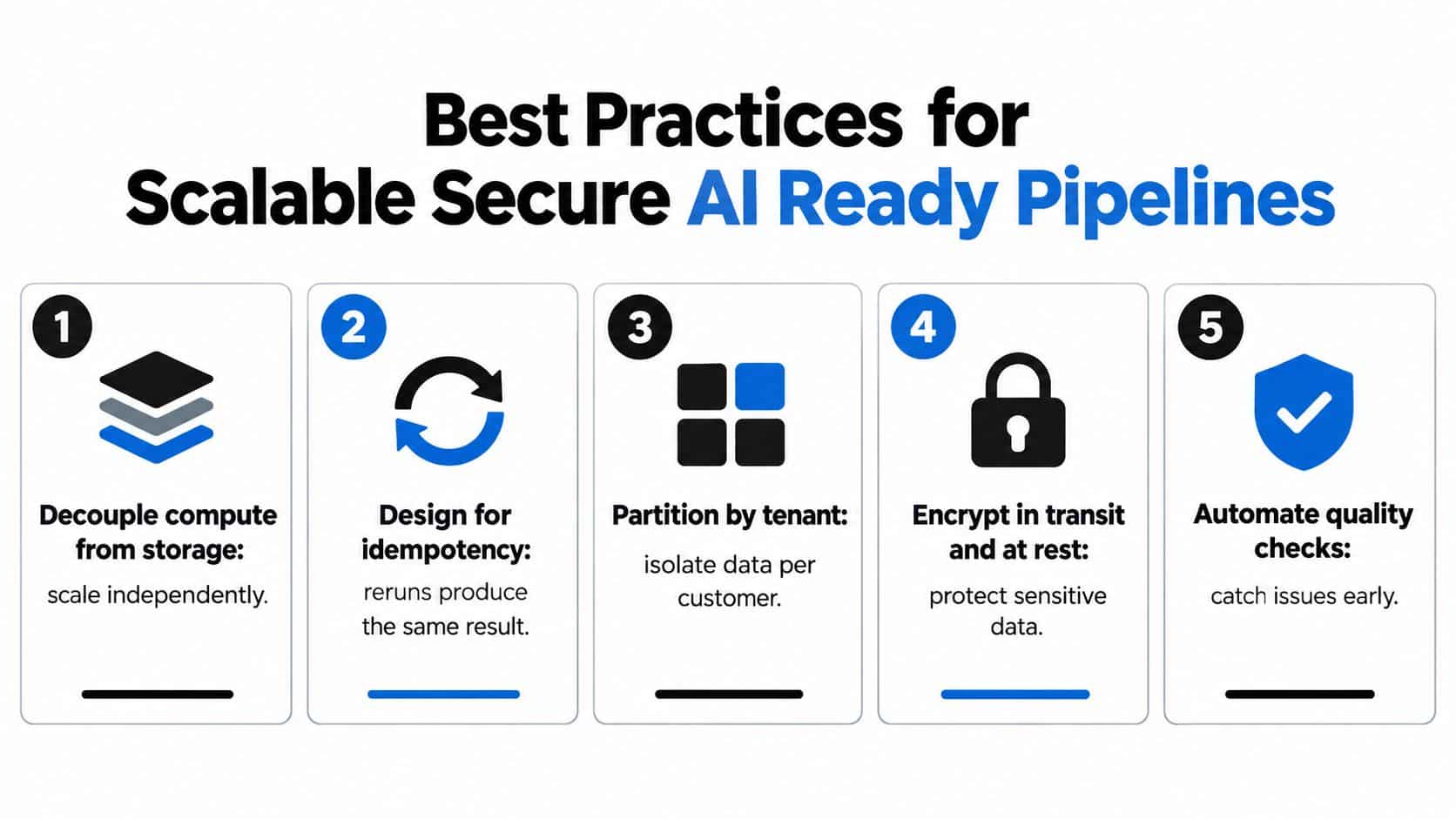
Decouple compute from storage where the architecture supports it, so teams can adjust processing capacity without redesigning how data is retained. Design jobs to be idempotent, meaning a retry produces the same intended outcome rather than duplicate orders or repeated ledger entries. Partition work by tenant or business domain when that supports isolation and load management, and make streaming consumers scale in response to demand without overwhelming downstream services.
Build security into access paths
Encrypt data in transit and at rest, give each connector only the permissions it needs, and keep credentials in a managed secrets system rather than embedded in code or workflow configuration. Define how personally identifiable information is masked, retained, or excluded from logs. Audit trails should show who accessed data and what the integration did, especially where regulated workflows require a defensible record.
Security also depends on the shape of the integration. A convenient shared service account can obscure which application performed an action. A narrowly scoped identity makes access easier to review and revoke. For teams planning AI data flows, this overview of secure AI data ingestion patterns provides additional context on protecting information as it enters AI workflows.
Prepare data for model use, not just model access
AI features need data teams can explain and maintain. Preserve lineage from source through transformation, curate evaluation data that reflects the decisions the model will support, and use bias-aware sampling rather than assuming a large dataset is representative. Where a model influences a consequential action, keep a rollback path so the team can disable or reverse the behavior if evaluation or production monitoring finds a problem.
A feature store can help teams serve consistent, governed features to models and applications, but it doesn't remove the need for quality checks or ownership. Treat model inputs and outputs as part of the product's operational record.
Use this short review to assess readiness:
- Repeatability: Can a failed job run again safely?
- Isolation: Can access and processing be separated by tenant or domain where needed?
- Protection: Are sensitive fields, credentials, and logs handled deliberately?
- Traceability: Can teams connect model inputs to their sources and transformations?
- Recovery: Can operators pause, roll back, and investigate a bad change?
How Wonderment Apps Builds Integrations That Last
A useful integration design starts with the business decision, then works backward to the systems and controls required to support it. Wonderment Apps assembles engineers, designers, QA specialists, and project managers to modernize existing ecosystems and build applications around the integration patterns that fit each domain. The point isn't to make every system use the same architecture. It's to make the pieces work together without losing accountability.
In ecommerce and retail, event streams can inform relevant recommendations while product and inventory data keep the experience grounded in what's available. A feature store can give personalization systems a consistent way to access useful customer and product signals. The operational test is whether the experience supports conversion and retention without serving stale offers or exposing sensitive data.
For fintech and SaaS, carefully controlled data flows can support reconciliation, anomaly detection, and predictable scaling. Teams need to know where financial records originate, how exceptions are resolved, and what happens when a downstream service slows down. An alert without enough context just gives an operations team another puzzle to solve.
In healthcare and wellness, integration has to preserve the meaning of information as it crosses systems and enters clinical or user-facing workflows. Standards-based exchange and clear governance help teams design data products that can be interpreted and used responsibly. For media and entertainment, high-performance applications need to serve rich content while handling changes in demand gracefully, without turning every content update into a manual release.
Choose developers for the work ahead
A development partner should be able to discuss trade-offs plainly: which data belongs in a stream, where an API boundary is useful, how access is tested, and what recovery looks like after a failure. Wonderment Apps' Inc. 5000 recognition provides company context, but the practical questions remain about delivery: who owns testing, how teams communicate risk, and what support continues after launch.
Ask prospective developers to explain how they'll document system ownership, validate data quality, and handle changes to existing applications. The right team will talk about the people and operational processes around an integration, not only the connectors. That's how modernization supports outcomes such as more relevant experiences, reliable operations, and compliance-aware product decisions.
The Control Plane That Ties It All Together
Integration creates pathways for data; AI adds another layer that needs governance. A prompt management system can connect to existing software and give teams a place to manage how applications access and use AI, without replacing the applications or rebuilding the integration stack.
How the Wonderment Apps Prompt Management System Connects to the Stack
| Pillar | Pain Point Solved | Who Benefits |
|---|---|---|
| Prompt vault with versioning | Prompt drift and unclear changes between releases | Developers and product teams |
| Parameter manager for internal database access | Uncontrolled or inconsistent access to internal data | Engineers and administrators |
| Logging system across integrated AIs | Limited visibility into AI requests and responses | Operators, QA, and governance teams |
| Cost manager showing cumulative spend | Difficulty tracking AI costs across integrations | Entrepreneurs and finance leaders |
The control plane doesn't repair poor source data or replace pipeline quality gates. It does give teams a way to govern prompts, parameters, logs, and spend alongside the systems that provide data to AI features. That makes it easier to investigate unexpected answers and understand how an application is using its integrated AI services.
Wonderment Apps' prompt management system is designed to plug into existing apps and software. Explore the demo to see how its prompt vault, parameter manager, AI logging, and cumulative cost view could fit your integration stack.
Wonderment Apps helps teams modernize software with AI integration, custom application development, and a prompt management system for governing prompts, database parameters, AI logs, and cumulative spend. Visit Wonderment Apps to explore the demo and see how a practical control plane can support data integration that scales.