

Your team needs a single customer view by the end of the week. Customer profiles sit in a CRM, purchases live in an ecommerce database, support conversations arrive through a ticketing platform, product activity comes from event streams, and finance maintains its own records. Each system uses different identifiers, schemas, update schedules, and ideas about what “current” means.
That's where data pipeline architecture earns its keep. A dependable pipeline doesn't merely move records from point A to point B. It defines how data enters the system, how teams validate and transform it, what happens when a source fails, how duplicates are prevented, and who owns recovery. Those decisions also determine whether a desktop or mobile application can safely use AI features without serving stale, duplicated, or untraceable information.
Why Data Pipelines Are Chaos Without Architecture
A rushed integration often starts as a small script. It pulls an API response, reshapes a few fields, and writes the result to a database. Then a source changes its schema, an event arrives late, a credential expires, or a vendor experiences an outage. The script fails without warning or produces plausible-looking data that's harder to detect than an obvious error.
The organizational reality is already fragmented. Nearly 50% of surveyed data engineers said valuable organizational data wasn't centralized for analysis, 59% of companies used 11 or more data sources, and 72% transferred data more than once per day, according to Fivetran's survey of modern data infrastructure. A customer-facing application may therefore depend on many independent delivery paths, not one neat warehouse feed.

The real cost of an improvised pipeline
A fragile pipeline creates more than an engineering nuisance:
- Trust erodes: Product managers stop believing dashboards when totals change without explanation.
- AI responses degrade: A recommendation, support answer, or risk score can rely on incomplete context.
- Incidents become personal: The engineer who wrote the integration becomes the default owner, even when the failure crosses several teams.
- Recovery stays vague: Nobody knows whether to retry, reload, roll back, or accept data loss.
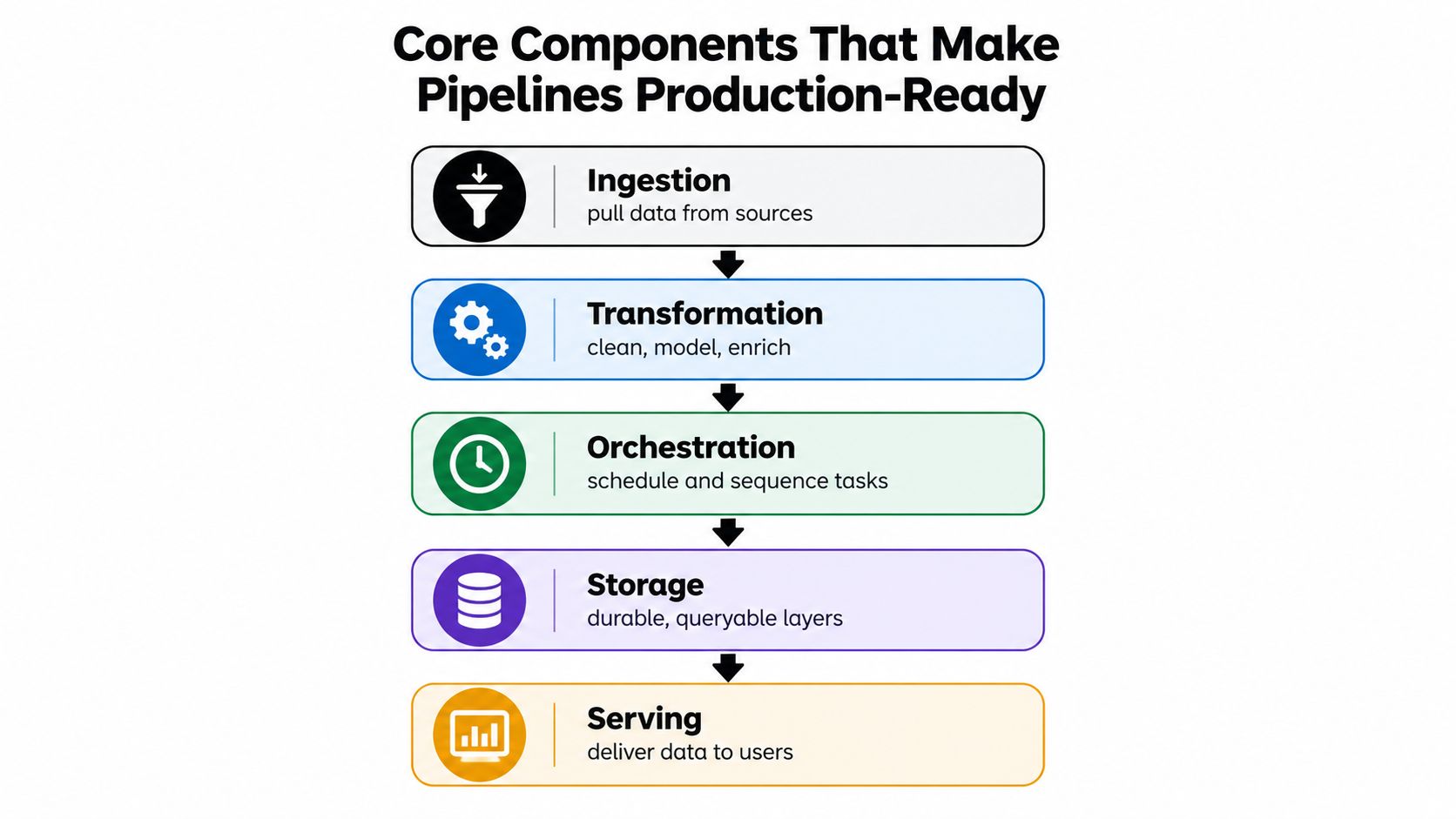
Architecture turns those questions into explicit behavior. Ingestion captures source data and metadata. Transformation applies controlled business logic. Orchestration manages dependencies and retries. Storage preserves durable states. Serving layers expose validated information to applications, analysts, and AI features.
Practical rule: Design the failure path before optimizing the happy path.
Cloud-native design can help startups avoid tying every workload to one oversized platform, but the architectural principles still matter more than the hosting label. For a useful perspective on the broader benefits and trade-offs, review why cloud-native matters for startups. The aim isn't fashionable infrastructure. It's a flow that remains understandable, auditable, and recoverable as sources and users multiply.
Core Components That Make Pipelines Production-Ready
A production pipeline is easier to operate when each layer has a clear job. That separation lets a team replace an ingestion connector without rewriting business logic, or change a serving application without disturbing historical storage.
Start with durable ingestion
Ingestion pulls or receives data from databases, APIs, files, SaaS platforms, and event brokers. Capture the original payload where practical, along with source identifiers, event timestamps, ingestion timestamps, schema versions, and correlation IDs. Those fields make later replay and investigation possible.
Use change data capture when you need database changes without repeatedly scanning entire tables. Use event collection for user actions that must reach operational systems quickly. Either way, isolate source-specific quirks at the boundary. The transformation layer shouldn't contain a different workaround for every vendor.
Keep transformation explicit
Transformation cleans, standardizes, joins, enriches, and models data. Treat transformation logic as versioned software, not as undocumented logic hidden inside a dashboard or one-off notebook. Tests should check required fields, accepted values, duplicate behavior, and relationships between records.
A raw layer preserves what arrived. A curated layer applies validated business meaning. A serving model then shapes information for a particular consumer, such as a mobile API, recommendation service, finance report, or AI retrieval workflow.
Orchestrate the work
Orchestration controls sequence, dependencies, retries, backfills, and ownership. A successful task shouldn't trigger downstream work until its outputs pass the required checks. Retry transient connection failures, but don't blindly replay a payment or customer notification without idempotency protection.
Storage should preserve enough history to support audit and recovery while offering practical query performance. Partitioning by a meaningful access pattern can reduce unnecessary work. Retain raw events when replay matters, and make retention rules explicit when privacy or cost limits apply.
Hadoop's history illustrates why these principles endure. It demonstrated that distributed storage and processing could run across commodity servers, using partitioning across nodes, computation close to stored data, replication for hardware failure, and horizontal scaling as foundational techniques. A concise Visbanking pipeline guide can provide another practical starting point for mapping these layers to an implementation.
Finally, serving delivers trusted outputs to warehouses, dashboards, APIs, operational tools, and AI systems. Add backpressure so a slow consumer doesn't overwhelm the entire flow, and use idempotent sinks so a retry doesn't create a second business event.
Batch Versus Streaming Versus Lambda and Kappa Patterns
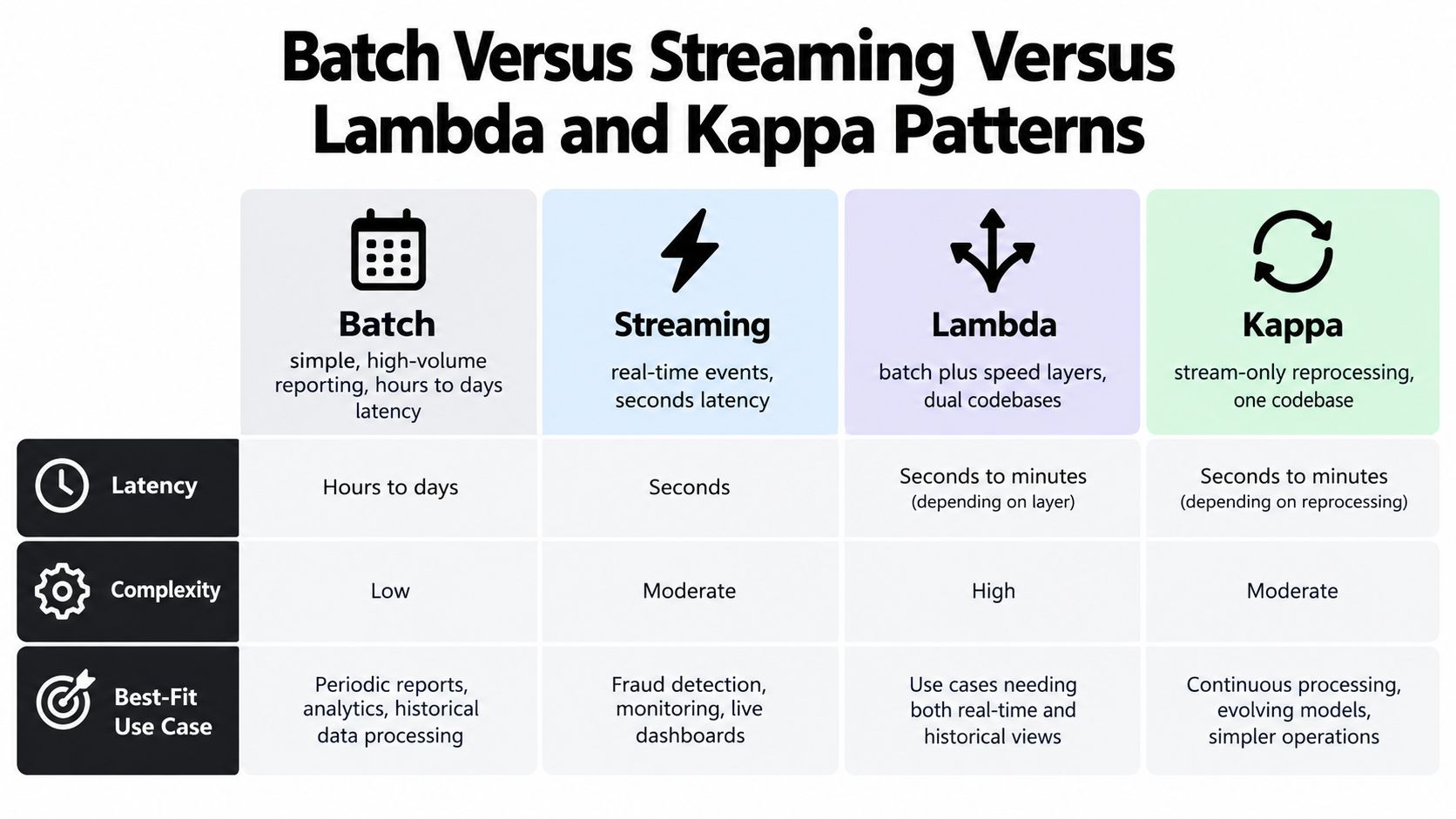
The right pattern depends on the decision the data supports. A finance reconciliation process may value completeness and traceability over immediate freshness. Fraud screening or inventory updates may need events to arrive quickly enough to influence an active transaction.
| Pattern | Where it fits | Main trade-off |
|---|---|---|
| Batch | Historical reporting, reconciliation, and workloads that tolerate delayed freshness | Simpler recovery, but results wait for the next run |
| Streaming | Fraud signals, personalization, and event-driven application behavior | Faster decisions, with harder state and failure management |
| Lambda | Systems needing both a comprehensive historical view and a fast path | Two processing paths can create duplicated logic and operational work |
| Kappa | Event-first systems that can rebuild state by replaying a durable stream | Requires strong event retention, schema discipline, and replay design |
Batch remains a serious engineering choice
Batch is often the safest option when users don't need immediate results. A scheduled job can validate a complete input set, produce deterministic outputs, and make reconciliation straightforward. It's also easier to backfill after a rule change because the processing boundary is clear.
The weakness appears when source changes arrive throughout the day and the business acts on stale information. Large batches can also create a single failure boundary, where one broken transformation delays several dependent reports.
Streaming earns its complexity selectively
Streaming makes sense when freshness changes an outcome. It introduces state, message ordering, consumer lag, schema evolution, replay, and window management. A team that chooses streaming for every dataset usually pays the complexity cost without receiving business value from it.
Event time and processing time must remain distinct. Apache Beam's model assigns timestamps to records and uses watermarks to estimate which earlier events should have arrived. Fixed, sliding, or session windows need an explicit lateness policy, while late-event rates and watermark lag should appear in operational dashboards. The real-time data processing guide offers further context for teams evaluating event-driven workloads.
Lambda and Kappa solve different organizational problems. Lambda can support separate speed and historical paths, but teams must reconcile their outputs and maintain more than one implementation. Kappa reduces duplicated transformation logic by treating the stream as the primary record, yet it only works well when the event log is durable, replayable, and sufficiently expressive.
Correctness and Replayability Over Raw Latency
At 2 a.m., nobody cares that a pipeline was fast when it was healthy. They care whether you can explain which records were affected, replay them safely, and restore trust in the output. That is why pipeline architecture should be treated as an operational recovery problem first, and a latency problem second.
Exactly-once processing makes that trade-off visible. In Google Cloud's published Kafka-to-BigQuery benchmark, exactly-once pipelines showed mean end-to-end stage latency of approximately 1.2 seconds at P50, 3.0 seconds at P95, and 5.4 seconds at P99, excluding the input stage. The benchmark documentation also notes that complexity, user-defined functions, additional transformations, and windowing logic affect latency.
Teams usually feel this during incidents, not design reviews. A fast pipeline that duplicates transactions, drops late events, or leaves no clean path to reconstruct customer state is operationally weak, even if dashboards update in near real time.
Before launch, I want clear answers to a small set of recovery questions:
- What is the system of record? Identify the source that can reconstruct the event or state.
- What can be replayed? Retain the inputs and metadata needed to rebuild affected outputs.
- What makes a write safe to repeat? Use deterministic record identifiers, idempotency keys, and upsert behavior where appropriate.
- What may be temporarily stale? Define graceful degradation for non-critical dashboards or recommendations.
- Who owns the incident? Assign an operational team, escalation path, and decision authority.
The failure modes are concrete. A payment event should not create two ledger entries because a worker timed out after writing once. A customer event should not trigger repeated notifications because a consumer restarted.
That standard often leads to a less glamorous choice. Batch can be the better design when delayed results are acceptable and recovery must stay simple, auditable, and predictable. Streaming still earns its place, but only when the business benefit outweighs the added burden of ordering, replay, state management, and on-call ownership.
Monitoring, Error Budgets, and Reliability as Practice
At 2 a.m., the hard question is rarely whether the pipeline is running. It is whether the numbers can be trusted, whether yesterday's state can be rebuilt, and whether one team has the authority to stop changes until the system is stable again.
Reliability work starts with signals that map to consumer impact, not only scheduler health. Track freshness, delivery latency, job success, record rejection rates, source availability, duplicate rates, replay volume, watermark lag, state-store size, and time to recover. Those metrics tell different stories. A green job can still publish stale data, and a successful retry can still leave duplicated outputs.
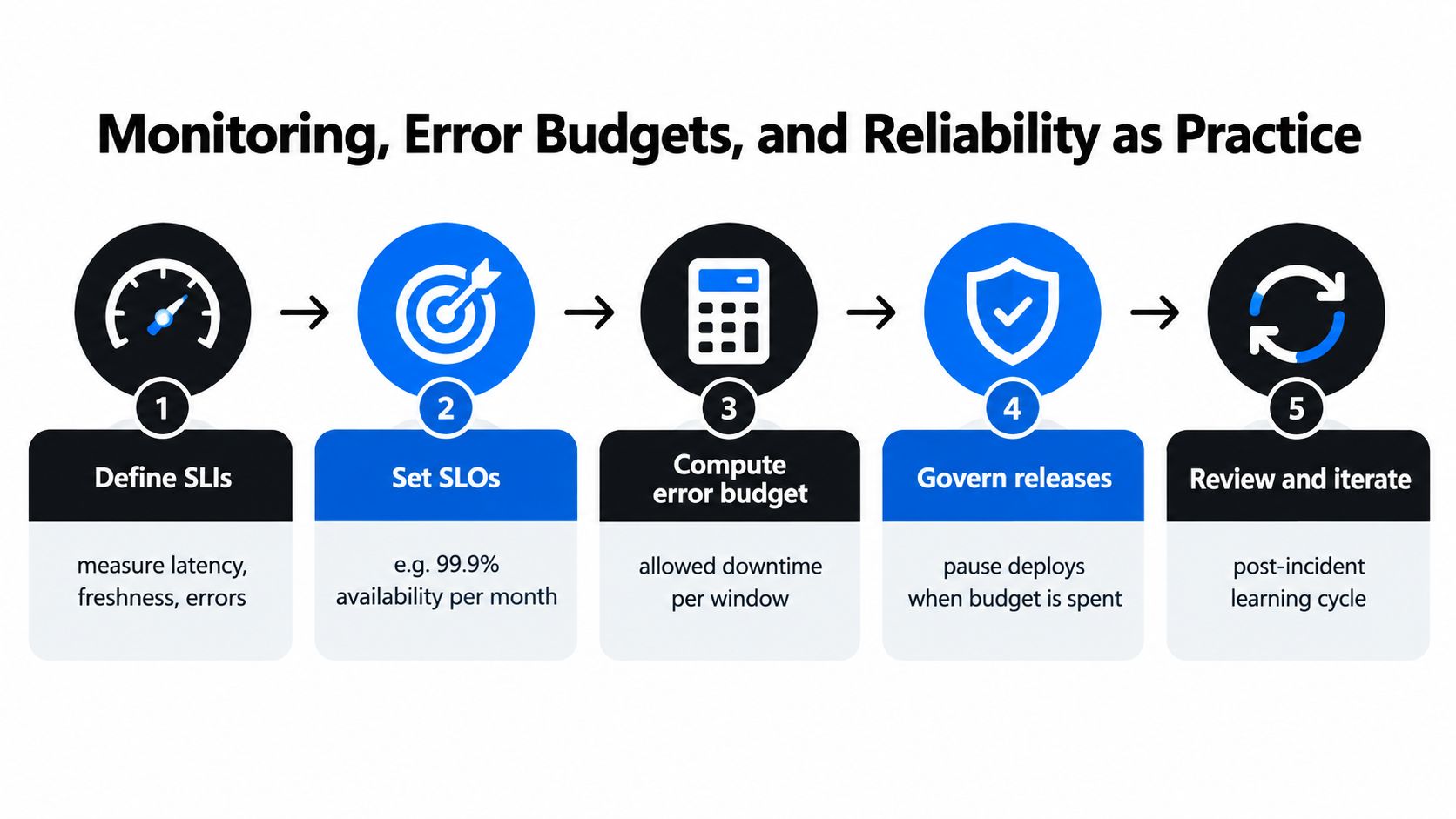
Google's SRE work gives a useful frame here. Define service-level objectives from measurable indicators, then use an error budget to decide how much instability the system can absorb before release velocity has to slow or stop, as described in Google's SLO guidance. For pipelines, that usually means writing targets in business terms: when a dataset must be queryable, how old accepted data may be, how completeness is checked, and how correctness is verified through schema validation, duplicate detection, or reconciliation.
The budget only matters if it changes behavior.
I have seen teams publish elegant dashboards that nobody uses during an incident. Better practice is operational. If freshness slips for a customer-facing dataset, freeze risky deployments. If duplicate rates climb after a consumer change, prioritize containment and replay over new feature work. If source outages consume the budget, separate that from defects in transformation code or capacity planning so ownership stays clear.
A useful dashboard answers recovery questions quickly. Is the event late or missing. Did the retry succeed. Did a correction alter downstream results. Is queue growth normal burst absorption or a sign of sustained backpressure. Monitoring task status alone will miss pipelines that complete on time while producing wrong answers.
That is why mature teams treat reliability as an operating discipline, not a reporting exercise. The day-to-day model is measurement, controlled change, incident review, and rehearsal of replay paths. For a broader operating perspective, see reliability engineering for modern software teams.
Security, Compliance, and Governance in Pipeline Design
A pipeline incident rarely starts as a security story. It starts with a bad replay, a rushed backfill, a copied production table in the wrong environment, or a downstream team seeing fields they were never meant to access. That is why pipeline security begins with control over movement and recovery. Classify sensitive fields at ingestion, separate identifying data from analytical attributes when the use case allows it, and enforce least-privilege access across raw, curated, and serving layers.
The design test is simple. After corruption, exposure, or an incorrect result, can the team identify what was touched, stop further spread, and restore a known-good state without guessing?
For pipelines that support identity verification, healthcare workflows, financial decisions, or public services, encrypted transport is only one control. Teams also need lineage that ties outputs back to source records and transformations, audit logs that show access and change history, retention rules aligned to business purpose, and a defined process for containing and correcting bad or exposed data. Governance matters most during recovery, when ownership and evidence decide whether a fix is safe.
Oversight has to exist in the system itself. The NIST Generative Artificial Intelligence Profile describes responsibilities for human-AI configurations, incident tracking and recovery, and product-level controls such as approval queues, confidence thresholds, audit records, and correction paths. Used this way, AI becomes another governed software component with traceable operational duties.
In practice, every high-impact output should carry enough context to support action under pressure. Record the responsible team for the model, pipeline, and decision. Link the result to the relevant data, model version, prompt version, and processing run. Route uncertain cases to an authorized reviewer. Give users and staff a way to challenge and amend incorrect results. Preserve evidence needed for investigation, containment, replay, and recovery.
Teams can enforce part of this before deployment with automated security controls as code. The goal is repeatable safeguards, clear ownership, and fewer judgment calls during an incident.
Reference Architectures for Ecommerce, Fintech, and Healthcare
The same five pipeline layers behave differently when failure has different consequences. An ecommerce team may tolerate a delayed recommendation but not a duplicate order. A fintech team needs a replayable transaction history and a defensible audit trail. A healthcare organization must protect sensitive information while preserving enough lineage to explain an insight.
| Industry | Primary emphasis | Critical controls |
|---|---|---|
| Ecommerce | Fresh personalization, fraud signals, purchase attribution | Event-time windows, idempotent order handling, late-event monitoring, graceful fallback |
| Fintech | Correctness, replayability, reconciliation, and auditability | Deterministic identifiers, immutable event history, duplicate prevention, incident ownership |
| Healthcare | Privacy, controlled access, lineage, and timely clinical or operational insight | Data classification, least privilege, consent-aware access, approval and correction workflows |
Ecommerce
A practical ecommerce design captures product views, cart actions, purchases, returns, and customer-service events through an ingestion layer. A streaming path can support fraud checks or active personalization, while a batch path reconciles orders, refunds, attribution, and inventory after source systems settle.
The serving layer should degrade gracefully. If a recommendation feed is stale, show a safe fallback. If an order event cannot be confirmed, don't retry a side effect that could create another fulfillment request. Correctness and latency must coexist rather than compete.
Fintech
Financial systems face heterogeneous source reliability, connection failures, outages, slow processing, and multi-source scalability bottlenecks. Recent coverage also emphasizes that AI workloads require data that's scalable, high-quality, available, auditable, and actionable, as discussed in industry analysis of financial data systems.
A fintech architecture should preserve source events, validate balances and relationships, use idempotent writes, and support controlled replay. Analytical models can consume curated data, but the transaction path needs stricter isolation and explicit incident procedures.
Healthcare
Healthcare pipelines should separate sensitive source data from approved analytical views. Access policies, lineage, retention, and audit records belong in the architecture from the first ingestion point. AI-assisted workflows should route uncertain outputs to qualified staff and preserve the evidence needed for review.
Across all three industries, the winning design is the one that makes the most damaging failure difficult to repeat and straightforward to investigate.
Modernizing Pipelines with Prompt Management and AI Control
AI adds another consumer to the pipeline, but it also adds configuration, cost, and governance concerns. A mobile or desktop application may retrieve internal records, assemble context, call different models, store the response, and send feedback into a later evaluation loop. Without centralized control, prompt changes spread through application code and become difficult to compare or audit.
AWS identifies token consumption, model selection, vector-store operations, and agent workflow execution as first-class cost drivers. Its guidance recommends right-sized context windows, per-request token budgets, prompt caching, and logging token count, task-success rate, and cost for each prompt version. The AWS guidance on agent cost controls provides the implementation rationale.
Treat prompts as governed pipeline inputs
A prompt management layer should provide:
- A prompt vault: Store approved prompts with version history and rollback.
- Parameter management: Control how prompts access internal databases and application context.
- Cross-model logging: Record requests, responses, errors, model choices, and relevant metadata across integrated AI services.
- Cost management: Let operators see cumulative spend by model, feature, tenant, or prompt version.
- Evaluation signals: Compare token use and task success before promoting a change.
This approach reduces prompt bloat and makes AI behavior observable. It also helps developers separate low-risk tasks from high-impact decisions, routing routine work to efficient models while reserving heavier processing for cases that justify it. More background on the operating model appears in prompt management for modern AI applications.
Wonderment Apps' prompt management system is one example of an administrative tool that developers and entrepreneurs can plug into an existing application. It includes a prompt vault with versioning, a parameter manager for internal database access, logging across integrated AI systems, and a cost manager for viewing cumulative spend. Teams can evaluate a demo alongside their existing pipeline, security, and product requirements rather than treating AI as an isolated add-on.
The durable architecture connects data quality, recovery, governance, and AI controls. That's how a legacy application becomes an intelligent product without turning every prompt change into an operational mystery.
Wonderment Apps helps organizations modernize legacy software, build scalable web and mobile applications, and integrate governed AI features with practical controls for prompts, integrations, logging, and token costs. Visit Wonderment Apps to discuss your data pipeline, application modernization, or prompt management demo with a team that can support design, engineering, QA, and long-term delivery.