

A legacy system can be one of the most valuable assets in a business and one of its biggest barriers to change at the same time. A 2026 survey of 500 IT decision-makers and line-of-business leaders found that 78% believe legacy systems matter more to their organizations than they did two years earlier, while 52% now prefer optimizing and extending existing systems instead of replacing them outright. The same research found that 71% of modernization initiatives exceeded planned budgets, and 97% said talent shortages increased modernization costs. (Ensono's 2026 legacy systems research)
That tension is easy to recognize. The software still processes deposits, policies, claims, orders, or production data, but its batch cycles, rigid data structures, and isolated interfaces make mobile experiences, real-time insight, and AI adoption unnecessarily difficult.
Wonderment Apps' prompt management system offers an administrative layer for connecting AI to existing desktop and mobile applications without immediately replacing the transaction system underneath. It includes prompt versioning, controlled parameters, cross-AI logging, and cost visibility. Explore the prompt-management demo to see how those controls can fit into an existing application.
The following legacy systems examples use the same practical question: what does the system protect, where does it constrain the business, and should you wrap, extend, or gradually replace it? The answer usually isn't “rewrite everything.” It's a carefully governed path that modernizes the experience while preserving the logic the business already trusts.
1. COBOL Mainframe Banking Systems
COBOL mainframes are a classic example of software that works too well to discard casually. Banking applications built around COBOL can encode decades of rules for deposits, withdrawals, loans, account balances, settlements, and compliance. That logic may be difficult to understand from outside the organization, but it has usually been tested through years of real transactions.
The constraint appears at the edges. A mainframe may process a transaction reliably while making it difficult for a mobile application, analytics platform, or AI service to access the right information in real time. A customer doesn't care that the core ledger is dependable if a digital channel can't provide a timely balance explanation or a personalized service recommendation.
Practical rule: Keep the ledger authoritative. Modernize the interfaces, data access, and decision-support workflows around it first.
A sensible first step is an API gateway or integration layer that exposes narrowly defined COBOL services. Don't give an AI model unrestricted access to the database. Define parameters for the specific records, fields, and operations that a fraud, compliance, or service workflow needs.
Wonderment's legacy system modernization strategies are relevant here because the safest route is usually incremental. A bank might begin with customer-service search, document classification, or analyst assistance before allowing AI to influence a regulated decision. The prompt vault can keep approved instructions versioned, while logs record which prompt, data parameters, tool calls, and model output supported each result.
The system should also track input, output, cached, and reasoning tokens because those categories can affect AI billing differently. (AI observability guidance on prompt and cost telemetry) That visibility matters when several fraud, risk, and compliance workflows share the same AI environment.
2. Enterprise Resource Planning Systems
SAP R/3 and early Oracle E-Business Suite deployments are recognizable legacy ERP systems. They brought finance, human resources, procurement, manufacturing, inventory, and supply-chain processes into large, unified environments. Their value comes from the consistency they create across departments, but that same centralization can make change slow.
ERP data rarely lives in a clean, modern shape. Years of custom fields, extensions, approval rules, integrations, and local workarounds often sit between the standard product and the way the company operates day to day. Replacing the whole platform can disrupt purchasing, invoicing, payroll, or fulfillment, so the business case needs to be stronger than "the interface feels old." These systems are explicitly identified as common targets for legacy modernization. (Examples of legacy ERP platforms)
AI can add value without becoming the system of record. A forecasting assistant can summarize demand signals, an anomaly workflow can flag unusual procurement activity, and a planning tool can help employees compare supplier or inventory options. Each use case should read approved data through a controlled integration rather than inventing a new version of the company's financial truth.
Start with a decision, not a chatbot
A prompt vault is useful when several ERP workflows need different instructions, permissions, and review paths. Versioning lets the team test a new forecasting prompt without changing the output used by procurement. A parameter manager can restrict access to inventory, supplier, or purchase-order fields, while logs make it possible to investigate why a recommendation was produced.
The strongest starting points are usually bounded workflows such as procurement analysis, demand planning, and invoice assistance. The weakest approach is connecting a general-purpose model directly to every ERP table and hoping employees will spot incorrect answers. That creates data exposure, inconsistent recommendations, and an unclear audit trail.
A 2025 survey of more than 500 U.S.-based IT professionals found that 62% of organizations still rely on legacy software, while 50% said they hadn't upgraded because the current system still works. (2025 legacy software survey) ERP modernization succeeds when it respects that reality and improves a valuable process before demanding a disruptive replacement.
3. Legacy E-Commerce Platforms and Proprietary Monoliths
A proprietary e-commerce monolith often combines the storefront, catalog, pricing, cart, checkout, order management, and customer data in one tightly coupled application. Many custom Java or older server-rendered platforms were designed for desktop browsing and predictable release cycles, not mobile-first shopping, experimentation, or individualized recommendations.
The business risk is visible in every requested change. A merchandising team wants a better search result, a mobile team needs a new checkout flow, and an AI team wants to personalize product discovery. If all three changes touch the same presentation and order logic, a small improvement can become a release coordination problem.
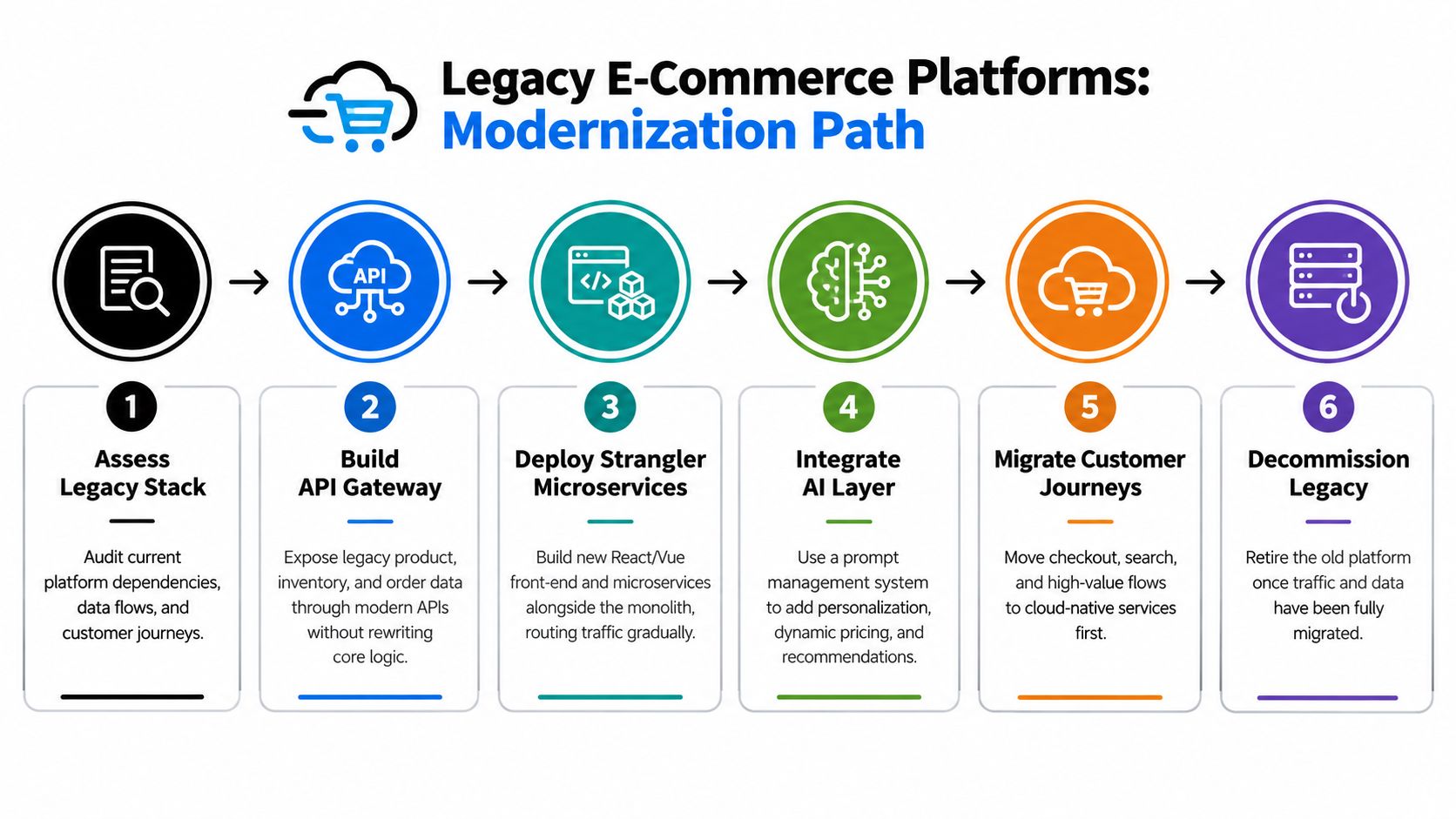
A strangler pattern provides a more realistic path. Build a modern service beside the monolith, route one capability to it, compare behavior, and expand only when the new path is stable. Search, recommendations, product content, account features, and selected checkout experiences can move at different speeds. The core order process can remain in place until the replacement has earned trust.
Headless commerce architecture can help separate customer experiences from back-office transaction logic. The architectural choice should still be deliberate. A monolithic versus microservice architecture comparison is useful when deciding whether a service boundary will reduce coupling or merely distribute it across more systems.
Add AI where the feedback loop is clear
AI personalization works best when the application can measure a useful business action, such as search refinement, product discovery, or customer support resolution. The prompt-management layer can version recommendation instructions, expose only approved product and inventory parameters, and log the customer context supplied to each model.
Cost controls matter because personalization can call AI services frequently. Track cumulative spend by feature, model, and workflow, then compare that cost with the value of the experience. Don't place an expensive model in every page request before confirming that the journey benefits from it. Start with high-value paths, keep deterministic pricing and checkout rules authoritative, and migrate the monolith one capability at a time.
4. Healthcare Electronic Health Record Systems
Older Epic, Cerner, Meditech, and custom health-information systems show why modernization in healthcare requires restraint. An EHR can hold patient histories, clinical documentation, orders, referrals, scheduling information, and billing context. It also supports workflows shaped by clinical practice and regulatory obligations, so a technically elegant replacement can still fail if it makes ordinary care harder.
The central limitation is fragmentation. A clinician may need information that exists across encounters, departments, scanned documents, and connected systems. An AI assistant could summarize records, route referrals, identify missing administrative information, or help staff prepare a visit. It shouldn't receive unrestricted access to every patient field, and it shouldn't inadvertently turn a probabilistic suggestion into a clinical instruction.
Separate assistance from authority
Use an API layer to expose the minimum necessary data for a defined workflow. A parameter manager can restrict which fields the model may retrieve, for which role, and under which purpose. De-identification, consent handling, access controls, and human review remain essential. Prompt instructions can't compensate for weak identity or data governance.
Start with non-critical uses such as appointment coordination, referral routing, coding support, or document organization. Once the organization can audit those workflows, it can evaluate more sensitive decision-support applications with clinical and compliance teams.
The prompt vault should preserve approved versions, and cross-AI logging should record the model, prompt, retrieved context, and resulting recommendation. That creates a reviewable history instead of a mysterious answer appearing inside a clinical application.
Use the same discipline for operational cost. Diagnostic-support, summarization, and resource-planning workflows can have different usage patterns, so a cost manager should show cumulative spend by integration. This infographic illustrates the broader pattern of moving a tightly coupled digital platform toward separate, modern services without assuming that every function must move at once.
5. Government and Public Sector Systems
Government systems often preserve rules that cannot be rewritten from a clean slate. Tax processing, benefits administration, licensing, identity records, and public-service portals may depend on COBOL mainframes, custom monoliths, and older infrastructure. A change that seems minor in software can alter eligibility, payment timing, legal compliance, or access to a critical service.
The U.S. federal government provides a clear historical example. In 2019, the Government Accountability Office identified 10 critical federal legacy IT systems that were already 8 to 51 years old and cost roughly $337 million per year to operate and maintain. (Background on federal reliance on legacy systems) The age and operating cost illustrate why these systems persist. They carry important institutional rules, and replacing them involves more than moving data to new servers.
A public-sector modernization program should begin at the citizen-facing boundary. Status tracking, application portals, appointment scheduling, document intake, and service notifications can improve access without changing the legal decision engine. API gateways need strong identity controls and clear separation between public, sensitive, and classified information.
A model may help explain an eligibility rule. It must not become the rule.
Use a parameter manager to enforce the permitted data and operations. An AI assistant can retrieve an application status or explain a published process, but it shouldn't override statutory criteria. Prompt versioning supports controlled changes, while complete logs provide an accountability record for public review and internal investigation.
Integration with legacy systems is the practical focus. Agencies should test for bias before using AI in enforcement or benefit decisions, involve policy owners in approval, and measure reliability with human reviewers. A cost manager also helps budget holders distinguish a useful service improvement from an open-ended experiment.
6. Telecommunications Switch and Billing Systems
Telecommunications infrastructure is a different kind of legacy system. Switches, billing platforms, roaming services, and network-management tools have evolved through many technology generations. They need to route calls, apply subscriber rules, reconcile usage, and coordinate with external carriers while maintaining dependable service during ordinary demand and unusual spikes.
The constraint is not just that the code is old. The system is connected to physical networks, contractual billing rules, operational dashboards, and customer-support processes. A careless modernization can create duplicate charges, incorrect roaming records, or routing failures that are difficult to diagnose while traffic is moving.
An integration layer should observe before it changes. Service meshes and controlled gateways can manage traffic between new services and older components, while network telemetry and call-detail records feed analysis systems without allowing an AI model to modify billing logic directly.
Use AI for recommendations before control
Predictive maintenance, network heat maps, anomaly detection, and churn analysis are sensible early use cases because they can produce recommendations for operations teams. The AI can identify an unusual pattern, rank likely causes, or suggest where an engineer should investigate. Core routing and charging decisions need stricter testing, deterministic safeguards, and explicit approval.
A prompt-management system can coordinate different models for network optimization, support, and operational analysis. Version prompts like code, restrict the fields available through parameters, and record model activity across every integrated AI service. Logging should cover the input context, tool calls, output, and human action that followed.
Cost visibility is especially important when models process large volumes of telemetry. Separate experimentation from production traffic, set approval thresholds for new workflows, and evaluate whether a simpler model can handle a bounded task. The winning design isn't the one with the most AI. It's the one that adds useful intelligence without placing an untested decision-maker inside a service customers depend on.
7. Insurance Claims and Policy Management Systems
Insurance platforms carry a dense concentration of business rules. Policy issuance, premiums, endorsements, claims, reserves, underwriting, fraud review, and regulatory reporting may all depend on applications built with older technologies such as Progress 4GL, Informix, or custom Java. The system can look dated while still expressing years of actuarial and operational knowledge.
Claims provide a practical modernization boundary. A mobile or web application can collect photographs, descriptions, policy details, and supporting documents through a modern intake experience. An API can pass that structured information to the existing claims platform, preserving established adjudication logic while reducing friction for customers and adjusters.
AI belongs beside the decision process at first. It can classify documents, identify missing information, prioritize a queue, summarize a claim file, or surface patterns for a trained investigator. It shouldn't automatically deny a claim just because a model found a similarity to previous cases.
Preserve explainability in the workflow
A parameter manager can limit AI access to the policy, claim, and document fields required for a specific task. Prompt versioning lets the insurer distinguish an approved claims-summary instruction from an experimental fraud-analysis instruction. Cross-AI logs should capture the source data, model response, and reviewer action so compliance teams can reconstruct the path to a decision.
Start with high-volume, lower-complexity workflows where human review is straightforward. Auto-damage documentation or property-claim intake may offer a clearer test than a complex medical claim involving multiple policy interpretations. The point isn't to automate the most sensitive decision first. It's to prove that the integration improves an operational bottleneck without weakening fairness or auditability.
Track cumulative AI spend by claim type and workflow. A fraud model that catches useful signals may justify its cost, while a summarization feature used rarely may need a simpler implementation. Modernization works when the insurer measures both operational value and the controls needed to keep the system accountable.
8. Manufacturing and Industrial Control Systems
SCADA, MES, programmable logic controllers, and process-control systems are legacy systems examples where uptime and safety matter more than fashionable architecture. Older industrial environments monitor sensors, control equipment, track quality, manage production, and coordinate inventory through proprietary protocols and specialized computers. Their operators may trust them precisely because the behavior is predictable.
That predictability creates a hard boundary for AI. An AI model can help identify sensor patterns, estimate equipment degradation, or recommend a maintenance window. It should not receive permission to change a production parameter without a tested control process, an authorized operator, and a safe fallback.
Industrial IoT gateways offer a low-disruption starting point. They can collect data from legacy SCADA environments without modifying the control logic, then send approved telemetry to a data platform for analysis. The modernization team can establish a baseline before deploying predictive models, validate recommendations against maintenance records, and measure whether alerts are useful rather than merely frequent.
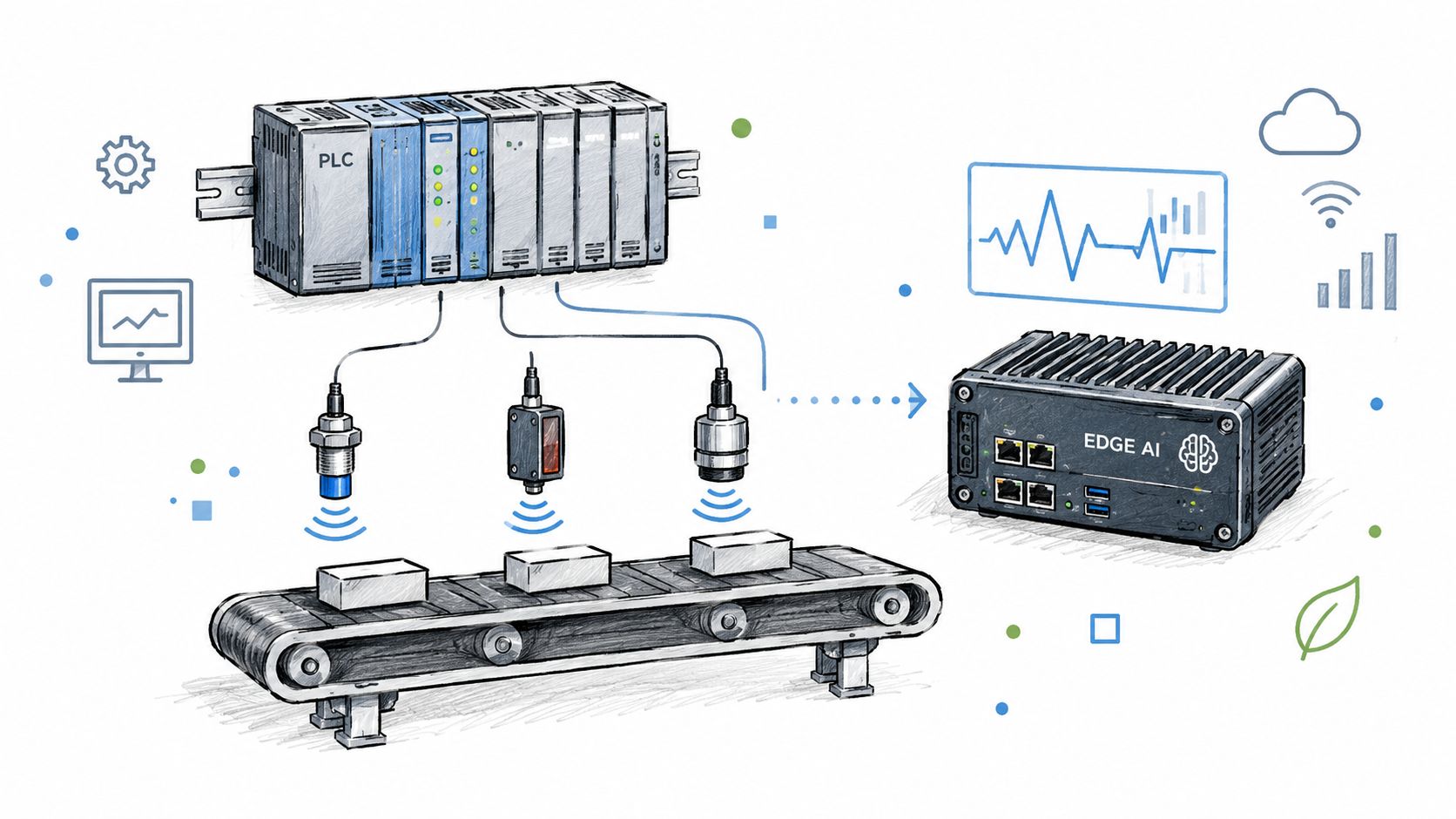
Safety boundary: Let AI observe and recommend before it can influence a control loop.
Prompt governance still matters at the edge. A prompt vault can manage instructions for predictive maintenance, quality analysis, and production planning. Parameters can expose sensor groups or production metrics while excluding control commands. Logs should record every recommendation, the data behind it, the model version, and whether an operator accepted or rejected it.
The same principle applies to cost. Track model usage by facility, line, and workflow, then compare it with maintenance and quality outcomes. Teams looking for an industry-specific next step can explore AI-driven automotive predictive maintenance, but the implementation should still begin with observation, not autonomous intervention.
8-Point Legacy Systems Comparison
| System | Implementation complexity | Resource requirements | Expected outcomes | Ideal use cases | Key advantages |
|---|---|---|---|---|---|
| COBOL Mainframe Banking Systems | Very high, decades-old monoliths, ACID-critical logic | Mainframes, COBOL expertise, high operational cost | Ultra-reliable transaction processing; limited real-time agility | Core banking, settlements, regulatory reporting | Proven stability, high throughput, built-in compliance |
| ERP Systems, SAP and Oracle | Very high, large configs, extensive customizations | Large implementation teams, heavy licensing, complex infra | Single source of truth; slow change cycles with strong controls | Enterprise finance, procurement, HR consolidation | Integrated workflows, mature security, auditability |
| Legacy E‑Commerce Platforms, Proprietary Monoliths | High, tightly coupled presentation, logic, and data layers | Dedicated servers, legacy dev skills, high maintenance costs | Stable commerce operations; poor personalization and mobile UX | Specialized retail with custom rules, high switching costs | Tailored business logic and full platform control |
| Healthcare EHR Systems | High, clinical workflows, strict regulatory constraints | Secure infrastructure, clinical integration, compliance teams | Centralized patient records; limited interoperability and UX issues | Hospital clinical operations, longitudinal patient management | Rich longitudinal data, validated workflows, HIPAA compliance |
| Government & Public Sector Systems | Very high, legal logic embedded, high risk aversion | Mainframes/custom hardware, legislative oversight, large budgets | Extremely stable citizen services; slow modernization, limited UX | Benefits, taxation, voting, large-scale public services | Stability, legal compliance, continuity for large populations |
| Telecommunications Infrastructure | Very high, real-time stateful switches and signaling | Specialized telecom hardware/software, 24/7 ops teams | Exceptional uptime and scale; limited cloud/AI flexibility | Call routing, billing, roaming, carrier-scale network ops | Reliability under extreme load, telecom-optimized performance |
| Insurance Claims & Policy Systems | High, complex rule engines and actuarial models | Domain experts, legacy DBs, compliance and testing resources | Accurate adjudication; slow claims cycles, limited personalization | Policy administration, claims processing, regulatory reporting | Mature underwriting logic, comprehensive audit trails |
| Manufacturing & Industrial Control (SCADA/MES) | Very high, deterministic, safety-critical control systems | PLCs/SCADA hardware, OT engineers, often air-gapped networks | Safe, reliable production; minimal analytics without gateways | Factory floor control, process automation, critical infrastructure | Proven safety and real-time deterministic control |
Turn Legacy Constraints Into a Modernization Roadmap
Across these legacy systems examples, the same pattern appears. The core system protects validated business logic, historical data, safety controls, financial records, or legal rules. It constrains the business through rigid interfaces, limited interoperability, slow release processes, and data that is difficult to use outside its original workflow.
That doesn't mean every legacy platform deserves indefinite protection. Application modernization services were reported at roughly $16.84 billion to $17.80 billion in 2023, with the market approaching about $30 billion by 2026 in one summary. Another market report projects the legacy application modernization market from $19.16 billion in 2025 to $21.94 billion in 2026, at a 14.5% CAGR. (Legacy modernization market summary) The figures describe a large and active market, but they don't remove the need to choose the right intervention for each system.
Use this sequence to turn modernization into an operating plan:
- Inventory dependencies: Document applications, databases, interfaces, batch jobs, vendors, users, and undocumented workarounds before changing the core.
- Rank business pain: Prioritize customer friction, operational delays, compliance exposure, and maintenance burden instead of modernizing whichever component is easiest to move.
- Choose a boundary: Use an API gateway, integration layer, or industrial IoT gateway to separate new experiences from authoritative legacy logic.
- Restrict data access: Define parameters for each AI workflow. Give the model the fields and operations it needs, not a broad connection to the underlying database.
- Version prompts: Treat system prompts as governed application assets. Approve, test, and roll back changes just as you would code changes.
- Log model activity: Record prompts, tool calls, retrieved context, model responses, reviewers, and downstream actions where the workflow requires an audit trail.
- Track cumulative spend: Monitor input, output, cached, and reasoning tokens, then attribute costs to features, teams, and business workflows.
- Test human oversight: Decide where a person must review, approve, reject, or override an AI recommendation before it affects a customer, patient, citizen, policyholder, or production line.
- Expand gradually: Move from bounded, measurable workflows to higher-impact decisions only after the new path is reliable and controlled.
Wonderment Apps' prompt management system is designed for this administrative layer. Its prompt vault with versioning helps teams manage instructions over time. Its parameter manager controls how integrated AI services access internal application data. Its logging system across integrated AI services creates a shared operational record, and its cost manager gives entrepreneurs visibility into cumulative spend.
That approach is useful when an organization wants to modernize an existing desktop or mobile application while leaving proven transaction systems in place. It won't replace architecture planning, security review, testing, or domain expertise. It can give those teams a governed place to manage the AI connections they introduce during a phased modernization program.
The best modernization roadmap is rarely a dramatic rewrite. It preserves what has earned trust, creates a cleaner boundary around it, and improves one valuable workflow at a time. When the new experience proves its value, the organization gains evidence for the next investment and a safer basis for deciding what should eventually be replaced.
Wonderment Apps helps organizations modernize existing software through AI integration, web and mobile development, UX, and governed prompt management. Visit Wonderment Apps to explore its prompt vault, parameter manager, cross-AI logging, cost visibility, and request a demo for your legacy application.