


Your team has shipped the new customer portal, connected several internal APIs, added a mobile companion app, and given a language model access to business data. The login works, the CI pipeline is green, and the demo looks polished. Then a user changes an object ID in an API request, an exception exposes internal details, or an AI prompt sends more context than the product team intended.
That's the uncomfortable reality of modern web development. Security is no longer a final scan or a list of headers added before launch. It's a design discipline covering authorization, dependencies, deployments, observability, and the administrative controls around AI features. The strongest web development security best practices make applications harder to abuse while keeping them useful, scalable, and pleasant to operate.
For teams modernizing legacy software, prompt versioning, AI activity logs, safe parameter controls, and spend visibility belong in that same conversation. Wonderment Apps' prompt management system is one example of an administrative layer that can be connected to an existing application, giving developers and entrepreneurs a more controlled way to manage AI integrations rather than scattering prompts and model calls across the codebase.
Building a Resilient Secure SDLC
A modern application rarely lives in one repository. A typical product may include a browser interface, native mobile clients, API gateways, microservices, cloud storage, payment providers, analytics platforms, and several AI models. Each connection introduces a trust boundary, a new identity, or another place where data can be transformed. A secure Software Development Life Cycle, or Secure SDLC, treats those boundaries as design concerns instead of waiting for a penetration test to discover them.
A practical team starts during planning. Product managers describe valuable assets and abuse cases alongside normal user stories. Architects map data flows, service identities, administrative actions, and model access. Developers then turn those decisions into controls, tests, and deployment policies that run inside the same workflow as feature delivery.

Put security into the developer workflow
Shift-left security works when it provides context, not when it floods engineers with unexplained findings. A useful pull request check can flag a hardcoded secret, an unsafe dependency, an invalid infrastructure setting, or a missing authorization test. The developer should see the affected file, the reason the pattern matters, and a practical remediation path.
A balanced workflow usually combines:
- Threat modeling: Identify who can abuse a feature, what they could reach, and which assumptions need enforcement.
- Automated code checks: Run SAST, secret detection, dependency analysis, and infrastructure-as-code checks before merge.
- API-focused testing: Test object-level and function-level authorization directly, because business logic often lives behind APIs rather than page routes.
- Runtime validation: Confirm that deployed configuration matches the approved baseline and that important events produce useful telemetry.
- Security ownership: Assign someone to resolve findings, document accepted risk, and verify that exceptions expire rather than becoming permanent.
Teams also need a clear learning path for engineers and nontechnical stakeholders. A resource such as the Vigil Security training platform can support structured security education while internal reviews connect lessons to the application's actual architecture.
Treat AI changes as production changes
Generative AI makes the Secure SDLC more dynamic. A prompt can alter model behavior without changing a conventional business rule, and a model provider can return different output after an update. Store prompts with ownership, review history, versioning, and test cases. Log model, prompt version, input classification, output policy results, and failure state without capturing unnecessary personal or regulated data.
Teams modernizing delivery can also use Wonderment's guidance on security in DevOps to connect code review, pipeline controls, and runtime responsibility. The principle is simple: security should travel with the feature from its first design discussion to its final production alert.
Mitigating Critical Access and Injection Risks
Foundational vulnerabilities remain foundational because they sit close to business logic. OWASP's Top 10:2021 placed broken access control at the number one risk, with an average incidence rate of 3.81% and more than 318,000 occurrences across the dataset, mapped across 34 CWEs. The category had moved up from fifth place in the prior edition, which reflects how damaging authorization mistakes can be in applications built around APIs and distributed services. OWASP's Broken Access Control entry provides the category details.
Injection remains equally practical. OWASP reported that injection affected 94% of tested applications, with a 3.37% average incidence rate and about 274,000 occurrences in the dataset. Security misconfiguration appeared in 90% of applications, with a 4.5% average incidence rate and more than 208,000 occurrences. These figures are historically important because they reinforced authorization checks, input validation, secure defaults, and hardened deployments as baseline engineering expectations. OWASP's 2021 Top 10 documents those findings.
MITRE's 2024 CWE Top 25 reinforces the same priorities. Cross-site scripting ranked #1, SQL injection ranked #3, and missing authorization ranked #9. Cross-site scripting, SQL injection, and unrestricted file upload all appeared in the top 10, making input handling and authorization concrete development priorities rather than abstract security vocabulary. MITRE's CWE and OWASP reference contains the cited ranking information.
Authorize every meaningful action
A gateway can authenticate a request, but it can't decide every business permission by itself. The service handling the operation must verify the user, tenant, resource relationship, and action. A request to read /orders/123 should trigger a server-side ownership or role check, not trust that the client was allowed to display a button.
For microservices and serverless functions, use explicit service identities and narrowly scoped permissions. Test both positive and negative paths:
- Object authorization: Can one customer retrieve another customer's record by changing an identifier?
- Function authorization: Can a basic user invoke an administrative operation directly?
- Tenant isolation: Can filters, exports, search, or background jobs cross organization boundaries?
- Workflow authorization: Can a user skip an approval step by calling a later endpoint?
Keep untrusted input inert
Validate data on the server with strict schemas, expected types, length limits, and business constraints. Parameterized queries should carry values separately from SQL instructions. For dynamic sorting, filtering, or field selection, use an allowlist of permitted values rather than inserting raw request content into a query.
Output encoding still matters after input validation. Encode data for its destination, whether that's HTML, JavaScript, a URL, a template, or a database command. A regular expression alone isn't a security architecture, particularly when an attacker can reach another interpreter downstream.
Practical rule: Authentication tells you who sent the request. Authorization decides whether that identity may perform the action.
Misconfiguration deserves its own release check. Remove default credentials, disable unused services, restrict administrative surfaces, protect secrets through a managed secret store, and make secure configuration the default in infrastructure templates. The easiest vulnerability to exploit is often the one a team never intended to expose.
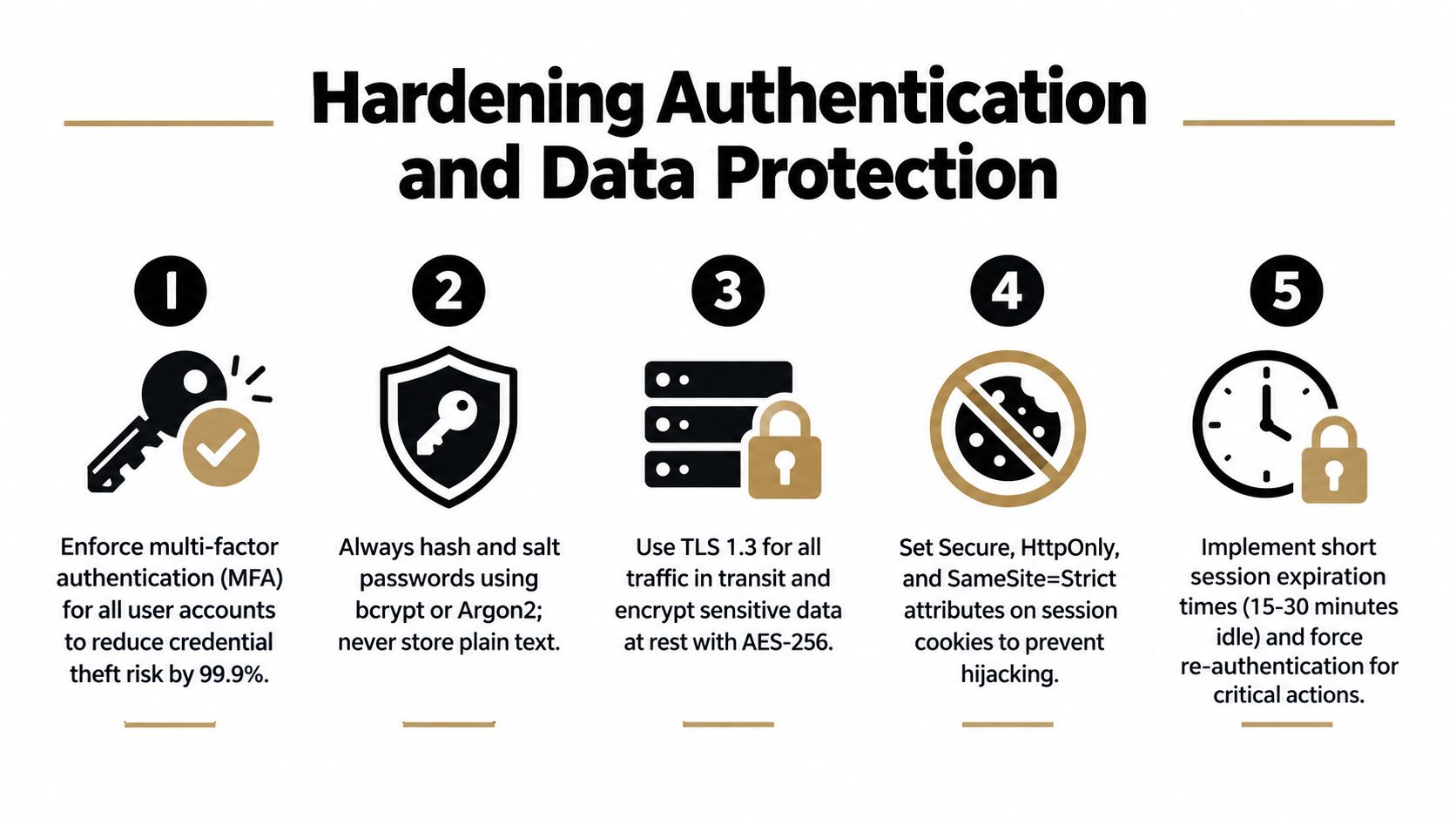
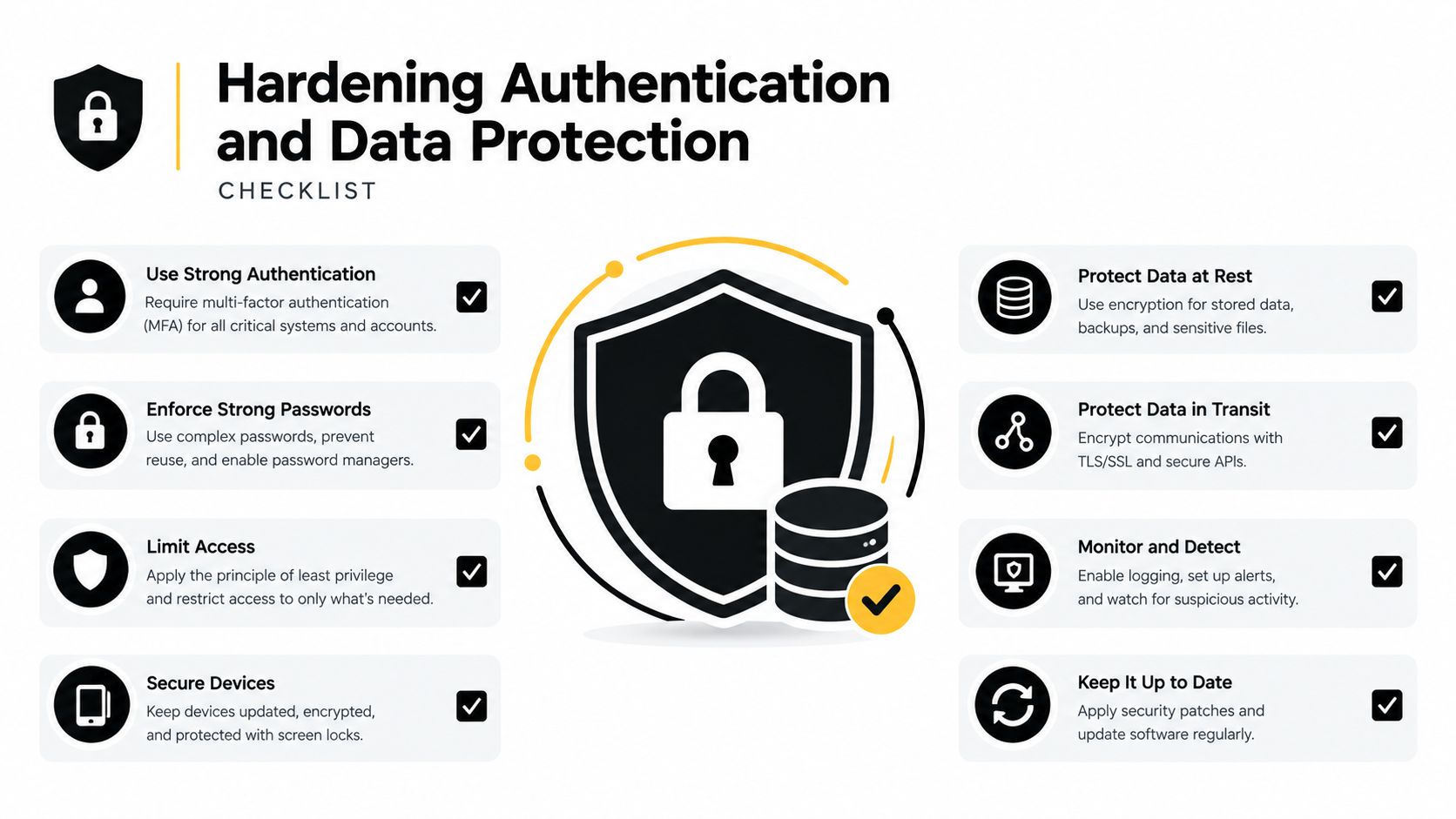
Hardening Authentication and Data Protection
Authentication is the front door, but a successful login doesn't make every request trustworthy. Session handling, authorization, browser behavior, encryption, and key management must work together. A secure login flow can still fail if a session cookie is readable by JavaScript, transmitted over an unsafe connection, or sent in an unintended cross-site context.
Set authentication and session cookies with HttpOnly, Secure, and SameSite=Lax or Strict by default. MDN explains that HttpOnly blocks JavaScript access, SameSite limits cross-site transmission, and SameSite=None requires Secure. Together, these attributes reduce exposure to cookie theft through XSS and cross-site request forgery while preserving secure browser session handling. MDN's cookie security guidance covers the behavior of each attribute.
Make sessions difficult to reuse
Use established identity protocols and let a maintained identity provider handle difficult flows where appropriate. Validate token issuer, audience, signature, and intended scope. Rotate refresh credentials, revoke sessions after account recovery or suspicious activity, and require fresh authentication for especially sensitive changes.
Keep authorization separate from authentication. A valid token proves that a principal has been identified, not that the principal can access every record or invoke every function. Teams building API-heavy products can use this API authentication best practices guide as a practical reference while reviewing token validation and service boundaries.
Reduce XSS impact with browser policy
A strict Content Security Policy, or CSP, limits where scripts and other resources may load from. OWASP identifies CSP as an important web security control, and a published browser experiment found that CSP successfully mitigated all tested XSS attack types across four popular browsers. That result doesn't excuse unsafe output handling, but it demonstrates why runtime policy enforcement can reduce exploitability when an input flaw survives. OWASP's Top Ten project provides the cited CSP context.
Start with reporting and inventory existing script sources, then move toward a restrictive policy. Avoid broad allowances that make a policy look active while permitting arbitrary inline scripts or unknown origins. Test third-party analytics, payment widgets, customer-support tools, and AI interfaces before enforcement, because a strict CSP can expose undocumented dependencies.
Protect stored information and keys
Encrypt sensitive fields when the application's threat model requires protection beyond database access controls. Separate encryption keys from encrypted data, restrict key use by service identity, rotate keys through a managed process, and keep decryption events auditable. Don't place keys in source code, application logs, client bundles, or error messages.
Data minimization matters too. If a feature doesn't need a sensitive field, don't send it to the browser, another service, or an AI model. Privacy-aware architecture often improves security because fewer systems can accidentally expose information.
Securing Deployments and Managing Dependencies
A secure repository can still produce an unsafe release. Build runners may have excessive permissions, container images may contain unnecessary packages, and deployment configuration may drift from the reviewed code. Treat the delivery pipeline as production infrastructure, not as a convenience script that happens to run before launch.
Build a trustworthy release path
Use short-lived CI credentials where possible, separate build and deployment permissions, and require protected approvals for sensitive environments. Store secrets in a dedicated manager rather than pipeline variables copied between projects. Pin actions and build dependencies to reviewed versions, and restrict who can modify workflow definitions.
Immutable infrastructure reduces surprise. Build an artifact once, scan it, sign it, and promote that same artifact through environments. A deployment should reference a known image digest or release artifact, not rebuild from an evolving dependency tree at the moment of production delivery.
A practical pipeline can enforce these gates:
- Source review: Require code ownership or peer review for authentication, authorization, infrastructure, and workflow changes.
- Artifact checks: Scan application packages, container images, and infrastructure definitions for known issues and unsafe settings.
- Provenance verification: Record how and where the artifact was built, then verify its signature before deployment.
- Configuration policy: Reject public storage, excessive permissions, missing encryption settings, or exposed administrative services.
- Rollback readiness: Keep a tested path to restore the previous known-good release without improvising during an incident.
Make dependencies accountable
Open-source packages are part of your application's attack surface. Maintain a software bill of materials, or SBOM, so the team can identify which services use an affected component. Use software composition analysis in pull requests and scheduled scans, then prioritize fixes based on actual reachability and exposure rather than blindly upgrading everything.
Automatic patching works well for low-risk, routine updates with strong tests. It works poorly when teams merge upgrades without reviewing breaking behavior, transitive changes, or new permissions. Assign owners to important packages, remove unused libraries, verify package integrity, and document exceptions.
The same discipline applies to mobile applications and desktop clients. Protect signing credentials, keep update channels controlled, and assume client code can be inspected. Sensitive authorization decisions belong on trusted server-side components, even when the user experience runs primarily on a device.
Designing for Safe Failures and Observability
Security doesn't end when a release reaches production. OWASP's more recent framing highlights logging and alerting failures and mishandling exceptional conditions, which reflects an operational truth: an application that cannot explain suspicious behavior is difficult to defend, and an application that fails noisily may disclose information or create downtime. OWASP's 2025 Top 10 provides that category context.
A safe failure has three properties. The user receives a clear, limited response. The service stops the risky operation or moves to a controlled fallback. The internal system records enough structured detail for an authorized responder to investigate without exposing secrets or personal data.
Separate user messages from diagnostics
Return generic error messages to users, but attach a correlation identifier that support staff can use. Keep stack traces, query details, provider responses, and internal topology in protected diagnostic systems. Redact authorization headers, session values, payment details, health information, and prompt content that isn't required for the investigation.
Centralized logging should answer practical questions:
- Who acted: Record a stable principal or service identity, with privacy controls.
- What happened: Capture the event type, resource category, outcome, and policy decision.
- Where it happened: Include service and environment context without revealing sensitive infrastructure details externally.
- When it happened: Use consistent timestamps and synchronized system clocks.
- What changed: Track configuration, permission, prompt, and deployment changes with an accountable actor.
Detect abuse without creating a second privacy problem
Tamper-evident storage, restricted access, retention rules, and alert routing matter as much as log collection. In healthcare and fintech, the security team may need deep telemetry while privacy and compliance teams require strict limits on content. Log metadata and classifications when full payload capture isn't justified, and document who can access sensitive event details.
Alert on behavior that suggests abuse, such as repeated authorization failures, unusual export activity, privilege changes, sudden model-call spikes, or an AI integration attempting an unapproved tool action. Avoid alerting on every error. A noisy system trains responders to ignore the one event that matters.
A log that nobody can search, trust, or act on is storage, not observability.
Design fallback behavior before incidents occur. If an AI provider fails, return a safe explanation or route to a human workflow. If a dependency times out, don't retry indefinitely with multiplied side effects. If authorization cannot be evaluated reliably, deny the sensitive action rather than guessing.
Securing AI Integrations with Prompt Management
AI features introduce a new class of operational ambiguity. A developer may hardcode a prompt in a web service, another team may place a variation in a mobile client, and a third integration may call a different model directly. Nobody has a complete inventory, prompt changes bypass normal review, logs contain inconsistent fields, and a useful feature can become an untracked path to sensitive data.
The answer isn't to treat a prompt as harmless text. A prompt is part of application behavior and should be managed like infrastructure, configuration, and code. That means version control, access boundaries, test coverage, observability, and a defined rollback path.
Create a prompt control plane
A prompt management system should provide a prompt vault with versioning. Store approved prompt templates centrally, assign owners, record revisions, and promote versions through development, testing, and production. Keep model-specific instructions separate from user content, and test for prompt injection, data exfiltration, unsafe tool use, and unexpected output formats before approval.
The parameter manager is equally important. It can mediate internal database access by allowing a prompt or model workflow to request only approved parameters, fields, and operations. The application should still enforce authorization server-side. The model must never become the authority that decides whether a user can access a record.
Centralized logging across all integrated AI systems gives teams one audit view for model selection, prompt version, tool invocation, policy result, latency, errors, and sensitive-data classification. Logging every raw prompt and response may create privacy and retention problems, so capture the minimum content needed for troubleshooting, governance, and incident response.
Make cost and safety visible together
Cost controls belong beside security controls because unbounded model calls can become an availability and governance issue. A cost manager should let an entrepreneur see cumulative spend across integrated AI providers, products, environments, and features. Set internal budgets, route low-risk tasks to suitable models, and require approval for high-cost or high-sensitivity workflows.
Useful design controls include:
- Input boundaries: Limit user-provided context and reject content that attempts to override system policy.
- Tool allowlists: Define which functions a model may call, with typed arguments and server-side authorization.
- Output validation: Require structured schemas where downstream code consumes model output.
- Provider isolation: Keep credentials and provider-specific settings on the server, never in browser or mobile bundles.
- Fallback rules: Choose a safe response when a model is unavailable, refuses a task, or returns malformed content.
- Reviewable changes: Require human approval for prompts that access regulated data or trigger consequential actions.
Teams evaluating the wider ecosystem can also consult tools for secure AI workflows, particularly when comparing guardrails, monitoring, and governance approaches. For a practical treatment of prompt libraries, version control, and administrative ownership, see Wonderment Apps' prompt management guidance.
Wonderment Apps' prompt management system brings these administrative ideas into an existing application through a prompt vault with versioning, a parameter manager for controlled internal database access, logging across integrated AI systems, and a cost manager for cumulative spend visibility. That doesn't replace application authorization or privacy review. It gives the engineering and business teams a clearer control surface for AI behavior that would otherwise be scattered across services.
Aligning Security with Business and Compliance Goals
Security becomes a business enabler when teams connect controls to outcomes. Strong authorization protects customer trust and reduces the blast radius of an API mistake. Safe error handling supports uptime and customer support. Centralized AI records make model changes easier to review. A repeatable SDLC gives product leaders a defensible way to scale web, desktop, and mobile features without turning every release into a manual security event.
Map controls to the obligations your organization carries. SOC 2 work benefits from evidence of access reviews, change management, monitoring, and incident response. HIPAA programs need careful handling of protected health information, access boundaries, and auditability. GDPR planning requires attention to data minimization, purpose, retention, and individual rights. The specific implementation depends on your legal and operational context, so involve qualified compliance and privacy professionals rather than treating a checklist as legal advice.
A phased modernization path keeps the work realistic:
- Stabilize: Inventory APIs, identities, dependencies, AI providers, sensitive data, and production failure paths.
- Control: Enforce authorization, secure cookies, validation, secrets management, deployment policy, and centralized event handling.
- Observe: Create useful alerts, tamper-evident records, privacy-aware retention, and tested incident procedures.
- Modernize: Add governed AI capabilities through versioned prompts, controlled parameters, model logs, and cumulative cost visibility.
- Scale: Automate evidence collection, regression testing, dependency updates, and policy checks as the audience and product surface expand.
The right developers understand both code and consequences. Look for engineers who can explain trade-offs, test negative authorization paths, design for failure, and work with product, compliance, and operations teams. Secure software that lasts isn't merely patched well. It has clear ownership, measurable behavior, maintainable architecture, and controls that remain visible as the product evolves.
Wonderment Apps helps organizations modernize legacy software into secure, scalable web and mobile products, including AI integrations with prompt versioning, controlled parameters, centralized logging, and cost management. Visit Wonderment Apps to discuss your application, security priorities, and a practical path to building software that can grow with your users.