

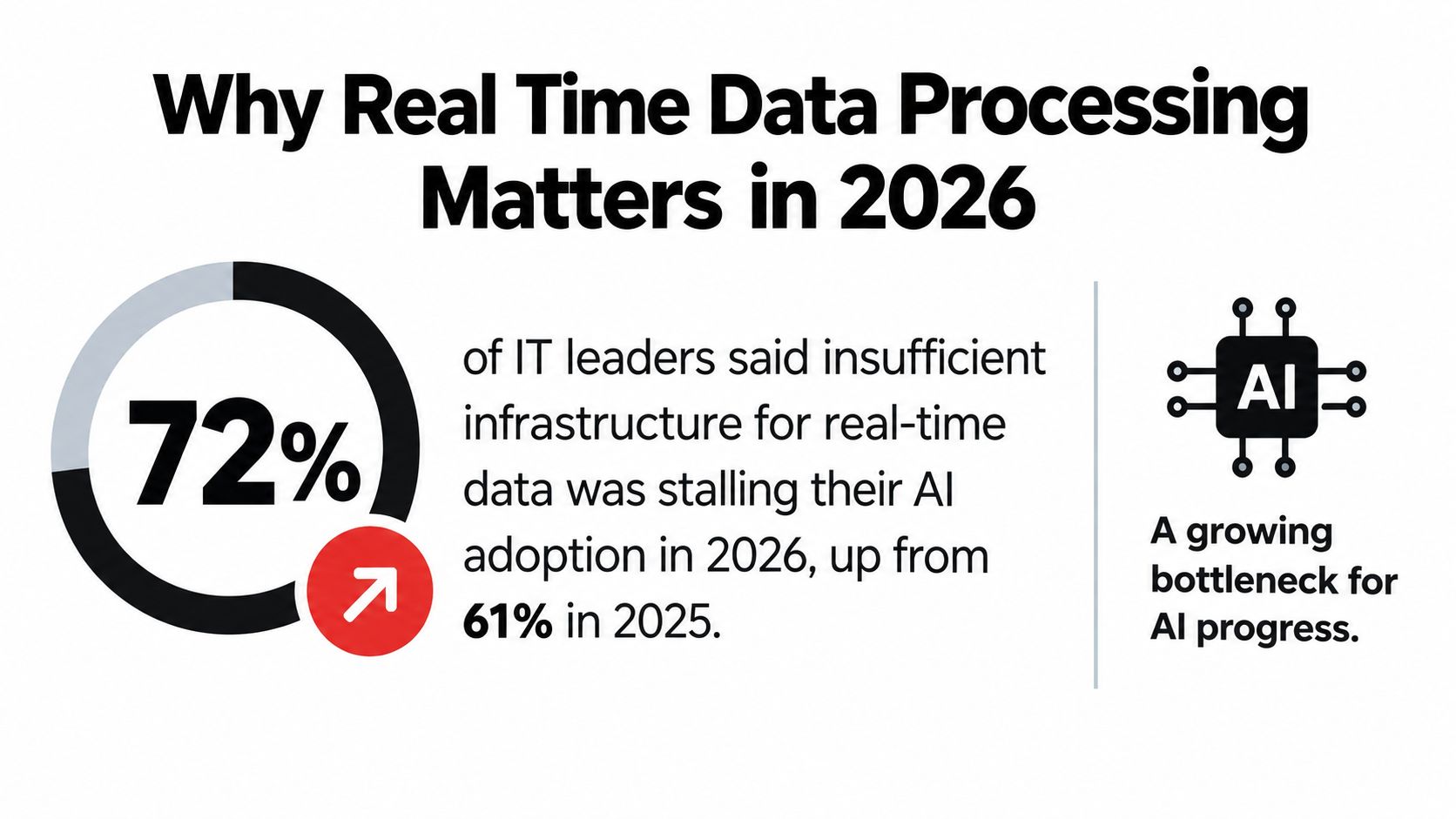
In 2026, 72% of IT leaders said insufficient infrastructure for real-time data processing was stalling AI adoption, up from 61% in 2025. Question isn't whether streaming works, but whether your team is organized and equipped to run it reliably.
That distinction changes the conversation. Many product leaders start with a familiar checklist of brokers, processors, databases, and dashboards. Yet the technology rarely fails in isolation. Projects stall because nobody owns event quality, lineage is unclear, latency targets are vague, or an AI feature consumes fresh data without a safe way to manage prompts, models, costs, and access.
Real-time data processing means ingesting, transforming, and acting on events while they still matter. A retail cashier scans each item as it reaches the register. An overnight batch job collects the day's transactions and reconciles them later. Both approaches can be correct, but only the first can immediately update inventory, flag a suspicious purchase, or personalize the next screen.
The same principle applies to custom desktop and mobile applications. A live order status, fraud decision, operational alert, or recommendation depends on a chain of systems that can move information quickly and preserve enough context to make the result trustworthy. For teams modernizing older software, data modernization fundamentals provide useful context before adding streaming infrastructure or AI features.
Why Real Time Data Processing Matters in 2026
The infrastructure bottleneck IBM identified is not primarily a hardware problem. It often appears as unclear ownership, undefined latency targets, inconsistent event quality, and no agreed process for handling failure. IBM's report on the infrastructure bottleneck shows why real-time processing is an organizational and governance decision before it becomes a tooling decision.
Real-time data processing handles events continuously, usually within seconds rather than hours, so software can respond while the situation remains relevant. The required speed depends on the decision. Hard real time applies when missing a deadline could threaten safety or invalidate a control decision. Soft real time applies when seconds or minutes of delay reduce the value of a recommendation, dashboard, or operational alert.
AI increases the cost of stale information. A model trained on historical behavior may become less useful when customer intent, inventory, risk, or device conditions change. A stream-fed feature store can refresh inference inputs, but only when teams define who owns each event, validate its quality, and maintain a reliable path from event creation to model serving.
The same governance questions affect teams modernizing older applications. Before adding streaming infrastructure or AI features, data modernization fundamentals can help establish ownership, lineage, access rules, and a dependable source of truth.
Practical rule: Define the business decision first, then set the latency it can tolerate. A sub-millisecond architecture adds cost and operational burden when the decision remains useful for several minutes.
A modernization plan should examine five connected concerns: latency, consistency, scaling, observability, and security. Their balance changes across ecommerce personalization, fintech risk detection, healthcare monitoring, and media streaming. A technically fast system can still disappoint users when its data is stale, queries fail under concurrent demand, or nobody can explain the origin of a recommendation.
Core Concepts Behind Real Time Data Processing
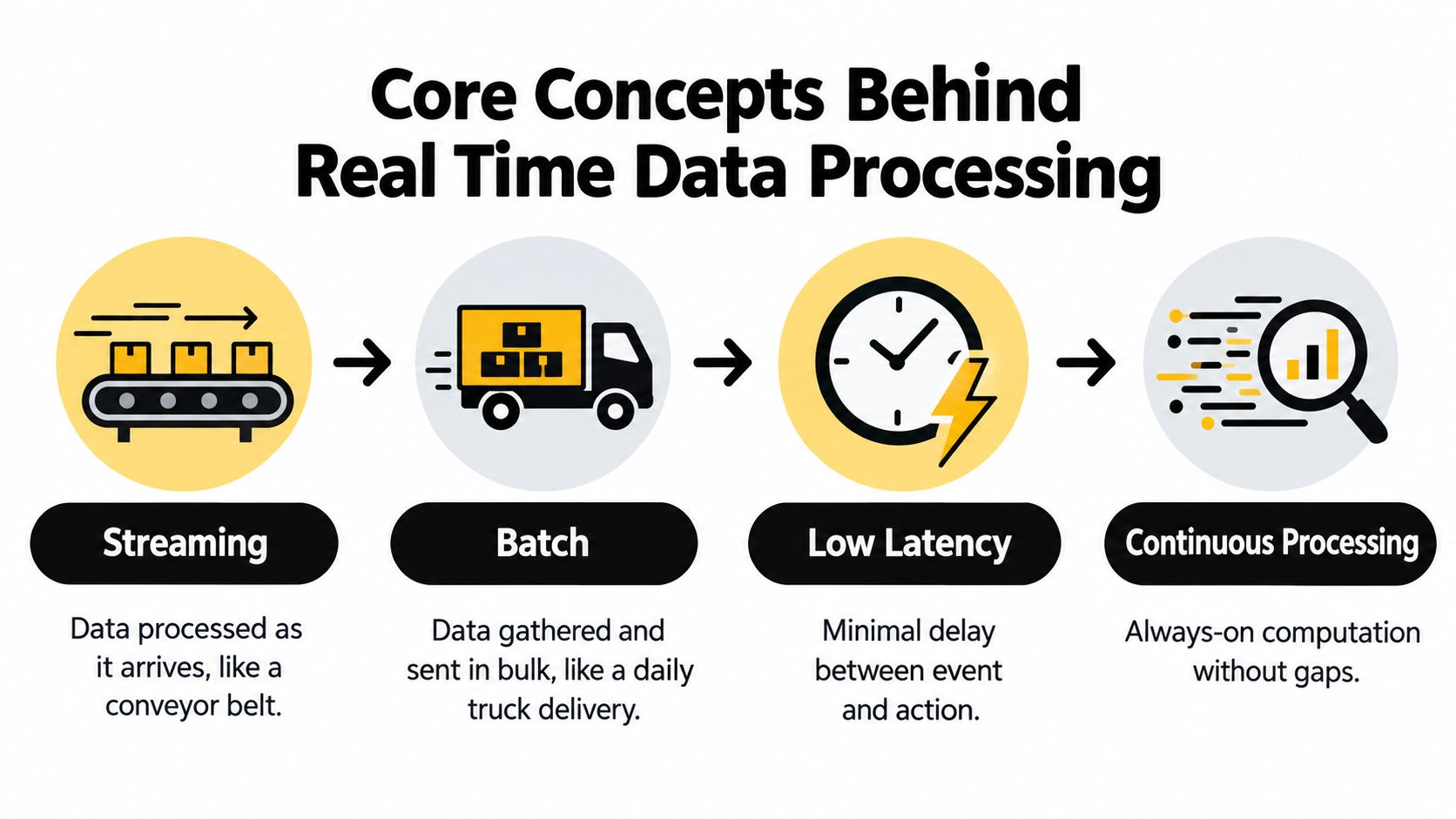
Think of a warehouse that ships once a day. Workers gather orders, load a truck, and send everything together. That's batch processing. A conveyor belt moves each package as it arrives, which is closer to streaming. The conveyor can reduce waiting time, but it also demands constant monitoring, clear package labels, and a plan for damaged items.
Streaming and batch
Streaming processes each event as it arrives. A purchase event can update an active cart, inventory view, or fraud score without waiting for a scheduled job. Batch processing groups records into a window and handles them together, which remains sensible for historical reporting, large reconciliations, and workloads where immediate action has little value.
The trade-off isn't speed versus slowness. Streaming introduces more moving parts, including event schemas, consumer offsets, replay behavior, state management, and backpressure. A batch job may be easier to rerun from a defined input set, while a stream needs durable history and carefully managed recovery.
Events and independent consumers
An event-driven architecture separates the producer from the applications that use its output. An ordering service publishes an OrderPlaced event to a durable log. Inventory, payment, fulfillment, analytics, and notifications can consume that event independently.
This decoupling lets teams add a consumer without rewriting the producer. It also creates responsibilities. Producers need stable contracts, consumers need idempotent behavior, and platform teams need policies for retention, ownership, schema evolution, and access.
Windows and state
Windowing gives a stream a meaningful frame of reference. A tumbling window can answer how many purchases arrived during a fixed five-minute interval. A sliding window moves continuously and helps smooth a trend. A session window groups a user's actions until an inactivity gap indicates that the session has ended.
Stateful processing stores the information needed to calculate aggregates, join streams, or detect patterns. A fraud processor might combine a payment with recent login activity and device history. A recommendation service might maintain a user's current session interests. The state must survive restarts and scale across workers, which is why checkpointing and durable state stores matter.
Apache Flink explains that checkpoint alignment generally adds only a few milliseconds of latency, although outliers can experience noticeably higher latency. Its documentation also describes stateful stream processing concepts and recovery behavior in detail. (Flink's stateful stream processing documentation)
For an order pipeline, the pieces compose naturally: the storefront emits an event, Kafka retains and distributes it, a processor validates and enriches it, a state store tracks relevant totals, and downstream services update inventory, payment status, dashboards, or customer notifications. Historical warehouses still have a role. A clear explanation of data warehousing concepts helps teams separate durable analytical history from the live path that powers immediate decisions.
Comparing the Leading Real Time Data Processing Tools
Choosing a tool starts with workload shape, not brand familiarity. Kafka, Flink, Kafka Streams, and Spark Structured Streaming can appear together in one architecture, but they solve different problems.
Apache Kafka is primarily a durable event backbone. It accepts, stores, and distributes streams so consumers can process or replay them. Kafka isn't a complete analytics engine by itself, so teams commonly pair it with Flink, Kafka Streams, Spark, or a real-time analytical database.
Apache Flink fits complex, stateful workloads that need event-time handling, windows, joins, and consistent recovery. It offers strong expressive power for low-latency processing, but that power brings a steeper learning curve and a broader operational footprint.
Kafka Streams is a library embedded in an application. If a team already operates Kafka and wants stream processing inside Java services, it can avoid deploying a separate processing cluster. The trade-off is that application teams own more of the runtime and service lifecycle.
Spark Structured Streaming works well for organizations with established Spark skills and data platforms. It's a pragmatic choice for near-real-time workloads where seconds or minutes are acceptable, rather than a first choice for the most latency-sensitive paths. Teams evaluating orchestration alongside processing can also see what HelpWithMetrics recommends when comparing workflow tools and operating models.
| Tool | Typical Latency | Exactly-Once | Language | Ops Complexity |
|---|---|---|---|---|
| Apache Kafka | Low-latency transport, processing requires consumers | Depends on the consuming design | Java and broad client ecosystem | High when self-managed |
| Apache Flink | Sub-second stateful processing | Mature, with coordinated checkpoints and transactional designs | Java, Scala, Python, SQL | High |
| Kafka Streams | Low-latency processing inside services | Supported with transactional and idempotent producer behavior | Java and JVM ecosystem | Moderate, distributed across services |
| Spark Structured Streaming | Seconds to minutes for many practical workloads | Supported through checkpointing and sink design | Scala, Java, Python, SQL | Moderate to high in Spark environments |
The table is a starting point, not a benchmark. Network placement, serialization, state size, partitioning, sink behavior, query concurrency, and operational discipline can matter more than the product name. Teams with existing Hadoop and Spark investments may find this overview of Spark and Hadoop useful when deciding whether to extend an existing platform or introduce a separate low-latency stack.
Latency, Consistency, and the Engineering Trade-offs
A production stream is a set of deliberate compromises. The five most important dials are latency, consistency, scaling, observability, and security. Turning one tighter usually increases cost or complexity somewhere else.
A survey-style technical paper identifies sub-100-millisecond response time as a widely used benchmark for real-time systems, especially in interactive analytics and personalization. (Technical discussion of real-time response latency) Financial trading pushes expectations much further. One 2026 benchmark describes institutional desks targeting a tick-to-trade window under 500 microseconds, with high-frequency systems aiming for 5 to 50 microseconds and systematic strategies targeting 1 to 10 milliseconds. (2026 real-time trading analytics benchmarks)
Latency also has several meanings. Integration latency measures how quickly data reaches the platform. Query latency measures how quickly a request returns. Freshness measures how current the data is, while concurrency measures how many users or services can access it under load. A fast ingestion layer won't rescue a dashboard that serves stale aggregates or times out during a traffic spike. (A practical comparison of real-time analytics platforms)
| Trade-off | Tight Setting Looks Like | Cost Paid Elsewhere | Diagnostic Question |
|---|---|---|---|
| Latency | Inline decisions with tightly controlled processing paths | Specialized infrastructure and less room for heavy computation | Which decision loses value when delayed? |
| Consistency | Exactly-once delivery with coordinated checkpoints and transactional sinks | Throughput, implementation effort, and recovery complexity | What error can the business tolerate? |
| Scaling | Keyed parallelism, partitions, and distributed state | Ordering challenges, hot keys, and replay coordination | How will the system behave when one key dominates? |
| Observability | Lag, checkpoint health, processing time, freshness, and dead-letter monitoring | Instrumentation work and alert maintenance | Can an on-call engineer locate the delay quickly? |
| Security and compliance | Encryption, RBAC, audit trails, schema controls, and PII tokenization | Policy work, key management, and access friction | Can we prove who used sensitive data and why? |
Exactly-once is a system property, not a checkbox. It depends on replayable sources, coordinated checkpoints, and idempotent or transactional sinks. Kafka Streams documents that end-to-end exactly-once requires transactional or idempotent producer support, and its StreamsConfig.EXACTLY_ONCE_V2 setting can enable that behavior on supported broker versions. (Kafka Streams processing guarantees)
Real-time systems also aren't zero-latency. Listening for an event, capturing it, moving it, processing it, and triggering an action all create unavoidable delay. (Academic discussion of real-time processing limits) Keep expensive disk writes and polling out of the critical path where possible, because they add avoidable delay. (Rules for real-time stream systems)
Industry Use Cases for Real Time Data Processing
The architecture looks different once a real customer, clinician, trader, or viewer depends on it. The right design begins with the consequence of being late, wrong, or unable to explain the result.
Ecommerce personalization
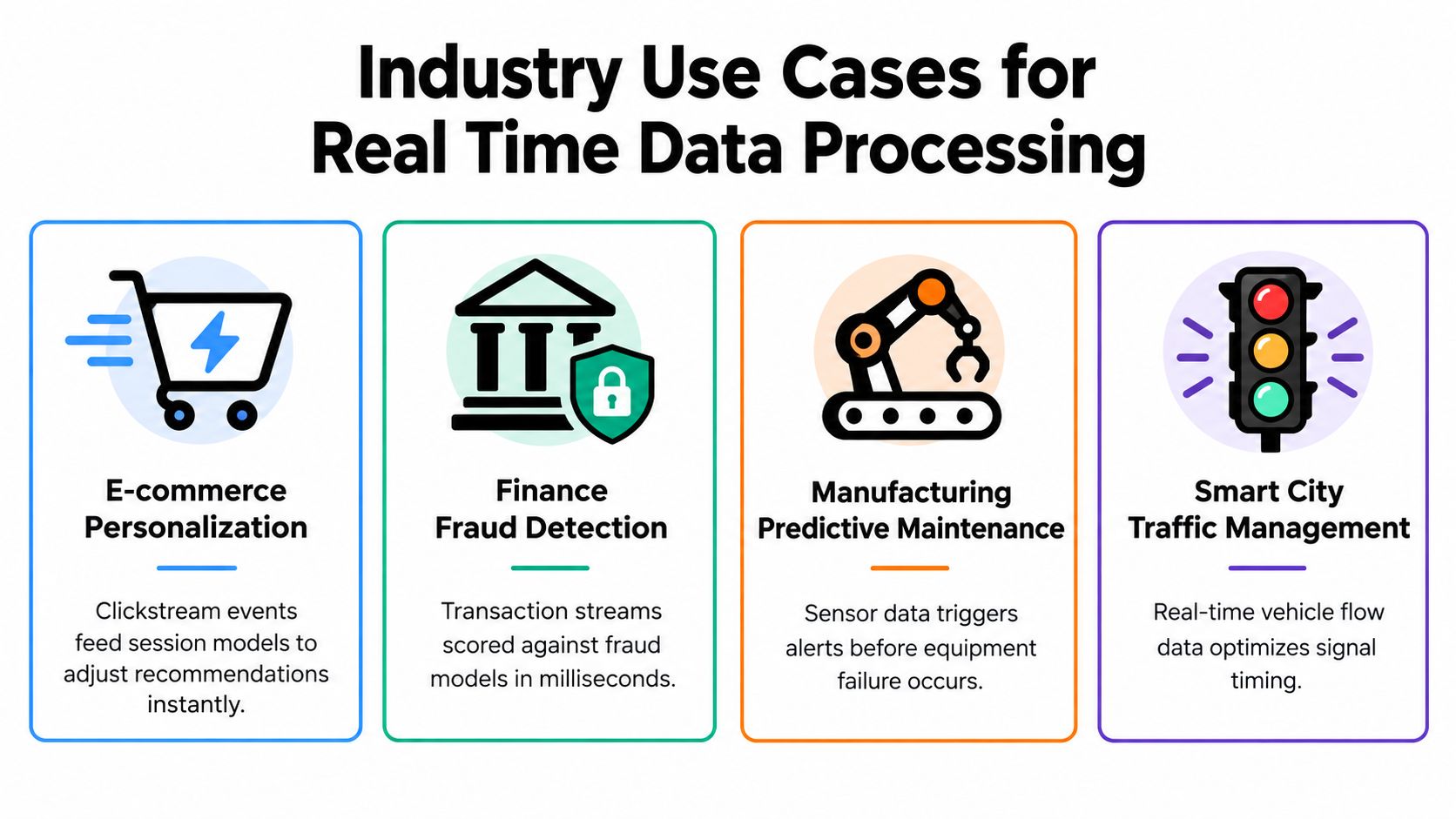
A storefront can consume clickstream events, cart changes, searches, and inventory updates to refresh a session profile. A recommendation service may then alter the next product suggestions while the shopper is still browsing. The central trade-off is freshness versus catalog stability. If every click changes the experience too aggressively, the system can feel erratic or recommend products that are unavailable.
Teams building triggered campaigns can also explore practical patterns for notifications for ecommerce ads, while keeping consent, frequency controls, and customer preferences in the application layer.
Fintech risk detection
A payment stream can be joined with recent login behavior, device signals, account history, and behavioral features. The processor then returns a risk decision before authorization completes. Exactly-once semantics, idempotent sinks, lineage, and audit trails matter because a duplicate or unexplained decision can create financial and regulatory consequences.
The critical question isn't whether the processor can be fast. It must also explain which inputs were available, which model version ran, and what happened when an upstream feature was late.
Healthcare monitoring
Bedside telemetry and lab results can feed rules and machine-learning models that flag possible deterioration for clinicians. Healthcare teams should prioritize reliable delivery, protected health information handling, clinician workflow, and explainability over a raw latency contest.
A useful alert needs context, not just speed. The system should distinguish a genuine pattern from a missing sensor, delayed result, or malformed event, then preserve enough evidence for a clinician to review the recommendation.
Media streaming
Viewing events, playback quality, CDN signals, ad decisions, and content reports arrive continuously. A media platform can use them to adjust bitrate, insert advertising, monitor outages, or route moderation work. Here, throughput and replay often matter more than the smallest possible processing interval, because teams need to recover from incidents and analyze viewing history.
The same primitives recur in each scenario: an event source, a durable transport, stateful computation, a query or decision layer, and controls for recovery and accountability. The business chooses the acceptable balance.
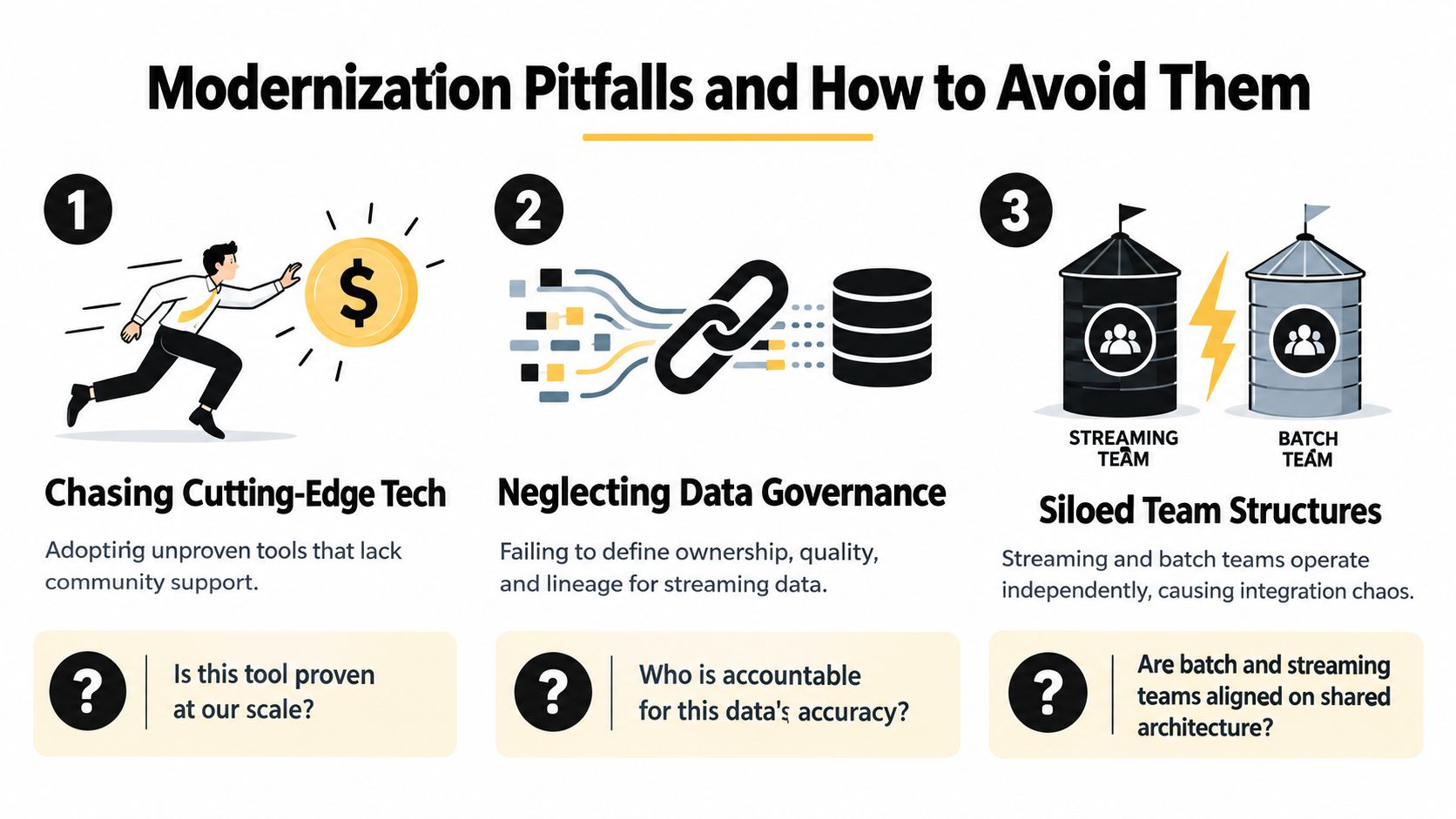
Modernization Pitfalls and How to Avoid Them
Technology can be sound while the modernization project still fails. The common mistakes are usually planning mistakes disguised as performance goals.
Chasing speed everywhere
Teams often demand sub-millisecond latency for dashboards, recommendations, alerts, and safety decisions alike. That inflates infrastructure costs and diverts engineers from reliability work.
Diagnostic question: Which decisions lose value when the result arrives later?
Set a latency budget per use case. Event-streaming systems commonly express freshness in milliseconds to a few hundred milliseconds, but the useful target depends on the decision, not the marketing label. (Guide to data latency and freshness)
Treating streaming as an infrastructure upgrade
Installing Kafka or Flink won't repair ambiguous ownership or inconsistent event definitions. Producers and consumers need data contracts, schema evolution rules, lineage, and a named owner for quality.
Diagnostic question: Who is accountable when an event is late, incomplete, or wrong?
Document ownership before scaling the pipeline. IBM's 2026 survey also identifies uncertainty around lineage, timeliness, and quality, plus fragmented data ownership, as major barriers to AI adoption. (IBM's findings on real-time data readiness)
Forgetting replayable history
A live path without durable history turns every outage into a guessing exercise. Replayable events support incident recovery, backfills, model retraining, and audits.
Diagnostic question: Can we reproduce this decision from retained input events?
Keep storage out of the critical path when latency matters, but don't confuse that rule with discarding history. Separate the fast execution path from durable retention and recovery workflows.
Coupling every consumer to one broker implementation
Hard-coded clients and incompatible schema assumptions make upgrades and cloud migrations risky.
Diagnostic question: Can one consumer evolve without forcing a coordinated release across every producer?
Use versioned contracts, compatibility testing, and clear ownership boundaries. Finally, invest in lag dashboards, checkpoint alerts, dead-letter queues, and on-call runbooks before the first incident, not after it.
A Modernization Checklist and Where Wonderment Apps Fits
A practical program moves from evidence to a narrow delivery, then expands only after the operating model works.
Phase one, discovery
Inventory event sources, map latency expectations to business decisions, and establish a baseline for lineage and data quality.
- Source inventory: List applications, devices, APIs, and databases that create relevant events.
- Latency map: Record freshness, query, and action requirements for each use case.
- Ownership baseline: Assign producers and consumers responsibility for schemas, quality, and access.
This is Crawl maturity. You know what exists, who owns it, and which decisions deserve live data.
Phase two, pilot
Choose one valuable stream rather than attempting an enterprise-wide rewrite. Add a bounded state store, define service-level indicators, and test replay, failure recovery, and data contracts before expanding volume or scope.
- Focused use case: Select one decision with a clear business owner.
- Observable path: Measure lag, freshness, processing failures, and sink outcomes.
- Recovery test: Re-run events and confirm that downstream behavior is safe.
This is Walk maturity. The team has delivered a useful path and can operate it deliberately.
Phase three, scaling
Address partition strategy, backpressure, durable replay, failover, access controls, and FinOps guardrails. Scaling isn't just adding workers. It requires protection against hot keys, runaway queries, unbounded state, and poorly governed retention.
- Capacity design: Test partitions, state growth, concurrency, and backpressure.
- Resilience plan: Exercise restart, replay, regional failure, and sink recovery.
- Cost controls: Track storage, compute, retention, and model-related usage.
This is Run maturity. The platform can support more products without making every team reinvent recovery and governance.
Phase four, AI integration
Connect streaming features to model serving, online feature stores, retrieval-augmented generation pipelines, and drift monitoring. AI modernization also needs prompt governance. Wonderment Apps' administrative prompt management system can be integrated into existing software and includes a versioned prompt vault, parameter management for internal database access, logging across integrated AI systems, and cost management for cumulative spend.
Wonderment Apps can support discovery sprints, pilot delivery, platform co-building, and AI-readiness work. The important test is delivery: can the team ship a governed stream, operate it, and connect it to a useful product experience?
Wonderment Apps helps organizations modernize web, mobile, and legacy software with real-time data processing, AI integration, scalable engineering, and UX-focused delivery. Visit Wonderment Apps to discuss a discovery sprint, a focused streaming pilot, or a prompt management demo that gives your team versioning, access controls, AI logging, and cost visibility.