

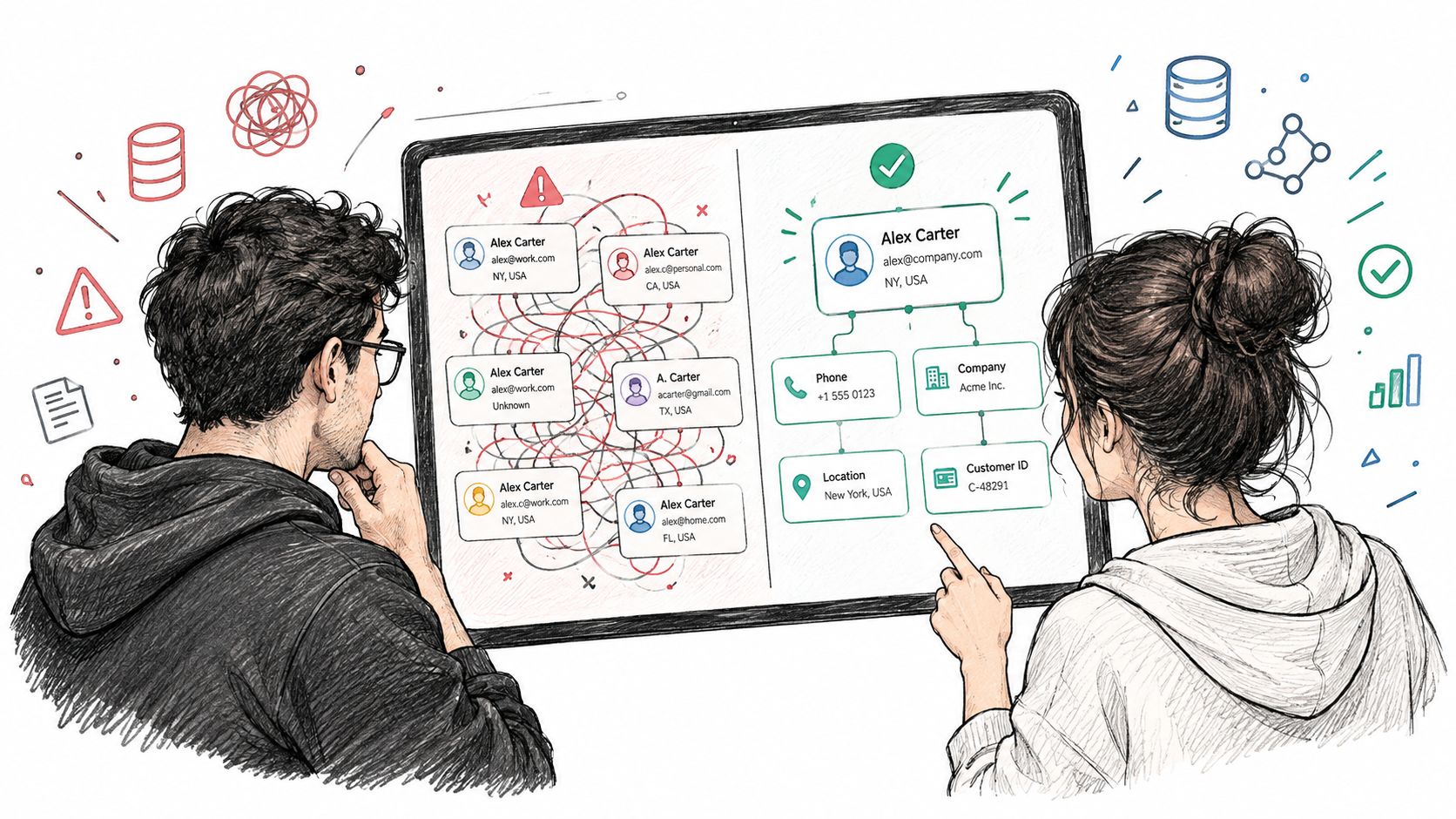
Your app's recommendation engine returns three different customer profiles, the support assistant cites an outdated policy, and finance can't explain why the AI bill keeps growing. None of these problems necessarily starts with a bad model. They usually begin earlier, when teams use different definitions, unclear ownership, untracked prompts, and data sources nobody has formally approved.
Data governance frameworks provide the structure that turns scattered data practices into a repeatable operating model. They help business and engineering leaders decide who owns information, which source is authoritative, how quality is checked, and how AI actions can be traced. Modern tooling can extend that discipline into prompt versions, retrieval parameters, model logs, and usage costs, so governance supports scalable apps instead of becoming a folder of policies that nobody opens.
Why Data Governance Frameworks Decide If Your App Scales
A retail app can have a polished interface, fast APIs, and a capable recommendation model, yet still deliver an unreliable experience. The customer record in the mobile app might show one address, the order system another, and the analytics warehouse a third. A personalization model then receives conflicting signals and produces suggestions that feel random. Users don't blame the data pipeline. They blame the product.
The same pattern appears in internal software. A finance dashboard labels revenue one way, a sales tool labels it another, and an AI assistant confidently combines both. Developers add exceptions, analysts add manual checks, and product teams slow down every time they introduce a new feature. Scale exposes inconsistency because more users, integrations, and automated decisions multiply the number of places where an unclear definition can cause trouble.
A governance framework acts like the operating agreement for your data estate. It gives teams shared answers to practical questions:
- Who decides: Which person or council approves definitions, access, and policy changes?
- What counts as trusted: Which system is the authoritative source for a customer, product, transaction, or policy?
- How systems behave: Which validation, retention, privacy, and monitoring rules apply?
- How AI remains explainable: Which model, prompt, retrieved data, and parameter produced an output?
Practical rule: If a team can't explain where an AI answer came from, it hasn't finished governing the workflow.
This is closely connected to product discovery and experience design. A practical data driven product design guide can help teams think about how evidence informs product decisions, while governance makes sure the evidence is consistent enough to trust.
For AI-enabled desktop and mobile apps, governance also needs to cover the instructions given to models. A prompt vault with versioning, controlled database parameters, cross-model logging, and cost visibility can give developers an administrative layer for that work. Wonderment Apps' prompt management system is one example of the kind of tooling that brings governance closer to the application rather than leaving it only in enterprise documentation.
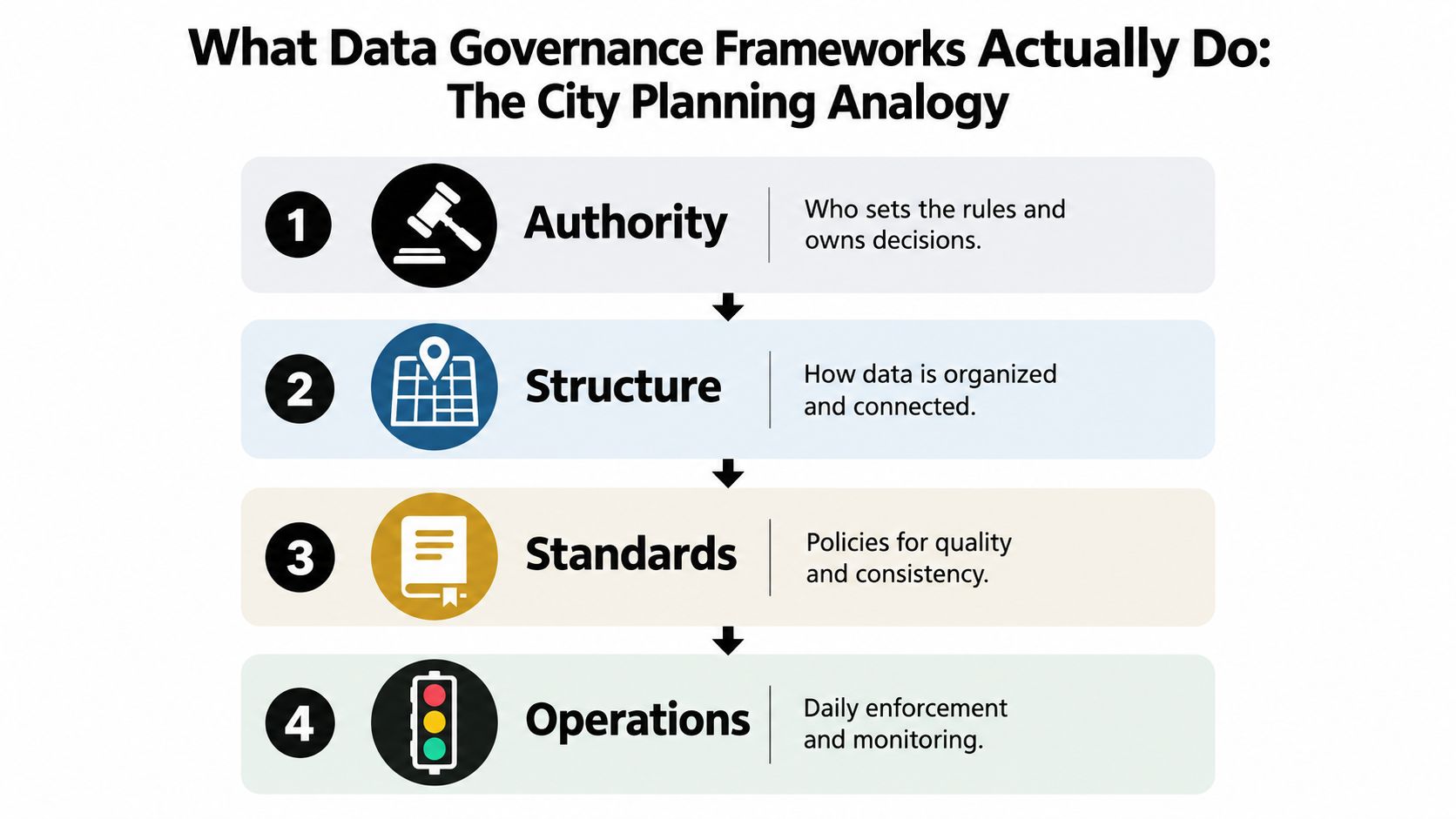
The rest of the framework conversation becomes easier when you separate four concerns: authority, structure, standards, and operations. Once those are clear, you can compare established models, assign responsibilities, implement controls, and measure whether the app is becoming safer and more scalable.
What Data Governance Frameworks Actually Do
Think of a growing company as a city. Data is the network of roads, buildings, utilities, addresses, and public records. Without planning, every department builds its own roads and names its own streets. People can still move around, but deliveries get lost, maps disagree, and expansion becomes expensive.
Data governance is city planning for information. It establishes authority, organizes the environment, defines standards, and makes sure daily work follows those standards. DAMA-DMBOK describes governance as the exercise of authority, control, and shared decision-making over data assets through planning, monitoring, and enforcement. Its functional framework places governance at the center of 11 data management knowledge areas, coordinating the other disciplines rather than treating governance as an isolated project. DAMA-DMBOK functional framework
Four layers of practical governance
Authority determines who can make decisions. A data owner might approve a definition or access rule, while a governance council resolves disputes between departments.
Structure describes how data assets relate to one another. Catalogs, schemas, metadata, master data, and lineage help teams understand what exists and how information moves.
Standards establish consistency. They can cover naming, classification, quality checks, retention, privacy, and permitted uses.
Operations turns the framework into daily behavior. Teams monitor quality, approve access, investigate exceptions, update metadata, and enforce policies through systems.
Authoritative sources are especially important. The U.S. DCMA manual explains that sources established through regulation, policy, and public law should be used to eliminate redundancy, reduce ambiguity, and increase data sharing. Research on authoritative data sources frames this as more than an administrative preference. When downstream systems inherit a verified source of truth, engineers face fewer conflicting definitions and integration teams spend less time reconciling records.
A useful application example is the relationship between pipelines and reporting. Teams building or modernizing data pipelines for business intelligence need governance decisions before data reaches dashboards. Otherwise, the pipeline may move inconsistent information faster without making it more trustworthy.
The DAMA-DMBOK revision history also changed the label from “data governance program” to “data governance function.” That wording matters. A program can sound temporary, while a function implies an operating capability with people, responsibilities, workflows, and ongoing decisions. DAMA-DMBOK revision history
Comparing Popular Data Governance Frameworks DAMA DCAM and NIST
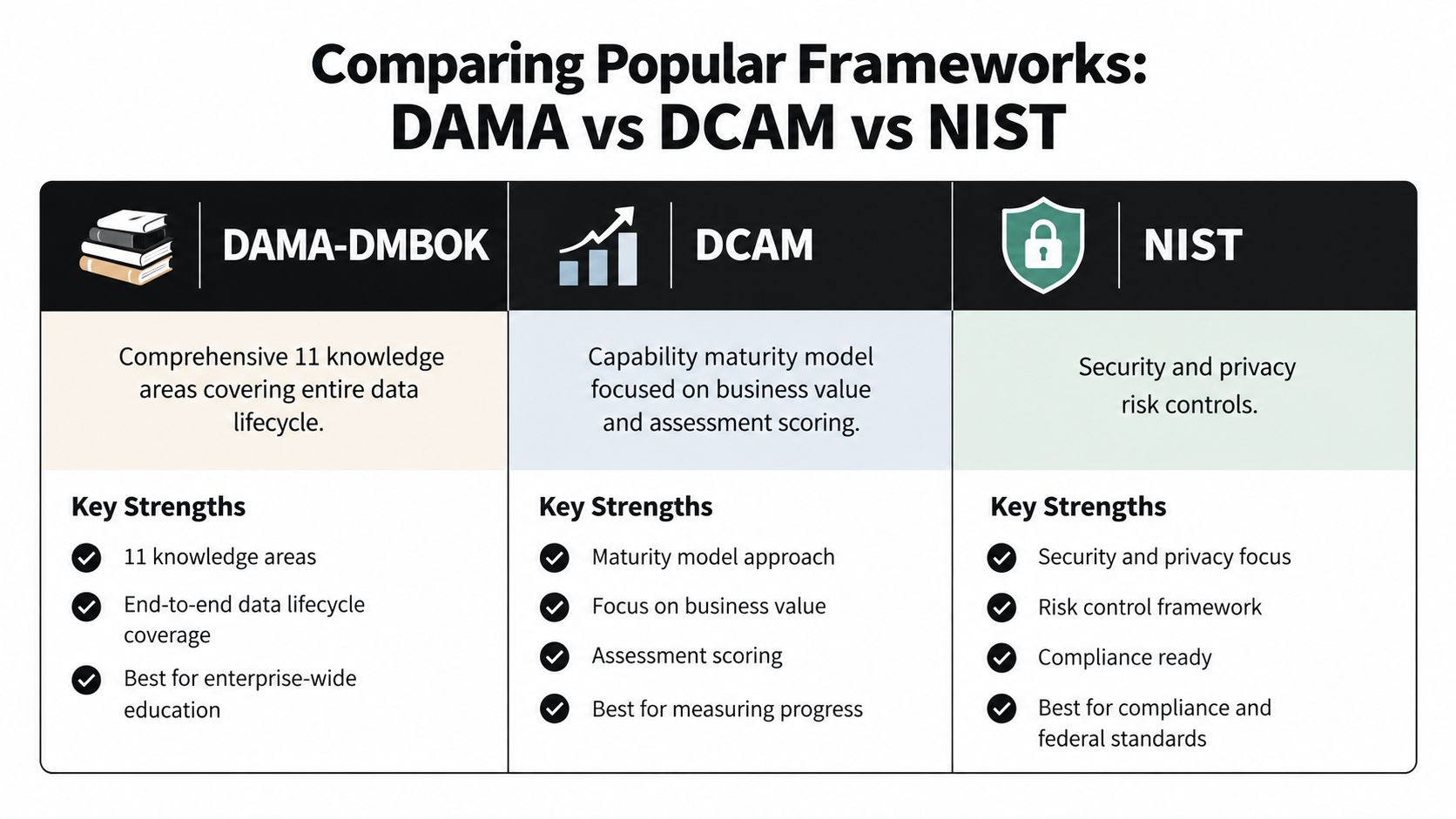
Choosing a framework is easier when you treat each model as a tool for a different job. DAMA-DMBOK gives broad data management vocabulary and coverage. DCAM helps organizations assess capability and plan improvement. NIST SP 800-53 provides security and privacy controls that connect governance to formal requirements.
DAMA-DMBOK is often the strongest starting point for teams that need a common language across architecture, quality, metadata, security, integration, and other data disciplines. It's detailed, which makes it useful for education and enterprise planning, but leaders still need to translate its concepts into local decisions and workflows.
DCAM is more assessment-oriented. It helps leaders ask how consistently the organization performs governance activities and where capability needs attention. That makes it useful when the executive conversation is about maturity, readiness, or progress rather than defining data management responsibilities.
NIST SP 800-53 takes a control-based approach. Its PM-23 control, Data Governance Body, requires policies, procedures, and standards so data, including personally identifiable information, is managed according to applicable laws, directives, regulations, policies, standards, and guidance. NIST SP 800-53 Rev. 5
How Leading Data Governance Frameworks Compare
| Framework | Core Structure | Best For |
|---|---|---|
| DAMA-DMBOK | Broad data management model organized around 11 knowledge areas | Enterprise-wide education, shared terminology, and a complete data management foundation |
| DCAM | Capability assessment and maturity-focused structure | Measuring current capability and prioritizing improvement |
| NIST SP 800-53 | Detailed security and privacy controls, including a Data Governance Body control | Compliance, risk management, and federal standards |
A practical selection method starts with the business problem, not the framework's reputation. If teams argue about ownership and definitions, DAMA-DMBOK offers useful breadth. If leadership wants a structured view of progress, DCAM can provide the assessment lens. If the organization must demonstrate control alignment, NIST gives the governance body and policy requirements a concrete place in the control environment.
Most AI modernization projects need more than one perspective. A broad data model can explain the current state, an assessment model can expose gaps, and control guidance can define what must be enforced. None of these models, by itself, fully describes prompt lineage, retrieval context, model provenance, or the traceability of an AI decision. That extension belongs in the implementation design.
Roles Policies and Compliance Controls That Make Frameworks Work
A framework diagram doesn't govern anything by itself. People make decisions, policies set boundaries, and technical systems enforce the rules. The most common confusion is ownership versus stewardship.
A data owner is accountable for a domain or asset. This person has the authority to approve access, resolve important definition disputes, and accept policy decisions. A data steward works closer to the content and process, defining quality rules, reviewing issues, and helping business teams use shared terms consistently. A data custodian usually operates the technical environment, implementing permissions, storage controls, monitoring, backups, and integrations.
The operating roles
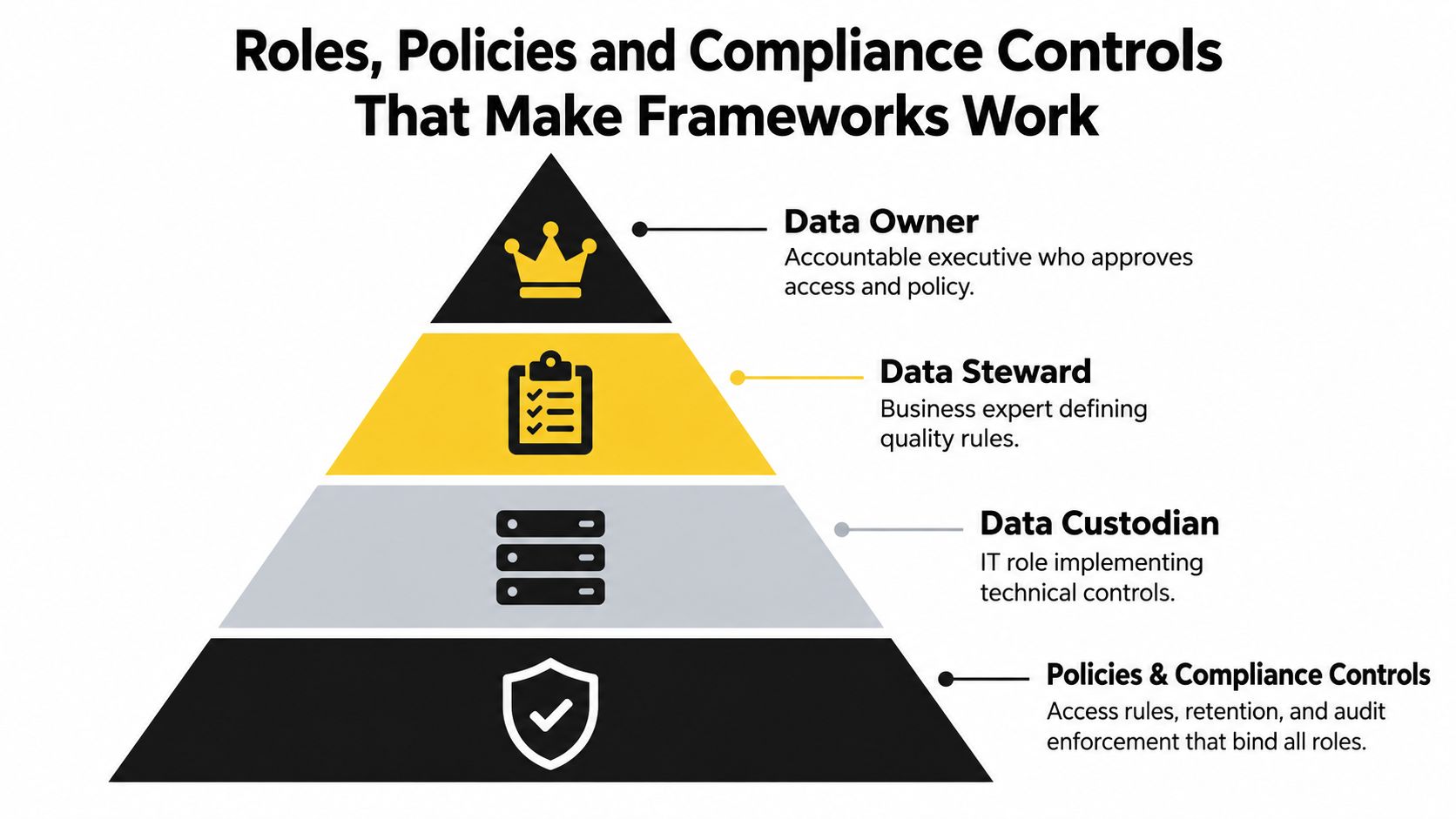
A governance council connects these roles. It shouldn't become a meeting that merely approves documents. It needs clear decision rights, a way to resolve conflicts, and enough authority to prioritize remediation when a data issue blocks an application or creates compliance exposure.
Policies then turn decisions into repeatable rules. A mature policy set commonly addresses:
- Classification: Whether information is public, internal, confidential, or sensitive.
- Access: Which roles can view, change, export, or share an asset.
- Quality: Which fields require validation and what makes a record usable.
- Retention: How long information remains available and what happens when it should be archived or deleted.
- Lineage: Which source, transformation, application, or model consumed the information.
Authoritative-source designations make these policies technical. If a customer identifier has one approved source, downstream applications can validate against it instead of inventing local interpretations. That reduces ambiguity across APIs, analytics, and AI retrieval workflows.
GDPR Article 30 provides a concrete compliance example. It requires controllers to maintain records of processing activities with fields covering controller contact details, processing purposes, categories of data subjects and personal data, recipients, cross-border transfers, envisaged erasure time limits, and a general description of technical and organizational security measures. Processors must keep analogous records for processing performed on behalf of controllers. GDPR Article 30 records of processing
Teams designing applications should connect these artifacts to product delivery rather than treating them as legal paperwork. A privacy by design principles guide can help product and engineering teams address privacy decisions while they design workflows, not after the database and AI integrations are already difficult to change.
Your Implementation Roadmap From Assessment to Measurable Value
A governance rollout should follow the path of a real business problem. Start with a customer, transaction, or product record that moves through an app, warehouse, report, and AI workflow. Trace where definitions change, access becomes unclear, or lineage disappears. The aim is to locate the decisions that slow delivery or weaken trust, rather than catalogue every asset at once.
Start with the current state
Inventory the systems, integrations, owners, and known conflicts behind that workflow. Then write the business outcome that justifies the effort: more reliable personalization, faster access approvals, defensible AI responses, or fewer manual reconciliations. That sentence sets the boundary for the first phase and prevents governance from becoming a catalogue with no product connection.
For AI applications, extend the assessment beyond datasets. Record which prompt version, retrieval source, model, and output influenced a user-facing decision. Prompt lineage and model provenance give teams a way to investigate behavior when an answer changes, a source is updated, or a model is replaced.
Choose an operating model
Governance commonly uses centralized, federated, or hybrid authority. A centralized model places decisions with one team. A federated model gives business domains local responsibility within shared guardrails. A hybrid model sets central standards while domains handle execution.
A 2025 enterprise report found centralized and federated models each at 36%, with hybrid models at 29%. The same findings report that 39% of data leaders struggle to demonstrate governance impact to leadership. 2025 State of Enterprise Data Governance findings These figures do not identify a universal winner. Choose based on where decisions happen, how independent domains are, and whether a central team can maintain the standards.
Sequence the work
- Define principles and sources: Agree on shared definitions and designate authoritative systems for the first domain.
- Assign accountability: Name owners, stewards, custodians, and escalation paths.
- Publish minimum policies: Start with access, classification, quality, retention, and AI usage rules for the selected workflow.
- Automate enforcement: Connect catalog, quality, access, lineage, and application controls where practical.
- Review evidence: Track unresolved quality issues, access decisions, policy exceptions, lineage coverage, and AI traceability.
Measure control performance and business usefulness together. Faster issue resolution, clearer ownership, and more defensible application behavior show whether governance is helping delivery. They also give leadership evidence that the program supports scalable AI apps, not only compliance paperwork.
For older platforms, include governance in the migration plan. A focused data warehouse modernization approach can align source decisions, quality rules, lineage, and application dependencies before a new environment carries old inconsistencies into production.
Tooling and Templates That Operationalize Governance for AI Apps
Governance becomes durable when it appears in the work teams already perform. A policy in a document repository helps people look up a rule, while an application needs that rule in deployment reviews, access requests, data pipelines, and model operations.
Start with small artifacts that give teams a shared vocabulary:
- Data dictionary: Defines fields, business meaning, acceptable values, and ownership.
- Business glossary: Connects technical terms with language used by finance, sales, support, and product teams.
- RACI chart: Shows who is responsible, accountable, consulted, and informed for key decisions.
- Policy templates: Give teams a consistent starting point for classification, retention, access, quality, and AI use.
- Lineage record: Shows where information originated, how it changed, and which products or models consumed it.
For AI, lineage must extend beyond a dashboard or report. The chain should include training data, retrieval sources, prompt versions, parameters, model selection, outputs, and decisions based on those outputs. Data governance frameworks and AI compliance highlights this gap, along with manual documentation, limited visibility into policy enforcement, and the need for explainable governance that business teams can use.
Prompt lineage and model provenance turn an AI feature from a black box into a service that teams can inspect, test, and improve. If a response changes, engineers can trace the relevant source, prompt, parameter, or model version instead of searching through scattered code.
Wonderment Apps offers a prompt management system that can connect to an existing application as an administrative layer. It includes a prompt vault with versioning, a parameter manager for internal database access, a logging system across integrated AI systems, and a cost manager showing cumulative spend. These functions let product and engineering teams manage prompts and model interactions as application assets.
The readiness gap is operational. One industry finding reports that 23% of organizations have a formal governance process with clear roles and policies, while 71% discuss governance at senior leadership level. The same AI governance readiness findings show why templates and embedded controls matter: awareness creates meetings, while tooling creates repeatable behavior.
Sector Playbooks and Next Steps for Healthcare Fintech and Ecommerce
A healthcare team building a patient-facing assistant needs to know which records the assistant may retrieve, what consent permits, how sensitive information flows, and which human process handles an uncertain answer. Lineage should connect the patient data source to retrieval, prompt, model response, and application action. A resource on a Medical virtual assistant can help product teams think through the user experience, while governance determines whether the underlying workflow is controlled and explainable.
Fintech teams face a different emphasis. A lending, payments, or financial planning app needs clear ownership for account and transaction data, consistent definitions for reporting, strict access decisions, and evidence that important actions can be reconstructed. DAMA-DMBOK can provide broad data management structure, DCAM can support capability assessment, and NIST controls can help align governance responsibilities with security and privacy expectations.
Ecommerce teams often feel governance problems through personalization. A customer may update a preference in a mobile app, while a web experience and recommendation service continue using older information. Teams need authoritative customer and product sources, quality checks for catalogue data, clear consent handling, and real-time lineage for AI features. When these controls live close to the application, developers can scale experiences to larger audiences without multiplying hidden exceptions.
A practical starting sequence is simple:
- Choose one high-value customer, product, or transaction workflow.
- Name the owner and steward before writing a large policy library.
- Approve authoritative sources and shared definitions.
- Trace the full path through data, prompts, models, and actions.
- Add measurements that show both control health and product value.
Wonderment Apps helps organizations modernize legacy software, integrate suitable AI models, and build web and mobile products with the engineering, design, QA, and delivery support needed for long-term scale. Visit Wonderment Apps to explore how its application modernization and prompt management capabilities can turn governance decisions into practical controls for AI-powered products.