

You're at the point where the whiteboard is clean, the backlog is still theoretical, and one stack choice is about to shape the next few years of your product. If you're weighing Python vs Ruby, the question isn't which syntax feels nicer at 9 p.m. It's which language will still feel like a good decision when you need to hire faster, ship AI features, and keep the system maintainable after the first wave of growth.
| Decision factor | Python | Ruby |
|---|---|---|
| Ecosystem and talent | Much larger developer pool and package base | Smaller pool, more focused web community |
| Best fit | Automation, data, AI, backend breadth | Rapid web product development, Rails-heavy teams |
| Performance reality | Strong on many application and numeric workloads, depends on runtime | Can outperform Python on some compute tasks and certain web setups |
| Hiring strategy | Broader recruiting funnel | Narrower but often highly experienced web talent |
| AI modernization | Natural fit for model-heavy work | Fine for integration, but usually paired with external AI services |
Choosing the Right Language for Your Next Big Idea
A founder stares at a fresh architecture diagram, and the debate starts immediately. One side wants Python because the roadmap mentions automation, analytics, and AI features. The other side wants Ruby because the team has shipped Rails apps before, the product needs to move fast, and nobody wants a long setup fight before the first demo.
That's the honest frame. Language choice is really business strategy disguised as engineering preference, especially when the product has to evolve after launch. If the plan includes AI-assisted workflows, admin tooling, or anything that touches model orchestration later, the stack needs to leave room for that without turning every feature into a rewrite.
There's also a maintenance angle that gets ignored in startup conversations. A stack that feels elegant on day one can become a recruiting bottleneck if it narrows the pool of engineers who can step in later. That's why the stack decision should be made the same way you'd choose a core vendor, by asking how much optionality it gives you when the product, team, and roadmap change.
Practical rule: pick the language that reduces the number of future rewrites, not the one that wins the first internal demo.
If you're still deciding how much framework lock-in, AI-readiness, and hiring flexibility you need, a good starting point is this guide on how to choose the right technology stack for your project. It's the kind of decision lens that keeps teams from optimizing for the wrong trade-off.
Python and Ruby at a Glance
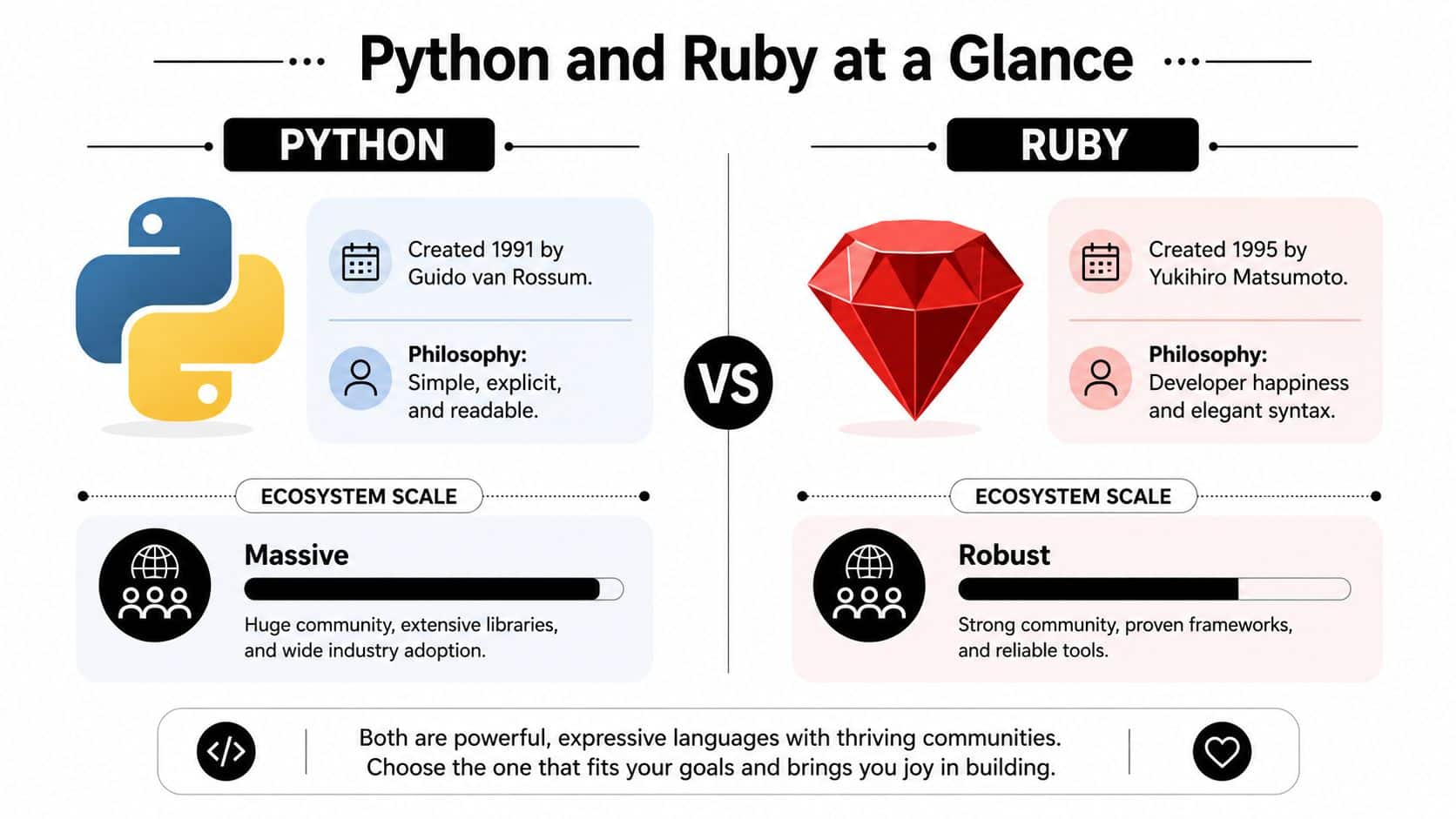
Python and Ruby started from different places, and that still shapes how engineering teams evaluate them. Python first appeared in 1991, created by Guido van Rossum, while Ruby was created in 1995 by Yukihiro Matsumoto. That gap matters because Python had a longer runway to build libraries, tooling, and community momentum before modern product teams began planning around automation, analytics, and AI systems.
Their philosophies also point in different directions. Python puts a premium on readability, explicitness, and versatility, which makes it a practical fit for general-purpose development, scripting, data work, and machine learning. Ruby focuses on developer happiness and expressive syntax, which is why many teams still prefer it for web application work where fast iteration and a clean codebase matter more than broad language coverage.
The ecosystem difference is harder to ignore once a team starts planning for hiring and long-term support. UpGuard estimates about 8.2 million Python developers worldwide versus 1.8 million Ruby developers worldwide, roughly a 4.6-to-1 gap, and it also reports more than 450,000 packages on PyPI versus about 180,000 on RubyGems. That larger base gives Python more room for quick prototyping, easier staffing across regions, and smoother integration with AI and automation tooling without forcing the team to assemble as much from scratch. UpGuard's Python vs Ruby overview lays out those market signals clearly.
For a different example of how trade-offs get framed in practice, compare React, Angular, and Vue frameworks and notice how teams weigh ecosystem depth, hiring availability, and implementation speed. The same logic applies here, the best choice is the one that fits the product's next phase, not just the first release.
Performance Benchmarks and Real-World Speed
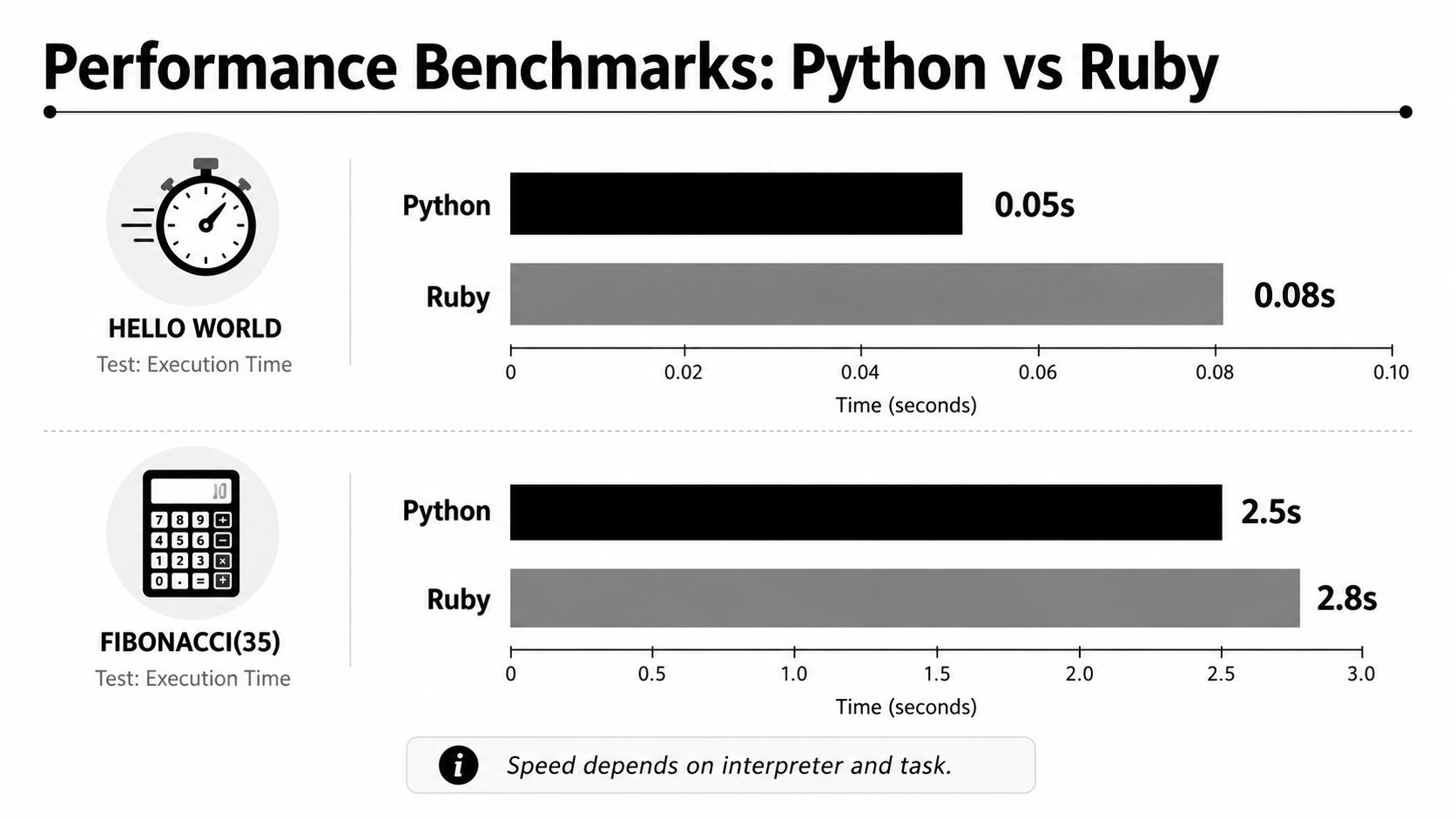
Raw speed arguments get messy fast because Python vs Ruby performance depends on runtime and workload more than on language branding. In the Debian Benchmarks Game comparison, Ruby finished fannkuch-redux in 154.32 seconds, while Python 3 took 943.88 seconds on the same task, which shows Ruby can absolutely win on some compute-heavy work. The same benchmark set also reports the opposite pattern in other cases, including a 1,000,000-iteration Fibonacci test where Python took about 1.2 seconds versus Ruby's 4.9 seconds, plus a character-counting task where Python used 17.9 MB versus Ruby's 218.2 MB. Benchmark Game's Ruby and Python 3 results make the point bluntly, there isn't a universal winner.
Interpreter choice changes the story
That's even clearer when you compare real runtimes. In one public benchmark set, Python on PyPy 3.11.13 finished in 1,165 ms with 96.8 MB peak memory, while Ruby on TruffleRuby 24.2.2 took 1,486 ms and 801.2 MB. Another task flipped the result, with Ruby on TruffleRuby at 528 ms and 407.2 MB, versus Python on CPython 3.13.5 at 734 ms and 12.9 MB, and Ruby on YJIT 3.4.5 at 932 ms and 19.5 MB. The Python vs Ruby benchmark page is a useful reminder that runtime selection can matter as much as language choice.
The most practical takeaway is that framework and concurrency model often dominate request-level performance. One published comparison noted Python being about 2.5x faster than Ruby for typical loop iteration and roughly twice as fast for JSON parsing, while also observing that Ruby can be slightly faster for file reading and that framework choice can overwhelm raw language speed. That same source also reported a Ruby web server at about 14,904 requests/sec versus a Python server at about 2,990 requests/sec on a simple endpoint, but it explicitly framed that as a framework-specific result, not a universal verdict. Scout APM's Python vs Ruby breakdown is the right way to read that kind of number.
Engineering rule: benchmark the runtime you'll actually deploy, on the workload you'll actually run, with the framework you'll actually ship.
Django and Flask vs Ruby on Rails
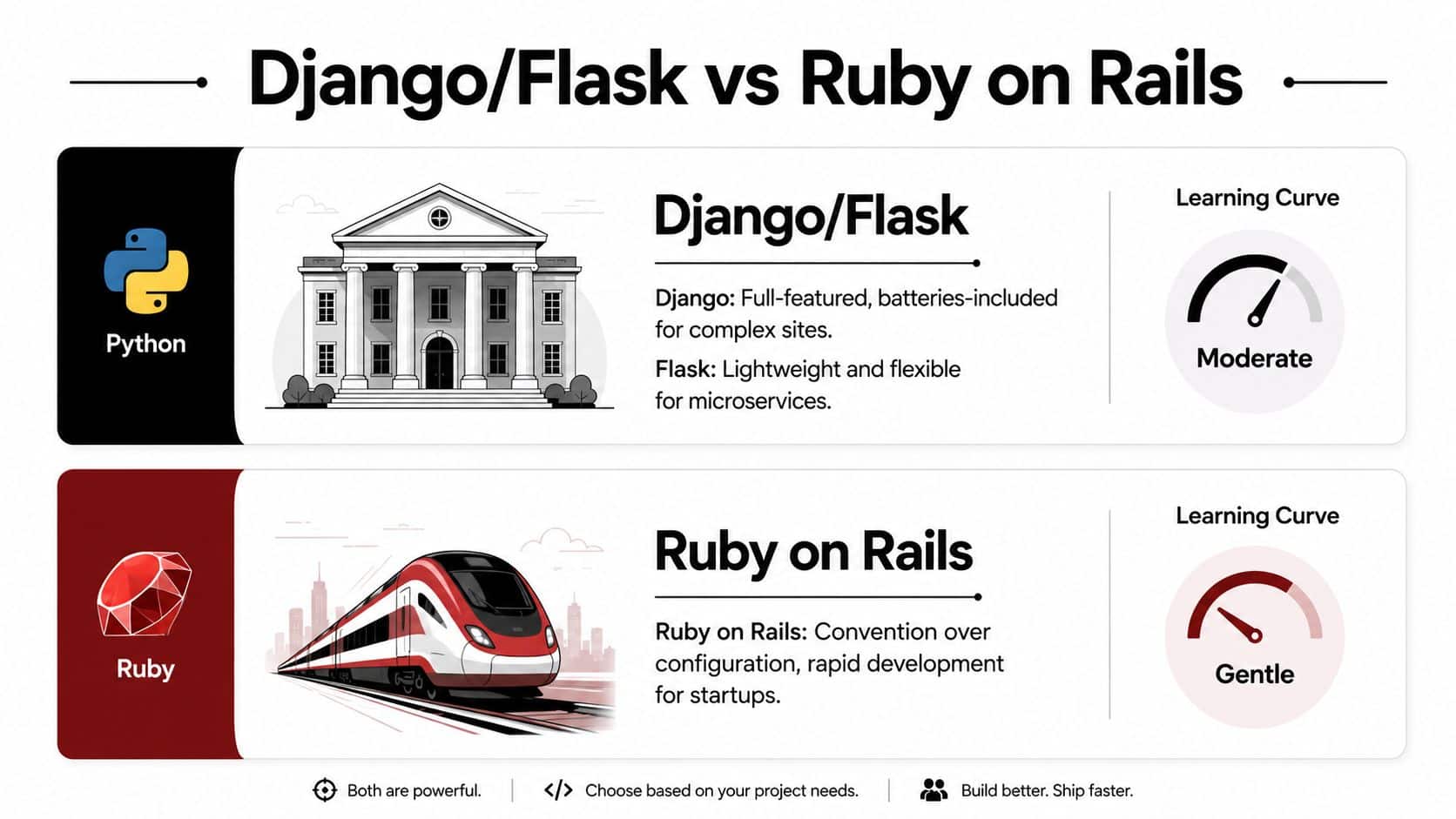
The framework decision usually carries more weight than the language debate. On the Python side, Django is the batteries-included choice for teams that want authentication, admin tooling, database structure, and a cohesive project layout without assembling every piece themselves. Flask is the lighter option when a team needs APIs, microservices, or a minimal surface area that will not fight a custom architecture.
Ruby on Rails fits teams that value convention over configuration and need to move quickly on a product with familiar web patterns. That makes it a strong match for startup MVPs, content platforms, and products where shipping working behavior matters more than designing a highly modular stack on day one. Railsware's overview of the ecosystem also points out that Rails is one of the reasons many developers love Ruby in the first place. For a side-by-side framework perspective, the internal guide on the best framework for web application development is a useful companion read.
The trade-off is operational. Django teams usually prefer structure and completeness, Flask teams usually want flexibility, and Rails teams often benefit from an opinionated path that keeps early development moving. That structure helps until the product needs unusual integrations, heavy background processing, or a deeper AI layer, because then architectural discipline matters more than framework charm. In practice, the right framework is the one that fits the next two years of product work, not just the first release.
Modern requirements change the fit
API-first products can run on all three, but they do not feel the same in production. Django gives you a strong base for data-heavy applications, Flask makes it easier to stay lean, and Rails gets fast when the application mostly follows familiar CRUD and workflow patterns. The better choice depends on whether the team needs guardrails or open-ended control, and whether the roadmap points toward AI modernization, reporting, and automation or toward a focused web app with a narrow scope.
When a team plans for long-term AI work, hiring risk, and operational scale, Python usually carries less friction. Rails can still be the right call for a small team that needs to ship a polished product quickly and keep the codebase opinionated. The mistake is choosing a framework because it feels pleasant in a demo, then discovering later that the product needs a different operating model, a different hiring profile, or a different path for future AI integration.
Industry Use Cases and Strategic Fit
The language choice starts to make more sense when you map it to the business model. Python is the safer bet for teams building around AI, data science, automation, and backend logic that may need to support analytics later. Ruby is often the better fit when the company's immediate need is a polished web product, especially when the team is small, experienced with Rails, and focused on fast iteration.
In ecommerce, Python is often the better long-term fit when personalization, recommendations, or operational automation are part of the roadmap. In fintech and healthcare, the attraction is similar, because those teams usually need a broader backend and data-processing footprint, not just a fast web shell. Government and public-sector teams also benefit when the work leans toward simulations, reporting, or data pipelines that may grow more complex over time.
Ruby still holds its ground in product organizations that care most about rapid MVP delivery and content-rich web experiences. Media companies, especially, can benefit from the speed of a Rails-style workflow when the launch window is tight and the first version needs to be good enough to start learning from real users. The practical pattern is simple, Python tends to widen the product surface area, while Ruby tends to help a focused team ship a usable web experience quickly.
That difference matters because a product rarely stays in its original shape. A content platform becomes a recommendation engine. An ecommerce site adds AI search. A fintech dashboard starts feeding on more automation and data enrichment. Choosing the stack that matches the next phase, not just the first release, saves teams from an expensive rewrite later.
Hiring, Community, and Long-Term Viability
Hiring risk is easy to ignore until the roadmap expands. A language choice that looks fine for the first release can become expensive if the next phase needs AI features, data work, or a wider set of backend skills. Python usually gives teams more hiring flexibility because it sits across web development, automation, analytics, and machine learning, while Ruby often pulls from a narrower pool centered on Rails and web application work. That difference shows up in recruiting, team planning, and how fast you can staff a new initiative.
The practical signal is simple. If your product strategy points toward long-term AI modernization, Python is easier to support because more candidates already work near the kinds of problems you will eventually face. That is also why teams building systems like Wonderment Apps' prompt management approach usually want a language with a broad adjacent talent base, not just a strong web community. The smaller Ruby community is still capable and experienced, especially for product teams that need people who know how to ship with Rails, but the hiring pool is narrower when you need analytics, AI integration, or data-heavy workflows.
Community matters for maintenance as much as for hiring. Libraries change, frameworks move, and the people available to support your stack three years from now may not match the team you have today.
A broader ecosystem gives you more options when the architecture changes. You can swap components, add specialists, and keep the core product stable without forcing a full rewrite just to cover a new requirement. That matters for operational scalability because the cost of the stack is not only runtime performance, it is also the cost of finding people who can keep extending it.
Long-term rule: choose the ecosystem that gives you more ways to solve the next problem, not the one that only fits today's implementation.
Ruby still makes sense when the company is committed to a focused web product and expects the team to stay close to the application layer for a long time. Python is the safer bet when you want more optionality, because it reduces hiring friction and gives the business more room to add AI, automation, and data work without changing direction later.
Modernizing Your Stack with AI Integration
The smartest modernization move is usually not a rewrite. It's adding a clean AI layer around the parts of the app that need intelligence, while keeping the core product stable. Whether the codebase is Python or Ruby, the same pattern works, isolate the model calls, define a clear parameter contract, log every interaction, and track spend so the feature doesn't become a black box.
What good AI plumbing looks like
A practical AI integration stack needs more than prompt text. It needs a prompt vault with versioning so teams can roll back changes safely, a parameter manager for controlled access to internal data, a logging system that records every integrated AI call, and a cost manager that shows cumulative spend before the bill becomes a surprise. Those controls matter whether you're extending a Ruby app or enriching a Python service.
If your team is evaluating external help, it's also worth weighing interview prep platforms alongside the staffing and delivery options you already have in mind. Teams often make better hiring choices when they compare the workflow tools and the implementation partner together, not separately.
The same rule applies to modernization projects. Start with one narrow AI use case, prove the workflow, then expand it into the product surface area that creates the most business value. That approach keeps the app maintainable and gives leadership enough visibility to decide whether the feature is worth scaling.
For a deeper look at the integration model itself, AI integration in software applications is the best reference point. If you're ready to turn a Python or Ruby codebase into something AI-ready without losing control of prompts, logging, or cost, the next step is to see a live demo of the tooling in action.
Wonderment Apps helps teams modernize Python and Ruby applications with practical AI integration, stronger administrative control, and long-term support that keeps the stack easy to evolve. If you're planning a product refresh, a new AI feature, or a safer way to manage prompts and spend, visit Wonderment Apps and request a demo to see how it fits your roadmap.