

Your team has probably already done the easy part. You shipped a chatbot, wired up a recommendation engine, maybe added a few internal automations, and everyone nodded because the demos looked smart. Then the work started, and the cracks showed up, each system kept its own context, each tool had its own failure mode, and nobody could explain how the whole thing was supposed to stay governed once the volume went up.
That's where an AI agent orchestrator stops being a nice-to-have and starts looking like infrastructure. It gives you a central control layer for routing work, managing state, enforcing policy, and keeping specialized agents from turning into a loose pile of clever scripts. For teams thinking about modernization, it also opens the door to a more disciplined way to integrate AI into custom software, rather than bolting intelligence onto the side and hoping it behaves.
What Is an AI Agent Orchestrator
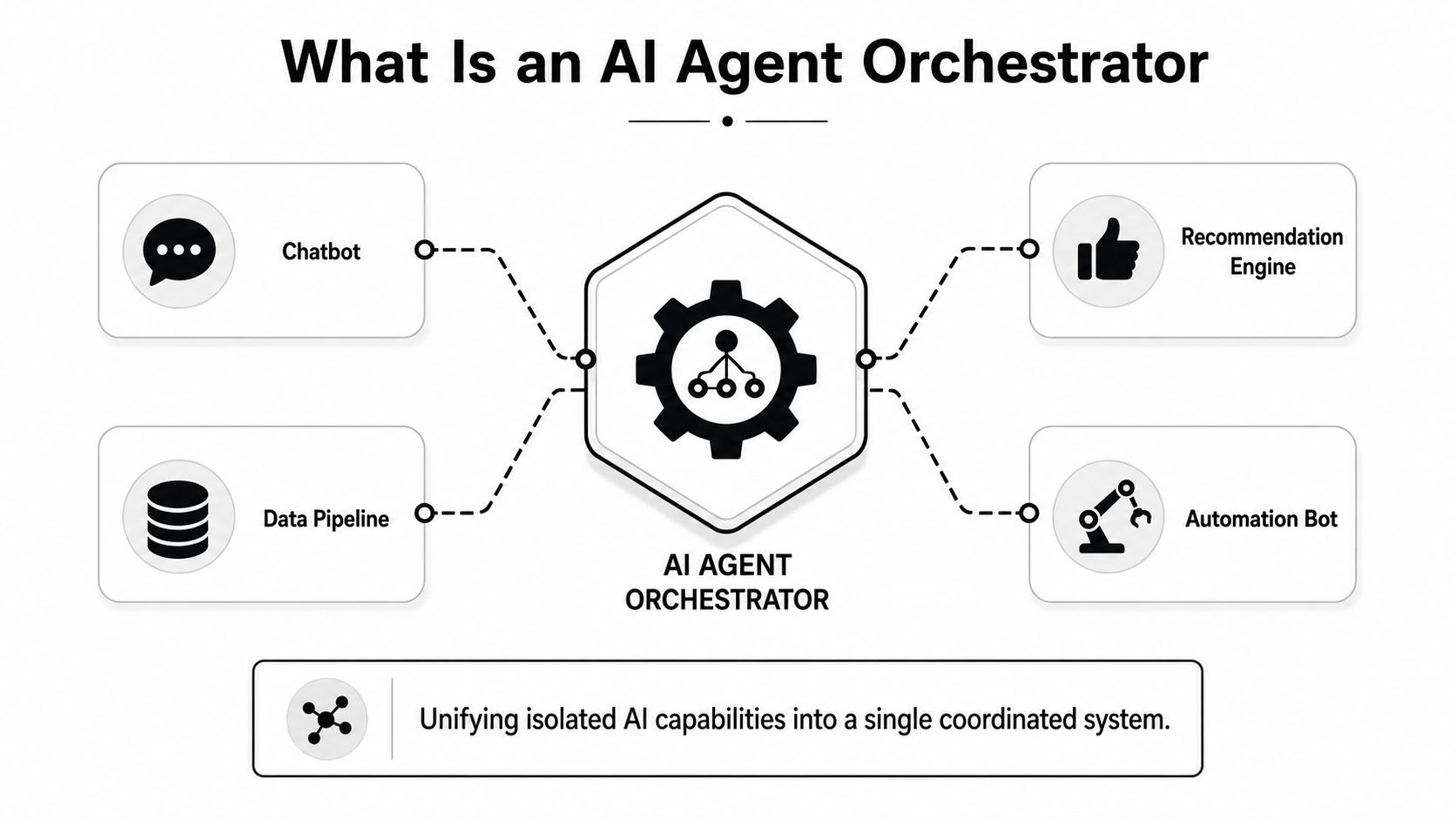
A good way to spot the need for orchestration is simple. Your support bot can answer questions, your data pipeline can move records, your recommendation engine can rank products, and your automation bot can trigger workflows, but none of them knows what the others just learned. The business keeps paying for intelligence in fragments, while the opportunity sits in the handoff between systems.
An AI agent orchestrator solves that fragmentation by acting as the central command layer. IBM describes it as assigning different tasks to specialized agents so they work together as a network, and Tyk frames it as the central command and control that sequences work and manages communication toward the original goal. That's the key distinction. Orchestration isn't a bigger chatbot, it's the layer that decides which agent should do what, when, and under which rules.
The market is clearly moving in that direction. One 2025 to 2035 forecast places the global AI agent orchestration platform market at USD 13.94 billion in 2025 and USD 107.34 billion by 2035, with a 22.67% CAGR and a projected USD 5.11 billion U.S. market in 2025 rising to USD 34.61 billion by 2035 (SNS Insider market forecast). A broader forecast for agentic AI orchestration and memory systems puts the market at USD 6.27 billion in 2025 and USD 28.45 billion in 2030, which is a strong signal that orchestration is becoming a core software layer, not a research toy (SNS Insider market forecast).
Practical rule: if a workflow needs more than one specialist, shared state, and governance, you're already in orchestration territory.
For a useful companion on lifecycle discipline, the MLOps lifecycle guide is a strong reference point, because orchestration behaves much better when you already think in terms of deployment, monitoring, and repeatability.
How AI Agent Orchestration Works
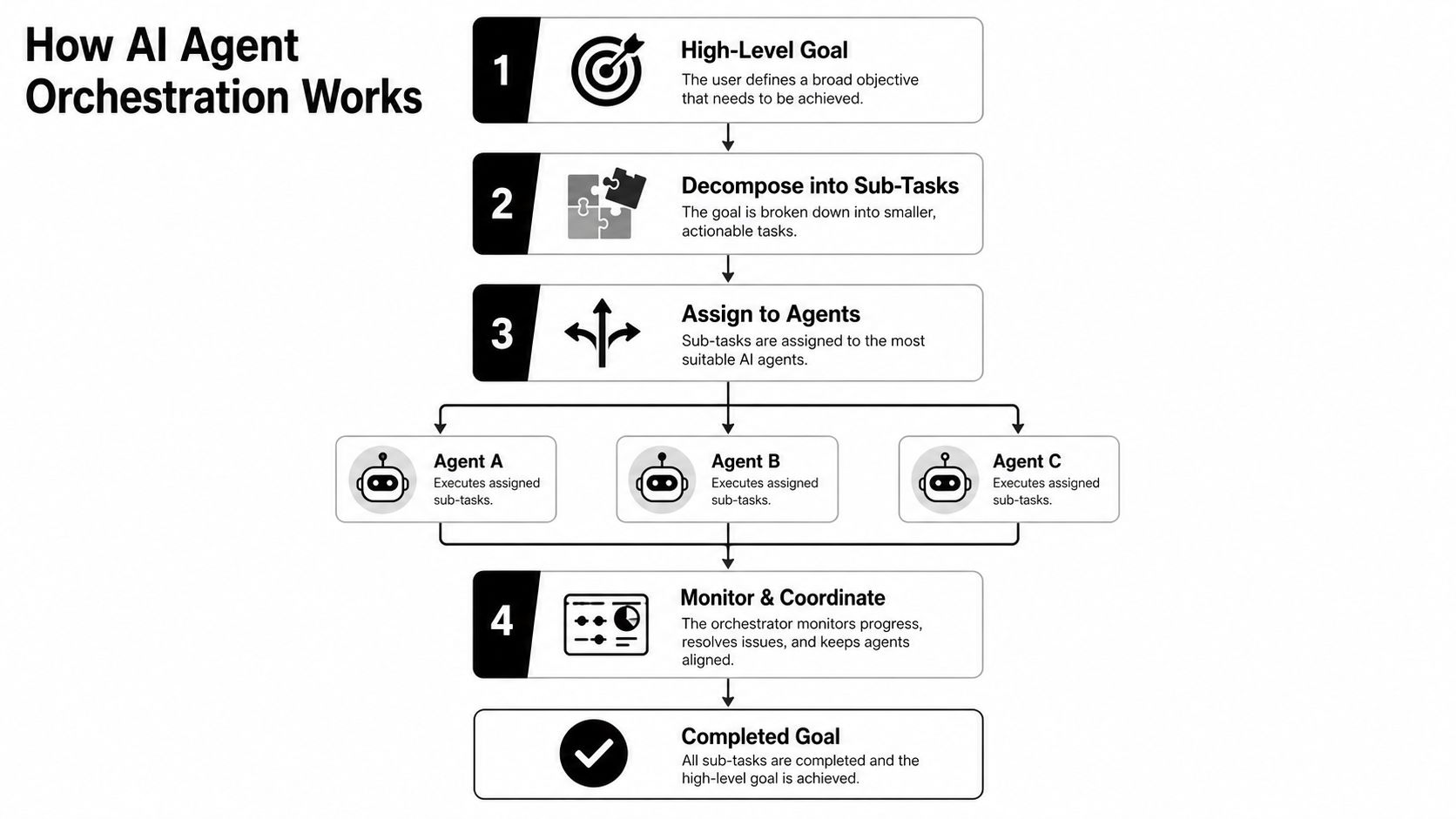
A production orchestrator behaves more like a control plane than a model. It takes a goal, breaks it into sub-tasks, routes those tasks to specialized agents, and keeps the shared state consistent while the work moves through the system. Microsoft's design guidance calls out the multiagent orchestration pattern for cross-functional or cross-domain problems, separate security boundaries, and parallel specialization, while also warning about the coordination overhead and failure modes that come with it (Microsoft Azure architecture guidance).
A concrete workflow usually starts with a business request, like resolving a customer case that touches billing, identity, and product usage. The orchestrator defines the goal, plans the task split, allocates work, sets up a shared workspace, then loops through execution, feedback, and escalation until the output is ready. Grammarly's walkthrough makes that sequence explicit, and it also notes that orchestration can coordinate AI agents, rule-based automations, machine-learning models, and APIs together in one workflow (Grammarly on AI agent orchestration).
Why durable execution matters
The part many teams underestimate is failure recovery. In production, an interrupted chain shouldn't force you to start over or guess what already happened. That's why enterprise stacks increasingly rely on durable execution engines such as Temporal, Inngest, Restate, or LangGraph checkpointers, because resumable, replay-safe workflows reduce failure amplification when an agent chain stops mid-flight (enterprise guide on AI agent orchestration).
The best orchestrator doesn't just dispatch work, it makes interruption boring.
The orchestrator needs to know which step is authoritative, which output can be retried, and which action must go through escalation before it touches a live system. That's the difference between a neat demo and software you can trust when the pager goes off.
For teams already automating processes, the jump from triggers and rules to orchestration feels small at first. A useful way to sanity-check that leap is the workflow automation perspective from Sheridan Technologies, because the boundary between simple automation and reasoning-driven orchestration is where a lot of projects get overbuilt.
AI Agent Orchestrators vs Related Technologies
The easiest way to waste time is to pick the wrong layer for the job. Agent frameworks like LangChain or CrewAI help you build agents, but they don't by themselves coordinate the whole operating model. Workflow tools like Zapier or Make are excellent for predefined trigger-action sequences, yet they aren't built to reason through changing conditions, manage agent handoffs, or enforce governance across a live workflow.
What each layer is good at
An agent orchestrator is responsible for the whole path from goal to outcome. A framework gives you parts of that path. A workflow engine gives you deterministic automation. MLOps tooling helps you deploy and manage models, but it doesn't decide how multiple agents should collaborate or when one should hand off to another.
That boundary matters in real enterprises. Azure's guidance says multiagent orchestration makes sense when multiple specialized agents solve cross-functional problems, when agents need distinct security boundaries, or when parallel specialization improves the work, but the tradeoff is extra coordination, latency, and new failure modes (Microsoft Azure architecture guidance). So the question isn't “Can we orchestrate this?” It's “Do we need the extra reasoning and control, or do we just need a reliable automation path?”
A simple comparison helps.
| Technology | Best for | Weakness |
|---|---|---|
| AI agent orchestrator | End-to-end coordination of multiple agents | More coordination overhead |
| Agent framework | Building individual agents | Lacks full workflow control |
| Workflow automation | Fixed trigger-action processes | Weak when conditions change |
| MLOps tooling | Model lifecycle and deployment | Doesn't manage multi-agent decisions |
If a task is stable, repetitive, and rule-driven, orchestration may be the expensive answer to the wrong problem.
The practical mistake is assuming every AI initiative needs a multi-agent backbone. Some workflows should stay in automation. Some should stay in model operations. Orchestration earns its keep when you need control across boundaries, not just one-off intelligence in a box.
Building Production-Ready Orchestration Architecture
A demo can fake coordination. Production exposes every shortcut. That's why a reference architecture matters, and why open-source systems are useful even when you don't copy them verbatim. The AI-Agents-Orchestrator project reports 5 independent systems, 9 specialized agents, 22 reusable skills, and 34+ MCP tools, plus a Graphify knowledge engine that analyzes code across 22 languages with persistent, queryable knowledge graphs (AI-Agents-Orchestrator project).
What to copy, and what to avoid
The architectural idea worth stealing is scope isolation. The project uses deterministic project_id partitioning and scope-based query filtering to reduce cross-project contamination in long-running development workflows (AI-Agents-Orchestrator project). That pattern maps well to enterprise orchestration. If an orchestrator can't separate one customer, one product line, or one workflow from another, context leakage becomes a hidden reliability bug.
A production stack also needs shared state that survives retries, not just a memory buffer. That means explicit state objects, durable checkpoints, and workflow records that can be inspected after the fact. The orchestration layer should know what has already executed, what still needs approval, and what must be replayed exactly as it happened.
A practical build order usually looks like this:
- Define the workflow boundary. Pick one process with clear inputs, outputs, and owners.
- Assign narrow agent roles. Each agent should do one kind of work well, not improvise across the whole stack.
- Partition state by scope. Separate projects, customers, or domains so the system can't mix contexts.
- Instrument every material action. Log task routing, tool use, and handoffs before launch, not after the first incident.
- Design for recovery. Resumable execution matters more than clever prompting when a step fails halfway through.
The best cloud-native patterns still apply here, especially around services, observability, and deployment discipline. A solid companion reference is the cloud-native architecture guide, because orchestration becomes much easier to reason about when the infrastructure layer is already modular and observable.
Scaling Multi-Agent Systems Securely
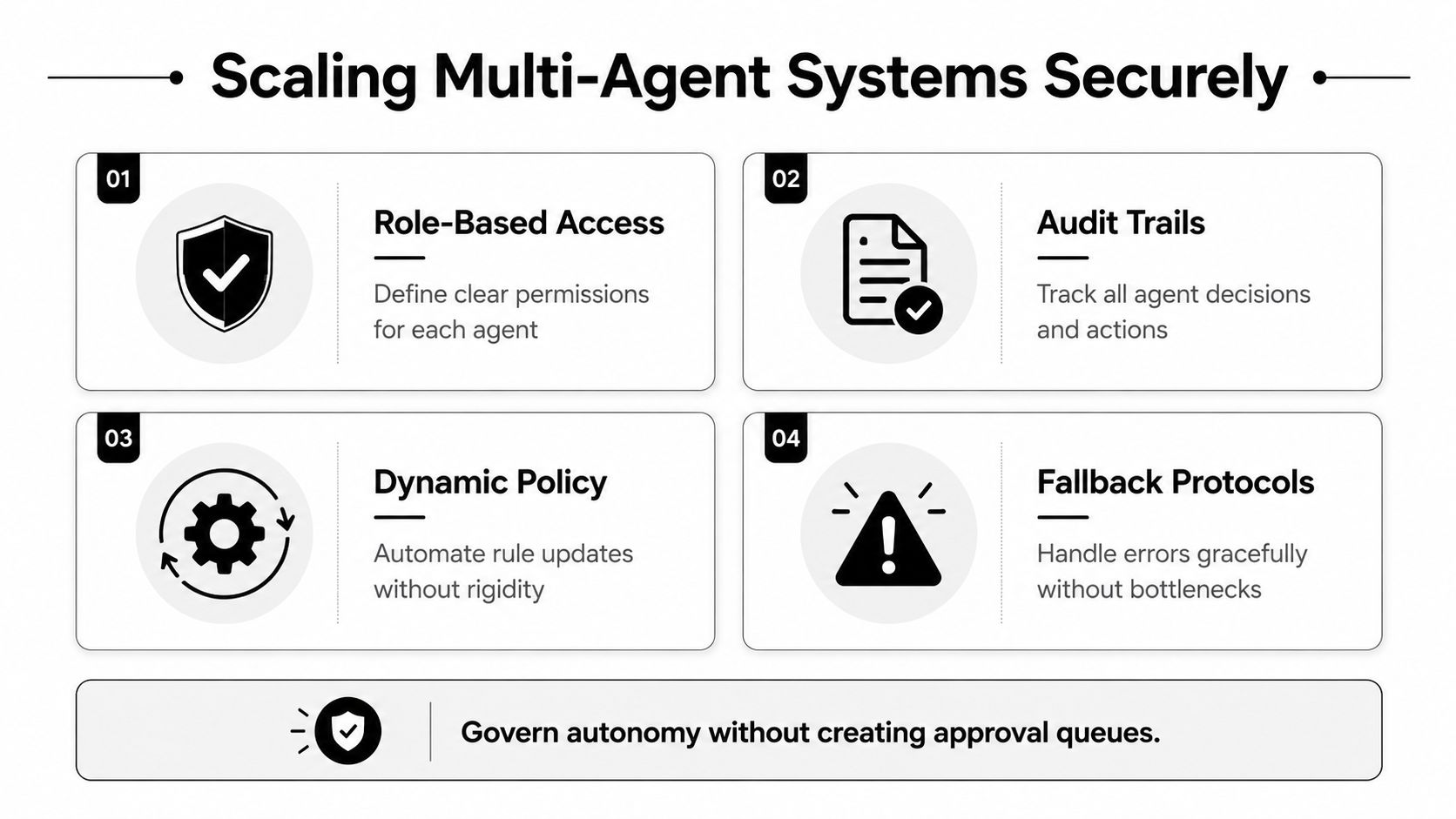
The hardest part of orchestration isn't getting agents to talk. It's deciding how much autonomy to give them without creating a brittle approval queue. Security guidance keeps pointing to permissions, audit trails, and human checkpoints, but those controls only work when the operating model is tight enough to support them. That starts with a business glossary, lineage between authoritative systems, narrower roles, and instrumentation on every meaningful action before launch.
Bounded autonomy beats unchecked autonomy
The contrarian lesson is that the best orchestrator is not always the most autonomous one. In enterprise settings, review-gated high-risk actions are often a better fit than full end-to-end automation, because orchestrated agents run on real cloud services with real IAM roles and real network configurations. That makes the orchestration layer a control point for operations and security, not just an AI abstraction (Samuel J. Woods on AI agent orchestration).
A healthy governance model keeps the system useful without turning it into a queue of manual approvals. The trick is to gate only what matters, keep fallback paths available, and make sure agents can fail safely instead of cascading into each other. That's especially important when one agent writes, another validates, and a third acts on the output.
Here's the operating stance that tends to hold up:
- Role-based access: give each agent only the tools and data it needs.
- Audit-first logging: capture prompts, actions, outputs, and overrides in a structured way.
- Policy-driven boundaries: let rules change without rewriting the whole workflow.
- Fallback protocols: route failures to a safe path instead of blocking the entire chain.
Governance fails when it becomes a manual bottleneck instead of an automated control surface.
This is also where a prompt management toolkit earns its place. Versioned prompts, parameter control, cross-platform logging, and spend visibility aren't “nice admin extras.” They're the operational layer that keeps experimentation from turning into drift, surprise costs, and untraceable behavior.
Industry Use Cases for Agent Orchestration
The value of orchestration shows up when the work crosses systems. In ecommerce, that might mean a customer session that needs product discovery, personalization, inventory checks, and post-purchase automation all in one flow. In fintech, it can mean compliant transaction handling, exception routing, and evidence collection tied to the same record. In healthcare, it often shows up around coordinated patient data pipelines, where the workflow must stay strict, traceable, and hard to break.
Databricks reports that multi-agent systems complete tasks 35% faster than single-agent systems, and that specialized agents create a 30% efficiency increase when they each handle defined parts of a complex workflow (Databricks on AI agent orchestration). The same source says 80% of enterprise applications shipped or updated in Q1 2026 embedded at least one AI agent, up from 33% in 2024, while production deployments coordinating three or more agents reached 22% in 2026, compared with 1% in 2024 (Databricks on AI agent orchestration).
Where orchestration tends to fit best
- Ecommerce: route shoppers through discovery, ranking, support, and fulfillment without losing session context.
- Fintech: separate fraud checks, compliance review, and customer communication while preserving auditability.
- Healthcare: coordinate intake, summarization, validation, and escalation across systems that can't afford confusion.
- Media: connect research, drafting, editing, asset handling, and distribution so content pipelines don't stall.
The pattern is consistent. Each industry has multiple specialists, shared state, and a need for traceable handoffs. Once those conditions exist, orchestration stops being an AI novelty and becomes a practical way to keep work moving without asking one model to do everything badly.
Getting Started with AI Agent Orchestration
The right starting point is not “Can we add agents?” It's “Which workflow deserves the complexity?” Orchestration pays off when the process needs reasoning, adaptation, and handoffs across changing conditions, while straightforward trigger-action work still belongs in automation. That distinction is the fastest way to avoid overengineering.
A practical rollout starts with governance, not clever prompts. Open standards such as MCP and A2A matter because they help keep integrations from becoming a pile of one-off adapters, and RBAC, immutable audit logging, and policy engines matter because production systems need boundaries. If you're evaluating whether a workflow is worth orchestrating, ask whether it depends on multiple authoritative systems, whether permissions need to vary by step, and whether you need to explain decisions later.
Wonderment Apps has built a prompt management system for exactly that kind of operating discipline. It includes a prompt vault with versioning, a parameter manager for internal database access, a logging system across all integrated AI platforms, and a cost manager that lets entrepreneurs see cumulative spend. That kind of administrative layer is useful because orchestration gets harder to run when prompts, parameters, and costs live in separate places.
For teams ready to go deeper on implementation, the AI agent development guide is a useful companion, especially when you're choosing the first workflow, the first agent roles, and the first production guardrails.
Start small, but don't start casually. Pick one process with clear value, build with observability from day one, and make sure the people who own the workflow can explain how it fails, how it recovers, and how much it costs to run.
If you're planning an AI modernization project, Wonderment Apps can help you design the orchestration layer, build the surrounding application experience, and put the governance pieces in place so the system can scale without becoming chaotic. Visit Wonderment Apps to explore how we approach AI integration, prompt management, and production-ready software delivery.