

What does a factory upgrade depend on, the newest machine on the floor, or the software layer that decides whether that machine can be trusted with production work? In practice, most modernization programs don't stall because the hardware is weak. They stall because the data is messy, the integrations are brittle, the AI rules aren't governed, and nobody has a clean way to track cost or control change once the line is live.
That's why the advancement in manufacturing technology in 2026 looks less like a shopping list of gadgets and more like an operating model. Modern plants are becoming software-defined systems where sensors, robots, analytics, and human workflows have to cooperate without constant manual babysitting. If the software architecture is sloppy, the smartest equipment in the building can still behave like a very expensive paperweight.
For teams trying to modernize existing systems, the first question isn't which model to buy or which robot arm to install. It's whether the plant can support reliable data flow, controlled AI behavior, and clear accountability across departments. That's also where tools like Wonderment Apps' prompt management demo fit into the picture, because AI features inside real operations need versioning, logging, access control, and spend visibility if they're going to stay useful after the pilot phase. For a broader technical lens on integration-heavy systems, see embedded software development services.
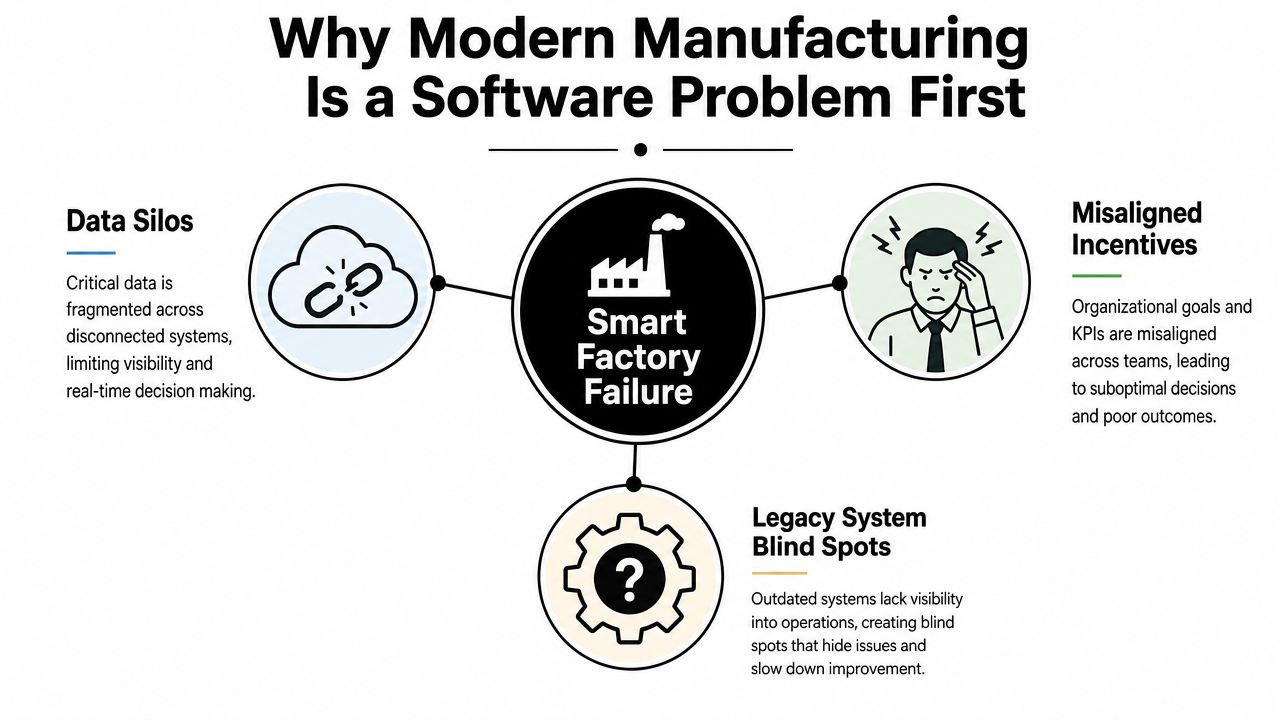
Why Modern Manufacturing Is a Software Problem First
The hard part of modernization isn't always the machine. It's making sure the machine can speak the same language as the rest of the plant, and that the software around it knows what to do when conditions change. That's why so many smart-factory efforts look impressive in a demo and then bog down once they hit production reality.
The real bottleneck lives between the assets
Factory leaders often start with sensors, robots, and dashboards because those are easy to see. The trouble begins when the line has to connect to older PLCs, production databases, maintenance tools, quality systems, and AI services that all expect data in different shapes. When that happens, the issue isn't “lack of innovation,” it's integration debt.
A useful way to think about it is this. Hardware is the visible surface, software is the plumbing behind it, and the plumbing determines whether the whole building works. If data is trapped in silos, even good analytics becomes noisy. If AI prompts are unmanaged, teams get inconsistent outputs. If nobody can track usage or permissions, costs and risk climb together.
Practical rule: if a modernization project can't explain how data gets from the machine to the decision-maker, it's not ready for scale.
That's why administrative control planes matter. A prompt management system, for example, is not just an AI convenience layer. It's the governance mechanism that lets teams version prompts, control internal data access, log what each model did, and keep cumulative spend visible before surprise bills show up.
Why the first win should be operational clarity
The best first milestone in most plants is not autonomy, it's visibility. Leaders need to know which data is trustworthy, which workflows are manual because they have to be, and which ones are manual only because nobody connected the right systems yet. That's the point where modernization becomes measurable.
The article on application modernization roadmap maps that same logic to software teams, and manufacturing follows the same pattern. Clean foundations first. Smart automation second. Governance all the way through.
Understanding Industry 4.0 and the Connected Factory
What makes a factory “connected” enough to qualify as Industry 4.0? The answer is not a new machine on the floor. It is a plant where equipment, materials, operators, and production systems exchange useful data fast enough to change what happens next.
A connected factory works like a smartphone that keeps sensing, computing, and updating its behavior. The difference is the inputs come from equipment health, process conditions, inventory movement, and operator actions. If those signals stay isolated, the plant still runs, but it runs with blind spots.
Industry 4.0 brings IoT, AI, cloud computing, advanced analytics, digital twins, and smart robotics into the same operational stack. IBM describes Industry 4.0 as the latest phase of digital transformation in manufacturing, and industry coverage consistently frames the shift as a move from isolated automation to software-defined production systems that adjust as conditions change.
The stack matters more than any single tool
Treating these technologies as separate purchases is where many modernization efforts stall. In a plant that works, they sit in layers. IoT sensors collect machine data. Cloud systems move and store it. Analytics turn it into decisions. AI predicts what is likely to happen next. Digital twins simulate changes before anyone touches the line. Smart robotics handles repetitive or precise tasks with less variation than human-only workflows.
That layering is what separates connected manufacturing from older automation. Traditional automation is strong at repeating one task. Industry 4.0 makes the whole system responsive. When a machine starts to drift, the data can reach the team that can fix it instead of sitting on a dashboard that looks impressive during a walk-through.
For leaders trying to connect strategy to operating steps, Machine Marketing's practical roadmap gives a clear sequence for modernization work. It is useful for teams that need to align software, process changes, and shop-floor realities without turning the project into a pile of disconnected initiatives.
The software side matters as much as the equipment. If prompt management, access controls, and data routing are weak, AI features can produce inconsistent outputs, create extra review work, and add cost without improving the line. That is why connected factories need governance built into the stack, not added after the fact.
Why this matters for the next decade
The market is already moving in this direction. Analysts using International Federation of Robotics data report that 542,000 industrial robots were installed globally in 2024, the second-highest annual total in history. That points to a simple reality, software-driven production is no longer a side path, it is becoming the default expectation for plants that want to stay competitive.
If your team is building or upgrading connected systems, the same design habits that apply to IoT apps matter here too. Reliable integrations, clear ownership, and predictable data flows keep a factory from turning into a stack of disconnected dashboards. For a practical view of how those systems are built and maintained, Internet of Things applications development translates well to manufacturing environments.
Core Technologies Driving the Advancement in Manufacturing
Which technologies move a plant forward, and which ones just add more software to manage? In practice, the strongest returns usually come from four technology families. They are mature enough to matter now, but each one solves a different operational problem. The right choice depends on whether the plant needs more uptime, lower scrap, faster changeovers, shorter lead times, or better control over how work flows across systems.
| Technology | How It Works | Primary ROI Lever |
|---|---|---|
| Industrial robotics | Automated cells handle repetitive, precise, or physically demanding tasks with consistent motion and fewer human interruptions. | Throughput, consistency, labor relief |
| IIoT-enabled smart manufacturing | Connected sensors and systems stream real-time equipment and process data for monitoring and predictive action. | Uptime, maintenance planning, quality visibility |
| Additive manufacturing | Parts are built layer by layer, which supports complex geometries and small-batch customization. | Lead time, part consolidation, waste reduction |
| AI-driven digital twins | Virtual models simulate process changes before they're deployed on the floor. | Risk reduction, process tuning, faster decisions |
Industrial robotics and why demand keeps rising
Robot adoption keeps rising because the value is broader than labor replacement. Industry groups tracking factory automation have shown sustained growth in robot installations over recent years, and that trend reflects a wider modernization pattern, because robot deployments usually arrive with vision systems, sensors, control software, and tighter process discipline. The hardware matters, but the integration work is what determines whether the cell pays back.
Robotics makes the most sense where the task is repetitive, hazardous, or unforgiving of variation. Assembly cells, palletizing, and machine tending are classic examples. The gain is not just speed, it is repeatability. Once the cell is tuned, variation drops and the rest of the process becomes easier to manage.
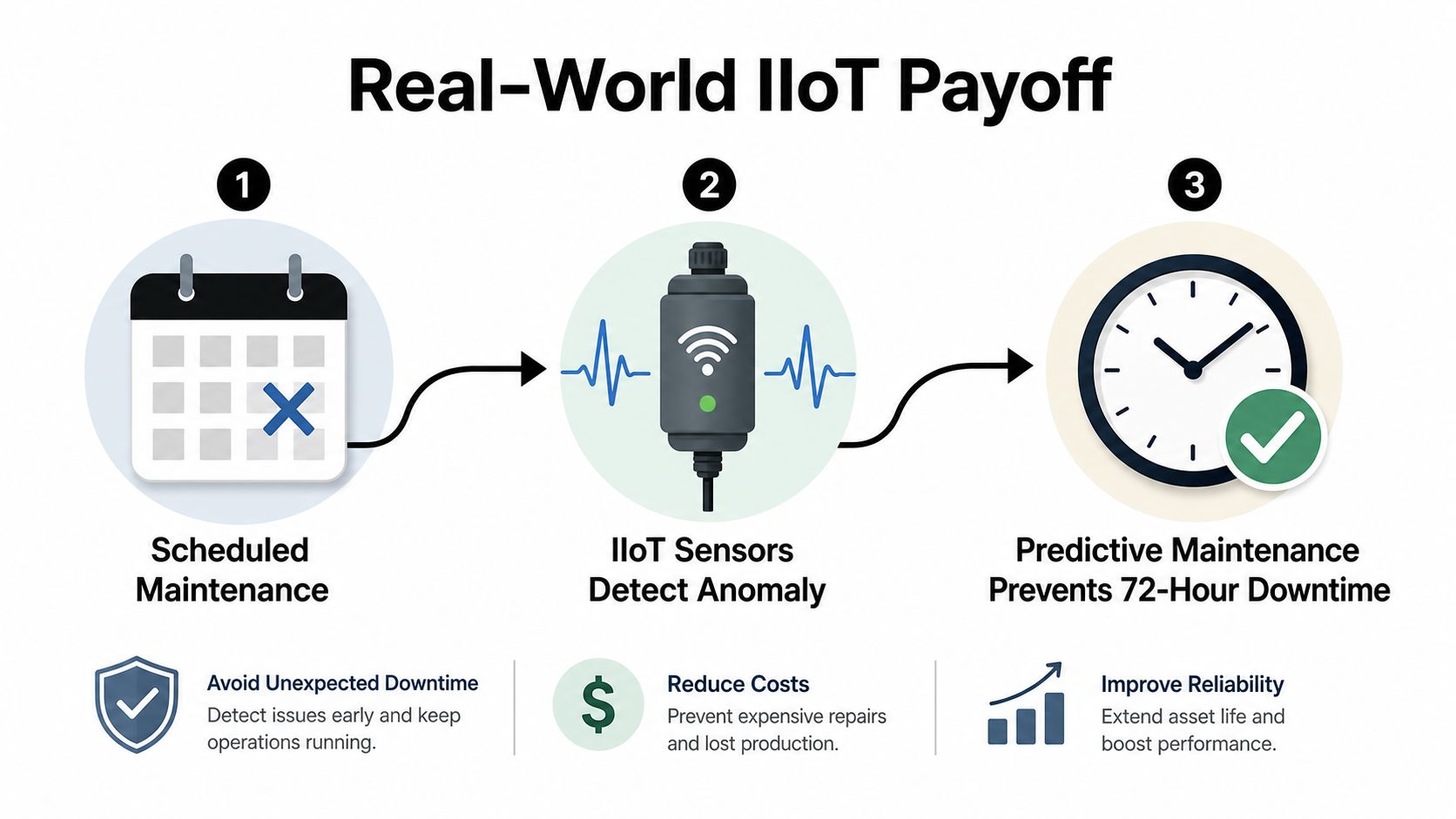
IIoT and the move from scheduled to condition-based maintenance
Connected sensors change maintenance from calendar-based guesswork to evidence-based intervention. BCG notes that machine-to-machine data exchange supports faster, more flexible production with higher-quality goods at lower cost, and in practice it lets teams spot failure trends before they become downtime (BCG). That fits modern plants better because maintenance teams stop replacing parts just because the calendar says so.
The software layer matters here as much as the sensors. If data pipelines are noisy, tags are inconsistent, or access rules are poorly set up, the maintenance team gets alerts it cannot trust and the value disappears into review work. Teams that want useful results need clean routing, clear ownership, and observability best practices for data platforms so the right signals reach the right people without creating another dashboard nobody uses.
A connected maintenance stack also improves the rest of the plant. If a motor is drifting, the quality team sees it earlier, the planner can reschedule riskier work, and operations can decide whether to slow a line or hold production steady. That kind of coordination is where IIoT-enabled smart manufacturing earns its keep.
Additive manufacturing and digital twins as flexible capacity
Additive manufacturing is no longer just a prototyping tool. BCG and TWI frame it as a production capability for customized small batches, complex geometries, and reduced waste, which is why it shows up in aerospace, healthcare, tooling, and automotive work where design freedom can beat subtractive methods (TWI advanced manufacturing). The trade-off is straightforward, you gain flexibility and part consolidation, but you also need strong process control, qualified materials, and a clear path from design file to repeatable output.
Digital twins are the safety net. Instead of making a risky line change and hoping for the best, engineers can test scenarios virtually first. The value is simple, fewer surprises on the floor. If the model is good and the data feeding it is clean, teams get a faster path to stable production and fewer costly dead ends.
Real-World Use Cases That Prove the Payoff
The most convincing modernization stories are usually unglamorous. They involve an operator, a maintenance lead, and a production manager solving a very practical problem that used to eat time, scrap, or trust. The tech matters, but the operational outcome is what gets funded next.
Predictive maintenance that replaces calendar-based work
A mid-sized manufacturer with mixed-age equipment often starts by instrumenting its most failure-prone assets. The first step is usually simple, connect sensors to the right machines and push the data into a system maintenance can use. Once vibration, temperature, or current trends are visible, the team can stop treating every service interval like an equal emergency.
The payoff is not magic, it's timing. Scheduled maintenance creates too many unnecessary stoppages and still misses some failures. Condition-based maintenance targets the parts that are drifting. BCG's point about faster decisions and earlier detection of failure trends becomes real when a maintenance lead can see a bad motor coming before it takes a line down.
Additive manufacturing for customized parts
A custom medical device producer works under different constraints. The goal isn't raw volume, it's precision, fit, and flexibility. Additive manufacturing helps when a patient-specific component or a complex geometry would be slow or wasteful to produce with traditional methods. Research on smart manufacturing for high-performance materials also notes that additive manufacturing is moving beyond rapid prototyping into more cost-effective production settings (PMC research).
That matters because lead time becomes a quality issue. If engineering can produce the right part without long tooling delays, the business can respond faster without forcing the product team to compromise the design.
AI vision in quality inspection
Consumer goods plants often get the quickest visible win from machine vision. Human inspectors are good, but they get tired, and their attention drifts during repetitive checks. AI vision systems are better at staying consistent across long shifts, especially when the defect is subtle or the part count is high.
The key is not just installing cameras. It's training the model on the right defect examples, wiring it into the line workflow, and making sure operators trust the system enough to act on the alerts. That last part is easy to overlook, but it's where many projects succeed or fail.
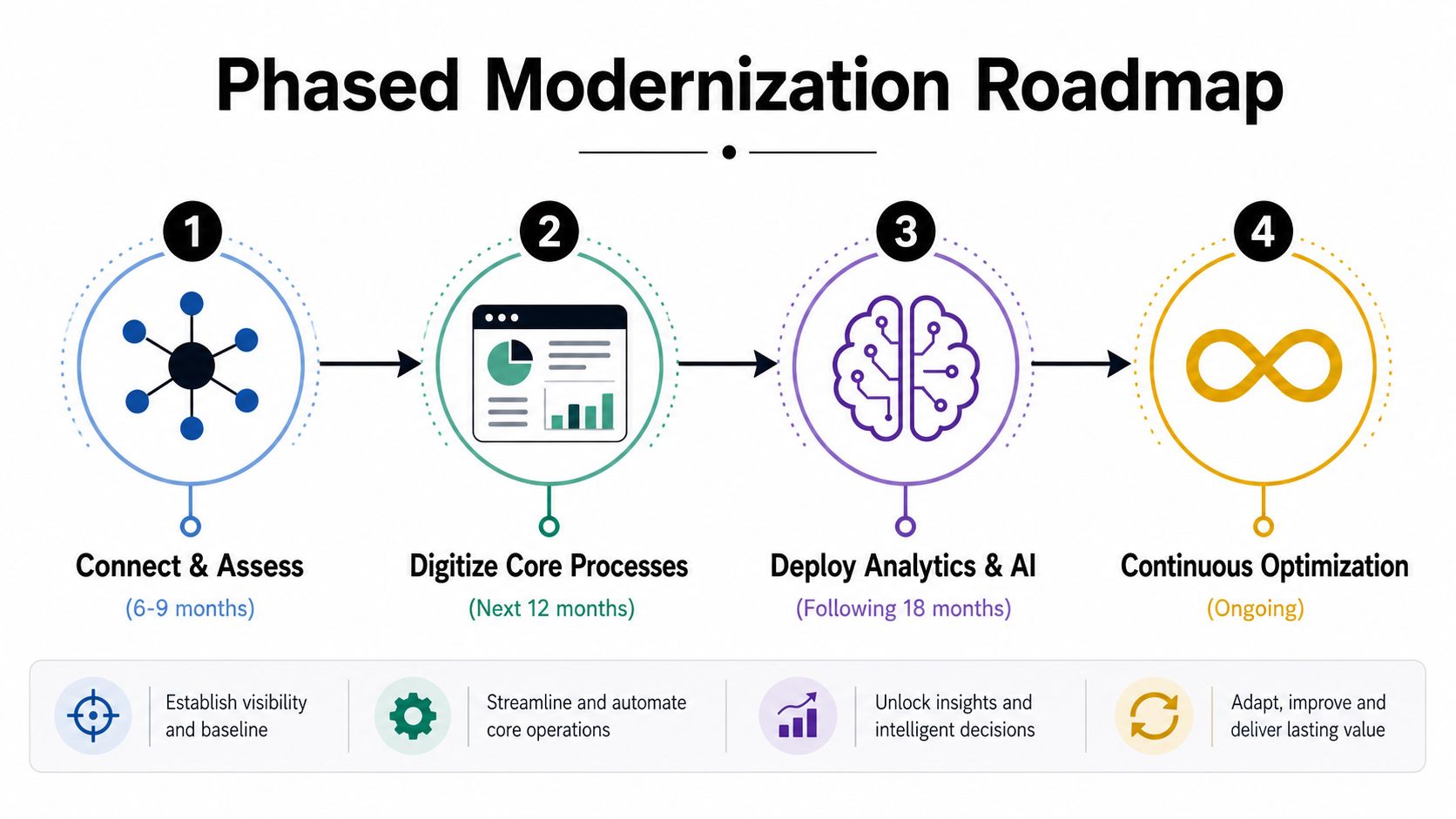
A Phased Roadmap for Modernizing Your Operations
The best modernization programs don't try to do everything at once. They start by fixing the data problem, then they layer in visibility, then they introduce intelligence, and only then do they chase deeper automation. That sequencing keeps the plant from drowning in tools it can't support.
Phase 1 connect and assess
Start by connecting the machines you already have and mapping where data lives. Some of it will come from modern equipment, some from legacy controllers, and some from systems that were never meant to talk to each other. This is the point to standardize naming, timestamps, and ownership before anyone asks for AI.
Phase 2 digitize core processes
Once the data is clean enough, build dashboards that operators and managers can use. The goal is not pretty charts, it's faster decisions. If the production supervisor can see the loss source without opening five systems, you're finally getting value from the software layer.
A useful reference for this kind of sequencing is digital transformation observability best practices, because the same discipline that helps data platforms stay reliable also helps factories keep operational signals meaningful.
Phase 3 deploy analytics and AI
Only after the plant has trustworthy data should it add predictive models, anomaly detection, or recommendation engines. That's where teams often rush and create pilot purgatory. AI is useful, but it's not a substitute for a bad data foundation.
Phase 4 continuous optimization
The last phase is where digital twins, closed-loop tuning, and stronger automation start to pay off. At that stage, the plant can learn from itself and make controlled adjustments instead of relying on one-off interventions. Brownfield plants usually need more time here than greenfield sites because legacy equipment integration tends to be the hardest part.
The cleanest modernization budget is the one that funds integration before intelligence.
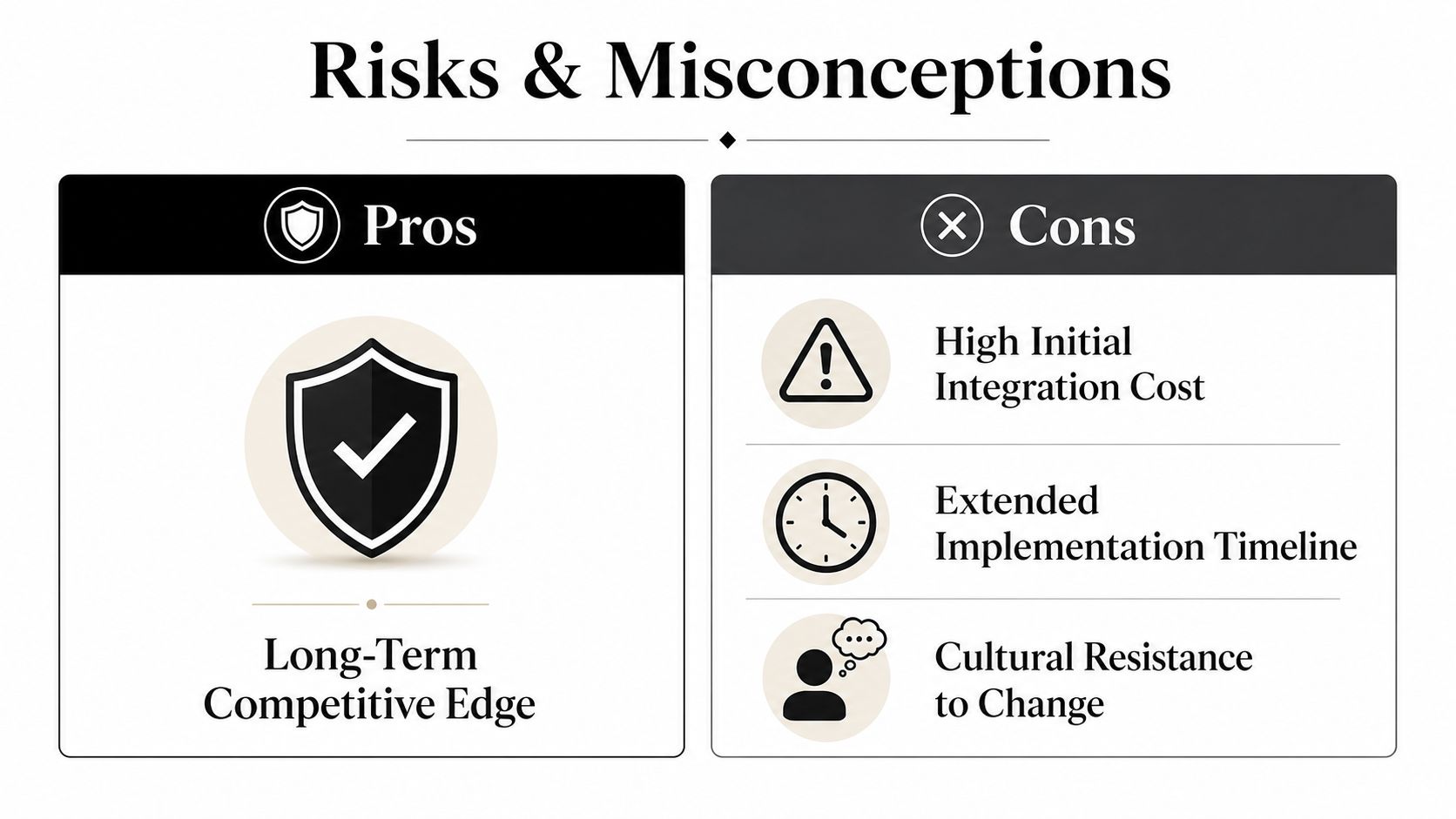
Risks, Hidden Costs, and Common Misconceptions
The biggest misconception in manufacturing tech is that buying software means buying results. It doesn't. Results come from data quality, workflow design, change management, and the unglamorous work of keeping systems reliable after go-live.
Legacy integration is the bill nobody wants to see
Older equipment can be very capable and still hard to connect. The hidden cost shows up in adapters, data cleanup, validation work, and operator retraining. None of that looks exciting in a demo, but all of it determines whether the new system survives contact with production.
AI introduces governance and spend risk
If model updates aren't controlled, outputs drift. If prompt usage isn't versioned, nobody knows why behavior changed. If the team can't see cumulative AI spend, cloud and token costs can grow until they're impossible to ignore. That's why a prompt management system acts like a control plane, it gives product owners and engineers the knobs they need to keep AI predictable.
Change management is part of the system
Operators have to trust the dashboard. Line leads have to trust the recommendation. Leadership has to define who can change prompts, who can access internal data, and who is responsible when the model behaves differently after an update.
Watch for this pattern: if the pilot depends on one enthusiastic engineer to babysit it every day, the system isn't ready for scale.
This is also where many smart-factory projects stall. The technology exists, the vision is good, but the organization hasn't built the habits to use it consistently. That gap is what turns promising tools into shelfware.
Choosing the Right Partners and Modernizing with Wonderment
The right modernization partner should be strong in both old and new stacks. That means understanding legacy control systems, modern APIs, data pipelines, QA, UX, and the messy middle where they all meet. A good partner doesn't just “add AI,” it helps the business decide where AI belongs and where a simpler workflow is better.
Wonderment Apps fits that pattern because it helps organizations move legacy systems into AI-enabled environments without pretending the transformation is only a design problem. Its prompt management system includes a prompt vault with versioning, a parameter manager for internal database access, a logging system across integrated AI models, and a cost manager that shows cumulative AI spend. Those controls matter because AI in manufacturing is only as dependable as the governance behind it.
The same discipline applies to team structure. The best outcomes come from right-sized groups that combine engineering, QA, product thinking, and operational context. Big teams can move fast for a while, but they usually slow down if ownership is unclear or if nobody is responsible for what happens after launch.
There's also a practical advantage in working with a partner that has managed delivery experience across product, integration, and long-term support. Manufacturing modernization is not a one-and-done build. It's an operating change that needs instrumentation, tuning, and maintenance, just like the factory itself.
If you want to see what a control plane for AI can look like in practice, a demo is the fastest way to evaluate whether the approach fits your environment. That's especially useful if you're trying to modernize software without letting prompt sprawl, hidden spend, or inconsistent outputs undermine the gains.
The Bottom Line and Your Next Move
The most meaningful advancement in manufacturing technology is not any single robot, sensor, or model. It's the combination of connected data, software governance, and carefully sequenced automation on the factory floor. Plants that win in the next few years will treat software like core infrastructure, not an add-on.
Three moves deserve attention right now. Audit your data foundations so you know what's connected and what isn't. Sequence investments realistically so AI lands after visibility, not before it. Put a governance layer in place for prompts, permissions, and cost before scaling AI across the plant.
Modernization is iterative. The factories that move fastest aren't the ones buying the most technology, they're the ones building systems that can absorb change without breaking production.
Wonderment Apps helps teams modernize legacy software, connect AI safely, and build the kind of control layer that keeps automation useful after the pilot. If your manufacturing roadmap includes AI, integrations, or long-term platform stability, visit Wonderment Apps to see how their prompt management system and engineering support can help your next release stick.