

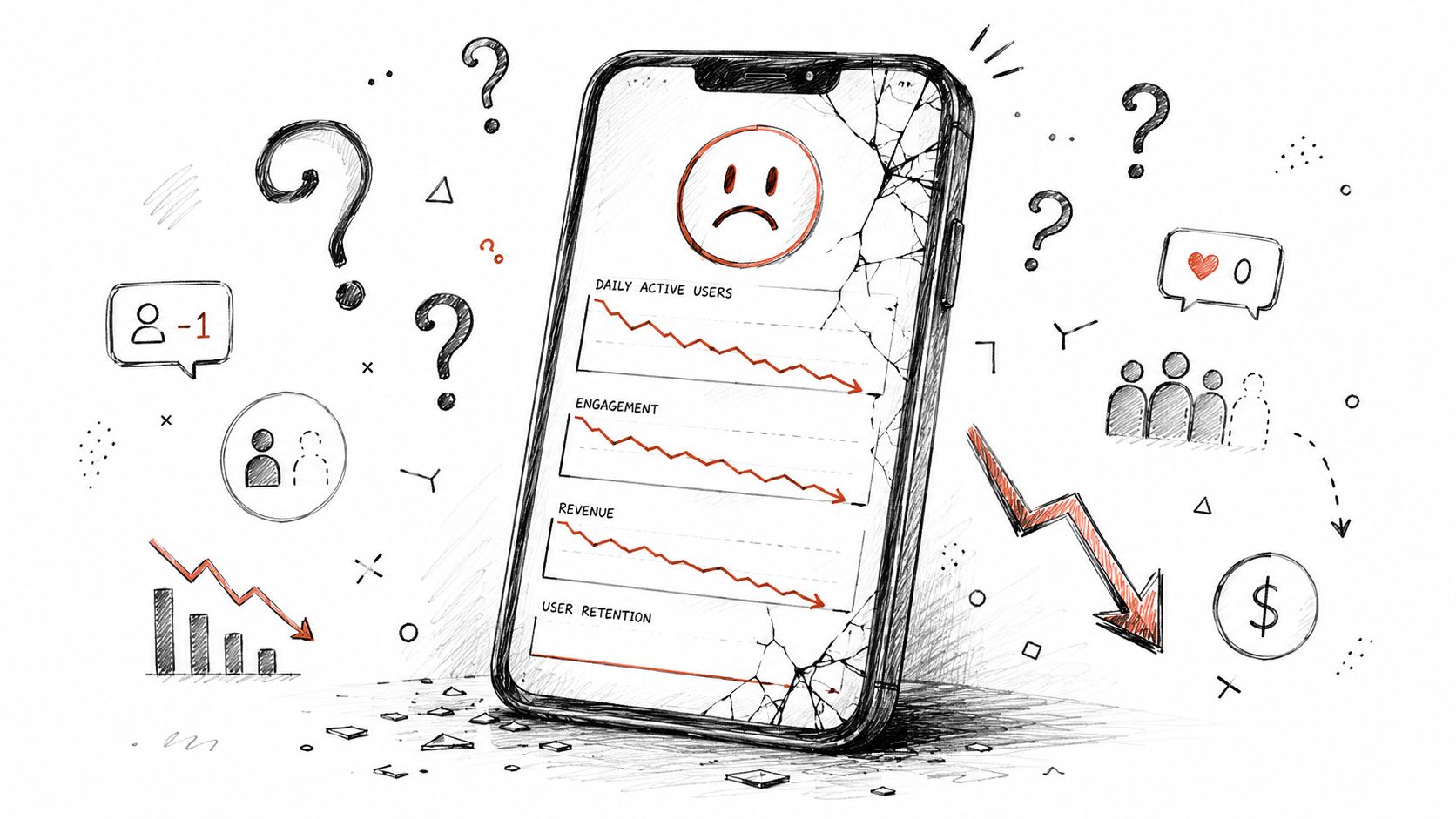
Your product probably isn't failing because you shipped too little. It's underperforming because users hit friction long before they reach the value you worked so hard to build.
That's the brutal truth behind a lot of flat adoption curves, weak conversion, and stubborn churn. Leadership teams keep adding features, engineering keeps shipping, marketing keeps driving traffic, and the customer experience still feels harder than it should. If that sounds familiar, UI UX consulting isn't a design luxury. It's a business diagnostic.
A good consultant's job is to find where your product leaks trust, attention, and intent. Then they give you a path to fix it before your team burns more budget building the wrong things. That matters even more if you're modernizing a legacy platform or introducing AI-powered workflows. AI doesn't rescue a confusing product. It magnifies whatever experience you already have, good or bad.
If you're already thinking about AI integration, governance, and interface quality together, that's the right instinct. The operational layer matters too. A prompt management system with versioning, parameter controls, logging, and spend visibility can support that work by making AI behavior more manageable inside real products, not just demos.
Why Your Great App Is Underperforming
A feature-rich app can still disappoint the market. Users don't care how much you built if they can't understand what to do next, don't trust the workflow, or hit avoidable friction at the exact moment they're supposed to convert.
That's why UI UX consulting belongs in the boardroom conversation, not just the design review. It answers a tougher question than “Does this look good?” It asks, “Why are users dropping off, hesitating, abandoning, or calling support in the first place?”
Growth in the field tells you this isn't optional
The demand signal is clear. The global UX services market is projected to grow from $8.8 billion in 2026 to $77.18 billion by 2034, with a 31.20% CAGR, and North America accounted for 32.50% of the market in 2025. That's not trivia. It's evidence that companies now treat UX as core infrastructure for digital growth, not visual polish.
What's really happening inside underperforming products
Most struggling apps share a few patterns:
- The onboarding is too clever: New users have to infer what the product does instead of feeling it immediately.
- Core paths are overloaded: Important actions compete with secondary options, settings, banners, and edge-case logic.
- Trust breaks at key moments: Payments, permissions, account creation, and AI-generated outputs all demand confidence.
- Internal teams design for familiarity: The product reflects the org chart, not the user's mental model.
A lot of teams discover these issues too late. They launch, watch dashboards wobble, then debate solutions based on opinion. That's expensive.
Good UI UX consulting doesn't start with mockups. It starts by identifying where intent turns into hesitation.
If you're reviewing product performance, pair this with practical thinking on app user experience strategy. The strongest teams don't separate interface quality from growth, retention, or modernization.
AI raises the bar
AI features create a new kind of UX pressure. Users now need to understand what the system is doing, what data it's using, when they should trust it, and how to recover when it's wrong. If your baseline experience is messy, AI makes it feel unpredictable.
That's why the next wave of UI UX consulting is less about prettier screens and more about decision clarity, workflow confidence, and operational control.
What UI UX Consulting Actually Delivers
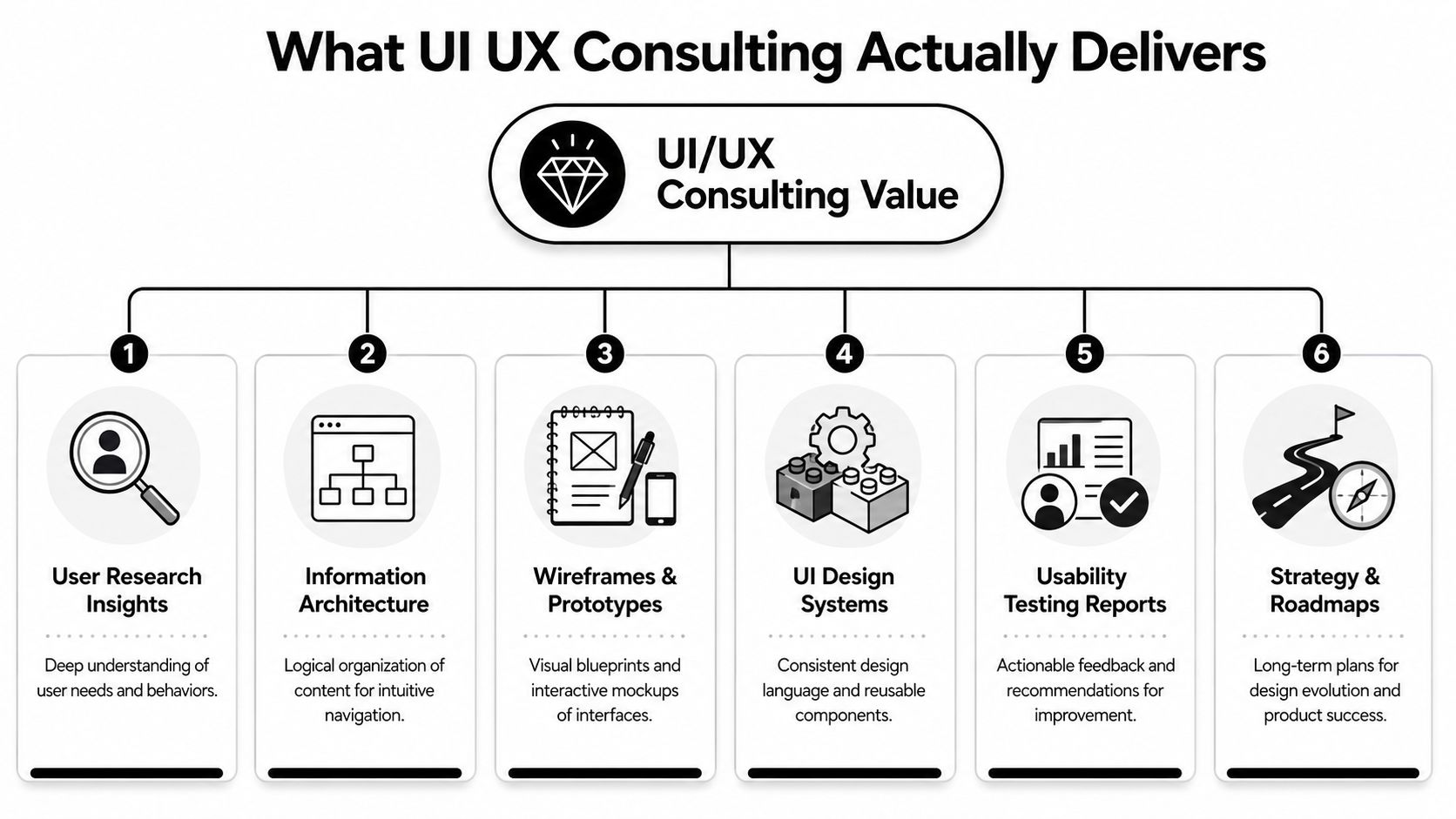
A serious UI UX consulting engagement should produce assets your product, engineering, and leadership teams can use to make decisions. If the consultant only promises “fresh design direction,” keep looking.
The useful output is usually a written assessment. That can include heuristic audits, accessibility reviews, design system assessment, and prioritized recommendations. According to Fuselab's overview of UX consulting, that kind of engagement reduces product risk by benchmarking the interface against established usability principles before engineering resources are spent.
The deliverables that actually matter
A consultant's value isn't in the vocabulary. It's in the decisions they help you make.
- Heuristic audit: A structured review of your interface against usability principles. This surfaces obvious friction that your internal team has stopped noticing.
- Accessibility review: A check on whether people can use the product across different needs and contexts. In regulated industries, this is risk management.
- Journey analysis: A map of how users move from first touch to key outcome. This helps teams stop optimizing random screens and start fixing broken paths.
- Prioritized recommendations: A ranked list of what to fix first. Without this, teams waste cycles on low-impact redesign work.
- Prototype or wireframe direction: Not art. Clarified interaction logic before code gets written.
- Design system assessment: A review of whether your interface components support consistency, speed, and scale.
Diagnostic work comes before redesign
Strong consultants don't jump straight into visual solutions. They use analytics, heat maps, conversion metrics, A/B testing, surveys, usability tests, and observation to find where users drop off and why. That's the point highlighted in TRIARE's explanation of UX consulting for businesses. The benefit isn't aesthetic improvement. It's connecting behavior to friction so changes are more likely to influence conversion.
For smaller teams trying to improve quickly, this kind of practical cleanup often starts with basics. Silver Spoon Agency's website UX tips for SMBs is a useful reminder that clarity, navigation, and reduced friction still beat flashy redesigns.
Practical rule: If a consultant can't tell you what decision each deliverable supports, they're producing artifacts, not value.
What you should expect at the end
Ask for a package your team can act on. It should include:
| Deliverable | Business use |
|---|---|
| Written findings | Gives leadership a plain-language view of risk and opportunity |
| Ranked issues | Helps product managers sequence work |
| UX rationale | Gives engineers context before implementation |
| Accessibility notes | Reduces compliance and usability risk |
| Design direction | Aligns design and development before build |
If you want a benchmark for what that evaluation can look like in practice, review an app UX audit approach before hiring anyone.
The Consulting Process and Engagement Models
Most CEOs hesitate on UI UX consulting because they assume it's fuzzy, slow, or hard to scope. It doesn't have to be. A disciplined engagement follows a sequence, and each phase should answer a business question.
What happens in a well-run engagement
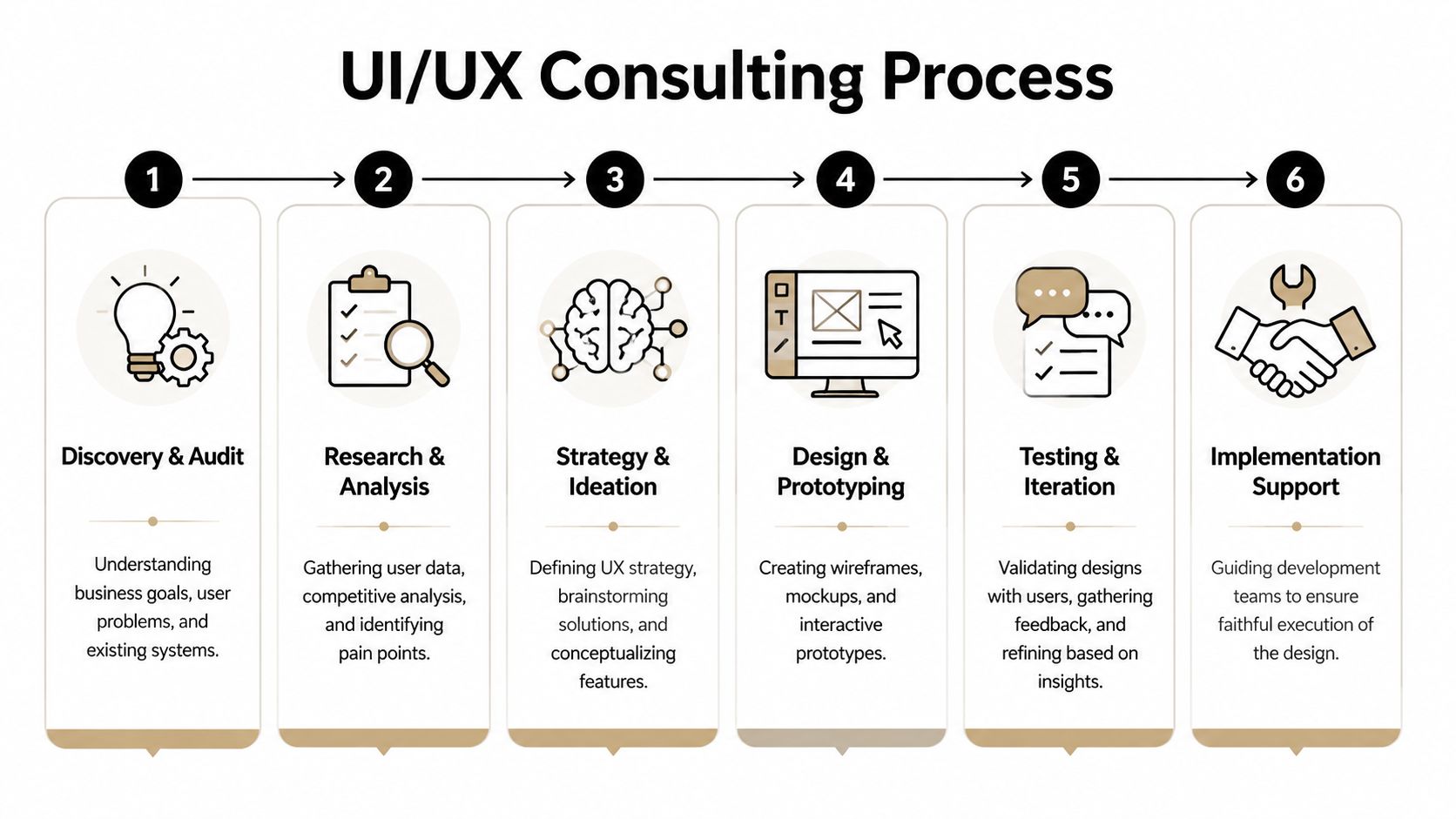
It usually starts with discovery. The consultant reviews your business goals, current product performance, user complaints, roadmap pressure, and technical constraints. If they don't ask about revenue paths, retention points, support burden, or operational workflows, they're not doing strategic work.
Then comes research and analysis. They inspect product behavior, user journeys, and competing experiences. The goal isn't to copy competitors. It's to understand what users expect and where your interface violates those expectations.
The middle phase is strategy and design direction. The consultant translates findings into flows, hypotheses, wireframes, prototypes, or experience recommendations. At this point, the strongest partners keep options narrow. They don't flood your team with endless concept variations.
A consulting process should reduce ambiguity at each step. If every phase creates more debate, the process is broken.
Testing and iteration follow. This validates whether the proposed direction makes sense before full development. After that, consultants may support handoff, design QA, or implementation guidance so the shipped product still reflects the intended experience.
Common engagement models
Not every company should buy UI UX consulting the same way. The model should match the problem.
| Engagement model | Best for | Watch out for |
|---|---|---|
| Project-based | Defined audit, redesign brief, or specific workflow issue | Scope gets too broad if goals aren't explicit |
| Retainer | Ongoing optimization, roadmap support, multi-team alignment | Can drift into low-accountability hours |
| Staff augmentation | Need embedded expertise inside an existing team | Role confusion if ownership isn't clear |
My recommendation by situation
- Choose project-based work when you have a clear problem such as checkout friction, onboarding confusion, or an upcoming platform redesign.
- Use a retainer when your product is live, complex, and constantly evolving. This works well when UX decisions touch multiple teams.
- Use staff augmentation when your internal product organization is solid but lacks senior UX leadership or specialty experience.
The mistake I see most often is using a retainer for what is really an undefined strategy problem. Start with a diagnostic engagement. Earn the longer relationship later.
How CEOs should stay involved
You don't need to review every wireframe. You do need to insist on three things:
- A business goal for the engagement
- A decision owner on your side
- A plan for how findings become shipped work
That's how UI UX consulting moves from an interesting report to actual product improvement.
Calculating the Real ROI of UI UX Consulting
If you still treat UX as a brand or design line item, you're looking at it the wrong way.
Forrester Research found that every $1 invested in UX returns $100, which equals a 9,900% ROI. That figure reshaped how enterprises, especially in ecommerce and fintech, think about UX spending. It turned UX from a subjective debate into a capital allocation decision.
Where the return actually shows up
The return doesn't come from “nicer screens.” It comes from fewer blocked users and more completed outcomes.
In ecommerce, better UX helps customers move from browsing to buying without second-guessing the process. In SaaS, it helps new users reach value faster and gives existing users fewer reasons to disengage. In fintech and healthcare, clarity and trust matter even more because people are making sensitive decisions inside the product.
There's also hidden ROI that is often overlooked. When consultants help you define the right workflow before development starts, engineers spend less time rebuilding features that shouldn't have shipped that way in the first place. Support teams also benefit when customers can complete tasks without asking for help.
Stop measuring UX like a design team
A lot of companies still evaluate UX work with design-centric outputs. That's too shallow. Measure it against business movement:
- Conversion quality: Are more users completing the intended path?
- Adoption strength: Are people reaching core product value without manual intervention?
- Operational efficiency: Is support carrying less avoidable burden?
- Delivery confidence: Is engineering building with fewer reversals and fewer subjective debates?
If your UX reporting stops at workshops, audits, or new screens, you haven't measured ROI. You've measured activity.
A useful reference point is this broader view of the ROI for your app or website. The point isn't to make UX justify itself with design language. The point is to connect experience decisions to revenue, retention, and avoidable waste.
That's why I'm opinionated here. UI UX consulting should pay for itself in business performance, or it's not being run well.
Key Triggers for Hiring a UI UX Consultant
You don't hire a UI UX consultant because “the product feels dated.” That may be true, but it's not a business case. You hire one when the company needs better decisions about user behavior, workflow friction, or product risk.
Obvious moments to bring one in
A new product launch is the clearest trigger. So is a major redesign. If you're changing your platform, expanding into a new audience, or rebuilding a core workflow, outside diagnostic support can prevent expensive internal guesswork.
Another strong trigger is measurable funnel confusion. If users consistently stall at signup, checkout, onboarding, document submission, or account setup, your team needs more than opinions. It needs a structured analysis of why that behavior is happening.
Less obvious triggers that matter more
Some of the best times to hire a consultant are the moments leadership underestimates:
- Your team keeps debating features without user evidence: That usually means no one has a shared understanding of the actual problem.
- Accessibility is becoming a real product concern: In healthcare, government, and enterprise environments, usability and accessibility carry operational and reputational consequences.
- Legacy modernization is on the roadmap: Old systems often have workflow logic users tolerate rather than like. Redesigning without first diagnosing that logic is risky.
- AI is entering the product: New AI interactions require trust, transparency, controls, and thoughtful error handling.
A quick self-check for executives
Ask yourself these questions:
| Signal | What it usually means |
|---|---|
| Users abandon high-value flows | Friction or trust breaks at critical moments |
| Teams argue about design direction | Decisions are being made without evidence |
| Support hears the same confusion repeatedly | The interface is carrying avoidable complexity |
| AI features feel bolted on | The product lacks a coherent interaction model |
Don't wait for a redesign project to justify UI UX consulting. Bring it in when uncertainty starts slowing product decisions.
If you're seeing two or more of those signals, the right move is often a focused assessment, not a full redesign. Diagnose first. Rebuild second.
How to Choose the Right Consulting Partner
A polished portfolio is not enough. Plenty of firms can present attractive screens. Far fewer can explain how those screens affect conversion, adoption, retention, support burden, or delivery risk.
That gap is common. As Cardinal Peak notes in its UX services discussion, many agencies stop at deliverables and don't clearly tie design changes to revenue, retention, or operational efficiency. For enterprise buyers, that's a problem.
What to test in the buying process
The right consulting partner should think like an operator, not just a designer. Ask questions that force them to reveal how they work under real business constraints.
| Question Category | Question to Ask | What a Good Answer Looks Like |
|---|---|---|
| Business alignment | How do you connect UX findings to business outcomes? | They talk about conversion, adoption, support burden, engineering risk, or retention, not just usability language |
| Diagnostic rigor | How do you identify the actual source of friction? | They describe analysis methods, user evidence, and prioritization logic |
| Deliverable quality | What will we have in hand at the end? | They can name the assessment, recommendation format, and decision support artifacts |
| Implementation realism | How do you ensure recommendations are buildable? | They discuss technical constraints, handoff quality, and collaboration with engineering |
| Measurement | How should we track success after the engagement? | They propose business-facing indicators, not vanity design outputs |
| Industry fit | Have you worked with complex or regulated workflows? | They understand trust, accessibility, compliance, and operational stakes |
Red flags I'd treat seriously
Some warning signs show up fast in sales calls:
- They lead with visuals: If the conversation jumps to style direction before business context, priorities are off.
- They avoid measurement: If they can't discuss post-engagement success criteria, they won't be accountable.
- They oversell process: Long workshops and thick decks can hide weak thinking.
- They dismiss technical constraints: Great UX advice that can't survive implementation is just theater.
The standard I'd use
Ask one blunt question: “How will your work change a business result we care about?”
If the answer revolves around delight, polish, or modern design trends, keep shopping. If they can connect interface changes to user behavior and operational outcomes, you may have the right partner.
Board-level filter: Hire the firm that reduces decision risk, not the one that produces the prettiest presentation.
The Future of UX Is AI and Your Next Step
AI is changing software faster than most companies can redesign for it. That doesn't make UX less important. It makes it operational.
Users now interact with systems that generate, predict, recommend, summarize, and automate. Those interactions need guardrails. They need clear prompts, understandable outputs, visible limits, and recoverable errors. If you don't design that layer carefully, users won't trust the product no matter how advanced the model is.
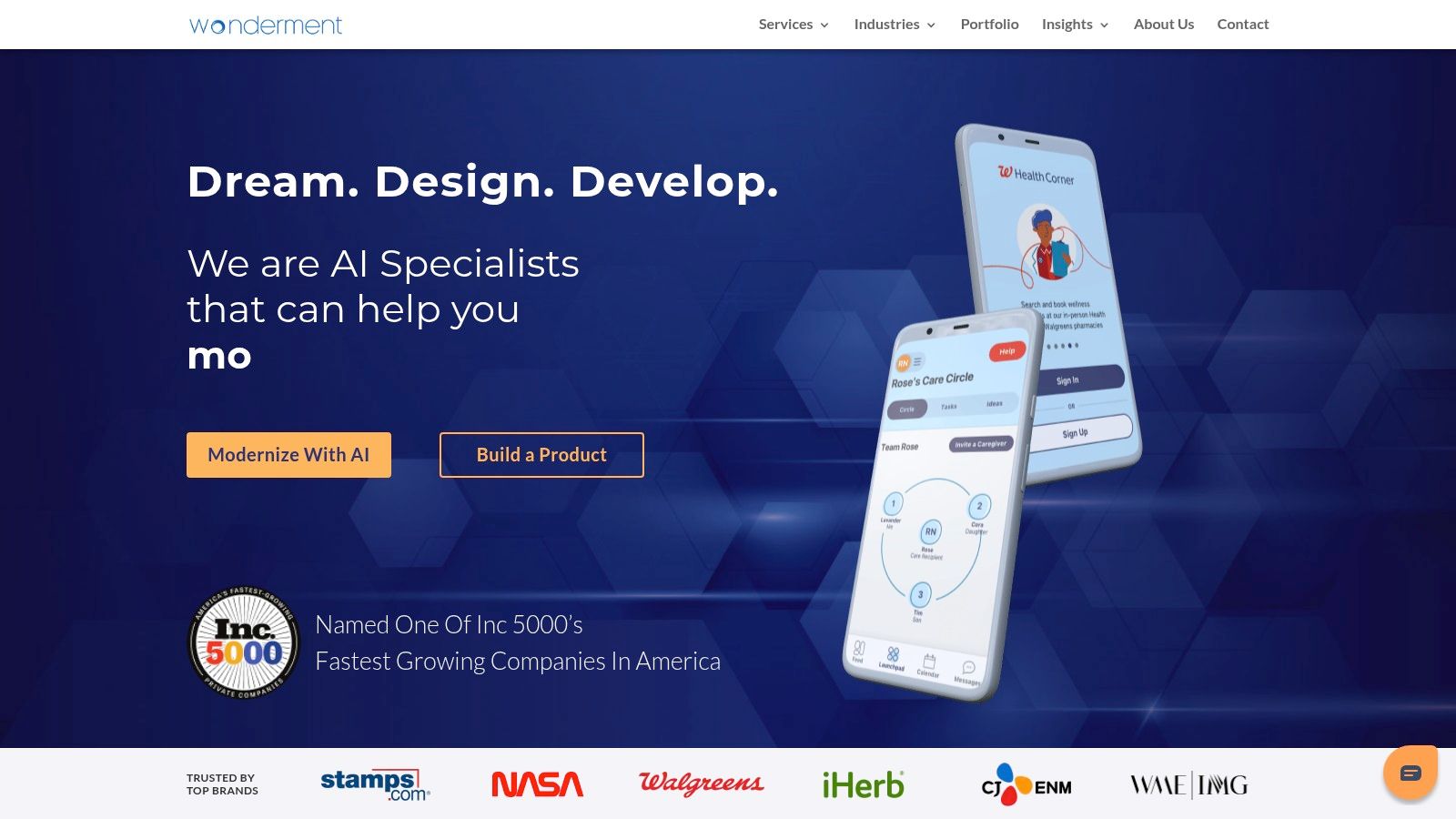
The operational side matters just as much. One option is Wonderment Apps' Prompt Management System, which provides a prompt vault with versioning, a parameter manager for internal database access, logging across integrated AI systems, and cost management for cumulative spend visibility. That kind of tooling helps teams govern AI behavior inside existing products instead of treating prompts like scattered experiments.
My advice
Don't separate AI modernization from UI UX consulting. Treat them as one leadership problem. The interface shapes trust. The workflow shapes adoption. The management layer shapes consistency and control.
If your product is due for modernization, start with the user experience questions that drive business. Then make sure your AI layer is managed with the same discipline as the rest of your software stack.
Wonderment Apps helps organizations modernize software, improve UX, and operationalize AI inside web and mobile products. If you're evaluating UI UX consulting alongside AI integration, explore a Wonderment Apps demo to see how their delivery approach and prompt management capabilities fit into a measurable product strategy.