

Your operations lead is chasing delayed orders in Slack. Your finance team is asking why freight costs swing so much from month to month. Your customer team wants better delivery visibility. Meanwhile, your ERP, WMS, ecommerce platform, and carrier portals all tell slightly different versions of the truth.
That's the moment when many CEOs start thinking about supply chain outsourcing as a logistics decision. It isn't. Not anymore.
Today, outsourcing the supply chain is just as much a software architecture decision as it is an operations one. The hard part isn't finding someone who can move boxes. The hard part is building a system where external partners, internal teams, and AI tools can all work from the same operational picture without creating chaos, cost leakage, or blind spots.
Rethinking Supply Chain Outsourcing in the AI Era
A lot of companies still talk about outsourcing like it's a simple handoff. Pick a provider, sign an agreement, ship them your SOPs, and let them run. That model breaks fast when your business depends on real-time inventory, dynamic routing, customer notifications, returns workflows, and demand shifts across channels.
Modern supply chain outsourcing works more like a connected operating model. You keep strategic ownership. Partners execute parts of the network. Software ties the whole thing together. AI helps teams make better decisions, faster.
The market has already moved in that direction. In a survey of 500 shippers, 80% said one-stop-shop providers are valuable, 50% increased spend with outsourced providers over the prior two years, 12% decreased spend, and 82% relied on third-party providers for carrier procurement according to RXO's outsourced supply chain research.
That matters because it changes the executive question. The question isn't, “Should we outsource?” For many companies, the question is, “How do we outsource without losing visibility, control, and speed?”
The bottleneck is data, not forklifts
When outsourcing fails, it usually doesn't fail because a warehouse can't scan a pallet or a carrier can't book a load. It fails because systems disagree. Product dimensions are wrong. Order statuses arrive late. Exception handling lives in someone's inbox. A provider's portal doesn't match your ERP. An AI assistant gives a useful answer one day and a risky one the next because the underlying instructions changed.
That's why the smartest operators now treat supply chain outsourcing as an integration challenge with physical consequences.
Practical rule: If your systems can't explain what happened in real time, your outsourced partner isn't your problem. Your operating model is.
Why AI changes the conversation
AI can improve forecasting, classify exceptions, summarize vendor communications, draft customer updates, and help teams find root causes faster. But AI also introduces a new management layer. Someone has to control prompts, permissions, logs, and usage costs across tools and teams.
Without that control, supply chain outsourcing becomes fragmented twice. Once in the partner network, and again in the software stack.
For a CEO, the takeaway is simple. The winners won't be the companies that outsource the most. They'll be the ones that build the cleanest digital control plane across partners, systems, and AI-assisted workflows.
Key Business Drivers for Outsourcing Your Supply Chain
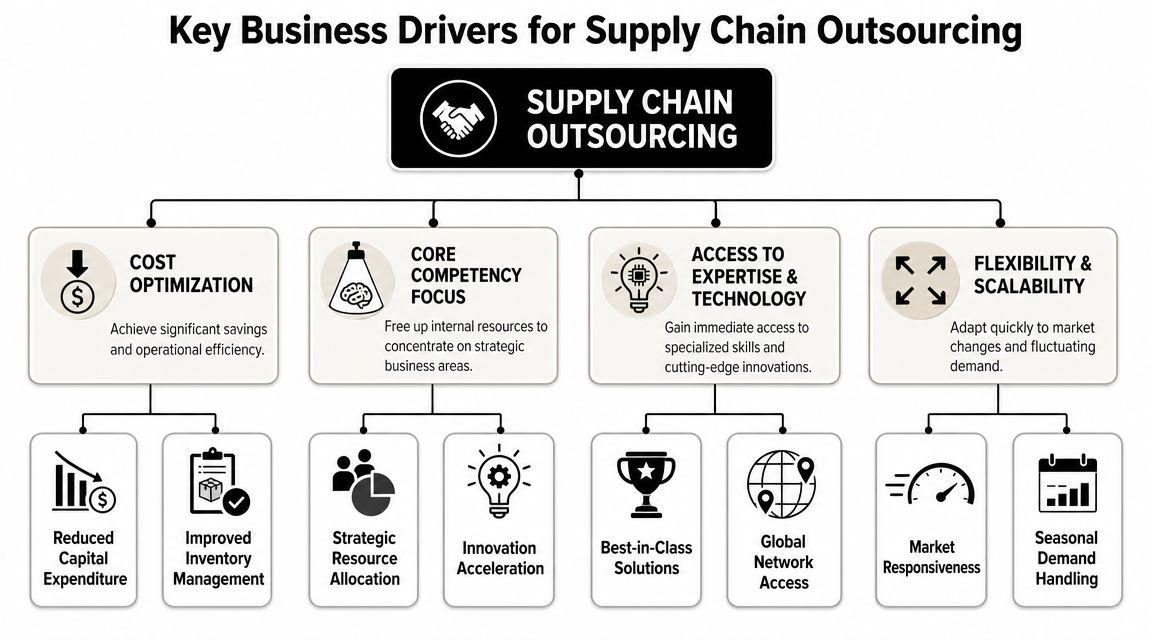
The strongest case for supply chain outsourcing isn't “save money somehow.” It's sharper than that. Companies outsource because the business needs capabilities they can't build quickly, economically, or consistently on their own.
A useful way to think about it is this. You are not buying trucks, warehouses, or labor. You are buying speed to competence.
Agility matters more than ownership
A 2025 supply chain guide highlighted that nearly 9 in 10 companies increased their use of outsourced 3PL services to respond to uncertainty in tariffs, inflation, and customer demand by improving visibility and agility through integrated digital platforms, as summarized in NetSuite's supply chain management outsourcing guide.
That trend tells you something important. Companies aren't outsourcing because they've given up on operations. They're outsourcing because volatility punishes rigid systems.
When demand changes, internal networks can become slow to adapt. Headcount, facility constraints, carrier relationships, and legacy tools all create drag. An experienced outsourcing partner can often absorb that variability faster, especially when they already operate the infrastructure and software.
Four drivers that come up most often
- Capability access: You may need stronger transportation planning, compliance support, warehousing discipline, or multi-node fulfillment before you can justify building those functions in-house.
- Focus: Your internal team should spend more time on product, merchandising, customer experience, and channel strategy. They shouldn't spend all day reconciling shipment data across disconnected systems.
- Scalability: Growth introduces operational weirdness. New regions, new SKUs, more returns, more service exceptions. Outsourcing can help absorb that complexity without forcing immediate fixed investment.
- Technology Benefits: Good partners don't just provide labor. They provide process discipline, platform integrations, and operational telemetry you can use to make better decisions.
Good outsourcing creates room for your team to do higher-value work. Bad outsourcing creates a larger meeting calendar.
What CEOs should watch
The strategic upside is real, but only if the outsourcing move matches your business model.
Ask these questions early:
- Are we outsourcing a stable process or a broken one? If the process is broken, the provider may inherit confusion rather than solve it.
- Do we need execution capacity or decision support? Those are different needs, and they require different partner profiles.
- Will the partner improve our data visibility or create another silo? This one often decides whether outsourcing feels like acceleration or loss of control.
The best supply chain outsourcing decisions usually come from companies that know what they want to keep, what they want help with, and what data they need to govern both.
Choosing Your Supply Chain Outsourcing Model
Most leaders hear 3PL and 4PL and assume they're just industry jargon. They're not. They describe very different operating models.
The easiest analogy is construction. A 3PL is like hiring a specialist contractor. A 4PL is like hiring a general contractor who coordinates the specialists, manages the plan, and gives you one accountable layer above the moving parts.
What a 3PL actually does
A 3PL typically handles execution. That can include transportation, warehousing, fulfillment, returns, or some mix of those functions. You usually retain more direct control over provider selection, systems, and process design.
This model works well when you already have a strong operations team and you want external capacity or expertise in a specific area.
What a 4PL changes
A 4PL sits one level higher. It manages a broader slice of the supply chain and often coordinates multiple providers on your behalf. That can simplify governance for a growing company, but it can also create distance between your internal team and the underlying operation.
For some businesses, that abstraction is helpful. For others, it makes troubleshooting slower unless the data layer is strong.
Comparison of Supply Chain Outsourcing Models
| Feature | 3PL (Third-Party Logistics) | 4PL (Fourth-Party Logistics) |
|---|---|---|
| Primary role | Executes specific logistics functions | Orchestrates multiple logistics functions and partners |
| Relationship model | You manage the provider directly | You manage a lead partner that manages others |
| Control level | Higher hands-on control | More delegated coordination |
| Best fit | Companies with internal supply chain leadership and clear process ownership | Companies with broader complexity across regions, partners, or channels |
| Technology ownership | Often shared between your team and the provider | Often centered in the lead orchestration model |
| Accountability | Tied to a defined operational scope | Tied to end-to-end coordination and performance management |
| Complexity tolerance | Better for bounded needs | Better for multi-partner environments if governance is mature |
| Risk | Siloed execution if you add too many providers | Overdependence on a single orchestrator if contracts and data access are weak |
How to choose without overcomplicating it
Pick the model that matches your current maturity, not the one that sounds more advanced.
- Choose 3PL when you know exactly which functions need help, your internal team can manage vendors well, and you want to preserve direct control.
- Choose 4PL when you're dealing with cross-border complexity, multiple providers, or fragmented execution that needs one governing layer.
- Avoid both models in their naive form when your process logic lives in spreadsheets, tribal knowledge, and disconnected systems. In that case, you need cleanup before scale.
If you're working through the operational implications of 3PL selection, this practical overview of optimizing logistics for B2B eCommerce gives a useful lens on where provider capabilities intersect with platform complexity.
A related mistake shows up when companies blur staffing and managed delivery. Adding people to your team is not the same as outsourcing an outcome. This guide on outstaffing vs outsourcing and choosing the winning strategy is worth reviewing before you write an RFP or restructure ownership.
The cleanest model is the one your team can govern on a bad Tuesday, not just in a board slide.
A Framework for Selecting the Right Outsourcing Partner
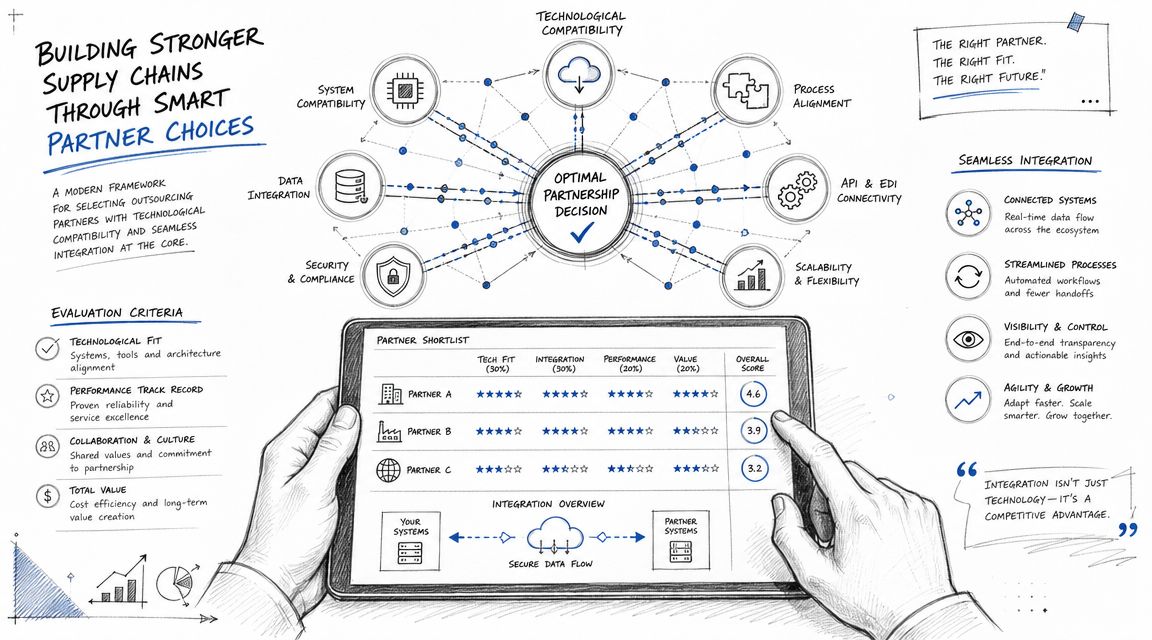
The old selection process focused on square footage, fleet size, and geography. Those still matter, but they're no longer enough. If a partner can't integrate cleanly, share high-quality operational data, and adapt workflows without drama, their physical footprint won't save you.
You're choosing a technology-enabled operating partner. Evaluate them that way.
Five things to assess before you shortlist anyone
Integration maturity
Ask how they connect to ERP, WMS, TMS, ecommerce, and reporting systems. Look for API readiness, webhook support, and a practical approach to exception handling when systems disagree.Data governance
Ask who owns master data, how changes are approved, and how they validate incoming records. If they can't explain their data hygiene practices clearly, implementation risk goes up.Operational transparency
You want more than portal screenshots. Ask what event data they can expose, how often it updates, and whether your team can extract it for your own dashboards and AI workflows.Security and compliance discipline
This matters even more in fintech, healthcare, and regulated ecommerce categories. The provider should be comfortable discussing controls, user access, auditability, and retention practices.Adaptability
Every business has weird edge cases. Packaging rules, customer-specific routing instructions, returns logic, lot tracking, handoff timing. A good partner won't pretend your operation is generic.
Questions that separate serious partners from polished presenters
Use direct questions in the RFP and in live diligence:
- How do you handle real-time status updates when upstream systems are delayed?
- What happens when item dimensions, units, or order attributes change after implementation?
- How do you document customer-specific workflow exceptions?
- Can your team support co-designed integrations, or do you force clients into a fixed template?
- What operational data can we stream into our own reporting and AI systems?
If you're evaluating regional options and need a grounded example of how local specialization can matter, this roundup of Midwest 3PL providers for Eastern Iowa is useful because it reflects the practical reality that proximity, service fit, and relationship quality still matter alongside software.
For a broader diligence checklist, this set of questions you should ask before hiring outsourcing companies is a solid companion to procurement and technical reviews.
The real selection test
Don't ask only, “Can they run the work?” Ask, “Can they help us run a better system?”
A provider who executes well but can't integrate will become a manual workaround. A provider with strong process design, clean data habits, and open integration patterns can become a force multiplier.
Mastering the Transition and Technical Integration
Most outsourcing projects don't fail in the contract phase. They fail in the handoff.
Leaders underestimate how much operational knowledge is buried in field names, spreadsheet tabs, warehouse habits, and team memory. The provider gets the official process. The business keeps the actual one in the heads of three experienced employees and a stack of exceptions nobody documented.
Start with data, not training decks
According to supply chain experts at DSV, operational and costing issues frequently arise when real-world data such as weights and dimensions doesn't match the data modeled for the bid, creating a classic “garbage in, garbage out” pattern that leads to significant manual work, as explained in DSV's warehouse outsourcing guidance.
That warning should shape your transition plan. Before you train users or map new workflows, clean the data that drives them.
Check these areas first:
- Item master data: units of measure, dimensions, weights, packaging hierarchy, handling rules
- Order attributes: channel flags, priority logic, customer-specific instructions, routing constraints
- Location data: ship-from rules, dock logic, cutoffs, inventory ownership markers
- Exception codes: the reasons orders fail, pause, split, or require manual intervention
A practical transition sequence
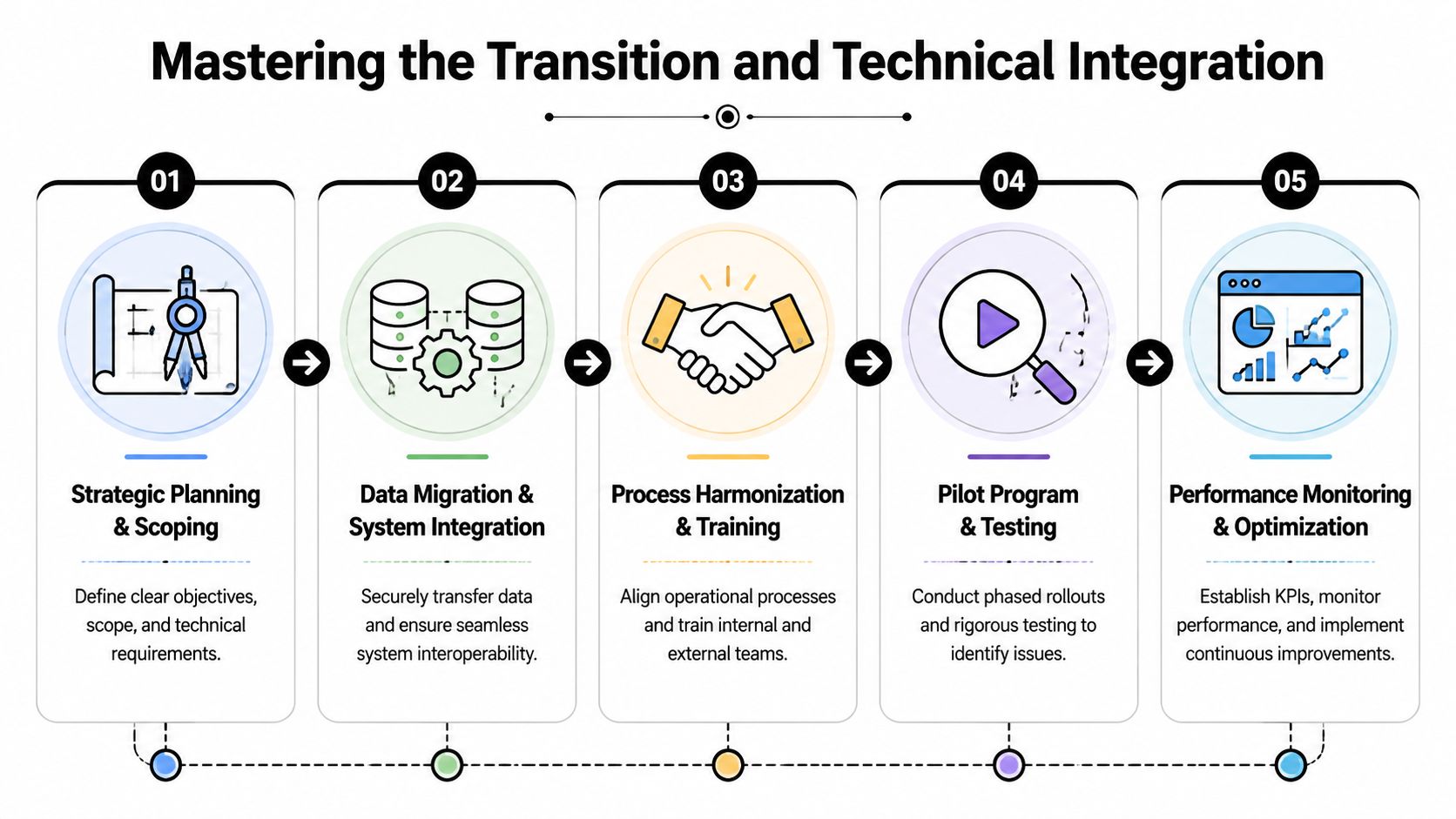
A disciplined rollout usually follows five stages.
Scope the operating model
Define which workflows move, which stay internal, who owns decisions, and what success looks like in live operations.Map systems and schemas
Identify source systems, field definitions, event timing, transformation rules, and failure states. During this process, most hidden risk surfaces.Capture undocumented rules
Teams often forget the little things that matter most. Special packing patterns. Retail compliance nuances. Customer-specific pallet requirements. These details drive real service outcomes.Run a constrained pilot
Don't go live with every customer, SKU, node, and exception on day one. Choose a bounded slice of the business and stress test the handoffs.Instrument the flow
Log events, compare source and destination records, and monitor operational KPIs consistently after launch.
Field note: If two systems both say they are the source of truth, neither one is.
Where AI and integration tooling actually help
Software modernization pays for itself. AI is useful during transition, but not as magic. Use it to classify exceptions, summarize implementation issues, spot mismatched records, and help teams query operational logs in plain language.
What matters more is the administrative control layer around those AI workflows. You need a reliable way to manage prompts, control which systems AI can access, log outputs for auditability, and watch usage costs. Without that, teams end up creating shadow automation with no governance.
The companies that handle supply chain outsourcing well build a translation layer between business systems and external providers. That layer doesn't just move data. It preserves meaning.
Governance Models and Mitigating Outsourcing Risks
The most common executive fear is losing control. That fear is valid, but it's often pointed at the wrong problem.
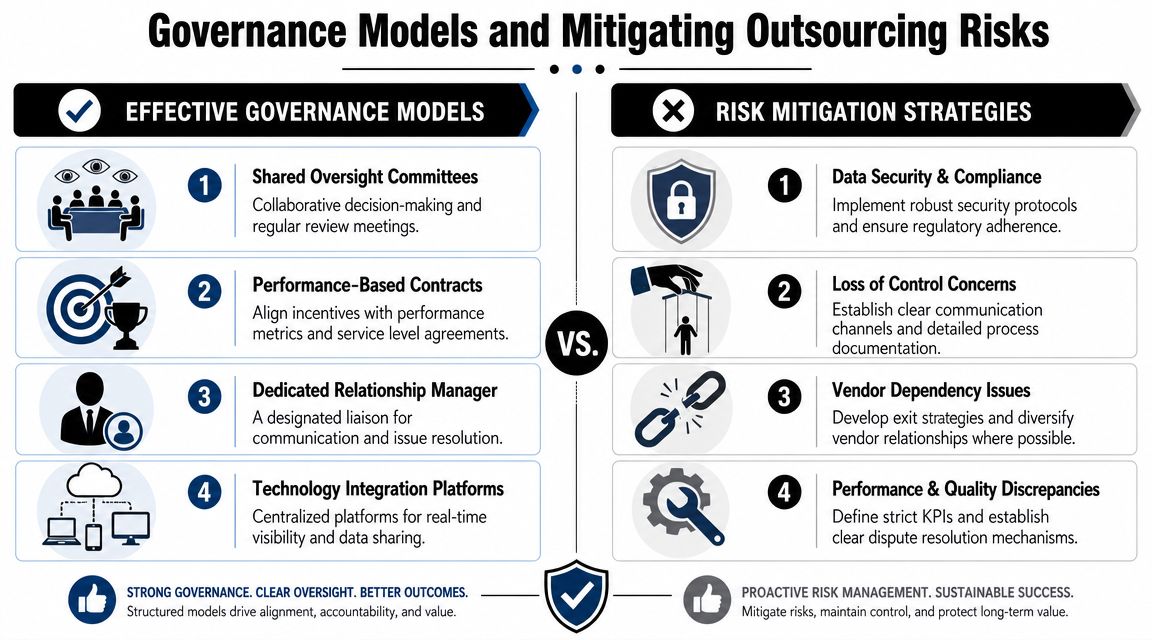
Outsourcing itself isn't automatically what makes a supply chain fragile. The bigger risk is usually poor design. Too many handoffs. Too many vendors. Too many systems. Too many countries or process owners in the same workflow.
The contrarian risk that leaders miss
A pilot study found that while the total share of outsourced activities was not linked to higher supply chain vulnerability, greater dispersion of outsourced activities and higher supply chain complexity were significant drivers of vulnerability, according to Deskera's summary of the research.
That finding lines up with what operators see in practice. One well-governed partner handling a clearly bounded function is often easier to manage than a patchwork of providers, each owning a narrow slice with weak coordination.
Governance that actually works
Use simple structures that force clarity and rhythm.
Shared operational oversight
Set up a recurring review with decision-makers from both sides. Not just account managers. Include operations, systems, and finance when needed. The meeting should cover service issues, root causes, upcoming changes, and open integration risks.
Performance-based management
Track outcomes that matter to the business, not vanity metrics. Common examples include on-time delivery, freight cost per shipment, inventory turnover, and order lifecycle timing. Use them to drive corrective action, not just dashboards.
Named ownership
Give both organizations a designated relationship owner. Problems multiply when every issue gets routed through a different person with a different context window.
Exit readiness
A mature outsourcing model includes an exit plan before you need one. Document data access, transition obligations, reporting expectations, and knowledge transfer requirements while the relationship is healthy.
Complexity is a design choice. Many outsourcing headaches start when nobody owns the handoffs.
Reduce risk by reducing fragmentation
If you want resilience, resist the urge to outsource every pain point to a different specialist. That often creates a network that looks optimized on paper and behaves unpredictably in production.
A better approach is to keep the model coherent:
- Bundle related workflows when shared data and timing matter.
- Minimize handoffs across regions, systems, and providers.
- Standardize event definitions so everyone interprets the same status the same way.
- Review changes centrally before new vendors or tools are added.
Good governance doesn't mean micromanaging the provider. It means making sure the operating system around the provider stays legible.
Modernizing Your Supply Chain with AI and Custom Software
Different industries feel the pressure in different places. Ecommerce teams struggle with fulfillment visibility and returns complexity. Fintech teams worry about secure workflows, audit trails, and vendor risk. Healthcare teams need tighter controls, fewer manual errors, and better documentation. SaaS companies with physical products or distributed hardware face a mismatch between digital expectations and operational reality.
In every case, the pattern is the same. The companies that win at supply chain outsourcing don't just choose a provider. They modernize the software layer around the relationship.
AI belongs in the workflow, not off to the side
AI is most useful when it supports real operating decisions:
- classify and route exceptions
- summarize shipment or order issues
- identify likely data mismatches
- support customer service with delivery context
- surface patterns across partner performance and internal process failures
But AI only helps when it's governed. An unmanaged AI setup can create inconsistent instructions, overbroad data access, missing logs, and surprise model spend. That's not innovation. That's a new category of operational debt.
Custom software is the real competitive advantage
Off-the-shelf logistics tools can cover common workflows. They rarely capture the specific logic that makes your business run well. That logic lives in custom integrations, decision rules, exception handling, and interfaces designed for your team.
For leaders thinking beyond logistics, there's a useful parallel in these resources for industrial contractor management. The same lesson shows up there too. Outsourced execution only performs well when expectations, workflows, and accountability are structured clearly.
If you're planning a broader modernization effort, these AI development services offer a practical view of how AI can be embedded into real applications rather than treated like a disconnected experiment.
The long-term opportunity is bigger than process efficiency. Once your systems, partners, and AI tools share a governed data layer, supply chain outsourcing stops being a defensive move. It becomes a platform for faster decisions, better customer communication, and cleaner scaling.
If your company is modernizing an outsourced supply chain, the missing piece is often administrative control over AI and integrations. Wonderment Apps helps organizations build that control layer with custom software and a dedicated prompt management system that includes a prompt vault with versioning, a parameter manager for secure internal database access, a logging system across integrated AI tools, and cost management for cumulative model spend. Book a demo to see how an AI-ready operating layer can bring order, auditability, and strategic advantage to your supply chain outsourcing strategy.