


Agile gets pitched as standups, sticky notes, and sprint boards. That's rarely the problem executives are trying to solve. The core problem is this: you need software teams to ship useful work faster, adapt without chaos, and handle modern delivery pressure that now includes AI features, compliance reviews, distributed teams, and cost control.
That's where a practical agile development example matters. Not a toy example. A real operating model you can picture inside your own organization.
The business case is strong. A widely cited benchmark summarized by Echometer says traditional waterfall projects have only a 14% success rate, while 29% fail outright. The same summary says agile teams work 25% more productively, reach market about 50% faster, and that full Scrum can increase product quality by up to 250% through lower defect density, according to the Echometer summary of agile statistics. Those numbers explain why agile keeps showing up in boardroom conversations. They don't explain how to use it well.
That's the gap most articles miss. Modern teams aren't just managing features. They're managing AI prompts, model changes, token spend, release risk, and security boundaries. Administrative tooling now matters a lot more than it did a few years ago. At Wonderment, that's exactly why we built a prompt management system with versioning, parameter controls, logging, and cost visibility for teams integrating AI into production software.
Here are eight agile development example models worth studying if you want something more useful than “run two-week sprints and hope.”
1. Spotify's Agile Model
Spotify's model became famous because it gave large product organizations a simple way to scale autonomy. Squads own outcomes. Tribes group related squads. Chapters connect specialists across squads. Guilds let people share practices across the company without redrawing the org chart every quarter.
This works best when a company has multiple product surfaces moving at once. A streaming app is the classic example, but the same pattern fits ecommerce platforms with checkout, search, subscriptions, and personalization teams all shipping in parallel. It also fits AI-enabled products where one squad may own the customer workflow while another owns evaluation pipelines or prompt orchestration.
Where it works and where it breaks
The appeal is speed without central bottlenecks. A squad can make local decisions, ship quickly, and stay close to users. Chapters and guilds keep the engineering system from fragmenting into eight different frontend stacks and three logging standards.
It breaks when leaders copy the labels without the operating discipline. Calling a team a squad doesn't create ownership. If product decisions still require three steering committees, the model becomes theater.
Practical rule: Start with a small number of tribes and force clear missions before you scale names, rituals, or governance.
A few patterns tend to work:
- Define squad missions clearly: Give each squad a product problem to own, not a list of tickets to process.
- Use chapter leads as coaches: They should strengthen craft, hiring, and standards. They shouldn't become shadow managers.
- Keep shared dashboards visible: Autonomy only works when executives can still see quality, flow, and delivery health.
- Prevent silos with guilds: Architecture, testing, AI evaluation, and security are common guild topics.
If your organization is trying to grow this kind of team structure, Wonderment's guide on creating and maintaining effective tech teams is a useful companion.
2. Amazon's Two-Pizza Team Rule and Working Backwards
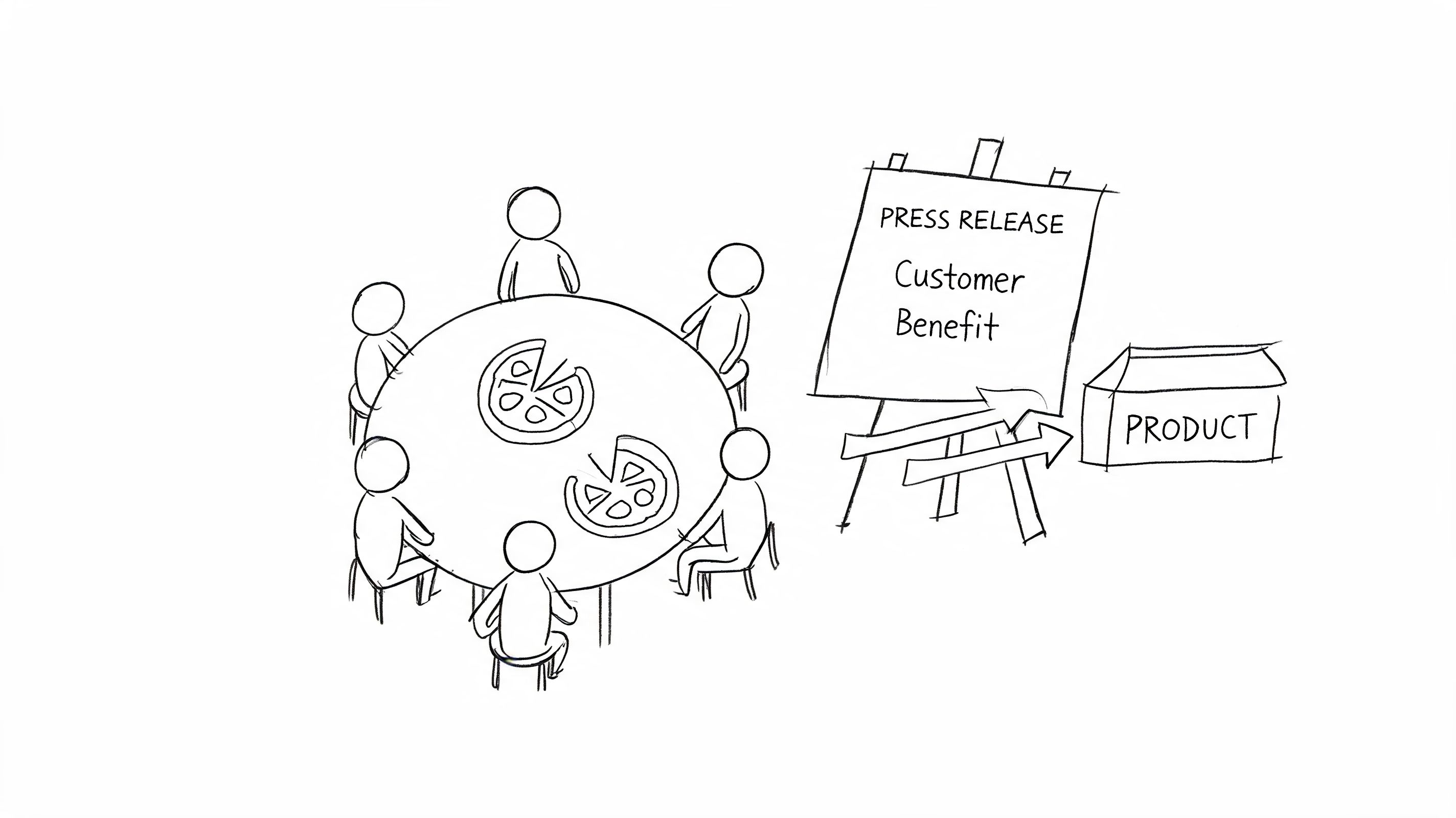
Amazon's most transferable lesson isn't the pizza metaphor. It's the insistence that teams begin with the customer outcome. The working-backwards method pushes teams to write the press release and FAQ before they build. That forces clarity early, when changing your mind is cheap.
This is one of the best agile development example patterns for executives because it ties delivery to business intent. A team doesn't start by asking, “What can we build this sprint?” It starts by asking, “What would make a customer care?”
Why this approach travels well
Small teams stay accountable because they can't hide behind coordination complexity. A checkout team, an AWS service team, or a mobile growth team can own a narrow surface and still think commercially. That's where the true value lies.
The press release and FAQ exercise is especially useful for AI features. If a team can't explain the user benefit, failure modes, trust boundaries, and support questions before coding starts, the feature isn't ready. That applies whether you're launching AI search, support summarization, or internal knowledge retrieval.
Useful habits from this model include:
- Write the launch narrative first: If the value proposition sounds fuzzy on paper, it will be worse in production.
- Name a single owner: Someone needs final accountability for the decision trail.
- Protect API boundaries: Small teams move faster when interfaces between systems are stable.
- Validate assumptions with customers: A polished internal FAQ is still a guess until users react to it.
A lot of teams say they're agile while still building from internal assumptions. Amazon's model is a reminder that fast delivery only matters when it's pointed at something customers want.
3. Netflix's Freedom and Responsibility Model
Netflix is the counterexample to process-heavy agile. It operates on the belief that high-talent teams do better with context than control. That sounds liberating, and it can be. It can also become expensive chaos if the team lacks judgment.
For the right environment, though, this model is powerful. Recommendation systems, experimentation platforms, and streaming infrastructure all benefit when strong engineers and product leaders can move without waiting for procedural approval at every step.
The hidden requirement is management quality
Executives often focus on the “freedom” part and miss the harder half. This model only works when leaders communicate strategy with unusual clarity. Teams need to understand the business direction, risk posture, quality standards, and decision boundaries. Otherwise autonomy turns into drift.
High-autonomy teams need more context, not fewer conversations.
That matters even more in AI delivery. If a team is selecting models, shaping prompts, and deciding release gates, leadership has to define what success and acceptable risk look like. A vague instruction to “move fast with AI” is not a strategy.
A few lessons travel well even if you never want to be as loose as Netflix:
- Hire for judgment: Technical skill alone isn't enough in low-process environments.
- Share strategy broadly: Teams make better local decisions when they understand the commercial goal.
- Measure outcomes, not theater: Count reliability, product impact, and adoption. Don't reward ceremony completion.
- Let teams learn visibly: Mistakes are tolerable. Hidden mistakes are not.
This is not the right model for every regulated team. But if you've overcorrected into approvals, templates, and sprint mechanics that slow down competent people, Netflix offers a useful corrective.
4. Scrum Framework with Kanban Integration
Most companies don't live in a neat Scrum world. They have roadmap work, support requests, urgent defects, security patches, customer escalations, and executive interrupts arriving all at once. That's why Scrumban tends to survive contact with reality better than pure Scrum in many product organizations.
The blend is straightforward. Keep Scrum's planning cadence, ownership, and review rhythm. Add Kanban's visual flow management and work-in-progress limits so the team can handle interruptions without pretending they don't exist.
For mixed-workload environments like fintech, ecommerce, healthcare, and SaaS, this is often the most honest agile development example.
What to manage closely
The failure mode is easy to spot. Teams keep all the meetings from Scrum, add a board from Kanban, and change nothing about prioritization discipline. They end up with more process and the same unpredictability.
A stronger version uses flow metrics to guide behavior. At Siemens Health Services, the team moved away from story points and velocity toward work in progress, cycle time, and throughput. The case study reports a 42% reduction in cycle time after the shift, as described by the Agile Alliance report on actionable metrics at Siemens Health Services.
That lesson matters. If leaders want predictable delivery, they should usually watch flow before they obsess over velocity.
- Set explicit WIP limits: If too much work starts, little work finishes.
- Make interrupt rules visible: Decide what can break sprint commitments and who approves it.
- Separate work types visually: Features, defects, support, and compliance work shouldn't blur together.
- Review flow every week: If items stall in test or review, the board should expose it.
If your team is choosing between approaches, this breakdown of agile vs scrum vs kanban helps frame the trade-offs clearly.
5. Microsoft's DevOps and Continuous Delivery Model
Microsoft's evolution is a useful reminder that agile without operational discipline hits a ceiling. A team can plan beautifully and still ship badly. Continuous delivery closes that gap by treating deployment, telemetry, rollback, and monitoring as part of product development, not as downstream chores.
This model fits cloud platforms, SaaS products, enterprise apps, and mobile systems that need controlled rollout. It also fits AI-enabled software, where deployment risk includes not just code defects but model behavior, prompt regressions, and spend anomalies.
The release system is the product system
Feature flags matter here because they decouple deployment from release. Teams can ship code, limit exposure, and expand only when the signals look healthy. Ring deployments do the same thing at a broader level. Internal users see it first, then early adopters, then the wider market.
That approach becomes even more useful when teams are coordinating app updates and backend changes across environments. Some teams standardize release automation with commit conventions and CI pipelines. If you want a concrete example of that mechanics layer, this guide on automating Capgo deployments with conventional commits is worth a look.
Operating principle: If a team can't roll back safely, it doesn't really have release agility.
Three habits separate mature DevOps teams from teams that just deploy frequently:
- Automate testing thoroughly: Unit, integration, and end-to-end coverage protect speed from becoming recklessness.
- Invest in observability early: Logs, traces, and metrics should exist before the first major launch.
- Practice rollback paths: Recovery shouldn't require a war room and guesswork.
- Use telemetry to decide releases: Opinions matter less once production data starts arriving.
For a broader view of how delivery operations differ from planning frameworks, Wonderment's piece on agile vs devops is a practical reference.
6. Google's OKR Framework with Agile Execution
Some teams aren't struggling with sprint mechanics. They're struggling with aim. They ship plenty, but the portfolio feels scattered. That's where OKRs help. They create a strategic frame so agile teams can move quickly without pulling in different directions.
Google popularized the pairing of ambitious objectives with measurable results, while leaving implementation details to the teams. That balance is useful for product companies that need both alignment and experimentation.
Why executives like this model
OKRs give leadership a portfolio language. Teams can own a quarterly objective around conversion, reliability, activation, support deflection, or AI feature adoption, then use agile execution to discover the best path. The key is that the objective stays stable enough to focus the team while the backlog stays flexible enough to learn.
Business adoption data also supports agile as a mature operating model. Businessmap reports that engineering and R&D teams make up 48% of agile practitioners, up 16% from 2022. The same report says 39% of respondents using an agile project-management approach reported the highest average project performance rate, with an overall project success rate of 75.4%, according to Businessmap's agile statistics roundup.
That doesn't mean every team should force OKRs onto every initiative. It means agile is no longer a niche software ritual. It's an organization-wide execution system, and OKRs are often the missing alignment layer.
A few practices keep OKRs useful instead of performative:
- Limit the count: A small set of objectives forces prioritization.
- Assign team ownership: Individualized OKRs often create local optimization.
- Review progress frequently: Quarterly goals still need regular steering.
- Write results that expose reality: If a key result can't fail, it won't guide behavior.
7. Shopify's Agile and Async-First Culture
Distributed teams don't fail because people work remotely. They fail because decisions stay trapped in meetings. Shopify's async-first reputation made a lot of leaders rethink how agile should work when teams span offices, time zones, and disciplines.
The lesson is simple. If important decisions only exist in live conversation, scaling gets expensive and exclusionary. Written proposals, documented decisions, and shared sources of truth make agile more durable.
What modern async agile actually looks like
A healthy async culture doesn't mean “no meetings.” It means meetings become a last-mile tool, not the default operating system. Teams use RFCs, design docs, backlog notes, architecture records, and recorded walkthroughs so people can contribute without being in the same room at the same time.
That's especially relevant for AI delivery. Model selection, prompt revisions, evaluation criteria, red-team findings, and cost controls all need a paper trail. The practical example of agile here isn't a standup. It's a well-documented decision that lets engineering, product, legal, and operations stay aligned.
MITRE's overview of agile fundamentals makes an important point for larger programs. Agile work often spans multiple teams and depends on coordination patterns such as scrum-of-scrums and shared product ownership, as described in MITRE's agile fundamentals guidance. In distributed environments, that coordination must be documented, not left to hallway conversations.
Good async habits are usually mundane:
- Use templates for major decisions: Teams write better when they don't start from a blank page.
- Set deadlines for comment windows: Async without timing rules becomes drift.
- Record final decisions explicitly: Don't make people reverse-engineer the outcome from chat threads.
- Keep one source of truth: Duplicate docs create political debates disguised as process.
8. ING Bank's Agile Transformation at Scale
Large, regulated organizations don't need another lecture about standups. They need a credible model for changing how hundreds of people plan, coordinate, govern, and release work without breaking compliance or customer trust.
That's why ING-style transformation examples matter. The headline isn't that a bank adopted agile language. It's that a traditional enterprise restructured around cross-functional delivery and coordination mechanisms that could operate at scale.
Scale changes the job
At this size, agile stops being a team-level question and becomes a management architecture question. Dependency management, portfolio prioritization, release governance, and compliance involvement all need a place in the system.
John Deere offers one of the clearest large-scale benchmarks. Scrum@Scale was rolled out across 500 teams, and leadership predefined measurable outcomes. The reported results were 165% more output versus a 125% target, 63% faster time to market versus a 40% target, and an engineering ratio of 77.7% “fingers on keyboards” versus a 75% goal, according to Scrum Inc's write-up on Agile at John Deere.
Those numbers matter because they show a common executive mistake. Many leaders try to scale agile by multiplying ceremonies. Mature scaled programs instead define portfolio outcomes and let teams organize around them.
For banks, healthcare systems, insurers, and large commerce platforms, the hard-earned lessons usually look like this:
- Embed compliance into the flow: Reviews must happen inside delivery, not as a late-stage blockade.
- Use planning cadences for alignment: Multi-team work needs explicit synchronization points.
- Track outcome KPIs above team metrics: Portfolio leaders need more than sprint burndowns.
- Keep transformation visible from the top: If executives treat agile as a middle-management initiative, the org will copy the rituals and ignore the intent.
For another view on how platform teams support iterative improvement, this piece on how Shopify teams run CRO experiments shows the value of structured experimentation inside a fast-moving digital business.
Comparison of 8 Agile Development Models
| Model | Implementation complexity | Resource requirements | Expected outcomes | Ideal use cases | Key advantages |
|---|---|---|---|---|---|
| Spotify's Squad/Tribe/Chapter/Guild | High, multiple layers and coordination overhead | Medium–High, experienced leaders, communication tooling, cultural change | Rapid feature iteration with autonomous teams and shared technical quality | Large product orgs scaling agile across features (streaming, AI-enabled products) | Autonomy + communities for learning; reduces silos; scales distributed teams |
| Amazon's Two‑Pizza & Working Backwards | Moderate, disciplined documentation and small-team setup | Low–Medium, strong PM/PR writing skills, metrics, clear APIs | Customer-driven products with clear ownership and fast decisions | Customer‑obsessed product teams (ecommerce, fintech, healthcare UX) | Strong customer focus, clear accountability, prevents scope creep |
| Netflix's Freedom & Responsibility | Moderate–High, cultural shift to minimal process | High, top talent, trust-based leadership, transparent context | Very fast decision-making and high innovation from empowered teams | High-performing engineering orgs and innovation-focused companies (SaaS, media) | Speed and innovation with minimal bureaucracy; attracts top talent |
| Scrumban (Scrum + Kanban) | Low–Moderate, blend of ceremonies and flow controls | Low–Medium, kanban boards, training, WIP enforcement | Balanced predictability and flexibility; handles planned work and interrupts | Teams with mixed workloads (features + support + urgent fixes), fintech, healthcare | Visual flow management, flexible planning, better handling of interruptions |
| Microsoft's DevOps & Continuous Delivery | High, automation, CI/CD, and observability at scale | High, tooling, infra, SRE/ops skills, testing automation | Frequent, low‑risk releases with fast production feedback and rollbacks | SaaS, cloud platforms, fintech requiring high reliability | Rapid feedback loops, controlled rollouts via feature flags, telemetry-driven decisions |
| Google's OKR + Agile Execution | Moderate, regular goal-setting plus execution alignment | Medium, leadership alignment, OKR tooling, review cadence | Organization-wide strategic alignment and measurable, ambitious outcomes | Organizations balancing innovation and strategy (large SaaS, enterprise) | Clear measurable goals, transparency, motivates focus and alignment |
| Shopify's Async‑First Culture | Moderate, requires habit changes and documentation standards | Low–Medium, strong writing skills, async tools, templates (RFCs) | Effective distributed collaboration, fewer meetings, durable decision records | Remote/distributed teams and global orgs ( ecommerce, distributed engineering) | Timezone-friendly collaboration, documented rationale, better deep work |
| ING's SAFe Transformation | Very High, heavyweight scaling, complex ceremonies and governance | Very High, training, coaches, program management, compliance integration | Scaled alignment across large orgs with compliance and coordinated delivery | Large regulated enterprises (banking, healthcare, government) | Structured scaling for compliance, clear coordination for many teams |
Modernize Your Agile Process with AI-Ready Tools
These examples point to a simple truth. There isn't one perfect agile model. There's a fit-for-purpose model.
Spotify's structure helps when autonomy needs guardrails. Amazon's working-backwards method sharpens customer focus. Netflix shows what high-trust execution can look like. Scrumban manages mixed workloads effectively. DevOps-driven delivery closes the gap between code and production. OKRs improve strategic alignment. Async-first practices make distributed work sustainable. Scaled enterprise models help regulated organizations move without losing control.
The harder question for 2026 and beyond isn't whether your team uses agile. It's whether your agile system is modern enough for AI-enabled software. Traditional project tools weren't built to manage prompt versioning, model behavior changes, token spend, internal parameter controls, and release logging across multiple AI services. Teams can ship faster and still lose control if those pieces live in scattered documents, code comments, and ad hoc dashboards.
That's why this part of the stack deserves executive attention. Product leaders need visibility into what changed, engineering teams need a reliable way to manage prompt history, and operations teams need one place to review logs and costs. Without that administrative layer, AI work often becomes a fragile side system attached to an otherwise disciplined software process.
McKinsey reported in 2024 that 72% of organizations had adopted AI in at least one business function, as referenced in Product School's discussion of types of agile methodology and modern product tradeoffs. That level of adoption changes the practical meaning of an agile development example. It's no longer just backlog, sprint, demo, retro. It's also model governance, prompt review, cost monitoring, and safe rollout patterns.
Wonderment's Prompt Management System was built for that reality. It includes a version-controlled prompt vault, a parameter manager for internal database access, a unified logging system across integrated AI services, and a cost manager so entrepreneurs and product teams can see cumulative spend. If your company is modernizing an application with AI, that kind of control layer can make the difference between an interesting prototype and a maintainable production system.
If you're evaluating your own operating model, start with the bottleneck you have. If teams are misaligned, don't start with deployment tooling. If shipping is risky, don't hide behind more planning ceremonies. If AI is entering the product, don't treat prompt management as an afterthought. And if your users need faster access to business data, tools in the broader market for AI software to skip SQL queries also show how quickly expectations around software interaction are changing.
The best agile system is the one your team can run consistently, measure accurately, and evolve without drama.
If you're planning an app modernization effort, an AI integration, or a broader delivery reset, Wonderment Apps can help you design the right operating model and build the software around it.