

A lot of companies reach the same frustrating point. The product is working. Customers are coming in. New ideas keep piling up. But every meaningful change takes too long because the software underneath is brittle, tightly coupled, or living in a stack that made sense years ago and now acts like wet cement.
That’s usually when cloud strategy consulting stops sounding like an IT project and starts sounding like a growth decision.
The pattern is familiar. An ecommerce team wants better personalization, but customer data is scattered across old systems. A fintech company wants faster fraud analysis, but its infrastructure was designed for batch processing, not real-time decisioning. A healthcare platform wants to launch a cleaner patient experience, but every change drags compliance concerns behind it. In each case, the primary blocker isn’t ambition. It’s architecture.
In practice, a modern cloud strategy is also an AI strategy. If you want recommendation engines, anomaly detection, operational automation, or smarter internal tools, you need a foundation that can support data movement, scalable compute, secure integrations, and consistent governance. You also need operational controls for the AI layer itself, including prompt versioning, logging, parameter handling, and cost visibility, because unmanaged AI inside a modern app gets messy fast.
Your Cloud Journey Starts Here
One of the biggest mistakes leaders make is assuming the cloud journey begins with migration. It usually begins with a bottleneck. Releases slow down. Security reviews get harder. Teams work around old systems instead of improving them. The business starts carrying technical debt like extra luggage through every initiative.
That’s why cloud strategy consulting matters. Good consulting doesn't start with “Which provider should we use?” It starts with “What is the business trying to achieve, and what is implicitly preventing that today?”
The wall most companies hit
A legacy platform often looks stable from the outside. Orders still process. Users still log in. Reports still run. But behind the scenes, developers are making careful edits to avoid breaking tightly connected systems, and every new integration feels riskier than it should.
For organizations dealing with document platforms and older collaboration stacks, practical migration planning resources such as SharePoint migration solutions can help frame the operational issues that appear long before a migration starts.
A similar perspective shows up in Wonderment’s own writing on developing in the cloud, where the cloud is less about hosting and more about building software that can evolve without constant structural friction.
A cloud move without a business outcome is just a hosting change.
The hidden cost almost everyone underestimates
The most overlooked part of cloud transformation is what happens to the old environment after the new one goes live. BCG puts it plainly in its discussion of cloud transformation: “without a clear plan for how to decommission legacy systems, cloud transformation will struggle to be sustainable,” and the cost of running dual infrastructures can negate cloud savings for 18-36 months in many cases, as noted in BCG’s cloud strategy analysis.
That matters because parallel environments are expensive in more than one way:
- Finance carries both stacks: You may pay for cloud growth while still funding licenses, support contracts, and operations for the old estate.
- Teams split their attention: Engineers end up maintaining two realities instead of improving one.
- Risk lingers longer: Data movement, access controls, and audit responsibilities remain more complex until legacy systems are retired.
If a consultant doesn’t talk about legacy exit early, they’re only solving half the problem.
What Is Cloud Strategy Consulting Really
Cloud strategy consulting is often described too narrowly. It’s not just advice about infrastructure. It’s the work of designing how the business should operate, scale, and modernize through technology choices that won't corner you later.
Architect first, builder second
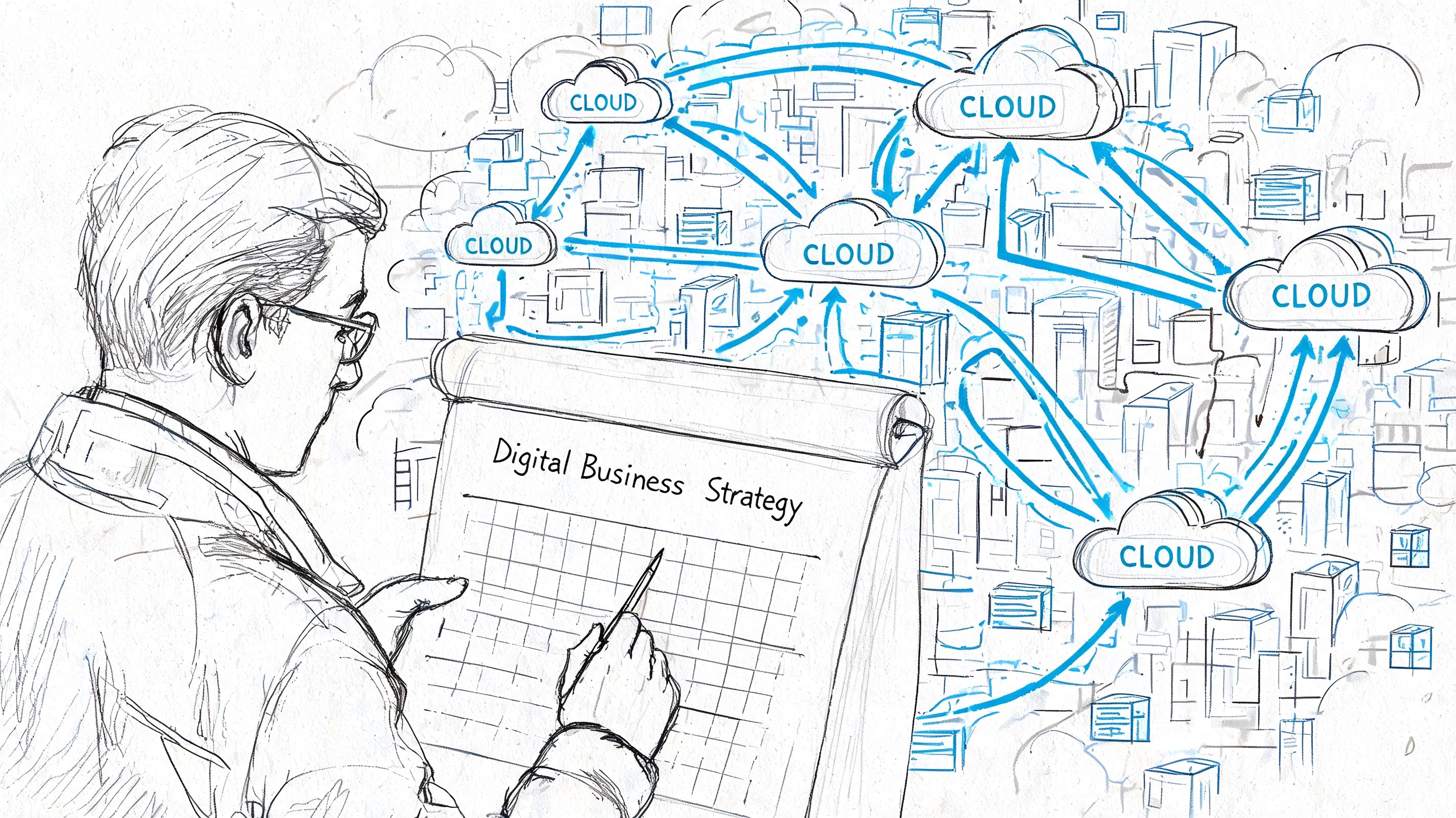
The simplest analogy is this. Your development team builds the house. Your cloud strategy consultant is the architect.
A builder can pour concrete, frame walls, and install systems. However, the architect decides whether the house fits the land, whether it can handle a future extension, where the plumbing should run, and whether the entire structure supports the way the owner lives.
Cloud strategy consulting works the same way. The consultant should answer questions like these:
- Business fit: Which capabilities matter most right now, speed, compliance, resilience, AI readiness, cost control, or all of the above?
- Operating model: Which workloads belong in public cloud, private infrastructure, or a hybrid design?
- Future flexibility: Are you building something that can absorb acquisitions, new customer demand, and new product lines?
Why the market keeps expanding
Companies are spending on this work because bad cloud decisions are expensive to unwind. The global Cloud Strategy Services market was valued at about $1.5 billion in 2024 and is projected to grow at a 15% CAGR to 2033, with over 68% of enterprises accelerating cloud modernization, according to Market Report Analytics on cloud strategy services.
That growth makes sense. Most executive teams don’t need another generic roadmap deck. They need someone who can connect technical design to business outcomes such as:
| Business goal | Cloud strategy question behind it |
|---|---|
| Launch AI-powered personalization | How should data, APIs, and compute be structured for low-friction model integration? |
| Expand to new markets | Which architecture supports regional compliance and reliable performance? |
| Reduce release friction | Which parts of the current stack should be refactored versus preserved? |
| Improve uptime and resilience | Where should failover, monitoring, and workload separation sit? |
The consultant’s value isn't in naming cloud services. It’s in reducing expensive ambiguity before the build starts.
What good consulting looks like
Strong cloud strategy consulting usually has a few traits:
- It ties architecture to commercial goals: A recommendation should lead back to revenue, speed, risk reduction, or customer experience.
- It respects trade-offs: Multi-cloud can improve flexibility, but it also adds management complexity. Refactoring creates long-term payoff, but it asks more from the team up front.
- It stays involved long enough to matter: A report alone rarely changes outcomes. Decisions need translation into execution.
If the work feels abstract, it’s probably not close enough to the business.
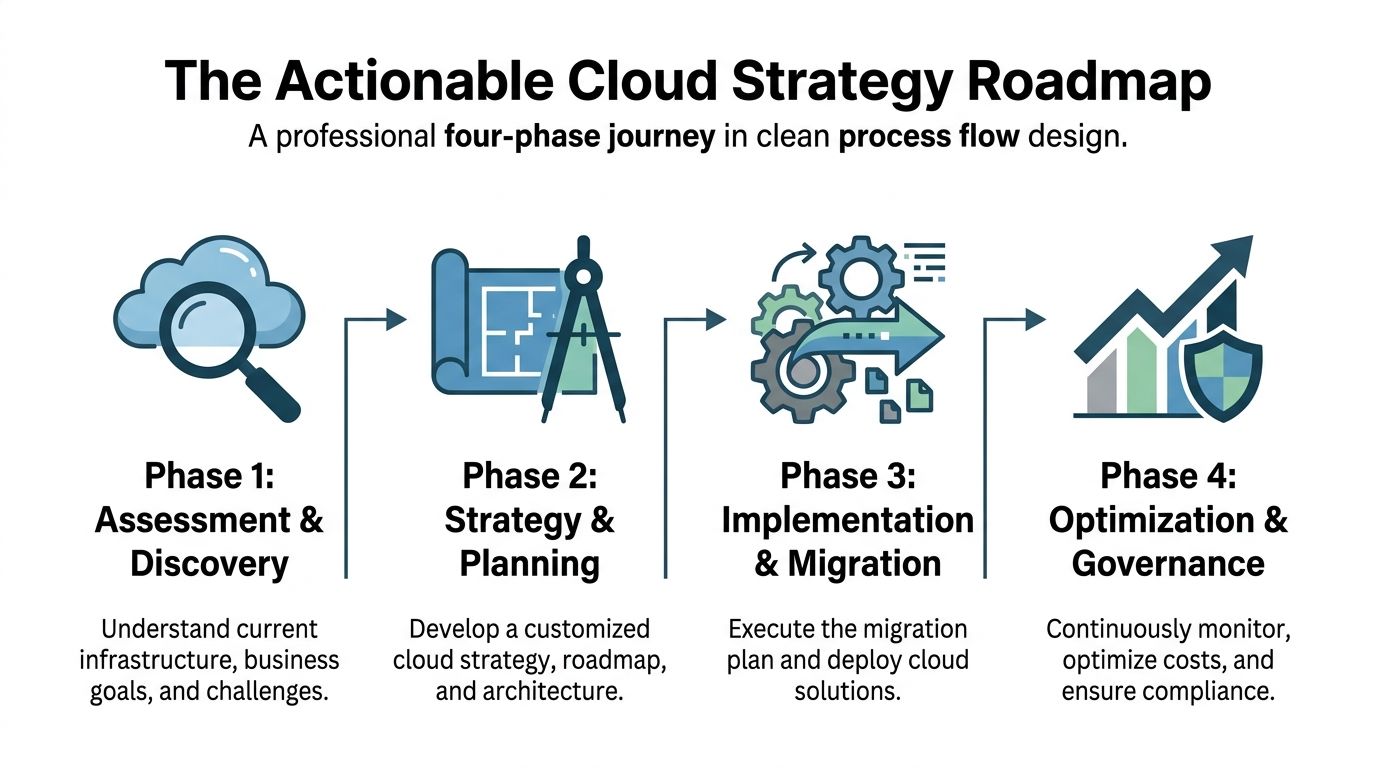
The Actionable Cloud Strategy Roadmap
A useful cloud program usually follows a sequence. Not because consultants love frameworks, but because skipping a step creates cleanup work later.
Phase 1 Assessment and discovery
At this stage, teams inventory the current estate. Applications, databases, integrations, identity models, data sensitivity, latency requirements, and operational pain points all go on the table.
The goal isn't just technical documentation. It’s decision quality.
In regulated sectors, this early analysis matters a lot. Flexential’s explanation of cloud strategy notes that hybrid models can reduce compliance risks by 40-60% for industries like healthcare and fintech, and that migrations of legacy apps can have a technical debt-related failure rate of up to 25% without proper readiness assessment.
Phase 2 Strategy and planning
Once the current state is clear, the consultant defines the target state. At this stage, a lot of executive misunderstandings happen, because “move to the cloud” is not one decision. It’s a series of design choices.
A practical plan usually covers:
- Deployment model: Public cloud, private cloud, hybrid, or multi-cloud.
- Application treatment: Rehost, replatform, refactor, retire, or replace.
- Security posture: Identity boundaries, encryption expectations, access models, and auditability.
- Data design: Where core data lives, how it moves, and who owns quality.
Phase 3 Implementation and migration
Reality puts strategy to the test. Some workloads can move with minimal adjustment. Others need partial redesign. Others should never be migrated in their current shape because all you’d be doing is relocating an old problem.
A good migration sequence usually separates workloads into categories:
- Quick wins for systems that can move with low disruption.
- High-value rebuilds for applications that are holding back growth.
- Deferred or retired systems that don’t justify the migration effort.
Practical rule: Never migrate a mess just because it already exists.
Phase 4 Optimization and governance
Many teams treat go-live as the finish line. It isn’t. Once the platform is in use, governance becomes the difference between disciplined scale and expensive drift.
That ongoing work includes:
- Cost controls: tagging, budgets, anomaly review, environment hygiene
- Operational monitoring: reliability, response times, incident patterns
- Security governance: least-privilege access, policy reviews, audit evidence
- Architecture refinement: improving weak spots discovered under real load
The roadmap works because each phase produces a concrete outcome. Assessment reduces uncertainty. Planning creates a decision framework. Migration changes the operating environment. Governance keeps the new environment from slowly becoming the next legacy estate.
Building an AI-Ready Cloud Foundation
Many companies still treat AI as a later add-on. First migrate. Then stabilize. Then maybe experiment with models. That sequencing sounds cautious, but it often creates the wrong platform.
If AI matters to the business, cloud decisions should be designed backward from that requirement.
Why AI changes the architecture conversation
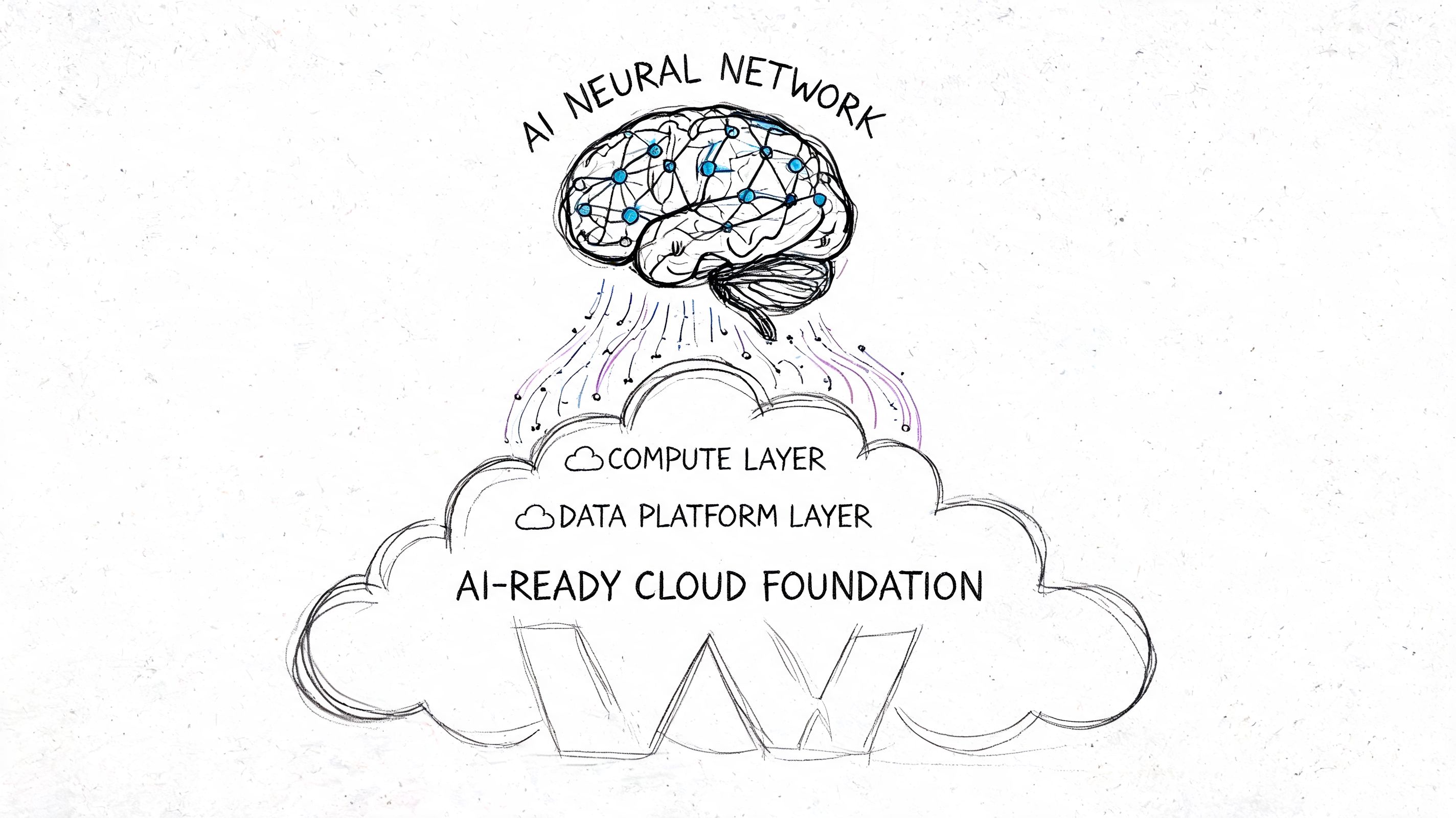
An AI-ready platform has different needs from a basic hosting upgrade. It cares more about data pipelines, event flow, model access, logging, prompt orchestration, latency, and operational visibility.
That means the classic migration question changes. Instead of asking only, “Can this app run in the cloud?” the better question is, “Can this app support intelligent behavior once it gets there?”
Research summarized by EY points to a strategic gap here. Cloud consulting often treats AI and ML as optional, while cloud-native architectures designed for AI enable efficient integration of ML modules and are central to realizing $3 trillion worth of business value in cloud adoption, according to EY’s view on rethinking cloud strategy.
The migration choice changes when AI is the goal
The 6R framework is useful, but AI readiness changes how you use it.
| Migration path | Works when | Often falls short when |
|---|---|---|
| Rehost | You need speed and minimal change | The application needs cleaner services and data access for AI features |
| Replatform | You want some cloud benefits without full redesign | Data and business logic are still too tangled |
| Refactor | You need modular services, scalable APIs, and cleaner event flows | The organization isn't ready to invest in application change |
For a company planning personalization, recommendation engines, decision support, or predictive workflows, refactoring usually deserves stronger consideration than it gets in standard migration conversations.
A useful technical primer on this way of thinking is Wonderment’s article on cloud-native architecture, which focuses on designing systems that can evolve rather than relocate.
If AI is in the roadmap, your cloud should be shaped for data movement and model operations from day one.
What the foundation should include
An AI-ready cloud foundation usually needs:
- Modular application services that expose clean interfaces
- Data patterns that support both transactional operations and analytical use
- Governance for security, logging, and traceability
- Scalable compute choices that can flex as AI workloads change
- Operational controls around prompts, outputs, and integration behavior
That last item is easy to miss. Teams often modernize infrastructure and then discover the AI layer has become its own sprawl problem.
How to Choose the Right Consulting Partner
The wrong consulting partner can leave you with polished slides and a harder mess. The right one helps your team make decisions with confidence, challenges weak assumptions, and stays grounded in the realities of delivery.
Start with fit, not brand recognition
A large firm isn’t automatically the right firm. A niche specialist isn’t automatically the right specialist. What matters is whether the partner understands the risk profile and operational logic of your business.
A fintech team should hear thoughtful questions about data handling, auditability, fraud workflows, and resilience. A healthcare organization should hear detailed thinking around sensitive records, workflow continuity, and patient experience. An ecommerce business should hear a lot about elasticity, seasonal traffic behavior, personalization, and release speed.
Ask these questions early:
- Have they worked inside your kind of constraints?
- Can they explain trade-offs in plain language?
- Do they treat architecture as a business tool, not a technical monument?
Watch how they communicate
A good partner teaches while they advise. They don’t hide uncertainty behind jargon. They also don’t pretend every problem has a tidy answer.
One of the more useful external checklists on provider evaluation comes from insights from Nutmeg Technologies. It’s worth reviewing because provider choice often breaks on operational issues, communication quality, and support expectations, not just certifications.
The best consulting conversations usually sound clear, specific, and occasionally uncomfortable. That’s a good sign.
Choose the engagement model that matches the work
Not every company needs the same shape of consulting relationship. The engagement model should fit both the complexity of the environment and the maturity of the internal team.
Here’s a practical comparison:
| Engagement model | Best for | Watch out for |
|---|---|---|
| Fixed-scope assessment | Early decision-making, board prep, current-state analysis | It may stop before implementation friction appears |
| Embedded consulting team | Complex modernization, architecture plus delivery alignment | Requires stronger internal participation |
| Ongoing advisory | Long migrations, evolving governance, AI expansion | Value depends on clear ownership and cadence |
Red flags that show up quickly
A few warning signs are common:
- They jump to tooling before understanding the business
- They recommend the same pattern for every client
- They don’t ask about legacy retirement
- They separate AI discussions from core platform planning
- They produce a roadmap with no clear ownership model
If a partner talks a lot about migration and very little about operation after migration, keep looking.
Measuring the Real ROI of Your Cloud Investment
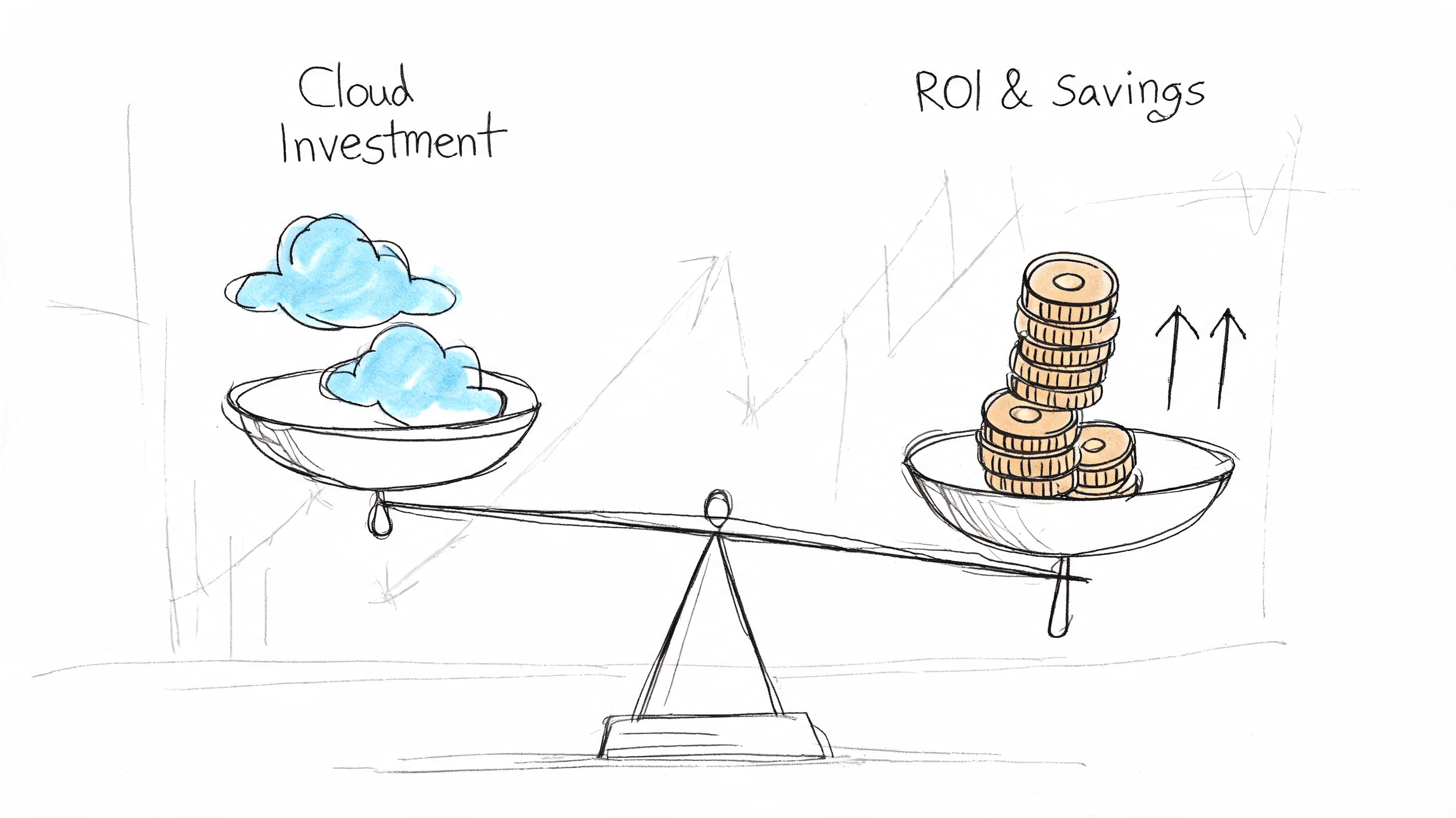
A board approves a cloud program expecting lower run costs. Twelve months later, the hosting bill may look better, but the harder question is whether the business can ship faster, reduce operational drag, and support new data and AI use cases without adding more complexity.
ROI should be measured that way from the start.
Start with TCO, but don’t stop there
A Total Cost of Ownership analysis is still the right baseline. It compares current infrastructure, support, licensing, and operating effort against the projected cost model in the cloud.
Bridge Global’s discussion of cloud strategy consulting highlights a point many teams learn late. Cloud economics improve when environments are governed well and workloads are matched to the right operating model. Without that discipline, overspend shows up quickly.
TCO also needs one line item many business cases understate: legacy retirement. If old systems remain in place for years after migration, the company ends up funding two estates at once. That weakens savings, slows simplification, and often keeps data trapped in systems that make AI adoption harder than it should be.
The ROI metrics executives should actually watch
A stronger ROI lens includes measures like these:
- Product delivery speed: Are teams releasing customer and internal improvements faster?
- Time to revenue: Can new services, integrations, and market tests go live sooner?
- Operational resilience: Are incidents contained and resolved with less business disruption?
- Data readiness: Is information easier to access, govern, and use across the company?
- AI operating discipline: Can the business track model usage, prompt changes, and spend with confidence?
That last area deserves more attention than it usually gets. Many cloud programs were scoped as infrastructure modernization projects, then asked later to support AI features, retrieval pipelines, and data-heavy products. If the foundation was not designed for that shift, costs rise in awkward places, governance gets patchy, and teams start improvising around missing controls.
For teams that need this layer of governance, tools like Wonderment Apps provide administrative controls for AI operations.
Budgeting also becomes more realistic when cloud modernization, application change, and AI delivery are planned together. Wonderment’s article on the cost of software development is a useful reference for that broader investment view.
What value creation actually looks like
Strong cloud ROI shows up in business capability.
That may look like a retail platform that can support personalization and forecasting without a brittle chain of integrations. It may mean a SaaS company can add AI-assisted workflows because product data is structured, accessible, and governed. In a regulated environment, it may mean modernizing customer-facing services while retiring legacy components in a controlled sequence instead of carrying them indefinitely.
Those outcomes are easier to miss because they do not sit on a single invoice. They show up in faster launches, fewer operational delays, cleaner data, and a realistic path to decommissioning systems the business no longer needs.
If those measures are absent, the ROI story is still incomplete.
Sector-Specific Strategies in Action
Cloud strategy consulting gets clearer when you view it through real operating environments. The right design always depends on the business problem being solved.
Ecommerce and retail
Retail platforms live with uneven demand. A quiet week can turn into a peak event overnight, and customer expectations don’t soften just because the backend is under pressure.
A practical strategy often combines elastic customer-facing services with a data architecture ready for recommendation logic, search tuning, and AI-assisted merchandising. In this environment, cloud planning should also account for promotional traffic, seasonal catalog changes, and the governance of customer data used for personalization.
Fintech and SaaS
Fintech teams usually need a more selective design. Sensitive data, transaction workflows, and regulatory scrutiny make a simple all-in public cloud move less attractive in many cases.
A hybrid architecture is often the sensible answer. Critical systems of record can remain under tighter control, while analytics, model training, or customer-facing services use cloud elasticity where it adds value. The important part isn’t the label. It’s the separation of concerns.
Healthcare and wellness
Healthcare organizations tend to succeed when they modernize around user journeys rather than around old departmental systems. A patient app, scheduling experience, telehealth workflow, or care coordination portal can often become the entry point for broader platform change.
That strategy works best when compliance is designed into the architecture from the start, not added as a review gate at the end. Identity, auditability, data handling, and role-based access all need to be part of the design conversation early.
Media and entertainment
Media systems punish weak architecture fast. File movement, content processing, streaming performance, publishing workflows, and audience spikes all hit at once.
A sound strategy usually focuses on decoupling ingest, processing, storage, and delivery. That creates room for scalable transcoding pipelines, multi-region distribution, and AI-assisted tagging or discovery features without locking the entire content operation into one fragile chain.
Public sector and nonprofits
Public-facing digital services often inherit older systems, constrained budgets, and a wide user base with uneven technical comfort. That changes the strategy.
Here, cloud consulting should prioritize reliability, maintainability, accessibility, and cost discipline. The best modernization plans don’t try to rebuild everything at once. They pick high-friction services first, create a stable operating pattern, and then expand from there.
The pattern across all sectors is consistent. The right cloud strategy isn’t the most fashionable one. It’s the one that supports the business model, removes delivery friction, and makes future AI and data work easier instead of harder.
If your team is modernizing a product, planning AI features, or trying to get out from under a brittle legacy stack, Wonderment Apps can help you evaluate the path forward. That includes cloud-minded product strategy, UX-driven application delivery, and practical AI operations support. If you want to see how prompt versioning, AI logging, parameter control, and spend visibility work in a live environment, book a demo and review it with your product and engineering leads together.