

When people hear the phrase “machine learning for businesses,” they often picture something impossibly complex, reserved only for tech giants with massive engineering teams. The reality is much simpler. It's a powerful and surprisingly accessible tool for making smarter, faster decisions using the data you already have.
Think of it this way: machine learning just teaches computers to spot patterns, much like an experienced employee would, but on a scale humans can't possibly match. And integrating it into your custom software application—for desktop or mobile—is more achievable than you think.
Your Business Is Ready For Machine Learning Even If You're Not
If you have customer data, sales histories, or even basic operational logs, you’re sitting on the raw materials for machine learning. The real challenge isn’t a lack of data; it's finding a manageable way to plug that data into an AI model and actually control what comes out. This is where modernizing your existing software becomes the most practical first step.
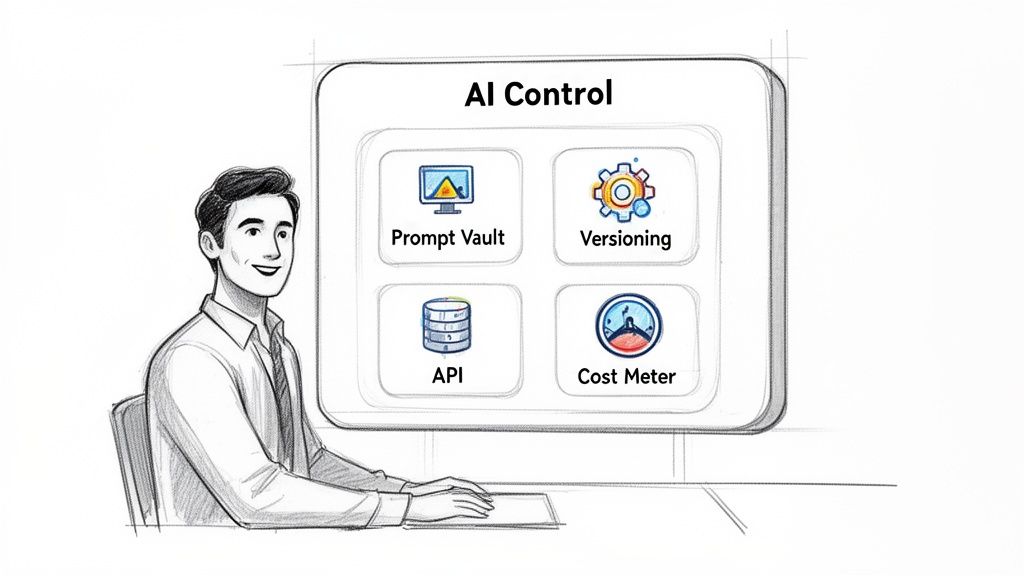
Forget about building a massive, ground-up AI system. Instead, think about adding a smart administrative tool to your current application. This layer acts as a central control panel for all your future AI initiatives, turning what seems complicated into something much more straightforward. At Wonderment, we've developed a prompt management system that does exactly this, serving as an administrative tool developers and entrepreneurs can plug into their existing app to modernize it for AI integration.
A Control Panel For Your AI Initiatives
Imagine having one place to manage every single prompt you send to various AI models. That's the core idea behind a prompt management system—an essential piece for any business looking to use AI responsibly and effectively. It gives you the power to:
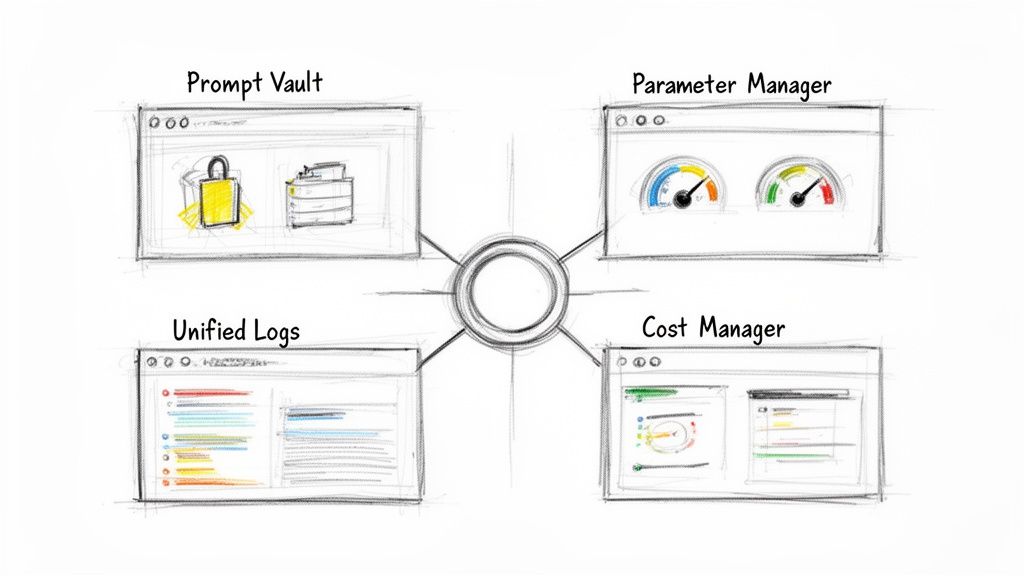
- Organize and Version Prompts: Keep all your prompts in a central "prompt vault" complete with version history. This lets you track changes, test new ideas without breaking what works, and easily roll back to a previous version if something goes wrong.
- Connect to Your Data Securely: Use a parameter manager to securely link the AI to your internal databases. This allows it to pull real-time information, making its responses far more relevant and accurate.
- Monitor Performance and Costs: Track every single AI interaction through a unified logging system. You can also keep a close eye on spending with a cost manager that shows your cumulative API usage, preventing any surprise bills.
This control-panel approach takes the mystery out of machine learning for businesses. It provides the governance and oversight you need to experiment, learn, and scale your efforts confidently. You’re turning a potentially daunting project into a series of controlled, measurable steps.
The numbers back this up. The global machine learning market is projected to hit $113.10 billion this year and is on a trajectory to reach an incredible $503.40 billion by 2030. This isn't just hype; it's growth driven by real results, with 92.1% of businesses reporting measurable outcomes from their AI projects. You can dig deeper into these findings on machine learning statistics.
At its heart, machine learning for businesses isn’t about replacing human intuition. It’s about augmenting it with data-driven insights, allowing your team to make better, more informed decisions faster than ever before.
By integrating a control system first, you're not just "doing AI." You're building a solid foundation and a lasting capability to modernize your software, create better user experiences, and stay ahead of the curve for years to come.
Understanding The Different Flavors Of Machine Learning
Stepping into the world of machine learning is a bit like walking into a professional kitchen. A great chef doesn’t just have one cooking method; they pick the right technique for the ingredients and the dish they want to create. Searing, braising, baking—each has its place. Machine learning works the same way. It isn't a single, monolithic tool but a collection of different "flavors," each designed to solve specific business problems.
Getting a handle on these core types is the first step to seeing the opportunities right in front of you. When you match the right flavor of machine learning to the right challenge, you can start pulling incredible insights from the data you already have.
Let's look at the three main approaches.
Supervised Learning: Teaching By Example
Supervised learning is the most common and intuitive starting point. Think of it like training a new hire. You wouldn't just give them a mountain of paperwork and hope for the best. Instead, you'd provide a stack of labeled examples to help them learn the ropes.
You might show them hundreds of past invoices, each one clearly marked as either "Paid" or "Overdue." By studying these examples, the new employee starts to pick up on the patterns. Soon enough, they can look at a brand-new invoice and correctly categorize it all on their own.
This is exactly how supervised learning operates. We feed an algorithm a huge dataset where we already know the right answers—the input (invoice details) and the correct output ("Paid" or "Overdue"). The model learns the relationship between the two.
This method is a powerhouse for tasks that involve prediction and classification. You see it at work all the time in applications like:
- Spam Detection: A model learns from thousands of emails you've already marked as "spam" or "not spam" to keep your inbox clean.
- Image Recognition: It can be trained to identify your products in a photo after analyzing a dataset where every image is tagged with the correct product name.
- Sales Forecasting: By digging into historical sales figures, it can predict future revenue by connecting the dots between past performance, marketing spend, and the time of year.
Unsupervised Learning: Finding Hidden Patterns
Now, let's flip the script. Imagine you hand a data analyst a massive spreadsheet of all your customer purchase data with a simple request: "Tell me what you find." You aren't giving them specific labels to look for. You're asking them to discover the natural groupings and patterns hidden within the data. That’s the core idea behind unsupervised learning.
Unlike its supervised cousin, this method works with unlabeled data. The goal isn't to predict a known outcome but to explore the data for structures you didn't even know were there. It’s a tool built for discovery.
Unsupervised learning helps you answer questions you didn't even know to ask. It’s brilliant at revealing the underlying structure in your data, whether that’s identifying natural customer segments or flagging bizarre activity that needs a closer look.
This approach is perfect for:
- Customer Segmentation: Grouping customers based on their buying habits to create hyper-targeted, effective marketing campaigns.
- Anomaly Detection: Finding the needle in the haystack by spotting unusual transactions that could signal fraud, simply because they don't fit the established patterns.
Reinforcement Learning: Learning From Trial And Error
The third flavor, reinforcement learning, is all about learning through trial and error—much like playing a video game or training a dog. The algorithm, known as an "agent," learns by taking actions within an environment. It gets rewards for actions that move it closer to a goal and penalties for those that don't.
The agent's entire purpose is to figure out the sequence of actions that will maximize its total reward over time. For a business, this could mean anything from optimizing a supply chain for peak efficiency to adjusting ad spend in real-time to get the most conversions. To see how these different models fit into a broader strategy, it's helpful to explore the four main types of AI in business.
Reinforcement learning really shines in complex, dynamic systems where the "right" answer isn't just one label but a whole series of optimal decisions. While it can be more complex to set up, its power is being unlocked in areas like robotics, dynamic pricing models, and sophisticated resource management.
How Machine Learning Is Changing the Game in Key Industries
Theory is great, but the real "aha!" moment comes when you see machine learning in action. Using machine learning for businesses isn't some far-off concept; it’s happening right now, solving real problems and creating serious value in just about every sector. From the way you shop online to how your bank protects your money, ML is the engine making things smarter and more efficient.
The numbers back this up. AI adoption is soaring, with 78% of organizations now using it in at least one part of their business. This isn't just isolated experiments, either—more than two-thirds are applying it across multiple departments.
For an ecommerce team, this could mean ML-powered recommendations that keep customers coming back. For a fintech company, it means building secure apps, with ML for cybersecurity being a key feature in 22.54% of cases. These are just a couple of examples of its widespread impact.
Let's dig into how this tech is making waves in a few specific industries.
Ecommerce and Retail Transformation
In ecommerce, machine learning has become essential for crafting personalized experiences that actually drive sales. It goes way beyond basic analytics to actively predict what customers want and guide their buying journey.
Think of it as giving every single visitor to your site their own personal shopper. Recommendation engines, fueled by machine learning, look at a user's browsing history, past buys, and even what they've lingered on to suggest products they're almost guaranteed to love. This isn't a gimmick; it’s a proven strategy for increasing order sizes and building loyalty.
But it doesn't stop there. ML also powers:
- Dynamic Pricing: Models can adjust prices on the fly based on supply, demand, competitor pricing, and even the time of day to get the most out of every sale.
- Inventory Management: By crunching historical sales data and market trends, ML can forecast demand with incredible accuracy, helping you avoid running out of popular items or getting stuck with stuff that won't sell.
- Customer Churn Prediction: Algorithms can flag customers who are showing signs of leaving, giving you a chance to step in with a special offer or extra support to keep their business.
Fortifying the Fintech Sector
In the world of finance, there's no room for error. Security and accuracy are everything. Machine learning delivers the tools to operate at a scale and speed that humans just can't match, especially when it comes to fraud detection.
Old-school, rule-based systems can only catch the kinds of fraud we already know about. Machine learning models, on the other hand, learn the normal transaction patterns for millions of users. This allows them to spot tiny, almost invisible red flags in real-time that signal a potential threat. For a closer look at how ML is reshaping finance, check out this guide on Machine Learning Fraud Detection: A Proactive Guide to Internal Risk.
A transaction that's just a bit larger than usual, from an odd location at a weird time, might not trigger any single rule. But to an ML model, that combination of small oddities screams "high-risk."
This capability is used for more than just stopping fraud. Fintech companies rely on ML for:
- Credit Scoring: Analyzing thousands of data points to assess creditworthiness, leading to fairer and more accurate lending decisions.
- Algorithmic Trading: Making complex market predictions to execute trades at the perfect moment.
- Customer Service: Using natural language processing (NLP) to power chatbots that can answer customer questions instantly, 24/7.
Engaging Audiences in SaaS and Media
For SaaS and media companies, the biggest fight is for user attention and loyalty. Machine learning is their secret weapon for creating "sticky" products and experiences that people can't imagine living without. By understanding user behavior on a deep level, these companies can deliver incredibly personalized content.
A SaaS product might use ML to see which features a certain type of user isn't using, then trigger a helpful in-app tutorial to guide them. A streaming service uses it to build that "For You" page that feels like it was put together by a friend who knows you perfectly. The real magic is in making users feel seen and understood. We dive deeper into this in our guide on how SaaS companies are using AI to improve their products.
This personalized touch appears in a few key ways:
- Content Personalization: Suggesting articles, videos, or songs based on a user's unique history.
- Churn Prediction: Spotting behavioral patterns of users who might be thinking about canceling, which allows for targeted campaigns to win them back.
- User Engagement Scoring: Predicting which users are most likely to upgrade to a paid plan, helping sales teams focus their energy where it counts.
Across all these different fields, the story is the same: machine learning for businesses provides the tools to shift from simply reacting to what's happened to proactively shaping what happens next.
Your Practical Roadmap To Implementing Machine Learning
Knowing what machine learning can do is one thing. Actually making it happen in your business is a whole different ballgame. It's the biggest hurdle most companies face, and it's easy to get bogged down in the technical weeds, losing sight of the actual business goal.
The secret is to follow a pragmatic, step-by-step approach. This isn't a playbook for data scientists; it's a roadmap built for business leaders. Following these phases ensures your machine learning project stays on track, solves a real-world problem, and delivers a clear return on your investment.
This flowchart gives you a bird's-eye view of how ML creates value across different industries.
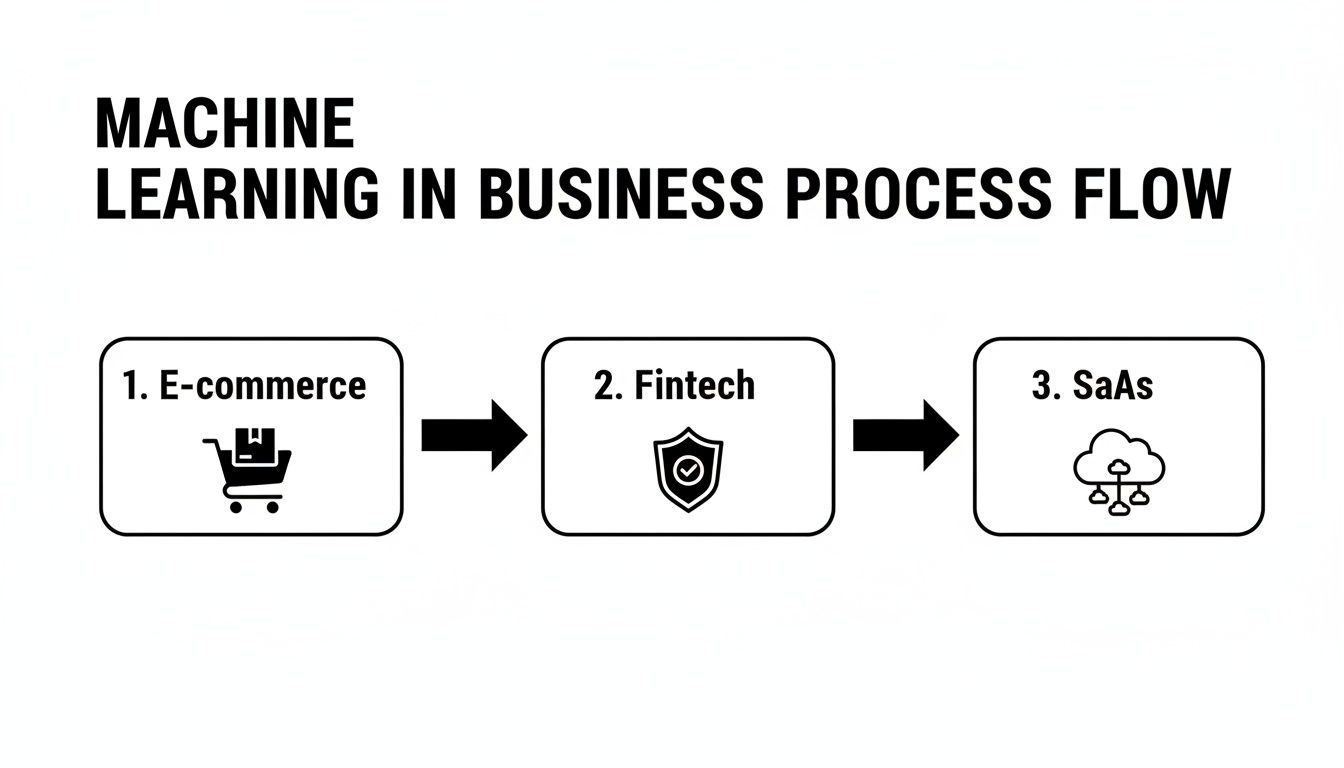
As you can see, the path always starts in the same place. Whether it's smoothing out the customer journey in e-commerce, locking down transactions in fintech, or driving up user engagement in SaaS, you have to begin by identifying a specific business need.
Phase 1: Define The Business Problem
Before anyone writes a single line of code or even glances at a spreadsheet, you have to nail this down: What specific business problem are we trying to solve? This is, without a doubt, the most critical step.
Starting with a vague goal like "we want to use AI" is a surefire recipe for a failed project.
Instead, frame the problem around a tangible business metric you need to move. Here’s what a solid starting point looks like:
- Problem: "Our customer churn rate has jumped by 15% in the last two quarters."
- Goal: "We want to use machine learning to flag customers at high risk of leaving so our retention team can step in."
- Success Metric: "Reduce churn by 5% within six months of going live."
This simple exercise anchors the entire project to a real business outcome. It gives your team a clear target and makes measuring success down the road incredibly straightforward.
Phase 2: Assess Your Data Readiness
With a clear problem in your sights, it's time to look at your data. A machine learning model is only as smart as the data it learns from. You don't need a perfect, massive dataset to start, but you do need to be honest about what you have and what you might be missing.
Ask yourself a few key questions:
- Relevance: Do we actually collect the data needed to solve this? For that churn model, you’d need user activity logs, subscription histories, and maybe even support ticket data.
- Quality: Is the data clean and consistent? Things like missing values, duplicate entries, and typos can completely throw off a model's accuracy.
- Accessibility: Can we easily get to the data? Often, it’s siloed across different systems, and just pulling it all together is a project in itself.
This is where having robust systems for moving information is non-negotiable. To get any value out of your raw data, you need a solid foundation. You can get a deeper sense of why this is so important by exploring how to start applying data pipelines to business intelligence.
Phase 3: Choose The Right Model And Integrate
Now we get to the fun part: picking the right tool for the job. Your business problem will point you toward the right type of machine learning model. For our churn prediction example, a supervised learning model that specializes in classification would be a perfect fit.
The good news is you don't always have to build these things from scratch. Many pre-trained models are available that can be fine-tuned with your specific data, which can shave months off your timeline.
Next up is integration. This is all about connecting the model to your existing software. That could mean plugging it into your CRM to automatically flag at-risk customers or wiring it into your e-commerce site to power a recommendation engine. The goal is to make the model's insights truly actionable for your team.
Phase 4: Deploy, Monitor, And Iterate
Launching an ML model isn't the finish line; it’s the starting gun. Once a model is live, you have to constantly monitor its performance. Is it still accurate? Is it driving the business value you expected?
Models can experience "drift," where their performance degrades over time as new data patterns emerge. Continuous monitoring allows you to catch this early and retrain the model to keep it effective.
Think of this final phase as a continuous loop:
- Deploy: Push the model into your live environment.
- Monitor: Keep an eye on its accuracy, the business KPIs it's supposed to impact, and its operational costs (like API usage).
- Iterate: Use that performance data to make improvements. This could mean retraining the model with fresh data or refining the prompts you use to interact with it.
This iterative rhythm is what ensures your machine learning solution evolves right alongside your business, delivering sustained value long after the initial launch party.
How To Manage Your AI Integration For Success
Launching a machine learning model isn't the finish line; it’s the starting block. Too many businesses treat implementation as a 'set it and forget it' task, but to get lasting value, you need a solid system to manage, monitor, and tweak your AI integrations over the long haul. This is where a dedicated administrative tool becomes your command center for success.
Think of this tool as the governance layer that lets you scale your AI efforts responsibly and affordably, ensuring your initial investment keeps paying dividends. At Wonderment Apps, we've developed a prompt management system that provides this exact control. This tool is designed for developers and entrepreneurs to plug into existing software, giving them the power to modernize their applications and build for the future. To get there, it's vital to understand the potential hurdles and learn from lessons from common AI implementation pitfalls.
Building Your AI Command Center
A centralized management system gives you the controls to fine-tune performance, maintain consistency, and keep a tight rein on operational costs. It's the dashboard for your entire AI operation. Our system is built on four key features that form the foundation of this robust control.
-
A Prompt Vault with Versioning: Consistency is everything. A prompt vault is your central library for all the instructions you feed your AI models. With version control, you can safely test new prompts, track every change, and instantly roll back to a previous version if an update goes sideways. This gets rid of the guesswork and ensures every part of your app is using the most effective instructions.
-
A Parameter Manager for Internal Database Access: For an AI to give truly useful answers, it needs a window into your internal business data. A parameter manager is the secure bridge that makes this happen. It lets you define exactly which data points—like a customer ID or order number—the AI can request and use. This allows it to deliver relevant, real-time answers without ever putting your data security at risk.
These components are absolutely essential for creating predictable and reliable AI-powered features. Here's a look at how our tool's features benefit your business.
| Core Features Of Our AI Management Tool |
| :— | :— |
| Feature | Business Benefit |
| Prompt Vault with Versioning | Guarantees consistent, high-quality AI responses and allows for safe experimentation. |
| Parameter Manager | Securely connects AI to internal data for personalized, context-aware interactions. |
| Logging System Across All AIs | Provides a single source of truth for troubleshooting and performance analysis. |
| Cost Manager | Delivers real-time visibility into your cumulative spend to prevent budget overruns. |
Having these pieces in place turns your AI from a powerful but unpredictable tool into a managed, scalable business asset.
Monitoring Performance And Controlling Costs
Beyond managing the inputs, you absolutely need clear visibility into what the AI is doing and how much it's costing you. This is where our logging and cost management features become non-negotiable.
A logging system across all integrated AIs is your single source of truth for performance. It records every prompt, response, and error, giving you the data needed to troubleshoot issues, identify performance trends, and refine your approach.
Similarly, our dedicated cost manager provides a clear, real-time view of your cumulative AI spending. It tracks usage so you're never surprised when the bill arrives. This financial oversight is crucial for making smart decisions about how and where to scale your use of machine learning for businesses.
With AI adopters expecting 60% higher revenue growth and 50% bigger cost reductions, managing the implementation effectively is the only way to realize those gains. The investment is massive; in the US alone, firms put $109.1 billion into AI in 2024. That number alone underscores the need for strong governance and cost management. This level of oversight turns AI from an exciting experiment into a predictable and profitable part of your business.
Finding The Right Partner For Your AI Journey
Let's be honest: navigating the world of machine learning doesn't have to be a solo mission. While the technology is incredibly powerful, the road from a great idea to a value-driving application is filled with potential wrong turns. Picking the right development partner is one of the most important decisions you'll make—it often spells the difference between success and failure for the entire project.
A great partner doesn't just write code. They bring a mix of deep technical skill and sharp business sense to the table. They should spend time getting to know your specific goals, your market, and the unique problems you're trying to solve. That alignment is what turns a technology project into a real business solution.
What To Look For In An AI Partner
Finding the right team means looking beyond a simple list of technical skills. You need a partner who can guide you through the entire lifecycle of an AI-powered product, from the initial strategy sessions all the way through to long-term support. A top-tier partner will have a proven track record in a few key areas.
Here's what to look for:
- Expertise in AI Modernization: They should have real-world experience helping businesses like yours integrate AI into existing systems, not just building shiny new things from scratch.
- Scalable App Development: Look for a deep portfolio of building high-performance web and mobile apps that can handle a large audience without breaking a sweat.
- A User-Experience-Driven Approach: The smartest AI in the world is useless if it's trapped behind a clunky, confusing interface. A partner who obsesses over user experience ensures your final product is intuitive, engaging, and genuinely helpful.
The right partner acts as a force multiplier for your vision. They provide the strategic guidance to avoid common mistakes, the engineering talent to build a robust product, and the project management discipline to deliver on time and on budget.
Assembling Your A-Team
Bringing an AI-powered application to life takes a village. It’s not just about data scientists and engineers. You need designers who understand user flow, QA specialists who know how to test complex systems, and project managers who keep everyone on the same page and moving forward.
This is where a managed projects practice becomes so valuable. Instead of you having to hire and coordinate a dozen different contractors, a partner like Wonderment Apps puts together the perfect, right-sized team specifically for your project. This handpicked group of seasoned engineers, designers, and QA experts works as a single unit to design, build, and launch your application.
This approach means you get the exact expertise you need at every stage, without the headache. The result is a high-performance application built not only to meet today’s needs but also to stay competitive and deliver value for years to come. By choosing a partner who provides this all-in-one support, you're not just buying software; you're investing in a long-term strategic advantage.
Answering Your Questions About Machine Learning
When you're thinking about bringing machine learning into your business, it's totally normal to have questions. This is a big step, and getting a handle on the practical side of things is the key to moving forward with confidence. We've put together some of the questions we hear most often from business leaders, along with clear, straightforward answers.
How Much Data Do We Really Need For Machine Learning?
There's a common myth that you need massive amounts of "big data" to even get started. The truth is, the amount of data you need completely depends on the problem you're trying to solve.
For some jobs, like running a sentiment analysis on your customer reviews, a few thousand examples can be more than enough to build a really effective model. What matters most is the quality and relevance of the data, not just the raw quantity. A good partner can help you look at the data you already have, figure out a plan to get what you need, or even use pre-trained models to get you up and running faster.
What's The Difference Between AI And Machine Learning?
It's helpful to think of Artificial Intelligence (AI) as the whole, broad field of creating machines that can act with human-like intelligence. Machine Learning (ML) is a very specific—and right now, the most popular—part of AI. ML is all about teaching a computer to learn from data on its own, without you having to write explicit, step-by-step instructions for every single task.
So, while all machine learning is a form of AI, not all AI is machine learning. For your business, ML is the practical application that brings it all to life, powering the tools you see every day, like recommendation engines and fraud detection systems.
How Do I Measure The ROI Of A Machine Learning Project?
Measuring the return on your ML investment starts with setting clear business goals before you even begin. The key performance indicators (KPIs) you track should tie directly back to real-world business results.
For example, if you're building a recommendation engine to suggest products, you’d measure the lift in average order value. If it's a new fraud detection system, you measure the direct reduction in financial losses from fraudulent transactions.
Focusing on these specific business metrics is the clearest way to show the financial value your machine learning for businesses initiative is creating.
Is My Business Data Secure When Implementing Machine Learning?
Security is absolutely a top priority, and modern machine learning practices are built with data privacy in mind from the ground up. This involves everything from data encryption and removing personally identifiable information (PII) before training a model to using highly secure cloud infrastructure.
When you team up with a partner, it's crucial they follow industry best practices and comply with regulations like GDPR or HIPAA. In fact, a well-built ML system can actually make you more secure by spotting unusual activity that might be the first sign of a breach.
Ready to modernize your software and unlock the power of your data? The expert teams at Wonderment Apps specialize in building custom AI solutions that deliver real business results. From designing scalable apps to providing a complete administrative toolkit for managing your AI, we provide the partnership you need to succeed.
Schedule a demo to see how we can bring your vision to life.