

When it comes to healthcare software, a one-size-fits-all approach is a recipe for frustration. Off-the-shelf products often crumble under the weight of complex regulations, unique clinical workflows, and the non-negotiable need for seamless data exchange. This is precisely why savvy founders and healthcare leaders are turning to custom healthcare application development—it’s about gaining a real, sustainable competitive edge.
Trying to force a generic solution onto your specialized operations is like fitting a square peg into a round hole. It makes your team bend their processes to the software's will, which breeds inefficiency and kills morale. A custom-built application, on the other hand, is shaped around your exact operational DNA, creating a workflow that feels natural for clinicians and patients alike. And when you're ready to modernize, integrating advanced AI becomes not just possible, but powerful—especially when you have the right tools to manage it. This is where a dedicated system, like the prompt management tool we've developed at Wonderment, becomes a game-changer, but more on that later.
Why Modern Healthcare Is Custom-Built, Not Bought
Building a custom application is about more than just checking off a list of features. It’s about creating a strategic asset that’s perfectly aligned with your business goals. These bespoke solutions offer a level of flexibility that allows you to innovate and pivot much faster than competitors stuck with a rigid, pre-packaged system. The benefits of this approach boil down to one thing: creating a more resilient and future-proof organization.
Think of it this way: a custom app isn't just a tool; it's an extension of your care model.
The Strategic Advantage of Tailored Solutions
When you build from the ground up, you gain control over the elements that truly matter. It allows you to sidestep the compromises inherent in off-the-shelf software and focus on what will make the biggest impact for your organization and your patients.
- Scalability on Your Terms: A custom app is designed with your growth plan in mind, ensuring it can handle more users, data, and features without collapsing or requiring a costly overhaul.
- Seamless Interoperability: It can be engineered to communicate flawlessly with existing Electronic Health Record (EHR) systems and other critical platforms using standards like FHIR and HL7. No more data silos.
- A Unique Patient Journey: You get to design every single touchpoint of the user experience, creating a branded, intuitive, and empathetic journey that builds patient trust and loyalty.
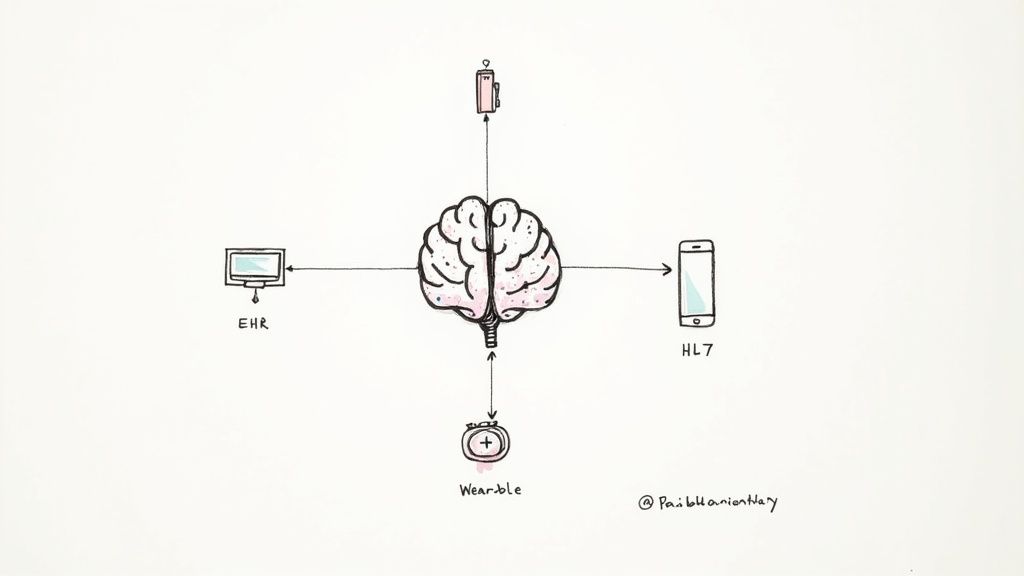
This visual breaks down how these core pillars support more advanced capabilities down the line.
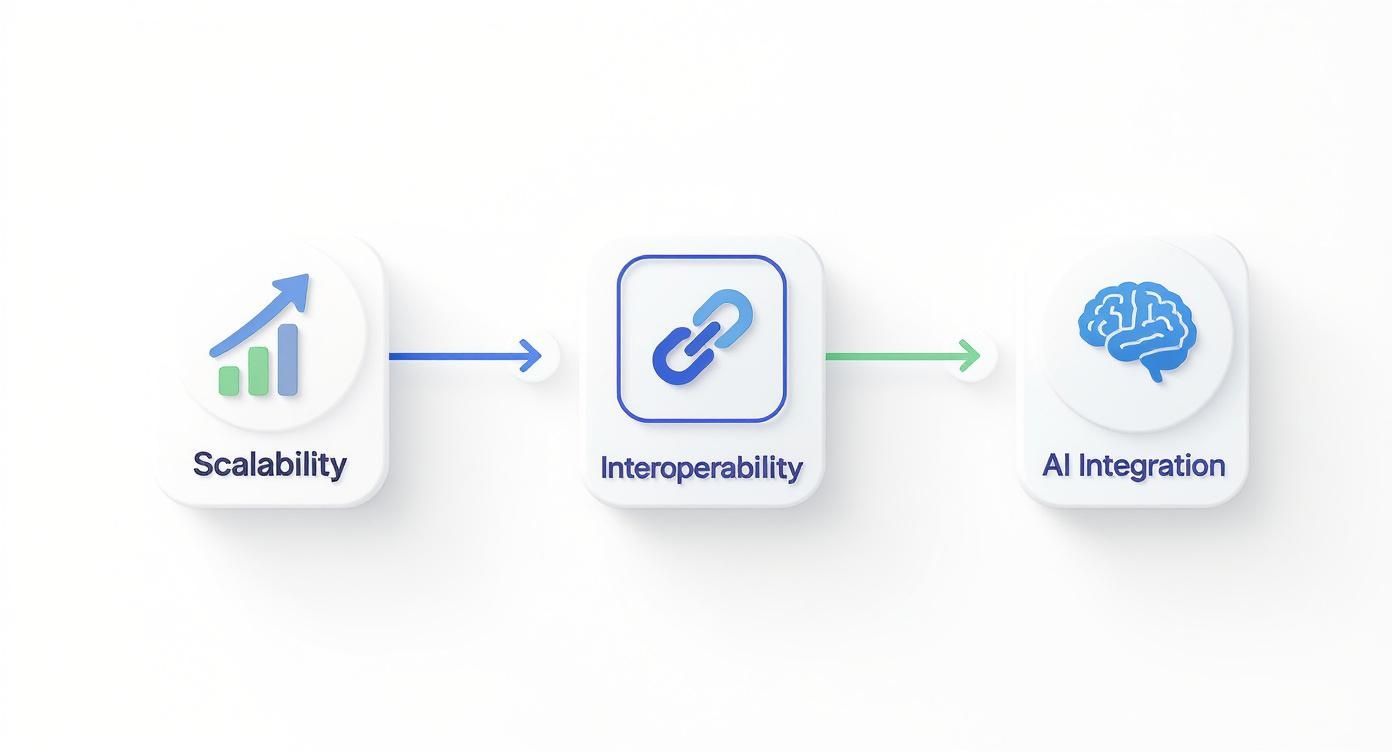
As you can see, a solid foundation of scalability and interoperability is what makes sophisticated AI integration possible—a key differentiator in today's healthcare market. Understanding how Custom Software Development Outsourcing Boost Your Business can unlock these capabilities is often the first step for forward-thinking organizations.
Custom vs Off-the-Shelf Healthcare Software
The choice between building and buying is a significant one. This table lays out the core differences to help you see why a custom path often delivers far greater long-term value in the healthcare space.
| Feature | Custom Application | Off-the-Shelf Software |
|---|---|---|
| Workflow Fit | Designed to perfectly match your existing clinical and administrative workflows. | Forces you to adapt your workflows to its rigid, pre-defined structure. |
| Compliance | Built with specific HIPAA, FDA, and other regulatory needs integrated from day one. | Offers generic compliance features that may not cover your specific use case. |
| Interoperability | Engineered for seamless integration with your specific EHR, LIS, or PACS systems. | Limited, often clunky integrations that can create data silos and friction. |
| Scalability | Architected to grow with your user base and data volume without performance loss. | May require expensive upgrades or a complete platform change as you scale. |
| Competitive Edge | Creates a unique patient experience and operational efficiency that sets you apart. | Puts you on the same functional playing field as every other competitor using it. |
| Long-Term Cost | Higher initial investment but lower costs over time due to no licensing fees. | Lower upfront cost but ongoing subscription fees can become a major expense. |
| AI Integration | Allows for the integration of specialized, best-in-class AI models and tools. | You're stuck with whatever limited, pre-built AI features the vendor provides. |
While off-the-shelf software might seem like a quick fix, the compromises often lead to bigger headaches and missed opportunities down the road. Custom development is an investment in a solution that truly works for you, not against you.
Modernizing with Artificial Intelligence
The move toward custom solutions is hitting overdrive thanks to the rise of AI. Using AI for predictive diagnostics or automating soul-crushing administrative tasks is no longer some far-off concept; it’s happening right now. The global healthcare IT market was valued at an eye-watering $394.6 billion in 2022 and is expected to rocket to $974.5 billion by 2027.
With a reported 94% of healthcare organizations either using or planning to use AI by 2023, the industry is in the midst of a massive shift. This is where a custom approach becomes non-negotiable. Generic products give you limited, black-box AI features. A custom application, however, gives you the freedom to integrate cutting-edge AI models that are trained on your specific data to solve your specific problems.
Navigating Healthcare Compliance and Security
When you’re building a custom healthcare application, compliance isn't just another feature on the roadmap—it's the absolute foundation. A security breach isn't just a bad press day; it can trigger crippling fines, drag you into legal battles, and completely shatter patient trust. This is why security can't be an afterthought. It has to be baked into every single stage of the development lifecycle. It’s a matter of survival.
The Health Insurance Portability and Accountability Act (HIPAA) is the law of the land for healthcare data security in the U.S. Think of it less like a one-time checklist and more like an ongoing commitment to protecting Protected Health Information (PHI). For founders, this means understanding that compliance shapes everything from your database architecture to the final UI design.
Core Pillars of a Secure Healthcare App
When you sit down with your development team, you need to push past the simple question, "Is it HIPAA compliant?" Real security is built in layers, tackling potential weak spots from every angle.
Here’s what that looks like in practice:
- Robust Data Encryption: All PHI has to be unreadable to unauthorized eyes. This means encrypting it both when it's sitting on a server (at rest) and when it's moving across a network (in transit). Your team should be using strong standards like AES-256 for data at rest and TLS for data in transit. No exceptions.
- Secure Authentication: A simple username and password just don't cut it anymore. Multi-factor authentication (MFA) is non-negotiable. It adds that critical second layer of security, forcing users to verify their identity with something like a code sent to their phone before they can get in.
- Detailed Audit Trails: You have to know who accessed PHI, what they did with it, and precisely when they did it. Comprehensive logging and audit trails are a direct HIPAA mandate and are your first line of defense when investigating a potential security incident.
These three pillars are the technical backbone of a secure app. If you get even one of them wrong, you're leaving the door wide open.
The Real-World Cost of Compliance Failures
Let's be clear: the financial and reputational stakes are sky-high. HIPAA violations have led to massive penalties, sometimes running into millions of dollars for a single breach. In one well-known case, a healthcare provider was slammed with a $2.5 million fine just for failing to properly manage who could access its EHR system. The result? Unauthorized employees viewed thousands of patient records.
Another organization had to pay a $3 million penalty after a stolen, unencrypted laptop exposed the PHI of thousands of patients. These aren't just scary stories; they're stark reminders that cutting corners on security can gut your business. Often, the damage to your brand's reputation is even more devastating than the fine.
Building trust is a slow, deliberate process. Losing it can happen in an instant. In healthcare, that trust is anchored in the unwavering promise that a patient's most sensitive information is safe.
Your Security and Compliance Checklist
To build a product that's both innovative and trustworthy, you need a clear security framework from day one. It's far cheaper and more effective to build security in from the start than to try and bolt it on later. For a much deeper dive, our guide on HIPAA-compliant app development offers more detailed strategies.
Here’s a practical checklist to guide the conversation with your development team:
- Access Control: How are we implementing role-based access control (RBAC)? We need to ensure users can only see the absolute minimum information required to do their jobs.
- Data Disposal: What’s our protocol for securely and permanently deleting PHI when it's no longer needed? This has to cover both our live systems and our backups.
- Third-Party Vetting: How are we vetting our vendors (like cloud hosts or API services) for their own HIPAA compliance? Do we have signed Business Associate Agreements (BAAs) with every single one of them?
- Incident Response Plan: If a breach happens, what's our step-by-step plan? Who does what, and how will we notify affected patients and the authorities?
By asking these tough questions early and often, you shift compliance from a bureaucratic headache into a true strategic advantage. You end up with a product that patients and providers alike can trust without a second thought.
Designing an Experience That Scales with Your Patients
A good healthcare app solves a problem. A great one solves that problem with an intuitive, empathetic experience that can grow from a few beta testers to millions of patients without breaking a sweat. This dual focus—empathetic design and scalable architecture—is what separates successful projects from those that stall out.
It all starts with getting into the mindset of a healthcare user. This isn't like an e-commerce app where the goal is a quick purchase. Healthcare interactions are often stressful, urgent, and require absolute clarity. Your user interface (UI) and user experience (UX) must be built around this emotional reality, prioritizing simplicity and accessibility above all else.
Building for Everyone: Accessibility and Clarity
When you design for healthcare, your audience is incredibly broad. You're building for tech-savvy millennials and, in the same breath, for older patients who might be using a smartphone app for the very first time. This isn't just about being inclusive; it's a fundamental requirement for the app to actually work as intended.
Your design absolutely must adhere to the Web Content Accessibility Guidelines (WCAG). While these standards are framed around helping people with disabilities, the principles make the app better for everyone.
Here's what that looks like in practice:
- High-Contrast Visuals: Text and key interface elements need to pop. This is crucial for users with visual impairments but also helps anyone using their phone in bright sunlight.
- Clear, Simple Language: Ditch the clinical jargon. An instruction should be just as easy for a patient to understand as it is for a doctor.
- Intuitive Navigation: Users should never have to guess where to go next. A logical, predictable layout reduces stress and keeps people from getting frustrated.
- Large, Tappable Targets: Buttons and links need to be big enough to press easily, which is a game-changer for users with motor skill challenges.
The market backs this up. The global digital health market is projected to hit an incredible $660 billion by 2025, driven by the demand for personalized care. A huge slice of that is mobile health (mHealth), with downloads expected to top 5 billion annually. This isn't a niche audience; it's everyone. For more on where the industry is headed, check out these innovations in healthcare software development.
The Architectural Blueprint for Growth
While a great UX brings users in, a scalable architecture is what keeps the app running when your user base explodes. Making the right architectural choices early is the single best way to avoid a costly, painful rebuild later on. Think about a telehealth app that works perfectly for 100 daily consults but crashes when thousands try to log on during a public health crisis. That's the exact scenario you need to engineer against.
Your first big decision is your cloud provider. The "big three"—Amazon Web Services (AWS), Microsoft Azure, and Google Cloud Platform (GCP)—all offer robust, HIPAA-compliant services. The right choice often boils down to your team's existing expertise and the specific services you need.
Next, you need to decide between a monolith and a microservices architecture.
Monolithic Architecture: The whole application is built as one big, unified codebase. It’s often simpler to get up and running at the very beginning.
Microservices Architecture: The application is broken down into a collection of smaller, independent services. Each one handles a specific function, like patient authentication, appointment scheduling, or billing.
For nearly any modern healthcare app expecting serious growth, a microservices approach is the clear winner.
Why Microservices Win for Scalability
A monolith might get you to an MVP faster, but it becomes a massive bottleneck as you grow. A single bug can take down the entire system. And when you need to scale? You have to duplicate the whole application, which is wildly inefficient.
Microservices, on the other hand, give you resilience and flexibility:
- Independent Scaling: If your appointment scheduling service is getting slammed with traffic, you can scale just that service without touching anything else. It's far more cost-effective.
- Fault Isolation: When one service fails, the rest of the app can often keep running. This prevents a small bug from causing a total system outage.
- Technology Freedom: Different services can be built with different programming languages. This lets your team use the absolute best tool for each specific job.
By pairing a human-centered design philosophy with a forward-thinking microservices architecture, you build an application that not only serves users well today but is ready for whatever tomorrow brings.
Integrating AI and Interoperability for Smarter Care
A modern healthcare application can't afford to be an island. Its real value comes from its ability to talk to other systems and pull intelligent insights from the data it gathers. This is where two critical pieces of custom healthcare application development come into play: seamless data exchange (interoperability) and AI-powered intelligence.
Think of interoperability as the central nervous system for your app. It’s what lets your software securely pull a patient's lab results from one system, their medication history from another, and their primary care notes from an EHR—all in real-time. Without it, you’re just creating frustrating data silos that lead to an incomplete picture of the patient and clumsy, inefficient care.
Connecting the Healthcare Ecosystem with FHIR and HL7
To make this seamless communication a reality, the industry relies on a few standardized languages. The two big ones you absolutely need to know are HL7 and FHIR.
- HL7 (Health Level Seven): This is the old guard, the well-established standard for swapping clinical and administrative data. It’s the workhorse humming behind the scenes in countless hospitals.
- FHIR (Fast Healthcare Interoperability Resources): FHIR is the modern, web-based evolution of HL7. It's built on APIs, which makes it a dream for developers to work with and a perfect fit for mobile and cloud-based apps.
A huge part of your initial discovery phase has to be figuring out which systems your app needs to communicate with and what standards they speak. A solid integration strategy using FHIR or HL7 isn't just a nice-to-have; it's non-negotiable if you want to build a tool that actually fits into a real clinical workflow.
Unleashing the Power of Artificial Intelligence
Once your application can tap into and understand data from all these different sources, you can start doing some truly remarkable things with Artificial Intelligence. AI isn't just a buzzword here; it's a powerful set of tools that can chew through massive amounts of health data to find patterns a human would almost certainly miss. The potential is staggering. You can explore some truly innovative AI solutions for healthcare to see what's possible.
This combination of connected data and built-in intelligence is driving massive growth. The healthcare cloud computing market is expected to leap from $53.8 billion in 2024 to over $120.6 billion by 2029, largely because custom software is finally solving these big interoperability problems. At the same time, AI in healthcare is projected to explode from $18.16 billion to $72.85 billion in the same timeframe. This highlights the huge opportunity for founders building smart, connected applications.
Making AI Integration Manageable for Founders
Okay, integrating AI sounds complicated, and frankly, managing it can quickly turn into a massive headache. You have to juggle different AI models, keep track of thousands of prompts, get a handle on skyrocketing costs, and log every single thing for compliance and troubleshooting. This is the exact operational nightmare we built Wonderment's prompt management system to solve.
Trying to manage AI prompts, versions, and costs across multiple models using spreadsheets and manual logs is a recipe for chaos. It doesn't scale, it's not secure, and it distracts you from building your core product.
Our tool is essentially a central command center for all your AI integrations. It’s an administrative layer that plugs right into your application, making advanced AI not just accessible but manageable, even for a lean startup team.
Here’s how it helps you sidestep the common pitfalls:
- Prompt Vault with Versioning: Keep all your prompts stored, tested, and organized in one spot. If a new prompt version starts giving you weird results, you can instantly roll back to a previous one that you know works.
- Secure Parameter Manager: This lets you safely connect your AI prompts to your internal databases. Your AI can pull real-time, relevant data to generate personalized responses without ever exposing sensitive information.
- Cross-AI Logging System: Get a single, unified log of every interaction across every AI model you’ve integrated. This is a lifesaver for debugging, monitoring performance, and maintaining those crucial audit trails for compliance.
- Token Cost Manager: See your cumulative AI spend on a clear dashboard. No more surprise bills. This helps you understand the exact cost of each AI-powered feature, so you can allocate your resources wisely.
By taking these backend operational headaches off your plate, our system frees you up to focus on what actually matters: creating an intelligent, interconnected healthcare application that delivers exceptional care.
How to Choose the Right Development Partner
Picking a development partner for your custom healthcare app is probably the single most important decision you'll make. I can't stress this enough. The right team isn't just there to write code; they act as a strategic partner who gets the high-stakes, regulated world of healthcare.
The wrong one? They can burn through your budget, blow past deadlines, and, worst of all, build a product that’s dead on arrival because of compliance failures. Your success really depends on finding a team with a proven track record, not just in software, but specifically in healthcare. This is no time to hire a group that's "willing to learn" HIPAA on your dollar. You need experts who already live and breathe it.
Beyond the Portfolio: What to Ask Potential Partners
When you're vetting potential partners, you have to dig much deeper than their slick marketing website. Your real goal is to get a feel for their actual, in-the-trenches experience and processes. When you're diving into custom healthcare application development, making the right choice is everything, which means carefully choosing medical device software development companies that fit the bill.
Here are the essential questions you should be asking point-blank:
- HIPAA & Security: "Can you walk me through a specific project where you implemented security controls to meet HIPAA standards?" Don't settle for a simple "yes." You want to hear the gritty details about encryption, access controls, audit logs, and secure data handling.
- Past Healthcare Projects: "Show me 2-3 healthcare applications you've actually built. What were the biggest challenges you ran into with interoperability or compliance?" This question forces them to talk specifics and shows you how they solve real-world problems in your domain.
- Project Management: "What’s your go-to project management style—Agile, Waterfall, or something else?" For most healthcare apps, an Agile approach is a much better fit. It allows for the flexibility and constant feedback loops that are critical when you're navigating complex, evolving requirements.
A vague answer to any of these is a massive red flag. Real experts will be eager to get into the weeds and share the details of their work.
When you're vetting potential development partners, it's easy to get lost in technical jargon. A structured approach helps you compare apples to apples. The table below outlines critical questions to ask, ensuring you cover all your bases—from technical chops to compliance know-how.
Key Questions for Vetting Development Partners
| Category | Essential Question to Ask | Why It Matters |
|---|---|---|
| Healthcare Experience | "Can you provide case studies for 2-3 HIPAA-compliant apps you’ve successfully launched?" | Proves they've navigated the complexities of healthcare development before and aren't learning on your project. |
| Compliance & Security | "Describe your process for conducting a Security Risk Analysis (SRA) and implementing necessary safeguards." | Demonstrates a proactive, structured approach to security, not just a reactive one. A core HIPAA requirement. |
| Interoperability (FHIR) | "What is your experience with FHIR APIs and integrating with major EHR systems like Epic or Cerner?" | Gauges their ability to build a connected application that can actually communicate with other healthcare systems. |
| Technical Stack & QA | "How do you approach testing for a healthcare app, specifically around data integrity and security vulnerabilities?" | Shows their commitment to quality and patient safety. Healthcare QA is far more rigorous than in other industries. |
| Team & Process | "Who will be my day-to-day contact, and what does your communication and reporting cadence look like?" | Transparency is non-negotiable. You need to know how you'll get updates and resolve issues quickly. |
| Long-Term Support | "What do your post-launch support and maintenance plans look like?" | Your app needs ongoing monitoring and updates. You need a partner for the long haul, not just the initial build. |
Using a checklist like this ensures you don't miss anything critical. A partner who can confidently and specifically answer these questions is one you can trust.
Engagement Models: Which One Is Right for You?
Understanding how a development firm structures its contracts is just as important as its technical prowess. The engagement model you choose dictates how you collaborate, how you're billed, and how much wiggle room you have.
Here’s a quick rundown of the three most common models:
- Fixed-Price: This works best for projects with a crystal-clear, set-in-stone scope. You agree on a single price for a very specific list of deliverables. It’s predictable, but it offers zero flexibility. If you need to add a feature or pivot, you’re looking at a slow and costly change order process.
- Time & Materials (T&M): You simply pay for the actual hours the team works on your project. This model gives you maximum flexibility, which is perfect for complex healthcare apps where requirements are likely to evolve. It does require a high level of trust and transparent communication from your partner.
- Dedicated Team: In this model, you essentially hire a full-time team of developers, designers, and project managers who work only on your project. It provides the highest level of control and integration, feeling like an extension of your own company. This is a great fit for large-scale, long-term projects.
For most founders building a custom healthcare app from the ground up, a Time & Materials or Dedicated Team model is the smart money. The rigid nature of a fixed-price contract almost always clashes with the dynamic, unpredictable reality of healthcare tech development.
At the end of the day, the best partner is one who can prove they have deep industry expertise, communicates with total transparency, and offers a flexible working model that makes sense for your project. Choosing wisely here sets the entire foundation for your success.
Common Questions About Healthcare App Development
Jumping into custom healthcare application development always kicks up a lot of questions. As a founder, you know you're not just building another app; you're creating a complex, heavily regulated product that patients and doctors will rely on. Getting straight answers to the big questions right from the start is absolutely critical.
We've been through this process countless times, so we’ve rounded up the most common (and important) questions we hear. These are the practical, real-world concerns that can genuinely make or break a new healthcare tech venture.
How Long Does It Typically Take to Build a Custom Healthcare Application?
This is always the first question, and the honest-to-goodness answer is: it really depends on the complexity. But that's not a helpful answer, so here’s a realistic framework based on our experience.
A Minimum Viable Product (MVP) with a solid core feature set—things like user profiles, a basic appointment scheduler, and secure messaging—is typically a 4 to 6-month journey from kickoff to launch.
If you’re aiming for something more comprehensive with advanced features like AI-driven diagnostics, deep EHR integration using FHIR APIs, or remote patient monitoring, you should plan for 9 to 12 months, sometimes longer.
The project timeline usually breaks down like this:
- Discovery & Strategy (4-6 weeks): This is where we get into the weeds, mapping out user journeys, defining the tech requirements, and locking down the compliance strategy. It’s the foundation for everything that follows.
- UX/UI Design (4-8 weeks): Healthcare apps demand an intuitive, accessible, and empathetic interface. This isn't just about looking good; it's about usability for everyone, from tech-savvy doctors to elderly patients.
- Development Sprints (12-24+ weeks): This is the heart of the project where the code gets written. We run this using an agile methodology, which lets us build, get feedback, and adjust in cycles instead of waiting until the end.
- Testing & Compliance Audits (4-8 weeks): Rigorous QA and security testing aren't optional in this space. We hammer on the app to make sure it's stable, secure, and ready for a HIPAA audit.
An agile approach is your best friend here. It gives your team the flexibility to react to new insights without throwing the whole project off the rails.
What Are the Biggest Hidden Costs in Custom Healthcare Software?
While the hours spent on development are the biggest line item, several other significant costs often catch founders off guard. You absolutely need to budget for these from day one to avoid painful surprises later.
The biggest budget mistake you can make is thinking the spending stops at launch. A healthcare app isn't a one-and-done product; it’s a living system that needs continuous investment to stay compliant, secure, and relevant.
Here are the "hidden" expenses we always tell our partners to plan for:
- Ongoing Compliance and Security Audits: HIPAA isn't a certificate you hang on the wall. It requires constant vigilance—regular risk assessments, monitoring, and periodic penetration testing to protect against new threats. Think of this as a recurring operational cost, like rent or salaries.
- Third-Party Integration Fees: Your app won't live in a vacuum. Connecting to EHR systems, payment gateways, e-prescribing services, and analytics platforms almost always involves licensing or subscription fees that can stack up fast.
- Legacy Data Migration: If you're replacing an old system, moving years of patient data over to your new platform can be a massive headache. It's a specialized, delicate process that requires careful planning to maintain data integrity and security. Don't underestimate the time and cost involved.
Can I Add AI Features to My Existing Healthcare Application?
Absolutely. In fact, injecting AI into a legacy application is one of the smartest ways to extend its life and give it a serious competitive advantage. And it's more achievable than you might think. This is exactly the kind of challenge that tools like Wonderment's prompt management system are built to solve.
Instead of building a massive AI infrastructure from the ground up—a truly monumental task—you can integrate a system like ours directly into your existing software. It acts as a command center for managing prompts, connecting to different AI models (like those from OpenAI or Google), and keeping a close eye on performance and costs.
This approach lets you roll out sophisticated features—like predictive analytics to flag at-risk patients or AI that automates tedious administrative reports—without having to completely re-engineer your application.
Ready to modernize your application with powerful, manageable AI features? Wonderment Apps provides the tools and expertise to seamlessly integrate artificial intelligence into your custom healthcare software. Schedule a demo today to see how our prompt management system can accelerate your journey from idea to intelligent application.