

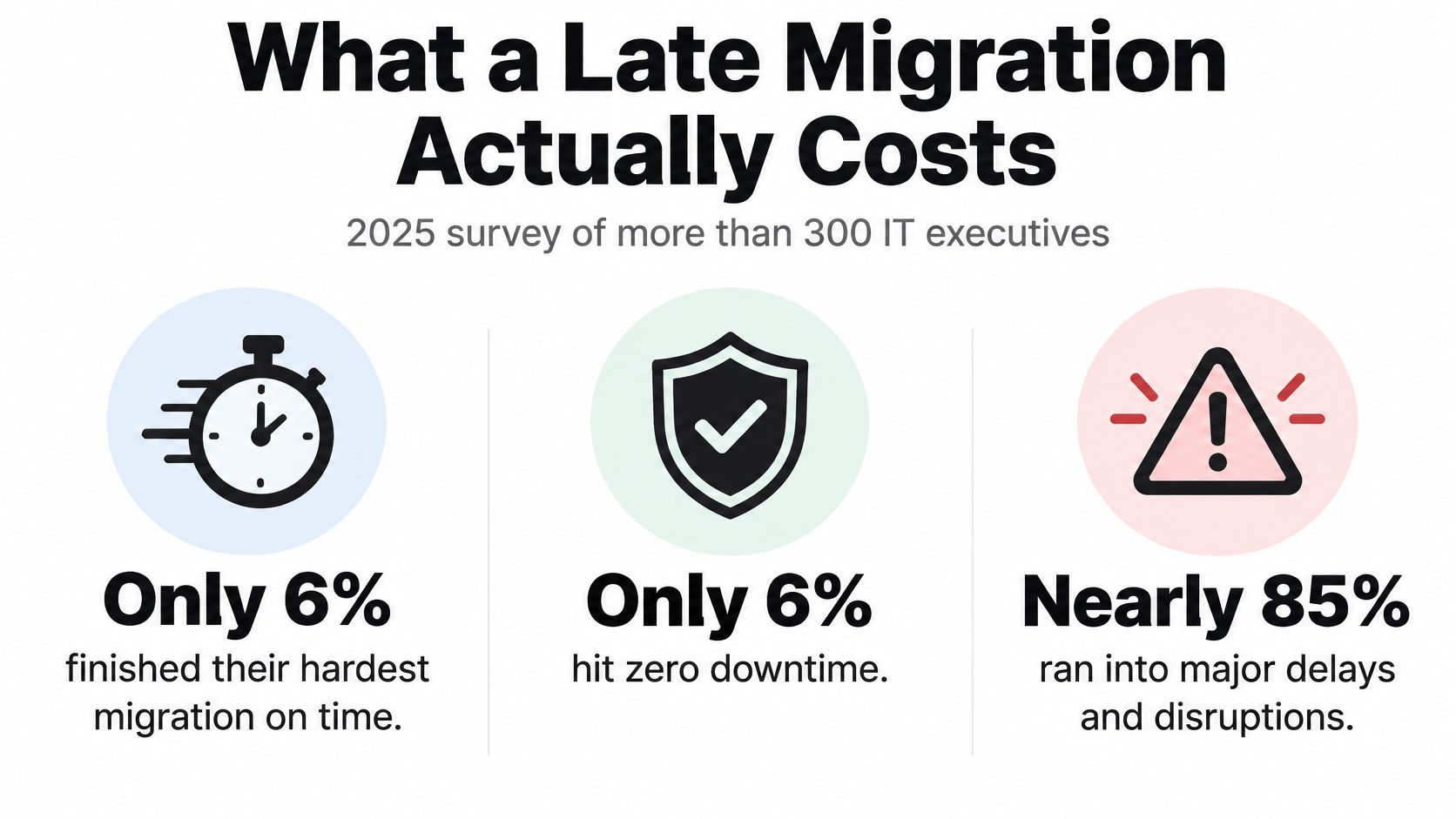
Only 6% of respondents finished their most challenging database migration on schedule, according to a 2025 survey of more than 300 IT executives reported by Yahoo Finance. That's a reason to rethink the database migration process: success isn't just getting records into a new database. It's keeping the business operating and proving those records still produce the right decisions.
What a Late Migration Actually Costs
A late migration can mean extending infrastructure contracts, keeping engineers away from product work, and asking customers to tolerate another maintenance notice. The expensive part often isn't the copy operation. It's discovering, too late, that a payment integration, reporting job, or mobile client depends on behavior nobody documented.
The survey summarized by Caylent describes the following schedule, downtime, and business outcomes for respondents' most difficult migrations.
What goes wrong on hard database migrations
| Outcome | Share of organizations |
|---|---|
| Finished the hardest migration on time | 6% |
| Achieved zero downtime | 6% |
| Ran one week to six months longer than planned | Nearly 85% |
| Delay of one to three months | 21% |
| Delay of four to six months | 10% |
| Delay longer than six months | 4% |
| At least five hours of downtime | 46% |
| Customer-experience problems | 51% |
| Lost revenue | 49% |
| Operational slowdowns | 44% |
These are reported outcomes, not a prediction for your project. They show why a migration plan needs business acceptance criteria alongside engineering tasks.
Write the downtime budget before the schema plan
Ask the business owner to approve concrete limits before engineers select migration tools:
- Longest tolerable interruption: Separate unavailable service from read-only service. Customers viewing an account isn't equivalent to customers completing a payment.
- Cost of that window: Estimate interrupted revenue, staff inactivity, support demand, and recovery work. Don't assume every delayed transaction is permanently lost.
- Journeys that must remain live: Name checkout, payments, claims, or citizen-portal tasks, then assign each an availability requirement and acceptance test.
For financial systems, CEFCore's steps for migrating legacy financial data offer a useful companion when organizing the legacy-data workstream. Keep that work connected to customer continuity, not isolated inside a database ticket.
Schema conversion and record movement sit beside dependency discovery, compatibility testing, validation, rollback preparation, and cutover coordination. Someone must own each workstream.
Include AI administration early
If AI features read the database, include an administrative layer in the plan: a versioned prompt vault, a parameter manager for internal database access, logging across integrated models, and a cost manager for cumulative spend. A demo of a prompt-management tool should show how administrators control these connections during a schema transition, not merely how they edit prompt text.
Require application routing and database permissions to keep prompts away from partially migrated structures. Leave planning with a written downtime budget and a named approver, not a hopeful promise of zero downtime.
Run the Database Migration Process in Order
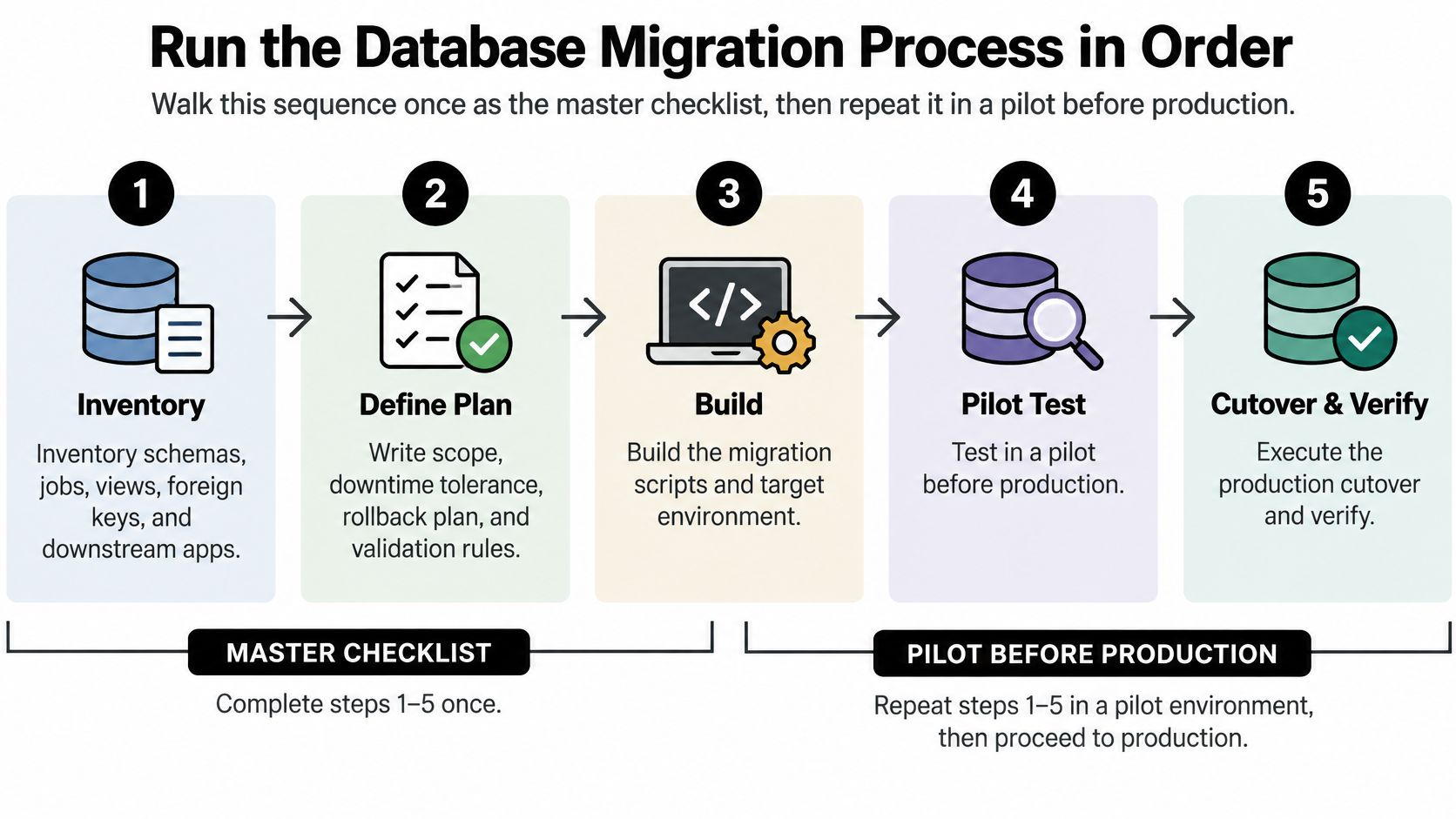
Treat the migration as an executable runbook, not a collection of tickets that happen to share a deadline. The Dell EMC migration methodology emphasizes scripted execution, pilots, backups, documented procedures, rollback preparation, and post-load validation.
Walk the sequence as a master checklist, then run it in a pilot before production. Record actual results and elapsed time so the production plan reflects observed behavior.
Build a repeatable execution path
Inventory schemas and dependencies, including tables, views, foreign keys, scheduled jobs, stored procedures, and downstream applications, because an unlisted consumer can fail after an otherwise clean move.
Write scope and acceptance rules, including downtime tolerance, permitted data loss, rollback triggers, and responsible owners, and stop planning if stakeholders disagree about what constitutes success.
Take a full backup and prove a restore in an isolated environment, because a completed backup job doesn't demonstrate that the application can recover from it.
Profile and cleanse the source, inspecting nulls, encodings, time zones, duplicates, and invalid references, and quarantine ambiguous records rather than inventing replacements.
Convert schema and procedural code, including deprecated functions and engine-specific SQL, because translating column types alone won't preserve stored application behavior.
Extract and transform through rerunnable scripts, with explicit type mappings and transformation logs, so a failed run doesn't require someone to reconstruct manual edits.
Load in restartable batches, recording checkpoints and rejected records, and stop if retries create duplicates or skip records without a trace.
Reconcile the loaded target, checking record counts, checksums or aggregates, foreign keys, constraints, indexes, and permissions, because a successful import command proves only that the command finished.
Pilot with representative transactions and real clients, including an order, payment-state transition, or claim, and reject the run if application connectivity or expected results differ.
Perform a controlled cutover, requiring replication lag to meet the approved limit when replication is used, and retain the rollback path until production acceptance checks pass.
A dependency inventory should include small public-facing systems, too. If you're planning to build a website for your trade, Wistec's service context is a useful reminder to inventory quote forms, booking flows, and customer notifications rather than treating the website as a static page.
Make the pilot earn production approval
For near-zero downtime, bulk-load existing records while change data capture, or CDC, streams subsequent inserts, updates, and deletes. Dual writes are another option, but they require deliberate handling of partial failures. Before switchover, test clients against the target, reduce the replication backlog, and drain in-flight work.
Keep a signed execution record containing script versions, source boundaries, validation results, failed checks, and elapsed times. A pilot that succeeds only after undocumented console edits isn't a repeatable procedure.
Go/no-go rule: The business owner signs acceptance of service behavior. The DBA signs database readiness. Neither signature substitutes for the other.
Before booking the window, attach a specific cutover approach, lag limit where applicable, and rollback owner to the final step. “We'll switch when it looks ready” isn't an operational instruction.
Prove the Data Still Means the Same Thing
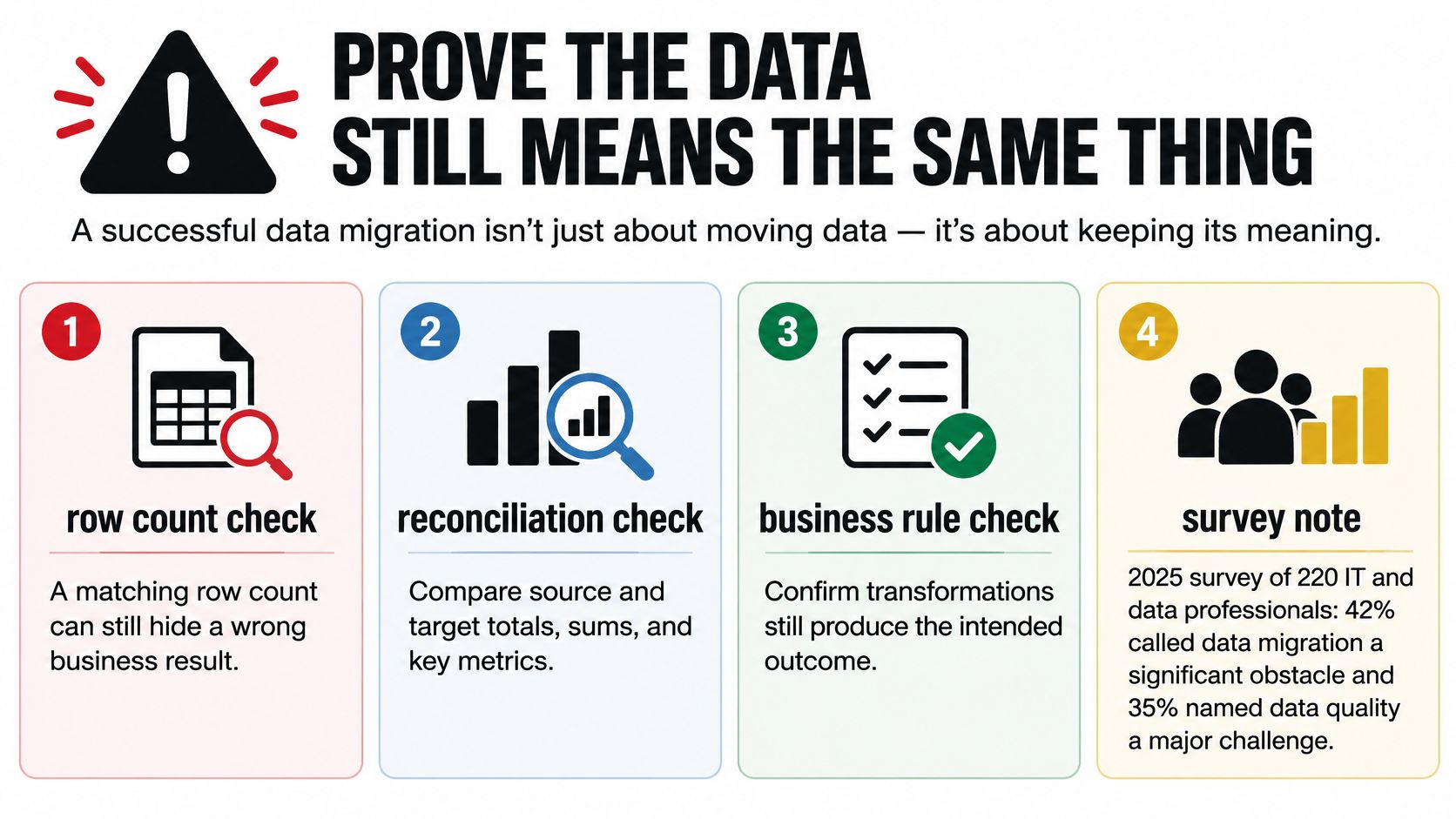
Complete data can still produce an incorrect business result. A timestamp can arrive intact but be interpreted in a different time zone; a customer entitlement can exist while the application incorrectly denies access.
In a 2025 survey of 220 IT and data professionals, 42% considered data migration a significant obstacle and 35% identified data integration as a top challenge, according to Quest's account of changing database-management responsibilities. Integration matters because the database rarely makes the final business decision alone. Applications, APIs, background jobs, and analytical models interpret its contents.
Test the interpretation, not just the transfer
Use engine-specific test cases rather than assuming all database changes present the same problems. For SQL Server moves, exercise application SQL, drivers, transaction isolation, and error handling. For MySQL, scrutinize consistency, collation, and type-conversion behavior. For PostgreSQL upgrades, inspect procedural code for obsolete functions and deprecated features.
Then test the semantic traps that counts and file-level checksums won't settle:
- Permissions: Confirm that customer, staff, service-account, and AI roles can access exactly the intended records.
- Dates and text: Test time-zone boundaries, Unicode names, and encoding conversions through the actual application.
- Business rules: Compare rounding, null behavior, and empty-string handling in calculations and filters.
- History and sequence: Confirm audit trails remain attributable and event consumers process changes in the intended order.
These checks belong in a broader data governance framework so ownership, access rules, and accepted transformations remain documented after launch.
Reconcile outcomes people recognize
Say an order contains a discount, tax, a partial refund, and a pending payment. Matching its database rows isn't enough. Compare the amount the customer owes, the payment state the support team sees, and the revenue the reporting pipeline recognizes.
Use the same approach for clinical records, policy entitlements, and account balances. Exercise triggers, stored procedures, downstream APIs, analytics jobs, and AI retrieval workloads against known fixtures. For recommendation features, compare eligibility rules and retrieved inputs separately from naturally variable generated text.
A migrated record passes when the application makes the intended decision with it, not merely when the record exists.
Introduce traffic gradually and investigate unexpected changes before expanding access. Regulated teams should retain business reconciliations beside technical sign-off, including expected outcomes, observed outcomes, and approval evidence.
If a known claim changes status incorrectly, stop the cutover even when every row arrived. That's not excessive caution. It's the difference between transporting data and preserving the service.
Choose and Run the Cutover Window
Choose the cutover method by comparing interruption cost, consistency risk, and recoverability. A maintenance window can be safer than an elaborate always-on design when the organization can tolerate the outage but can't reliably reconcile concurrent writes.
Cutover approaches compared
The timing below describes planning expectations, not guaranteed performance. Establish your actual window through a production-sized rehearsal.
| Approach | Typical downtime | Consistency risk | Choose when | Rollback |
|---|---|---|---|---|
| Maintenance window | Minutes to hours, planned | Low if writes are stopped | Smaller data sets or a tolerated outage | Restore the backup or reopen the source |
| Blue-green cutover | Seconds to minutes | Schema or config drift between environments | Two full environments you can switch | Flip traffic or connection strings back |
| Change data capture | Near zero once lag is caught up | Lag spikes and event ordering | Always-on checkout, payments, or claims | Stop apply and return traffic to the source |
| Dual writes | Near zero during a short bridge | Split brain and partial failures | App rewrite that must bridge both stores | Disable writes on the new path |
| Big-bang reload | Hours to days | Highest, with a long freeze | Archive or noncritical reporting only | Reload from a verified backup |
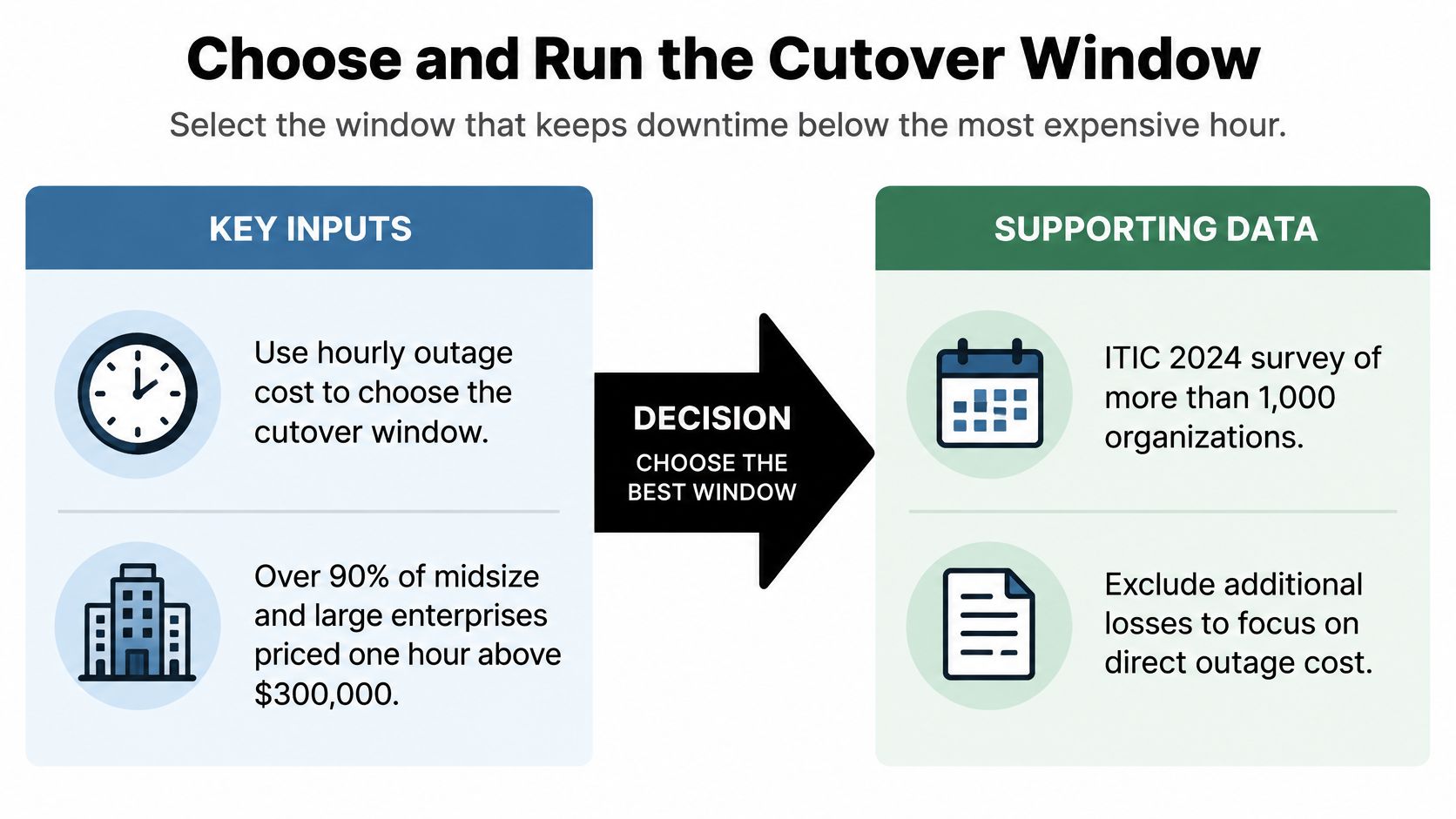
The financial stakes can justify additional engineering: ITIC's 2024 survey of more than 1,000 organizations found that over 90% of midsize and large enterprises estimated hourly downtime costs above $300,000, excluding litigation and regulatory penalties, while 41% placed the cost between $1 million and $5 million, as summarized by Zinstall. Those estimates encompass interrupted transactions, data loss or damage, and employee productivity, not just missed sales.
Choose the least complicated safe approach
Maintenance windows work when you can stop writers, finish the transfer, validate, and reopen within the business budget. Remember that writers include queue consumers, imports, scheduled jobs, and administrative tools, not just customer-facing requests.
Blue-green keeps parallel environments available for a traffic switch. It doesn't automatically synchronize their databases. Define how data reaches the green environment and how connection pools, cached configuration, and long-running sessions switch.
CDC fits systems that need continuous updates during a bulk backfill. Measure lag during peak activity and confirm transaction ordering and delete handling. A quiet dashboard during low traffic doesn't establish peak readiness.
Dual writes introduce a harder failure question: what happens when the source accepts a write and the target rejects it? Use idempotency keys, durable retry records, and a reconciliation process. Don't choose this approach merely because “zero downtime” sounds better in a steering meeting.
Reserve big-bang reloads for archive or noncritical reporting workloads where the long freeze is acceptable. For critical transactional systems, a simpler planned interruption may be preferable to dual-write reconciliation the team cannot rehearse.
Define lag in terms engineers can act on
Write a maximum lag in seconds into the runbook, along with the measurement method and abort condition. Distinguish replication delay from missing or failed events: a low lag reading doesn't excuse an unapplied transaction.
At the final write fence, prevent new source writes, drain active transactions, and verify that the target has applied the source's final committed position. This matters especially for payments and claims, where switching before the last acknowledged transaction arrives can produce a misleading customer state.
Freeze schema changes ahead of cutover and make the freeze duration explicit in the project schedule. Any exception should trigger compatibility review and, where necessary, another rehearsal.
Make rollback honest
A connection-string reversal is safe only if the old source contains every accepted write. Once the target begins accepting production changes, returning traffic may require reverse replication, reconciliation, or another controlled write pause.
Document that boundary in the backup and disaster recovery plan. Time the recovery procedure, including validation and client reconnection, rather than timing only the restore command.
Operational safeguard: Never advertise a rollback time that excludes the work needed to preserve writes accepted after cutover.
Before execution, publish status-page wording and identify who may extend the window versus who must call it off. Spot-check leap-day dates, Unicode names, and null versus empty-string behavior through representative journeys.
Retain the source read-only during the agreed observation period, but don't mistake that copy for a continuously current recovery system. Retire it only after acceptance, retention, and recovery requirements are satisfied.
Monitor Apps and AI After Go Live
Watch the application, not only the database console. Track request errors, slow queries, failed jobs, residual replication, and business counters such as completed orders or rejected payments. Compare them with a representative prior-week baseline, accounting for differences in traffic and business activity.
During the initial soak, refresh optimizer statistics where appropriate, confirm expected indexes are available, and compare the slowest application queries with their previous behavior. Don't immediately enlarge connection pools or add replicas to hide a query-plan regression.
Turn AI governance into an operating loop
The voluntary NIST AI Risk Management Framework organizes risk work into Govern, Map, Measure, and Manage. Applied to a migrated application, those functions become practical responsibilities:
- Govern: Name who approves prompt changes, integrations, and access-policy exceptions.
- Map: Document each AI use case, its users, permitted tables, and potential consequences.
- Measure: Test output quality, retrieval accuracy, access boundaries, and security controls.
- Manage: Assign responses to failures and revise controls as the application changes.
An administrative tool supports that loop, but database permissions and server-side authorization must still enforce access. Prompt wording isn't a security boundary.
Keep prompts, connections, and costs observable
One option is Wonderment Apps' prompt management system, an administrative tool that plugs into an existing desktop, web, or mobile application. It includes a prompt vault with versioning, a parameter manager for internal database access, logging across integrated AI models, and a cost manager showing cumulative spend.
Centralized administration helps teams keep prompts out of scattered application code and preserve a review process when changing models. A useful demo should follow a concrete migration scenario: update an approved database parameter, run a known AI request, inspect the model log, and verify the resulting cost visibility.
Keep sensitive information out of unrestricted logs, and associate requests with the prompt version and integration configuration used. That makes it easier to distinguish an application regression from a prompt or retrieval change.
Alert on unexpected token spending alongside query failures and latency. A changed schema can cause retrieval retries or oversized context even when the customer sees no obvious error.
Keep recovery available through the agreed soak period, assign an explicit retirement date, and require acceptance evidence before removing it. Go-live is a traffic event. Acceptance is an operational decision.
Staff the Migration Before You Book the Window
Don't reserve a production window until the people authorized to stop it are named. A migration needs more than someone who can run an export command; it needs people who can recognize an incorrect customer outcome and coordinate a safe response.
The U.S. Bureau of Labor Statistics occupational profile groups software developers with quality-assurance analysts and testers, lists 1,905,400 jobs and median annual pay of $134,040 in 2025, and projects 10% employment growth from 2025 through 2035, with approximately 106,100 openings annually. Those figures don't endorse any vendor. They reinforce why engineering and QA capacity deserve advance planning.
Assign ownership by responsibility
- Architecture and discovery: Name who owns dependency mapping, target design, product requirements, and user-experience consequences.
- Implementation and verification: Reserve engineers plus automated and manual QA practitioners who understand the actual stack.
- Security and AI access: Assign someone to validate authorization, prompt administration, and internal-data boundaries.
- Deployment and communication: Identify the cutover operator, incident commander, customer-message owner, and support coverage after launch.
Evaluate domain experience, not just technology lists. Fintech ledger reconciliation differs from media-delivery readiness, and healthcare access checks differ from ecommerce personalization tests.
A dedicated development team can provide continuing ownership, but ask who will attend rehearsals and support production. When operations are outsourced, RDE Technologies' guidance on choosing outsourced IT support in NYC offers a useful starting point for discussing support scope and accountability.
Require written go/no-go decisions
Before anyone sends the maintenance announcement, complete these decisions:
- The cutover approach, including its lag rule where relevant and the rollback owner.
- The business validation totals, proving that orders, payments, claims, or other critical journeys still work.
- The timed rollback rehearsal date, with the people who will execute it.
If any line is blank, don't schedule. A deliberate pause gives the team a solvable planning problem instead of an improvised production incident.
Wonderment Apps offers custom application development, AI modernization, and engineering teams that connect database changes to application behavior and long-term support. Visit Wonderment Apps to discuss your migration scope, validation requirements, and production-readiness plan.