


A shopper arrives at your storefront with a blank browser session, no cookies, and no purchase history. Your catalog still has to make a useful first impression, even though the system knows almost nothing about the person behind the screen.
That moment captures the core challenge of an AI recommendation engine. The visible product carousel is only the final step. Behind it sits a network of behavioral signals, models, business rules, APIs, fallback logic, and increasingly important governance controls. Wonderment Apps' prompt management system fits into that hidden layer by helping teams manage prompt versions, parameters, logs, and cumulative AI spend as recommendation features evolve.
When a Stranger Lands on Your Storefront
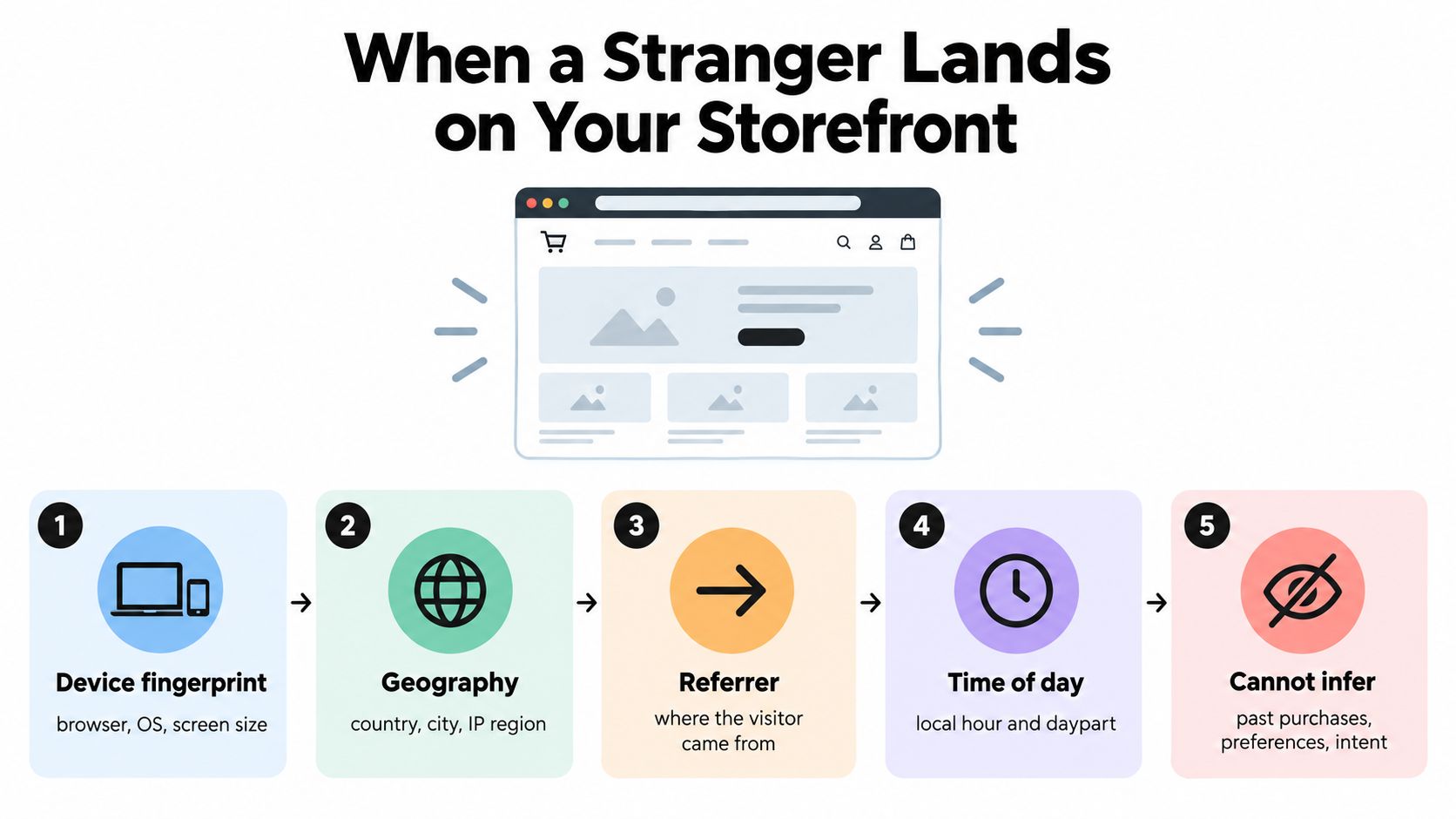
The homepage loads. The shopper hasn't signed in, accepted personalization cookies, or viewed a product. Your engine can still inspect useful context, but it must avoid pretending that context reveals more than it does.
It may receive a device fingerprint, such as browser, operating system, and screen size. It may have geography, including country, city, or IP region. The referrer can indicate whether the visitor came from a search result, paid campaign, email, or another page. The time of day can provide a broad session cue, such as morning browsing or evening shopping.
It can't infer past purchases, personal preferences, or current intent from those signals alone. A visitor arriving from a product comparison article might be ready to buy, casually researching, or looking for a gift. The catalog default therefore matters. Popular products, seasonal collections, editorially selected items, or inventory-aware categories give the engine a safe starting point until the shopper creates stronger signals.
The brain behind the visible carousel
The recommender isn't the only decision-maker. A separate prompt and configuration layer may determine which model gets queried, which data fields are passed into an AI workflow, which fallback runs when a model times out, and how the result is formatted for the storefront.
That orchestration layer makes recommendations easier to inspect. A product team can ask why a particular model version ran, which rule removed an item, whether a fallback supplied the list, and what request data was logged for later review.
Practical rule: Treat prompts and recommendation configuration as production code. Version them, review them, test them, and make rollback possible.
A prompt vault with versioning, a parameter manager for internal database access, logging across integrated AI systems, and a cost manager become operationally useful here. The shopper sees a row of products. Your team needs to see the chain of decisions that produced it.
What an AI Recommendation Engine Actually Does
Start with a bookstore clerk. The clerk remembers that you bought a beginner photography book, notices that readers with similar interests often choose a lighting guide, and places a small stack beside the counter. The clerk isn't claiming certainty. They're making ranked suggestions from incomplete evidence.
An AI recommendation engine follows the same basic pattern:
- Predict value. Estimate which products, articles, or actions a user may find useful.
- Generate candidates. Create a manageable set from the full catalog.
- Score candidates. Assign each item a relevance score using user, item, and context signals.
- Rank and filter. Put stronger options first, then apply rules for availability, exclusions, and business constraints.
The output isn't “the perfect product.” It's a list ordered according to the objective the team selected.
Four patterns worth knowing
Collaborative filtering learns from behavior across users. If shoppers who bought a particular espresso machine often purchased a certain grinder, the engine can surface that grinder to another shopper viewing the machine.
Content-based filtering uses item attributes. If a visitor repeatedly views waterproof hiking jackets, the system can recommend products with similar categories, materials, features, or use cases, even when interaction history is limited.
Hybrid models combine behavior with product information. That combination helps the engine use community patterns for established products while using catalog attributes for newer items.
Deep learning recommenders learn richer representations from sequences and feature interactions. They can model a shopper's order of actions, such as searching for a camera, comparing lenses, reading delivery information, and returning to the camera page.
These patterns support broader work around unlocking CPG growth with AI, especially when product discovery depends on a large catalog and changing consumer context. The model still needs clean events and a clear business objective. More complex machinery won't rescue ambiguous tracking or an undefined notion of “better.”
The Algorithm Families Behind Every Recommendation
No algorithm family wins every storefront. Each one makes a different bargain between data requirements, adaptability, interpretability, and failure risk.
| Algorithm | Data Required | Failure Mode | Best Fit |
|---|---|---|---|
| Collaborative filtering | User-item interactions, such as views, clicks, purchases, or ratings | Cold start, popularity bias, feedback loops | Catalogs with meaningful interaction history |
| Content-based filtering | Product attributes, categories, descriptions, specifications, and user interaction history | Filter bubbles, narrow discovery, metadata dependence | Newer catalogs or products with strong structured attributes |
| Matrix factorization | A user-item interaction matrix, often sparse | Limited handling of context and side information | Established catalogs with useful interaction patterns |
| Hybrid models | Interaction data plus item and user side information | Greater system complexity and tuning overhead | Teams that need stronger resilience across new and established items |
| Deep learning | Rich behavioral sequences, contextual features, and learned representations | Drift, feature quality problems, difficult debugging | Mature products with substantial behavioral data and engineering capacity |
Collaborative filtering is the familiar “people who bought this also bought” approach. It can discover associations that product metadata misses, but it tends to favor items with abundant interaction history. That creates a visibility loop: frequently shown products collect more interactions, then become even easier for the model to select.
Content-based methods start with what an item is. They're useful when a new product has accurate attributes but no behavioral history. Their weakness is repetition. A shopper who views one trail shoe may receive a shelf full of similar trail shoes, even if they're really looking for socks, a backpack, or a gift.
Matrix factorization compresses a large interaction matrix into learned user and item factors. It can work efficiently for established catalogs, but classical versions don't naturally understand every contextual signal, such as session intent, margin, or inventory status.
Hybrid models combine the strengths of several methods. A systematic review of deep learning collaborative filtering describes how learned representations and side information help address sparse feedback and cold-start item problems in its analysis of deep learning-based collaborative filtering.
For a practical overview of choosing among these approaches, see recommendation algorithms for product teams. The right choice depends less on fashion and more on the data your application can collect reliably.
Inside the Architecture of a Modern Recommender
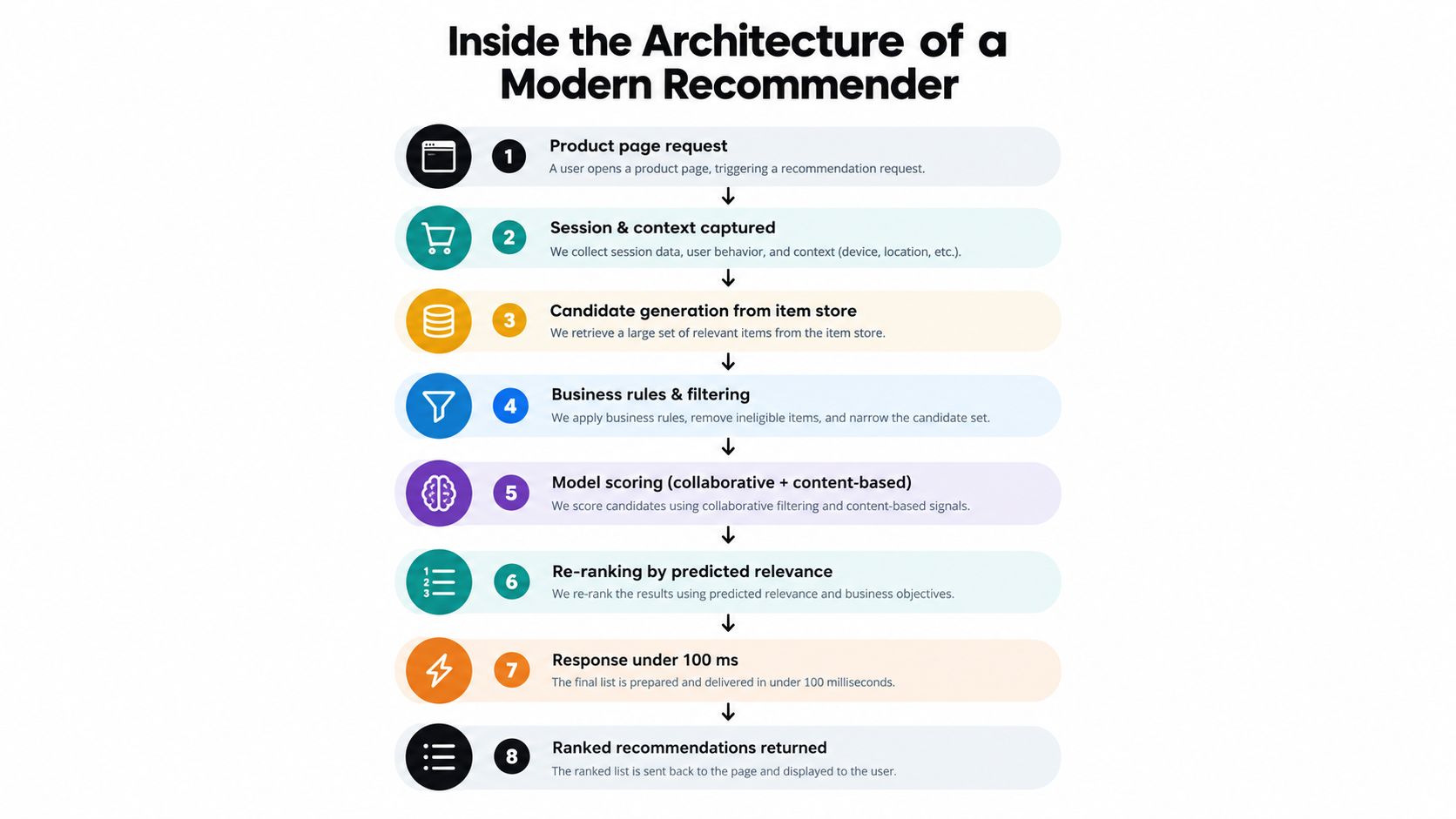
A recommendation request starts when a shopper opens a product page. The application captures the session context, then asks a recommendation service for a ranked result. The service has to balance freshness against latency and recall against precision at every stage.
From raw event to reusable signal
The event pipeline records actions such as clicks, add-to-cart events, purchases, and dwell time. Streaming processing can update session features quickly, while batch processing can build stable aggregates and retrain models. A feature store turns those raw events into reusable signals, such as recent category interest or product interaction frequency.
The retrieval layer then narrows the catalog. It might use collaborative associations, content similarity, embeddings, or a mixture of candidate generators to reduce a large inventory to a workable candidate set. Business filters remove unavailable, restricted, already purchased, or otherwise unsuitable items.
The ranker scores what remains. It can combine collaborative and content-based signals, predicted relevance, context, and business controls. A re-ranking step then adjusts the order to enforce diversity, inventory priorities, or other policies that the base model wasn't trained to understand.
Serving the result
The serving layer returns the ranked list through a recommendation microservice. Teams commonly separate this service from the storefront so they can update models, test rules, and scale inference independently. A microservice architecture example for scalable applications shows why that separation helps product teams isolate workloads and reduce bottlenecks.
Prompt governance fits at the orchestration stage, not as a substitute for retrieval or ranking. If an LLM generates explanations, interprets conversational intent, or selects among recommendation workflows, the team should record the prompt chain, model configuration, upstream signals, and response status. That record helps engineers distinguish a model-quality problem from a missing feature, a stale catalog field, or a faulty fallback.
Measuring Success Beyond Click-Through Rate
CTR is useful, but it answers only one narrow question: did someone click the recommendation? A shopper may click an item without buying it, while a low-click recommendation may support a profitable basket, introduce a new category, or prevent a poor experience caused by repetitive results.
Offline evaluation starts with a held-out interaction set. Precision@K asks how many displayed items were relevant, while Recall@K asks how much of the relevant set the system surfaced. F1, MAP, and NDCG provide additional views of ranking quality. For rating prediction, teams often use RMSE and MAE. These measures are part of the standard recommendation evaluation toolkit described in this metrics overview.
| Metric | What it Measures | Stage | Limitation |
|---|---|---|---|
| Precision@K | Relevant items among the top recommendations | Offline ranking | Doesn't show commercial value |
| Recall@K | Relevant items recovered from the candidate set | Offline ranking | Can reward broad, less useful lists |
| MAP or NDCG | Ranking quality and position sensitivity | Offline ranking | Depends on how relevance is labeled |
| RMSE or MAE | Rating prediction error | Offline prediction | Ratings may not represent purchases |
| CTR | Share of recommendation impressions that receive clicks | Online behavior | Clicks can reward curiosity rather than value |
| Conversion lift | Change in desired commercial action | Online experiment | Requires controlled testing |
| Average order value | Commercial value of resulting orders | Online business KPI | Can move because of unrelated merchandising |
| Catalog coverage | Breadth of items receiving exposure | Online monitoring | More coverage isn't automatically better |
A model can perform well offline and lose money online. Popularity-skewed training data may make the model excellent at predicting familiar clicks while hiding products with healthy margins or useful new inventory. Cold-start bias can produce the opposite problem, where a new item receives too little exposure to collect the interactions needed for evaluation.
Business teams should pair offline tests with a holdout A/B experiment and commercial KPIs. Business guidance commonly evaluates recommendation engines through conversion lift, average order value, repeat purchase rate, and customer lifetime value, rather than technical accuracy alone as outlined in this commercial evaluation guidance.
A useful dashboard has three layers: model quality, customer behavior, and business outcome.
The Hard Part Is Balancing Competing Goals
Most recommendation discussions start with relevance. Production teams quickly discover that relevance is only one resident of the ranking system.
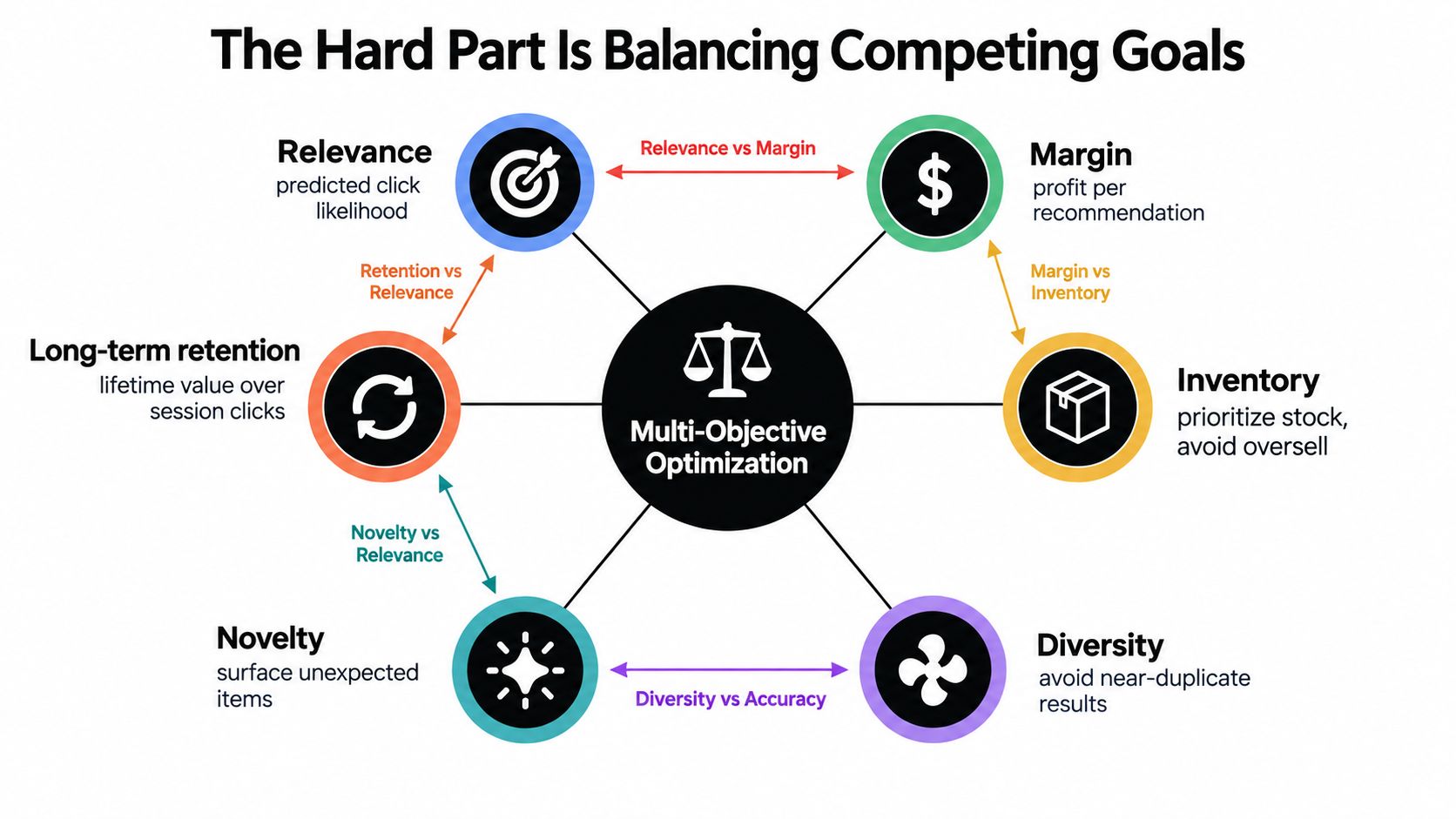
A product can be highly relevant but unavailable. It can attract clicks but deliver weak margin. It can be profitable but make the storefront feel repetitive. It can perform well in the current session while reducing long-term trust because the engine keeps steering the customer into the same narrow category.
The store manager analogy helps. A manager assigns floor space to products customers want, products the store needs to move, items with healthy supplier economics, and alternatives that keep the experience fresh. An AI ranking system makes a similar allocation decision, except it does so through scores, constraints, and re-ranking logic.
Turning priorities into ranking behavior
A practical ranker may blend predicted relevance with margin, inventory health, diversity, novelty, and a longer-term retention objective. The exact weights should come from business decisions, not from whatever metric happens to be easiest to optimize.
- Relevance helps the shopper find a suitable item.
- Margin protects the economics of the recommendation.
- Inventory prevents the engine from promoting unavailable or overcommitted stock.
- Diversity reduces near-duplicate results.
- Novelty gives useful products a chance to enter discovery.
- Long-term retention keeps the system from trading durable trust for a short-term click.
Each algorithm family behaves differently under these pressures. Collaborative filtering can over-index on popular products. Content-based models can keep recommending similar items and may favor well-described products. Deep learning models can capture richer behavior, but a re-ranking layer still needs to enforce inventory, diversity, and policy constraints.
Industry coverage describes a shift toward multi-objective optimization and more responsive personalization across intent, inventory, session behavior, and lifecycle stage in this market analysis of recommendation engines. The key product question is simple but uncomfortable: what should the system sacrifice when relevance, profitability, assortment, and trust point in different directions?
Deploying Recommendations at Scale Without the Headaches
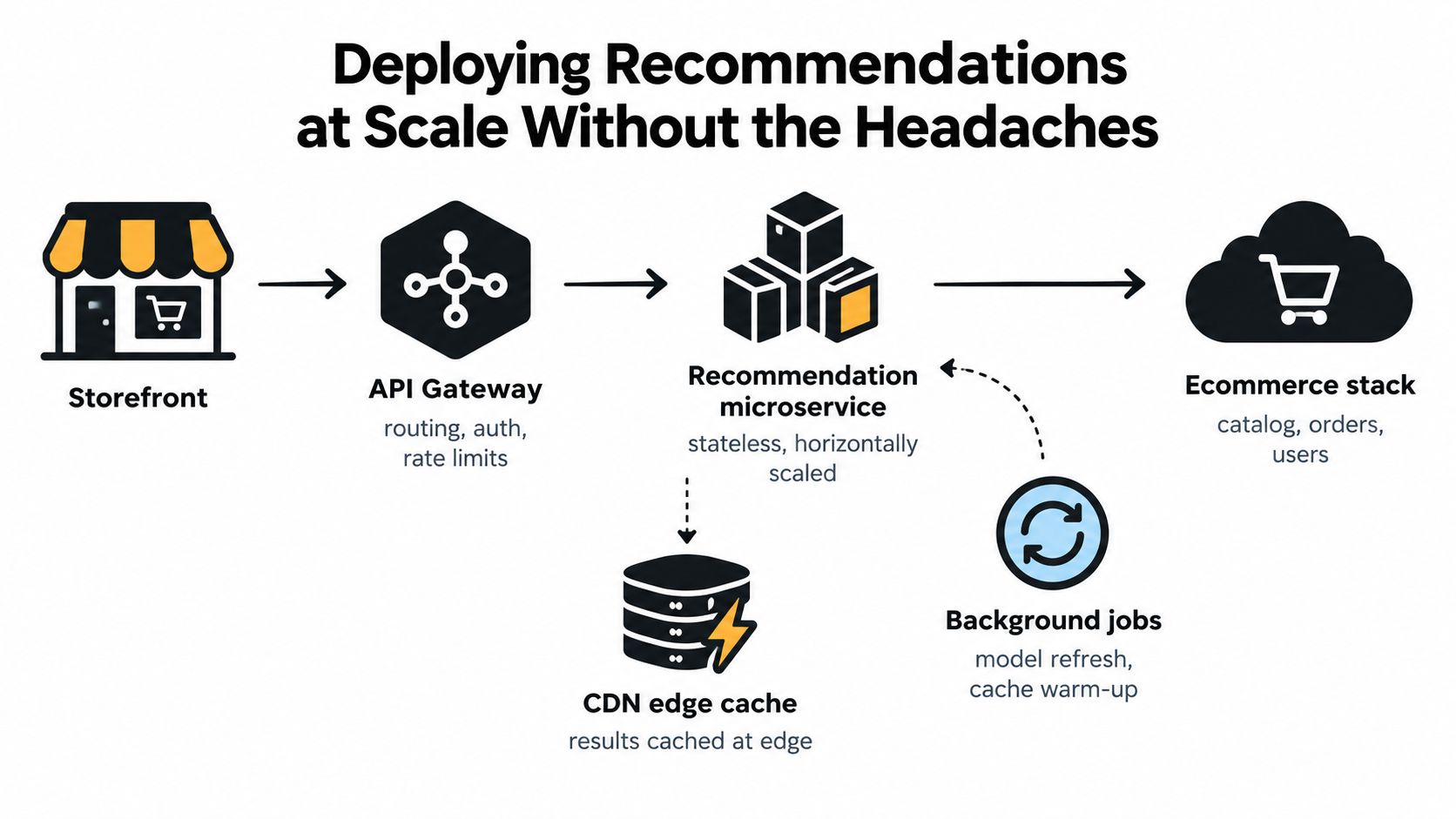
A recommendation service usually works best as a small, stateless microservice behind an API gateway. The gateway handles routing, authentication, and rate limits. The service retrieves candidates and features, scores them, applies business rules, and returns a response that the storefront can render without knowing how the model works.
Caching belongs close to the user. Frequently requested results can sit at a CDN edge, while background jobs refresh candidate sets and warm caches asynchronously. Feature stores and precomputed candidates reduce the work required during a live request. Teams can then scale the inference path according to request volume instead of coupling storefront responsiveness to model-training jobs.
Reliability is part of recommendation quality
A recommendation that arrives too late is functionally absent. A model that returns unavailable products is misleading. A prompt update that changes output formatting can break the storefront even if the generated text sounds better.
Production controls should include:
- Model versioning: Record which ranker and feature definitions produced each response.
- Prompt rollback: Restore a previous prompt or chain when an AI-assisted workflow behaves unexpectedly.
- Request tracing: Follow a recommendation from the storefront through the gateway, service, feature store, and model.
- Feature flags: Release a new strategy to a controlled audience before making it the default.
- Fallback logic: Serve catalog defaults or a simpler ranker when dependencies fail.
The guide to personalized product recommendations provides useful context for connecting recommendation inputs to application behavior. The same principle applies to cost design. A CPU-based ensemble or linear re-ranker may be more sensible than heavy GPU inference when the added quality doesn't justify latency and operating expense. Batch scoring can handle stable segments, while real-time scoring should focus on signals that require immediate updates.
Prompt management completes the operational picture for AI-assisted layers. Token-level logging can capture timestamp, model, input tokens, output tokens, latency, cost, calling team, and use-case tags as described in this AI cost optimization guidance. Teams can also audit and compress system prompts quarterly, set explicit output limits, and flag prompts whose token count grows more than 15% between releases, using the documented governance recommendation in that guide.
Your Pre-Launch Checklist for a Recommendation Engine
Before launch, experienced product teams ask a short set of uncomfortable questions. Each answer should be a decision, not a vague intention.
- Is the event taxonomy clean? Default to launch only after clicks, views, carts, purchases, and exclusions mean the same thing across web and mobile.
- Are user and item IDs stable? Default to one consistent identity strategy, with anonymous sessions handled separately from authenticated profiles.
- What happens for a new user or item? Default to catalog, contextual, or content-based fallbacks instead of an empty component.
- Which business KPI matters most? Default to one primary outcome, such as conversion lift or average order value, alongside offline ranking metrics.
- Do you have a holdout? Default to a controlled online comparison before declaring the model successful.
- Can you explain one recommendation? Default to an auditable path from displayed item to signals, rules, model version, and any AI-generated explanation.
- Can you roll back safely? Default to rollback controls for both the model and the prompts that shape an AI-assisted workflow.
Ship the smallest engine that moves the target number, then iterate. If your current AI governance tooling can't answer these questions today, review the gaps before adding another model.
Wonderment Apps helps teams modernize web and mobile products with AI integrations, scalable application engineering, and an administrative toolkit for prompt versioning, database parameters, integrated AI logging, and token cost control. Visit Wonderment Apps to discuss how to make your recommendation workflows more measurable, governable, and ready for production.