

A retailer can have a point-of-sale system, an ecommerce platform, a loyalty app, an email tool, and a warehouse system, yet still struggle to answer a simple question: what does this customer need right now, and can we fulfill it? A shopper sees one brand. The business often sees disconnected records, delayed inventory updates, and AI features that can't share context.
Custom retail software development addresses that gap by treating the retail operation as one connected product. The work isn't limited to building a storefront. It includes identity data, integrations, performance, automation, mobile and desktop experiences, and the controls needed to modernize responsibly. AI can recommend products, assist staff, forecast demand, or summarize service conversations, but it needs a dependable application foundation.
That foundation also needs governance. A prompt management system, for example, can give developers a prompt vault with versioning, a parameter manager for controlled internal database access, logging across integrated AI services, and cost management for cumulative spend. These capabilities turn experimental AI features into maintainable software rather than a collection of hidden instructions scattered through code.
The Modern Challenge of Retail Software
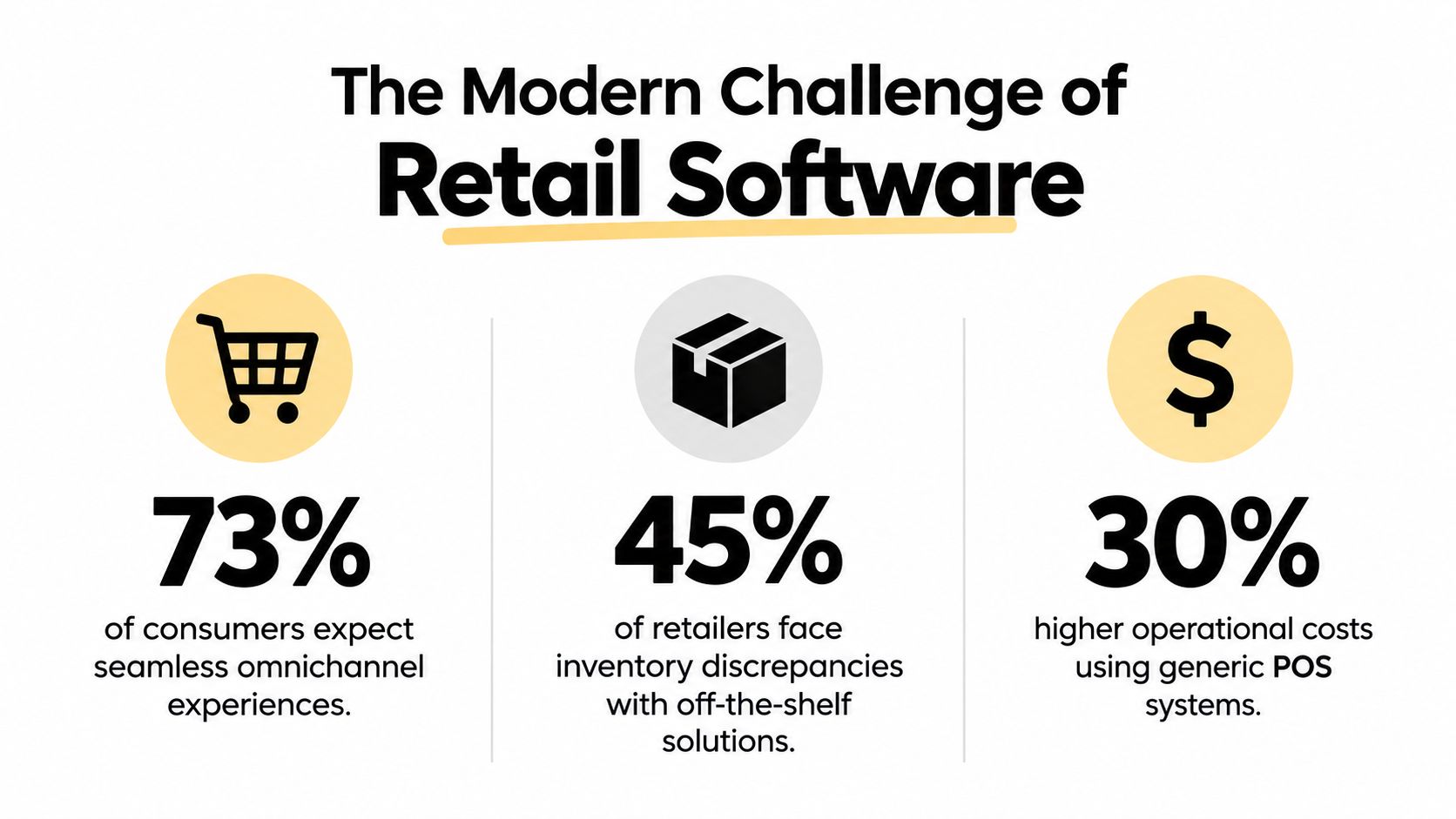
A store manager starts the morning with three different versions of the truth. The POS says an item sold yesterday. The ecommerce catalog still displays it as available. The warehouse dashboard has a delayed update, while the loyalty platform knows the shopper bought a related product but can't pass that context to the website.
That isn't a minor inconvenience. It affects customer trust, staff workload, fulfillment decisions, and the experience across every channel. Retailers now need systems that can coordinate stores, websites, mobile apps, marketplaces, fulfillment operations, customer service, and marketing without forcing employees to reconcile data by hand.
The financial context explains why this has moved beyond a narrow IT discussion. The global retail digital transformation market was valued at $201 billion in 2025 and is projected to reach $582.6 billion by 2034, with a 12.5% CAGR, according to Dataintelo's retail digital transformation market forecast. The same forecast places software solutions at $116.6 billion in 2025, while enterprise software represents about 58% of total digital-transformation budgets.
Why generic systems reach their limits
Off-the-shelf products are useful when your workflows match their assumptions. They become restrictive when your business needs a different order-routing rule, a custom loyalty model, store-specific pricing, specialized returns logic, or AI that draws from your own customer and inventory data.
A retailer doesn't necessarily need to replace every existing platform. Often, the better answer is a custom orchestration layer that connects the systems already in place and gives teams a consistent operating experience. That approach aligns with the broader principles described in digital transformation for retail, where modernization is treated as an operating model rather than a single software purchase.
Customer communication adds another integration challenge. A campaign may need to respond to a purchase, abandoned cart, store visit, or loyalty event. Retail teams evaluating retail SMS marketing strategies should ask whether their messaging platform receives trustworthy, timely events from the commerce system. If it doesn't, the message may be poorly timed even when the copy is excellent.
The strategic decision is simple to state: build the flexible layer where your competitive workflow lives, and integrate standard tools where they already perform well. That keeps custom retail software focused on differentiation instead of rebuilding commodity features.
What Custom Retail Software Development Entails
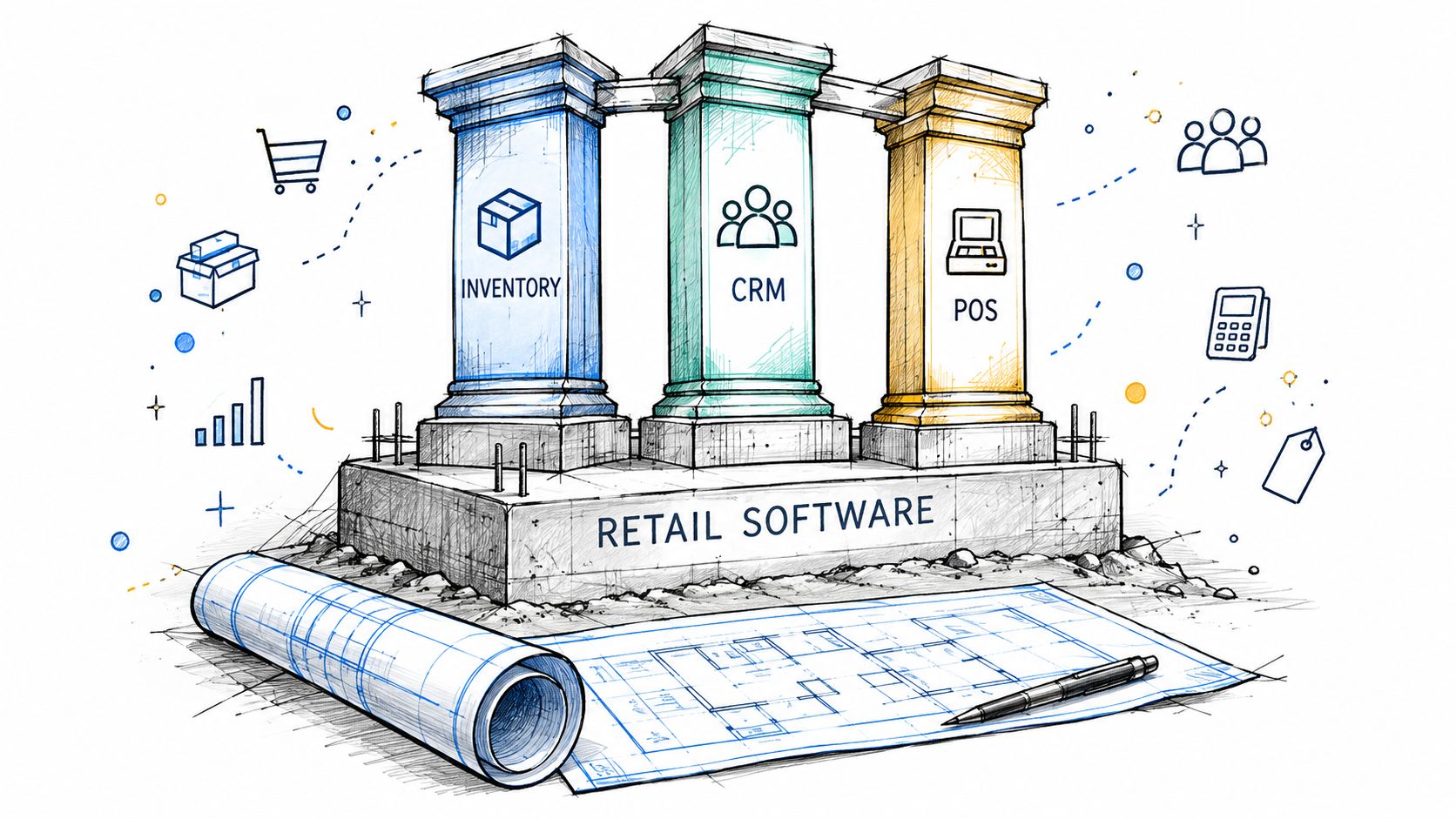
A custom retail platform is an ecosystem, not a single screen. Start by mapping the customer journey and the operational journey together. A shopper may browse on mobile, ask a question through an AI assistant, reserve an item online, collect it in a store, and return it through a different channel. Each step creates data that another part of the business may need.
The customer and staff surfaces
The front end can include a responsive ecommerce site, native or cross-platform mobile apps, store associate tools, customer-service workspaces, and desktop administration panels. Good design keeps the experience coherent while adapting it to the task. A shopper needs fast discovery and clear checkout. An associate needs accurate stock, customer context, and a quick way to complete an action on the shop floor.
AI fits into these surfaces when it has a defined job. A recommendation engine can rank products. A conversational assistant can explain differences. A staff copilot can summarize a customer's history. None of those features should bypass permissions or invent stock availability.
The operational core
Behind the interface sit product information, pricing, promotions, inventory, orders, payments, fulfillment, returns, customer identity, loyalty, analytics, and integration services. APIs connect these domains, while event-driven workflows notify the right service when something changes.
A practical architecture also separates responsibilities. The search service shouldn't own payment logic. The mobile app shouldn't contain business rules that the web experience can't use. A shared backend makes behavior consistent and gives developers a safer place to introduce new channels.
The AI control layer
Different AI models may suit different tasks. One model might handle product descriptions, another might classify service requests, and a third might support internal search. A unified prompt management strategy lets the team control prompts, parameters, permissions, model selection, and logs without burying those decisions inside application code.
That separation matters during an upgrade. Developers can change a prompt version, test it against known scenarios, review the output, and roll it back without shipping an unrelated storefront change. Teams comparing the best ecommerce software for growth should therefore evaluate not only visible features, but also how cleanly the platform can connect to identity, data, AI, and operational systems.
Core Business Drivers for Custom Platforms
Custom software earns its place by improving a business process that generic tools cannot represent accurately. In retail, three drivers recur: personalization, operational visibility, and order orchestration. They overlap, but each calls for a different engineering response.
Personalization starts with identity, not recommendations. A storefront widget can display a suggested product, yet the suggestion has value only when the platform knows which customer, consent state, channel, purchase history, and current intent it represents. POS records, ecommerce accounts, mobile behavior, loyalty activity, and service interactions must be matched carefully. Otherwise, the system may personalize the wrong experience for the right-looking profile.
McKinsey's personalization research reports that personalization at scale can produce a 1% to 2% lift in total sales for grocery companies, while other retailers may see larger gains. It also connects strong customer-experience programs with 10% to 15% higher sales-conversion rates and 20% to 30% higher employee engagement, as summarized in the Ecommerce Personalization Benchmark Report.
These figures do not guarantee the same outcome from every recommendation feature. They show why the data foundation deserves the same engineering attention as the interface. A recommendation is the visible tip of a system that must resolve identity, permissions, history, and intent.
Inventory and order decisions
Inventory visibility must account for reservations, transfers, returns, damaged goods, warehouse allocations, and store-level availability. The order management system then applies rules for choosing a shipping location, deciding whether a store can fulfill an order, and handling substitutions or cancellations.
A custom platform can keep these rules in one place instead of duplicating them across channels. That reduces the chance that a website promises one outcome while fulfillment works from another.
Architecture rule: Treat customer identity and inventory state as shared platform capabilities. Do not rebuild them separately inside every channel.
Fragmented data makes unified commerce difficult. Netguru's retail software development analysis identifies fragmented systems as a major barrier and reports that only 14% of retailers deliver real-time personalization across all channels. The same analysis places retail AI returns strongest in IT application development at 50% and customer personalization at 48%.
The practical lesson is to define the identity graph, event contracts, data ownership, consent rules, and failure behavior before adding another AI feature. Personalization is a product capability, but its reliability depends on integration. For a deeper look at how unified data supports reporting and decisions, see our guide to business intelligence for retail.
Navigating the Development Lifecycle
A retail project becomes easier to control when the team turns a large ambition into decisions that can be tested. The lifecycle shouldn't be a ceremonial sequence of meetings. Each stage should remove a specific type of uncertainty.
Discovery defines the real problem
Begin with workflows, not screens. Interview shoppers, store associates, merchandisers, customer-service agents, operations leaders, and technical owners. Document where data enters the business, where people re-key it, and where decisions depend on stale information.
The output should include user journeys, integration boundaries, security needs, success measures, and a deliberately narrow first release. A product team might choose unified inventory search before building a complex recommendation engine because reliable availability supports every later experience.
Design protects the future product
UX design should make the important action obvious on each device. System design should define APIs, data models, event flows, permissions, observability, and recovery behavior. The team decides here whether a mobile app can function during weak connectivity, how an associate sees an updated reservation, and what happens when an AI provider is unavailable.
Performance needs the same early attention. Catchpoint's 2025 retail benchmark highlights Time to First Byte, Largest Contentful Paint, and total document completion as important page-load measures. Google Cloud's Tchibo case study reports web response time falling from about 1.1 seconds to 0.5 seconds and product search improving by 75%, documented through this retail digital transformation case study.
Development, testing, and deployment
Developers should build vertical slices that connect interface, API, data, and operational behavior. Automated tests protect rules such as pricing, promotions, stock reservations, returns, and permissions. Manual QA then explores the situations scripted tests miss, including interrupted payments, duplicate events, partial fulfillment, and confusing customer journeys.
Use load testing, caching, search indexing, CDN delivery, and API-level observability before a major campaign creates pressure. Deployment should include feature flags, monitoring, rollback procedures, and a support plan. Scaling isn't just adding servers. It's making sure the database, queues, search layer, third-party integrations, and team processes can absorb demand without creating contradictory states.
Selecting the Right Software Developers
A polished portfolio doesn't prove that a team can build retail infrastructure. Ask how candidates handled data ownership, integration failures, observability, security, testing, and long-term maintenance on projects with similar complexity.
Use a decision matrix rather than choosing on personality or hourly rate alone.
| Criterion | Questions to ask | Strong evidence |
|---|---|---|
| Retail fit | Have you connected POS, ecommerce, inventory, loyalty, or OMS systems? | Clear architecture examples and tradeoffs |
| Engineering depth | How do you handle queues, caching, search, permissions, and failures? | Diagrams, tests, monitoring practices |
| AI modernization | How are prompts, models, data access, and logs governed? | Evaluation workflow and rollback plan |
| Delivery behavior | How do you report risk and manage changing requirements? | Regular demos, visible backlog, named owners |
| Long-term support | Who maintains the system after launch? | Support model, documentation, handover plan |
A useful job description should name technologies, responsibilities, and the type of work involved. The developer hiring checklist from daily.dev recommends specific requirements, transparent salary ranges, practical coding tests, team-based assessments, and reference checks. Avoid labels such as “rockstar developer.” They describe enthusiasm, not competence.
Look for evidence of impact, not activity. HackerRank's guide to hiring software developers recommends concrete evidence such as reduced API latency, along with structured interviews, independent scoring rubrics, and tracked funnel data.
For an external partner, define scope, deliverables, timeline, and budget before screening. Upwork's software developer hiring guide also recommends checking comparable application experience, GitHub, portfolios, client reviews, cloud, CI/CD, testing, and deployment knowledge. A developer who can explain why a decision was made is often more valuable than one who only lists a long technology stack.
For a broader evaluation of distributed teams, see how to pick the best offshore software development company.
Cost, Timeline, and Measuring ROI
Custom software costs more than a license because you're funding decisions that generic products avoid. The team must understand your workflows, model your data, build integrations, create interfaces, test edge cases, operate the system, and support it after launch.
That doesn't make the investment automatically worthwhile. The business case depends on the process being improved and the cost of leaving it unchanged. A retailer should compare the project with continuing manual reconciliation, missed fulfillment opportunities, slow campaign changes, poor search experiences, repeated vendor workarounds, and the cost of maintaining disconnected AI experiments.
Build the business case around outcomes
Choose measures that connect engineering work to business behavior:
- Conversion quality: Track whether faster search, clearer product information, and relevant recommendations help shoppers complete intended actions.
- Operational effort: Measure time spent reconciling inventory, correcting orders, answering repetitive questions, or preparing reports.
- Fulfillment reliability: Monitor cancellations, split shipments, unavailable promises, and return-handling friction.
- Product agility: Record how quickly the team can release a rule, integration, experiment, or AI improvement safely.
- System health: Review error rates, latency, queue depth, failed integrations, and recovery time.
Avoid claiming that AI automatically creates value. Radixweb's software development statistics roundup reports that more than 80% of retailers invest in custom software development to improve engagement, inventory visibility, and real-time decisions. It also reports that over 70% of ecommerce platforms use cloud-native or SaaS architectures, while AI-driven personalization and recommendation engines can lift retail revenue by 10% to 15%, and automation or AI-powered software can improve operational efficiency by up to 30%, as detailed in the roundup.
Those are market-level findings, not a promise for your project. Your team still needs a baseline, a measurable hypothesis, controlled releases, and a review process that separates genuine improvement from seasonal effects.
Include returns in the calculation
Retail leaders often calculate personalization value through additional sales and ignore avoidable returns. That can distort priorities. Recent retail coverage reports that returns cost ecommerce retailers $642 billion annually, that the average ecommerce return rate is three times higher than in-store, and that augmented-reality shopping experiences reduced ecommerce returns by 40% in early research, according to Ometria's retail report.
The engineering choice depends on the category. Fit guidance, better product visualization, sizing recommendations, and clearer specifications may matter more than another promotional message when shipping and returns are expensive. Model both sides of the equation, then fund the workflow that improves customer confidence and operational economics together.
Modernizing Your App with Intelligent Management
AI modernization fails when a team adds model calls without adding control. A retail application may begin with one assistant and one prompt, then grow into product enrichment, service classification, search, recommendations, staff support, and automated workflow decisions. Without shared administration, developers lose track of which prompt is live, which model received sensitive data, and how much each feature costs.
A prompt management system creates a practical control plane for that growth. It doesn't replace application architecture or product judgment. It gives the team a reliable place to manage the instructions and connections that AI features depend on.
Four controls that make AI maintainable
- Prompt vault with versioning: Store prompts centrally, record changes, compare versions, and roll back a problematic instruction without editing scattered application files.
- Parameter manager: Define approved variables and controlled access to internal database context. This helps the application provide relevant information without giving a model unrestricted access.
- Cross-model logging: Record requests, responses, errors, latency, and selected model metadata across integrated AI services. Teams can investigate quality problems instead of guessing.
- Cumulative cost management: Give entrepreneurs a view of spend across AI integrations, features, and environments. That makes cost part of product management rather than an unpleasant surprise at month end.
These controls also support desktop and mobile applications. A mobile shopping assistant and an internal desktop merchandising tool can use different interfaces while sharing governed prompts, approved parameters, and consistent logging. Developers can test a new model in one workflow, compare results, and preserve a safe fallback for production.
Practical rule: Treat every AI prompt as a versioned product asset. It should have an owner, a purpose, an evaluation method, and a rollback path.
Wonderment Apps offers this kind of prompt management system alongside backend architecture, API and database development, frontend delivery, server-side engineering, and manual and automated QA. Used appropriately, it can help a product team modernize an existing application without turning every AI change into a full rewrite.
The lasting advantage comes from combining governed AI with sound fundamentals: unified identity, explicit APIs, observable workflows, resilient integrations, fast search, accessible UX, and a release process that learns from real usage. That combination lets a retailer add capabilities over time while protecting reliability and customer trust.
Wonderment Apps helps retail teams design, modernize, and operate web and mobile products with custom engineering, AI integration, UX, and quality assurance. Visit Wonderment Apps to explore a practical path for connecting your retail systems and managing AI capabilities as your product grows.