

You approve an AI feature with a tidy estimate. The prototype works, the demo impresses stakeholders, and the launch date looks realistic. Then real users arrive. Prompts get longer, retrieval calls multiply, files need processing, and nobody can explain why the monthly bill has become a second product budget.
That's the trap behind AI app development cost. The initial build matters, but production economics depend just as heavily on data readiness, integrations, monitoring, model operations, and token usage. A sensible budget treats the application as a living system, not a conventional app with an AI button attached.
Why AI Budgets Break After Launch
A product team may begin with a familiar plan: define the screens, estimate engineering time, launch, and move into maintenance. That approach fits a conventional business application. AI applications continue making variable-cost decisions after deployment, so the initial estimate covers only part of the financial commitment.
A support assistant can generate a low-cost answer under narrow test conditions, then incur higher costs when a customer attaches a document, asks follow-up questions, and requires retrieval from several internal systems. One response may involve document processing, embeddings, database queries, multiple model calls, and a longer prompt. Without token tracking and per-workflow cost attribution, engineering hours look manageable while usage drains the operating budget.
A broad app development cost guide places simple apps around $15,000 to $40,000, while complex applications that include AI or machine learning commonly reach $100,000 to $250,000 or more. Enterprise-grade products with advanced security, integrations, and AI capabilities can reach $250,000 to $500,000 or more, with timelines of 12 to 18 months or longer. These ranges are not a quote for a specific product. They show how data, governance, security, and integrations can move an AI project into a different budget category.
Budget the whole operating life
Lifecycle budgeting starts before the first production prompt. It should cover:
- Discovery and data readiness: What information can the system use, who owns it, and how clean is it?
- Build and integration: Which web, desktop, or mobile workflows need AI, and how will they connect to existing software?
- Quality and governance: How will the team test outputs, record decisions, and control access?
- Operations: Who monitors model behavior, token consumption, latency, failures, and data drift?
- Change: What happens when a model, policy, customer expectation, or source dataset changes?
Prompt governance belongs in the initial plan. A prompt management system can give developers and entrepreneurs one place to control prompt versions, parameters, logs, and cumulative AI spend from the start. Set token limits by workflow, compare model costs against quality, and flag unusual usage before it becomes a monthly surprise. Visibility does not make an expensive use case cheap, but it helps the team protect margins after launch.
Practical rule: If a budget has no line for monitoring, retraining, usage controls, and model changes, it is not an AI budget yet.
Core Cost Drivers in AI Development
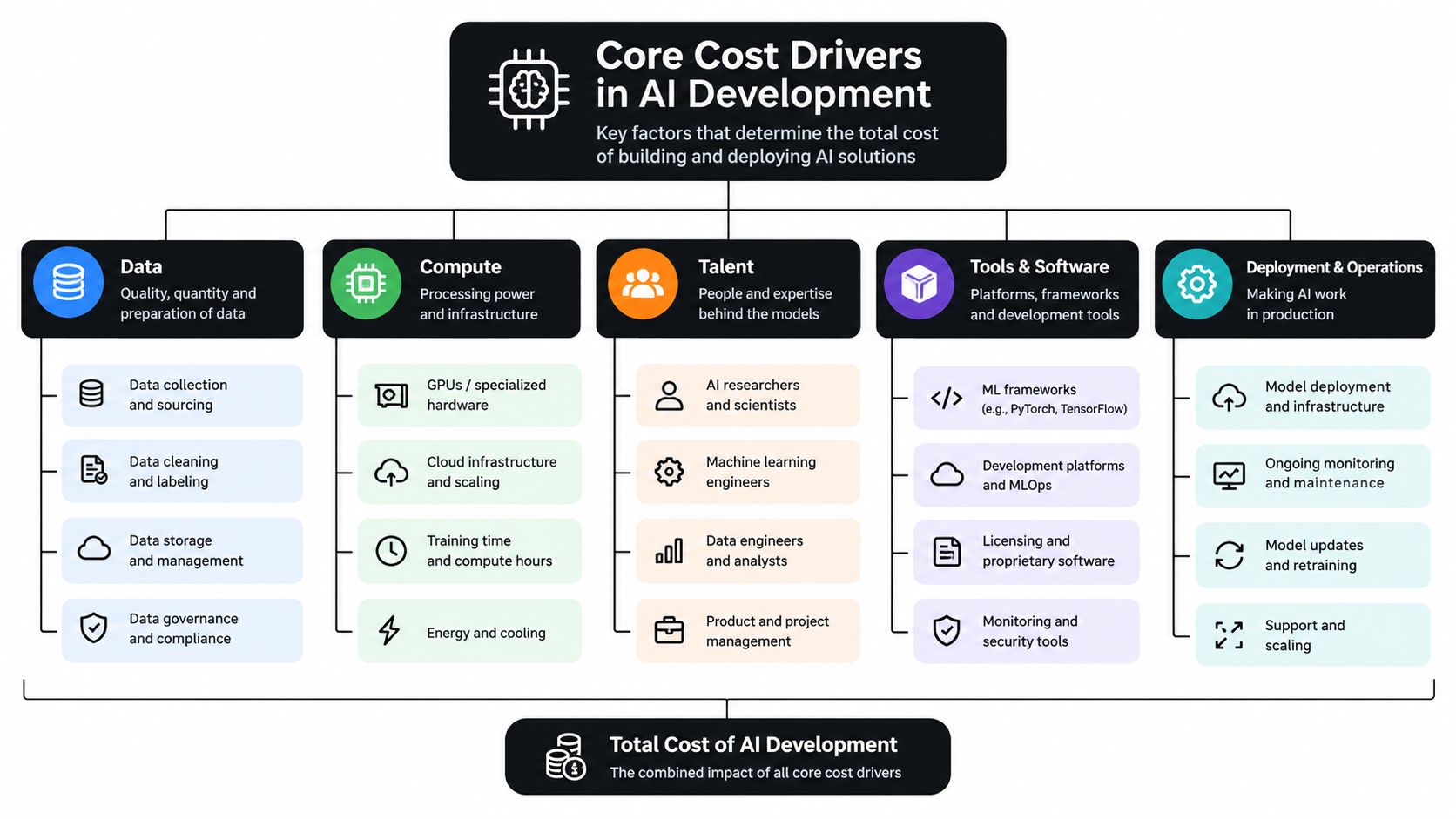
Connecting a language model API to a mobile screen is a technical task. Delivering a reliable AI product is a broader engineering program. The difference includes data pipelines, security boundaries, evaluation workflows, failure handling, and the people required to operate the system.
Data usually creates the first serious variance
Production models need usable data, not merely a database full of records. Teams may need to clean documents, normalize fields, remove duplicates, map permissions, label examples, create evaluation sets, and establish processes for new data. A model can be technically capable and still fail because the application supplies incomplete, stale, or unauthorized context.
One AI development pricing breakdown estimates that data preparation and annotation account for 20% to 25% of AI development cost, while model training and fine-tuning account for about 15%. The same source identifies data readiness, use-case complexity, model strategy, integration depth, team geography, compliance, and ongoing run cost as major reasons apparently similar projects receive very different estimates.
That explains why a consumer-facing assistant and a regulated fintech workflow can share a chat interface yet require radically different budgets. The latter may need carefully labeled records, audit trails, strict access controls, monitoring for drift, and repeatable validation before users can trust the output.
Model choice is only one decision
Teams often overfocus on selecting a model and underfund the surrounding system. A practical architecture might combine retrieval, a vector store, a business rules layer, an observability service, a fallback model, and a human review path. Each connection creates design, testing, security, and operational work.
Traditional software development cost planning still matters for the interface, backend, authentication, and deployment environment. AI adds new questions: should the product use a hosted model, an open model, fine-tuning, retrieval-augmented generation, or a combination? Should sensitive information stay in a private environment? Can the system degrade gracefully when the model is unavailable?
Scope the proof of concept around a decision
A proof of concept should answer a business or technical question, not demonstrate every possible feature. Define the smallest workflow that can test whether the data is sufficient, the output is useful, and the integration is feasible. A chatbot that answers from a controlled knowledge base teaches more than a broad assistant that has no clear success criteria.
For desktop and mobile products, separate the AI capability from the experience around it. The application still needs responsive interaction, accessible states, error recovery, authentication, analytics, and a clear explanation of what the AI can and can't do. Those elements often determine whether users trust the result more than the model label does.
Hidden and Ongoing Operational Expenses
The most expensive assumption in AI product planning is that launch marks the end of development. It doesn't. Launch begins the period when the team learns how users behave, which sources produce weak answers, and which prompts consume more resources than expected.
Model behavior can change as the underlying data distribution changes. A search assistant may receive new product terminology, a healthcare workflow may adopt new documentation formats, or a finance system may encounter patterns absent from its original evaluation set. The application needs monitoring for quality, latency, failures, drift, and policy violations, followed by a controlled response.
MLOps keeps accuracy from becoming a memory
Enterprise AI systems need repeatable operational routines:
- Evaluation: Run representative test cases whenever prompts, models, retrieval logic, or source data changes.
- Drift detection: Watch for changes in inputs and outcomes that indicate the system no longer behaves as expected.
- Retraining and tuning: Refresh pipelines when new labeled data or domain behavior justifies a model change.
- Release control: Move updates through review, testing, and rollback rather than editing production prompts casually.
- Incident response: Give the team a way to investigate bad outputs and prevent recurrence.
An overview of software maintenance is useful here because AI maintenance expands the conventional work of patching, updating, and supporting an application. The team also has to revalidate model behavior, manage dependencies, review provider changes, and maintain the data pathways that supply context.
Usage creates a second operating budget
The headline build estimate may omit AI usage, infrastructure, monitoring, retrieval calls, file processing, and repeated prompts. Recent guidance estimates that hidden costs can add 15% to 25% annually, or 30% to 50% of the initial build, particularly when real users create substantial token and processing demand. See the AI app cost breakdown for the underlying distinction between construction and operation.
A useful cost review asks what happens per user action. Does one request invoke one model or several? Does the app send the entire conversation every time? Does retrieval return too much context? Does a file pass through extraction, classification, embedding, and generation? These details turn a product requirement into a recurring cost.
Enterprise guides commonly place monitoring, retraining, and infrastructure at 15% to 30% of the initial build cost per year. The enterprise AI development cost analysis frames this as a lifecycle issue, not a temporary surcharge. Teams that postpone these expenses usually pay them later, with less control and more urgency.
Estimation Ranges by Application Complexity
A budgeting decision changes sharply depending on what the AI must do after launch. A hosted model added to an existing workflow has limited integration and data risk. A platform handling regulated information, real-time decisions, several business systems, and high availability requires a larger delivery and operating plan.
The AI app development cost guide provides broad planning ranges. Use them as starting points, then price data preparation, evaluation, security, support, and model usage separately. The table distinguishes a focused proof of concept from a production integration so the estimate matches the work.
AI App Development Cost Estimates by Complexity
| App Complexity Tier | Estimated Cost Range | Typical Timeline |
|---|---|---|
| Simple AI integration | $15,000 to $40,000 | Focused discovery, implementation, and testing |
| Focused proof of concept | $50,000 to $100,000 | Defined scope with a narrow data boundary and evaluation plan |
| Complex AI-enabled application | $100,000 to $250,000 or more, with some advanced applications reaching $400,000 or more | Multi-phase delivery shaped by data and integration work |
| Enterprise-grade platform | $250,000 to $500,000 or more, with full enterprise platforms potentially exceeding $1 million | 12 to 18 months or longer for advanced security, integrations, and governance |
A simple integration might add summarization, classification, or a support assistant to an existing web or mobile workflow. The delivery risks usually sit in prompt quality, permissions, user experience, and dependence on a model provider. Keep a proof of concept narrower: use controlled data, define success tests, and avoid building production-grade breadth before the workflow earns it.
Complex applications often combine several models, proprietary data, retrieval, automation, or real-time processing. Integration depth and evaluation work can cost more than the model calls themselves. A $150,000 complex build, for example, should also carry $30,000 to $45,000 in first-year operating cost, before unexpected usage growth. Prompt governance and token tracking help keep that operating budget visible after release.
Enterprise systems require funding for security architecture, compliance, audit trails, permissions, resilience, model governance, and support capacity. Those requirements can outweigh the visible AI feature. A regulated anomaly-detection workflow may cost more than a consumer chatbot because the business must demonstrate how the system behaves, control its prompts and data, and review changes over time.
Strategies to Budget and Reduce Token Spend
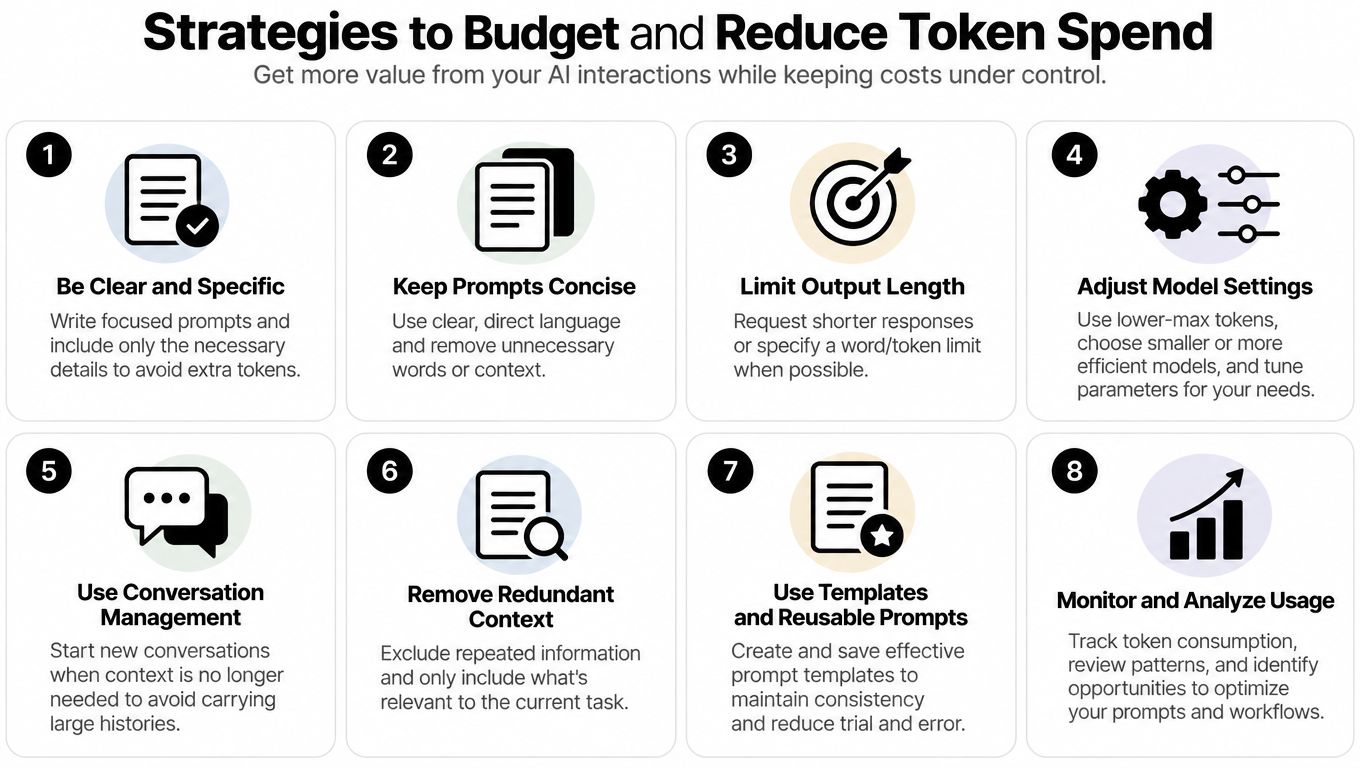
Cost control starts with product design. If every user action sends a long conversation, a large document, and broad retrieval context to a premium model, no dashboard can rescue the economics. The engineering team has to reduce unnecessary work before it reaches the model.
Start with an action-level cost map
List each AI-enabled action and record its input, output, model, retrieval behavior, and fallback path. This exposes expensive patterns that look harmless in a user story.
- Trim context: Send the relevant passages, not an entire document or unrestricted conversation history.
- Route semantically: Use a lighter or specialized model for predictable tasks, and reserve more capable models for difficult requests.
- Cache repeatable work: Cache stable system instructions, recurring retrieval results, and outputs that don't depend on changing user data.
- Set output boundaries: Define appropriate response lengths and structured formats so the model doesn't generate unnecessary text.
- Batch background work: Process non-urgent classification or enrichment outside the interactive path when the user doesn't need an immediate answer.
- Add quotas: Set usage limits by workspace, team, feature, or customer segment before costs become difficult to attribute.
- Measure failed calls: Track retries, timeouts, invalid outputs, and abandoned workflows because unsuccessful requests can still consume resources.
- Review unit economics: Compare the cost of an AI action with the business value it creates, not just the total monthly invoice.
Decide when governance pays for itself
Governance has a cost, so apply it where usage and risk justify the investment. One prompt governance reference suggests that low-frequency prompts below 1,000 calls per month may not justify full governance, while high-frequency prompts above 100,000 calls per month can recover governance costs within days through token-efficiency gains. It also gives a practical example: if inference costs $500 per month, spending $50 on governance can be justified.
Those thresholds aren't universal. A low-volume healthcare workflow may need controls because the data is sensitive, while a high-volume internal experiment may not need an elaborate platform. Use frequency, risk, cost, and the effort required to investigate failures as the decision criteria.
Optimize infrastructure with restraint
Prompt caching and semantic routing can reduce repeated work, but they add state, invalidation rules, and observability requirements. A smaller model can lower token spend, but only if quality remains acceptable and the application doesn't create expensive retries or human review. The cheapest call is the one the product doesn't need to make.
Usage-based prompt tooling may cost $0.001 to $0.01 per prompt, while implementation services can add $20,000 to $200,000. LLM API expenses may reach 2x to 10x the platform cost, according to this enterprise prompt tooling pricing summary. Include those layers in the operating model before choosing a tool.
Modernizing Applications with Prompt Management
A prototype can survive with prompts stored in source code and usage checked through separate provider dashboards. A product serving customers, employees, or regulated workflows needs stronger separation between application logic and prompt operations.
A dedicated prompt management layer gives product and engineering teams controlled change. It can make prompts editable without redeploying the entire application, preserve the relationship between a prompt version and its results, and expose the usage patterns that ordinary application logs miss.

What a production toolkit should control
Wonderment Apps' prompt management system is one example of this administrative approach. Its capabilities include:
- A prompt vault with versioning: Teams can store approved prompts, compare revisions, and roll back a change when an update harms quality or increases usage.
- A parameter manager: Developers can control how prompts access internal database information instead of scattering sensitive query behavior through application code.
- Unified logging: Teams can review activity across integrated AI services, making it easier to trace which model, prompt, and workflow produced an outcome.
- A cost manager: Entrepreneurs can see cumulative AI spend and connect usage to applications, teams, or features.
The prompt management overview explains why these controls matter beyond convenience. A versioned prompt creates an operational record. Logging connects behavior to a request. Parameter controls establish a boundary around internal data. Cost visibility turns a surprise invoice into a measurable product signal.
Modernization should preserve what already works
AI modernization doesn't require replacing a mature web, desktop, or mobile application. A team can add an orchestration layer, connect selected models, and introduce AI where it improves a defined workflow. For example, a legacy service platform might gain summarization and routing while retaining its existing authentication, records, and audit structure.
The right design keeps business rules outside the model where possible. The model can interpret language or generate a draft, while deterministic services handle permissions, calculations, transaction states, and irreversible actions. That division improves testing and makes future model changes less disruptive.
Prompt management also supports safer experimentation. Teams can test a new instruction against an evaluation set, monitor token behavior, and deploy it to a controlled audience before broad release. This is more disciplined than changing a prompt in production and waiting for support tickets to reveal the result.
A scalable AI product needs an operating console, not just a model endpoint.
Choosing the Right Development Partner
A low developer quote often becomes expensive when the team understands interfaces but has little experience operating AI systems. Assess partners on data access, evaluation, security, model selection, observability, device constraints, and post-launch support.
Ask each candidate to decompose the first release. A useful plan identifies the business decision, required data, failure modes, human fallback, success measures, and operating owner. A weak plan starts with a model name and a polished interface.
Vet the team across the full delivery surface
Look for evidence of:
- Product discovery: Can the team reduce a broad AI ambition to a testable workflow?
- Data engineering: Can it clean, permission, label, and monitor the information models use?
- Application engineering: Can it integrate AI into web, desktop, and mobile products without weakening reliability?
- UX design: Can it present uncertainty, citations, review states, and errors clearly?
- Automated QA: Can it test probabilistic outputs, regressions, prompt changes, and edge cases?
- Operations: Can it monitor quality, latency, token usage, provider failures, and drift after release?
Ask which capabilities the partner keeps in-house and which it assigns to specialists. Organizations comparing staffing options can review resources such as hire AI developers, then assess every candidate against the same architecture, governance, and long-term support requirements.
Ask for lifecycle economics, not only a build quote
Request a sample monthly operating report from a live AI product. It should show token spend by feature, evaluation pass rates, notable incidents, provider failures, and remediation work. A team that cannot produce this evidence may have delivered prototypes without running an AI product in production.
Require separate estimates for discovery, application work, integration, governance, infrastructure, usage, support, and model changes. Enterprise prompt tooling can also carry implementation costs, while API usage may become a major cost layer, as discussed in this enterprise prompt tooling pricing reference. The partner should explain which assumptions drive each estimate and how token tracking will prevent budget surprises.
Choose a team that can launch a focused product, instrument it from the first release, and improve it as users, data, and models change.
Wonderment Apps helps organizations modernize web, mobile, and legacy software with AI integrations, prompt governance, logging, parameter controls, and cost visibility. Visit Wonderment Apps to define a lifecycle budget and plan an AI product without letting token and infrastructure costs run unchecked.