

Three weeks before launch, a founder stands at a whiteboard with two boards of sticky notes behind her. One board promises a single, polished release. The other breaks the same product into smaller increments. Requirements keep moving, compliance wants a frozen specification, and the AI feature promised to the board is stranded between a model team and legacy data.
That scene isn't a failure of project management. It's a routing problem. Some work needs firm gates, documented approvals, and controlled change. Other work needs short feedback loops, working software, and permission to learn in public.
The right agile vs waterfall methodology decision depends on the work, not on which camp has the better conference stickers. An operational layer matters either way, especially when AI enters the product. Wonderment Apps' prompt management system can provide prompt versioning, parameter management for internal database access, logging across integrated AI systems, and cost visibility, giving delivery and product teams a governed place to manage AI behavior as the roadmap changes.
The Crossroads Most Teams Hit Before Their Next Release
The founder's first question is usually, “Which methodology should we choose?” That framing creates trouble. A better question is, “Which parts of this initiative need predictability, and which parts need discovery?”
Her compliance lead may need an approved specification before development begins. Her product manager may still be testing whether customers want an AI assistant, a recommendation engine, or a simpler search experience. Meanwhile, engineers are trying to connect a new model to data structures that were never designed for machine-generated responses.
Those are different workloads. Forcing them into one delivery pattern guarantees friction.
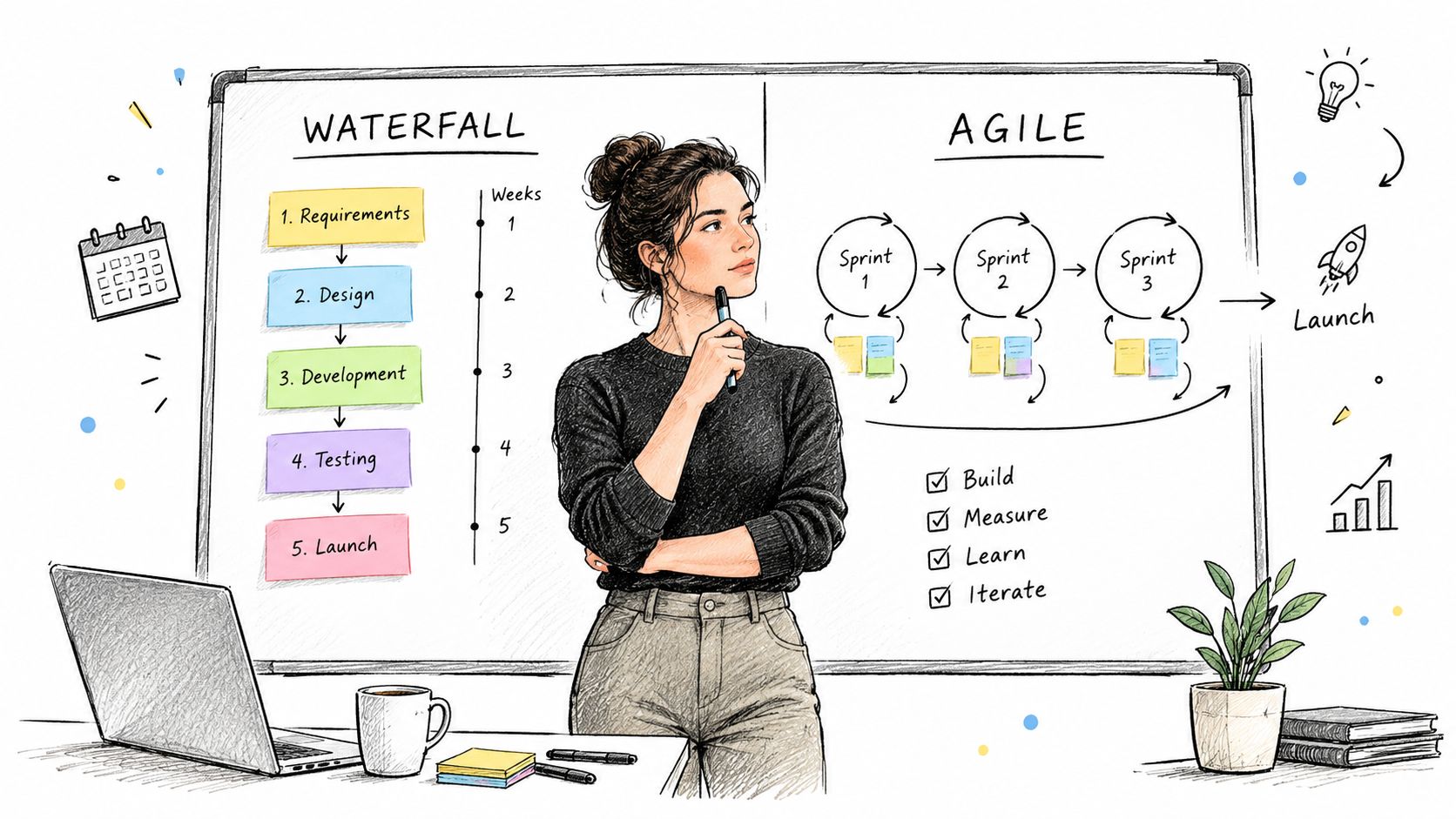
Route certainty and uncertainty separately
Use Waterfall-style control where a late change creates contractual, regulatory, safety, or migration risk. Use Agile delivery where user behavior, product scope, model performance, or integration feasibility remains uncertain.
That doesn't mean running two disconnected projects. It means creating one roadmap with distinct controls:
- Fixed commitments: Define scope, owners, dependencies, acceptance criteria, and approval gates.
- Uncertain capabilities: Run small experiments, validate assumptions, and keep the backlog adjustable.
- AI operations: Track prompts, model inputs, evaluation results, access parameters, logs, and spend from the start.
- Release control: Require explicit sign-off for data migration, security, compliance, and production changes.
The prompt management layer becomes especially useful when an AI feature crosses team boundaries. A product owner can see which prompt version is active, an engineer can trace the parameters passed to internal data, and a finance or operations lead can review cumulative AI spend without searching through disconnected project tools.
This article gets practical from here. It compares the mechanics of both approaches, interprets the available performance evidence, maps sensible defaults across industries, lays out a hybrid modernization path, and ends with a decision matrix you can apply to the next release.
How Each Methodology Actually Works Day to Day
Waterfall and Agile grew from different responses to software delivery problems. The historical foundation commonly associated with Waterfall is Winston W. Royce's 1970 paper, Managing the Development of Large Software Systems. Royce warned against a purely sequential process, but later summaries treated the publication as a foundation for the Waterfall model. The Agile counter-movement culminated in February 2001, when 17 software practitioners met at Snowbird, Utah, and produced the Agile Manifesto, a 68-word statement favoring iterative and adaptive development. This historical arc is summarized in a history of Agile and Waterfall development.
Waterfall starts by trying to understand the whole problem before building. Teams document requirements, often in a Software Requirements Specification, then move through design, implementation, testing, deployment, and maintenance. Each phase normally requires completion and approval before the next begins, as described in this overview of Waterfall project management.
Agile assumes that some important facts will emerge only after users see working software. Teams maintain a prioritized backlog, select work for an iteration, build and test an increment, demonstrate it during a review, and improve their process during a retrospective. The Agile Manifesto places individuals and interactions over processes and tools, working software over detailed documentation, customer collaboration over contract negotiation, and responding to change over following a plan. Its principles emphasize early delivery, continuous value, and welcoming changed requirements, as stated in the Agile Manifesto.
The operating difference
Waterfall uses formal change requests. If an approved requirement changes, someone assesses the effect on scope, schedule, budget, testing, and dependencies. Agile uses reprioritized stories. The product owner can move work through the backlog as evidence changes, provided the team preserves quality and makes trade-offs visible.
Their artifacts reflect that distinction. Waterfall teams commonly produce business requirements documents, requirements specifications, architecture decisions, design documents, test plans, approval records, and release packages. Agile teams commonly use user stories, acceptance criteria, sprint backlogs, reviews, retrospectives, release notes, and burndown charts. Agile doesn't eliminate documentation. It asks whether each document helps someone build, operate, govern, or improve the product.
Practical rule: If an artifact protects a user, a regulator, an operator, or a future maintainer, keep it. If it exists only because nobody trusts the delivery process, fix the process.
| Dimension | Waterfall | Agile |
|---|---|---|
| Planning | Detailed upfront plan | Adaptive planning through a backlog |
| Scope | Defined and controlled early | Refined as evidence arrives |
| Delivery | Sequential phases and a planned release | Working increments throughout delivery |
| Change control | Formal request and approval | Reprioritized stories and trade-offs |
| Stakeholder role | Strong at requirements and approval gates | Continuous collaboration and feedback |
| Governance owner | PMO, program manager, or steering group | Product owner and empowered delivery team |
| Typical visibility | Phase completion and milestone status | Working software, flow, and iteration outcomes |
For teams documenting dependencies, owners, deliverables, and approvals before implementation, a practical software implementation roadmap for DXP can help turn a methodology choice into an executable plan.
What the Numbers Say About Cost, Time, and Risk
The Standish CHAOS dataset covering more than 10,000 software projects from fiscal years 2011–2015 reported Agile projects as successful 39% of the time, compared with 11% for Waterfall. Agile projects failed 9% of the time, while Waterfall projects failed 29% of the time. The figures appear in this discussion of Agile and Waterfall success rates.
Large programs show a wider gap. Agile success was reported at 18%, versus 3% for Waterfall. Waterfall failure reached 42%, compared with 23% for Agile. For a budget holder, the practical reading is clear: iterative delivery offers stronger protection against discovery risk when dependencies, stakeholders, and assumptions keep changing.
Academic comparisons point in the same direction, though they are not a forecast for every organization. One comparative study summary reported roughly 40% Agile success with about 10% failure, versus around 15% Waterfall success with about 30% failure. It also found statistically significant differences across cost, time, and quality measures. The study summary is available in this comparative Agile and Waterfall review.
| Outcome Metric | Waterfall typical range | Agile typical range |
|---|---|---|
| Reported project success | Around 11% to 15% | Around 39% to 40% |
| Reported project failure | Around 29% to 30% | Around 9% to 10% |
| Large-project success | 3% | 18% |
| Large-project failure | 42% | 23% |
Use these figures to route work, not to declare a winner. They come from defined datasets and comparative summaries, not a guarantee for your project. Vendor reports can reflect selection effects, inconsistent definitions of success, and projects stopped before completion. Before turning a benchmark into a business case, check how the source defines success, failure, scope, and project size.
Translate the evidence into risk language
Agile reduces discovery risk. Teams expose incorrect assumptions sooner, test integrations before final release, and let stakeholders respond to working increments. Waterfall reduces contract and governance risk when requirements are stable, approval gates are mandatory, and multiple suppliers need a shared baseline.
Budget predictability does not equal economic efficiency. Fixed scope can make a contract easier to price, while an incorrect fixed scope can make the final product expensive to change. Agile can reveal valuable options early, but it requires active product ownership and disciplined funding decisions.
For a budget owner, compare the cost of software development with the uncertainty behind the estimate. Route stable, compliance-bound work through defined gates. Route uncertain product discovery through short delivery cycles. Then fund the controls each path requires, instead of forcing one methodology across the entire program.
Choosing the Right Fit for Ecommerce, Fintech, Healthcare, Media, and Government
Industry labels help, but they don't make the decision for you. The deciding signal is usually regulatory exposure, release cadence, or contract structure.
| Industry | Default Methodology | Key Exception |
|---|---|---|
| Ecommerce | Agile | Use a Waterfall discovery phase for a major replatform |
| Fintech | Waterfall or staged gate | Use Agile pods for customer-facing surfaces |
| Healthcare | Waterfall rigor | Use Agile inside bounded clinical workflow tooling |
| Media | Agile | Use Waterfall for rights windows and licensing milestones |
| Public sector | Waterfall | Use Agile increments inside approved tranches |
Ecommerce
Choose Agile for storefront improvements, personalization, search, checkout experiments, and mobile experiences. A two-week sprint rhythm fits fast merchandising decisions and gives product teams a practical way to learn from customers before committing to a larger build.
The exception is a replatforming effort. Start with a Waterfall-style discovery phase that maps catalog data, pricing rules, order flows, integrations, analytics, and cutover constraints. Once the baseline is approved, let domain teams deliver migration tooling, components, and customer-facing improvements iteratively.
Fintech
Use a staged-gate backbone for core ledgers, settlement logic, identity controls, and compliance-bound workflows. These areas need traceable requirements, controlled changes, testing evidence, and named approval owners.
Agile fits around that backbone. Separate pods can improve onboarding, dashboards, notifications, support tooling, and other customer-facing surfaces while architecture, security, and compliance checkpoints protect the core.
Healthcare
Healthcare projects need Waterfall rigor around HIPAA obligations, validation, audit trails, clinical safety, and data handling. Agile can work inside a clearly bounded workflow, such as a staff-facing scheduling interface, when the team defines the clinical and compliance boundaries before iteration begins.
Media and content
Media organizations usually benefit from Agile because content operations, audience behavior, recommendations, and publishing workflows evolve quickly. Waterfall still makes sense for annual rights windows, licensing milestones, and distribution commitments where dates and contractual deliverables are fixed.
Public sector
Government delivery often leans Waterfall because procurement, funding, approvals, and FAR-style gates constrain how work gets authorized. Agile increments can operate inside an approved delivery tranche, but the team must preserve traceability from the increment back to the authorized scope.
Choose the methodology around the consequence of change. A changed recommendation card is inconvenient. A changed ledger rule, clinical validation record, or procurement commitment may require a formal control path.
Running a Hybrid Playbook for Modernization and AI Integration
Hybrid delivery works when it has explicit boundaries. It fails when “hybrid” means every team can invent its own process and nobody knows which decision is final.
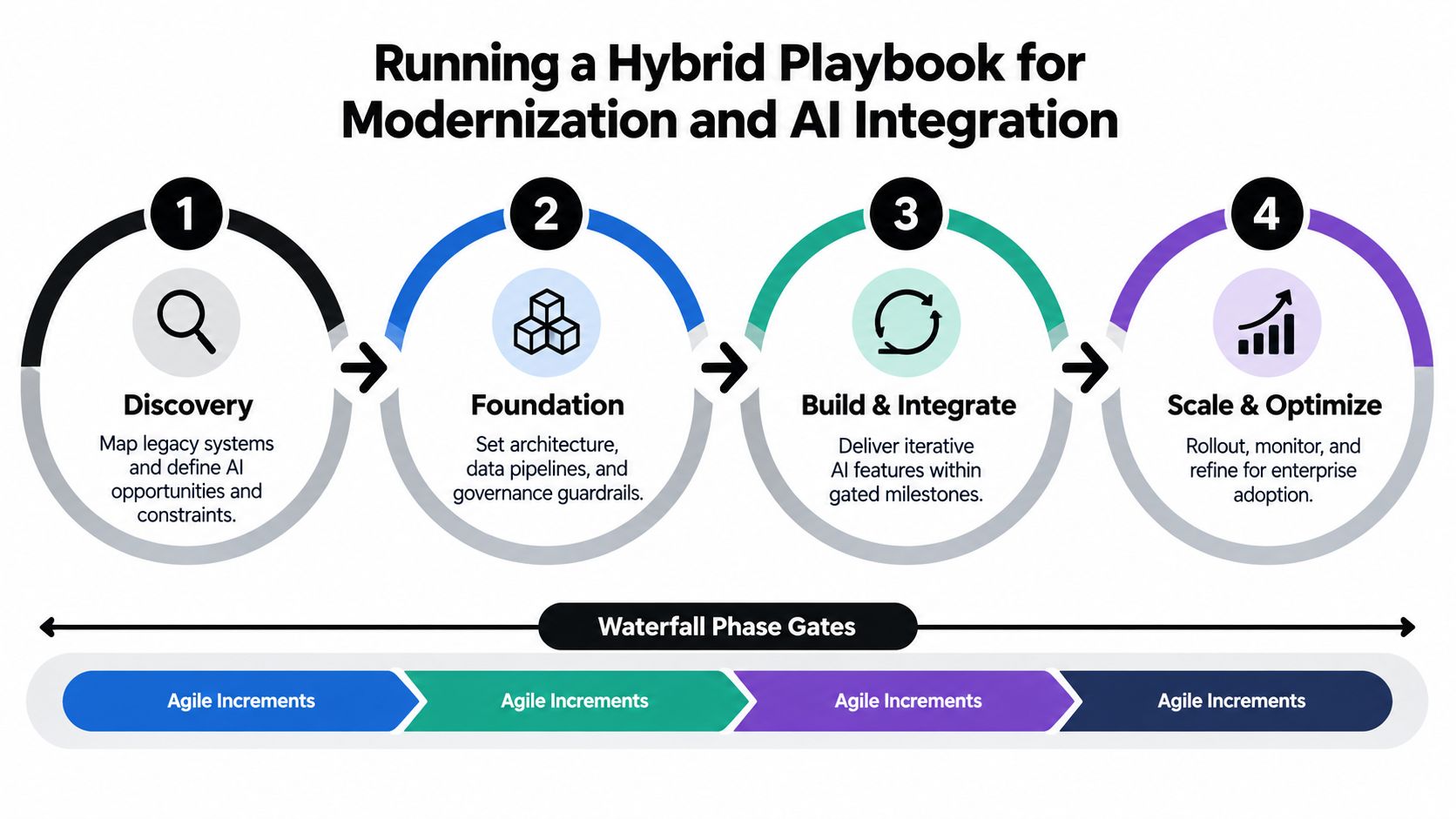
For legacy modernization and AI integration, use Waterfall-style gates for commitments and Agile increments for learning. The application modernization roadmap should show both layers instead of hiding iterative work inside a single milestone.
Use four deliberate gates
Discovery: Map legacy systems, data ownership, integration constraints, security risks, and AI opportunities. Produce a requirements baseline and risk register. Don't freeze every future feature. Freeze the constraints that protect the business.
Foundation: Run a short Agile spike to prove identity, data access, model integration, observability, and failure handling. A prompt that works against a sample dataset isn't production-ready until the team proves its access and evaluation path.
Capability buildout: Run parallel Agile trains by domain, such as search, recommendations, support, or internal operations. Each train can iterate on working capabilities while architecture and compliance checkpoints approve the boundaries between increments.
Production cutover: Return to Waterfall-style sequencing for change windows, data migration, rollback rehearsals, operational readiness, and final approval. Production deployment is not a sprint demo with a larger audience.
Put these controls on the roadmap
- Single backlog taxonomy: Tag work as product, platform, data, security, compliance, migration, or AI operations.
- Shared definition of done: Include testing, documentation, monitoring, access review, and rollback readiness.
- Named gate owners: Assign one accountable decision-maker for architecture, compliance, product value, and production operations.
- Prompt versioning: Record the active prompt, its owner, purpose, dependencies, and approval state.
- Evaluation cadence: Define when prompts and models are evaluated against representative test cases.
- Guardrail sign-off: Document approved data sources, prohibited behavior, escalation paths, and release criteria.
- Cost controls: Set review thresholds for cumulative model spend and investigate unexpected usage.
Hybrid wins when the roadmap can hold fixed obligations and uncertain experiments at the same time. It gives governance something concrete to approve and gives builders room to discover what works.
Metrics, Telemetry, and the Role of Prompt Tooling
A methodology argument becomes unproductive when each side selects the metric that flatters it. Waterfall teams point to approved milestones. Agile teams point to completed stories. Executives need a connected view that shows whether delivery is moving, quality is holding, users are receiving value, and AI behavior remains controlled.
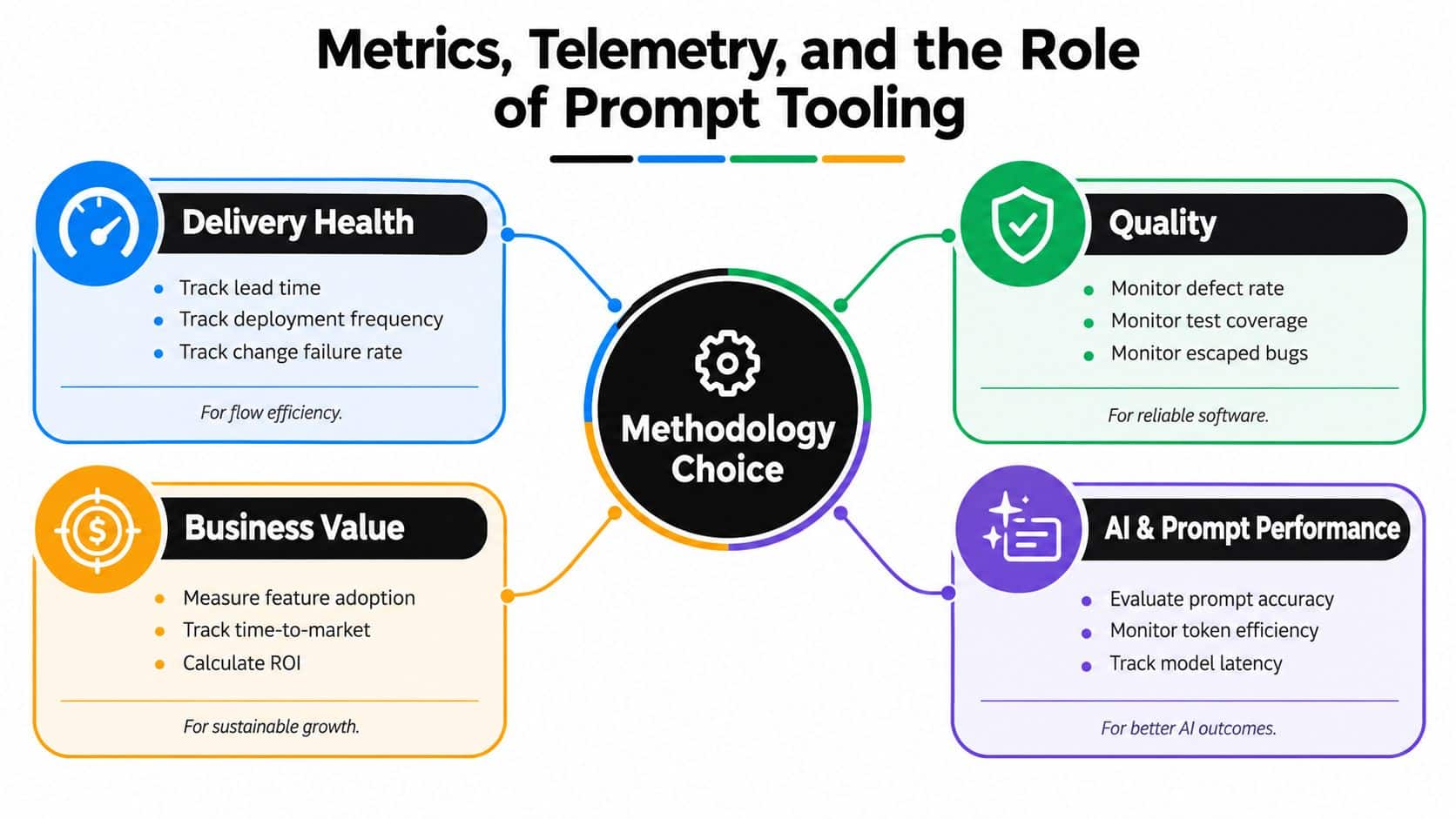
Track four metric families:
- Delivery health: Lead time, deployment frequency, and change failure rate show how work moves from decision to production.
- Quality: Defect escape rate and mean time to detect reveal whether testing and monitoring catch problems before users do.
- Business value: Time to first value, stakeholder NPS, feature adoption, and revenue per release connect delivery activity to outcomes.
- AI telemetry: Prompt cost, hallucination rate, evaluation pass rate, latency, and guardrail violations show whether an AI capability is useful and safe to operate.
Waterfall organizations often review these signals at phase gates. Agile teams inspect them continuously and adjust priorities during delivery. Neither pattern works without trustworthy instrumentation.
Make AI behavior part of delivery governance
Prompt tooling provides the connective tissue. A practical system should keep prompt versions, evaluation suites, model selection, access parameters, logs, cost budgets, and rollback controls visible to the people responsible for the product.
That matters because a prompt change can alter an application without changing its user interface. If the team can't identify which prompt produced a response, compare evaluation results, or see cumulative spend, the product has an operational blind spot. The same principle applies whether releases happen through formal gates or sprint-based deployment.
A prompt management tool overview can help product and engineering leaders evaluate the capabilities required for this layer.
A useful dashboard joins delivery and AI telemetry by release, capability, environment, and owner. For each release, show the work completed, escaped defects, change failures, stakeholder response, prompt version, evaluation status, guardrail events, and cost trend. That view turns “Agile feels faster” or “Waterfall feels safer” into a testable operating conversation.
Your Decision Matrix and a Smart Way to Start
Use a decision matrix before choosing a framework. Score the work, not the team's current preference. The matrix below uses qualitative scores, so you can weight the criteria according to your business rather than pretending every project has the same risk.
| Criterion | Agile Score | Waterfall Score | Hybrid Score | Decision Signal |
|---|---|---|---|---|
| Requirements stability | Low when requirements are fixed | High | High for fixed boundaries, flexible inside | Stable scope favors Waterfall |
| Regulatory load | Moderate with strong controls | High | High | Heavy audit and approval needs favor Waterfall or Hybrid |
| Team distribution | Moderate | High for handoffs and roles | High with clear interfaces | Many vendors require explicit ownership |
| Time-to-market pressure | High | Low | High for customer-facing increments | Fast learning favors Agile |
| Integration complexity | High for discovery | Moderate for known interfaces | High | Unknown legacy dependencies favor Hybrid |
Answer five questions before you commit
- Does compliance require an approved baseline before build? If yes, lean Waterfall or Hybrid.
- Will users and stakeholders need to shape the product through feedback? If yes, lean Agile.
- Are suppliers, contracts, or public funding tied to fixed deliverables? If yes, put Waterfall gates around those commitments.
- Does the roadmap include legacy modernization and AI augmentation? If yes, choose Hybrid unless the AI scope is already proven and tightly bounded.
- Can a product owner make frequent decisions? If no, Agile will become a backlog theater exercise. Strengthen ownership or choose more structured controls.
Your answer should be decisive. Heavy compliance, distributed vendor teams, and fixed government budgets point toward Waterfall. Fast experimentation and product-led growth point toward Agile. Legacy modernization with AI augmentation almost always deserves a Hybrid plan.
Start with the next roadmap, not a company-wide transformation program. Map phase gates, inventory risky unknowns, and route those unknowns through two-week Agile spikes before you lock scope. Define the approval evidence for each gate, then instrument delivery and AI behavior so leaders can adjust based on facts.
Wonderment Apps offers a prompt management system that supports prompt versioning, internal data parameters, integrated AI logging, and cumulative cost management. Book a demo through Wonderment Apps to connect your chosen delivery model with prompt evaluation, observability, and cost guardrails before the next AI feature reaches production.