

A software project rarely goes off track because someone requests one spectacular feature. More often, a sponsor adds a “small” reporting tweak in Slack, a developer agrees to a shortcut during a sprint review, and a compliance request arrives after the architecture has already settled. Each decision feels harmless. A few weeks later, the team is delivering a different product on the original budget and deadline.
That's why learning how to manage scope creep requires more than writing a better requirements document. It requires a working governance system that makes requests visible, assigns decision rights, records trade-offs, and gives teams a safe way to say, “Yes, if we change the plan.” For teams adding AI to desktop or mobile software, that visibility matters even more. Prompt changes, model integrations, database access, and usage costs can expand unless someone manages them deliberately.
Recognizing Scope Creep Before It Derails Your Project
The warning signs usually appear before the schedule moves. A product owner asks for one more filter during a sprint review. A sales leader forwards a customer request directly to an engineer. A designer adds an extra workflow because it makes the interface feel more complete. Nobody opens a change request because each addition seems too minor to justify a meeting.
That pattern is dangerous precisely because the requests are reasonable. Scope creep is the uncontrolled expansion of agreed work after execution has begun, not necessarily bad product thinking. A feature may be useful and still belong in a different release. The governance question is whether the team has evaluated its effect on delivery before accepting it.
The micro-change pattern
I look for four signals when reviewing a project that feels unusually busy:
- Requests bypass the product backlog: Stakeholders send work through Slack, email, or direct messages instead of a shared intake path.
- Acceptance criteria keep moving: The team finishes a story, then hears that the “real” expectation included another behavior.
- The roadmap has no exclusions: Everyone can name what the product will do, but nobody can explain what it deliberately won't do.
- The team absorbs effort: Engineers work late, designers revise approved screens, and testers add coverage without updating the plan.
The last signal often gets misread as commitment. It's usually missing governance. When the team says yes without recording the decision, leadership loses the chance to choose between more time, more money, fewer features, or greater risk.
Practical rule: A request isn't harmless because it takes only a short conversation. It becomes a scope change when it creates work, dependency, testing, support, security, or operational impact.
A useful diagnostic is to compare the current backlog, release criteria, architecture decisions, and staffing plan with the approved baseline. If the team can't trace a piece of work to that baseline or to an approved change, it needs review. The purpose isn't to punish initiative. It's to stop informal enthusiasm from becoming an invisible contract.
The Hidden Cost of Uncontrolled Scope Changes
A request that looks minor can trigger security review, data migration, new test coverage, or another release decision. That chain is why scope control belongs in executive governance, not only in project planning. A widely cited PMI survey found that 52% of projects completed in the previous 12 months experienced scope creep or uncontrolled scope changes, up from 43% five years earlier. PMI's analysis of rising scope creep connects uncontrolled changes with missed deadlines and budget growth.
Construction makes the financial effect easier to isolate because change orders are formally recorded. Industry summaries commonly report average change-order costs of 8% to 14% of total contract value, with distressed projects reaching 25% of the original contract. They also report that rework and delay linked to change orders can consume 5% to 9% of total project value, while 10% to 20% of timeline delays are attributed directly to the change-order process. These figures come from industry reporting on change-order costs and delays, not a software-specific benchmark. The mechanism still applies: late decisions make teams revisit work they considered complete.
Software projects expose the same cost through architecture, testing, data migration, and release operations. A new integration can require security approval. A reporting request can change the data model. A mobile feature can add accessibility work, analytics, offline behavior, and support documentation. The request may be small. Its delivery surface is not.
Why informal governance fails
Project literature also cites a 2023 Standish Group CHAOS benchmark in which only 16.2% of projects were fully successful. The same industry summary says 92% of organizations identified scope creep as a top reason for project failure, while only 38% had a formal process to manage it. These figures appear in the project statistics summary from ZipDo, so treat them as industry benchmarks rather than a forecast for a specific team.
Clear communication helps stakeholders understand a request. It does not approve the work, fund it, or assign its consequences. Without a decision path, stakeholders can agree on the desired outcome while the delivery team absorbs the additional effort, risk, and delay.
Leaders making the business case should connect each scope choice to the cost of software development. Change review is a governance decision point. It records whether the organization accepts more time, more cost, reduced scope, or greater delivery risk.
Building a Scope Baseline and Change Control Process
A baseline doesn't need to be a giant document nobody reads. It needs to be specific enough that a team can classify a request, estimate its impact, and identify who must approve it.
Start with the work, not the feature list
Define the business problem first. State the user, the outcome, the constraints, and the evidence that will show the outcome has been achieved. Then document the preliminary scope, including deliverables, assumptions, exclusions, dependencies, and acceptance criteria.
Build a work breakdown structure from those deliverables. Validate it with the people who will design, build, test, operate, and support the product. If the WBS lists “customer notifications,” ask what that includes: email, push, in-app messaging, preferences, retries, templates, localization, audit history, and support tools. Ambiguous nouns create future change requests.
A practical baseline should answer:
- What will ship: Name the deliverables and acceptance conditions.
- What won't ship: Record exclusions in language stakeholders can understand.
- What the plan assumes: Note dependencies such as access to data, approvals, or external systems.
- Who accepts the result: Identify the accountable approver before work begins.
PMI guidance emphasizes that verbal approvals are insufficient. Every proposed change should be evaluated for schedule, cost, risk, and downstream impact before execution. Its recommended approach to controlling scope creep also supports keeping out-of-scope work visible through a separate change budget or cost account rather than absorbing it.
Make every change earn a decision
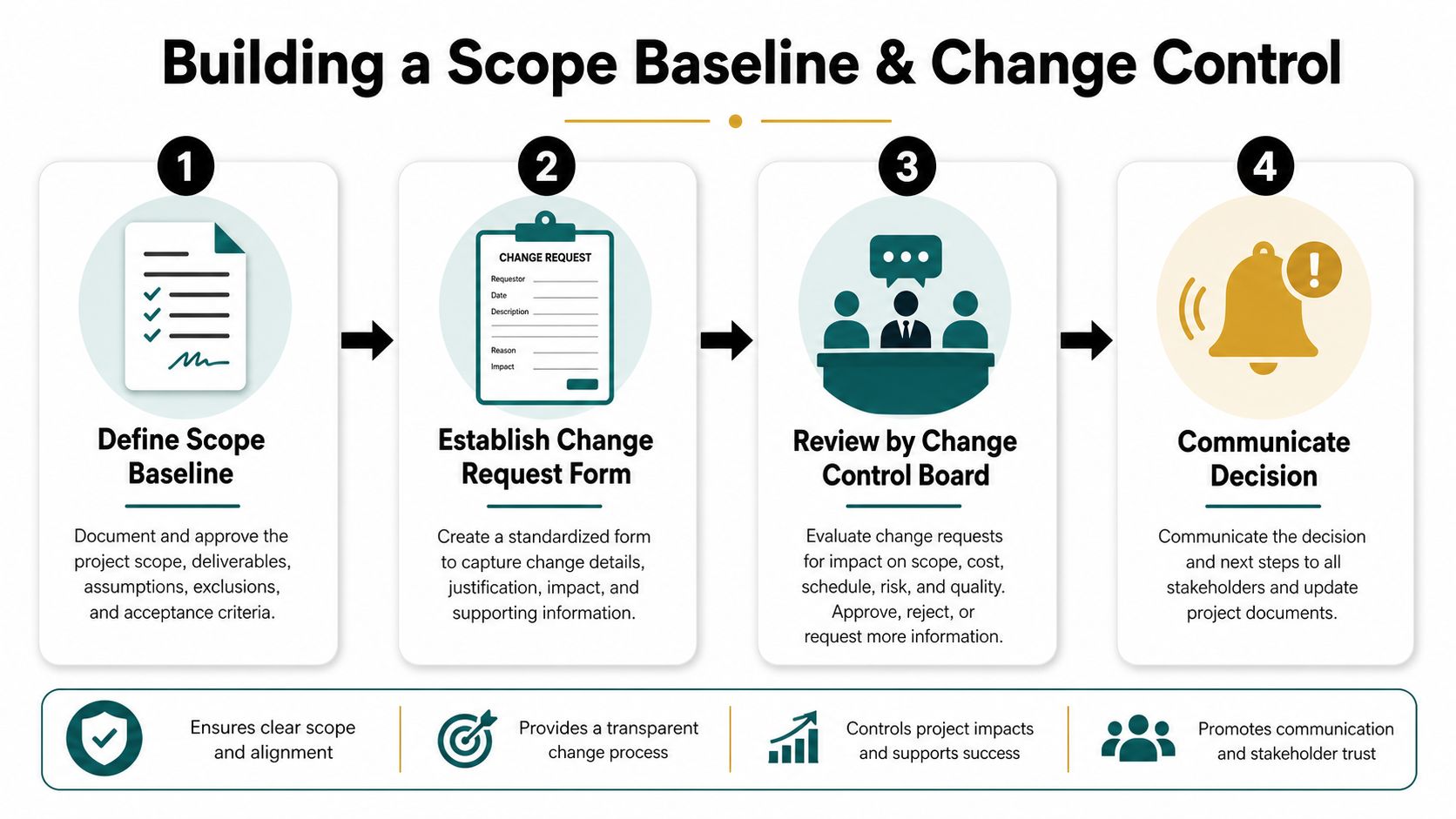
Use a simple workflow:
- Request: Capture the requested outcome, reason, urgency, and requester.
- Classify: Mark it as in-scope clarification, defect correction, regulatory obligation, or out-of-scope work.
- Evaluate: Record effects on time, cost, resources, architecture, security, quality, and operations.
- Decide: Approve, reject, defer, or request more information.
- Re-baseline: Update the product plan, backlog, budget, and delivery forecast when approval changes the commitment.
- Communicate: Tell affected teams what changed and what no longer fits.
A change log is enough for a small product. A change board may be appropriate for a larger program. Teams looking for practical change tracking for startups can also examine SpecStory, Inc.’s approach to making development decisions easier to record and review.
The most common failure is the “tiny request exception.” Several small additions can create the same effect as one major change, especially when they touch shared services or require repeated testing. Put a threshold on review effort, not on whether governance applies. A lightweight review is still a review.
For product teams, keep the approved scope connected to a living product roadmap. The roadmap should show what moves when a new commitment enters, not merely add another line.
Managing Stakeholder Communication and Decision Rights
Some teams don't need more meetings. They need fewer ambiguous decisions.
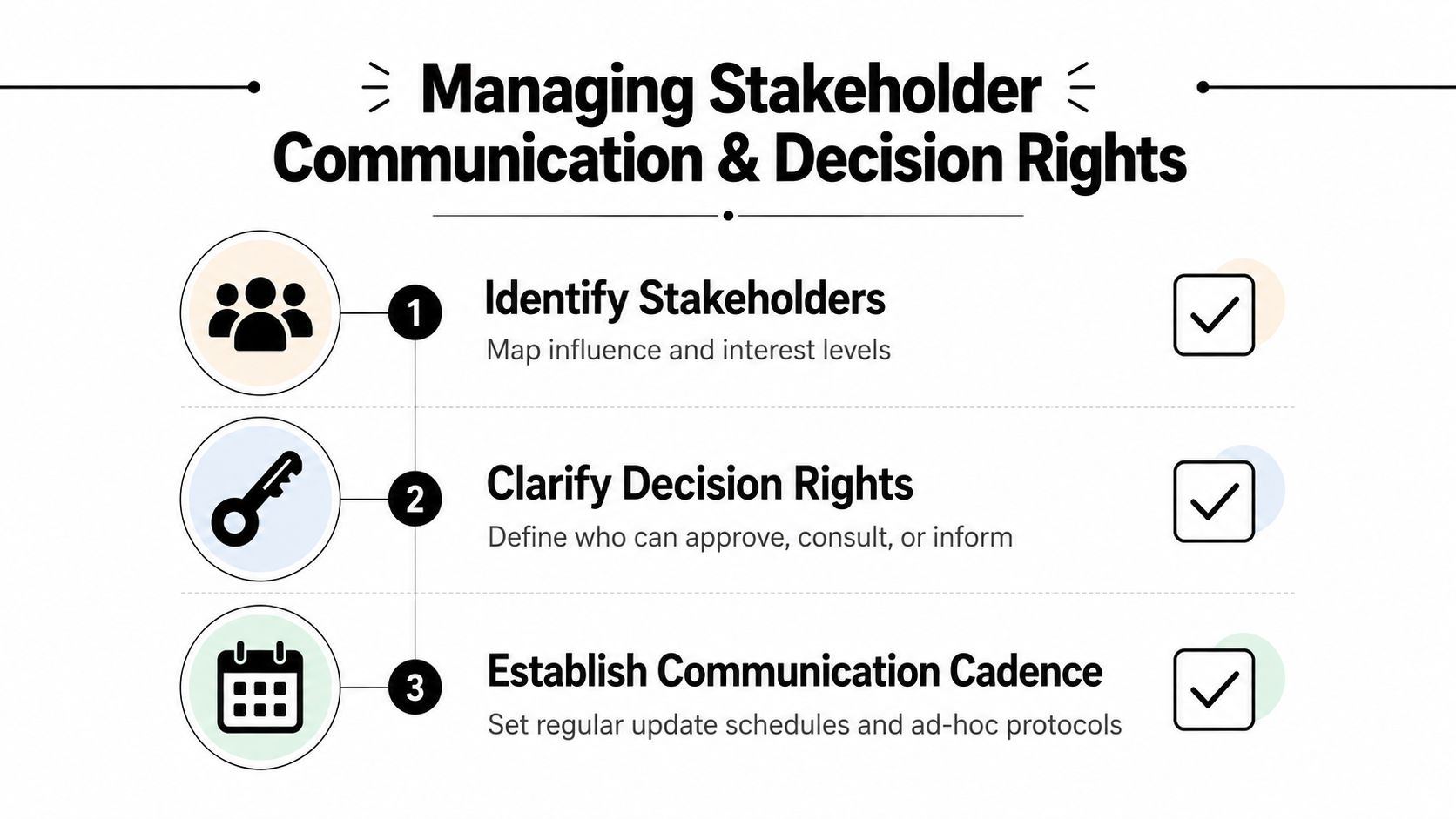
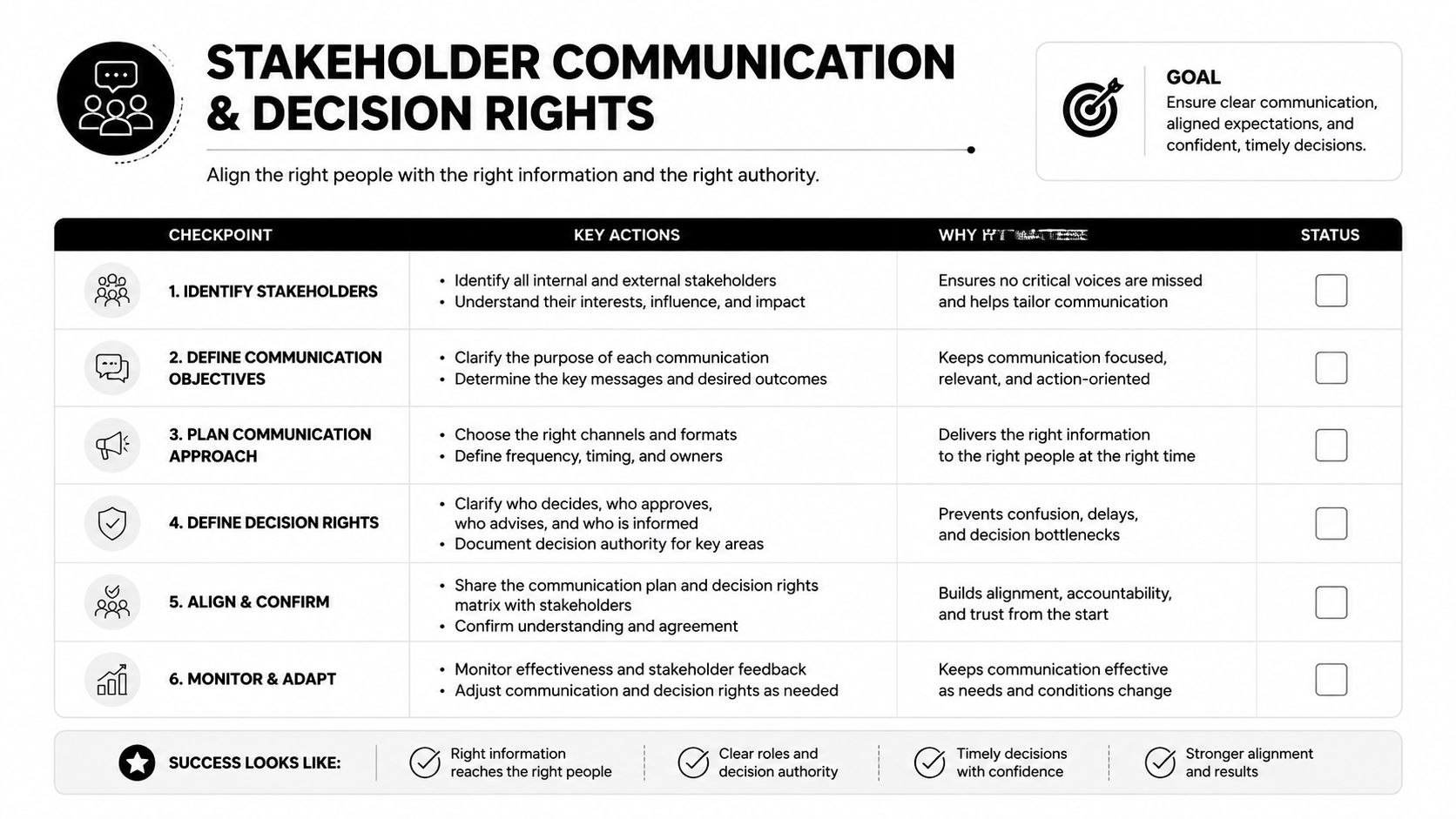
Start by naming the person accountable for the product outcome and the person authorized to change the delivery commitment. Those may be the same person, but don't assume they are. A stakeholder can request a feature, advise on risk, or provide user context without having authority to add work.
Put authority where the impact is visible
A useful decision-rights map distinguishes among four roles:
| Role | Responsibility |
|---|---|
| Requester | Explains the need, urgency, and desired outcome |
| Evaluator | Estimates delivery, technical, security, and operational impact |
| Approver | Accepts the trade-off and authorizes the revised commitment |
| Informed group | Adjusts work after the decision is recorded |
Set approval thresholds around consequences. A product manager may approve a clarification that doesn't alter the baseline. A sponsor may need to approve a change that moves a release. Security, legal, compliance, or operations may hold approval rights when their controls are affected.
The change meeting should be short and evidence-based. Present the request, the reason, the options, and the consequence of each option. Don't ask stakeholders to approve an abstract estimate. Ask them to choose among concrete alternatives: keep the date and remove another item, keep the scope and move the date, add capacity, or accept a documented risk.
Make “no” a trade-off conversation
A blunt refusal creates resistance. An unqualified yes creates debt. Use language that preserves the relationship while protecting the baseline:
“We can support that outcome. It isn't in the current release, so we'll price the impact and show what must move if we add it.”
That sentence acknowledges the value of the request without pretending the team has spare capacity. If a request is urgent, label it urgent and route it through the same process. An emergency path should speed up decision-making, not erase the record.
Send a written decision after every review. Include the approved wording, owner, affected requirements, new assumptions, and the plan impact. A concise project summary template can help teams maintain a shared record without turning every update into a long report.
Good communication makes governance usable. It doesn't replace governance. A polished status meeting cannot compensate for unclear authority, missing impact estimates, or stakeholders who believe a private conversation can authorize engineering work.
Handling Scope Creep in High-Stakes and Regulated Environments
Rigid scope freezes fail in environments where laws, policies, safety findings, or audit requirements can change during delivery. A healthcare, fintech, or government team can't reject a necessary control because it wasn't in the original backlog. The right response is controlled flexibility, not permanent openness and not artificial certainty.
Research on software projects found that scope creep affects both critical and non-critical applications, but critical applications are more sensitive to it in terms of time, cost, defects, and project success. The findings are discussed in research on scope creep in critical software applications. That distinction matters because the same change process should not treat a cosmetic preference and a safety-related requirement as equivalent.
Separate obligation from expansion
Create an intake category for regulatory, security, safety, and audit-driven changes. Require the requester to identify the obligation, affected control, deadline, evidence required, and consequence of non-compliance. A compliance lead or designated risk owner should confirm whether the request is mandatory, recommended, or merely desirable.
Then assess the change against the system's risk profile:
- Traceability: Link the obligation to requirements, design decisions, implementation tasks, tests, approvals, and release evidence.
- Impact: Evaluate data handling, access controls, failure modes, vendor dependencies, and operational procedures.
- Priority: Place mandatory risk reduction ahead of discretionary enhancements, while documenting what gets deferred.
- Approval: Route high-impact changes to the accountable sponsor and relevant control owners, not just the product backlog.
This approach creates an auditable reason for changing scope. It also prevents “compliance” from becoming a vague label attached to ordinary feature demand.
Use agile control points
Agile delivery doesn't mean every sprint can accept unlimited work. Keep a stable goal for the iteration, maintain a ranked backlog, and use release-level change decisions for requests that affect architecture, controls, or commitments. A requirement can evolve within an approved outcome, but a new outcome needs explicit evaluation.
For critical systems, preserve versioned requirements and test evidence. Don't overwrite the original acceptance criteria to make a late change look like it was always included. Re-baseline formally, identify the superseded requirement, and retain the decision history.

Using AI Tools to Prevent Invisible Scope Drift
AI-enabled software introduces a new form of scope drift. The product team may approve “an assistant,” but the work expands through prompt design, model selection, retrieval, permissions, evaluation, monitoring, fallback behavior, and usage management. A prompt revision can alter output quality without appearing as a conventional code change. A new data source can create security and compliance work that the original feature description never mentioned.
Treat AI behavior as a governed product surface. Each production prompt should have an owner, purpose, expected inputs, approved data access, evaluation criteria, and a version history. Teams building an internal content or support assistant may also benefit from guidance on how to build an AI knowledge base, especially when retrieval content and source permissions form part of the product boundary.
Make invisible work inspectable
A prompt management system can support the same control principles used for conventional scope:
- Prompt vault with versioning: Keep approved prompts, revisions, owners, and rollback points together.
- Parameter manager: Control access to internal databases and define which application context reaches an AI integration.
- Cross-model logging: Record activity across integrated AI systems so teams can investigate behavior and identify unplanned usage.
- Cost manager: Show cumulative spend so leaders can spot resource consumption that no longer matches the approved feature or operating plan.
These controls don't decide whether a feature belongs in scope. They give decision-makers evidence. If a team adds another model, expands retrieval sources, or increases automated usage, the governance record can capture the operational effect instead of leaving it hidden in scattered configuration files and provider dashboards.
Wonderment Apps has developed a prompt management system that developers and entrepreneurs can plug into an existing application to modernize it for AI integration. Its administrative tooling includes a versioned prompt vault, a parameter manager for internal database access, logging across integrated AI systems, and a cost manager for cumulative spend visibility.
The human change board still matters. AI tooling can flag drift, preserve history, and expose cost, but product, engineering, security, and compliance owners must decide whether the change is justified. That combination is stronger than either side alone: people make the trade-off, while the system makes the trade-off difficult to hide.
Wonderment Apps helps organizations define product goals, manage change requests, and build scalable web, mobile, and AI-modernized applications with the right engineering, design, QA, and project leadership. Visit Wonderment Apps to discuss your project, review its scope-control needs, and see how a prompt management system can make AI behavior, access, and cumulative cost visible before scope drift becomes delivery debt.