

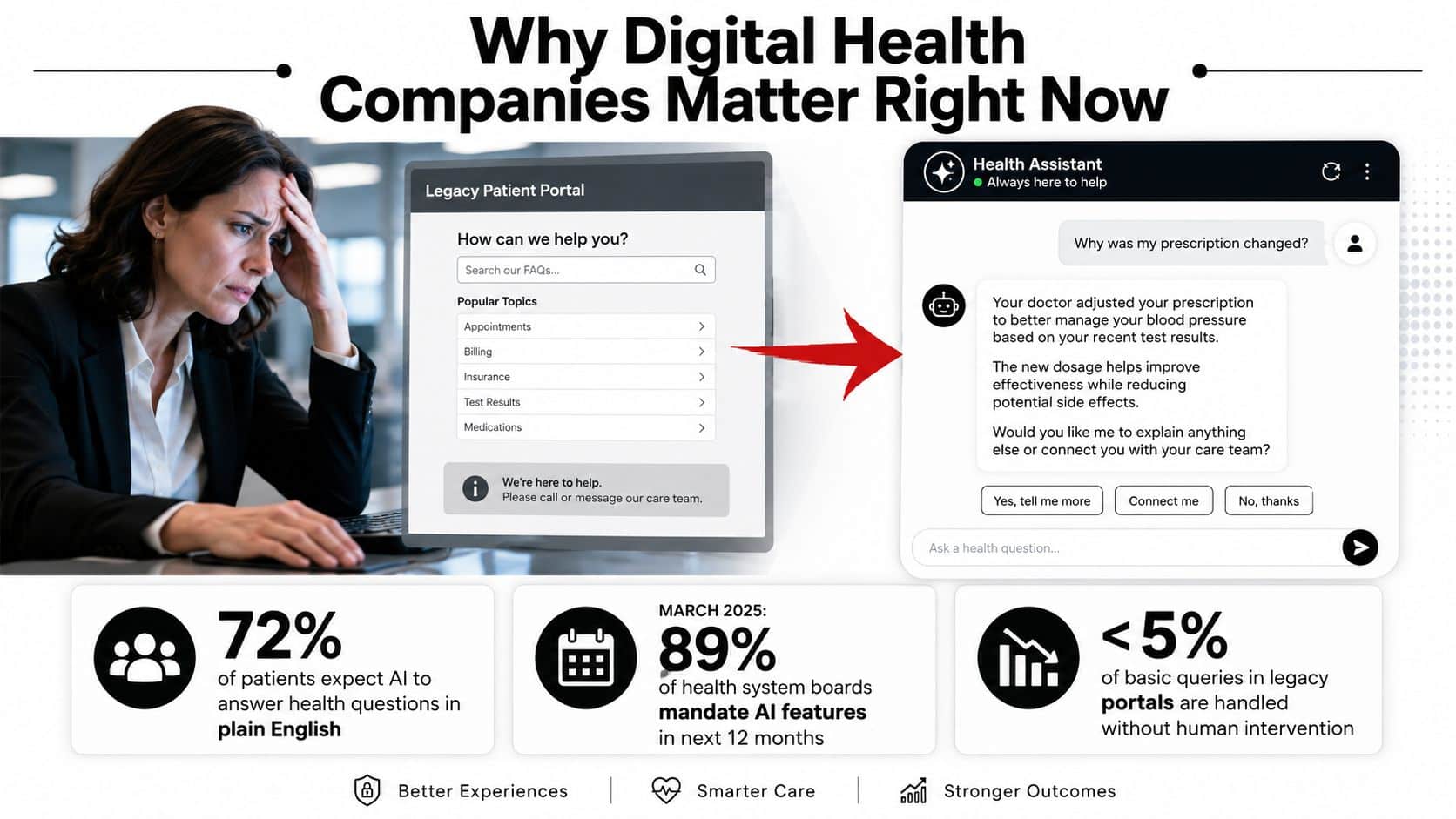
A healthcare operations lead opens a patient portal, types a simple question, and gets three screens of jargon back. The board wants AI features by next quarter, the integration team is already overworked, and the old software can't explain itself in plain English. That's exactly where digital health companies come in, they turn messy clinical workflows, legacy data, and half-connected tools into software people can use.
The opportunity is real, and the capital is there. U.S. digital health startups raised $14.2 billion in venture funding in 2025, up 35% from $10.5 billion in 2024, with Q4 2025 alone bringing in $4.2 billion across 129 deals Rock Health. At the same time, the global market is large and still expanding, with one major forecast placing it at $347.4 billion in 2025 and projecting $1.83 trillion by 2033 Grand View Research. If you're trying to modernize a patient-facing app, a clinical workflow, or a back-office platform, this is no longer a niche software problem.
A practical path exists for legacy estates, too. Teams don't always need a full rebuild to become AI-ready, they need the right layer for prompts, logging, cost tracking, and access control, then a safe way to plug that into the software they already have. If you're mapping that kind of modernization effort, a useful starting point is digital transformation in healthcare, because the software question is rarely separate from the operating model question.
Why Digital Health Companies Matter Right Now
A lot of healthcare leaders are sitting on the same uncomfortable contradiction. The existing portal or app still handles the basics, but only barely, and every new request from clinicians or the board pushes the system closer to a rewrite. That's why digital health companies matter now, they're the firms that turn awkward, fragmented care experiences into software that can support real-time decisions, safer handoffs, and better patient communication.
The market moved from experimentation to scale
The funding picture tells you what investors believe. In 2025, capital concentrated into fewer, larger rounds, which is a strong signal that the market now rewards companies that can show scale, clinical utility, and commercial traction Rock Health. This matters for buyers as much as for founders, because mature platforms usually come with stronger implementation discipline, clearer evidence plans, and more realistic support expectations.
Practical rule: if a vendor can't explain its data model, interoperability plan, and post-launch support model, it's probably still a product demo, not a healthcare system.
The market is also broad enough to support many product shapes. Digital health spans mobile health apps, telehealth platforms, wearable devices, electronic health records, and artificial intelligence tools according to the World Health Organization's framing of digital health as the use of digital technologies to support health systems and outcomes WHO. That breadth is useful, because it means a company can improve patient access, clinician workflow, or operational visibility without pretending one interface solves everything.
Why the legacy portal problem keeps showing up
Legacy systems usually fail in predictable ways. They ask patients to translate medical language, they hide status behind internal codes, and they force staff to act as the human middleware. The better digital health companies remove those translations one layer at a time, often starting with the highest-friction touchpoints like scheduling, triage, medication tracking, and follow-up messaging.
That's also where AI starts to make sense. Not as a chatbot stuck on top of a brittle backend, but as a controlled layer with logs, versioning, and guardrails. Wonderment Apps' prompt management approach fits that pattern, a versioned prompt vault, parameter controls for internal data access, unified logging across integrated AI providers, and cost visibility can modernize existing software without forcing a full rewrite.
The practical takeaway is simple. Digital health companies matter because they sit at the intersection of care delivery, software engineering, and regulatory reality. The good ones don't just add features, they reduce the number of places where a clinician or patient can get stuck.
What Digital Health Companies Build
A care team can have good clinicians and still lose time to messy software. Appointments get buried in separate systems, test results arrive in one place and patient messages in another, and staff end up stitching together the workflow by hand. Digital health companies build the software layers that reduce that friction, so the care process keeps moving instead of stopping at each handoff.
Start with the workflow, not the label
The WHO defines digital health as the use of digital technologies to support health systems and outcomes. A 2020 cohort study in npj Digital Medicine gives a more business-useful version, digital health companies are firms that build and sell healthcare-focused technologies and services paired with those technologies, such as telemedicine consultation or remote monitoring services npj Digital Medicine. That pairing matters because the software and the service usually depend on each other.
So the label on the slide deck matters less than the workflow the product changes. If a tool helps a care team triage symptoms faster, helps a patient get a diagnosis sooner, or helps a payer understand utilization more clearly, it belongs in this category.
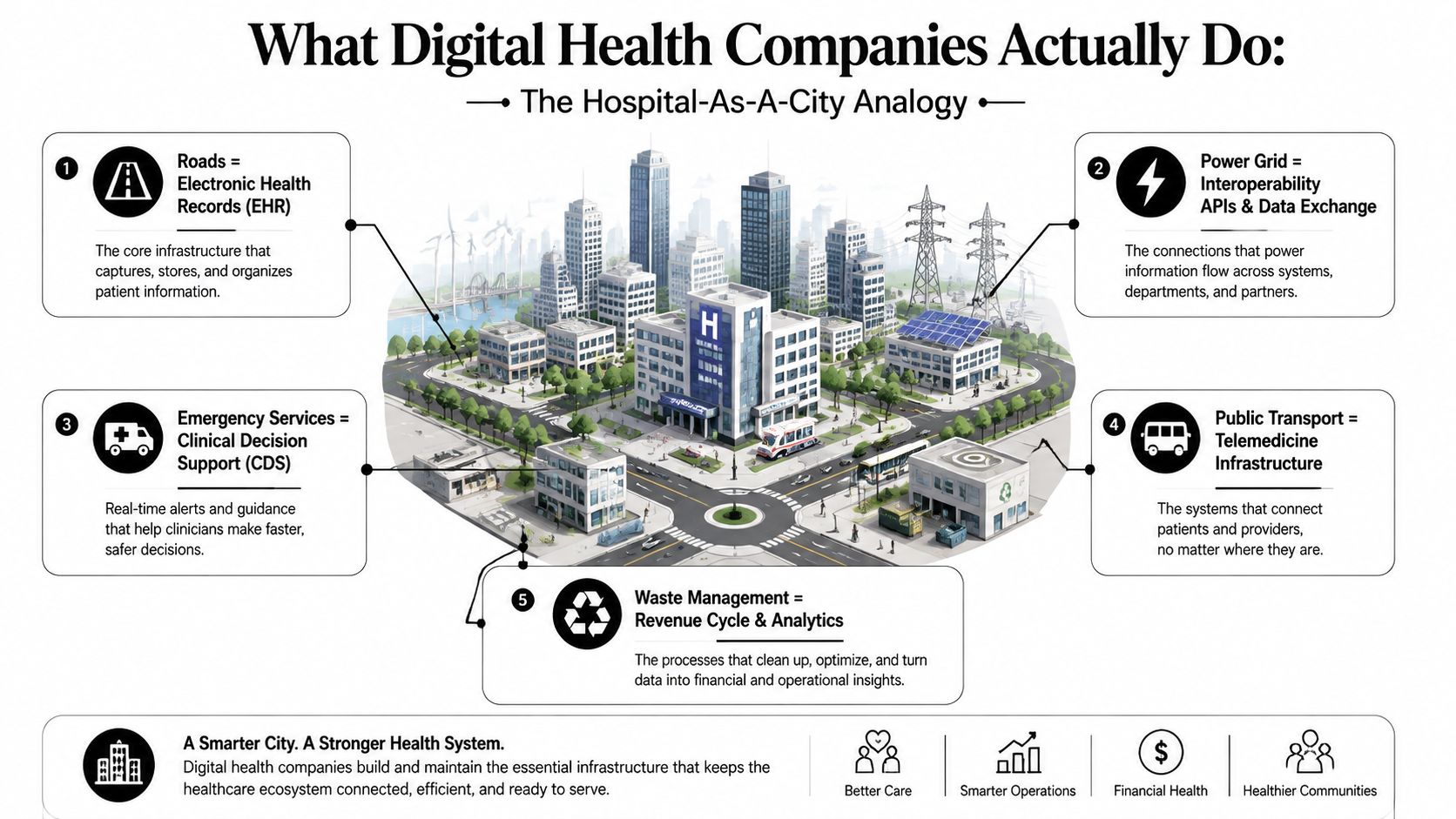
The hospital-as-a-city model makes the stack easier to understand
A hospital needs records, devices, decision support, scheduling, analytics, and communication channels. Digital health companies tend to work across those layers, sometimes starting with one and then extending into the others as the product matures. One company may focus on the record layer, another on the monitoring layer, and another on the logic that helps clinicians decide what to do next.
The useful mental model is straightforward.
- Records and coordination: systems that store the clinical story and help teams share it.
- Connectivity and exchange: tools that move data between apps, devices, labs, and payers.
- Decision support: software that flags risk, recommends action, or reduces manual review.
- Patient access: telehealth, messaging, portals, and remote care tools.
- Operations and finance: analytics, billing support, and population reporting.
A digital health company does its real work when the clinician does not have to enter the same fact three times.
That is why category labels can mislead. A patient app with a polished interface can still be a weak digital health product if it does not connect cleanly to the rest of the care pathway. A quieter infrastructure tool can have a larger clinical impact if it removes friction from documentation, handoffs, or follow-up.
The shortest definition is still the most useful. A digital health company is a company that sells technology and services that change how healthcare is delivered, measured, or managed. Everything else, branding, interface style, even whether AI is involved, comes after that.
The Main Categories You Will Keep Meeting
The easiest way to stop treating digital health as one giant bucket is to sort companies by the problem they solve. The market is getting more selective, too. U.S. digital health funding in 2025 shifted toward fewer, larger rounds, which tends to favor mature platforms over experimental concepts Rock Health. That makes category clarity more valuable, not less.
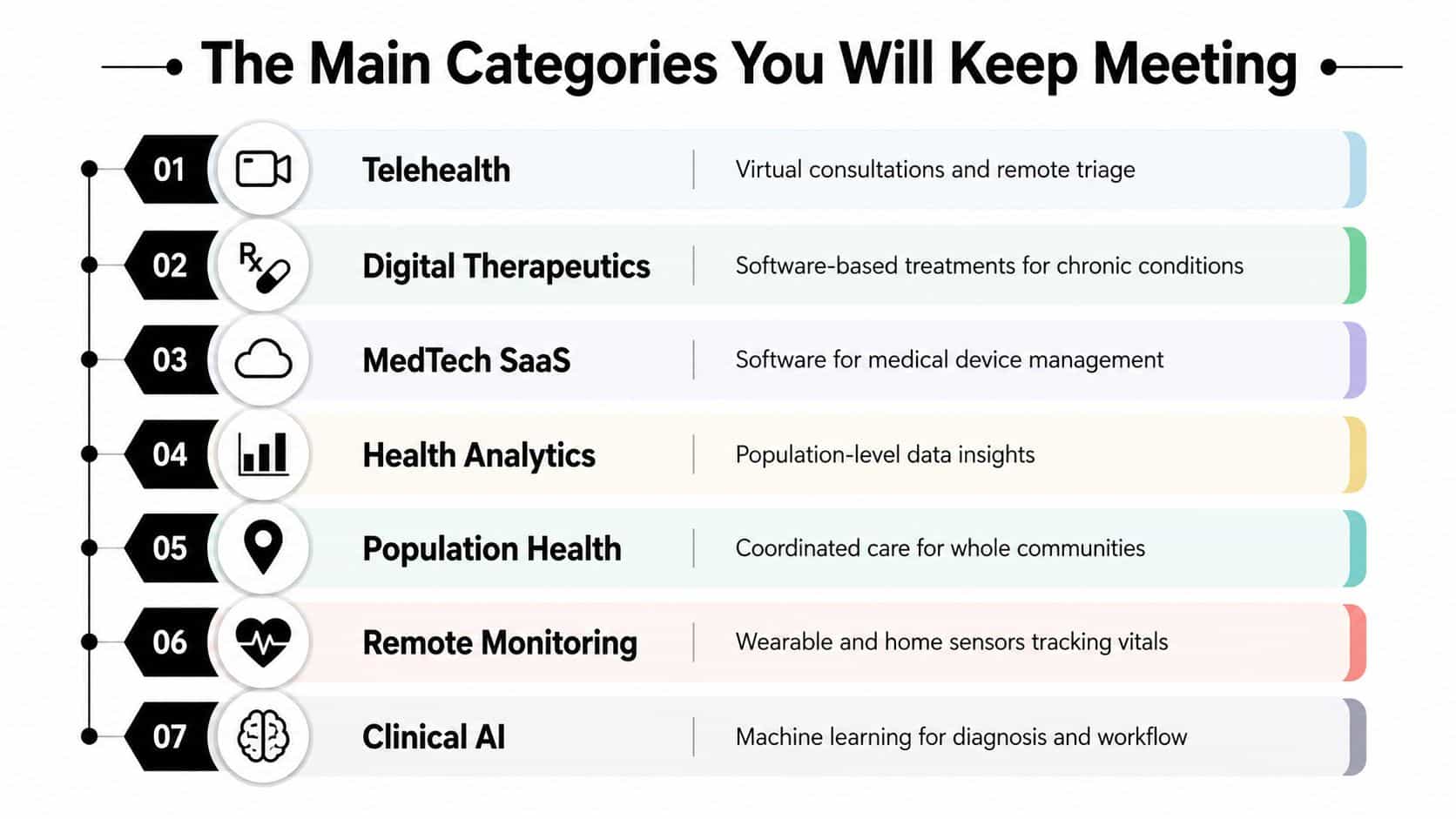
Seven categories that keep coming up in real buying decisions
- Telehealth. A video visit platform or remote triage tool. The engineering challenge is reliable real-time media, identity checks, and clinical routing under variable network conditions.
- Digital therapeutics. Software-based treatment for a chronic condition, often paired with care plans or coaching. These products need evidence, adherence tracking, and strong validation.
- MedTech SaaS. Cloud software for managing devices, service history, or operational workflows. This tends to demand device integration, traceability, and audit-ready workflows.
- Health analytics. Dashboards and data products that turn operational or clinical data into decisions. The main skill here is data modeling, not pretty charts.
- Population health. Coordination tools for groups of patients, often tied to risk stratification and care management. These platforms need clean cohort logic and payer or provider alignment.
- Remote monitoring. Wearables, home sensors, and connected devices that send ongoing signals back to a care team. This category lives or dies on data quality and alert triage.
- Clinical AI. Machine learning for diagnosis support, prioritization, or workflow automation. The hard part is governance, model monitoring, and clinical trust.
The categories overlap, but the engineering emphasis changes. A telehealth platform can feel like a consumer app on the surface, while a remote monitoring product is really a data pipeline with a patient interface attached. That distinction matters when you're choosing a vendor or scoping an internal build.
How to map your idea to the right shape
If your product depends on live interaction, think telehealth. If it changes behavior over time, think digital therapeutics. If it's mainly about operational visibility, health analytics may be the better fit. If it depends on sensors, device data, or repeated measurements, remote monitoring is the right bucket.
The common mistake is to buy a feature list instead of a category fit. A company that builds great appointment software may not know how to design longitudinal monitoring or regulated AI. A team that ships strong analytics may not know how to handle patient-facing consent, messaging, or clinical escalation.
That's why the best buying conversations start with a workflow map, not a product demo. Once you know whether you're improving access, monitoring, decision support, or care coordination, the category becomes obvious, and the engineering skills you need become easier to evaluate.
The Technology Stack Behind Modern Digital Health
A clinic team may see a single patient portal on the surface, but the product underneath is usually a chain of connected systems. If one layer is weak, the whole flow slows down, and people end up retyping data, reconciling records, or making decisions from incomplete context. The core layers usually include AI and machine learning, interoperability, cloud infrastructure, mobile and wearable front ends, and analytics.
The layers that drive outcomes
AI and ML are the most visible pieces, but they do not help on their own. In practice, they support decision support, prediction, summarization, and automation only when the underlying data is structured well enough to trust. The engineering work that makes those outputs usable usually starts with logging, schema design, and data quality, not model selection.
Interoperability is the quiet superpower. If a platform cannot exchange data with EHRs, labs, devices, or payer systems, every feature eventually turns into a manual re-entry problem. For a practical overview of the implementation side, the developer guide to interoperability solutions is a useful reference point because it treats exchange as an engineering problem, not just a standards discussion.
Cloud infrastructure gives digital health companies room to scale storage, processing, and deployment across different customers and care settings. Mobile and wearable interfaces then become the patient-facing layer, where clinicians and patients feel the product. Analytics sits on top and turns usage, outcomes, and operational data into decisions.
The layer many engineering teams underbuild
A 2023 review in PMC notes that electronic documentation, bar coding, and automated dispensing systems can reduce mistakes across diagnosis-to-medication workflows PMC. That is a reminder that the highest-value software is often not the flashiest patient app. It is the system that improves data capture, closes the loop between action and verification, and reduces the chance that someone has to guess.
Engineering lesson: if the data is messy at capture time, AI will only automate confusion faster.
That is why digital health products increasingly rely on closed-loop workflows. A clinician documents once, the system routes the next step, the patient gets the right follow-up, and the audit trail stays intact. That is a much harder product than a simple dashboard, but it is also much more defensible.
The direction of travel is clear. Recent startup coverage highlights AI systems that infer cardiovascular risk from ECG data, support full-body preventive scans, and enable at-home diagnostic testing CB Insights. The stronger products combine continuous data streams with decision-support models, because longitudinal signal is usually more useful than one-off snapshots.
Teams also need to decide how the stack supports compliance from the start. A useful reference for that layer is HIPAA compliant software requirements, because privacy controls, auditability, and deployment choices affect architecture rather than sitting outside it.
Regulation, Security, and Clinical Evidence as One Framework
A patient portal, a remote monitoring workflow, and an AI triage tool can all fail for the same reason, the product treats privacy, security, and validation as separate chores. In digital health, those pieces shape the system together, because the way data moves, where it is stored, and how it is proved in use all decide whether the software can hold up in real settings.
Build the guardrails into the architecture
HIPAA, GDPR, SOC 2, FDA Software as a Medical Device pathways, and IEC 62304 all push teams toward the same discipline, clear data boundaries, reliable audit trails, and controlled software change management. If you are reviewing a deployment plan, HIPAA compliant deployment shows how privacy requirements affect operations, and our guide to HIPAA compliant software requirements goes into the technical details.
Retrofits are expensive. If you add logging, access control, or model versioning after a product is already shipped, you usually end up touching core workflows anyway. A better path is to separate data domains early, log every meaningful AI interaction, and version prompts and models from the start.
The same logic applies to vendors. If a team cannot explain auditability, tenant boundaries, or rollback, it will struggle the moment a regulator, customer, or security review asks hard questions.
Evidence is part of the product, not a slide deck
A systematic review in Journal of Medical Internet Research found that successful scale-up depends on more than product quality alone, with market access, reimbursement strategy, clinical evidence, and strategic partnerships all mattering JMIR. That is the part many software teams miss. They treat shipping the feature as the finish line, while healthcare usually treats it as the start of proof.
A 2024 PMC study of top-funded digital health lifestyle companies found that less than half produced any scientific research, with 83 publications identified in total PMC. That is not a flattering signal for the sector, and it explains why buyers should ask for validation plans early, not after launch.
If a digital health product cannot show how it will be measured, it is not ready for healthcare procurement.
Clinical evidence does not always mean a randomized trial, but it does mean a plan for validation, logging, outcomes tracking, and long-term support. In Medicaid, rural, or multilingual settings, operations matter just as much as code, because reimbursement, patient access, and trust all shape whether the product gets used.
The practical takeaway is blunt. Compliance, security, and evidence are one system, and the product architecture has to be built around that reality.
Choosing a Vendor and Modernizing Without Rebuilding
The best vendor isn't the one with the flashiest demo. It's the one that can survive healthcare's reality, integration mess, regulatory review, changing evidence standards, and the long tail of support after launch. If you're buying or building, start with the workflow, then test the vendor against the parts that usually break.
Vendor evaluation checklist for digital health builds
| Criterion | What to Look For | Red Flag |
|---|---|---|
| Healthcare experience | Real shipped work in clinical, payer, or regulated workflows | Generic SaaS experience only |
| Regulatory familiarity | Clear understanding of privacy, audit, and software lifecycle requirements | “We can add compliance later” |
| Evidence mindset | Measurement plan, logging, and validation approach | Feature-first thinking with no outcomes plan |
| Integration muscle | Comfort with EHRs, APIs, devices, and data exchange | One-off connectors and brittle handoffs |
| Post-launch support | Monitoring, rollback, incident handling, and iteration | “Launch and hand off” culture |
The internal business case often gets stronger when teams treat modernization as a sequence rather than a rewrite. Start with the highest-friction workflow, add instrumentation, introduce a thin AI gateway, and only then expand into new use cases. That keeps risk down and gives you a clean way to observe what the AI is doing.
For teams wanting a broader implementation lens, custom healthcare application development is a useful companion topic because it connects product scope to the realities of healthcare build decisions. The important part is not just the feature list, it's whether the system can evolve without breaking care delivery.
A practical AI modernization path
A legacy app can become AI-capable without being torn apart. The trick is to isolate prompt logic, keep model access controlled, and log every integrated call in a way that engineers and auditors can both read. That's where a prompt management layer starts to matter.
Wonderment Apps' prompt management system is one concrete example of that approach. It includes a prompt vault with versioning, a parameter manager for internal database access, a logging system across all integrated AI providers, and a cost manager that shows cumulative spend, which is exactly the kind of control layer that helps teams modernize responsibly.
The right modernization pattern is boring in the best way, traceable prompts, predictable access, and enough visibility to catch problems before customers do.
If you're choosing a partner, ask how they handle version control for AI behavior, not just application code. Ask how they isolate sensitive data, how they monitor cost drift, and how they prove the system is still behaving as intended six months after launch. Those answers tell you more than a product brochure ever will.
Wonderment Apps helps healthcare teams modernize legacy software with AI integration, compliant architecture, and user-centered delivery. If you're planning a digital health build or trying to add AI to an existing platform without a risky rewrite, visit Wonderment Apps to explore how their engineering and prompt management tooling can fit your workflow.