

A lot of software initiatives stall before anyone writes meaningful production code. The idea sounds strong in the boardroom. The market case feels compelling. The AI angle makes it even more exciting. Then the team hits the first real decision and momentum drops fast.
Do you test the hard technical assumption first, or do you show people a model of the product and gather feedback?
That's the key difference between proof of concept and prototype. One reduces technical risk. The other reduces product and usability risk. If you mix them up, you'll spend design budget on an idea that may not work, or you'll burn engineering time proving technology no user wants.
For leaders building AI-enabled software, that early choice matters even more. Prompt behavior, model selection, parameter handling, logs, and spend control can get messy long before launch if the team experiments without structure. That's why many teams now put lightweight administrative controls around AI testing from the beginning, especially when they need to manage a prompt vault with versioning, parameter access to internal data, cross-model logging, and cost visibility before an MVP exists.
The Billion-Dollar Idea Dilemma
A familiar scenario plays out in product meetings every week. A retailer wants an AI-assisted shopping experience inside its mobile app. A fintech team wants to add an intelligent workflow to a legacy portal. A healthcare leader wants software that can process information faster, but the compliance and integration layers are complex.
The vision is clear. The first move isn't.
Some stakeholders ask for screens they can click through. Others want engineers to prove the core workflow can work at all. Both requests sound reasonable. Only one is usually right as the first step.
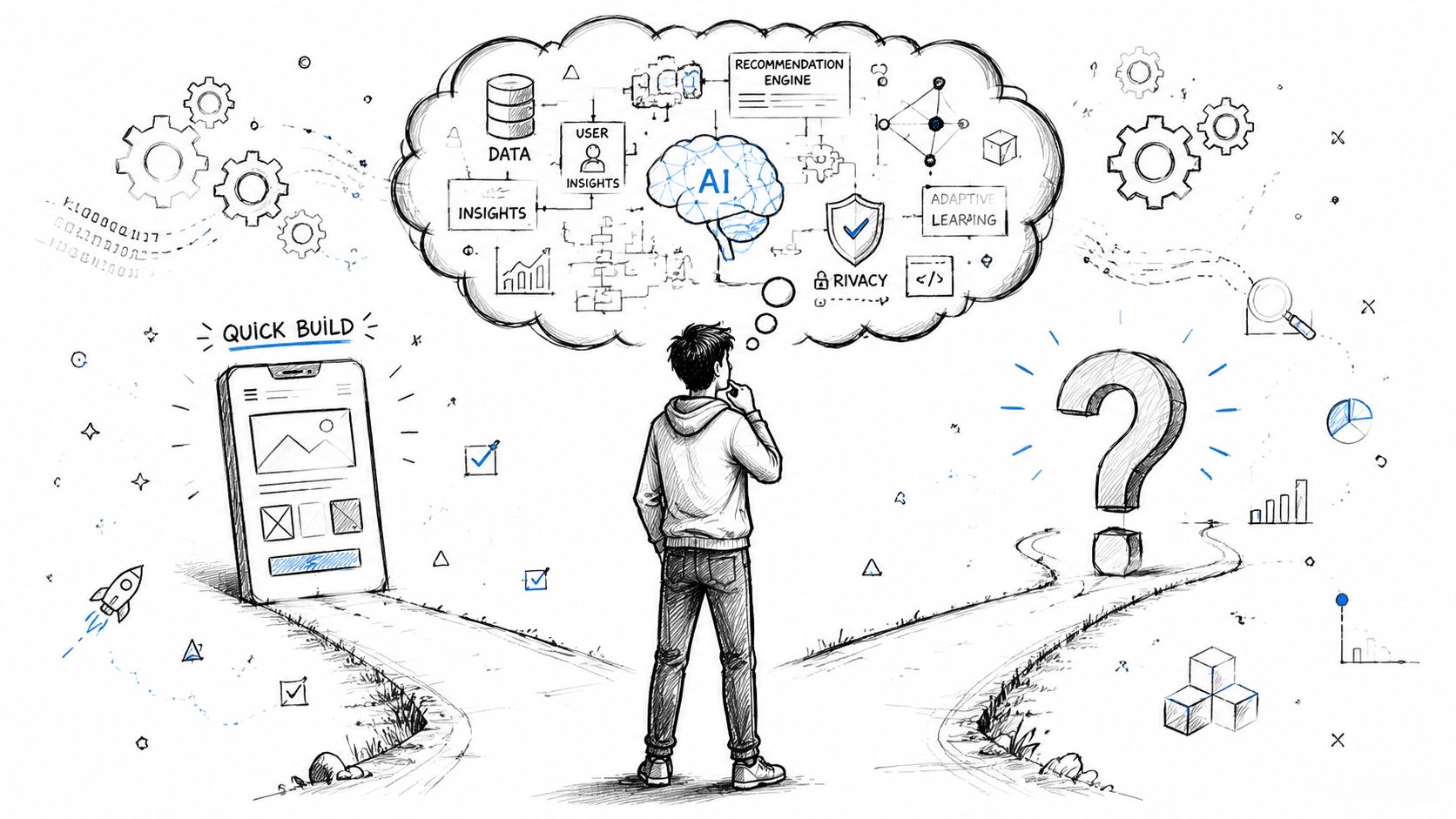
Where leaders usually get stuck
The confusion often starts because both artifacts happen early and both are incomplete. But they answer different business questions.
| Decision pressure | What the team is really asking |
|---|---|
| Investors or internal stakeholders want something visible | How will this product look and flow? |
| Engineering warns the idea depends on uncertain integrations or AI behavior | Can this actually be built? |
| Budget is limited and the team can't afford rework | Which risk should we remove first? |
If the unknown is technical, a polished mockup won't save you. If the unknown is user adoption, a backend experiment won't tell you whether customers can find their way through the product.
The most expensive early-stage mistake isn't building the wrong thing slowly. It's validating the wrong question first.
Why AI makes the choice harder
AI projects add one more layer of uncertainty. A team may need to test model behavior, prompts, parameter settings, database access rules, and logging before anyone should debate button placement or dashboard spacing.
That's why the first phase needs discipline. If leaders skip that discipline, teams end up with scattered prompts in docs, inconsistent test settings, weak audit trails, and no clean view of cumulative AI spend. Good decisions become harder because the experiment itself isn't controlled.
What Is a Proof of Concept (POC)
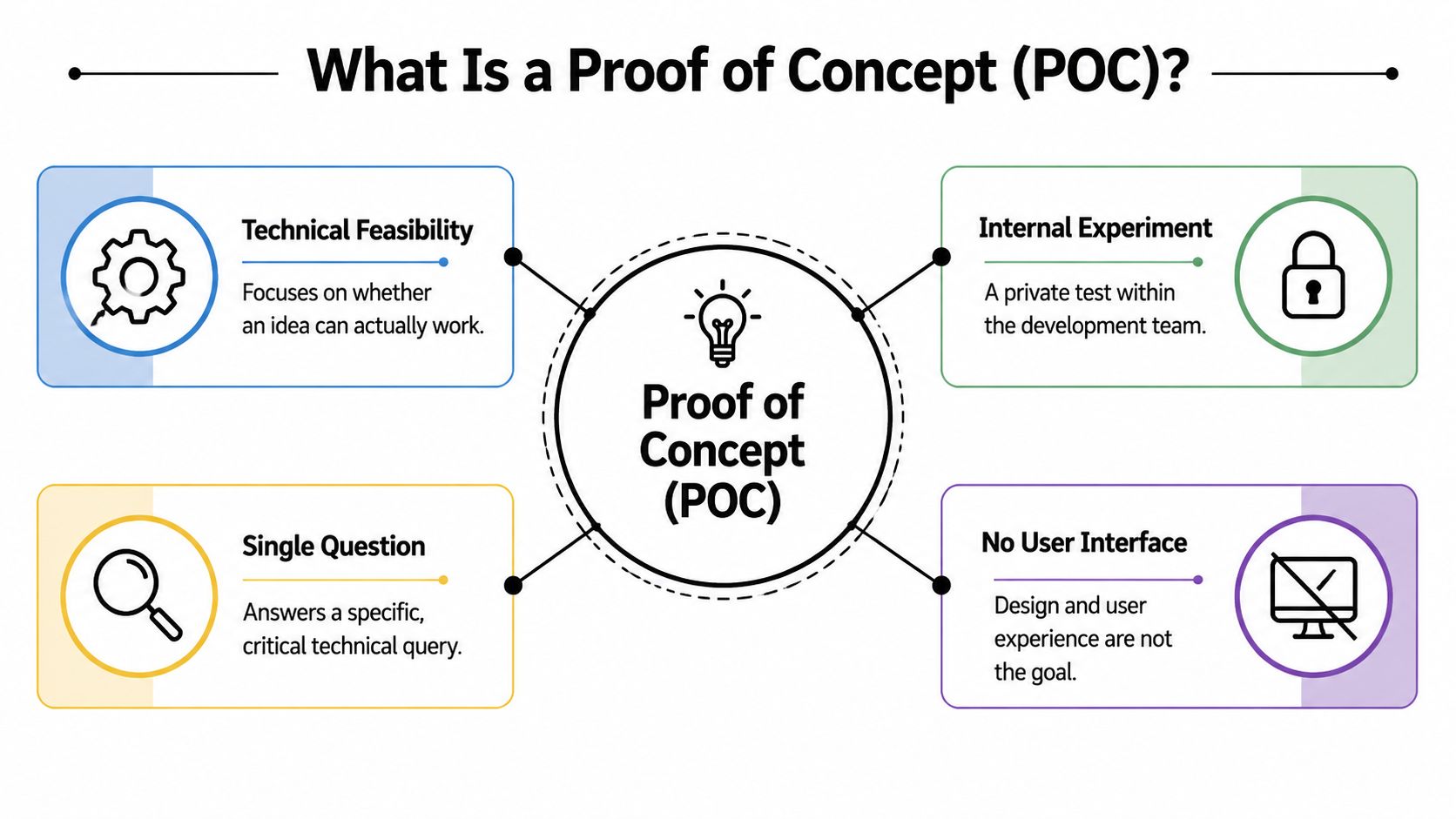
A proof of concept, or POC, is a narrow internal test built to answer one question: Can this be built?
That definition is precise, and it matters. As CodiLime explains in its breakdown of PoC vs prototype, a Proof of Concept is a minimal, internal, technical validation artifact focused exclusively on assessing the feasibility of a specific technology or core idea, answering the question “Can this be built?” with measurable success defined by proven viability and the absence of critical technical blockers.
That means a POC is not a mini product. It isn't a pitch deck with motion. It isn't a usability exercise. It is a controlled technical experiment.
What a POC looks like in practice
Think of a POC like a lab test. The team isolates one assumption and tries to prove or disprove it.
Examples include:
- AI integration test that checks whether your application can reliably connect to a selected model and return structured output.
- Performance check for a recommendation engine that must process product data fast enough to support a live experience.
- Security and access experiment that validates whether internal data can be exposed to an AI-assisted workflow without breaking governance rules.
- Automation feasibility trial that proves a specific workflow can be reduced with automation before a larger investment.
A POC is often rough by design. It may have no interface at all. The result might be a report, a simple demo environment, or engineering documentation rather than something stakeholders “use.”
What works and what doesn't
A strong POC has a tight boundary. It tests one assumption, uses clear success criteria, and ends with an executive decision.
A weak POC tries to impress everyone. That's when teams start adding screens, polishing interactions, and debating branding before they've answered the technical question.
Practical rule: If your team is arguing about colors, layout, or onboarding copy, you're probably no longer doing a POC.
Business leaders often get more value when they frame the work this way:
- Identify the blocker. What technical unknown could kill this initiative?
- Strip the scope down. Remove everything not required to test that unknown.
- Define the pass/fail condition. Engineering should know exactly what proof looks like.
- Decide fast. A POC exists to support a go, no-go, or revise decision.
If you're still shaping the commercial side of the idea, this practical look at valuing and monetizing an app concept in 5 steps pairs well with a POC because it keeps technical validation tied to business logic.
What Is a Prototype
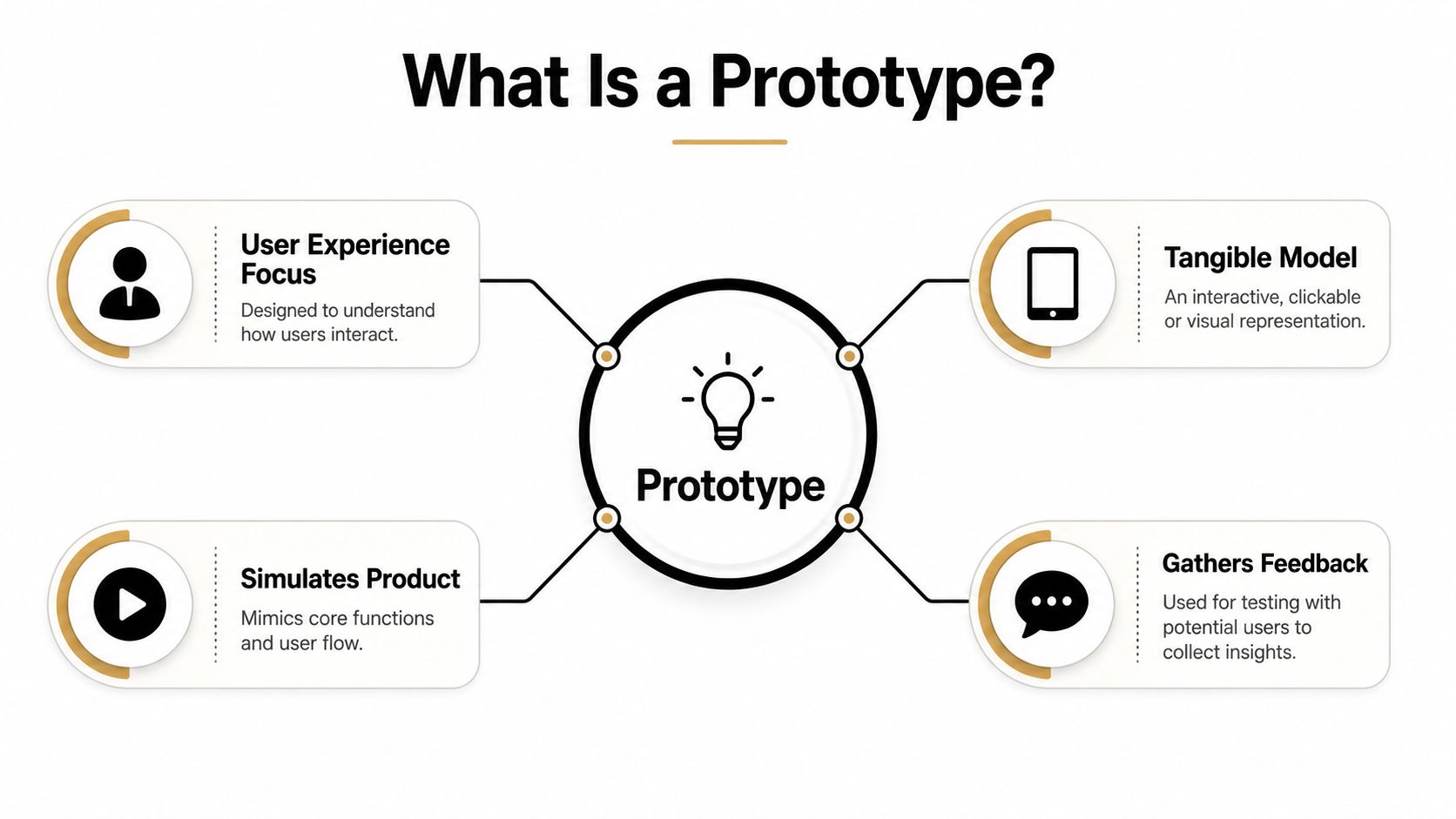
A prototype answers a different question: How will people use this?
It's an early, unfinished version of the product that simulates interaction, flow, and structure before development begins. According to Excited's explanation of PoC, prototype, and MVP, a prototype is used to test usability, navigation, and layout before coding begins, and 70–80% of product flaws are identified during prototype testing before coding begins.
That stat explains why prototypes matter so much to business leaders. They don't prove the underlying technology. They reveal where the product experience breaks.
What a prototype is actually for
A prototype is closer to an architect's model than a lab experiment. People can inspect it, move through it, and react to it. They can tell you where the flow feels confusing, what information is missing, and whether the feature set makes sense in context.
In software, that might mean:
- A clickable mobile shopping journey for a new retail app
- A desktop dashboard showing how operations staff move through AI-assisted tasks
- A fintech onboarding sequence that tests trust, clarity, and navigation
- A clinician-facing workflow that surfaces information in a usable order
Some prototypes are low fidelity. Others are highly interactive. The format matters less than the outcome. Stakeholders should be able to experience the product logic without building the full product.
Where prototypes pay off
Prototype work is where product, design, and business teams align. You can put the idea in front of decision-makers early, gather practical feedback, and change direction without rewriting production software.
A useful outside resource is this app prototyping guide, which walks through the mechanics of turning an abstract app idea into a testable interface.
What doesn't work is treating a prototype as if it proves engineering readiness. A beautiful prototype can still hide hard backend problems, model limitations, or integration risks. That's why teams need to know whether they're validating usage or feasibility.
For digital products, especially mobile and web applications, early structure matters. Good flows usually start with good wireframes, and this guide on why strong wireframes lead to better websites and mobile apps is a helpful reminder that teams should solve the experience before polishing visuals.
A prototype should make people react. If nobody can say where they got confused, it's probably too shallow to be useful.
POC vs Prototype A Side-by-Side Comparison
Leaders often treat these as interchangeable because both happen before full development. They aren't interchangeable. They are different tools for different types of uncertainty.
According to industry benchmarks summarized by Coherent Solutions, PoCs are used in 65% of pre-development projects to confirm viability before committing to full-scale development, while prototypes are used in 85% of projects to gather user feedback and refine features iteratively.
Proof of Concept vs. Prototype
| Criterion | Proof of Concept (POC) | Prototype |
|---|---|---|
| Primary question | Can this be built? | How will it be used? |
| Main risk reduced | Technical feasibility risk | Usability and design risk |
| Audience | Internal leadership, product, engineering | Stakeholders, users, investors, internal teams |
| Scope | Very narrow, usually one assumption | Broader, often multiple screens or flows |
| Interface expectation | Often little to none | Usually visual, clickable, or interactive |
| Success measure | Technical viability and removal of blockers | Clearer flow, feedback, and design refinement |
| Typical output | Documentation, demo logic, test results | Clickable model, wireframes, interactive mockup |
| Best owner | Engineering with product guidance | Product and design with engineering input |
| Bad use case | Trying to win user feedback with it | Trying to prove architecture with it |
The business trade-off
A POC is efficient when uncertainty lives in the stack. A prototype is efficient when uncertainty lives in the experience.
That sounds simple, but it changes budget allocation in a major way. If you ask design to solve a problem that engineering hasn't validated, your roadmap becomes fragile. If you ask engineers to test infrastructure before anyone maps the customer journey, you may prove the wrong thing elegantly.
Here's the quickest leadership filter:
- Use a POC first when the initiative depends on a novel integration, difficult automation, model behavior, compliance constraint, or technical dependency.
- Use a prototype first when the technology is already understood and the bigger risk is adoption, clarity, conversion, trust, or workflow usability.
- Use both when the product introduces technical novelty and meaningful user behavior change.
A sentence leaders can use with their teams
Ask this in kickoff meetings:
Are we trying to remove doubt about the technology, or doubt about the experience?
That single distinction usually reveals whether the next dollar belongs with engineering or with product design.
When to Use Each with Real-World Examples
The right choice depends on the biggest unknown in front of you. Not the loudest stakeholder. Not the most exciting deliverable. The biggest unknown.
UXPin's discussion of prototype vs MVP vs proof of concept makes the split clear. A failed PoC validates that the project is not commercially viable or technically feasible, which saves significant time and money. A prototype failure points to a design flaw that needs iteration rather than abandonment.
Use a POC when technical uncertainty could sink the project
A healthcare software team wants to add AI-assisted decision support into an internal workflow. Before anyone draws polished screens, the team needs to know whether the model can process the required inputs, whether the integration pattern is workable, and whether the environment can support the logic safely. That's a POC problem.
A fintech company wants to automate a compliance-heavy internal process. The main risk isn't whether the dashboard looks intuitive. The main risk is whether the automation can work inside the existing system boundaries. Again, that's a POC first.
A retail organization wants a recommendation engine connected to multiple legacy systems. If the team can't reliably unify data and return relevant results under the expected conditions, the experience layer is premature.
Use a prototype when user behavior is the unknown
An ecommerce team is redesigning mobile checkout. The technology stack already exists. The open question is whether the revised flow reduces confusion and creates a smoother path to purchase. That calls for a prototype.
A media company is launching a new content app with personalization features. The algorithm may already be feasible. What the team needs to test is whether users understand the home screen, content hierarchy, and recommendations enough to keep moving.
A nonprofit is digitizing a service workflow for the public. Leaders need to know whether people can complete tasks easily, understand instructions, and recover from mistakes. That's not something a backend test can answer.
What failure means in each case
The word “failure” scares executives because it sounds like waste. In early-stage product work, it often means the opposite.
- A failed POC stops a bad technical bet before it consumes larger budget.
- A failed prototype exposes friction while change is still cheap.
- A skipped validation step creates the most expensive outcome, because the team discovers the problem later.
If a prototype collapses under user feedback, keep iterating. If a POC collapses under technical testing, stop pretending design will rescue it.
A Modern Workflow for Product Teams
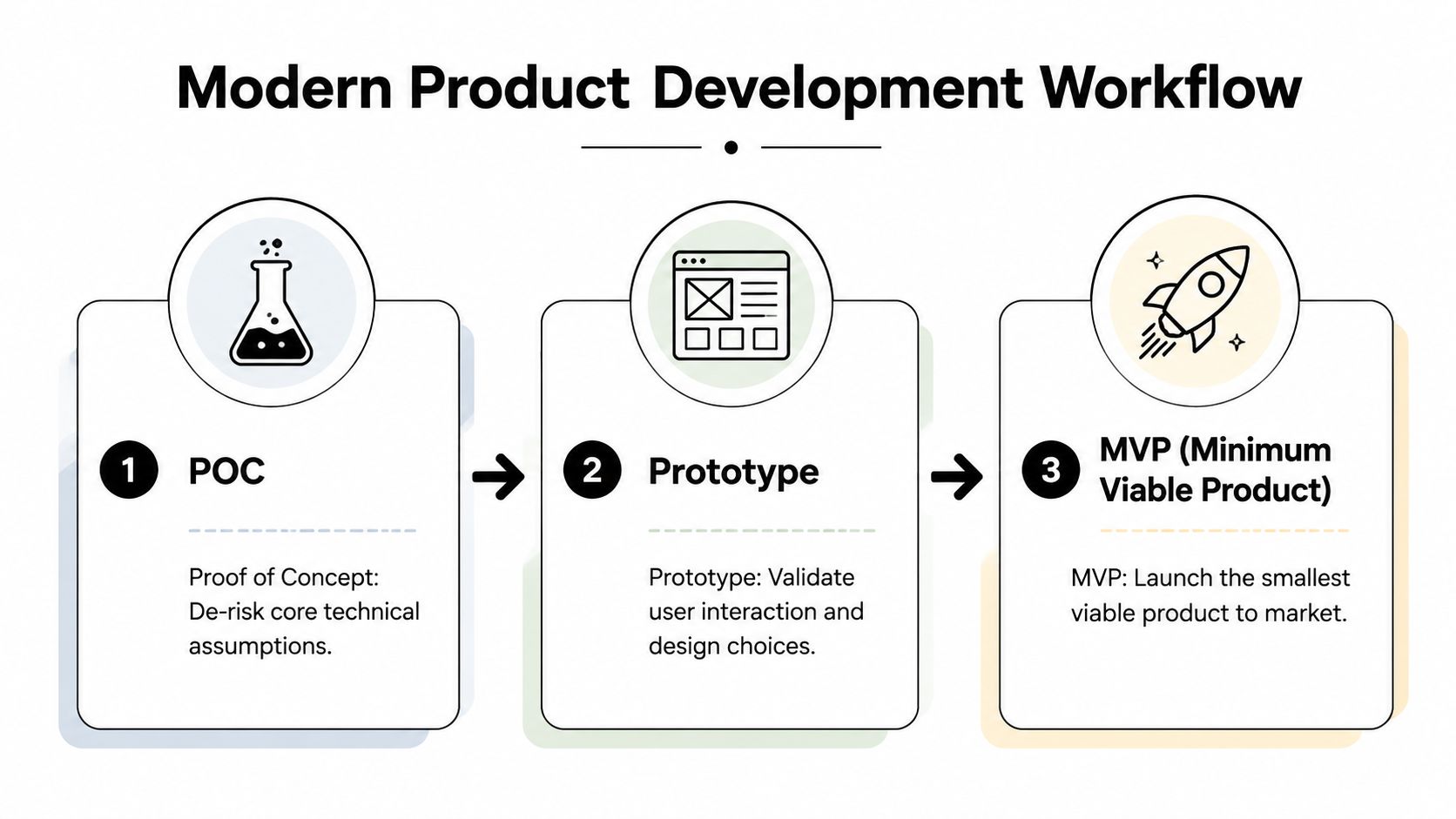
The strongest teams don't treat proof of concept and prototype as competing options. They treat them as stages in a disciplined path from idea to release.
A common sequence is simple:
- POC
- Prototype
- MVP
That order works because each stage removes a different kind of risk. A Proof of Concept typically happens in the pre-development phase and often takes 2–4 weeks to validate technical feasibility for a specific feature with a narrow scope focused on a single technical assumption rather than user experience, according to Ranorex's explanation of proof of concept and proof of principle.
What each team should do
In a healthy workflow, product, design, and engineering aren't waiting on one another blindly.
| Team | Focus in POC | Focus in prototype | Focus in MVP |
|---|---|---|---|
| Product | Define the assumption worth testing | Prioritize flows and feedback loops | Scope release and learning goals |
| Design | Support only what's needed for technical clarity | Shape interaction, layout, and test scenarios | Refine production-ready UX |
| Engineering | Prove feasibility and identify blockers | Validate implementation implications | Build stable, scalable functionality |
This structure matters even more in AI initiatives because experimentation gets chaotic fast.
Where AI teams need more control
Once AI enters the picture, a clean workflow needs more than tickets and whiteboards. Teams often test multiple prompts, tune parameters, connect internal data, compare outputs across models, and monitor spend. If those experiments live across chat threads, spreadsheets, and scattered docs, the project slows down and governance gets weaker.
That's why many modern teams add an administrative layer during validation. A practical setup includes:
- Prompt vault with versioning so teams know which prompt produced which result
- Parameter management for controlled access to internal databases and system settings
- Unified logging across integrated AI services
- Cost management so leaders can see cumulative spend clearly
Teams moving quickly also benefit from lightweight tooling and build acceleration. For leaders exploring modern delivery patterns, this article on how teams build full-stack applications fast is useful context for how rapidly idea validation can now turn into execution.
Operationally, product discovery also needs rhythm. This guide to product management sprints and UX sprints is a good reference for structuring the work so technical proof and design validation don't happen in isolation.
Organized experimentation becomes a reusable asset. Disorganized experimentation becomes institutional fog.
Make Your First Move the Right One
The difference between proof of concept and prototype comes down to disciplined decision-making. A POC tells you whether the idea can work technically. A prototype tells you whether people can use it in a way that creates value.
Business leaders don't need to eliminate risk. They need to remove the right risk first.
If your initiative depends on uncertain AI behavior, difficult integrations, or a new technical approach, start with a POC. If the core technology is already understood and the bigger question is flow, trust, adoption, or conversion, start with a prototype. If both forms of uncertainty are present, use both in sequence and resist the urge to jump straight to an MVP.
A practical companion resource is Proven SaaS's guide to idea validation, which is useful for leaders pressure-testing whether the problem, audience, and timing justify the next investment.
Good early-stage product work isn't flashy. It's structured. It protects budget, sharpens scope, and gives teams permission to learn before they commit. That's especially true for AI-enabled software, where technical experiments can drift without clear controls and where user experience still determines whether the product succeeds in its intended environment.
Choose the artifact that answers the question you have. That first move shapes everything after it.
If you're weighing a POC, prototype, or AI modernization roadmap, Wonderment Apps helps teams turn uncertain ideas into validated, scalable software. From UX strategy and custom app delivery to AI integrations and an administrative prompt management toolkit with prompt vault versioning, parameter controls, logging, and cost visibility, Wonderment brings the structure leaders need to move from exploration to launch with confidence.