

You're probably in one of two situations right now. Either your retail team is sitting on a mountain of customer, product, inventory, and channel data that never seems to turn into confident decisions, or you've already started experimenting with AI and realized the hard part isn't getting a model to run. It's making that model useful inside the software your teams rely on every day.
That's where machine learning for retail becomes more than a technical topic. It becomes an operating decision. Retail leaders don't need another abstract conversation about algorithms. They need to know where machine learning improves margin, where it reduces waste, how much data it needs to work well, and what kind of management layer keeps an AI-enabled application from becoming a fragile mess.
A lot of teams learn that second part late. They wire a recommendation model into ecommerce, add a chatbot to support, or test predictive forecasting, then discover they also need version control for prompts, parameter controls for internal data access, unified logging, and a clear way to track AI spend across services. In practice, AI needs a command center, not just a clever model.
Why Machine Learning Is No Longer Optional
A retail executive can see the pressure from every direction. Customers expect relevant recommendations, faster fulfillment, and smoother mobile experiences. Merchandising teams want better forecasts. Operations teams want fewer stock surprises. Finance wants proof that any AI investment will show up in the P&L.
That pressure is exactly why machine learning has moved out of the innovation lab and into core retail operations. It's no longer just for the digital giants. It's becoming part of how modern retail software works across desktop tools, mobile apps, ecommerce storefronts, service workflows, and fulfillment systems.
Retail leaders are already moving
One projection matters because it points to where the market is headed. By 2025, the top 10 global retailers will utilize AI to facilitate prescriptive product recommendations, transactions, and forward deployment of inventory for immediate delivery to consumers according to Itransition's ecommerce AI analysis. That matters because those capabilities don't live in isolation. They depend on AI being integrated into custom software applications that can support customer experiences at scale.
If you lead a mid-market or enterprise retail business, that projection creates a practical question. Not, “Should we use AI someday?” The question is, “Which workflows should we modernize first, and what infrastructure will keep those AI features manageable?”
AI in retail stops being impressive the moment it creates more operational complexity than business value.
The old retail stack wasn't built for this
Traditional retail systems were designed to record transactions, not learn from them. They're good at storing orders, tracking catalog data, and moving information from one system to another. They're less effective at spotting patterns across channels, reacting to shifting demand, or tailoring experiences to individual shoppers in real time.
Machine learning changes that by finding patterns humans and static rules often miss. A model can recognize purchase sequences, demand signals, pricing sensitivity, and fulfillment risk in a way that a manual spreadsheet process can't keep up with.
The catch is implementation. AI features don't age well when they're bolted onto legacy systems without governance. Teams need a practical layer that helps developers manage prompts, tune model behavior, connect securely to internal systems, and monitor outcomes over time.
Survival looks a lot like modernization
Retailers often frame machine learning as a growth initiative. That's true, but it's also a modernization initiative. If your desktop back office, mobile app, ecommerce platform, and service tools can't support AI-driven decisions cleanly, your competitors will create experiences that feel faster, more relevant, and easier to use.
That's why the conversation has changed. Machine learning for retail isn't about replacing people. It's about giving merchants, operators, marketers, and developers better systems to work with, so they can act earlier and with more confidence.
The Tangible ROI of Machine Learning in Retail
Retail leaders usually hear broad promises about AI. Better efficiency. Smarter operations. More personalization. Those claims aren't enough to fund a roadmap. What gets executive attention is measurable business impact.
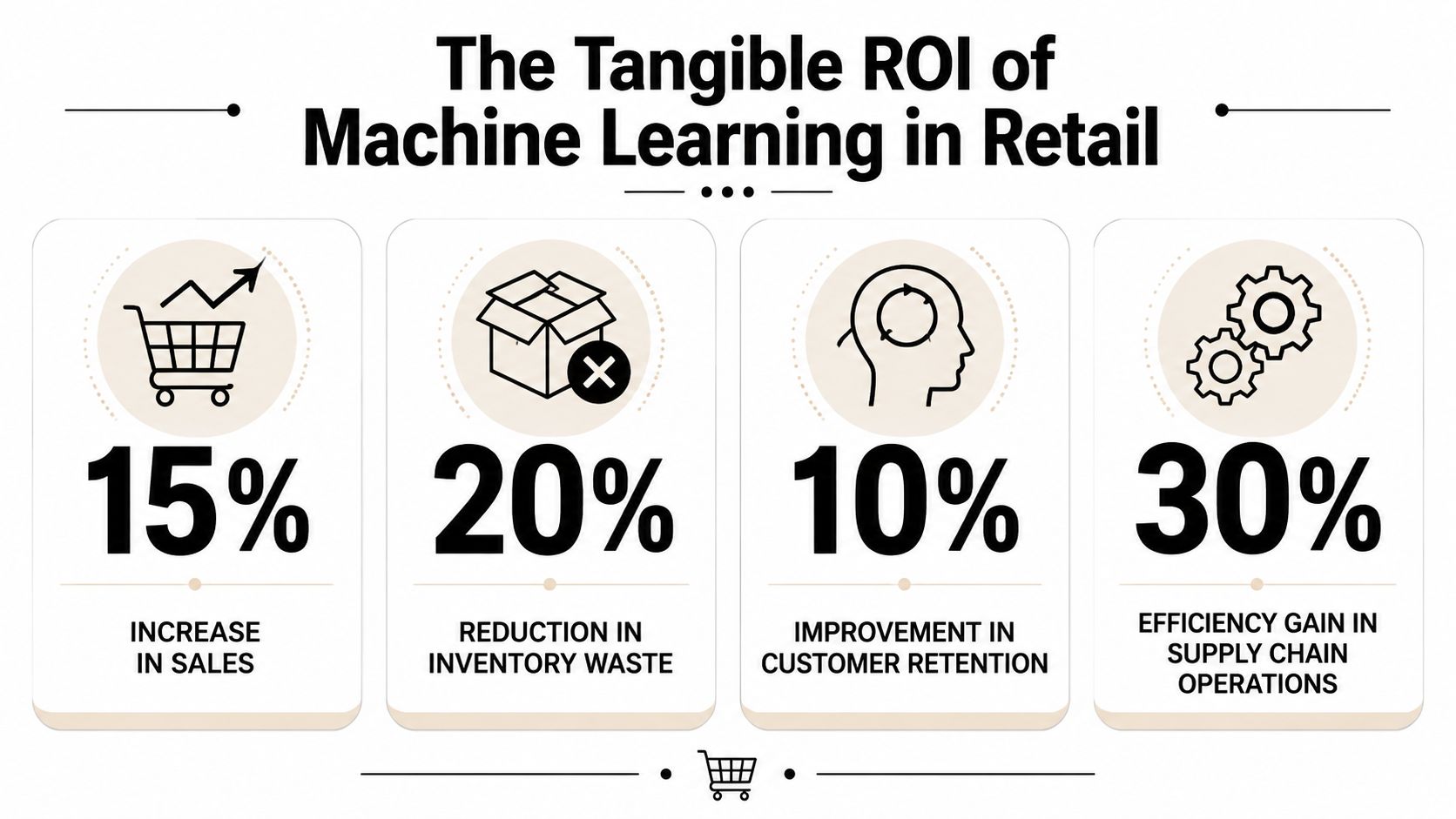
One of the clearest signals is profitability. Retailers that have adopted AI and machine learning technologies report an average annual profit growth of 8%, according to Itransition's retail machine learning analysis. That's a meaningful result because it ties machine learning directly to bottom-line performance, not just experimentation.
Where the return actually comes from
That profit impact doesn't come from one magic model. It usually comes from several operational improvements working together.
- Pricing decisions get sharper. Machine learning can model price elasticity, helping teams understand how a price change is likely to affect demand rather than relying on broad discounting habits.
- Customer targeting improves. Better segmentation and recommendation logic can make product discovery more relevant, especially in ecommerce and mobile shopping flows.
- Inventory gets tighter. Forecasting and replenishment decisions improve when teams use predictive signals instead of reactive guesswork.
- Service costs can drop. Automation can handle routine requests while human agents focus on higher-value interactions.
That mix matters because retail margins are won and lost across many small decisions. Machine learning helps teams make more of those decisions with evidence instead of instinct.
Supply chain gains are part of the ROI story
Inventory is where many ML programs prove themselves fastest. Better forecasting improves planning, but there's also a direct operational benefit in reducing avoidable mistakes. According to McKinsey & Company, AI-driven predictive forecasting can reduce supply chain errors by 20 to 50 percent, as cited in this ecommerce AI overview from Elogic.
For executives, that's useful because it connects machine learning to issues they already track closely: missed sales, stock friction, fulfillment inconsistency, and planning noise.
Boardroom translation: If your machine learning project can't be tied to margin, waste, service cost, or inventory performance, it's still a research project.
A useful companion read is this guide to AI business strategies, which frames AI initiatives around business outcomes rather than technical novelty. For retail operators focused on ecommerce modernization, this companion piece on the benefits of AI in ecommerce is also a practical reference.
ROI improves when software integration is clean
The number that executives should remember isn't just profit growth. It's implementation quality. Retail AI creates returns when the model is embedded into decision points your teams already use. A forecast that sits in a dashboard nobody trusts won't change outcomes. A pricing model that merchandisers can't interpret won't influence promotion planning.
That's why machine learning for retail works best when product, operations, and engineering teams treat it as software modernization. The value doesn't come from “having AI.” It comes from placing the right prediction inside the right workflow at the right moment.
Prioritizing Your First Machine Learning Projects
Most retail teams don't struggle with finding possible AI use cases. They struggle with choosing the first one. That's a good sign. It means the opportunity is broad. It also means focus matters.
The strongest starting projects usually have three traits. They touch an existing pain point, use data the company already has, and create a result that operators can act on quickly.
Start where the business already feels pain
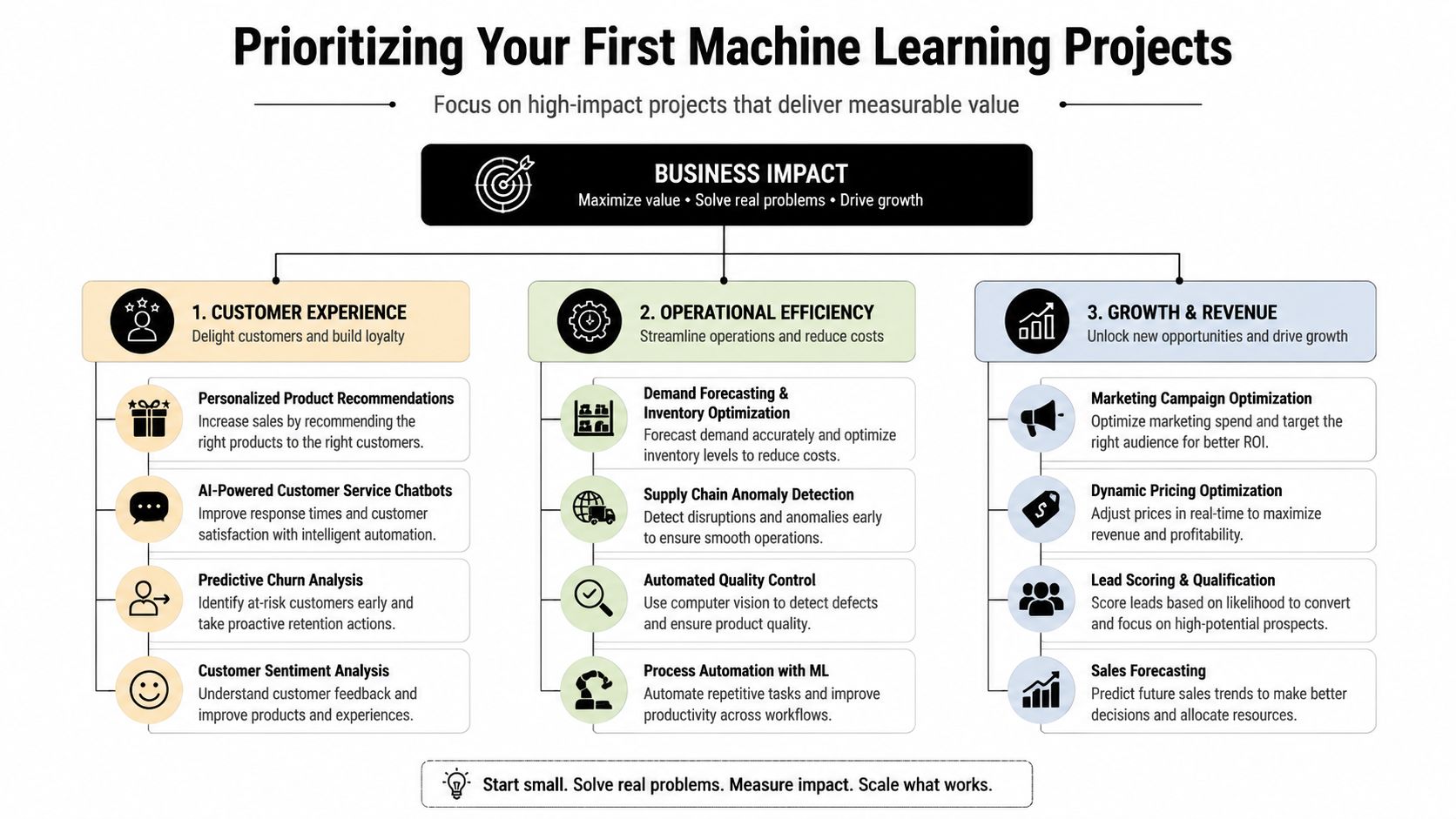
A simple way to prioritize machine learning for retail is to group projects by business function.
| Business area | Strong first ML project | Why it works early |
|---|---|---|
| Customer experience | Product recommendations | Clear effect inside ecommerce and mobile shopping flows |
| Inventory and planning | Demand forecasting | Solves a costly operational problem teams already track |
| Merchandising | Dynamic pricing support | Helps teams make pricing decisions with more confidence |
| Risk and operations | Anomaly detection | Finds exceptions that rule-based processes miss |
This framing keeps the discussion practical. Instead of asking which model is most advanced, ask which decision is most expensive when your team gets it wrong.
Four categories worth considering
Customer experience
Recommendation engines are a common first project because they're visible and relatively easy for stakeholders to understand. If a shopper browses running shoes, the system can suggest socks, insoles, or complementary gear based on behavior, product similarity, and past orders.
This use case works best when the recommendation appears naturally inside your software. Product detail pages, cart flows, email content selection, and mobile home screens are all common surfaces.
Inventory and demand
Demand forecasting is often the most valuable operational starting point. A planning team doesn't need a perfect crystal ball. It needs a forecast that's reliable enough to improve purchase orders, replenishment timing, and inventory placement.
Forecasting also creates downstream benefits. Better demand expectations improve allocation, staffing decisions, and promotional planning.
Pricing and margin
Dynamic pricing doesn't mean turning your storefront into a casino. In retail, it usually means helping teams understand when price changes are likely to increase volume, preserve margin, or support inventory goals.
Models that estimate price sensitivity are especially useful when merchants manage a large catalog and can't review every SKU manually.
Operational anomaly detection
This is the category many retailers overlook, and it can be one of the most practical. Incorrect employee operations at points of sale account for 24% of inventory discrepancies in retail, according to this research on inventory difference reduction using machine learning. That matters because inventory problems aren't always caused by demand surprises or theft. Sometimes the issue is process error.
A well-designed anomaly detection system can flag unusual stock transfers, suspicious order timing, quantity mismatches, or delivery volume inconsistencies before they ripple into broader inventory confusion.
The smartest first project is often the one that removes a daily frustration for operators, not the one that looks best in a strategy deck.
A practical prioritization filter
When you're choosing a first project, use these questions:
- Is the business problem expensive enough? A model should target a problem leaders already care about.
- Can someone act on the output? Predictions need an owner. If no team changes behavior, the model won't matter.
- Is the data accessible? Early wins come from existing systems, not heroic data recovery efforts.
- Will users trust the result? Teams adopt models faster when the recommendation or forecast is understandable.
Retail companies don't need to launch every use case at once. One strong project, shipped into a real workflow, usually teaches the organization more than ten slide-deck ideas.
Understanding Data and Feature Requirements
Machine learning projects usually fail long before model selection becomes the issue. They fail because the data is incomplete, inconsistent, siloed, or too messy to support a reliable prediction.
Retail teams often assume they have “lots of data,” which is true and not very helpful. The real question is whether they have the right history, in the right format, with enough consistency to train a model that people can trust.
What good retail data looks like
For forecasting and demand planning, transaction history matters most. You need clean records of what sold, when it sold, where it sold, at what price, and under what conditions. If stores, ecommerce, marketplaces, and mobile channels all use different identifiers or inconsistent timestamps, the model inherits that confusion.
There's also a minimum history requirement. To build reliable predictive models for seasonal patterns and demand cycles, retail operations require a minimum of 12 to 24 months of clean, consistent transaction history, while high-SKU or volatile omnichannel environments benefit from 2 to 3 years of unified data, according to Relex Solutions on machine learning in retail demand forecasting.
That requirement is easy to underestimate. Teams often want to pilot forecasting with a thin slice of recent data, then wonder why seasonal behavior is hard to detect.
Feature engineering in plain language
Feature engineering sounds technical, but the idea is simple. A feature is a signal the model can use to make a prediction. In retail, raw data becomes useful when you shape it into signals that reflect how the business operates.
Examples include:
- Sales context: Was the item sold during a promotion, a holiday window, or a markdown period?
- Product behavior: Is this item seasonal, frequently returned, or often bought with another category?
- Channel differences: Does demand look different in stores than it does in ecommerce or mobile?
- Price sensitivity: How did demand change when the item's price moved previously?
A merchant already thinks this way. They know demand for outerwear in October behaves differently from demand for basics in March. Feature engineering turns that kind of business logic into model-ready inputs.
Clean data is the entry ticket. Useful features are what make the model commercially relevant.
External signals can help, but only if your foundation is solid
Retail teams often ask whether competitor pricing, social sentiment, weather, or marketplace activity should be included. Sometimes yes. But external data helps most after core internal data is unified and trustworthy.
For teams evaluating external product and pricing visibility, resources like Amazon web scraping targets can help illustrate the types of competitive signals organizations may choose to monitor. Still, those signals won't rescue a weak internal data foundation. Your internal transaction, catalog, pricing, and inventory records carry the first burden.
If your data lives across disconnected systems, building a sound reporting and storage layer becomes a prerequisite. This primer on data warehousing concepts is useful for retail teams trying to unify operational and customer data before launching ML projects.
Your Implementation Roadmap from MVP to Scale
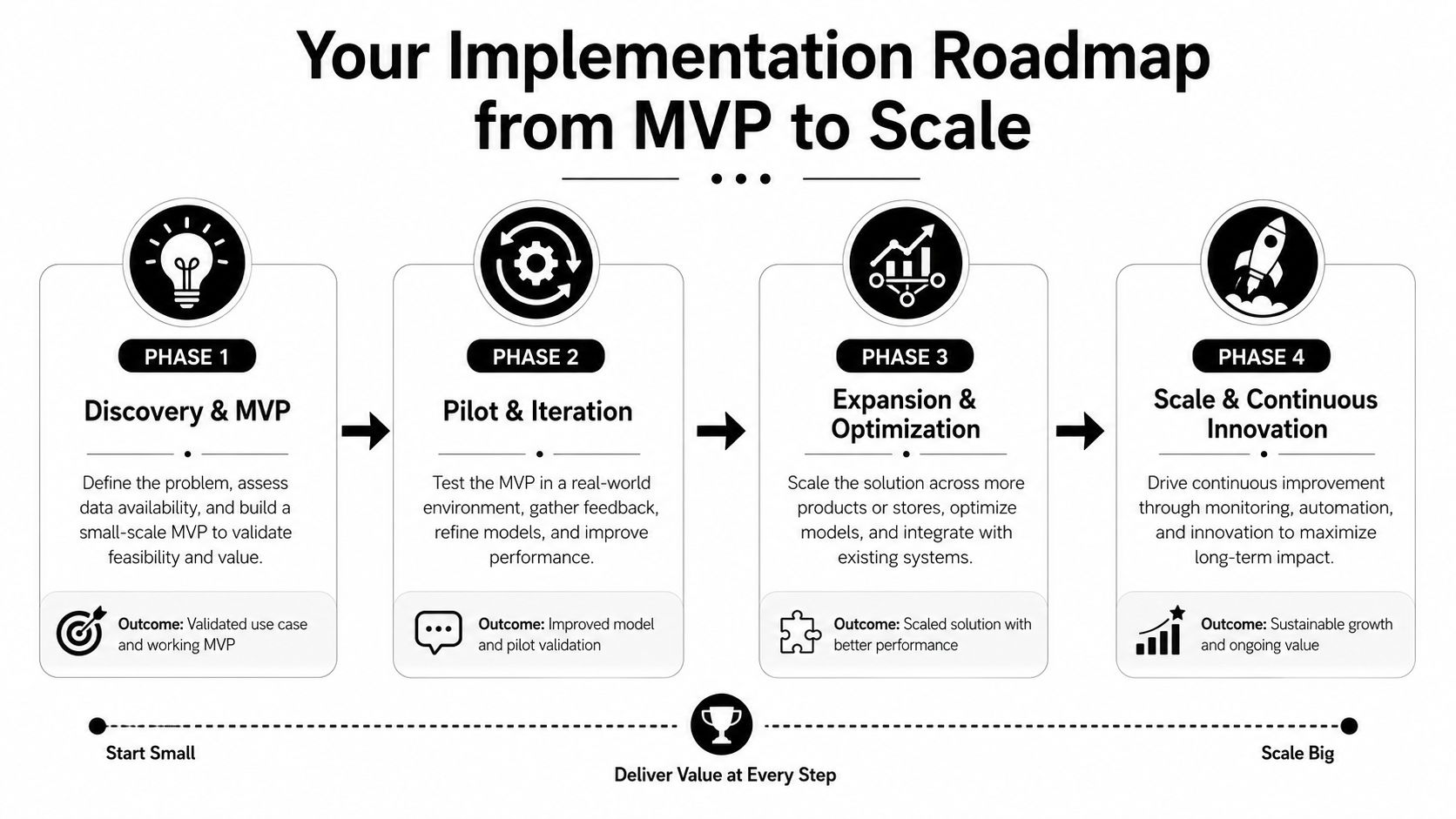
Retail AI projects get into trouble when companies try to transform the entire operation in one motion. The better path is narrower. Start with one use case, prove it inside a live workflow, then expand from there.
That's not a compromise. It's how mature teams reduce risk. A well-scoped MVP tells you whether the data is usable, whether operators trust the output, and whether the business process around the model is strong enough to scale.
Phase one defines the decision
The first phase isn't model training. It's problem definition.
A forecasting initiative should answer questions like these: Which decisions will the forecast improve? Who uses it? What metric tells us whether it's helping? How often does the output need to update? Which systems need the result?
If those questions sound basic, good. The expensive failures in machine learning for retail usually come from skipping them.
Phase two builds a narrow MVP
Your MVP should solve one business problem for one audience with a limited feature set. For example, a retailer might launch demand forecasting for a single product family, region, or channel instead of the full catalog.
A focused MVP makes tradeoffs easier. Teams can accept a manual review step, a smaller set of integrations, or a simpler interface if the project proves decision value quickly.
A useful MVP usually includes:
- One target workflow: such as replenishment planning or recommendation placement
- One accountable team: planners, merchandisers, ecommerce managers, or store operations
- One clear success measure: improvement in the business outcome the team already tracks
- One operational path: how the prediction appears and how someone acts on it
Phase three tests trust, not just accuracy
A pilot is where reality shows up. You learn whether the forecast arrives at the right time, whether merchants understand a recommendation, and whether a store operations team changes behavior based on an anomaly alert.
This is also where qualitative feedback matters. A model can be statistically impressive and still fail if the users don't understand how to use it.
A retail ML pilot succeeds when it changes a real decision, not when the data science team says the model performed well in isolation.
Phase four expands the operating system
Once the MVP proves value, scale becomes an engineering and product challenge. More categories, more stores, more channels, more users, and more integrations all increase complexity.
At that stage, teams typically need to strengthen:
| Scale area | What changes |
|---|---|
| Data pipelines | More frequent refreshes, better validation, broader source integration |
| Application surfaces | Predictions must appear in mobile, desktop, admin, or storefront workflows |
| Monitoring | Teams need visibility into model outputs, failures, drift, and usage |
| Governance | Access controls, approval flows, and deployment discipline become more important |
The retailers that scale well don't just expand the model. They expand the surrounding software discipline. That's how an MVP becomes a durable capability rather than a one-off experiment.
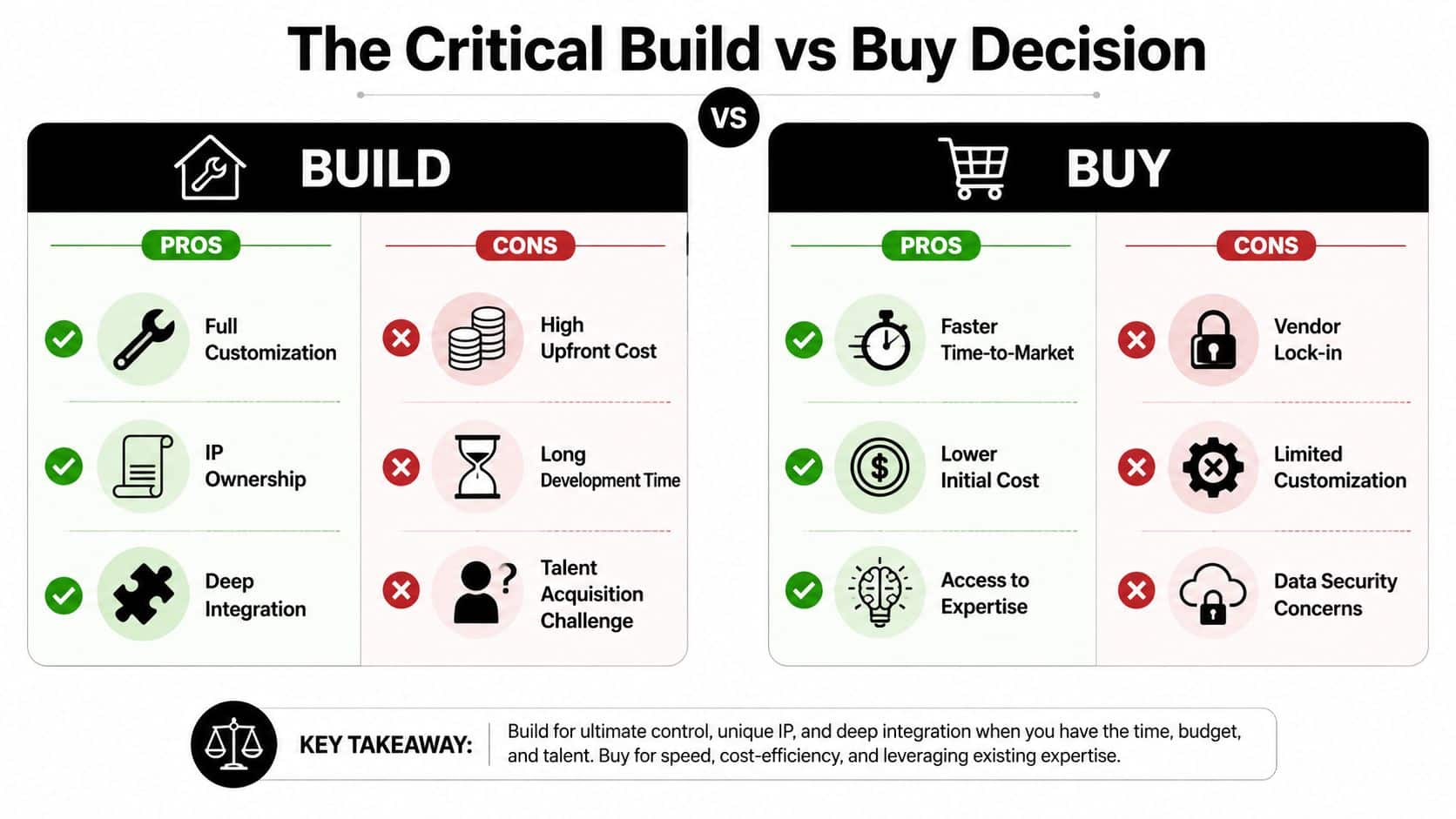
The Critical Build vs Buy Decision
Every retail leadership team reaches the same fork in the road. Should we build our machine learning capability in-house, buy an existing solution, or do some combination of both?
There isn't a universal answer because the decision depends on what you're optimizing for. Some companies need deep customization and direct control. Others need speed, lower upfront complexity, and a vendor that already solved the hard plumbing.
Build when the workflow is your advantage
Building makes sense when the use case is tightly tied to how your business competes. If your pricing logic, fulfillment model, merchandising process, or customer experience is highly differentiated, an off-the-shelf product may force too many compromises.
Build also makes sense when your internal systems are unusual enough that integration itself becomes the product challenge.
Good reasons to build
- You need custom logic that reflects your specific operating model
- You want IP ownership over the model behavior and supporting workflows
- You require deep integration with proprietary systems, processes, or data structures
Common downsides
- Longer implementation time
- More internal maintenance
- Higher demands on engineering, product, QA, and data talent
Buy when speed matters more than uniqueness
Buying is often the better choice when the use case is common, the business needs momentum fast, or the internal team doesn't want to own every layer of model infrastructure.
That's especially true for recommendation engines, customer service automation, or forecasting platforms where proven vendors already offer mature functionality.
| Decision factor | Build | Buy |
|---|---|---|
| Speed to launch | Slower | Faster |
| Customization | Higher | Lower to moderate |
| Internal control | Higher | Shared with vendor |
| Ongoing maintenance | Your team owns it | Vendor handles more of it |
| Integration effort | Can be extensive | Usually more guided, but still real |
A lot of retailers land in the middle. They buy a core capability, then build custom layers around workflow, reporting, and experience design.
The hidden question is operational ownership
The build versus buy conversation often sounds technical, but it's really organizational. Who will maintain the solution? Who will tune outputs? Who will handle change requests when business logic evolves? Who makes sure the mobile app, ecommerce frontend, and internal admin tools all stay aligned?
That's why the partner decision matters almost as much as the architecture decision. Teams evaluating outside support often benefit from reviewing what modern AI development services should include, from integration planning through long-term maintenance.
If your team can answer the ownership questions clearly, the build versus buy choice gets easier. If you can't, the smartest move is usually the one that reduces operational burden, not the one that looks most ambitious on paper.
Modernizing and Managing Your AI Stack for the Long Haul
Launching an ML feature is exciting. Running it well a year later is harder.
Retail teams usually discover this when the first AI workflow starts multiplying. One prompt becomes many. One model endpoint becomes several. Internal database access needs tighter controls. Developers need to compare versions. Product teams want auditability. Finance wants visibility into AI spend. Suddenly the challenge isn't whether AI can help. It's whether the stack is manageable.
Good AI products need administration, not just intelligence
This is the part many roadmaps miss. Once AI is embedded into a desktop tool, a mobile app, an ecommerce storefront, or a customer service workflow, it becomes a living product surface. It needs governance.
A strong AI management layer usually includes:
- Prompt vault with versioning so teams can track changes, compare prompt behavior, and collaborate safely
- Parameter management so developers can control how models connect to internal databases and application logic
- Unified logging across integrated AI services to monitor outputs, investigate failures, and improve reliability
- Cost management so leaders can see cumulative spend and avoid surprises as usage grows
Those capabilities sound administrative because they are. That's exactly why they matter. Without them, an AI-enabled retail app becomes difficult to govern, expensive to optimize, and risky to scale.
Long-term value comes from consistency
Retail software doesn't stand still. Product catalogs change. Promotions change. Customer expectations change. Channels change. The AI layer has to evolve with all of it.
That's why successful teams think beyond the first model. They ask whether the AI capability can survive staff changes, vendor changes, model changes, and business process changes. They create repeatable controls instead of tribal knowledge.
Retail AI maturity shows up when a team can update, monitor, and govern model behavior without turning every change into a custom engineering fire drill.
Build your AI stack to last
The companies that get durable value from machine learning for retail don't treat AI as a sidecar. They modernize the surrounding software so AI can be integrated responsibly and improved continuously.
That means choosing application architectures that scale on web and mobile, picking development partners who understand AI integration rather than just interface design, and putting management systems in place before complexity gets expensive.
If you're modernizing a retail platform, don't judge your AI stack only by the quality of the output. Judge it by how well your team can manage prompts, integrations, logging, and spend over time. That's what turns an impressive demo into a lasting business capability.
If you're upgrading a retail platform and want a cleaner way to operationalize AI, Wonderment Apps offers a practical path. Their team helps companies modernize web and mobile software, integrate best-fit AI into real business workflows, and support long-term scale with a prompt management system that includes a prompt vault with versioning, parameter management for internal database access, unified logging across AI integrations, and cost controls for cumulative spend visibility. If your team wants to move from AI experiments to durable execution, request a demo and see how the management layer works in practice.