

You're probably in the same spot most software leaders hit right before a serious build starts. The product idea is clear enough to fund. The business case is strong enough to defend. But one question keeps slowing everything down: how should the team build this thing?
That's where the SDLC versus Agile debate stops being academic and starts affecting budget, timeline, and product quality.
If your initiative includes AI, the decision gets sharper. You're no longer managing only screens, APIs, and releases. You're managing prompts, model behavior, integration drift, logging, governance, and cost visibility. A team can move fast and still create a mess if it lacks operational control. That's why more companies now pair an adaptive delivery model with tooling like prompt vaults, parameter controls, unified AI logs, and spend tracking. Speed without governance is just expensive improvisation.
The Billion-Dollar Question How Should We Build This
Business leaders often frame the wrong decision first. They ask whether they need developers, a product manager, a design sprint, or an AI consultant. Useful questions, sure. But the first strategic decision is your delivery model.
Pick the wrong one and everything downstream gets harder. Requirements drag. Testing slips. Feedback arrives too late. Teams build features customers didn't want. AI integrations get bolted on instead of designed in. Then leadership wonders why a promising initiative feels heavy before launch.
Why this decision matters early
Traditional Software Development Life Cycle (SDLC) methods give you structure. That structure can be valuable when requirements are stable, approvals are formal, and documentation matters as much as delivery. Agile gives you adaptability. That matters when users are still shaping the product, priorities change during development, and the team needs room to learn as it builds.
The issue is that many leaders treat this like a personality test. It isn't. This is an operating decision.
Practical rule: If your team expects meaningful change after kickoff, pretending the project is fixed won't create certainty. It will only delay reality.
AI raises the stakes. A standard app build already involves design, engineering, QA, deployment, and support. Add AI and you introduce prompt tuning, model changes, integration risk, token-spend management, and new review loops around output quality. That means your process has to absorb change without losing control.
What strong leaders do instead
They choose a method based on project conditions, not habit.
A good decision usually starts with three blunt questions:
- Are requirements stable: If yes, a more sequential model may work.
- Will users shape the product during delivery: If yes, you need iteration.
- Is AI part of the roadmap: If yes, plan for continuous validation from day one.
That last point matters most. AI projects rarely stay static once real usage begins. Leaders who recognize that early make better process decisions and avoid expensive rewrites later.
Understanding the Foundational Blueprints SDLC and Agile
Before you choose, get the definitions straight. Too many teams compare apples to slogans.
Traditional SDLC, usually represented by Waterfall, follows a linear sequence. Teams move from planning to analysis, then design, implementation, testing, deployment, and maintenance in order. That structure works best when the scope is stable and traceability matters. Invensis Learning's overview of SDLC versus Agile describes traditional SDLC models as linear and sequential, while Agile is iterative and incremental.
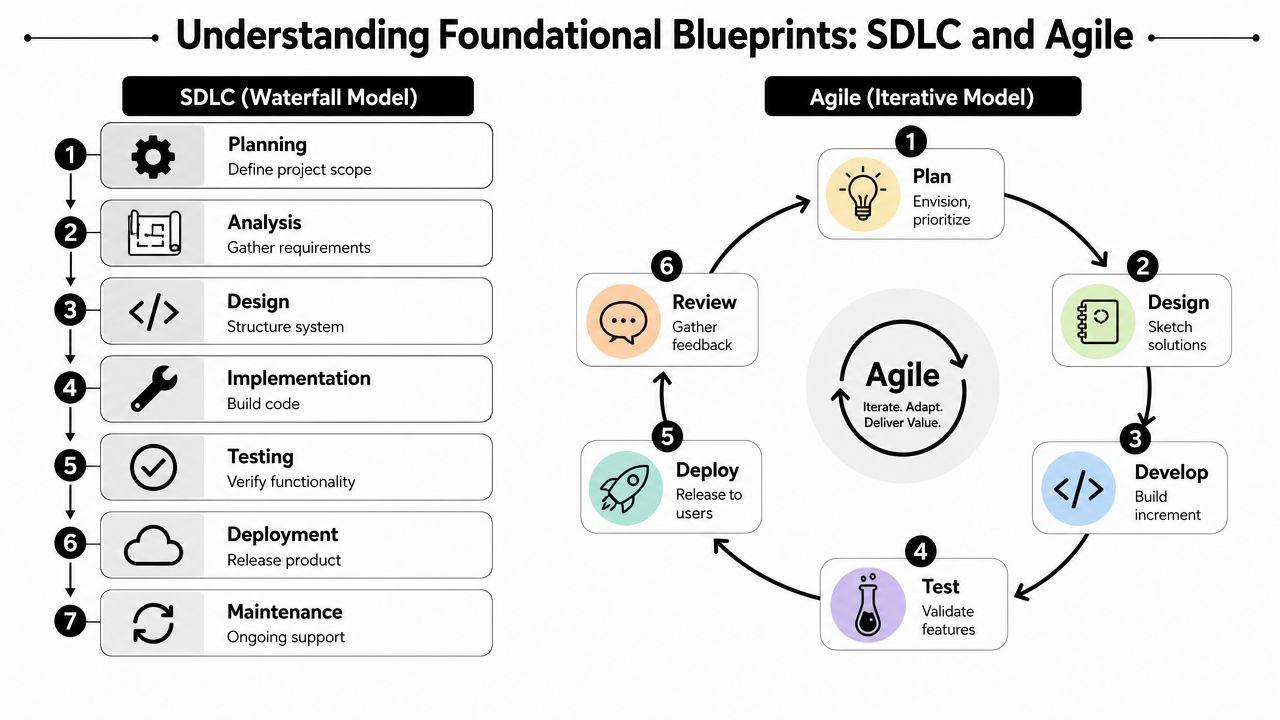
Agile is different in mindset before it's different in mechanics. Instead of treating change as a threat, Agile assumes learning will happen during development. Teams break work into smaller cycles, deliver usable increments, gather feedback, and adjust.
What SDLC is really optimizing for
SDLC is built for control through sequence.
That usually means:
- Upfront clarity: Requirements and approvals are expected early.
- Formal handoffs: Teams often complete one phase before the next group takes over.
- Documentation strength: Traceability, signoff, and auditability carry real weight.
That's why regulated systems, legacy modernization programs, and infrastructure-heavy projects still use it.
What Agile is really optimizing for
Agile is built for control through feedback. If you want a practical primer on how modern teams run iterative delivery, this breakdown of the agile product development process is a useful companion to the methodology discussion.
Agile usually means:
- Short planning horizons: Teams commit to near-term work, not fantasy roadmaps.
- Working software early: Progress is measured by usable output, not documents alone.
- Frequent stakeholder input: Product direction gets refined during the build.
Waterfall tries to reduce uncertainty before development. Agile reduces uncertainty during development.
That's the core difference.
If your organization still treats every model as a variation of the same old lifecycle, it helps to review the broader family of approaches through these software development models. The important takeaway is simple: Agile didn't eliminate SDLC. It changed how teams can execute it.
A Head-to-Head Comparison of SDLC Versus Agile
If you want the short version, here it is: SDLC is best when change is limited. Agile is best when change is expected. This concept is often overcomplicated.
The confusion usually comes from mixing business preference with project reality. Leaders say they want predictability, but the roadmap keeps moving. They ask for strict planning, then introduce new customer requests midway through design. That's exactly where the SDLC versus Agile choice becomes visible in cost, speed, and rework.
SDLC vs. Agile at a glance
| Attribute | Traditional SDLC (Waterfall) | Agile |
|---|---|---|
| Workflow | Linear, phase-based progression | Iterative, repeating cycles |
| Planning style | Heavy upfront planning | Ongoing planning and reprioritization |
| Requirements | Best with stable scope | Best with evolving scope |
| Feedback timing | Often later in the cycle | Frequent and built into delivery |
| Documentation | Extensive and formal | Leaner and just-in-time |
| Risk handling | Tries to prevent change through planning | Tries to absorb change through iteration |
| Testing pattern | Often concentrated later | Continuous within each cycle |
| Stakeholder involvement | More limited after early phases | Ongoing and active |
| Best fit | Compliance-heavy, predictable projects | Product discovery, fast-moving initiatives |
Delivery cadence changes everything
One of the most practical distinctions is cadence. Monday.com's Agile SDLC comparison notes that Agile teams typically work in 2 to 4 week iterations that produce a working increment, enabling continuous testing, review, and course correction. It also notes that sequential SDLC models usually defer integration and validation until later phases, which increases the cost of late changes.
That's not a small operational detail. That's the whole game.
If a team shows working software every few weeks, leaders can react while there's still time to fix direction. If a team waits until late-stage testing to reveal whether the product functions for users, leadership is buying risk on credit.
Where each model wins and loses
SDLC gives leaders a clean sequence. That's useful when governance is rigid and approvals drive progress. But it can create a false sense of certainty if requirements shift after planning.
Agile gives leaders visibility into real progress. But it demands stakeholder discipline. If nobody is available to review increments, prioritize tradeoffs, and make decisions, Agile turns into chaos with standups.
Here's the blunt advice:
- Choose SDLC when the scope is fixed, documentation is mission-critical, and late changes are rare.
- Choose Agile when customer learning, market response, or AI behavior will shape the product after kickoff.
- Choose neither blindly because the company has “always done it that way.”
If your team is also sorting out frameworks inside Agile, this guide to Agile vs Scrum vs Kanban helps separate the methodology from the implementation pattern.
The wrong model doesn't just slow delivery. It teaches the team to hide uncertainty until it becomes expensive.
Making the Right Choice for Your Project
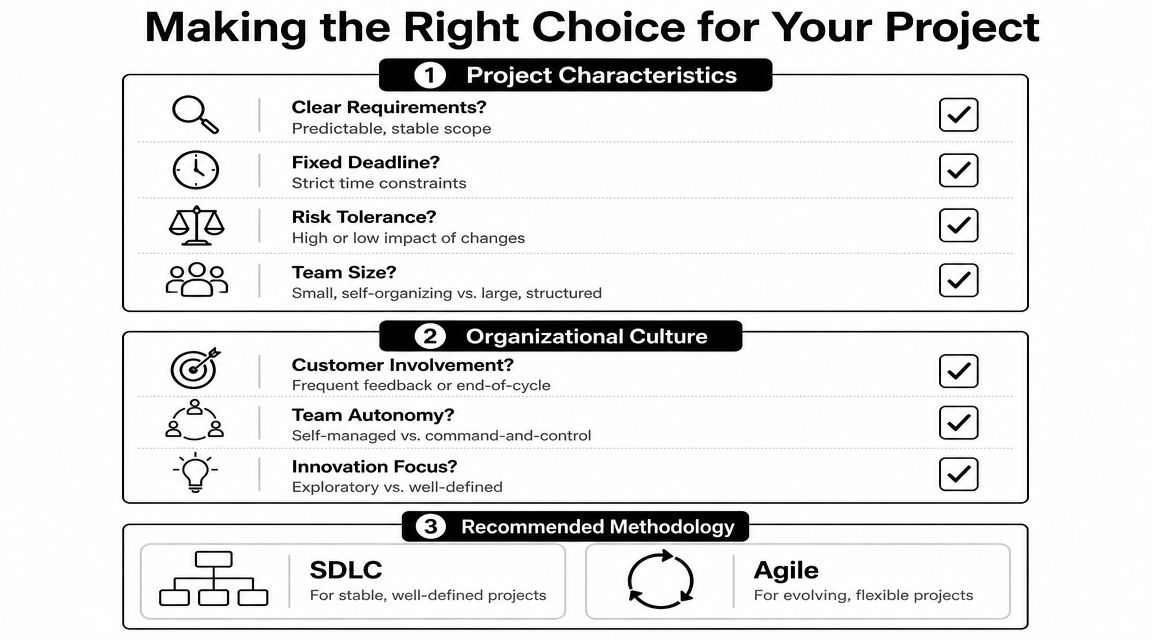
The right method depends on your project's DNA. Not your team's favorite buzzword. Not what your last vendor sold you. Not what the board heard at a conference.
The smarter question is the one highlighted in Mendix's guidance on Agile SDLC: which delivery model best absorbs rapid technical change without losing governance? That framing is far more useful than the usual SDLC versus Agile shouting match.
Start with project conditions
Some projects are naturally sequential. Others are discovery-heavy from day one.
Use this filter:
- Stable scope and fixed rules: SDLC is often the cleaner fit.
- Unclear feature priorities: Agile is usually safer because it lets the team learn fast.
- High documentation burden: Traditional SDLC has the advantage.
- Need for fast user validation: Agile wins because feedback is built in.
A payroll compliance engine is not the same as a new customer-facing mobile experience. Treating them the same is lazy governance.
Then assess your operating culture
Methodology doesn't fail only because of process mismatch. It fails because the organization can't support the way the model works.
Ask these questions:
- Will stakeholders review work regularly? Agile needs real participation.
- Can the team self-organize? Agile works best when delivery teams can make day-to-day decisions.
- Do you need formal signoffs at each stage? SDLC handles that more naturally.
- Can leaders tolerate learning during execution? If not, they'll sabotage any iterative approach.
If executives want flexibility but punish every mid-project adjustment, they don't want Agile. They want certainty with Agile vocabulary.
The AI factor changes the answer
My neutrality ends here. If your initiative includes meaningful AI integration, default toward Agile unless you have a compelling reason not to.
AI projects introduce moving parts that don't behave like static software requirements. Prompts evolve. Model outputs need review. Integrations shift. Guardrails need tuning. Cost visibility matters. Teams need continuous validation, incremental releases, and controlled adaptation. That makes an adaptive model the better fit in most cases.
A traditional SDLC can still support AI in tightly bounded use cases. But when you're building software plus model-driven behavior, rigid sequencing usually creates delay, blind spots, or both.
The best choice isn't the one that looks safest in a kickoff deck. It's the one your team can execute effectively under real conditions.
Real-World Scenarios Where Each Methodology Shines
Theory gets people through meetings. Scenarios get people to the right decision.
The SDLC versus Agile choice should be made at the project level, not the industry level. A healthcare organization can need both. A fintech platform can need both. Even inside one roadmap, different workstreams can justify different methods.
Ecommerce and retail
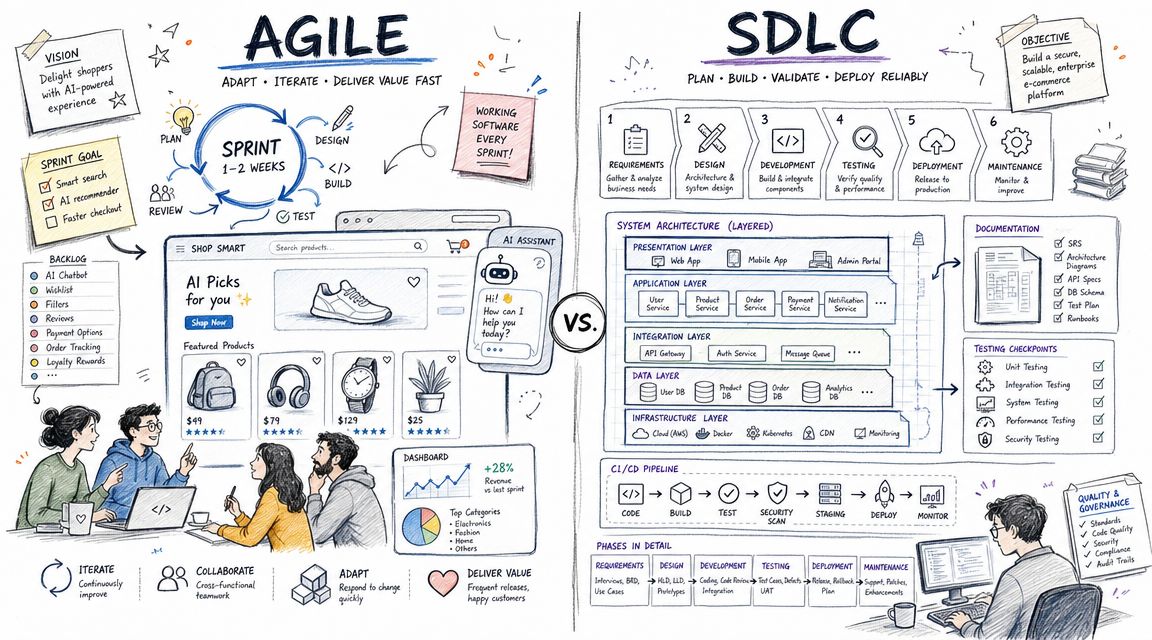
An ecommerce brand launching an AI-powered recommendation experience should usually run Agile. User behavior, merchandising logic, prompt behavior, and conversion flow all need refinement after launch. The team needs room to test and improve in cycles.
A back-office catalog compliance system is different. If the rules are established and documentation matters, a more sequential SDLC approach can be perfectly reasonable.
Fintech and SaaS
A core ledger, transaction engine, or sensitive reporting module often benefits from traditional SDLC discipline. Teams may need formal specifications, clear approval gates, and rigorous traceability.
But a customer-facing fintech app, onboarding flow, or AI support assistant usually needs iteration. User feedback changes assumptions fast. Product teams learn from each release, not just from initial requirements.
Healthcare and wellness
Clinical or administrative systems with strict traceability needs often lean SDLC. Teams may need predictable approvals, defined workflows, and careful release control.
A patient wellness app or member experience portal is another story. Those products live or die on usability, adoption, and rapid improvement. Agile fits better because the team can respond to what patients and staff do, not what everyone guessed upfront.
Public sector and media
Government service digitization often includes a split reality. The policy-heavy system underneath may require a more traditional model. The public-facing service layer often benefits from iteration because usability issues show up only when real users interact with it.
Media products are usually even clearer. Content-rich apps, personalization layers, and high-frequency release environments favor Agile because audience expectations shift quickly.
IBM's comparison of Agile and Waterfall captures an important historical point: Waterfall was documented by Dr. Winston W. Royce in 1970, while the Agile Manifesto was signed in 2001. That gap matters. Agile emerged later as a better fit for projects that need frequent feedback, not as a universal replacement for every structured lifecycle.
Beyond the Binary Hybrid Models and Migration Paths
Most mature organizations don't run pure theory. They run hybrids.
That's not a compromise to apologize for. It's often the practical answer when leadership needs governance, delivery teams need flexibility, and the portfolio contains both stable systems and evolving products.
What a hybrid model looks like
A common hybrid pattern uses traditional SDLC thinking for early governance, then Agile delivery for execution. Teams may define scope boundaries, architecture principles, security constraints, and approval requirements upfront. After that, they build in iterations.
This works well when an organization needs both of these truths to be respected:
- Leadership needs control: Budget, compliance, and risk rules can't disappear.
- Delivery needs adaptation: Teams still need room to learn from real usage and changing priorities.
That model isn't elegant, but it's often effective.
How to move from rigid SDLC to a more Agile culture
If your company has lived in phase-gated delivery for years, don't announce a grand transformation and expect behavior to change next Monday.
Take a staged approach:
- Start with one pilot project. Pick something visible but manageable.
- Choose a product owner with authority. Agile dies when nobody can make decisions.
- Protect sprint reviews. Leaders need to see working software, not slide decks.
- Keep governance, but trim ceremony. Don't confuse paperwork with control.
- Train managers, not just developers. Most failed transitions break at the leadership layer.
- Reward learning, not just predictability. Teams won't adapt if every change is treated like failure.
Hybrid models work best when leaders decide which controls are non-negotiable and which habits are just leftovers from older delivery cultures.
The broader market has already shifted in this direction. BMC's review of Agile versus Waterfall notes that Agile has become the mainstream methodology in modern software development and is commonly selected for larger, complex projects that require frequent changes and collaboration. That doesn't mean every team should abandon structure. It means structure now needs to coexist with adaptability.
Activating Your Strategy with the Right Partner and Tools
Methodology alone won't save a project. Plenty of teams say they're Agile and still ship confusion. Plenty of teams say they're structured and still lose control.
Execution depends on tools, operating discipline, and the ability to manage modern software reality. For AI-enabled products, that reality is messy. You're not only releasing code. You're managing prompts, model behavior, permissions, logs, evaluations, and spending patterns across multiple integrations.
What breaks first in AI delivery
Teams usually underestimate four things.
- Prompt sprawl: Without versioning, nobody knows which prompt changed behavior.
- Parameter risk: Loose handling of internal data access creates avoidable exposure.
- Fragmented logging: If each AI integration logs differently, debugging becomes slow and expensive.
- Cost blindness: Token usage can drift upward before leadership sees the pattern.
These are process problems as much as engineering problems. That's why the old SDLC versus Agile discussion is incomplete unless you account for tooling that supports both speed and governance.
What modern teams should demand
Whether you build internally or with a delivery partner, insist on operational controls that fit AI-enabled software:
- Prompt vault with versioning: Teams need traceability for prompt changes.
- Parameter management: AI workflows should access internal systems through governed rules.
- Unified logging: Product, engineering, and QA need one place to inspect AI interactions.
- Cost management: Leadership needs visibility into cumulative spend across integrated models.
That stack gives teams room to iterate without turning governance into guesswork.
If you're evaluating what mature AI delivery support looks like in practice, this overview of AI development services is a useful benchmark. For a second outside perspective, Silicon Prime AI development solutions also outlines the kind of implementation support organizations often need once AI moves from prototype to production.
The strongest execution model today looks a lot like this: use Agile where learning is real, keep governance where risk is real, and support both with tooling built for software plus models. That's how companies modernize without losing the plot.
If your team is deciding between structured delivery and iterative execution, Wonderment Apps can help you make the call based on the project you're building, not a generic playbook. We work with organizations that need scalable web and mobile products, AI modernization, and stronger delivery control. If AI is part of your roadmap, ask for a demo of our prompt management system, including the prompt vault with versioning, parameter manager, unified AI logging, and cost manager. It's built to help teams move fast without losing governance.