

You've got an app idea, a rough set of notes, a few investor conversations, and a growing sense that every decision now carries real cost. Should you build native or cross-platform? Do you need AI on day one, or is that just expensive decoration? Should you hire freelancers, an agency, or your own team? And if you do add AI, how do you stop prompt changes, model drift, and token spend from turning into a mess six months after launch?
This is mobile app development for startups in 2026. The challenge isn't just getting something into the App Store. It's building a product that can validate demand, survive launch, and evolve without forcing a rebuild every time your roadmap changes.
The opportunity is large enough to justify serious attention. One projection puts the global mobile application market at USD 378 billion by 2026, and notes that over half of all apps are built by small or medium-sized enterprises (AppMySite market overview). That matters because it means startups aren't locked out. They're competing in a crowded market, yes, but not one reserved for giant enterprise teams.
The smarter founders I've seen treat the first release as a business instrument, not a vanity artifact. They think about UX, telemetry, architecture, and operating cost before anyone starts polishing screens. They also think about AI in practical terms. Not “Can we bolt on a chatbot?” but “How will we manage prompts, parameters, logging, and spend once this is live?”
Your App Idea and the Modern Development Maze
A startup app usually begins with a simple sentence. “People need a better way to do this.” The trouble starts when that sentence meets real delivery constraints.
Founders often underestimate how many decisions sit underneath a mobile product. Channel selection, onboarding flow, account architecture, analytics, release scope, backend design, push strategy, app store review risk, and support processes all arrive early. Add AI and the list gets longer. Prompt versioning, model selection, observability, and cost control become product decisions, not just technical chores.
What founders get right early
The strongest early-stage teams narrow the mission fast. They define one user, one painful problem, and one action the app must do well. That discipline protects budget and usually improves UX because the team isn't trying to solve five workflows in one release.
A lean startup can still win here. The market is measured in the hundreds of billions, but it isn't won by whoever ships the most screens. It's won by the team that removes friction from a specific behavior and keeps learning after launch.
Practical rule: If your product story needs a long demo to make sense, your first version is probably too broad.
Why AI changes the build plan
AI has moved from “future enhancement” to a real architectural question. If your app will eventually include recommendations, AI-assisted search, summarization, support flows, or personalized workflows, plan for that now. You don't need every feature in version one. You do need a structure that won't break when AI enters the product.
That means separating business logic from prompt logic, logging what's happening, and making sure non-developers can review or tune AI behavior without a full release cycle. New admin tools now make that manageable for startup teams. A prompt management layer, for example, can keep prompt versions organized, connect model inputs to internal data safely, and expose cost behavior before finance starts asking uncomfortable questions.
The maze isn't the problem
Complexity alone doesn't kill startup apps. Unexamined complexity does.
A founder can survive imperfect branding, a limited feature set, or a scrappy launch. What's harder to survive is building the wrong thing, on the wrong stack, with the wrong team, and only discovering that after the budget is mostly gone. That's why the rest of the roadmap has to start with one uncomfortable question. Should this even be an app?
Validate Your Idea Before You Build Anything
Most startup advice jumps straight into features, wireframes, and sprint plans. That's often the wrong starting point. The first decision is whether a mobile app is the right product channel at all.
A lot of startups would be better served by a responsive web experience, a no-code workflow, or even a manual service layer while they test demand. That sounds less exciting than “we're building an app,” but it's often the more mature move. A common gap in startup advice is skipping this question entirely. As PixelPlex notes in its discussion of startup mobile decisions, success often depends more on choosing the right channel based on customer behavior and retention economics, since app usage is highly concentrated in a few categories.
Ask the go or no-go questions first
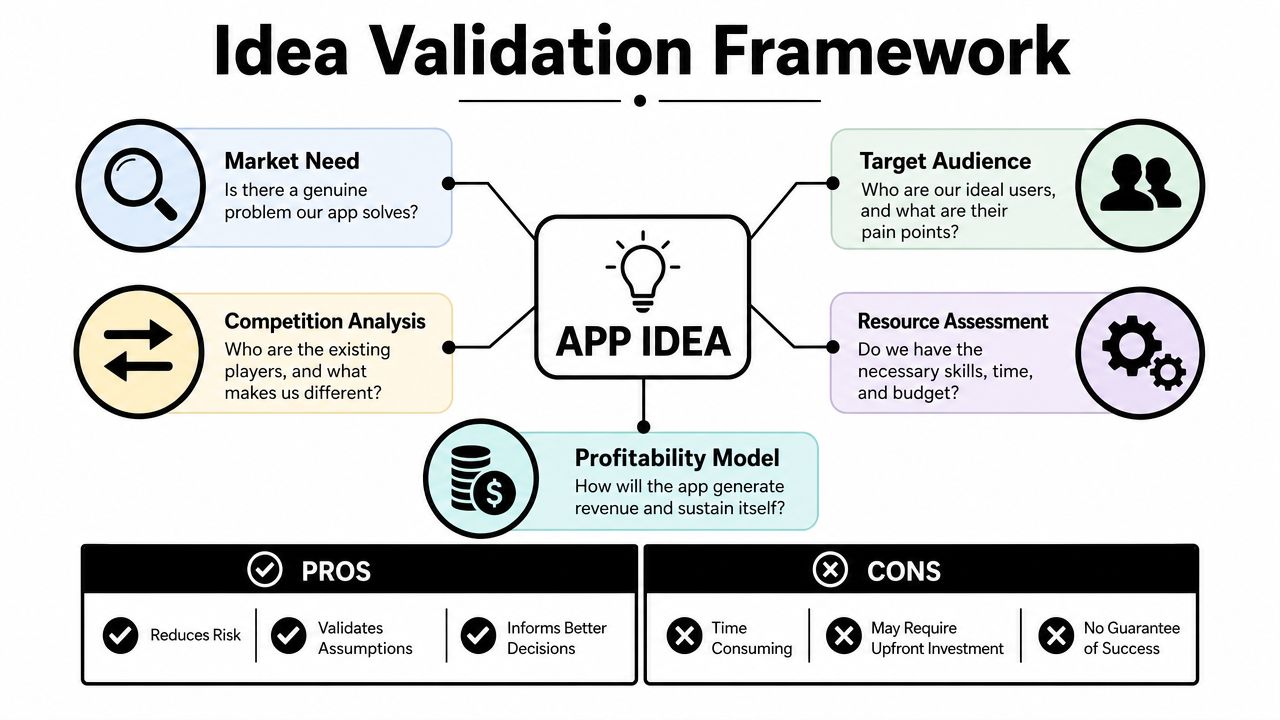
Before anyone estimates features, answer these plainly:
- Is the problem painful enough? People don't keep apps for mild annoyances. The job-to-be-done has to matter often enough to earn a home screen spot.
- Will users come back? Repeat usage is what justifies the app channel. If usage is occasional, web may be stronger.
- Does mobile provide a real advantage? Push notifications, camera access, offline behavior, location, or habit loops can justify native mobile. If not, don't force it.
- Can you describe the core user in one sentence? “Everyone” is not a target segment. Early traction usually comes from a narrow audience with a sharp need.
- Is there a believable monetization path? Downloads alone don't make a business. Revenue logic has to exist even if monetization comes later.
If you need help sizing the market and pressure-testing the competitive environment, Wonderment's article on audience size and competition for your app or website is a useful planning read before you commit to build scope.
Validation that produces evidence
Validation should create proof, not comfort. Founders often collect opinions from friends and mistake that for market feedback. It isn't.
Use a tighter loop:
- Interview target users and look for repeated language around pain, workarounds, and urgency.
- Map the current behavior users rely on today. Spreadsheets, email, text chains, or sticky manual processes are often strong signals.
- Review direct competitors and adjacent substitutes. You're not just competing with other apps. You're competing with existing habits.
- Test the offer before full build with a landing page, concierge service, clickable prototype, or waitlist.
- Define a kill condition ahead of time. If you can't reach a certain level of user interest or repeat intent, stop.
A startup that avoids a bad build hasn't lost momentum. It has preserved runway.
Good validation changes the product
Founders sometimes think validation should confirm the original idea. In practice, the best validation usually reshapes it.
Maybe the app becomes a web-first product. Maybe the audience shifts from consumers to operations teams. Maybe the “must-have” feature turns out to be irrelevant, while a plain workflow you barely noticed becomes the whole business. That's not failure. That's product strategy doing its job before engineering becomes expensive.
Define Your Minimum Viable Product
Once the idea survives validation, the next trap appears. Scope inflation.
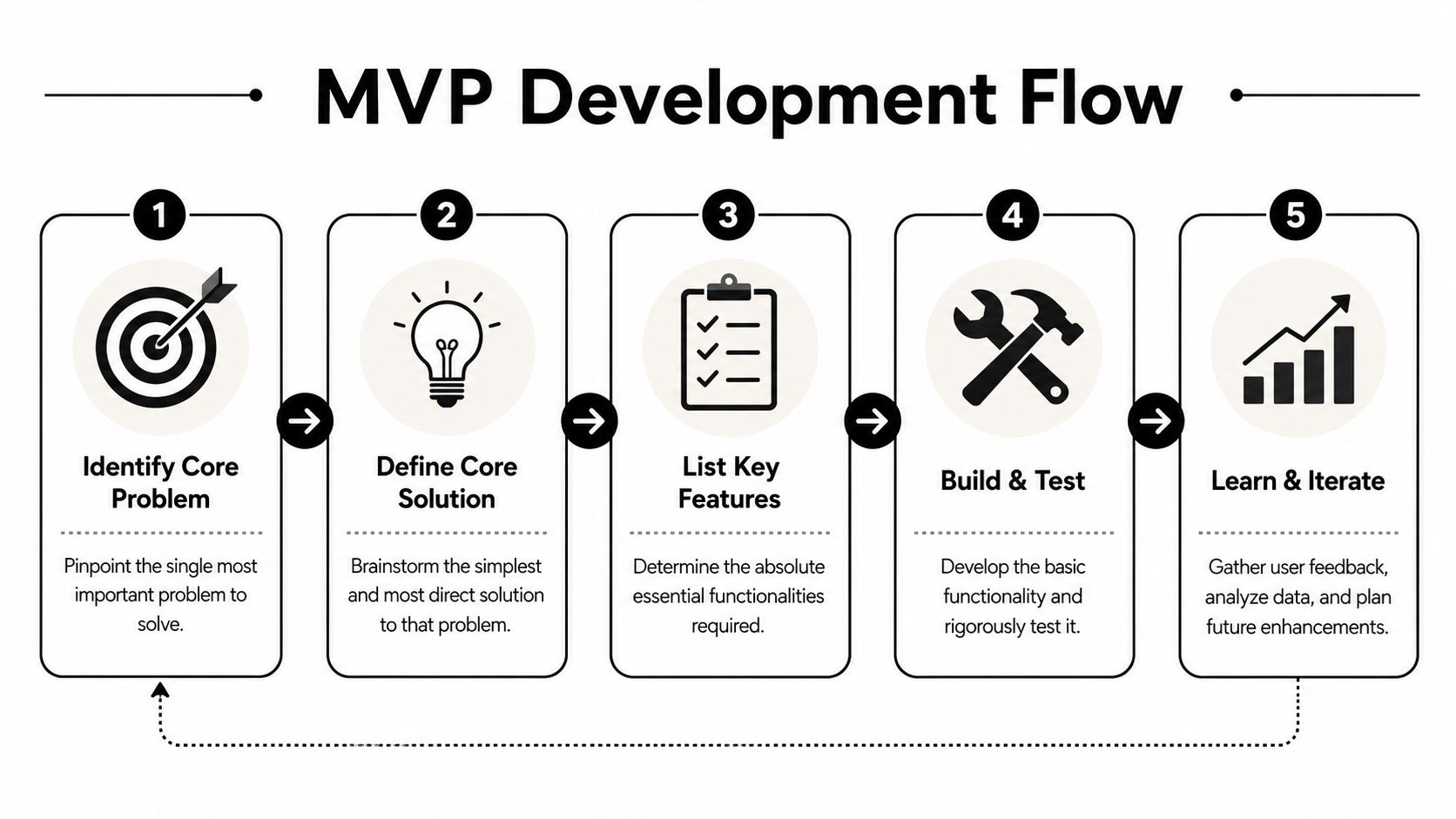
An MVP isn't the “cheap version” of your app. It's the smallest release that lets you learn whether your core workflow creates value. That distinction matters because startups that treat the MVP like a mini-enterprise product usually end up paying for complexity before they've earned it.
Industry guidance for startup teams is consistent here. The most impactful technical decision is to build the MVP around a single core workflow and instrument it with analytics from day one, so user behavior drives decisions instead of intuition (MTechZilla on startup MVP planning).
Start with one journey
Write down the one action your first user must complete successfully. Not five actions. One.
For a marketplace, that might be “find and book a provider.” For a fintech tool, “connect an account and see a useful financial snapshot.” For a wellness app, “complete an intake and receive a personalized plan.” Everything else is support material.
A practical way to pressure-test scope is to sort ideas into:
- Must have for the core workflow to function
- Should have if they materially reduce friction
- Could have if they improve delight later
- Won't have in v1 because they add complexity without proving demand
That last list is where good product judgment shows up.
Instrument before you polish
If the MVP launches without telemetry, you've built a black box. You may know that users signed up. You won't know where they got stuck.
At minimum, wire analytics into:
- Onboarding completion
- Activation event
- Feature usage
- Return visits
- Crash reporting
- Performance monitoring
Many teams often make a quiet mistake. They wait to add analytics until “after launch.” Then they discover they can't answer the basic product questions that should drive sprint planning.
Build the learning system at the same time you build the product. Otherwise you're guessing in production.
For a founder-friendly breakdown of how to shape an MVP without overbuilding, SubmitMySaas's guide to building MVPs is worth reviewing alongside your own feature triage process.
What doesn't belong in version one
Plenty of features sound strategic and still don't belong in the first release. Advanced personalization, social systems, loyalty mechanics, admin edge cases, multi-role permissions, and deep reporting often sneak in too early.
If a feature doesn't strengthen the primary journey or create a clearer signal about product fit, cut it. You can always add complexity after the app proves that users want the core experience.
Choose the Right Technology Stack
Often, non-technical founders feel pushed to the sidelines. They shouldn't be. You don't need to write the code to make sound stack decisions. You need to understand the trade-offs well enough to align technology with business priorities.
The key choices usually come down to native, cross-platform, or progressive web app, plus a backend approach that won't force a rewrite the first time traction appears.
Native, cross-platform, or PWA
Here's the practical version.
| Approach | Best fit | Trade-off |
|---|---|---|
| Native iOS and Android | Apps where performance, platform-specific UX, or deeper device capabilities matter | Higher build and maintenance effort |
| Cross-platform | Startups that need speed, shared code, and a unified release process | May require trade-offs for highly custom platform behavior |
| PWA or responsive web | Products still testing channel fit, lighter workflows, or web-first acquisition | Weaker access to some mobile-native behaviors |
Native is usually strongest when the app experience depends heavily on device capabilities or polished platform conventions. Cross-platform is often the smart startup default when speed, budget discipline, and shared code matter more than squeezing out every bit of platform-specific behavior. A PWA can be the right answer when the product is still proving whether users need an installed app at all.
Your backend matters more than most founders expect
Front-end debates get attention because they're visible. Backend decisions tend to show their consequences later.
The startup-friendly path is usually a backend that is simple, well-structured, and easy to monitor. Don't over-engineer for hypothetical scale. At the same time, don't build a tangle of hard-coded shortcuts that makes future iteration miserable. Good architecture for startups favors clean services, sensible data models, secure APIs, and room to add integrations without surgery.
If you're weighing frameworks, backend patterns, and mobile trade-offs with your team, Wonderment's guide on how to choose the right technology stack for your project can help structure that discussion.
AI-readiness belongs in the stack conversation
If AI is anywhere on your roadmap, stack selection should reflect it. That doesn't mean overbuilding. It means avoiding choices that make AI expensive to govern later.
A good AI-ready foundation usually includes:
- A clear integration layer between app logic and model calls
- Logging and observability so the team can review outputs and failures
- Admin control over prompts and parameters without full redeploys
- Cost visibility attached to AI usage patterns
- Security boundaries around internal data access
The wrong stack discussion is “Which framework is hottest?” The right one is “Which setup lets us launch, learn, maintain quality, and evolve responsibly?”
Find the Perfect App Development Partner
Who builds the app shapes the product almost as much as the roadmap does. Startups often focus on hourly rates first. That's understandable, but incomplete. Instead, key variables are delivery speed, product judgment, technical depth, and how much management burden lands back on the founder.
The right model depends on your stage, internal capability, and tolerance for operational overhead.
Comparing App Development Delivery Models
| Model | Best For | Speed | Cost | Management Overhead |
|---|---|---|---|---|
| In-house team | Startups with funding, long-term product plans, and leadership ready to manage hiring | Slower to start | Ongoing payroll commitment | High |
| Freelancers | Narrow projects or specialist tasks with tight founder oversight | Can start quickly | Variable | High |
| Managed project agency | Founders who need strategy, design, engineering, QA, and delivery wrapped together | Faster once scoped | Higher upfront than solo hires | Lower |
| Curated staffing | Startups with an existing lead team that needs extra hands or missing expertise | Fast if the workflow is already defined | Flexible | Medium |
What each model feels like in practice
In-house gives the most control, but early-stage founders often underestimate the management load. Recruiting, onboarding, process setup, and quality control all become your problem.
Freelancers can work well for contained assignments, but product cohesion can suffer if nobody owns the whole system. Founders then end up acting as PM, QA lead, architect, and escalation point.
Managed projects work best when the startup needs a complete delivery function. Agencies such as Wonderment Apps often fill this role. Managed Projects cover product strategy, UX, engineering, QA, and delivery leadership in one structure. That can reduce coordination drag when the founder needs momentum more than headcount.
Curated staffing is useful when you already have internal product direction but need specific expertise. If your team can lead the roadmap and architecture, adding vetted mobile engineers, QA, or UX support often makes more sense than outsourcing the whole initiative.
Questions to ask before signing anyone
Use these in partner conversations:
- Who owns product decisions when requirements get fuzzy?
- How will analytics, QA, and release planning be handled?
- What happens after launch?
- How is scope change priced and approved?
- Who owns the code, credentials, and deployment pipeline?
- What experience do you have with AI integrations, not just app UI?
If you're evaluating offshore or hybrid partners for more technical workstreams, this guide to Web3 and AI IT outsourcing from Blocsys Technologies offers a useful lens on vendor selection and outsourcing structure.
Don't hire a team just because they can build. Hire a team that can say no when a product decision will hurt the business.
That sounds harsh. It saves money.
Estimate Your App Development Costs and Timeline
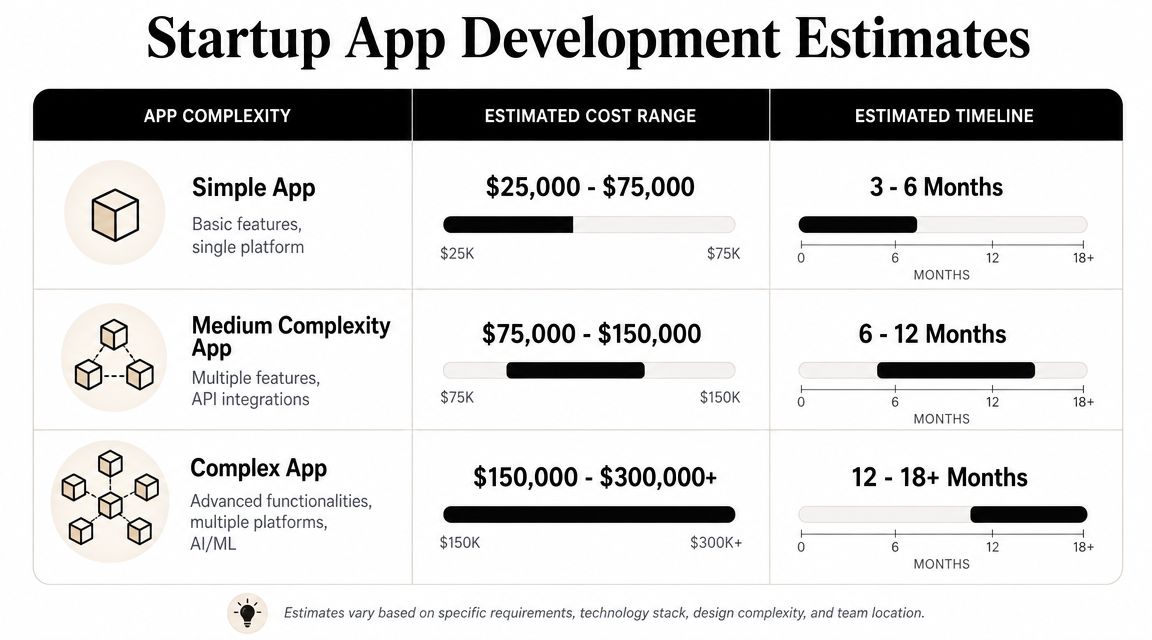
Founders usually ask for a price first. A better question is, “What exactly are we buying in this phase?” Cost only makes sense when tied to scope, complexity, and release intent.
The broad pattern is clear. MVPs are far cheaper and faster than feature-rich apps, and the curve steepens quickly as complexity grows. One startup-focused guide estimates MVP work at $8,000 to $25,000 and 3 to 4 months, while more complex apps can reach $60,000 to $150,000+ and take 6 months or longer (Galaxy Weblinks startup app guide).
What pushes the budget up
A simple app estimate can climb fast when teams add complexity in multiple places at once.
- Platform scope: Building for both iOS and Android increases testing and release coordination.
- Custom UX: Bespoke flows, animation, and dense interface logic take time.
- Integrations: Payments, identity, scheduling, maps, or third-party APIs add engineering and QA complexity.
- Backend requirements: Admin systems, permissions, and data-heavy workflows increase development effort.
- AI features: Prompt handling, model calls, governance, and observability create ongoing operational work, not just launch work.
Use budget ranges as planning tools
A useful budget conversation includes three scenarios:
| Scenario | What it usually means |
|---|---|
| Lean MVP | One core workflow, limited edge cases, essential analytics, basic admin support |
| Growth-ready v1 | More complete user journeys, stronger design system, expanded integrations, support tooling |
| Feature-rich product | Multi-role workflows, heavier backend logic, advanced personalization, broader platform requirements |
If you're trying to plan how much software delivery really costs beyond the first estimate, Wonderment's piece on the cost of software development gives helpful context for founders building a realistic budget.
For founders raising capital around the build, investor targeting matters too. If you're refining your fundraising process, this list of firms that find mobile app investors can help you research relevant investor categories.
The estimate you should trust most
The best estimate isn't the lowest one. It's the one that clearly explains assumptions, exclusions, timeline dependencies, QA coverage, and post-launch needs.
A blurry estimate is usually a warning sign. Either the team hasn't done enough discovery, or they're using a low number to get through procurement and planning to recover margin later through change requests. Neither outcome helps a startup.
Plan for Launch Growth and AI Modernization
Launch is where the product stops being theoretical. It's also where many startups discover they planned for build, not for operation.
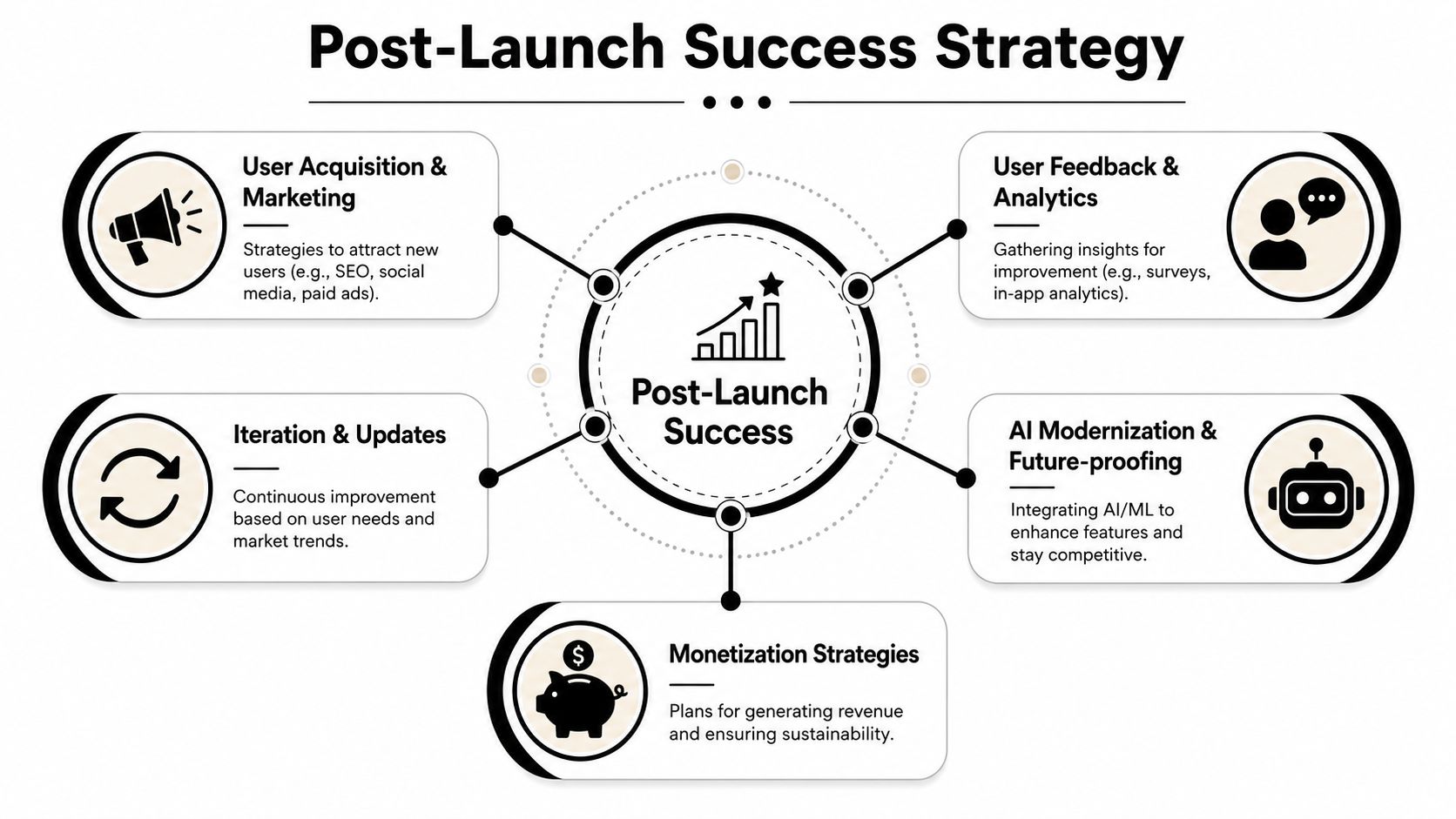
The weeks after release usually tell you more than months of internal debate. You'll see where onboarding stalls, which features people ignore, what support issues keep recurring, and whether the product has the kind of repeat behavior that can support real growth. That's why post-launch discipline matters just as much as build discipline.
What growth work looks like after launch
A solid post-launch rhythm usually includes five active lanes:
- Acquisition work through content, partnerships, paid distribution, app store optimization, or direct sales.
- Behavior review using onboarding, activation, retention, and feature usage signals.
- Feedback intake from support channels, interviews, reviews, and in-app prompts.
- Iteration planning that fixes friction before expanding scope.
- Monetization review so pricing, subscriptions, ads, or in-app purchases match actual user behavior.
Teams either get sharper or get distracted. Sharp teams look for patterns and respond quickly. Distracted teams react to the loudest customer request and gradually bloat the roadmap.
Launch isn't the finish line. It's the point where your assumptions start getting audited by real users.
Why AI changes post-launch economics
Most startup guides do a decent job on initial development cost. They're much weaker on the operational costs introduced by AI. That gap matters. As Pecode Software points out in its analysis of startup mobile cost planning, the challenge is building an AI-ready product that stays economical and controllable after launch, which requires token-cost control, model updates, and observability.
This is the part many teams discover late. AI features don't just add functionality. They add operational surface area.
You now need to manage:
- Prompt quality and version history
- Parameter control for how internal data gets passed into AI workflows
- Logging across model interactions
- Model update discipline
- Cost visibility so usage doesn't drift upward unnoticed
That's manageable if you plan for it early. It becomes painful if prompt logic is scattered across codebases, hard-coded by multiple developers, and invisible to product owners.
A practical way to modernize without chaos
For startups planning AI-assisted workflows, personalization, support tools, or recommendation layers, it helps to separate AI operations from the rest of the app in an admin-friendly way. One option is Wonderment Apps' prompt management system, which includes a prompt vault with versioning, a parameter manager for internal database access, logging across integrated AI systems, and a cost manager for cumulative spend. That kind of setup gives product and engineering teams a shared operating layer for AI changes instead of burying everything inside release cycles.
The benefit isn't hype. It's control.
A founder can review prompt changes. A product manager can compare behavior across versions. An engineer can trace failures. Finance can understand where AI spend is accumulating. That's the difference between “we added AI” and “we can operate AI responsibly.”
Keep the roadmap honest
Not every startup needs AI in version one. But if your product category will predictably move in that direction, your architecture and tooling should leave room for it. The same principle applies to growth. Don't plan a big launch and then improvise the next six months.
Treat launch as the beginning of a repeatable loop:
- Ship a focused release.
- Measure real behavior.
- Fix the points of friction.
- Expand only where usage supports it.
- Modernize with AI where it improves the product and can be governed cleanly.
That loop is what makes mobile app development for startups sustainable. Not ambition alone. Operational discipline.
If you're planning a new app or modernizing an existing one, Wonderment Apps can help you scope the right release, choose a delivery model, and prepare your product for AI integration without losing control of complexity or ongoing cost. If AI is part of your roadmap, ask for a demo of the prompt management system so you can see how prompt versioning, parameter control, logging, and spend tracking work in practice.