


If you run a retail operation, a clinic, a warehouse network, or a service business, you're probably already dealing with robotics in daily life without calling it that. A customer places an order. A mobile machine helps move inventory. A hospital robot delivers supplies. A home device handles repetitive chores. The hardware gets the attention, but the business value comes from the software layer that tells each machine what to sense, what to ignore, and what to do next.
That shift matters for executives because robotics is no longer just a capital equipment conversation. It is becoming a software governance conversation too. Once robots start using AI for perception, routing, exception handling, and human interaction, you need a way to manage that intelligence the same way you manage any other critical system. You need visibility, controls, logs, versioning, and cost discipline.
That is where many teams get stuck. They can picture the robot. They are less prepared for the operational reality of managing the AI brain behind it.
Beyond the Factory Floor How Robots Already Shape Your Day
A simple day tells the story.
A shopper orders a product online. In the background, a warehouse robot may help move stock to a packing station. A patient checks into a hospital. A logistics robot may later carry supplies or medications through the building. Back at home, a domestic robot handles a cleaning task while the customer answers email. None of this looks like the old stereotype of robotics. No welding sparks. No giant caged arm on an assembly line.
That old image is outdated.
By 2024, 98.9% of the 36.83 million robots in global operation were classified as service robots, not industrial units, and approximately 48.6 million domestic service robots were in use worldwide as of 2023, according to the figures summarized in these robotics statistics. The center of gravity has moved from factory-only automation toward homes, healthcare, logistics, and service environments.
The quiet shift executives often miss
For business leaders, the most important takeaway is not that more robots exist. It is where they create value.
Service robots show up where operations have friction:
- Repetitive movement tasks that slow down staff
- Environment-sensitive work where a fixed machine is too rigid
- Always-on workflows that keep running after a human shift ends
- Customer-facing expectations for speed, accuracy, and consistency
In other words, robotics in daily life is less about spectacle and more about removing small delays that stack into real cost.
Practical rule: If a process depends on moving things, scanning things, routing things, or repeating the same decision all day, robotics is already relevant to it.
Why software matters more than the shell
A robot without software is just a machine with potential. The business outcome comes from the logic layer that connects sensors, maps, rules, AI models, schedules, and human override paths.
That is why two companies can buy similar hardware and get very different results. One treats the robot as equipment. The other treats it as part of a managed software system.
Here is the better analogy for executives:
| Old view | Modern view |
|---|---|
| Buy a machine | Deploy a connected system |
| Automate one task | Orchestrate a workflow |
| Maintain hardware | Govern hardware plus AI behavior |
| Measure utilization | Measure operational impact |
That last column is where the return shows up. If robotics is entering your industry, the strategic question is not “Should we buy a robot?” It is “How do we manage the intelligence layer so it scales safely and predictably?”
The Two Sides of Modern Robotics Body and Brain
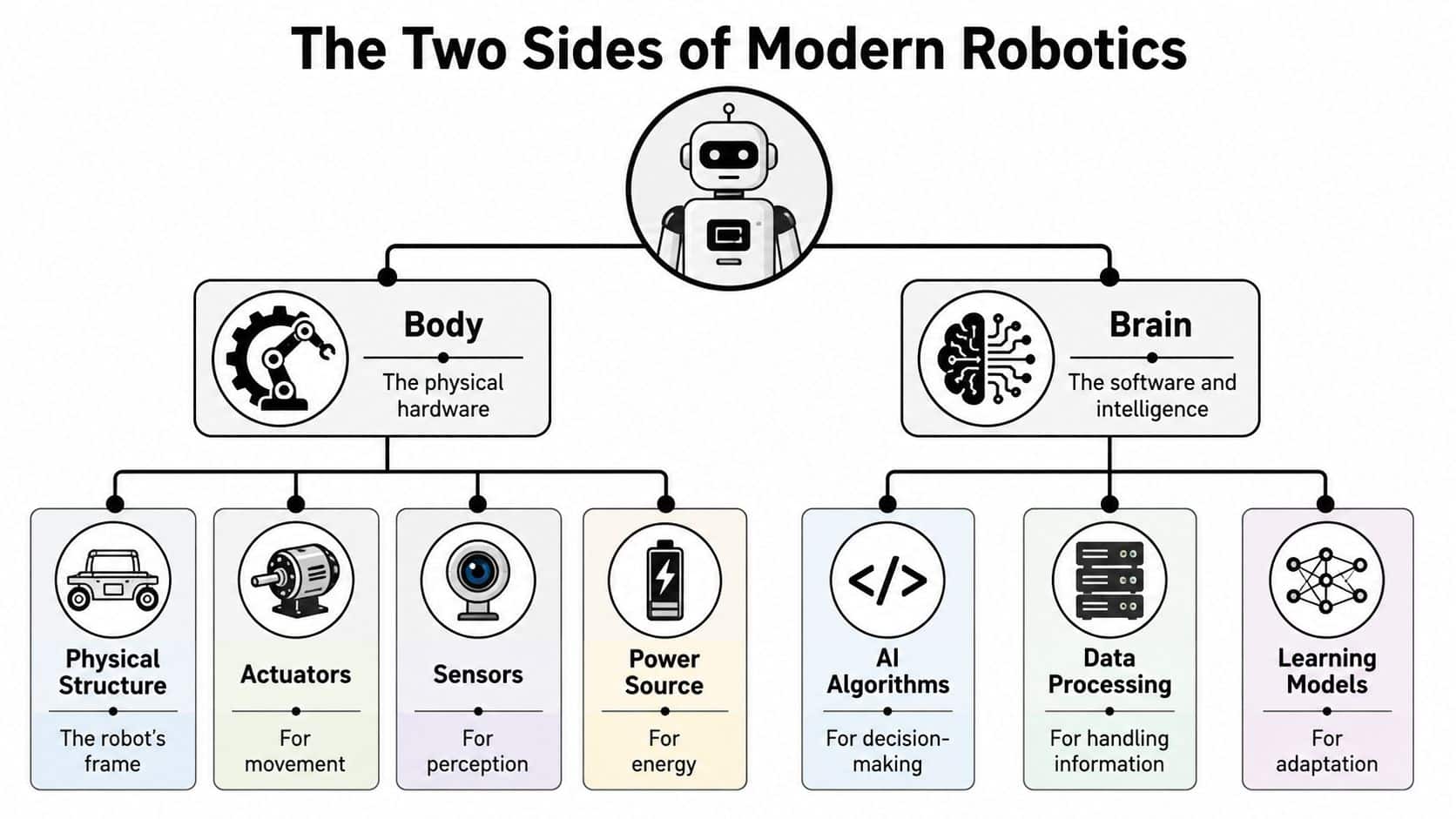
A useful way to understand robotics in daily life is to split every robot into two parts: the body and the brain.
The body is the physical system. Wheels, joints, grippers, cameras, batteries, frames, motors. The brain is the software stack that makes those parts useful. It interprets sensor data, decides what matters, plans motion, and handles changing conditions.
What the body does
The physical robot gives you reach into the physical world. It can move a tote, vacuum a floor, deliver supplies, inspect a site, or assist a worker with repetitive movement.
That matters, but only up to a point. Hardware is the delivery mechanism, not the source of adaptability.
A warehouse AMR and a home robot vacuum both prove the point. Their shapes are different, but the operational challenge is similar. They need to move through spaces that change. A box appears in an aisle. A person steps in front of them. A route becomes blocked. The robot must respond without freezing or causing trouble.
What the brain does
Modern robotics distinguishes itself from older automation.
The leap to autonomous mobile robots is powered by sensor fusion and AI-based perception. These systems combine cameras, lidar, and IMUs to localize themselves, detect obstacles, and plan routes in changing environments, enabling them to work safely alongside people in homes and warehouses, as described in this overview of autonomous robots in everyday life.
That sentence carries a lot of weight, so let's unpack it in plain language.
The robot brain does four jobs:
Sense
It collects inputs from cameras, distance sensors, motion sensors, and sometimes depth tools.Interpret
It decides what those signals mean. Is that object a wall, a person, a cart, or temporary clutter?Plan
It chooses a path or action based on current conditions.Act and adjust
It moves, checks results, and updates in real time if the environment changes.
That is not just automation. It is software-driven adaptation.
A modern robot is closer to an app with motors than a traditional machine with a fixed script.
Why this distinction matters to business teams
Executives often budget for the body and underestimate the brain. That leads to weak deployments.
The robot may arrive with solid hardware, but the primary integration work sits in the software layer. It must connect to inventory systems, operational data, user permissions, alerts, exception handling, and update cycles. That is why robotics projects often overlap with the same engineering disciplines used in embedded software development services.
If you remember one thing from this section, make it this: the body creates physical capability, but the brain creates business value.
Real-World Robotics Across Key Industries
Robotics in daily life becomes much easier to grasp when you stop thinking about robots as a category and start thinking about them as workflow tools. The question is never “Where can we put a robot?” The better question is “Where do delays, handoffs, errors, or safety constraints keep hurting operations?”
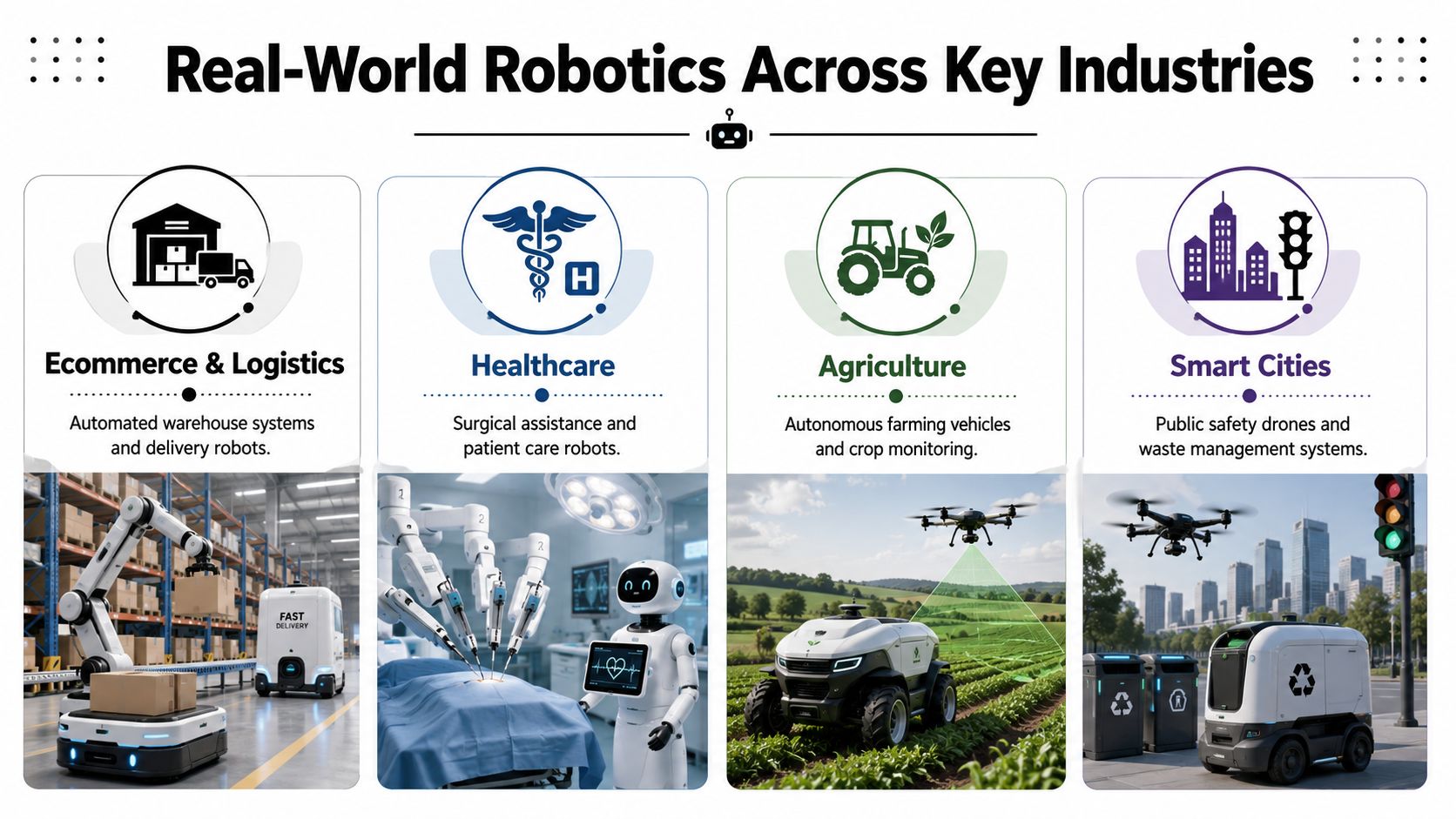
Ecommerce and logistics
Ecommerce leaders usually meet robotics first through fulfillment pressure. Order volume changes fast. Labor availability changes fast. Customer expectations do not get more forgiving.
Autonomous mobile robots help by moving items, carts, or inventory through the building without requiring every transfer to involve a person. In larger facilities, they often complement picking stations, sortation lines, and automated storage and retrieval systems that organize inventory flow more predictably.
The ROI logic is straightforward:
- Workers spend less time walking
- Inventory movement becomes more consistent
- Bottlenecks become easier to identify
- Fulfillment operations can run with fewer manual interruptions
The software challenge is just as important as the robot itself. Routing logic, warehouse maps, inventory status, and exception handling all have to connect cleanly. That is why many robotics programs also touch broader Internet of Things application development, especially when devices, sensors, and operational platforms need to share data in real time.
Healthcare and care environments
Healthcare is one of the clearest examples of robotics in daily life because the value is not futuristic. It is immediate.
A key benchmark for robotics in daily life is precision and continuity. In healthcare and retail, robots operate 24/7 with consistent, low-error execution. Robotic-assisted surgery improves precision and reduces recovery times, while hospital logistics robots cut staff workload by moving supplies reliably, as explained in HP's overview of everyday robotics.
For executives, the key lesson is this: healthcare robotics is often less about replacing clinicians and more about removing non-clinical friction.
Where the gains usually come from
| Healthcare task | What robotics helps with |
|---|---|
| Surgical support | Greater procedural precision |
| Internal transport | Reliable movement of medications and supplies |
| Staff workload relief | Fewer repetitive transport tasks for nurses and support teams |
| Service continuity | Round-the-clock execution without fatigue |
That is an operations story, not just a technology story.
Retail and service operations
Retail robotics often gets discussed through customer-facing novelty. The stronger use case is operational consistency.
Shelf-scanning tools, inventory robots, and delivery systems help teams keep stock visible, reduce manual checking, and move goods more predictably. In a store, the cost of an error is not just the error. It is the missed sale, the extra labor pass, and the customer frustration that follows.
A robot that performs a narrow task well can remove those recurring losses.
The best robotics use cases are often boring on purpose. If the task is repetitive, error-prone, and operationally expensive, boring is profitable.
Public sector and infrastructure work
Government and public infrastructure teams face a different problem set. They must inspect, monitor, and maintain assets across wide physical areas with safety and budget constraints.
Robotics helps when people should not have to perform the first pass in person. Drones for inspection, mobile platforms for monitoring, and automated systems for repetitive public tasks allow teams to focus human expertise on judgment rather than routine coverage.
The pattern across industries
Different sectors use different hardware, but the business pattern repeats:
- Move people off repetitive transport work
- Increase consistency
- Reduce avoidable delays
- Use software to coordinate machine action with human oversight
Once you see that pattern, robotics stops looking niche. It starts looking like a practical extension of modern operations design.
The Business Case for Robotic Automation
The business case for robotics is stronger when you stop treating it as a labor replacement story. The better frame is capacity, consistency, and resilience.
Robots do not call out sick, but that is not the main point. The main point is that they execute repeatable tasks with stable tolerances and can keep doing so across more hours of the day. That matters in environments where variability creates waste.
What executives should evaluate
A robot deployment is rarely justified by novelty. It is justified when it improves one or more of these conditions:
- Throughput constraints that limit output
- Quality variation caused by fatigue or inconsistent execution
- Safety exposure in repetitive or awkward environments
- Scalability bottlenecks when volume rises
- Data blind spots where operations lack visibility into movement and task flow
That last one deserves more attention than it usually gets. Robotics systems generate structured operational data. When managed well, that data becomes useful for staffing, layout decisions, scheduling, inventory placement, and service optimization.
ROI depends on integration discipline
For businesses, the key issue is operational ROI. Robots can improve efficiency and reduce waste, but only if organizations solve for interoperability, safety, and ongoing system updates. The most credible sources frame adoption as augmenting human workflows rather than fully replacing them, as noted in this analysis of robotics and autonomy in daily life.
That should sound familiar to any executive who has lived through ERP rollouts, CRM transformations, or cloud migrations. The technology itself may work. The return depends on whether it fits the operating model.
A simple decision lens
Ask these three questions before approving a robotics initiative:
- Is the task stable enough to automate but variable enough that fixed machinery struggles?
- Can we connect the robot to the systems that govern the workflow?
- Do we have a plan to manage updates, exceptions, and human handoffs?
If the answer to the first question is yes but the next two are no, the pilot may still demo well and fail commercially.
A robot can improve a process. It can also expose that the process was never well managed in software to begin with.
That is why the business case is not just about equipment payback. It is about whether the organization can operationalize intelligence at scale.
Key Considerations for Integrating Robotics and AI
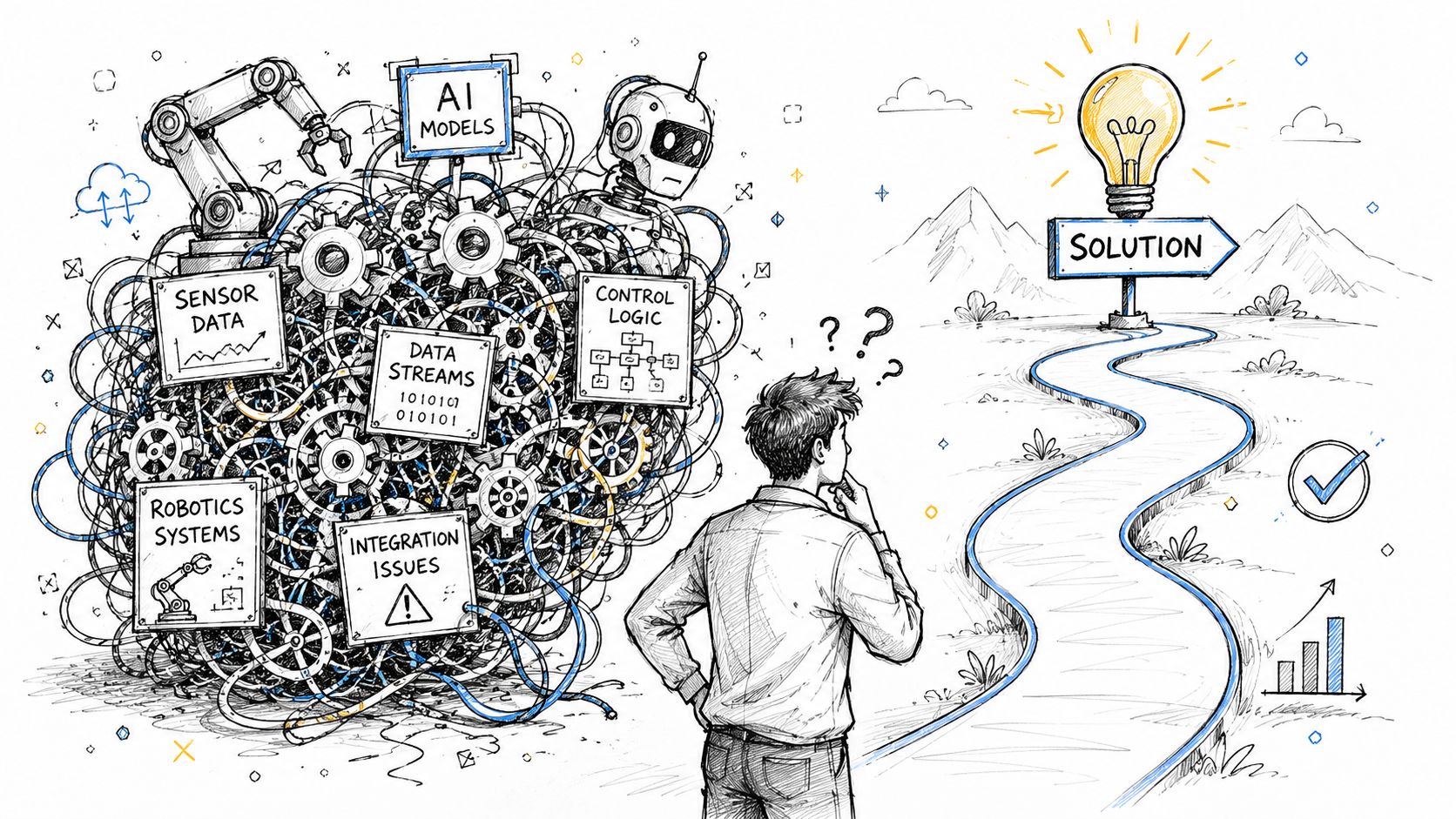
The hard part of robotics adoption is usually not buying the machine. It is integrating the machine into the digital environment your business already depends on.
A robot may need access to inventory status, route rules, user permissions, sensor data, escalation logic, and reporting systems. Add AI to the mix and another layer appears. Now you also need prompt control, model monitoring, logging, and cost governance.
The integration problems that show up first
Teams frequently hit the same obstacles:
Disconnected systems
The robot works, but it cannot reliably exchange information with core business software.Weak governance
AI behavior changes over time, but nobody has a clean record of which prompt, parameter, or model version drove which result.Security concerns
Access to internal data must be controlled tightly, especially in regulated industries.Cost uncertainty
AI usage grows through experimentation, then finance asks where the spend is going.
Those are not robotics-only problems. They are product operations problems. That is why leaders exploring robotics often benefit from broader thinking around AI in product management, where governance, iteration, and software decision-making matter as much as the feature itself.
What a workable control layer looks like
A strong robotics and AI stack usually needs a management layer with at least these capabilities:
| Capability | Why it matters |
|---|---|
| Prompt vault with versioning | Teams can track how AI instructions changed over time |
| Parameter manager | Sensitive internal data can be accessed in a controlled way |
| Central logging | Teams can audit outputs, failures, and unusual behavior |
| Cost manager | Leaders can monitor cumulative AI spend before it becomes opaque |
This is the part many organizations skip in early pilots. Then the pilot succeeds, usage expands, and nobody can fully explain what the AI is doing, what it costs, or how to tune it safely.
Why modernization matters
If your current systems were not built with AI and robotics in mind, integration gets messy fast. Legacy software often lacks the clean interfaces, observability, and update patterns these deployments need.
That is why robotics strategy often overlaps with broader work on how to implement AI in business. The robot is only one endpoint. The core project is modernization across software, process, and governance.
The companies that scale AI-powered robotics well usually treat it as an architecture problem first and a hardware project second.
What to decide before a pilot expands
Before a robotics pilot moves into production, leadership should lock down a few operational decisions:
- Who owns AI behavior changes
- How prompts and parameters are reviewed
- Where logs are stored and who can access them
- How spending is monitored
- When humans must override or approve actions
None of that feels glamorous. It is still the work that separates a demo from a dependable business capability.
Your Next Steps Building an AI-Powered Future
If robotics in daily life feels relevant to your business, the next move should be focused, not sweeping. Most strong programs start with a narrow pilot that solves a real operational problem.
Step 1 Pick one workflow with visible friction
Choose a process where movement, handoff, scanning, or repetitive handling slows the team down. In healthcare, that might be internal delivery. In ecommerce, it might be inventory movement. In public service, it might be inspection support.
Do not start with the most ambitious use case. Start with one that is important, measurable, and low enough risk that your team can learn without disrupting the business.
The accessibility angle is also worth serious attention. The clearest near-term value for daily-life robotics may be in assistive use cases such as helping people with paraplegia, easing nurses' workloads, and enabling independent living for older adults and people with disabilities, as highlighted in IFR's robots in daily life case studies.
Step 2 Evaluate partners who understand software, not just hardware
A robotics vendor may know the machine well. That does not automatically mean they understand your application stack, compliance constraints, customer experience, or legacy systems.
You need partners who can translate between physical automation and software operations. The best ones think about APIs, observability, permissions, and lifecycle management as much as sensors and mobility.
Step 3 Get control over the AI layer from day one
If AI is part of the robotics workflow, do not leave governance for later. Put controls around prompts, internal parameters, logs, and cost before usage spreads.
That same mindset applies to broader automation programs and even teams experimenting with managing AI agents. Once multiple systems start making semi-autonomous decisions, visibility stops being optional.
A practical roadmap looks like this:
- Pilot one workflow
- Choose integration-minded partners
- Set up management and oversight early
That sequence keeps the project grounded in operational value instead of drifting into a tech experiment.
Wonderment Apps helps teams modernize software for AI-powered operations, including the management layer that often determines whether robotics and AI scale cleanly or become hard to govern. If you want a closer look at a platform built for prompt vault versioning, parameter management, centralized logging, and AI cost visibility, book a demo with Wonderment Apps.