


Your software may be doing the business version of driving with the parking brake on. Revenue grows, traffic spikes arrive, AI expectations rise, and the application underneath it all starts showing its age. Pages slow down under load. Integrations take longer than they should. A feature that sounded simple in the boardroom turns into a long engineering detour.
That's usually the moment leaders start asking a deeper question. Not just “how do we ship faster,” but what is Golang used for, and is it the kind of foundation that helps modern software scale without becoming fragile?
That question matters even more now because modernization is no longer just about web performance. It's about building systems that can support cloud operations, high-traffic APIs, and AI-driven workflows at the same time. If the underlying stack is too heavy, too slow to compile, or too painful to maintain, every new initiative costs more than it should.
Is Your Software Built for the Future or Stuck in the Past
A lot of companies aren't held back by bad ideas. They're held back by software that was built for yesterday's traffic, yesterday's release cycles, and yesterday's operating model.
You see it in familiar ways. Holiday traffic creates anxiety instead of opportunity. Product teams wait on backend changes longer than they wait on customer feedback. AI features get discussed enthusiastically, then shelved because the core system can't support one more layer of complexity.
Modernization starts with the foundation
When leaders ask for faster releases, better uptime, and more intelligent customer experiences, they're usually asking for a stronger technical base. That's why language choice matters more than it sounds. The language underneath your platform shapes hiring, deployment speed, performance under load, and how easily teams can evolve the product over time.
If you're evaluating the broader architecture around that decision, Wonderment's guide on how to choose the right technology stack for your project is a useful companion to this discussion.
Practical rule: If every new feature requires a workaround, the problem usually isn't the feature. It's the foundation.
Why this question shows up during AI planning
AI raises the stakes. Once you add model calls, logging, data access, personalization, and governance into the mix, weak backend architecture gets exposed quickly. A modern language won't solve every problem, but it can remove a surprising amount of friction.
Go is one of the languages that keeps showing up in these conversations because it was built for operational simplicity. Not novelty. Not academic elegance. Operational simplicity.
That distinction matters to a CEO because the best modernization decisions are rarely about chasing what's fashionable. They're about choosing tools that make growth less expensive, less risky, and less chaotic.
What Is Go Really A Language Built for Modern Problems
Go came out of a practical problem, not a theory exercise. It was developed by Google engineers Robert Griesemer, Rob Pike, and Ken Thompson, then publicly released in November 2009 as a response to scalability problems in large C++ codebases during a period of rapid growth at Google. It was designed to compile directly to machine code, deliver C-like performance, and compile much faster, which is why it became attractive for high-performance backend systems, as summarized by Northwestern's overview of Go's origins and systems focus.
Why business leaders should care about that origin story
Go wasn't invented because engineers wanted another syntax to argue about. It was created because large teams needed to build complex systems without drowning in complexity.
That's the fundamental difference.
Older enterprise stacks can feel like carving a statue from stone. Powerful, yes. But slow to shape, expensive to change, and unforgiving when the design shifts mid-project. Go is closer to building with standardized parts. Teams can assemble, test, replace, and scale components without rebuilding everything around them.
For a business leader, that translates into three outcomes:
- Faster delivery cycles because developers spend less time wrestling with tooling and more time shipping useful features.
- Cleaner operations because deployments are simpler and services are easier to run.
- Lower long-term drag because the codebase tends to stay more understandable as the company grows.
Go is opinionated in a good way
Many languages promise flexibility. Go puts more weight on consistency. That can frustrate developers who enjoy endless customization, but it helps teams that want predictable engineering output.
A non-technical analogy helps here. If every architect on a commercial building project used a different blueprint standard, the construction firm would burn time translating decisions instead of making progress. Go reduces that translation cost inside engineering teams.
Go tends to reward companies that want dependable execution more than companies that want maximum language cleverness.
What Go is not trying to be
Go isn't trying to replace every language in your company. It isn't the first choice for every machine learning experiment, every mobile interface, or every legacy enterprise workflow. Its strength is narrower and more valuable than that. It's built for software that needs to be fast, reliable, maintainable, and ready to operate at scale.
That's why the answer to “what is golang used for” usually starts with backend systems, infrastructure, APIs, and distributed applications. Those are the places where complexity becomes cost, and where Go is often at its best.
Why Go Delivers Speed Scale and Simplicity
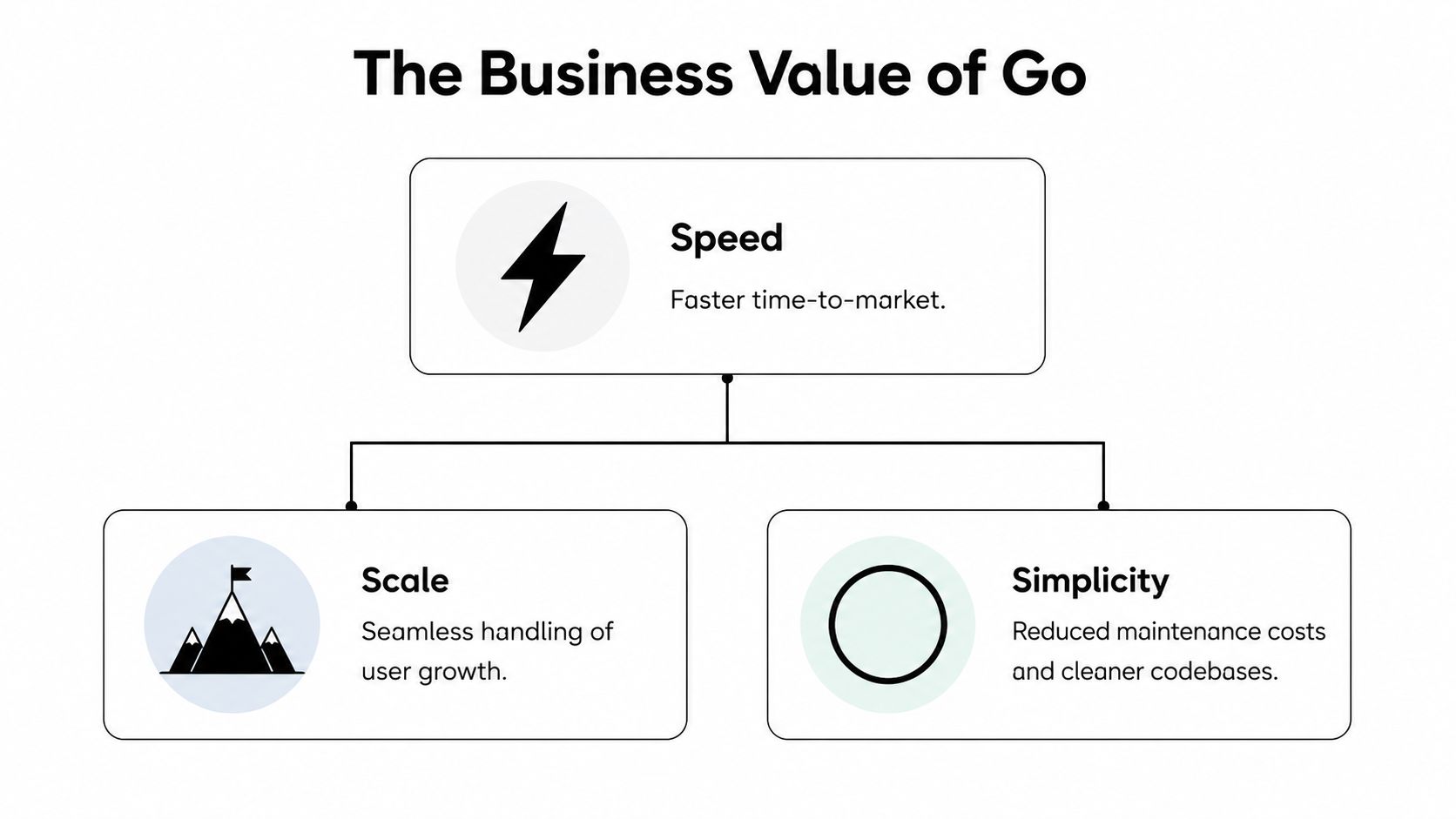
The strategic case for Go is straightforward. It helps teams build software that performs well, holds up under pressure, and stays manageable as the business grows.
That combination is harder to get than most technology pitches suggest.
Scale without architectural panic
One of Go's defining strengths is concurrency. In plain English, it can handle many things happening at once without the operational weight that comes with traditional thread-heavy systems. According to OGD Solutions' discussion of Go for high-load applications, Go's goroutines help systems manage tens of thousands of simultaneous connections with minimal overhead, and that's one reason Twitch chose Go for lower latency under heavy client load.
For a CEO, concurrency matters because customer demand rarely arrives in a neat, linear stream. It arrives in bursts. Campaign launches, breaking news, product drops, and seasonal peaks all create moments where the system must juggle a lot at once.
To illustrate, imagine staffing a hotel. A thread-heavy model is like assigning a full concierge desk to every guest request. Go is closer to having a highly efficient operations team that can coordinate thousands of requests without needing a separate office for each one.
Speed that affects delivery, not just benchmarks
Go compiles to machine code, so the resulting services tend to be fast in production. But the more underrated business benefit is development speed. Faster compilation tightens the loop between writing code, testing it, and shipping it.
That matters because release cadence is a business capability. Teams that can validate changes quickly can respond faster to customer behavior, competitive pressure, and operational issues.
If you're comparing language performance trends more broadly, the overview on Fastest programming language for 2026 is a useful outside read, especially for leaders trying to separate benchmark noise from practical engineering impact.
Simplicity lowers maintenance cost
This is the part executives often feel before they can name it. Some stacks accumulate drag. Every deployment feels fragile. Every hire needs extra time to understand the system. Every service carries more runtime baggage than expected.
Go tends to reduce that drag because it favors straightforward code and simple deployment patterns.
Operating insight: The cheapest infrastructure decision is often the one that avoids complexity before it enters the system.
Here's the business view of Go's three strongest traits:
| Business concern | What Go changes | Executive impact |
|---|---|---|
| Traffic spikes | Handles large numbers of concurrent requests efficiently | More stable customer experience during peak demand |
| Feature delivery | Fast compile and deploy cycles | Shorter path from roadmap to release |
| System maintenance | Simpler services and cleaner code conventions | Lower operational friction over time |
Go won't fix poor architecture by itself. But when the architecture is sound, it gives teams a strong engine with fewer moving parts than many alternatives.
Top 6 Real-World Use Cases for Golang
The best answer to what is golang used for is to look at where it earns its keep in production. Go is rarely the flashy part of a product. It's the part that keeps the product responsive, scalable, and sane to operate.
1. Cloud-native platforms
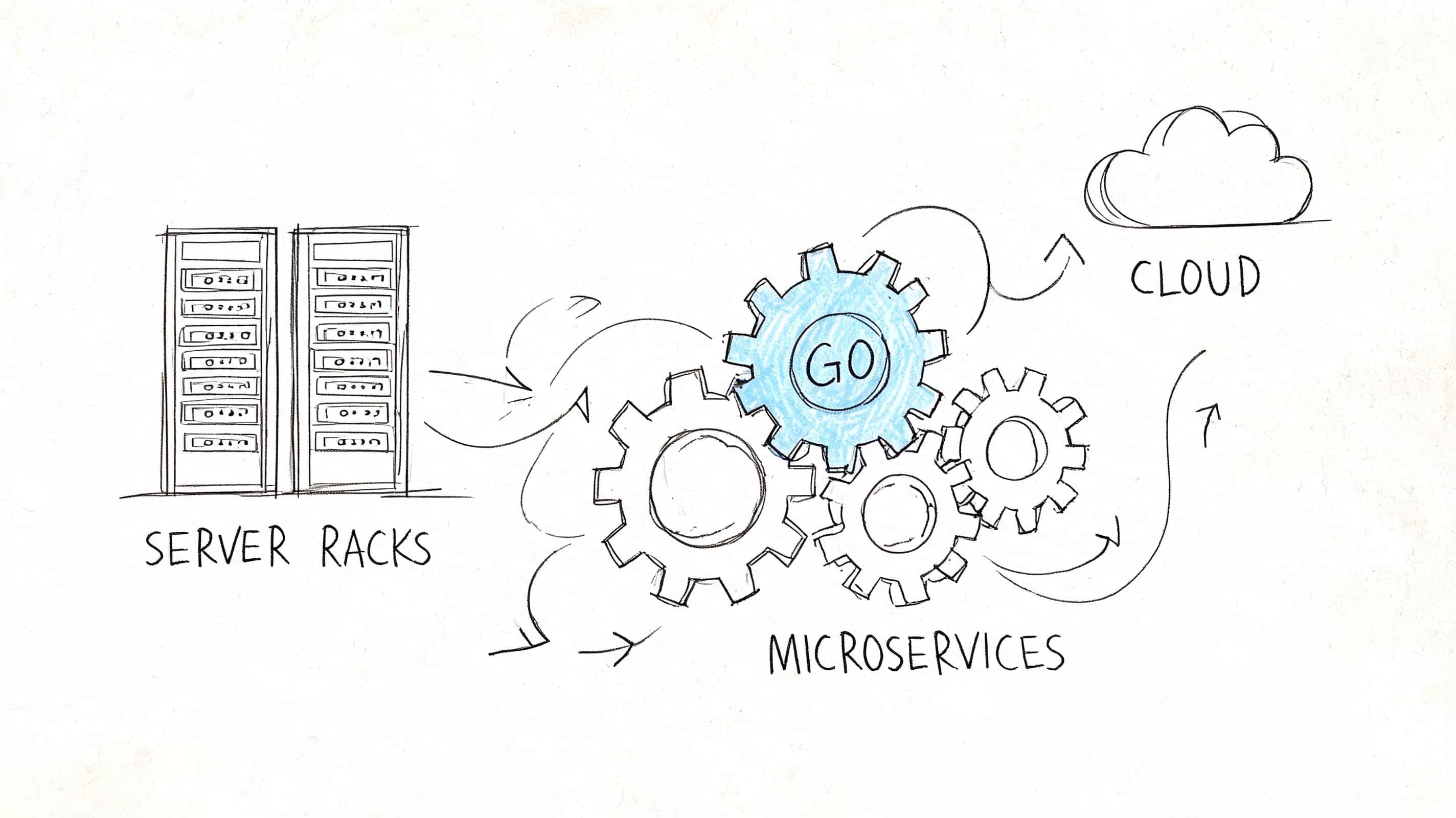
Go is strongly associated with cloud infrastructure because it fits distributed systems well. When companies build software meant to run across containers, services, and orchestrated environments, Go often becomes the practical choice for the underlying components.
This is one reason so many engineering leaders encounter Go while modernizing hosting, deployment, or platform operations.
2. Microservices that need clear boundaries
If your application is becoming a collection of smaller services instead of one giant codebase, Go is a strong fit. A retailer, for example, might split checkout, inventory, search, pricing, and fulfillment into separate services so each can scale and change independently.
Go works well here because it encourages focused services rather than bloated, all-purpose applications.
3. DevOps and command-line tools
Internal tools don't get much press, but they often save teams more time than customer-facing features. Go is widely used to build command-line utilities, deployment helpers, automation tools, and operational scripts that need to run reliably across environments.
That makes it valuable not only for product engineering, but also for platform and infrastructure teams.
4. High-performance APIs and networking layers
APIs are where customer experience and system design meet. Slow or unstable APIs create visible business problems quickly. Go is frequently used for API gateways, internal service communication, proxies, and networking-heavy backends because it handles concurrency efficiently and keeps resource use predictable.
A good API layer should feel boring in production. Go is often chosen because boring is the goal.
5. Big data and processing pipelines
Go is also useful in data-intensive systems. In big data and parallel processing, it benefits from lightweight goroutines that support millions of concurrent tasks with about 2KB per goroutine versus 1MB+ for OS threads, and it has benchmarked up to 4x faster than Python for JSON parsing, according to the Northwestern overview already cited earlier.
That makes it appealing for data collection, event processing, transformation pipelines, and services that move large volumes of structured information.
6. High-concurrency backend systems
Chat systems, streaming backends, logistics engines, alerting platforms, and multiplayer infrastructure all share one trait. They need to manage many live interactions at the same time without becoming expensive to operate.
Go is a natural fit for that pattern.
For leaders thinking about hiring and market demand, Go Hires international job market insights can also help frame where Go talent overlaps with adjacent backend and platform skills.
A practical use-case filter
Go is often the right fit when the software needs to do one or more of these things well:
- Serve lots of requests at once without requiring oversized infrastructure
- Run as a backend core for APIs, services, and integrations
- Support cloud operations where deployment simplicity matters
- Process data streams that would strain slower runtime environments
- Power internal tooling that engineering teams depend on daily
- Keep operations predictable as usage grows
That's the pattern worth noticing. Go tends to win where software must be useful at scale, not just elegant in a demo.
Golang in Your Industry
Technology decisions become clearer when you tie them to operating realities. Go's value looks different in ecommerce than it does in healthcare, but the underlying appeal is similar. It helps teams build systems that stay responsive when the business gets complicated.
Ecommerce and retail
Retail systems live or die by peak moments. Promotions, seasonal events, product launches, and recommendation traffic all stress the backend in different ways. Go is attractive here because it handles concurrency well and supports the kind of service-based architectures that let search, checkout, inventory, and fulfillment evolve independently.
That's useful when one part of the business needs to scale faster than another.
Fintech and SaaS
Fintech teams care about throughput, reliability, and attack surface. SaaS teams care about those too, plus multi-tenant performance and clean operations. Emerging data cited by Pluralsight notes that Go powers 35% of new Kubernetes-based microservices in fintech, and that companies like Monzo use it for fraud detection handling over 10 million transactions daily, with Go's static binaries cited as part of reducing attack surface for compliance-sensitive environments in this Pluralsight discussion of Go in fintech microservices.
For a business leader, the takeaway isn't “use Go because fintech does.” It's this: when performance and operational discipline are essential, Go keeps showing up.
Board-level lens: In regulated businesses, reliability is not just a technical metric. It's part of trust.
Healthcare and wellness
Healthcare organizations need software that is dependable, maintainable, and compatible with strict operational controls. Go can be a strong choice for data pipelines, APIs, and patient-facing backend systems where uptime and predictability matter.
Its appeal here is less about hype and more about operational fit. When teams need software that can process sensitive workflows without turning infrastructure into a science project, Go deserves a serious look.
Media, streaming, and audience-heavy apps
Media platforms deal with large concurrent audiences, live events, and strict latency expectations. In those environments, small delays become visible fast. Go's strengths map well to these systems because it supports high-concurrency backends that need to stay stable under pressure.
The industry examples are useful, but the strategic lesson is broader. If your product lives in moments of traffic concentration, Go is often more relevant than leaders first assume.
Golang vs Python Java and NodeJS
Choosing a language is rarely about finding the winner. It's about matching the tool to the operating model of the business.
Go earns its place because it balances performance, simplicity, and scalability well. But that doesn't mean it replaces Python, Java, or Node.js in every scenario.
The business trade-offs
Python is excellent for experimentation, especially where data science and machine learning exploration matter. Java remains established in enterprise environments and can be a strong fit for organizations with large existing ecosystems and mature JVM expertise. Node.js is attractive when teams want JavaScript across frontend and backend, especially for product teams moving quickly on web applications.
Go usually enters the picture when the company needs a backend that is lean, fast, and easier to operate at scale.
If you're weighing Go directly against a more traditional enterprise option, Wonderment's comparison of Go vs Java is worth reading.
Language Comparison for Business Leaders
| Factor | Golang | Python | Java | Node.js |
|---|---|---|---|---|
| Core strength | High-performance backend services | Fast experimentation and broad library ecosystem | Mature enterprise systems | Rapid web development with one language across stack |
| Operational profile | Simple deployment and strong concurrency | Easy to start, less suited to heavy concurrent backend workloads | Powerful but heavier runtime footprint | Strong for I/O-heavy apps, can get complex under CPU-heavy load |
| Team experience | Best for disciplined backend and platform teams | Best for data-heavy and scripting-oriented teams | Best for large enterprise teams with established processes | Best for web-centric product teams |
| Good fit | APIs, microservices, infrastructure, data pipelines | Prototyping, analytics, ML experimentation | Large legacy enterprise environments, complex corporate systems | Web apps, real-time features, full-stack JavaScript shops |
| Main trade-off | Smaller ecosystem for exploratory ML work | Performance and concurrency limits in some production workloads | More complexity and operational overhead | Reliability and maintainability can suffer in sprawling backends |
A simple way to decide
Use Go when the software is expected to be a durable backend asset. Use Python when discovery speed matters more than runtime efficiency. Use Java when the organization already has deep enterprise investment there. Use Node.js when frontend and backend alignment matters more than raw backend discipline.
The wrong language doesn't fail immediately. It slowly turns normal growth into expensive engineering work.
That's the actual cost to watch.
Adopting Go and Modernizing Your App with AI
The strongest reason to adopt Go is not that it's modern. It's that it aligns well with a certain kind of product strategy.
If you're building high-performance APIs, cloud-native services, event-driven systems, or backends that need to hold up under sustained load, Go is a serious contender. If your roadmap depends on rapid experimentation in notebooks or specialized research workflows, it may play a supporting role rather than the lead one.
A practical adoption filter
Go is usually the right strategic choice when these conditions are true:
- Your backend must scale cleanly across services, users, or regions
- Reliability matters more than language flexibility
- Your engineers need fast release loops without heavyweight deployment complexity
- You're modernizing infrastructure alongside product capabilities
- AI features depend on stable service layers rather than one-off experiments
That last point matters more than many teams expect.
AI doesn't replace architecture
A lot of companies treat AI as an overlay. Add a model, wire up a prompt, and call it transformation. That approach breaks down when no one can track changes, audit outputs, manage model interactions, or understand spending.
AI needs operational structure just like any other critical system.
That's why backend modernization and AI modernization should happen together. A stable service layer helps your application integrate models cleanly. A cloud-native approach helps teams deploy and scale those capabilities without creating a maintenance mess. Wonderment's article on cloud-native architecture is a helpful reference if you're evaluating that broader shift.
What a durable modernization plan looks like
A durable plan usually has two layers.
First, you upgrade the application foundation. That includes the backend language, deployment model, service boundaries, and operational tooling.
Second, you add governance around AI itself. In practice, that means managing prompts like product assets, controlling parameters for internal data access, logging model behavior across integrated systems, and monitoring AI spend so costs don't drift upward.
The companies that do this well don't treat AI as a bolt-on gimmick. They treat it like a product capability that needs engineering discipline.
Strong AI features sitting on weak backend architecture create impressive demos and painful operations.
If you've been asking what is golang used for, the strategic answer is this: Go is used for the parts of your software business that must keep working when growth, complexity, and intelligence all arrive at once.
If your team is modernizing a legacy application, planning AI integration, or trying to build a backend that can scale without becoming brittle, Wonderment Apps can help. They design and build high-performance web and mobile products, support AI modernization, and provide an administrative prompt management system with prompt versioning, parameter controls for internal data access, unified AI logging, and cost tracking so leaders can manage AI as an operational capability, not a black box.