


Your product might already be smart. It turns on, measures inputs, follows rules, and talks to a mobile app. That’s no longer enough.
Business leaders are now facing a tougher question. Can the product sense problems early, adapt to changing conditions, support remote decisions, and become part of a broader digital strategy instead of staying a clever standalone device? That’s where embedded software development services stop being a line item and become a strategic decision.
The market has moved in that direction fast. The global embedded software development services market grew from USD 30 billion in 2018 to USD 45 billion by 2024, reflecting how many companies now depend on embedded systems to compete across critical industries, according to Strategic Revenue Insights on the embedded software development services market.
A lot of companies still buy these services the wrong way. They compare hourly rates, ask for a rough delivery estimate, and hope a vendor can “handle the firmware.” That’s a weak buying strategy. In embedded work, value comes from system judgment, hardware awareness, testing discipline, compliance readiness, and the ability to make product decisions that won’t punish you later in manufacturing, maintenance, or support.
Your Product Is Smart But Is It Intelligent
A commercial device can be well-built and still fall behind. A connected coffee machine, a retail kiosk, a payment terminal, or a medical wearable can all work perfectly and still lose ground if they can’t deliver better data, better decisions, and better service workflows.
That gap matters because customers no longer separate hardware from software. They judge the full experience. If a device can’t report health status, support remote diagnostics, or surface useful recommendations, it starts to feel dated even if the hardware is solid.
Smart devices follow rules
Traditional embedded systems are built to do a defined job inside a constrained environment. They read sensor data, control hardware, manage timing, and execute predictable behavior. That’s the baseline.
A smart product might connect to the cloud, send alerts, or expose a dashboard. Useful, yes. Differentiated, not for long.
Intelligent products create operating leverage
The next step is turning product behavior into business advantage. That means using embedded software to support maintenance workflows, service operations, anomaly detection, personalization, or better decision support for users and internal teams.
Here’s the strategic shift:
- A smart product executes features: It performs tasks reliably.
- An intelligent product improves operations: It helps your team reduce friction, identify issues sooner, and create new service models.
- A defensible product creates feedback loops: It gets better because software, data, and user behavior inform what gets built next.
Don’t treat intelligence as a feature add-on. Treat it as a product operating model.
That’s why embedded software development services now overlap with cloud architecture, mobile experiences, support tooling, and AI governance. Once you add AI-assisted features, even modest ones, you need control over prompts, versions, parameters, logging, and spend. Otherwise your “innovation layer” becomes an untraceable mess that product, engineering, and compliance teams will all regret.
The wrong first question
Most buyers start with, “Who can build this cheapest?” The right question is, “Who can help us make the right technical decisions early, before those decisions become expensive?”
In embedded systems, bad early choices don’t stay dormant in a backlog. They show up later as hardware incompatibility, unstable behavior, field failures, certification pain, and support costs your finance team definitely notices.
If you’re upgrading a physical product into a connected or AI-enabled one, don’t shop for coders. Shop for embedded software development services that can shape the product, the delivery model, and the long-term architecture.
What Are Embedded Software Development Services
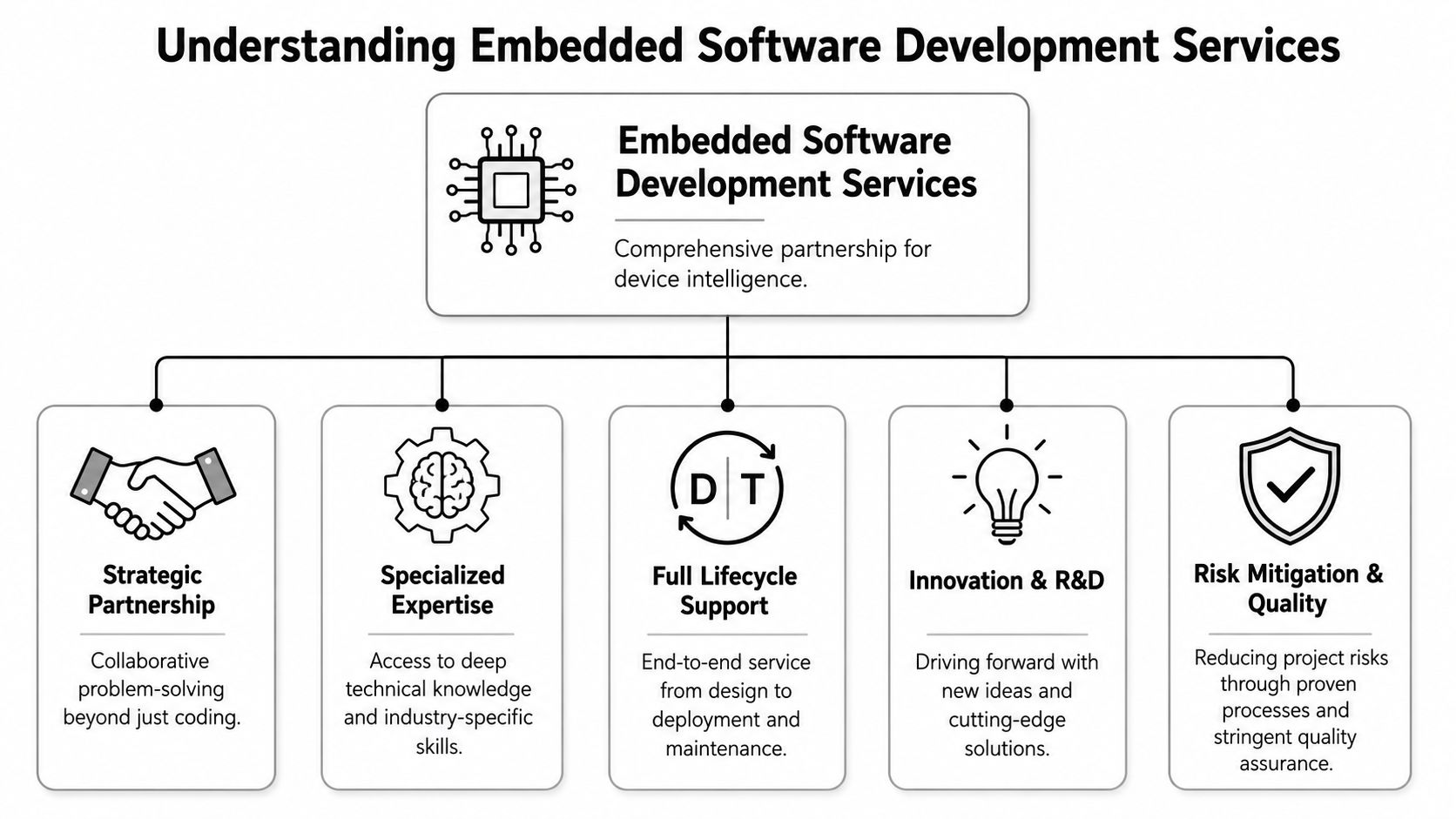
Embedded software development services are not just “firmware help.” They’re a full delivery capability for products where software has to work inside physical constraints, interact directly with hardware, and behave predictably in actual environments.
Consider building a house. You don’t hire one person and say, “Handle it.” You need architecture, structural planning, electrical work, plumbing, inspection, and long-term maintenance. Embedded products work the same way. If one layer is sloppy, the whole thing suffers.
Product definition and prototyping
Disciplined teams earn their keep through meticulous preparation. Before code goes deep into hardware, the team should clarify device purpose, user workflows, environmental constraints, connectivity needs, and failure conditions.
Good prototyping answers questions like:
- What must happen locally: Some decisions can’t wait on a network round trip.
- What belongs in the cloud: Analytics, dashboards, fleet management, and reporting often sit elsewhere.
- What happens when things fail: Devices lose connectivity, sensors drift, power fluctuates, and users do weird things.
A weak partner rushes through this. A strong one slows down just enough to avoid building the wrong product correctly.
Hardware and software co-design
This is the layer many non-specialist vendors underestimate. Embedded software is tied tightly to processor architecture, memory layout, interfaces, and board-level realities. It isn’t a mobile app with a different screen size.
When hardware and software teams work in isolation, the project pays for it later. Board revisions pile up. Driver behavior gets messy. Timing issues become hard to reproduce. Manufacturing exposes problems that should have been caught far earlier.
The cleanest embedded projects are co-designed. Hardware choices and software architecture should evolve together, not collide near launch.
Firmware, drivers, and system logic
This is the guts of the product. It includes the low-level code that talks directly to chips, sensors, peripherals, storage, and communication interfaces.
You’re typically buying expertise in areas such as:
- Boot and startup behavior: How the device initializes and recovers
- Device drivers: The code that makes hardware components usable
- System control logic: State handling, fault response, and operational rules
- Communication layers: How the device exchanges information with other systems
This work requires precision, not just programming skill. A team can be excellent at web development and still be a poor fit here.
Application features, QA, and lifecycle support
At the top of the stack, the product often needs user-facing capabilities. That can mean an on-device interface, a connected dashboard, a companion app, or service workflows for operators and admins.
The final part is testing and support. Not casual testing. Exhaustive testing across hardware conditions, update paths, failure states, and operational scenarios.
A serious embedded software development services partner should cover:
| Service layer | What it includes | Why it matters |
|---|---|---|
| Discovery | Requirements, constraints, architecture decisions | Prevents expensive rework |
| Core build | Firmware, drivers, control logic, integrations | Delivers the device’s actual behavior |
| Validation | Functional testing, hardware testing, edge cases | Protects reliability and safety |
| Release support | Deployment planning, updates, monitoring | Reduces launch risk |
| Ongoing maintenance | Bug fixes, enhancements, compatibility work | Keeps the product viable after launch |
If a provider only wants to talk about coding capacity, keep looking. Embedded software development services should cover the whole lifecycle, because the software doesn’t stop mattering once the device leaves the bench.
Real-World Applications and Industry Requirements
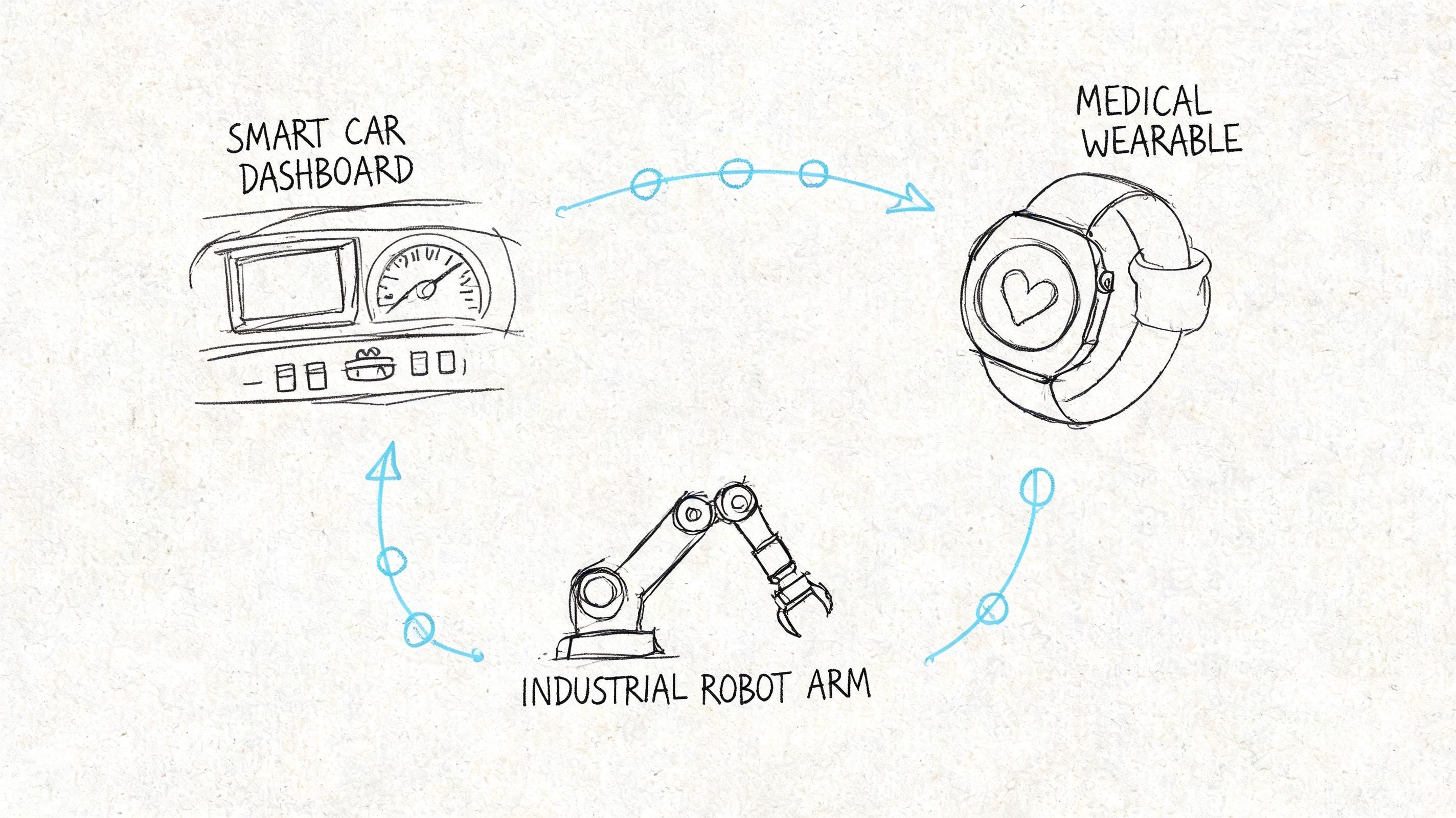
Embedded software gets real when a missed requirement creates a business problem, a safety problem, or both. The details change by industry, but the pattern doesn’t. The product has to behave correctly in context, not just in a demo.
Healthcare needs determinism, not excuses
A wearable monitor or connected therapeutic device doesn’t get to be “mostly responsive.” In mission-critical systems, developers must use Real-Time Operating Systems (RTOS) because failure to meet real-time constraints can compromise safety. One cited example is automotive anti-lock braking systems that must respond within milliseconds, as described in Senla’s guide to embedded software and real-time systems.
Healthcare buyers should apply that same mindset. If timing matters, then deterministic execution matters. If data matters, then traceability matters. If regulation matters, then engineering shortcuts are off the table.
Critical requirement: predictable behavior under strict timing and compliance conditions.
Fintech devices live or die by trust
Consider a payment terminal or secure retail device. Customers don’t care how elegant the board design is. They care that transactions complete, credentials stay protected, and downtime doesn’t ripple into lost sales.
In fintech, embedded systems often sit at the intersection of hardware control, secure communication, and operational continuity. That means the engineering team can’t think in feature tickets alone. They need to think like risk managers.
Watch for these realities:
- Security is architectural: You can’t bolt it on after device behavior is defined.
- Operational failure is visible: A broken POS terminal creates immediate revenue loss and frontline chaos.
- Supportability matters: Devices in the field need maintainable diagnostics and update paths.
Automotive and mobility systems punish latency
Automotive teams don’t have room for lazy assumptions. Systems that interact with braking, sensing, driver assistance, or in-vehicle controls demand extremely tight timing and clear fault handling.
That’s why low-latency behavior isn’t a “performance optimization.” It’s a design requirement. If a supplier treats it like a stretch goal, they’re not qualified for the work.
If your product affects motion, health, payments, or industrial control, reliability is part of the business model, not just the engineering scope.
Industrial IoT wins on reliability in ugly conditions
Factory sensors, machine monitors, smart controllers, and rugged field devices don’t operate in ideal environments. They deal with noise, heat, vibration, intermittent networks, and long maintenance cycles.
The embedded challenge here isn’t flashy UI. It’s resilient behavior over time. Businesses usually want these systems for one reason: fewer surprises. Better maintenance planning. Faster issue detection. Cleaner operational data.
Critical requirement: stable performance across harsh environments and imperfect infrastructure.
A partner that has only built polished consumer apps will struggle here. Industrial systems reward engineering restraint. They need robust fault handling, clear telemetry, and software that stays boring in production. That’s a compliment.
Key Technologies and Building Your Team
You don’t need to become an embedded engineer to lead an embedded project well. You do need enough fluency to ask sharper questions and avoid weak delivery models.
At the technology level, most embedded systems are built from a few foundational layers. Low-level languages such as C and C++ are common because they give teams fine-grained control over performance, memory, and hardware interaction. Microcontrollers or processors act as the device’s brain. Real-time operating environments may be necessary when timing can’t drift. Drivers, communication stacks, and application logic sit on top.
That sounds manageable on paper. In practice, the hard part is integration.
A significant technical hurdle is smooth hardware-software integration, and poor integration introduces defects that are exponentially more expensive to fix after manufacture, potentially leading to costly recalls, according to Evince’s embedded software development guide.
In-house team or managed partner
This is the decision that shapes speed, risk, and accountability more than any single framework or chip choice.
| Option | Best fit | Main advantage | Main risk |
|---|---|---|---|
| In-house build | You expect embedded work to be a core long-term function | Deep internal ownership | Slow hiring, uneven expertise, leadership overhead |
| Managed services partner | You need to move with focus and reduce execution risk | Cross-functional delivery and faster ramp | Requires careful partner selection |
| Hybrid model | You want strategic control with external execution support | Balanced knowledge transfer | Can create role confusion if governance is weak |
When in-house makes sense
Build internally if embedded systems are central to your competitive advantage and you’re ready to invest in long-term team development. That means hiring beyond firmware engineers. You’ll likely need product leadership, QA, hardware-aware architects, and people who can manage release quality.
That’s expensive in attention, even before it’s expensive in payroll.
When managed services are the smarter move
Choose a managed partner when time matters, the product is cross-disciplinary, or you need rare expertise without building an entire department around one initiative.
The key benefit isn’t labor arbitrage. It’s coordinated execution. A good managed partner gives you product thinking, engineering depth, QA discipline, and project leadership in one operating model. That’s usually a better business decision than assembling a fragile team through rushed hiring.
If you’re also sorting through architecture choices around platforms, integrations, and scalability, this guide on choosing the right technology stack for your project is worth reading alongside your partner evaluation process.
My recommendation
Don’t build an embedded team from scratch unless you know you’ll need that capability as a durable internal competency. Otherwise, use a managed delivery model and keep ownership over product direction, quality gates, and roadmap priorities.
That gives you speed without surrendering judgment.
How to Choose the Right Development Partner
Most companies select an embedded partner with the wrong filter. They review a portfolio, ask about rates, skim a process deck, and move forward if the team sounds confident. Confidence is cheap. Embedded mistakes are not.
A partner for embedded software development services should prove three things. They understand hardware reality. They communicate risk early. They can run a delivery process that keeps leadership and engineers aligned.
One blind spot matters more than most buyers realize. There’s a manager/engineer reality gap in many embedded projects, where management and developers perceive project success differently, creating hidden risk and deferred liabilities, as discussed in Black Duck’s analysis of embedded software quality and safety challenges.
What that gap looks like in practice
Leadership hears “progress is on track.” Engineers know the device still has unstable edge cases, unresolved integration issues, or test coverage gaps. Nobody is technically lying. They’re just using different definitions of done.
That gap gets dangerous fast in embedded work because defects don’t stay abstract. They become manufacturing delays, field failures, service incidents, and compliance exposure.
A good partner doesn’t just send status updates. They make uncertainty visible early enough for you to act on it.
Questions that expose real capability
Use questions that force specificity. Skip broad prompts like “How do you handle quality?” Ask for operating detail.
- Ask about co-design: How do they coordinate hardware and firmware decisions when assumptions change?
- Ask about failure behavior: What happens when connectivity drops, sensors misread, or updates fail?
- Ask about test evidence: How do they validate behavior across real device conditions, not just simulated paths?
- Ask about escalation: When a critical issue appears, who owns the decision and how is it surfaced to stakeholders?
- Ask about support: What happens after launch when field data reveals edge cases nobody saw in pre-release testing?
Vendor selection checklist
| Criteria | Question to Ask | Why It Matters |
|---|---|---|
| Hardware-software co-design | How do your engineers work with hardware constraints and board-level changes? | Prevents late-stage integration surprises |
| Real-time and reliability thinking | How do you identify timing-sensitive behavior and failure conditions early? | Protects safety, usability, and product stability |
| QA discipline | What evidence do you provide beyond “it passed testing”? | Separates rigorous teams from optimistic ones |
| Communication model | How do you avoid status reporting that hides technical risk? | Reduces the manager/engineer reality gap |
| Compliance awareness | How do you approach regulated or high-trust environments? | Limits downstream legal and operational exposure |
| Post-launch ownership | What support model do you provide after deployment? | Embedded products keep evolving in the field |
My blunt advice
Don’t hire a vendor who only talks about output. Hire one who talks clearly about constraints, trade-offs, testability, and accountability.
If their sales team speaks fluently but their engineers stay invisible until kickoff, that’s a warning sign. In embedded projects, you want direct access to the people making technical decisions. Anything else creates distance right where you need clarity.
Understanding Project Costs and Timelines
Every executive asks two questions first. What will this cost, and how long will it take? Fair questions. Bad projects usually start when someone insists on getting overly precise answers before the system has been properly defined.
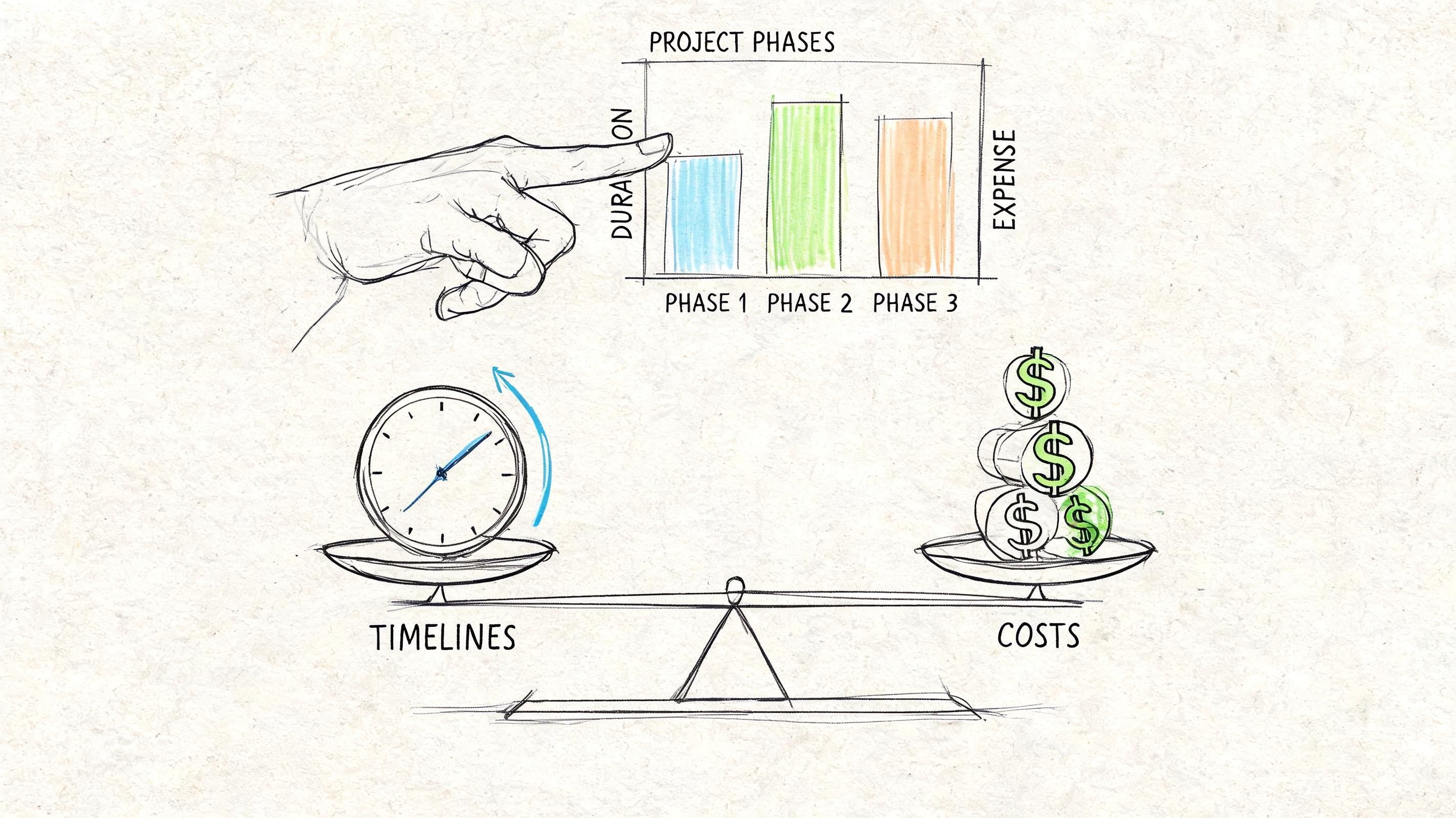
Embedded work doesn’t price like generic software because cost is driven by hardware coupling, testing rigor, field risk, and compliance needs. A simple connected device is one thing. A mission-critical regulated device is a different category of work.
Budget ranges you can actually use
The most grounded cost framing is tiered.
According to Research and Markets coverage of the embedded software services market, basic MVPs start around USD 10,000 to 30,000, mid-tier solutions range from USD 40,000 to 120,000, and high-compliance systems for medical or automotive applications typically cost USD 150,000 to 250,000 or more.
Those ranges are useful if you interpret them correctly.
- Basic MVP: Best for proving a concept, testing a narrow use case, or validating a hardware direction.
- Mid-tier solution: Fits industrial devices, smarter connected products, and broader commercial deployments.
- High-compliance system: Necessary when regulation, safety, certification, or mission-critical reliability drive the work.
What actually drives the number
Cost usually moves because of a handful of decisions:
| Cost driver | Budget impact | Executive implication |
|---|---|---|
| Hardware complexity | Higher integration effort | More specialist engineering time |
| Feature scope | More application and system logic | Longer path to release |
| Compliance requirements | More documentation and validation | Greater upfront rigor |
| Testing depth | More time before deployment | Lower risk later |
| Support expectations | More lifecycle planning | Better long-term stability |
Timelines need phases, not wishful thinking
I don’t recommend promising one grand launch date without phase gates. Use staged delivery. Prototype first. Validate integration early. Reserve time for hardware surprises, because they happen.
If you need a broader framework for discussing software budgets with internal stakeholders, this overview on decoding the cost of software development is a practical companion resource.
Cheap embedded development often becomes expensive support, expensive rework, or expensive failure. The invoice isn’t the whole cost.
A better budgeting model asks one question: what level of reliability does the business need? Once you answer that, cost expectations get much clearer.
Future-Proofing Your Embedded System with AI
A connected device can report what happened. An AI-enabled product can help decide what to do next. That’s the shift business leaders should care about.
A significant opportunity isn’t adding a chatbot to hardware and calling it innovation. It’s embedding intelligence where it improves operations, user guidance, diagnostics, support workflows, and decision quality. In some products that happens on-device. In others it happens through connected services around the device. Either way, your embedded strategy starts touching AI systems quickly.
AI adds capability and operational mess
The promise is strong. Better recommendations, smarter service alerts, more adaptive user experiences, and richer data use. The problem is that many teams add AI without governance.
That creates a pile of avoidable problems:
- Prompt sprawl: Nobody knows which prompts are live or why outputs changed
- Parameter confusion: Teams lose track of how models access internal context and data
- Weak traceability: Troubleshooting becomes guesswork because interactions aren’t logged consistently
- Spend drift: AI costs rise subtly until finance asks uncomfortable questions
If your product has any trust-sensitive workflow, security validation matters too. For teams tightening their review process around model-enabled features, this AI penetration testing guide is a useful reference.
What mature AI integration looks like
Mature teams don’t treat prompts as scattered snippets in application code. They manage them as product assets. They version them, review them, log outcomes, and control how AI touches internal systems.
That’s why AI administration tooling matters. The right setup should give your team:
- A versioned prompt vault so product and engineering teams can track changes cleanly
- A parameter manager to control how internal data is passed into model workflows
- Central logging across integrated AI services for debugging, auditing, and quality review
- A cost manager so leaders can see cumulative spend before “experimental” usage turns into a budget issue
If AI is part of your roadmap, don’t bolt it onto an embedded product with ad hoc scripts and scattered prompt text. Building a controlled operating layer around it makes broader AI development services for product teams directly relevant to embedded system planning.
The business call
Don’t settle for a device that’s merely connected. Build one that becomes more useful over time, and do it with enough control that engineering, product, support, and compliance teams can all trust what’s running.
That’s how you future-proof the system. Not with buzzwords. With architecture, governance, and a delivery model built for intelligence from day one.
If you're planning an embedded product, modernizing an existing device, or adding AI to a hardware-driven experience, Wonderment Apps can help you do it without the usual chaos. Their managed projects team brings together product leaders, engineers, designers, and QA to build reliable software systems that scale, and their AI administration toolkit gives teams control over prompt versioning, parameters, logging, and cost visibility. If you want a practical path from connected product to intelligent product, start with a demo and a real technical conversation.