

You’re probably weighing a familiar mobile dilemma. The business wants one polished app experience on iPhone and Android. Finance doesn’t want to fund two separate codebases, two release tracks, and two sets of specialists forever.
That tension is exactly why react native development services keep showing up in boardroom conversations, not just engineering meetings. The appeal isn’t only technical. It’s operational. You get a realistic path to launch faster, manage one product roadmap, and avoid turning mobile into two semi-related businesses.
The newer wrinkle is AI. Leaders now want recommendations, copilots, search, summaries, anomaly detection, and smarter workflows inside the same app. Building those features is possible. Governing them is the harder part. Once prompts, model settings, logs, and cost controls enter the picture, the mobile build stops being just a front-end project and starts becoming an administrative systems project too.
Your App on Every Phone Without Doubling Your Budget
A retail executive approves a mobile initiative. The first plan looks simple enough until the staffing model shows up. One iOS team. One Android team. Separate QA paths. Separate release timing. Separate bug backlogs. The app budget starts behaving like two budgets wearing the same logo.
React Native solves that problem in a way executives can understand. It lets teams build for both major mobile platforms from a shared foundation, which changes the economics of delivery and maintenance. That’s one reason the framework has become so hard to ignore.
React Native reached 4 million weekly downloads as of React Conf 2025, which was double the volume from 2024, and it’s used by over 30,000 companies. It also appears in 14.85% of the top 500 US apps, according to the State of React Native survey. Those numbers matter because they signal something business leaders care about more than hype. Staying power.
Why executives keep leaning toward React Native
- One roadmap, not two. Product leaders can prioritize features once instead of negotiating platform-by-platform tradeoffs every sprint.
- Shared user experience decisions. Design systems, navigation patterns, and analytics instrumentation are easier to keep aligned.
- Easier modernization. Teams can add new capabilities without rebuilding the product organization around separate mobile stacks.
Practical rule: If your app’s value comes from customer experience, workflow speed, content delivery, or account access, your first budgeting question shouldn’t be “iOS or Android?” It should be “Why are we paying twice for the same product idea?”
That said, building the first version is only half the decision. The more ambitious roadmap now includes AI inside the app itself. That means leaders need a vendor that can do more than ship mobile screens. They need one that understands model integrations, prompt governance, and the controls required to keep AI useful, observable, and affordable after launch.
Unpacking React Native Development Services
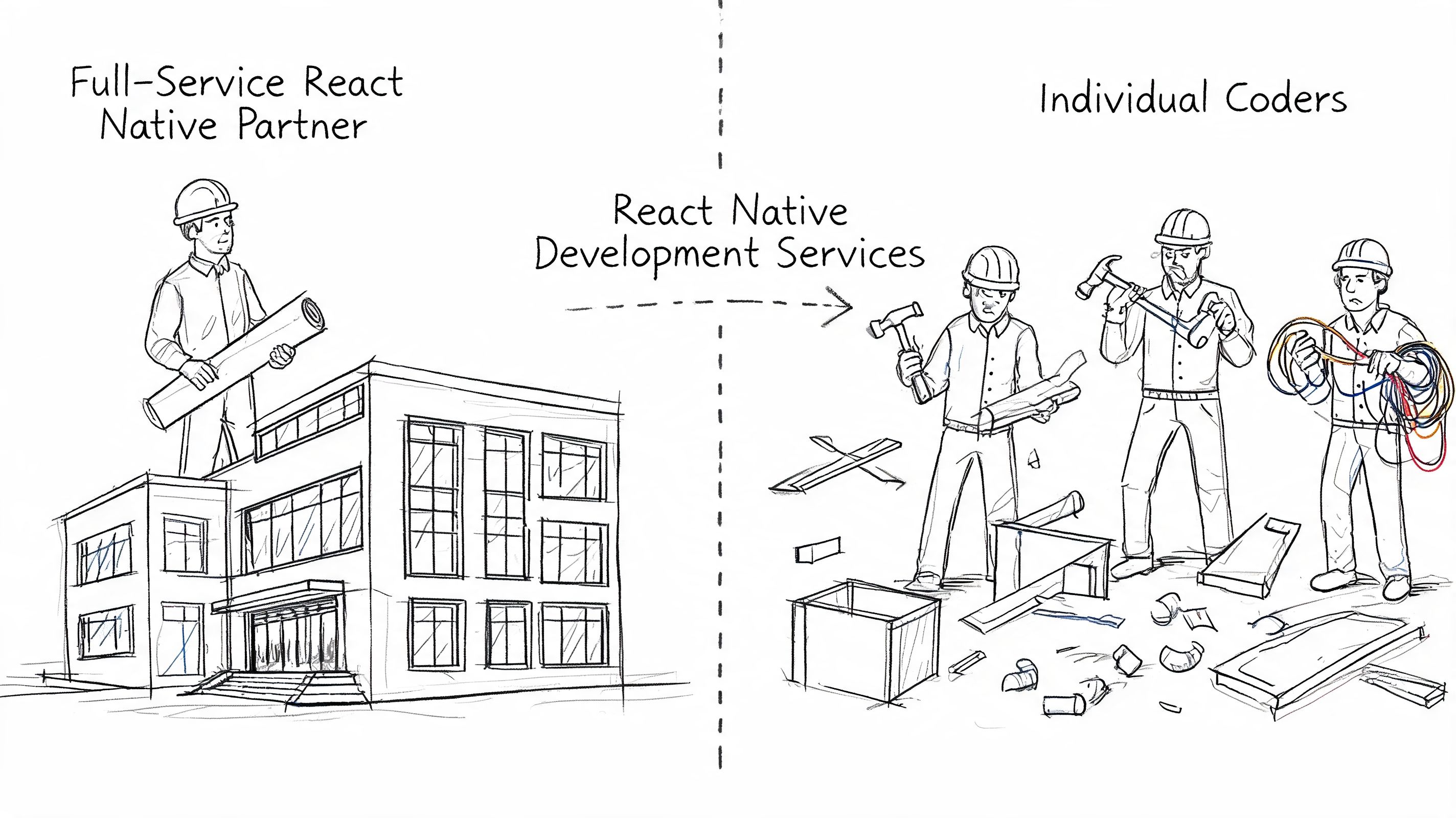
“Development services” sounds like coding hours on a proposal. In practice, a good service partner works more like a general contractor for a building project. You don’t hire framers, electricians, and inspectors separately if you want a predictable outcome. You hire a team that coordinates the whole job.
That’s how react native development services should be evaluated. You’re not buying screens. You’re buying a delivery system.
What a full-service engagement actually includes
A serious partner usually covers work in several layers:
- Product strategy and scoping. Feature prioritization, platform requirements, dependency mapping, release planning.
- UX and UI design. Shared design systems, native-feeling interaction patterns, accessibility, and handoff assets.
- Application engineering. React Native front end, backend APIs, auth flows, third-party integrations, analytics, and notifications.
- Quality assurance. Functional testing, regression checks, device coverage, app store readiness, and release validation.
- Post-launch support. Performance tuning, OS update compatibility, crash investigation, feature iteration, and maintenance planning.
If you want a useful framework for evaluating stacks before hiring, Wonderment’s overview of best app development frameworks is a practical place to start.
Where the ROI actually comes from
The core business case is code reuse. React Native services can deliver 70-90% code reusability across iOS and Android, which can lead to 40-60% cost savings and 2-3x faster iteration cycles than building two separate native apps, based on production benchmarks discussed by Iterators.
Those benefits are not magic. They come from a few very concrete mechanics:
| Service layer | What the team does | Why leadership should care |
|---|---|---|
| Shared codebase | Builds common business logic once | Fewer duplicate implementation costs |
| Hot reloading and rapid iteration | Tests UI changes quickly during development | Faster product feedback loops |
| Unified QA process | Validates one main application surface | Lower coordination overhead |
| Controlled native extensions | Adds platform-specific modules only where needed | Better focus on expensive engineering work |
A weak vendor talks about how fast they code. A strong vendor talks about how they reduce rework.
What this doesn’t mean
React Native services don’t eliminate every native concern. Camera-heavy features, advanced biometrics, and certain hardware integrations may still need custom native modules. That’s normal. The right partner plans for those exceptions instead of pretending they don’t exist.
This is why service quality matters more than framework enthusiasm. A vendor should know when to stay in shared code and when to drop into Swift, Objective-C, Kotlin, or Java to protect performance and reliability.
The Core Business Advantages of React Native
Leaders rarely get in trouble for choosing the most elegant framework. They get in trouble for choosing a delivery model that burns budget, delays launch, and leaves the organization with a maintenance mess.
React Native tends to earn executive support because the upside is legible in business terms.
Faster market entry
A shared mobile foundation helps teams release sooner because product, design, and engineering can move through one coordinated workflow instead of splitting the backlog into iOS-first and Android-later decisions.
That matters beyond launch day. It affects how quickly your team can test pricing changes, loyalty features, onboarding flows, and retention ideas. The company that learns faster usually competes better.
If mobile launch is only part of the growth plan, this practical guide to app marketing is useful because it connects product timing with acquisition and retention planning.
Less organizational drag
Running two mobile teams isn’t just more expensive. It creates management friction.
- One backlog keeps prioritization cleaner.
- One primary implementation path reduces alignment meetings.
- One mobile partner often means fewer handoff failures between design, QA, and release management.
Executives are often the first to feel the benefit. Fewer duplicated conversations. Fewer “that feature works on one platform but not the other” surprises.
More efficient use of specialized talent
Native specialists are still valuable, especially for platform-specific work. But many businesses don’t need two large mobile departments to support their app strategy. They need one strong cross-platform team with the ability to extend into native where necessary.
That staffing shape is usually easier to sustain over time, especially when the app roadmap includes backend integrations, analytics, experimentation, and AI capabilities.
Simpler maintenance economics
A unified codebase changes the cost profile of updates. Security patches, interface changes, and feature refinements are easier to coordinate when the core logic lives in one place.
Good mobile economics come from reducing duplicate decisions, not just duplicate code.
Better alignment with modernization work
React Native is also attractive when the app is only one piece of a broader platform upgrade. If your company is modernizing ecommerce, fintech workflows, member portals, content delivery, or service operations, mobile can’t become an isolated rebuild. It has to fit into the larger architecture.
That’s where React Native often pulls ahead strategically. It supports a modern front-end experience without forcing the company to create two separate mobile modernization programs.
Choosing Your Path React Native vs The Alternatives
Most executive stack decisions come down to three realistic paths. Build fully native apps for iOS and Android. Build with React Native. Or choose a lighter hybrid approach, often for broad reach or speed in simpler use cases.
None of these options is universally right. Each one makes a different promise, and each one creates a different set of obligations.
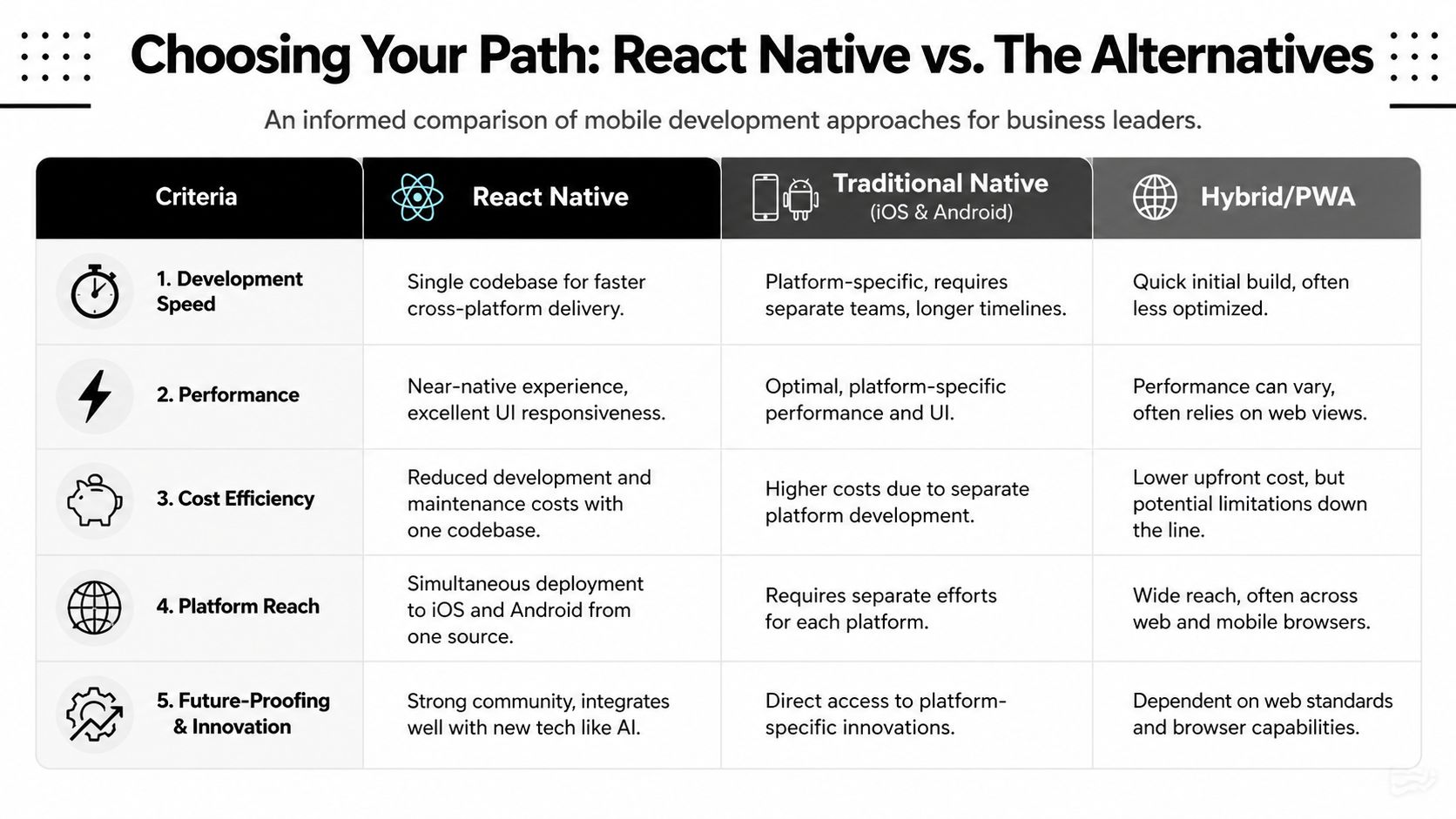
For a broader strategic view, this breakdown of native vs cross-platform mobile development is a useful companion when you’re weighing organizational fit, not just technical taste.
React Native versus fully native
Fully native development is still the right answer for some products. If your app lives or dies on tight hardware integration, advanced graphics, or extreme platform-specific optimization, Swift on iOS and Kotlin on Android may be worth the cost.
But native comes with permanent duplication in staffing, release management, and feature implementation. That can be justified for a few categories of app. It’s hard to justify for most commerce, media, SaaS, healthcare access, and service workflow products.
Consider this from a practical perspective:
| Option | Best fit | Main trade-off |
|---|---|---|
| React Native | Businesses that want strong mobile UX with shared delivery economics | Some native work still needed for edge cases |
| Traditional native | Performance-critical or hardware-heavy products | Higher long-term cost and coordination load |
| Hybrid/PWA | Simpler apps, broad browser reach, lower initial complexity | More limits on mobile experience and device capability |
React Native versus Flutter
This is the comparison leaders usually ask about first. Flutter has real momentum and a large ecosystem. React Native remains highly credible, especially in enterprise contexts.
According to Nomtek’s Flutter vs React Native analysis, a 2021 survey placed Flutter at 42% adoption and React Native at 38% globally, while professional developers in 2023 were nearly tied at 9.21% and 9.14%. The same source states React Native is used in 49% of the top-500 US applications, which is a meaningful signal for leaders who care about production reliability in demanding environments.
How to make the call
Ask four questions, in this order:
Does the app need elite platform-specific performance, or just excellent performance?
Most businesses need excellent.Will the company support separate mobile teams for years?
If not, don’t choose an operating model that assumes it.How important is ecosystem familiarity?
React Native often fits well when teams already work in JavaScript or TypeScript-heavy environments.Is AI modernization part of the roadmap?
If it is, the mobile framework needs to fit a larger integration plan involving APIs, model orchestration, analytics, and governance.
The wrong comparison question is “Which framework wins?” The better question is “Which delivery model fits the business we actually run?”
Where hybrid and PWA approaches fit
Hybrid and PWA approaches can be sensible for content-first, low-complexity products, internal tools, or early validation. They can also become a ceiling if the roadmap grows into advanced personalization, offline behavior, richer device features, or app-store-centered customer acquisition.
That’s why the choice should reflect your likely second and third year of mobile product strategy, not just the first release.
Future-Proofing Your App with AI Modernization
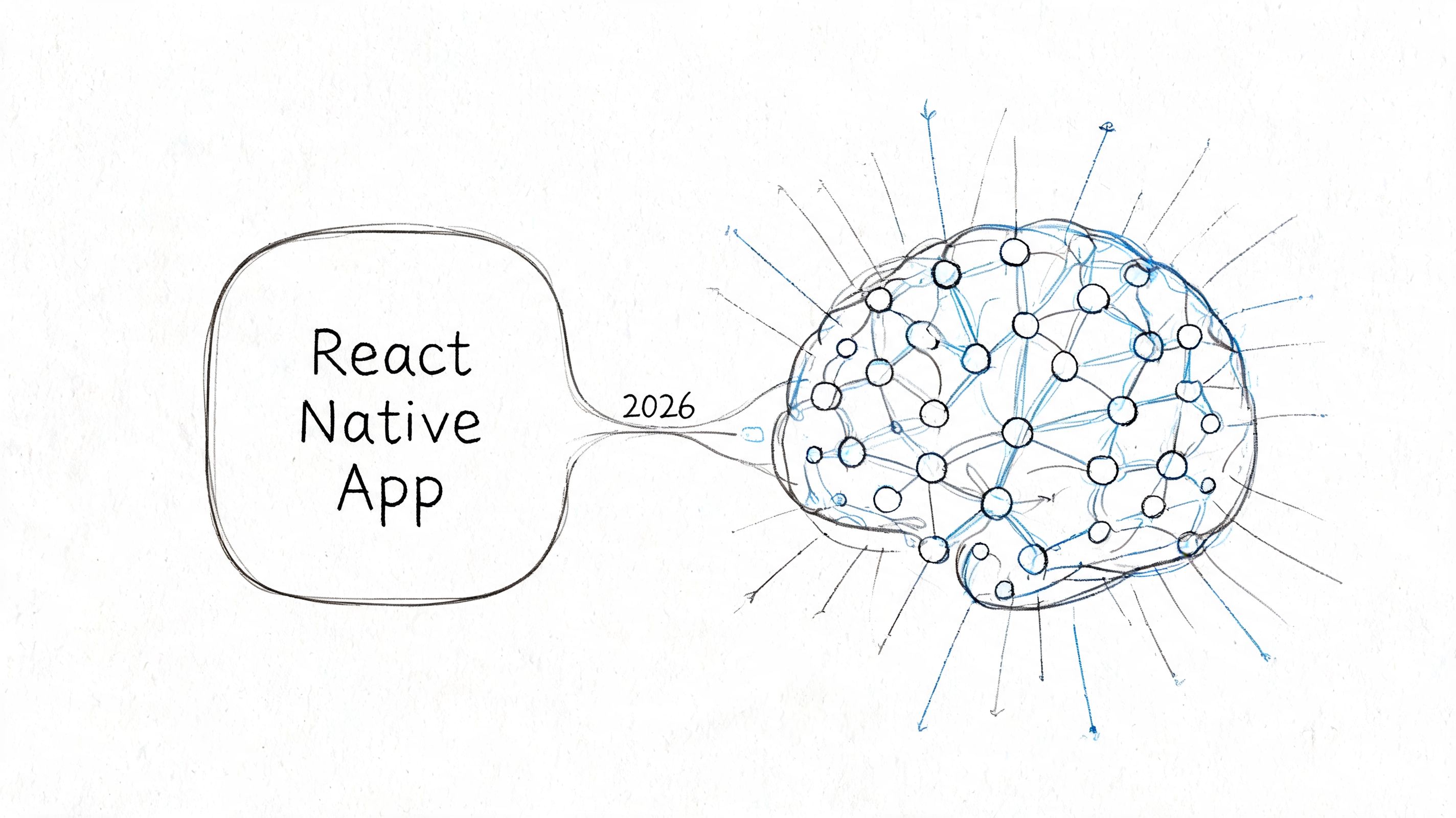
The most interesting React Native projects in 2026 aren’t just shipping mobile interfaces. They’re turning apps into intelligent operating surfaces for personalization, support, search, recommendation, and workflow automation.
That shift changes how leaders should think about mobile investment. The app is no longer just the destination. It becomes the delivery layer for model-powered experiences.
Why React Native fits AI-enabled products
React Native works well for modernization because it sits comfortably between business logic, mobile UX, and service integration. Teams can connect recommendation engines, AI-assisted search, chat interfaces, summarization, or operational copilots without rebuilding the mobile estate from scratch.
That matters for companies with existing systems. A retailer may want AI-guided product discovery. A healthcare organization may need structured intake support and compliant user flows. A SaaS company may want in-app assistant features tied to account context. In all three cases, the mobile app becomes more valuable when it acts as a smart front door to a broader data environment.
The opportunity is real, but so is the mess
There’s strong demand for this direction. As of 2026, 73% of ecommerce firms are actively seeking React Native and AI hybrid apps, but 51% face significant integration hurdles with prompt management and cost control. The same source notes that recent framework updates enable on-device AI that can reduce latency by 65%, as covered by Itransition’s React Native overview.
Those numbers point to a very practical truth. Adding AI is not just a feature decision. It creates governance work.
Common friction points show up fast:
- Prompt sprawl. Teams start with a handful of prompts and end up with dozens of production variants spread across features and environments.
- Weak observability. Product teams can’t easily trace which prompt, model setting, or fallback behavior produced a bad output.
- Escalating spend. AI costs drift when there’s no clean view into usage by feature, tenant, or workflow.
- Compliance exposure. Regulated teams need logging, version control, and clear administrative boundaries around model behavior.
AI features fail less often because the model is weak and more often because the operating controls are sloppy.
On-device AI changes the design conversation
Lower-latency inference opens new possibilities for recommendation experiences, ranking behavior, and contextual interactions inside the app. But it also raises product questions. Which decisions should happen on-device? Which need server-side orchestration? What gets logged? What gets versioned? What must remain auditable?
That’s why the modernization conversation has moved beyond “Can we add AI?” A better question is “How will we manage AI inside a production mobile system without creating chaos for engineering, finance, and compliance?”
How to Choose the Right React Native Development Partner
Most vendor evaluations over-focus on launch. Nice portfolio. Clean demo. Confident sales call. That’s not enough.
The real test is whether the partner can keep the app healthy after the first release, especially if you operate in fintech, ecommerce, healthcare, media, or another environment where updates, integrations, and compliance never stop.
The post-launch reality check
The vulnerabilities of weak partners become apparent. A 2025 survey found 42% of React Native users in fintech face scalability issues after 12 months, and Q1 2026 data shows a 27% higher crash rate post-update for ecommerce apps with unaddressed bridge overhead, according to Blanmo’s overview of React Native app development services.
That doesn’t mean React Native is fragile. It means undisciplined implementation is expensive.
If you’re also deciding how much capability to keep internal versus outsource, this perspective on choosing between in-house and agency is helpful because the underlying decision logic applies well beyond marketing teams.
Vendor evaluation checklist
If you’re hiring for react native development services, ask questions that expose operating maturity.
| Area of Evaluation | Key Question to Ask | What a Good Answer Looks Like |
|---|---|---|
| Architecture | How do you decide what stays in shared code versus native modules? | They describe a clear method, not a blanket preference |
| Scalability | What changes after launch when user volume grows? | They talk about profiling, monitoring, release discipline, and backend coordination |
| Regulated delivery | How do you handle healthcare, fintech, or sensitive user data workflows? | They discuss compliance-aware design, logging, update procedures, and review processes |
| QA and releases | What is your process for OS updates and regression prevention? | They explain device testing, automation strategy, release checklists, and rollback planning |
| AI readiness | How do you manage prompts, logs, and model-related controls inside a mobile product? | They treat AI operations as an administrative system, not an experimental add-on |
| Support model | Who owns issues after launch? | They define response expectations, maintenance scope, and governance clearly |
For businesses comparing service models, Wonderment’s guide to mobile app development services offers a useful lens on what to expect from a full delivery partner.
What to listen for in the answers
A good partner talks concretely about failure modes. They’ll mention release regressions, native dependency conflicts, app store review issues, crash triage, and long-term support planning. That’s a healthy sign.
A weaker partner stays at the portfolio level and keeps returning to visual polish or feature velocity. Those matter, but they don’t protect the product six months after launch.
Choose the team that sounds like they’ve cleaned up hard production problems before.
Red flags worth taking seriously
- They can’t explain maintenance ownership
- They wave away native module complexity
- They treat AI as a plug-in feature instead of a governed system
- They have no clear answer for regulated workflows
- They promise fixed certainty on evolving products without discussing change management
The partner you want is not just a builder. It’s a team that can act like a long-term architect.
The Wonderment Solution Managing AI Complexity with Ease
Once AI enters a mobile product, the work expands beyond app development. Teams need controls around prompt versioning, model parameters, logging, and spend. Without those controls, the organization ends up with feature teams improvising their own AI operations inside production software.
One option in this category is Wonderment Apps. The company offers an administrative prompt management system designed for software teams modernizing apps with AI.
What the tool is built to handle
The system includes four practical components:
- Prompt vault with versioning so teams can manage prompt history, revisions, and release-safe changes without losing track of what’s in production.
- Parameter manager for internal database access so developers can control how app features interact with business data and model inputs.
- Unified logging across integrated AI systems so teams can review outputs, trace behavior, and support governance needs.
- Cost management dashboard so entrepreneurs and operators can monitor cumulative AI spend instead of discovering overruns after the fact.
That matters because AI complexity usually lands in places most mobile estimates don’t cover. Product wants experimentation. Engineering wants consistency. Finance wants cost visibility. Compliance wants logs and accountability. If no one builds the administrative layer, all four groups end up frustrated.
Where this fits in a React Native program
A React Native app can be the customer-facing surface for AI-powered features. The prompt management layer sits behind it as an operational control plane. That combination is useful when the roadmap includes assistants, recommendations, content generation, search refinement, or internal staff tools.
The important distinction is simple. Building AI into an app is one task. Managing AI responsibly across an app’s lifecycle is another.
If your roadmap includes mobile modernization plus AI integration, it’s worth scheduling a demo of the tool before your teams hard-code prompt logic into scattered services and dashboards.
Your React Native Questions Answered
What does a typical React Native project team look like
A balanced team usually includes a product manager or delivery lead, a UX or product designer, React Native engineers, QA support, and backend or integration engineers when the app connects to existing systems. For projects with specialized requirements, teams may also add native iOS or Android support for platform-specific modules.
The exact mix should reflect your product risk. A content app, a healthcare workflow app, and an AI-enabled retail app don’t need the same staffing shape.
How are react native development services usually priced
Three common models show up most often.
- Fixed-price works best when scope is stable, requirements are well-defined, and change is tightly controlled.
- Time and materials fits evolving products where discovery continues during delivery.
- Dedicated team is usually the best fit for organizations treating mobile as a long-term product capability rather than a one-time build.
Executives should focus less on the cheapest model and more on which model matches product uncertainty. Mismatch there is what usually causes frustration.
How long does a React Native project take
Timelines depend on product complexity, integration depth, regulatory requirements, and how much design and discovery work happens before coding starts. A lightweight MVP can move quickly when scope is disciplined. A full enterprise app takes longer when identity systems, backend modernization, analytics, AI workflows, and compliance reviews are all part of the same program.
The better vendor answer is not a fast number. It’s a schedule built around milestones, dependencies, and decision points.
Is React Native a good fit for enterprise apps
Yes, often. The better question is whether the implementation approach is enterprise-ready. Enterprise apps need release discipline, testing strategy, security review, performance profiling, observability, and a plan for post-launch support. The framework can support that. The vendor still has to deliver it.
When should you avoid React Native
Skip it when the app depends heavily on deep platform-specific features, highly specialized graphics performance, or product requirements that strongly favor separate native implementations. Also skip it if the organization has already committed to a mature native operating model and sees strategic value in keeping platforms independent.
What should executives ask on the first vendor call
Ask how they handle architecture decisions, native extensions, release management, post-launch maintenance, AI governance, and ownership of production incidents. If the answers stay abstract, keep looking.
If you’re planning a mobile build or modernizing an existing product with AI, Wonderment Apps can help you evaluate the right delivery model, shape a scalable React Native roadmap, and review tooling for prompt management, logging, and cost control before complexity spreads.