

When you're weighing staff augmentation vs managed services, it boils down to a simple question: Do you need more hands on deck, or do you need to offload a result? Staff augmentation lends you people to direct, while managed services delivers outcomes you don’t have to worry about. The right choice hinges entirely on whether you need direct command over individual talent or a hands-off, results-driven partner for a specific business function.
But in today’s world, there's a new twist. No matter which model you choose, you're likely building AI into your applications. This means you need more than just developers; you need a strategy to manage the complexity AI brings. At Wonderment Apps, we've seen this firsthand and built a prompt management system to help developers and entrepreneurs plug AI into their software and modernize it for the future. We'll touch on how the right tools can supercharge either model a bit later.
Choosing Your Tech Partnership Model
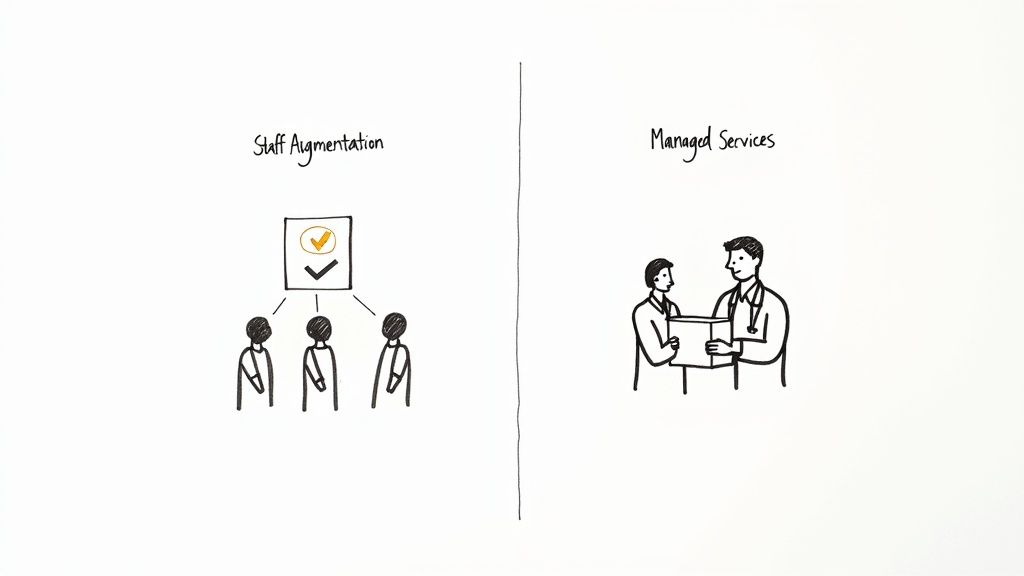
Deciding how to build or scale your development team is one of those pivotal moments for any business. The debate between staff augmentation and managed services forces you to take a hard look at your own team's capabilities, your project goals, and just how involved you want to be. One path gives you tactical control; the other offers strategic freedom.
Think of staff augmentation as hiring a specialist who temporarily joins your crew. You get the precise skills you're missing, and they slot right into your existing team and workflows. You manage their tasks, set their priorities, and you're ultimately the one responsible for the project's success. When you go this route, knowing how to hire software developers is key to making sure they integrate smoothly.
Managed services, on the other hand, is like outsourcing an entire department. You define the objective—"maintain our cloud infrastructure" or "build this mobile app"—and the provider takes full responsibility for delivering that result. They bring their own team, their own processes, and their own tools, all operating under a Service Level Agreement (SLA) that guarantees performance.
Quick Look Key Differences at a Glance
This choice isn't just about hiring; it shapes your budget, risk profile, and day-to-day operations. The decision often comes down to whether you're trying to fill a temporary gap or outsource a complete business function. To make it clearer, here’s a quick breakdown of the core differences.
| Factor | Staff Augmentation | Managed Services |
|---|---|---|
| Control | High. You directly manage the talent and their tasks. | Low. You manage the outcome, not the day-to-day work. |
| Responsibility | Internal. Your team is accountable for the project outcome. | External. The provider is accountable for delivering agreed-upon results. |
| Cost Model | Variable. Typically based on hourly or daily rates for individuals. | Fixed. Predictable monthly or project-based fees for a service. |
| Integration | Deep. Individuals become part of your internal team culture. | Shallow. The provider's team works as a separate, external unit. |
These models aren't new, and businesses have been using both for years depending on their needs. Since the early 2010s, over 60% of enterprises have increasingly favored managed services for long-term IT management. In contrast, staff augmentation saw a 40% surge in contracts during the 2020 pandemic as companies needed to scale their teams fast without adding permanent headcount.
Both are perfectly valid ways to bring in outside expertise. The right call depends on having a crystal-clear understanding of your project's scope, its duration, and exactly how much control you want to keep. For a deeper dive into your options, check out our guide comparing in-house tech hiring vs bringing in burstable partners.
Comparing Core Operational Differences
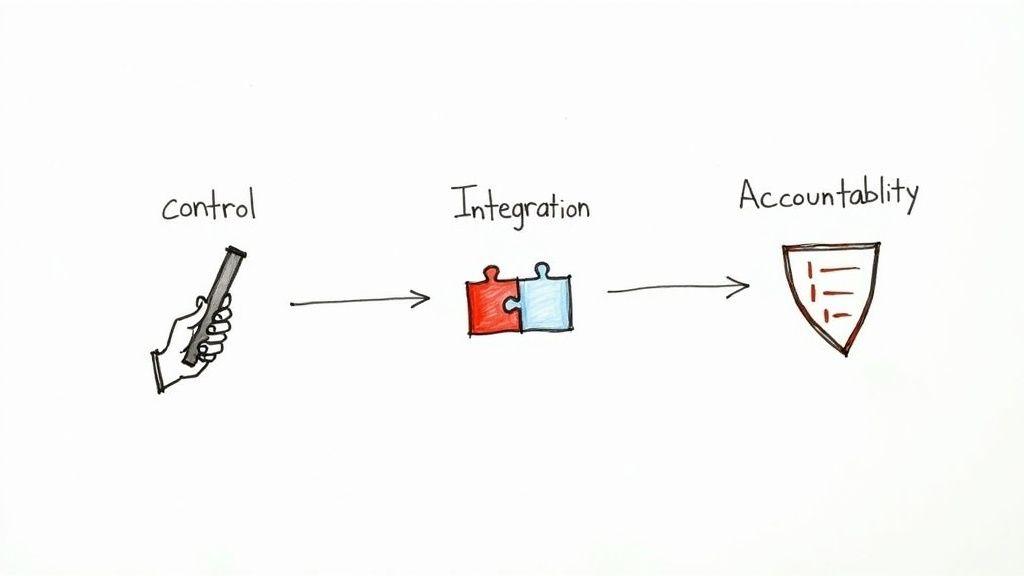
Once you get past the definitions, the real differences between staff augmentation and managed services show up in the day-to-day grind. The model you choose will ripple through everything from who runs the project meetings to who carries the weight if things go south. Nailing these operational details is crucial if you want a partnership that actually fits your workflow and business goals.
This is where "more hands" versus "outsourced outcome" gets real. One approach drops new talent right into your existing team, while the other builds a self-contained unit to handle a specific function. Let’s look at the three operational areas that really set these two apart.
Control and Governance
The most telling difference is simple: who's in charge?
With staff augmentation, you’re still driving the car. The new team members report directly to your managers, join your daily stand-ups, and live by your internal rules. You assign their tasks, manage their workload, and make sure their work hits the project milestones.
This kind of direct control is perfect for companies that have strong internal leadership but are missing a few key skills. It's like adding a specialized tool to a toolbox you already know how to use. Digging into the pros and cons of IT staff augmentation can help you decide if this hands-on style is right for you.
Managed services, on the other hand, is all about delegating authority. You hand over the "how" to the provider. Your role shifts from task management to high-level oversight, making sure they’re hitting the metrics defined in a Service Level Agreement (SLA).
The core trade-off is clear: staff augmentation gives you direct control over people and process, while managed services give you control over results and performance metrics. Choosing incorrectly can lead to either micromanagement headaches or a frustrating lack of visibility.
Team Integration and Culture
How new talent meshes with your current team is another critical factor. Augmented staff are meant to slot right into your company culture, even if it’s just for a short time. They work shoulder-to-shoulder with your full-time employees, contributing to the same projects and joining the same team meetings.
This deep integration fuels direct collaboration and lets knowledge flow freely. An augmented developer isn't just closing tickets; they become part of the team's DNA, soaking up your company’s unique way of doing things.
A managed services team, however, stays separate. They operate as their own unit, complete with their own project manager, tools, and Slack channels. They'll connect with your team at specific touchpoints, but they aren't there to blend into your company culture. Their job is to deliver a result, not become a part of your internal work family.
Risk and Accountability
So, where does the buck stop? In a staff augmentation model, the accountability for success or failure lands squarely on your shoulders. The provider’s job is to give you skilled people; your job is to manage those people to get the project across the finish line. That includes everything from planning and execution to QA and security.
With managed services, the provider takes on a huge chunk of that risk. Because you’re paying for an outcome, they are on the hook for hitting the deadlines, staying on budget, and meeting the quality standards in the SLA. If the project isn't meeting those targets, it’s their problem to solve.
This shift in accountability is a key factor. Augmentation offers incredible flexibility for short-term needs—letting you scale teams by 50-100% in just a few weeks. Meanwhile, managed services provide stability and better compliance, with 65% of enterprises reporting improved outcomes under this model. It’s an attractive option for businesses that want to de-risk a complex or non-essential project.
Analyzing the Financial Implications and ROI
Money talks, and when you’re deciding between staff augmentation and managed services, your budget is often the loudest voice in the room. But here’s the thing: the sticker price rarely tells the full story. To make a smart financial decision, you have to look past the hourly rates and dig into the Total Cost of Ownership (TCO) for each approach.
One model is a variable expense tied directly to time, while the other is a predictable cost tied to specific outcomes. Their financial DNA is just wired differently. Staff augmentation works on a time-and-materials basis, usually billed hourly or daily. Managed services, on the other hand, typically operates on a fixed, recurring fee—often monthly—pegged to clear deliverables and Service Level Agreements (SLAs).
Unpacking the Costs of Staff Augmentation
On the surface, staff augmentation pricing seems simple: you pay an hourly rate for a developer. But this simplicity can be a smokescreen for several hidden costs that creep into the budget.
- Management Overhead: Your project managers and team leads have to spend a significant amount of their time onboarding, training, and supervising the augmented staff. This is a real cost to your business, even if it doesn't show up on the vendor's invoice.
- Knowledge Transfer: What happens when the contract ends? All the project-specific knowledge that developer has accumulated can walk right out the door. Documenting their work and getting your permanent team up to speed takes time and money.
- Tooling and Infrastructure: Your augmented team members need access to your development environments, software licenses, and hardware. These all add up and contribute to the real TCO.
These indirect costs can quietly inflate the true price of staff augmentation far beyond the initial quote. To effectively reduce software development costs, you have to account for these hidden factors, not just the attractive hourly rate.
Evaluating the Managed Services Model
Managed services bring a welcome predictability to your budget. The fixed-fee pricing simplifies financial planning, as that monthly payment covers the entire service—the team, tools, management, and the guaranteed results outlined in the SLA. This structure effectively hands the financial risk of delays or inefficiencies over to the provider.
The value isn't just about the work getting done; it's also about what your own team is freed up to do. By outsourcing an entire function, your core employees can focus on high-impact, strategic work that directly grows the business. For a deeper dive into how these project costs are structured, understanding the full cost of software development can give you some valuable perspective.
The core financial trade-off is paying for time versus paying for results. Staff augmentation bills for hours worked, making your team responsible for turning that time into value. Managed services bills for a guaranteed outcome, placing the responsibility for efficiency and delivery on the provider.
To see how this plays out, let's look at a hypothetical six-month project under both models.
Project Cost Breakdown: A Comparative Scenario
This table provides a comparative cost analysis for a hypothetical 6-month software development project, illustrating the Total Cost of Ownership (TCO) for both staff augmentation and managed services.
| Cost Factor | Staff Augmentation Example | Managed Services Example |
|---|---|---|
| Direct Labor Costs | $180,000 (2 developers @ $150/hr for 6 months) | Included in the fixed fee |
| Internal Management | $25,000 (20% of a manager's salary) | Included in the fixed fee |
| Recruitment/Onboarding | $5,000 (Internal HR time and setup) | $0 (Handled by provider) |
| Tooling/Licenses | $3,000 (Access to internal systems) | Included in the fixed fee |
| Service Fee | N/A | $200,000 (Fixed project fee) |
| Total Cost of Ownership | $213,000 | $200,000 |
As you can see, while the direct labor cost for staff augmentation might appear lower at first glance, the TCO can easily climb and even surpass that of a managed service once you tally up all the associated expenses.
Ultimately, figuring out your true ROI means weighing these total costs against benefits like faster speed-to-market, reduced project risk, and the immense strategic value of letting your internal team focus on what they do best.
When to Choose Each Model for Your Project
The whole staff augmentation vs. managed services debate isn’t about which model is universally "best." It’s about finding the best fit for your specific situation. The right choice becomes obvious when you align it with your project's DNA—its scope, timeline, and how much control you absolutely need to keep in-house. The signals are always there; you just have to know what to look for.
Think of it this way: staff augmentation is like hiring a world-class session musician to play a complex solo on your band's new album. You provide the sheet music and creative direction, but you need their specific, high-level skill to nail that one part. Managed services, on the other hand, is like hiring an entire orchestra to compose and perform the film score for you. You just provide the high-level emotional cues.
This decision tree can help visualize the key factors that point you toward one model or the other.
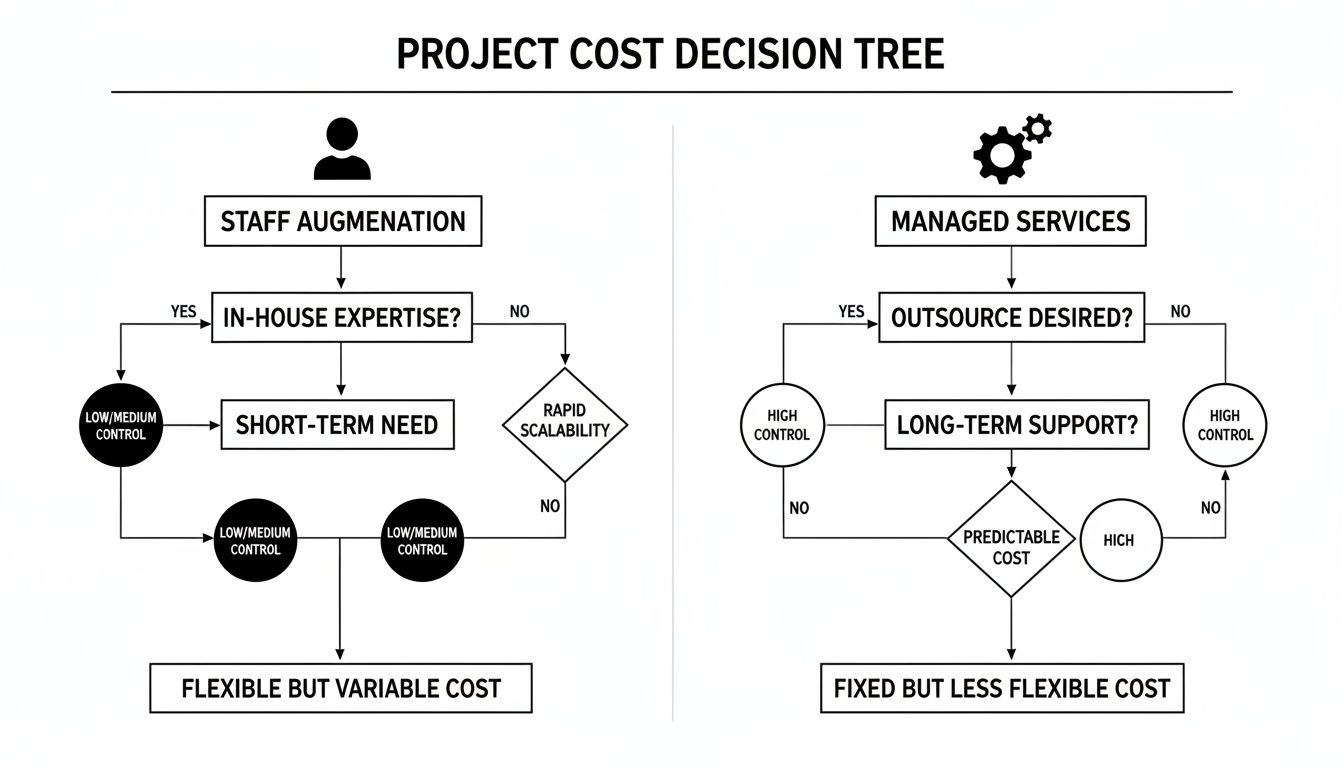
As the graphic shows, how you balance your need for control, specialized skills, and long-term management will ultimately drive your decision.
Scenarios Where Staff Augmentation Is the Clear Winner
Staff augmentation really shines when control and tight integration are non-negotiable. It’s the go-to solution for companies that already have a strong project management framework but are facing a specific, temporary resource gap.
Consider these common situations:
- Filling a Niche Skill Gap: Your team is building an AI-powered recommendation engine but lacks a senior machine learning engineer with deep experience in natural language processing. Augmentation lets you bring that one expert in for the six months you need them, without disrupting your existing team structure.
- Accelerating to Meet a Tight Deadline: You're two months from a critical product launch, and development velocity just isn't cutting it. Adding two senior backend developers through staff augmentation can provide the burst of speed you need to hit the release date.
- Protecting Proprietary Code: For projects involving highly sensitive intellectual property or core business logic, you want development kept as close as possible. Augmented staff work inside your systems, under your direct supervision, ensuring your IP never leaves your control.
The core idea behind choosing staff augmentation is simple: you pick it when you have the "what" and "how" figured out but are just missing the "who." It’s about adding capacity, not outsourcing your strategy.
Situations Perfectly Suited for Managed Services
Managed services becomes the logical choice when you need to offload an entire function to focus your internal team on what actually drives your business forward. It's about buying a guaranteed outcome, not just renting expertise for a while.
This model is ideal under these circumstances:
- Outsourcing Non-Core Functions: Let's say your team's genius is in developing groundbreaking fintech algorithms, not managing the cloud infrastructure they run on. A managed services provider can take over 24/7 cloud monitoring, security, and maintenance, freeing your brilliant engineers to innovate.
- Executing Well-Defined, Complex Projects: You need to build a new HIPAA-compliant patient portal, but your internal team has zero healthcare tech experience. A managed services partner with a proven track record in healthcare can take the project from concept to launch, assuming all the risk and responsibility for meeting those complex regulatory requirements.
- Gaining Budget Predictability: A startup needs to manage its burn rate carefully. Instead of dealing with the variable costs of hiring and managing developers, they can opt for a managed service with a fixed monthly fee to develop and maintain their mobile app. This creates predictable operational expenses and makes financial forecasting much simpler.
Ultimately, choosing between these two models is a strategic one. By analyzing your project's specific needs for control, expertise, and accountability, you can confidently select the partnership model that will set you up for success.
Future-Proofing Your Strategy with Modern AI Tools

Whether you choose staff augmentation or a fully managed service, one thing is certain: the future of software development is tied directly to artificial intelligence. Staying competitive means equipping your team—whether in-house, augmented, or part of a managed service—with the tools to build, manage, and scale AI features effectively. This isn't just about adding headcount; it's about building a solid foundation for innovation.
But here's the reality: integrating AI isn't as simple as plugging into an API. It introduces a whole new layer of complexity. Suddenly you're dealing with prompt engineering, version control, security, and cost management. Without the right administrative toolkit, even the most talented teams can get bogged down in manual work, inconsistent AI outputs, and runaway expenses. This is a challenge that hits you no matter which staffing model you pick.
Centralizing AI Development for Maximum Impact
This is where a dedicated prompt management system becomes a game-changer. Think of it as the central nervous system for all your AI initiatives. It provides the structure and control you need to graduate from messy experiments to enterprise-grade AI implementation, empowering your team while giving leadership the visibility to make smart decisions.
A robust system, like the one we've built at Wonderment Apps, typically includes a few core components that solve the biggest AI integration headaches:
- A Centralized Prompt Vault: This acts as a single source of truth for all your AI prompts. It allows for versioning, so you can track changes, roll back to previous iterations, and ensure every single developer is using the most effective, up-to-date prompts. No more guesswork.
- A Secure Parameter Manager: To make AI truly powerful, it needs to access your internal data. A parameter manager creates a secure bridge, letting prompts pull in relevant information from your databases without exposing sensitive data or creating security holes.
The real advantage of a modern AI toolkit is consistency. It ensures that whether an augmented developer is working on a feature for three months or a managed service is handling it for three years, the AI's performance, security, and cost remain predictable and under your control.
Gaining Control Over Performance and Spend
Beyond managing prompts, true AI governance requires a clear view into how your models are being used and what they're costing you. This is where logging and cost management become non-negotiable. A comprehensive logging system tracks every interaction across all your integrated AI models, giving you a detailed audit trail for troubleshooting and performance analysis.
At the same time, an integrated cost manager gives you a real-time view of your cumulative AI spend. This allows you to monitor token consumption, forecast expenses, and—most importantly—avoid nasty budget surprises. By putting a tool like this in place, you create a scalable and efficient foundation that helps any team, regardless of its structure, innovate faster and more responsibly.
Once you’ve made the call between staff augmentation and managed services, the real work begins: execution. A great partnership doesn't just happen. It’s built on a deliberate, well-managed transition that sets the tone for everything that follows. Getting this right from day one is the difference between starting strong and stumbling out of the gate.
Whether you're bringing a new developer into the fold or handing the keys to an entire IT function over to a partner, those first steps are everything. With staff augmentation, it’s all about fast cultural and technical integration. For managed services, it’s about establishing ironclad expectations and clear lines of communication.
The Staff Augmentation Onboarding Playbook
Just sending over a login and a link to the repo doesn't cut it. To get real value from an augmented team member, you need to make them feel like part of your team—fast. A structured onboarding process is your best tool for making that happen.
Your playbook should cover a few key areas:
- Cultural and Team Introduction: Don’t just point them to the project manager. Set up quick one-on-ones with the key people they’ll actually be working with. This builds real connections and helps them pick up on the team's unwritten rules and communication style.
- Technical Environment Setup: Have all their access ready before day one. This means code repositories, tools like Slack or Teams, and project management software. Nothing kills momentum like someone sitting around for a week waiting on permissions.
- Clear First Assignments: Give them a small, well-defined task to tackle in their first day or two. This lets them score an early win, learn your codebase and deployment process, and build confidence without feeling buried by a massive feature.
A successful staff augmentation onboarding isn't about ticking boxes on a checklist; it's about genuine integration. The faster your new talent feels like "us" instead of "them," the faster they’ll start delivering real value.
Initiating a Managed Services Partnership
Kicking off a managed services engagement is less about integrating an individual and more about aligning on strategy and process. This provider is your partner, and you’re both working toward a specific outcome. The initial phase is all about defining what success looks like and how you’ll talk to each other along the way.
A strong partnership is built on these pillars:
- Defining the Service Level Agreement (SLA): This document is your rulebook for success. It needs to clearly spell out the key performance indicators (KPIs), required response times, system uptime guarantees, and exactly what happens if those targets are missed.
- Establishing Communication Protocols: Who is the main point of contact on your side and theirs? How often will you have status meetings? What’s the escalation path when something critical breaks? Nailing this down upfront saves a world of confusion and frustration down the road.
- Knowledge Transfer and Discovery: Your new partner needs to get deep into your current systems and processes. This phase involves them digging through your documentation, getting system access, and interviewing your internal subject matter experts.
Key Performance Indicators to Track
You can't fix what you don't measure. The KPIs you focus on will look very different for each model because you're measuring two different things: individual productivity versus overall service outcomes. Picking the right metrics gives you an objective look at performance and helps you hold your partners accountable.
For Staff Augmentation:
- Developer Velocity: Are they keeping pace with the team? Track the story points or tasks they complete per sprint to gauge their productivity and how well they're fitting into your agile workflow.
- Code Quality: Use metrics like bug counts or feedback from code reviews to make sure their work is hitting your team's quality bar.
- Time to First Contribution: How long does it take for a new person to start committing code? This is a fantastic indicator of how smooth your onboarding process really is.
For Managed Services:
- Adherence to SLA: This is the big one. Are they hitting the agreed-upon uptime, response times, and other performance guarantees?
- System Uptime and Reliability: Track the availability of the service they’re running for you. If you’re paying a managed cloud provider for 99.9% uptime, you need to be sure you're getting it.
- Budget Adherence: Is the provider delivering what they promised within the fixed cost? Keep a close eye on any out-of-scope requests to manage your total spend effectively.
Frequently Asked Questions
Even when you have a good handle on the basics, some specific questions always come up when deciding between staff augmentation and managed services. Let's tackle a few of the most common ones we hear from business leaders.
Can I Switch from Staff Augmentation to Managed Services?
Yes, absolutely. It’s not just possible; it's a natural progression for many projects. Most providers that offer one model also offer the other and can help you make the switch. Typically, this happens when a project that needed flexible, embedded talent at the start grows into a stable, long-term function that can be run more independently.
Making that transition work requires some careful planning. The key is a thorough knowledge transfer from your augmented staff to the new managed team. You'll also need a new contract with airtight Service Level Agreements (SLAs). It's always a smart move to bring up this possibility with potential vendors right from the start.
Which Model Is Better for Evolving Project Requirements?
If your project scope is a moving target, staff augmentation almost always offers more flexibility. You're managing the team directly, so you can pivot on a dime, reshuffle priorities, and adapt to new information as it comes in. This makes it a perfect match for Agile development.
Managed services, on the other hand, really shine when the scope and deliverables are locked in from day one. The provider is on the hook to deliver a specific result for a fixed price. Any major changes usually mean kicking off a formal change request process, which can affect your timeline and budget.
It really boils down to agility versus predictability. Staff augmentation gives you the control to make adjustments on the fly, while managed services provides a predictable outcome based on a predefined scope.
How Is Security and Intellectual Property Handled?
Security and IP are handled in two completely different ways. With staff augmentation, the buck stops with you. Your company holds the primary responsibility for both. You'll want any augmented team members to sign your internal NDAs and follow your security protocols to the letter—they are, for all intents and purposes, temporary employees working inside your environment.
In a managed services agreement, the provider takes on a huge chunk of the security responsibility. Your contract needs to spell out their security obligations in detail, including any compliance certifications you require (like HIPAA or SOC 2). It also needs to be crystal clear about who owns the intellectual property created as part of the work.
At Wonderment Apps, we know that building a great application takes the right team and the right tools. Our AI modernization toolkit—complete with a prompt vault, parameter manager, and cost controls—gives any development team, whether augmented or managed, the power to build smarter, faster, and more securely. Book a demo to see how we can future-proof your development strategy.