


When you're building an application, its architecture is the foundational structure that determines if it will be scalable, maintainable, and secure. Think of it as the strategic blueprint that dictates how every component interacts. This isn't just about code; it's the high-level planning that happens before a single line is written, ensuring the system can grow and adapt without collapsing under its own weight. Integrating AI into your application makes this blueprint even more critical, and a strategic tool like a prompt management system can be a game-changer, acting as a pre-built component to modernize your app for AI integration and ensure it's built to last.
Your App's Blueprint Why Software Architecture Matters

Imagine your software architecture as the blueprint for a skyscraper. A solid plan ensures it can stand tall, handle more tenants, and even add new floors without crumbling. In the same way, your app's architecture is the foundation that dictates its performance, scalability, and ability to evolve. It’s what separates an app that buckles under pressure from one that grows right alongside your business.
For any business leader looking to integrate AI, this blueprint is the most critical starting point. A modern architecture isn't just about running smoothly; it's the key that unlocks powerful AI capabilities that can genuinely reshape user experiences and internal workflows.
The Foundation for Future Innovation
Without a strong architectural plan, even the most brilliant features are set up to fail. Those early decisions—how data flows, how services communicate, how the system handles load—have consequences that ripple out for years. Getting it right from the start saves you from costly rewrites and crushing technical debt down the road.
A well-architected system is the unsung hero of every successful application. It’s the invisible framework that ensures speed, reliability, and the capacity for future growth, empowering developers to build great features instead of constantly fighting fires.
A strong foundation makes it fundamentally easier to:
- Scale Efficiently: Handle sudden spikes in user traffic without your performance taking a nosedive.
- Innovate Faster: Add new features or swap out components without breaking the entire system.
- Reduce Downtime: Isolate failures so that one problematic service doesn't bring down the whole application.
- Improve Security: Build security into the core structure from day one, not as a panicked afterthought.
To understand how these concepts come together, it helps to break them down into their core pillars.
The table below outlines the fundamental principles that define a robust, future-proof software architecture.
Core Pillars of Modern Software Architecture
| Pillar | Core Objective | Business Impact |
|---|---|---|
| Modularity | Decompose the system into independent, interchangeable components. | Faster development cycles, easier maintenance, and parallel team workflows. |
| Scalability | Design the system to handle increased load without performance degradation. | Accommodates business growth, manages traffic spikes, and maintains user experience. |
| Observability | Gain deep insights into the system's internal state from its external outputs. | Quicker troubleshooting, proactive issue detection, and better performance tuning. |
| Security | Integrate security measures at every layer of the architecture. | Protects user data, prevents breaches, and builds customer trust. |
Ultimately, a strong architecture is about building for change, ensuring the system you create today can support the business you'll be running tomorrow.
Connecting Architecture to AI Modernization
Today, that blueprint must also account for AI. Integrating artificial intelligence requires a design that can manage complex data pipelines, handle intensive processing tasks, and communicate with external models without a hitch. This is where modern software architecture best practices become non-negotiable.
A specialized tool, like a prompt management system, can act as a pre-built architectural component. It streamlines how your app communicates with AI models and drastically cuts down on development complexity. By plugging in this kind of strategic layer, you're not just adding a feature; you're adopting a component that makes your app smarter, more manageable, and truly ready for the future.
To effectively draft and manage your app's blueprint, leveraging the right architectural design software options can make all the difference. This guide sets the stage for building applications engineered for the opportunities of tomorrow.
The Unbreakable Pillars of High-Performing Architecture
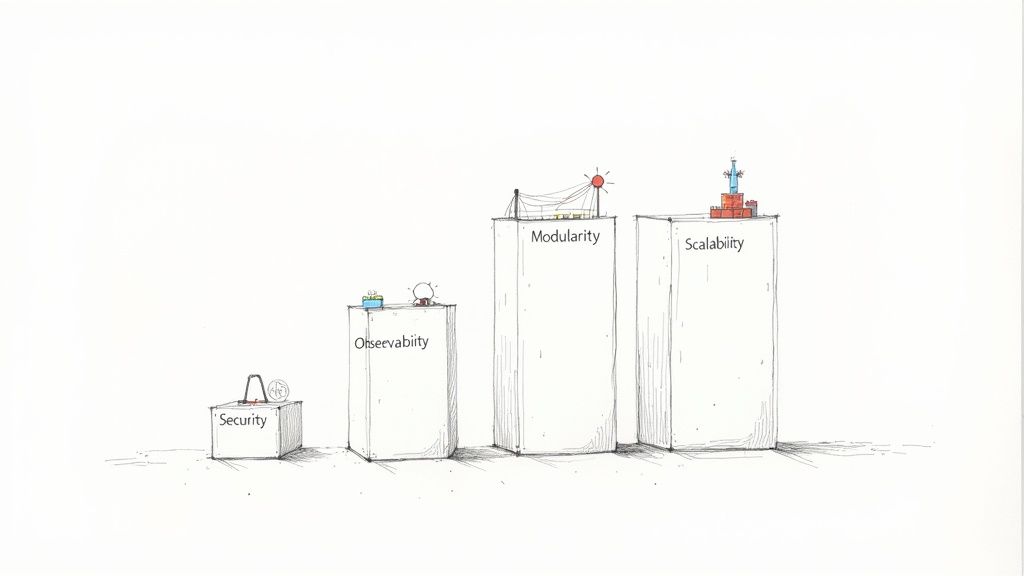
Every great piece of software, whether it’s a simple mobile app or a sprawling enterprise platform, stands on a few foundational principles. Think of these as the non-negotiable pillars holding everything up, ensuring the system is strong, resilient, and ready for whatever comes next. Getting these right is the difference between building something that lasts and something that crumbles.
We’re going to get practical and move past the dry, textbook definitions. Let’s explore the four pillars that truly matter: Modularity, Scalability, Observability, and Security. Each one is directly tied to business results you care about, like shipping features faster, keeping downtime to a minimum, and lowering your risk.
Modularity: Building with LEGOs
Imagine trying to build a complex model car from a single, solid block of wood. If a wheel broke, you’d be in for a world of hurt. Now, picture building it with LEGOs. A broken piece? You just snap it off and replace it, leaving the rest of the car untouched. That’s the core idea behind modularity.
In software, modularity means breaking down a big, monolithic system into smaller, independent components. Each of these "modules" has one specific job and can be developed, tested, and deployed all on its own.
This approach pays off in a few huge ways:
- Faster Development: Different teams can work on their own modules at the same time without tripping over each other.
- Easier Maintenance: When a bug pops up, it’s usually confined to one module, which makes it incredibly fast to find and squash.
- Improved Flexibility: You can swap out an old component for newer technology without having to tear down and rebuild the entire application.
By designing with modularity in mind, you end up with an application that's just plain easier to manage and evolve. It lets your team react to changes in the market with real speed.
Scalability: The Flexible Bridge
Think of scalability like a bridge built with modern, flexible materials. During quiet, off-peak hours, it handles a few cars with no problem. But when rush hour hits, it’s designed to expand its capacity, managing thousands of vehicles without buckling or causing a massive gridlock.
A scalable architecture does the exact same thing for your application. It ensures that as your number of users, data, or requests grows, the performance doesn't tank. A system that can’t scale is the one that crashes the moment your big marketing campaign goes viral—the very moment you need it to work perfectly.
There are two main paths to scalability:
- Vertical Scaling (Scaling Up): This is like dropping a more powerful engine into your car. You beef up a single server with more CPU, RAM, or storage. It’s simple, but you’ll eventually hit a hard ceiling.
- Horizontal Scaling (Scaling Out): This is more like adding more cars to your fleet instead of upgrading one. You add more servers and distribute the workload across them. While a bit more complex to set up, this approach gives you almost limitless room to grow.
For modern applications, especially anything built on the cloud, horizontal scaling is the go-to strategy. It provides the elasticity you need to grow right alongside your user base.
Observability: Your App’s Mission Control
If your application were a spaceship hurtling through the cosmos, observability would be its mission control center. It’s the ability to truly understand what’s happening inside your system just by looking at the data it produces. This goes way beyond old-school monitoring, which might just tell you that something is broken.
Observability gives you the "why." It arms you with the telemetry—logs, metrics, and traces—to ask new and complex questions about your system's state and actually get answers. It's how you diagnose problems before they ever affect a customer.
A system with good observability is built on three key data types:
- Logs: These are the detailed, timestamped diaries of every event that happens.
- Metrics: These are numbers measured over time, like API response times or CPU usage.
- Traces: A trace shows you the entire journey of a single request as it travels through all the different services in your system.
Without strong observability, your team is flying blind. They're left guessing, which leads to longer outages and frustrated users.
Security: The Steel Frame
Last but certainly not least, security can never be an afterthought. It's not a checkbox you tick at the end of a project. In a well-designed system, security is the steel frame of the entire building—integrated from the ground up. It’s a foundational principle that protects your data, your users, and your company’s reputation.
A security-first mindset means embedding best practices throughout the entire development lifecycle. This covers everything from writing secure code and vetting third-party dependencies to properly configuring infrastructure and enforcing strict access controls. Ultimately, building a secure architecture is the only way to earn and keep the trust of your users.
Proven Architectural Patterns for Modern Applications
Once you have a solid handle on the core principles, it’s time to look at the blueprints successful companies use to build for both speed and scale. Think of architectural patterns as battle-tested strategies. They offer repeatable solutions to common problems, saving you from reinventing the wheel and helping you choose the right approach for your project's unique challenges.
This isn't about chasing trends. It's about matching a specific business problem to the pattern that solves it best. We’ll dive into two of the most influential patterns in modern software: microservices and event-driven architecture. By the end, you'll see how these blueprints can give your application a serious competitive edge.
Microservices: The Power of Small, Independent Teams
Imagine a huge factory where every single production line is bolted together. If one tiny machine breaks, the entire factory grinds to a halt. That’s a monolith—a single, tightly coupled application where all the code lives in one massive codebase. They’re simple to start with, but as they grow, monoliths become a nightmare to update, test, and scale.
Now, picture a business park filled with dozens of small, independent workshops. Each one specializes in a single task. If one shop closes for repairs, the others keep humming along without interruption. This is the heart of the microservices architecture.
With this pattern, a large application is broken down into a collection of small, independent services. Each service is built to handle a single business capability, like user authentication, payment processing, or product inventory.
This approach brings some huge benefits to the table:
- Team Autonomy: Small, focused teams can truly own their services, allowing them to develop, deploy, and scale independently of everyone else.
- Technological Freedom: Teams are free to pick the best tech stack for their specific service. No more being locked into a single, company-wide standard that doesn't fit the job.
- Enhanced Resilience: When one service fails, it doesn’t bring down the entire application. The system as a whole becomes far more robust and fault-tolerant.
Of course, microservices come with their own set of challenges, like managing communication between services and keeping data consistent. But for large, complex applications, the gains in development speed and resilience are often too good to pass up. To go deeper, check out our detailed guide on microservices architecture best practices.
Event-Driven Architecture: Reacting in Real Time
Think about how a busy restaurant kitchen works. A waiter places an order (an "event"), which immediately triggers a chain of actions: the kitchen starts cooking, the bar prepares drinks, and the billing system adds the items to the table's tab. Each department reacts to the initial event without needing direct, top-down commands from the others. This is the essence of an event-driven architecture (EDA).
In an EDA, services communicate by producing and consuming events. An event is just a record of a significant change in state, like a "user signed up" or "payment processed." Services don't call each other directly. Instead, one service simply publishes an event to a central message bus, and any other interested services can subscribe and react to it.
This "fire-and-forget" model creates a highly decoupled system where components can operate asynchronously.
An event-driven architecture transforms your system from a rigid, top-down command structure into a dynamic, responsive network. Services don't wait for orders; they react to what's happening in the business right now, enabling true real-time functionality.
This pattern is incredibly powerful for scenarios like:
- E-commerce: A single "order placed" event can trigger inventory updates, shipping notifications, and fraud detection all at the same time.
- IoT Devices: A sensor reading can trigger alerts, data logging, and automated system adjustments without any direct coupling.
- Financial Services: A stock trade event can kick off risk analysis, portfolio updates, and compliance checks simultaneously.
The biggest win here is loose coupling. You can add brand new services that listen for existing events without ever having to modify the original services that produce them. This makes the entire system incredibly flexible and scalable, allowing it to adapt to new business needs with minimal disruption.
And the data backs this up. A 2023 industry analysis found that companies moving from monoliths to modular, event-driven, and microservices-based architectures achieved up to a 60% faster time-to-market for new features. On top of that, teams using these patterns saw their deployment frequency increase by 3–5x and recovery time drop by 30–50%.
Designing AI-Ready Systems for Tomorrow's Innovations
Artificial intelligence isn't some far-off concept anymore; it's a real, tangible part of modern business strategy. But to truly tap into its potential, you can't just staple an AI feature onto your existing application. That's a recipe for failure. Instead, you have to design a software architecture that’s built for AI from the ground up, not just as an afterthought.
This means seriously thinking about how your system will handle the unique pressures of AI, from managing colossal data flows to orchestrating complex machine learning models. A forward-thinking approach ensures your application is not just working today but is primed for the innovations just around the corner.
The diagram below shows this fundamental shift away from a rigid, monolithic structure toward a more flexible, AI-friendly microservices model.
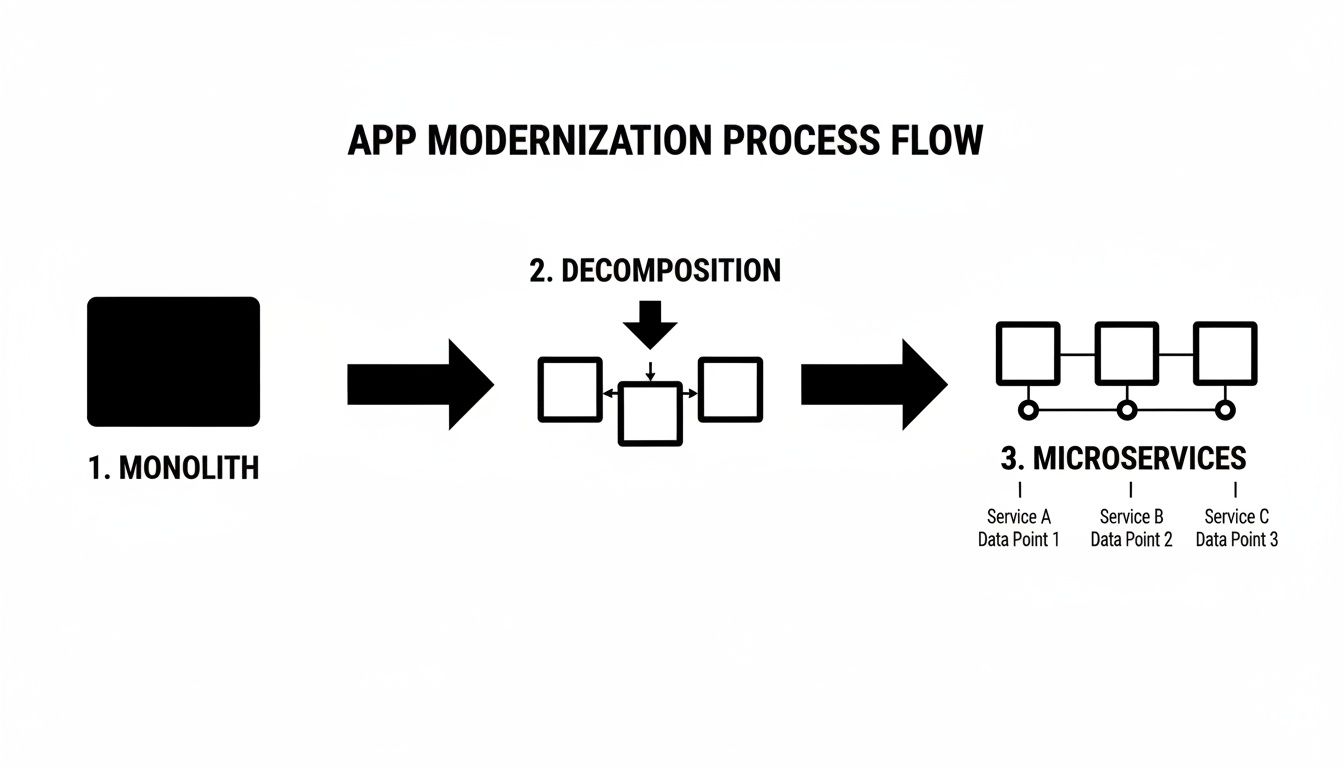
This transition is so critical because it creates the modularity and independence that specialized AI components need to operate effectively.
Connecting AI to Your Proprietary Data with RAG
One of the most powerful patterns for building AI-ready systems is Retrieval-Augmented Generation (RAG). Think of it as giving a powerful, general AI model a direct line to your company's private knowledge base. Instead of only relying on its public training data, the model can pull in real-time, context-specific information from your internal documents, databases, or support tickets.
This is where you can build a massive competitive advantage. By securely connecting a large language model to your proprietary data, you can create features like hyper-personalized customer support bots or internal search tools that give answers based on your actual business, not generic web content. To successfully leverage artificial intelligence, patterns like RAG are essential for creating truly distinct and valuable user experiences.
Building the Plumbing for Real-Time Machine Learning
AI models are only as good as the data they eat. For them to deliver accurate, timely insights, you need the right foundational plumbing to supply them with a constant stream of fresh, real-time data. This is where two key architectural pieces come into play.
- Event-Driven Data Pipelines: These are like automated conveyor belts for your data. When something important happens in your app—a customer adds an item to their cart, for example—an "event" is fired off and sent down a pipeline. This allows machine learning models to react instantly, maybe by generating a personalized recommendation on the spot.
- Feature Stores: Picture a feature store as a central library of pre-calculated data points (features) about your business, like a customer's total spending or their most-viewed product category. It makes this data readily available to any model that needs it, which ensures consistency and dramatically speeds up model development.
By treating data pipelines and feature stores as first-class citizens in your architecture, you build a system that is primed for machine learning. This isn't just about collecting data; it's about making it available, fresh, and useful for intelligent systems.
Adopting these data-centric patterns has a real, measurable impact. Companies that build robust data pipelines and feature stores can slash model deployment times from months to weeks, with some studies citing reductions of 50%–80% in the deployment cycle.
Facing the Infrastructure Demands
Building an AI-ready system also means being realistic about the hardware it needs to run on. Training and operating sophisticated AI models is computationally expensive and often requires specialized hardware that goes way beyond standard CPUs.
This means you have to account for an increased need for GPUs (Graphics Processing Units) or other AI accelerators. As a result, organizations are reporting a 2x–5x increase in their GPU and accelerator spending for AI-native services compared to traditional applications. While that’s a significant investment, it’s balanced by the immense business value unlocked through superior user experiences and the creation of truly intelligent, market-leading products.
Integrating Security and Compliance From Day One
In a world where data breaches are daily news, security can no longer be a feature you bolt on at the end. Treating security as an afterthought is like building a bank and only installing the vault door after you've already filled it with cash. Real-world software architecture demands that security is woven into the very fabric of your application from the first line of code.
This modern approach is often called "shift-left" security, or DevSecOps. The idea is simple but incredibly powerful: integrate security practices as early as possible in the development lifecycle. Instead of waiting for a final security review to catch flaws, you build a system that finds and fixes them automatically and continuously.
Adopting a Zero Trust Mindset
A core philosophy driving this shift is Zero Trust. The old model of a secure network perimeter—a castle with a moat—is completely obsolete. Zero Trust operates on a simple but profound principle: "never trust, always verify." It assumes that threats can come from anywhere, both outside and inside your network.
This means every single request to access a resource must be authenticated and authorized, no matter where it originates. For robust security from the outset, modern approaches like Zero Trust Architecture Design are essential to build a system where trust is earned, not assumed.
Here are a few practical techniques that strengthen your architecture from the inside out:
- Automated Security Scanning: Integrate tools directly into your CI/CD pipeline. These should automatically scan your code for known vulnerabilities every time a change is committed.
- Software Supply Chain Verification: You have to actively verify the open-source libraries and third-party dependencies you use. This ensures they haven't been compromised with malicious code.
- Principle of Least Privilege: Grant users and services only the absolute minimum level of access they need to do their jobs. This drastically limits the potential damage of a compromised account.
Designing for Privacy and Compliance
Beyond preventing active threats, modern architecture has to be designed to protect user data and adhere to regulations like GDPR and CCPA. This isn't just a legal checkbox; it's a critical part of building customer trust.
A key architectural pattern here is data minimization. Just because you can collect data doesn't mean you should. Only collect and store the data that is strictly necessary for a specific, defined purpose. By reducing the amount of sensitive data you hold, you inherently reduce your risk and compliance burden. For a deeper look, explore our guide on application security best practices.
Security isn't a feature; it's a fundamental quality of a well-architected system. By integrating security and privacy from day one, you transform it from a technical checklist into a powerful business advantage that builds trust and mitigates financial risk.
The benefits of this security-first posture are clear and measurable. Organizations that implement shift-left security, supply-chain verification, and Zero Trust principles cut exploitable vulnerabilities in production by an estimated 40%–60%. This is a huge reduction compared to teams that only perform security checks right before release. It’s not just about preventing breaches, either—it’s about the bottom line. Companies with well-integrated DevSecOps practices have significantly lower average breach costs, proving that investing in security early really does pay dividends.
Modernize Your App with a Strategic AI Layer
Putting these software architecture best practices into action is what turns theory into a real path forward. For businesses looking to bring AI into the fold, the big challenge is bridging the gap between an existing application and the world of generative models. This is exactly where a dedicated AI integration layer becomes a game-changing piece of your architecture.
Instead of building all this complex plumbing from the ground up, a specialized tool can handle the hidden difficulties for you. Think of it like plugging a smart, pre-built module into your system that instantly gives it modern capabilities. It's the fastest way to get your AI journey moving without having to go through a complete, and often painful, architectural overhaul.
Your AI Command Center
A dedicated AI integration layer, like Wonderment's prompt management system, essentially acts as a command center for all your AI interactions. This administrative tool provides the critical infrastructure you need to manage, monitor, and scale your AI features without the usual headaches. By plugging this strategic layer into your existing software, you’re not just tacking on a new feature; you’re adopting a core component that makes your application smarter and genuinely ready for the future.
A system like this gives you everything you need in one place:
- Prompt Vault: A central hub to create, manage, and version all your AI instructions. This ensures you get consistent, high-quality outputs every time.
- Parameter Manager: A secure gateway that lets your AI models safely tap into data from your internal databases, connecting AI to your proprietary knowledge.
- Unified Logging System: A single pane of glass to watch every interaction across all your integrated AI models, making it much easier to debug and optimize performance.
- Cost Manager: A clear dashboard that shows you a cumulative view of your spending across different AI services, so there are no surprise bills from your cumulative spend.
Integrating AI shouldn't require a months-long, high-risk rebuild. A strategic AI layer is an architectural shortcut that delivers the control, security, and visibility needed to modernize your application with confidence and speed.
By isolating the complexities of AI into a dedicated, manageable layer, you can free up your development resources to focus on what they do best: creating an excellent user experience. It's a practical architectural decision that delivers immediate value and prepares your application for whatever innovations come next.
If you're ready to see how this works, request a demo of our prompt management tool today.
Answering Your Key Questions
When you're knee-deep in system design, a few common questions always seem to pop up, whether you're a business leader or a developer on the front lines. Getting straight answers is the only way to make smart decisions that will pay off down the road. Let's tackle some of the most frequent queries we hear about architecture and modernization.
We'll skip the dense jargon and get right to the practical advice.
What Is the Most Important Software Architecture Principle?
That's a tough one, but if I had to pick a single principle that acts as the foundation for all others, it would be Modularity. Think of it as the ultimate "divide and conquer" strategy. By breaking a massive system into smaller, independent, and well-defined components, you make everything else possible.
Good modularity is what lets you scale one part of the system without touching another. It’s what allows different teams to work in parallel without tripping over each other. It’s the key to keeping complexity from spiraling out of control as your application grows.
Should My Small Business Worry About Microservices?
Honestly, probably not—at least not right out of the gate. Microservices are brilliant for solving the kinds of scale and organizational complexity that huge applications run into. For a new project or a small business, jumping straight into that world can be a classic case of premature optimization.
A much more pragmatic starting point is a well-structured modular monolith. It gives you the simplicity of a single codebase for building and deploying, but with the clean internal boundaries that leave the door open for future changes. You can always strategically peel off services later on when the complexity and business needs truly justify it.
How Do I Make My Existing Application AI-Ready?
The first and most critical step is to get your data house in order. High-quality, clean, and accessible data is the lifeblood of any AI model, so your focus should be on building solid data pipelines. Once that's handled, the next move is to create an abstraction layer—a kind of universal adapter—between your core application and the various AI models you want to use.
This is precisely where a prompt management tool becomes a game-changer. It acts as that ready-made layer, letting you manage prompts, track costs, and securely link AI to your data without needing a massive architectural rewrite. It’s a strategic shortcut to bringing AI capabilities into your existing stack.
By building on these software architecture best practices, you're not just writing code; you're creating a resilient foundation for growth, innovation, and seamless AI integration. Ready to add that strategic architectural layer and fast-track your AI journey? Wonderment Apps can help.