


When you hear “mobile app development services,” what comes to mind? If it's just a team of coders hammering out features, you're only seeing a tiny piece of the puzzle.
Real mobile app development is the whole journey—from a rough idea scribbled on a napkin to a polished, high-performing app in the hands of your users. It's a full-service partnership that covers strategy, design, engineering, launch, and the crucial support needed long after.
So, What Are Mobile App Development Services Really?
Think of it like hiring a master architect, a skilled construction crew, and a dedicated project manager to build your dream house. You bring the vision; they bring the blueprint, the materials, and the know-how to make it a reality—safely, on budget, and built to last. It’s a collaborative effort from the ground up.
This process is so much more than code. A genuine development partner walks with you through every critical stage, making sure the final product doesn't just work but actually hits your business goals.
Beyond Code: A Strategic Partnership
The best app projects start with strategy, not software. Before anyone writes a single line of code, a professional team needs to dive deep with you to understand exactly what you’re trying to achieve. This is the foundation—it defines the app’s purpose and makes sure you're building something your audience truly wants.
Here’s a quick look at the essential strategic groundwork:
- Market Research: Sizing up the competition and finding that sweet spot where your app can offer something unique.
- User Persona Development: Creating detailed profiles of your ideal customers. Who are they? What do they need? This guides every design choice.
- Feature Prioritization: Deciding what’s a must-have for launch (your Minimum Viable Product) and what can wait for version 2.0. This keeps you focused and on budget.
- Monetization Strategy: Figuring out how the app will make money. Will it be ads, subscriptions, one-time purchases, or something else entirely?
Getting this strategic groundwork right from day one is the best way to avoid costly missteps and build an app that has a real business case behind it.
Building for the Modern User
Today, an app can't just be functional; it has to be smart. Users expect an intelligent, personalized experience, and that’s where technologies like Artificial Intelligence (AI) come in. Integrating AI into your custom software gives you a massive competitive edge, whether you're building for desktop or mobile. It can make an app feel incredibly intuitive by offering smart recommendations, automating tedious tasks, and providing support that adapts to each person.
But let's be honest—managing AI integrations can get complicated, fast. That's why we built a unique prompt management system right here at Wonderment Apps. It’s an administrative tool that developers and entrepreneurs can plug into their existing app or software to modernize it for AI integration. Think of it as a central control panel for all your AI features, giving you a simple way to update prompts, manage data connections, and keep an eye on costs without needing a team of data scientists.
Our goal is to make sophisticated AI accessible. We empower business leaders to build intelligent, cutting-edge apps that can scale to any user audience, without getting bogged down in the technical weeds. It’s about putting the control back in your hands.
Ultimately, picking the right mobile app development service is about finding a partner who gets both the tech and the business strategy. You need a team that won't just build your app, but build it to win in a crowded marketplace.
The Blueprint for Building a Great App
Every great app starts with a solid blueprint. Just as you wouldn't start building a house without detailed architectural plans, you can't jump into code without a clear, structured development process. Professional mobile app development services bring that structure, guiding your project through distinct, interconnected phases.
Each stage builds on the last, ensuring the final product isn’t just beautiful and functional, but also ready to scale. Let’s walk through the essential components that make up this blueprint. Think of it as a guided tour of your app's construction site, from the first sketches to the final polish and ongoing support. This is the process that turns a simple idea into a powerful business tool.
The chart below shows the typical flow of an app development project, starting with the big-picture idea and moving down into the actual code.
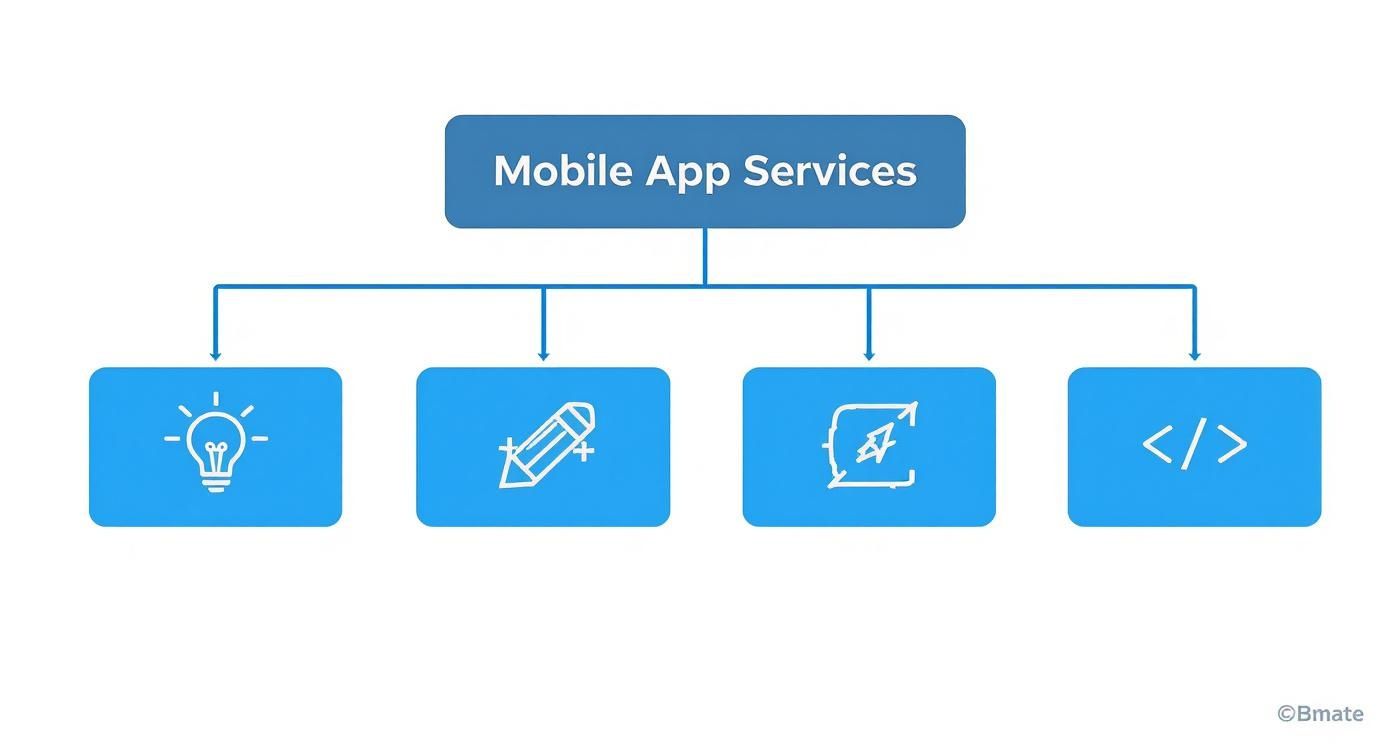
As you can see, a solid strategy and thoughtful design are the foundational pillars. They have to be locked in before any real development can begin effectively.
Crafting the User Experience (UI/UX Design)
Before anyone writes a single line of code, the entire focus is on the person who will use the app. This is the User Interface (UI) and User Experience (UX) design phase. Think of your UI/UX designers as the architects and interior decorators of your app. Their job is to create a digital space that’s not only visually appealing (UI) but also intuitive and effortless to navigate (UX).
A huge part of this is understanding core user experience design principles to build a seamless flow. This stage involves creating wireframes and mockups—the architectural drawings of your app. For a deeper look at this crucial step, check out our guide on how great wireframes make successful website and mobile apps. This intense focus on design ensures that users don't just use your app—they actually enjoy it.
Choosing Your Build: Native vs. Cross-Platform
Once the design is locked in, it's time for a major decision: how to build the app. There are two main paths here: Native and Cross-Platform development.
-
Native Development: This is like building a custom home designed specifically for its location—one for iOS (using languages like Swift) and a totally separate one for Android (using Kotlin). Native apps deliver the absolute best performance, integrate flawlessly with device features like the camera or GPS, and offer the most polished user experience.
-
Cross-Platform Development: This approach is like creating a brilliant modular home that can be assembled perfectly anywhere. Using frameworks like React Native or Flutter, developers write one codebase that runs on both iOS and Android devices. This method is often faster and more budget-friendly, making it a fantastic choice for many projects, especially when speed-to-market is the top priority.
There's no single "right" answer. The best path forward really depends on your app's complexity, performance needs, budget, and timeline. A good development partner will help you pick the right one for your software project.
Native vs Cross-Platform App Development at a Glance
| Factor | Native Development (iOS/Android) | Cross-Platform Development (Flutter/React Native) |
|---|---|---|
| Performance | Highest possible performance and speed, optimized for the OS. | Very good, but can sometimes lag behind native in intensive tasks. |
| User Experience | Feels completely "at home" on the device, using familiar UI elements. | Great UX, but can sometimes have minor platform inconsistencies. |
| Cost & Time | More expensive and time-consuming (separate teams/codebases). | Faster and more cost-effective (one codebase for both platforms). |
| Device Access | Full, direct access to all device hardware (camera, GPS, etc.). | Relies on plugins for hardware access, which can be limited. |
| Best For | High-performance apps, complex games, apps needing deep OS integration. | MVPs, content-driven apps, and most business applications. |
Ultimately, this choice shapes the entire project, so it’s a critical conversation to have with your development partner early on.
Powering the App: The Backend
If the UI/UX is what users see and touch, the backend is the engine room they never see. This is the server-side of your application—the complex system of servers, databases, and Application Programming Interfaces (APIs) that makes everything work.
The backend handles critical functions like user authentication, data storage, and business logic. It's the invisible infrastructure that makes sure your app's features work correctly, securely, and reliably every single time a user opens it.
Without a robust and scalable backend, even the most beautiful app will crumble under pressure. It's the unsung hero of mobile app development services.
Ensuring Perfection and Longevity
The final stages are just as critical as the first. Quality Assurance (QA) is the exhaustive inspection process that happens before launch. QA testers rigorously pound on every feature, button, and workflow to find and squash bugs, ensuring a smooth, error-free user experience from day one.
But the work isn't over once the app is live. Post-launch maintenance and support is the ongoing upkeep that keeps your app in prime condition. This includes updating it for new operating system versions, monitoring for security threats, fixing new bugs that pop up, and ensuring it stays fast and reliable as your user base grows. It’s the essential service that protects your investment for years to come.
How AI Integration Future-Proofs Your Application
Let’s be honest: integrating Artificial Intelligence isn't a futuristic "nice-to-have" anymore. It's quickly becoming the new baseline for any app that wants to stay relevant and competitive. Moving beyond basic functions, AI gives your app a real edge by making it smarter, more personal, and incredibly tuned in to what your users need. It’s what separates a static tool from a dynamic, intelligent partner.
Imagine an app that doesn't just show information but actually anticipates what a user needs next. Think of a retail app that suggests products with the spooky accuracy of a personal shopper, or a fintech app that flags weird spending patterns and alerts you to potential fraud in real time. That’s the power of AI at work.

From Standard App to Intelligent Tool
AI integration completely changes the game. Instead of making users hunt for what they need, the app can proactively bring solutions to them. This makes for a much stickier and more engaging experience that builds loyalty over the long haul.
Here are a few real-world examples of how AI turns a regular app into an intelligent asset:
- Intelligent Chatbots: Provide instant, 24/7 customer support. They can answer common questions, walk users through complex steps, and even handle transactions—all without a human lifting a finger.
- Personalization Engines: Analyze user behavior to dish out custom content, product suggestions, and even UI tweaks that make every single person’s experience feel one-of-a-kind.
- Generative AI Features: Let users create original content right inside your app, whether it's drafting an email in a productivity tool or generating custom artwork in a design platform.
These aren't just flashy add-ons; they solve genuine problems and deliver huge value, protecting your investment against whatever the market throws at it next. The ability to leverage artificial intelligence is now a core part of modern mobile app development services.
The Challenge of Managing AI
While the perks are obvious, the reality of juggling multiple AI models can be a massive headache. Every AI service has its own API, its own pricing, and its own unique set of prompts that need constant fine-tuning. For entrepreneurs and business leaders, this web of complexity can get overwhelming—and expensive—fast.
You might find yourself managing one set of prompts for a chatbot, another for a recommendation engine, and a third for a content generator. This fragmented approach is a recipe for version-control nightmares, spotty performance, and costs that spiral out of control when token usage spikes.
The real challenge isn't just implementing AI; it's managing it effectively at scale. Without a central command center, you risk losing control over both the performance and the cost of your app's intelligent features.
This is the exact problem we decided to tackle head-on at Wonderment Apps. We saw this growing complexity as a major roadblock for businesses trying to use AI to modernize their software applications.
A Smarter Way with a Prompt Management System
To cut through the chaos, we developed a powerful administrative tool: the Wonderment Apps prompt management system. Think of it as a single dashboard for every AI model plugged into your application. We designed it to give entrepreneurs and developers total control, no deep technical expertise required.
This tool is your command center, simplifying the entire AI management lifecycle. It plugs into your existing app or software, whether it’s a brand-new build or a legacy system you’re looking to modernize for AI integration. As the industry moves toward more accessible AI, resources like AI App Builder tools like Vibecoder show just how critical streamlined management has become.
Our system is built on four key pillars of control:
- Prompt Vault with Versioning: Store, test, and deploy all your AI prompts from one secure spot. If a new prompt version isn’t working out, you can roll back to a previous one with a single click. No more versioning nightmares!
- Parameter Manager: Securely connect your AI models to your internal database. This lets the AI pull real-time, relevant info—like product inventory or user history—to give sharp, context-aware answers.
- Unified Logging System: Keep an eye on the performance and outputs of all your integrated AIs in one place. This makes it a breeze to debug issues, monitor response quality, and see how users are actually interacting with your AI features.
- Cost Manager: Get a clear, cumulative view of your spend across all AI services. You can see your spend in real-time, set budgets, and get alerts to avoid any nasty surprises on your bill, giving you predictable control over your operational costs.
This system takes the chaos out of AI integration, so you can focus on what really matters: creating incredible user experiences and building software that will last for many years to come.
Ready to see how you can take control of your app's AI? Request a demo of our prompt management system today.
Choosing the Right App Development Partner
Picking the right developers for your app or software project is one of the biggest decisions you'll make. This isn't just about hiring a team to write code; it’s about finding a strategic ally who acts more like a co-founder for your digital product. The right team will be as invested in your business goals as you are, ready to steer you through technical minefields and market shifts with seasoned advice.
The stakes couldn't be higher. The global app market is exploding, with over 137 billion apps downloaded in a single year across Google Play and the Apple App Store. To get noticed in a sea of millions, you need more than a functional app—you need an excellent app experience. This simple fact makes your choice of partner the single most important factor in your success.
Evaluating Technical Expertise Beyond the Tech Stack
Any development agency worth its salt can rattle off a list of technologies they use. But real expertise runs much, much deeper. Your job is to find a team that understands not just the "how" but the "why" behind the technology they recommend for your specific project. A great partner can clearly explain why a certain framework or architecture is the best move for your long-term business goals, not just for the initial build.
To get a feel for their depth, ask some pointed questions:
- Industry Acumen: Have they built apps in your world before? A partner with a background in something like fintech or healthcare will already be fluent in the unique compliance and security headaches that come with the territory.
- Scalability Planning: How do they design and develop excellent app experiences that can scale? Ask them to walk you through their strategy for building a backend that can handle a jump from 1,000 to one million users without breaking a sweat.
- Problem-Solving: Throw them a curveball. Present a hypothetical challenge your app might face down the line. Their answer will tell you everything you need to know about their creativity and problem-solving chops.
Looking for Proof in the Portfolio
A portfolio should be more than a gallery of pretty screenshots; it's a collection of success stories. As you look through a potential partner’s past work, dig deeper than the surface-level design. The real question is, how did their projects solve actual business problems for their clients? A beautiful app that missed its business targets is a failure, plain and simple.
Look for evidence of real-world results. Did their app boost user engagement by a measurable percentage? Did it drive up conversion rates or make an internal process more efficient? These are the metrics that show a partner knows how to deliver genuine value.
A strong portfolio is a track record of turning a client's vision into a successful, market-ready product that does what it was built to do.
The Importance of Transparent Communication
Finally, never, ever underestimate the power of clear and consistent communication. Building an app is a collaborative journey with a ton of moving parts. A partner who makes transparency a priority will keep you in the loop, manage expectations honestly, and make you feel like you’re truly part of the team.
For more on this, exploring how to pick the best offshore software development company can offer some great tips for vetting partners, especially when it comes to communication.
Understanding App Development Pricing Models
Figuring out the cost of mobile app development services really starts with understanding how agencies price their work. It's a lot like building a house—there's no single flat fee. The final cost always comes down to the scope, the complexity of the job, and the kind of working relationship, or "engagement model," you choose.
Each model strikes a different balance between predictability, flexibility, and your own control over the project. Picking the right one is one of the most important first steps. It aligns your budget with your project's goals, whether you need everything locked down from day one or the freedom to change things on the fly.
The U.S. smartphone app industry is a massive, mature market, pulling in over $234 billion a year. That growth is driven by the huge demand from the 91% of adults who now own a smartphone. With an audience that big, getting the financial model right isn't just a detail—it's a critical strategic move. You can learn more about the robust app development market in the U.S. to get a sense of the scale.
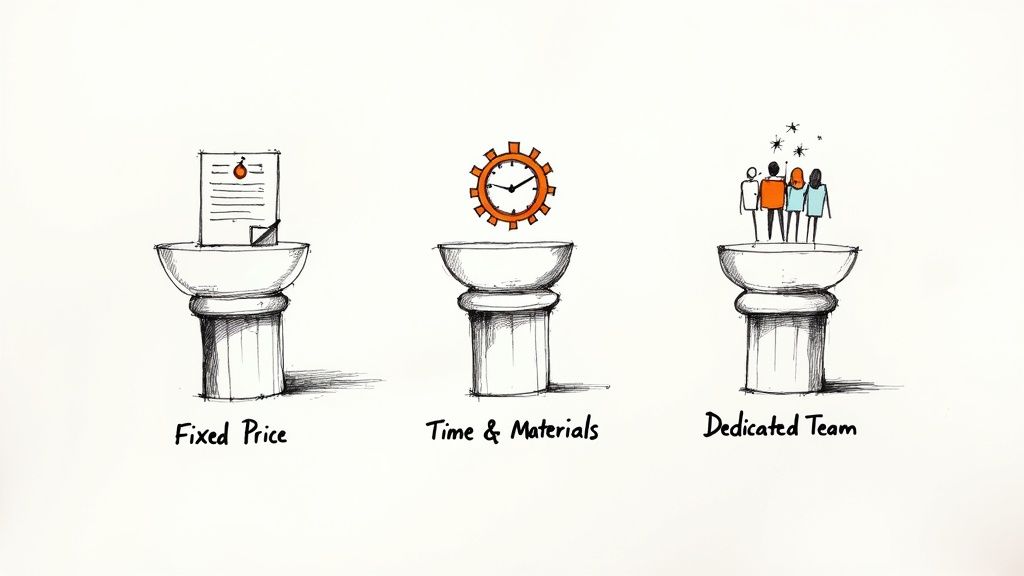
The Fixed Price Model
Think of the Fixed Price model as a fixed-bid contract for a construction project. It's the perfect fit when your project's blueprints—the scope, features, and timeline—are completely clear and locked in before anyone writes a single line of code.
You and the development partner agree on one single, unchanging cost for the entire project. This gives you fantastic budget predictability, which is a huge relief for businesses working with tight financial constraints. The flip side is its rigidity. Any changes or new ideas will mean a new contract and new costs, which can definitely slow things down.
The Time and Materials Model
On the other end of the spectrum is the Time & Materials (T&M) model, which is all about flexibility. Instead of one big price tag, you pay an agreed-upon hourly or daily rate for the time your development team spends working. This approach is built for complex, long-term projects where you know the scope is going to evolve.
The T&M model lets you pivot, add features, and react to market feedback without the hassle of renegotiating a contract every time. It's a deeply collaborative way to work, but it demands close oversight to keep the budget on track since the final cost isn't set in stone.
This model is built on trust and transparency. It's best suited for agile development methodologies, where the project is built in iterative cycles, allowing for continuous improvement and adaptation throughout the process.
The Dedicated Team Model
Finally, the Dedicated Team model is like hiring a specialized crew to become a true extension of your own company. You get a handpicked team of developers, designers, and QA specialists who work exclusively on your project for a flat monthly fee.
This model gives you the ultimate level of control and deep integration with your in-house staff. It’s the go-to choice when you need to bring in specific expertise your team lacks or when you're tackling a large-scale, long-term project that requires consistent, focused effort. It really is the best of both worlds: the expertise of an outside agency with the focus of an internal team.
Building Your App with Wonderment
This is where the rubber meets the road—turning your vision for a modern, intelligent app into a real-world product. We've walked through what goes into successful mobile app development services, from user-centric design to the technical nuts and bolts of AI integration. That mix of expertise is exactly how we operate at Wonderment Apps, turning complex business challenges into smooth, scalable mobile experiences.
We don't just write code; we engineer digital products built for the long haul. A key part of our process is focusing on scalable architecture. This means your app won't just work flawlessly on day one—it will be ready to grow from one thousand users to one million without skipping a beat. It's about building for your future success from the very first line of code.
The Wonderment Advantage
What really makes us different is how we handle intelligent integration. Plenty of agencies see AI as a complicated feature to tack on at the end. We see it as a core part of what makes modern software great. That's why we built our own prompt management system—an administrative tool that puts you in the driver's seat of your app's intelligence.
This system gives you the power to manage, version, and deploy AI prompts without needing a team of data scientists on standby. With a prompt vault for versioning, a parameter manager for database access, a unified logging system, and a cost manager, you get complete control. It’s all about making sophisticated tech accessible and easy to manage, so your app can adapt and stay relevant.
We believe the best partnerships are built on a shared vision for success. We are more than just developers; we are your strategic partner in building software that not only meets today's demands but is engineered to last for many years to come.
The app market isn't slowing down anytime soon. In fact, by 2025, mobile app downloads are projected to hit an incredible 299 billion, with market revenue expected to reach $613 billion. This massive growth underscores the huge opportunity for well-built apps that actually solve problems for people. You can dig deeper into these projected mobile app market trends to see the full picture.
Partnering with the right team is your first, most critical step in claiming a piece of this growing market. Let’s connect and talk about your project. We can explore how our mobile app development services can bring your idea to life.
Frequently Asked Questions
Jumping into the world of mobile app development for the first time can feel like a lot. To clear things up and help you move forward, we’ve put together some straight answers to the questions we hear most often from business leaders just starting out.
How Long Does It Typically Take to Develop a Mobile App?
This is the classic "it depends" question, because the timeline is tied directly to complexity. There’s no single answer.
A straightforward app with a focused set of features can often come to life in 3-6 months. But if you're envisioning a more complex build—something with a custom backend, unique design, or AI features—you’re likely looking at 9-12 months, maybe more. A smart approach is often to launch a Minimum Viable Product (MVP) first. This gets you to market faster, allowing you to gather real user feedback and build from there.
What Is the Most Important Factor for a Mobile App's Success?
While the technology has to be solid, the single most critical ingredient for success is a fantastic user experience (UX) that solves a real problem for your audience.
It’s that simple. If an app isn’t intuitive and genuinely helpful, people just won't stick around, no matter how clever the features are. That’s why putting user research and thoughtful, human-centered design at the forefront from day one isn't just a good idea—it's everything.
A beautiful app that fails to solve a user's problem is just a pretty distraction. A functional app that's frustrating to use will be deleted. Success lies at the intersection of powerful function and effortless design.
How Much Does It Cost to Maintain an App After Launch?
This is a big one, and it's vital to plan for it. A good rule of thumb is to budget around 15-20% of your initial development cost for annual maintenance.
That budget isn't just for sitting around; it actively keeps your app healthy and secure. It typically covers:
- Server hosting and other infrastructure costs
- Squashing any bugs that pop up after launch
- Updates to stay compatible with new iOS and Android versions
- Applying security patches to keep user data safe
- Monitoring and optimizing performance
Should I Build Separate Apps for iOS and Android?
This really comes down to a balancing act between performance, budget, and how fast you need to get to market.
Building native apps—one specifically for iOS and another for Android—gives you the absolute best performance and a user experience that feels perfectly at home on each device.
The alternative is cross-platform development, where you use a single codebase for both. This approach can save a significant amount of time and money. It’s a fantastic option for getting an MVP out the door, testing a new market, or when you need to be mindful of the budget.
At Wonderment Apps, we are your strategic partner in building software that lasts. Our unique AI prompt management system simplifies complexity and puts you in control. Let’s connect to discuss your project and explore how our services can bring your idea to life at https://wondermentapps.com.