

Picking the right language for machine learning is one of those foundational decisions that can make or break your app's performance, development speed, and ability to scale down the road. Python is the crowd favorite for a reason—it’s clean and packs a punch with its libraries—but it's not a silver bullet for every single project.
The best language really boils down to your specific business goals. Are you chasing raw processing speed? Deep statistical analysis? Or maybe seamless integration into a sprawling enterprise system? It’s a bit like choosing the right tool for a construction project; you wouldn’t use a sledgehammer to hang a picture frame. The key is to pick the language that lets you design and develop excellent app experiences that can scale, modernize your software, and last for years to come.
Your Strategic Guide to Machine Learning Languages
Choosing a programming language isn't just a technical detail; it’s a strategic move that dictates how quickly and effectively you can bring new ideas to life. It has a ripple effect on everything, from the engineering talent you can attract to how fast you can roll out new AI-powered features. This decision is just as critical as picking the right technology stack for your project, because both will shape your application's future.
Integrating AI into custom software for desktop and mobile is more than just writing code. You need tools to manage the whole process. That’s why we at Wonderment Apps developed a powerful prompt management system. It's an administrative tool you can plug into your existing app to modernize it for AI integration, giving you the control needed to succeed. We’ll show you how a tool like this is a game-changer a little later on.
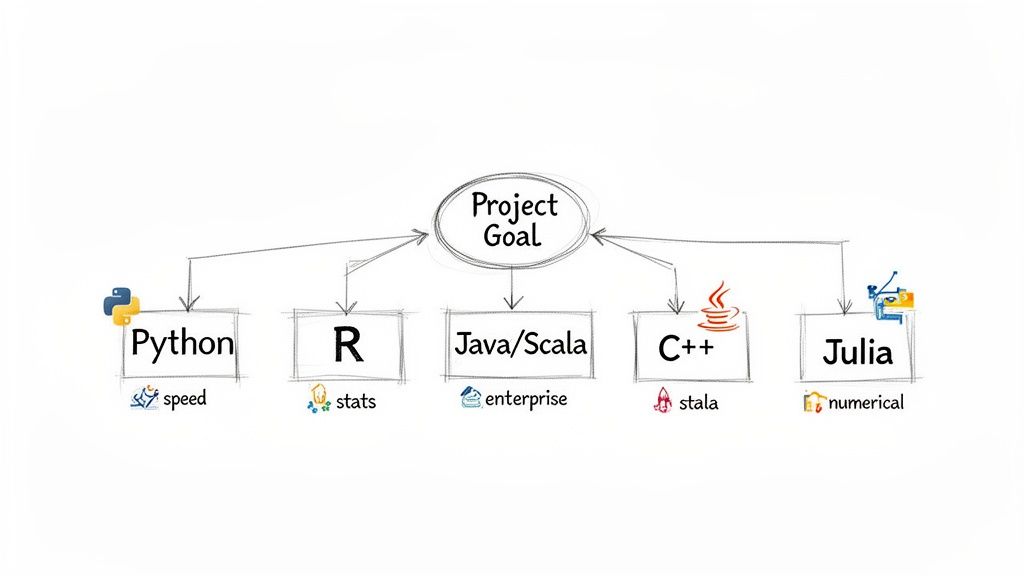
This guide will walk you through the top contenders, explaining why Python is the default for many but also shining a light on where other languages excel. We want to help you find the perfect match for your business objectives.
Why Python Dominates Machine learning
If you ask someone in tech to name a language for machine learning, chances are they’ll say Python. Its spot at the top is no accident—it's earned it. The secret is a powerful mix of dead-simple syntax and a massive, supportive ecosystem.
Python's clean, readable style lets developers turn a great idea into a working prototype ridiculously fast. For companies in fast-moving industries like ecommerce, fintech, and media, that speed is a killer advantage. It means getting sophisticated models for personalization, fraud detection, or content recommendations out the door before the competition even knows what hit them.
A Rich Ecosystem of Tools and Libraries
The real magic behind Python's reign is its collection of powerhouse libraries. Think of it like a perfectly stocked workshop. Instead of having to build every tool from scratch, you can just grab what you need off the shelf. This means your team isn't wasting time reinventing the wheel for common machine learning tasks.
This accessibility has had a huge impact. Recent surveys show Python running over 80% of data science projects around the world. Its biggest names—TensorFlow, PyTorch, and Scikit-learn—are behind 75% of ML framework usage all by themselves. The numbers don't lie: projects built with Python tend to wrap up 40% faster than those using languages like R or Java. That’s a serious edge.
Python's strength isn't just its syntax, but its community. The vast collection of open-source libraries means that for almost any problem you face, someone has likely already built a tool to help you solve it.
Community, Support, and Developer Velocity
Beyond the libraries, Python is backed by a huge and incredibly active global community. What does that mean for you? An endless stream of tutorials, top-notch documentation, and forums where your developers can find answers fast. When your team hits a wall, a solution is usually just a quick search away, which keeps projects moving.
This support network also makes it far easier to find and hire talented developers who can start contributing from day one. To get the most out of your team, it helps to equip them with the right tools. Exploring guides on the best IDE for Python can give your developers the environment they need to be productive.
It's this blend of simple code, powerful tools, and a massive community that makes Python such a ridiculously effective choice for building and deploying machine learning solutions.
Comparing The Top Machine Learning Languages
Sure, Python wears the crown in the machine learning world, but saying it's the only option is like telling a master carpenter they only need a hammer. Every project is different, and the right language for machine learning is always a balancing act—you’re trading off lightning-fast development, raw performance, and the ecosystem of tools available.
To make the right call, you have to look past the popularity contest and see how the top contenders really stack up. Each one brings its own unique flavor to the table, making it the perfect fit for certain kinds of problems.
The Major Players In Machine Learning
Let's break down the languages that every business leader and development team should have on their radar. Think of this as a guide to aligning your technical strategy with your actual business goals.
- Python: The undisputed champion of versatility. Its easy-to-learn syntax and absolutely massive library support make it the go-to for getting from idea to prototype in record time. It shines in just about every part of the process, from wrangling messy data to deploying a finished model.
- R: The statistician's old friend. Born and bred for statistical analysis and data visualization, R is still a fortress in academia and heavy-duty research. When it comes to pure statistical modeling, its packages are tough to beat.
- Java/Scala: The enterprise workhorses. Both run on the Java Virtual Machine (JVM), a staple in large-scale corporate systems. These are your best bet when you need to weave machine learning into existing big data pipelines, especially if you’re already using tools like Apache Spark.
- C++: The king of speed. When every single nanosecond is critical, nothing touches C++. Its low-level control over memory gives developers the power to squeeze out every last drop of performance, making it essential for things like high-frequency trading or graphics-heavy game engines.
- Julia: The rising challenger. Julia was designed from the ground up to be the best of both worlds—it feels as friendly as Python but runs with the unchained speed of C++. It’s quickly winning fans in scientific computing and other number-crunching fields where performance is non-negotiable.
The goal isn't to find the single "best" language, but the best language for your specific problem. The needs of a high-frequency trading algorithm are a world away from a university research project studying social trends.
Head-to-Head Language Comparison
Making decisions is hard, so here’s a straightforward comparison to help you see how these languages measure up across the factors that matter most for any machine learning project.
This table gives you a side-by-side look at the top languages, covering everything from what they're best used for to the strength of their communities.
Machine Learning Language Feature Comparison
| Language | Best For | Key Libraries | Performance | Community & Ecosystem |
|---|---|---|---|---|
| Python | Rapid Prototyping, Versatility | TensorFlow, PyTorch, Scikit-learn | Good | Massive & Active |
| R | Statistical Analysis, Data Viz | ggplot2, caret, dplyr | Moderate | Strong in Academia |
| Java/Scala | Enterprise Apps, Big Data | Deeplearning4j, Weka, Spark MLlib | High | Large & Established |
| C++ | High-Performance Computing | TensorFlow C++ API, Caffe, mlpack | Excellent | Niche but Deep |
| Julia | Scientific Computing, Speed | Flux.jl, Turing.jl, MLJ.jl | Excellent | Growing Rapidly |
The takeaway here is pretty clear: Python strikes a fantastic balance that works for the vast majority of projects. But if your app's success hinges on absolute peak performance for real-time analytics, you’d be better off looking at C++ or Julia.
On the other hand, if you’re building a secure healthcare platform that has to plug into existing enterprise systems built on Java, sticking with the JVM ecosystem is a no-brainer. Getting these nuances right from the start is the key to building an AI-powered product that not only works, but lasts.
How Industry Use Cases Shape Your Language Choice
Picking the best language for machine learning isn’t a one-size-fits-all decision. The right choice is almost always dictated by the specific demands of your industry. A fintech company building a high-throughput fraud detection system has a completely different set of needs than a media company spinning up a content recommendation engine.
The secret is to align your language choice with your business strategy from day one. This means weighing technical requirements against regulatory hurdles and long-term goals. For example, a fintech app needs rock-solid security and precision above all else. An ecommerce app, on the other hand, might prioritize speed-to-market and rapid personalization features. Let's see how this actually plays out.
This flowchart gives you a quick visual guide for making a decision. It all comes down to what you’re trying to achieve—raw speed, deep research, or all-around versatility.
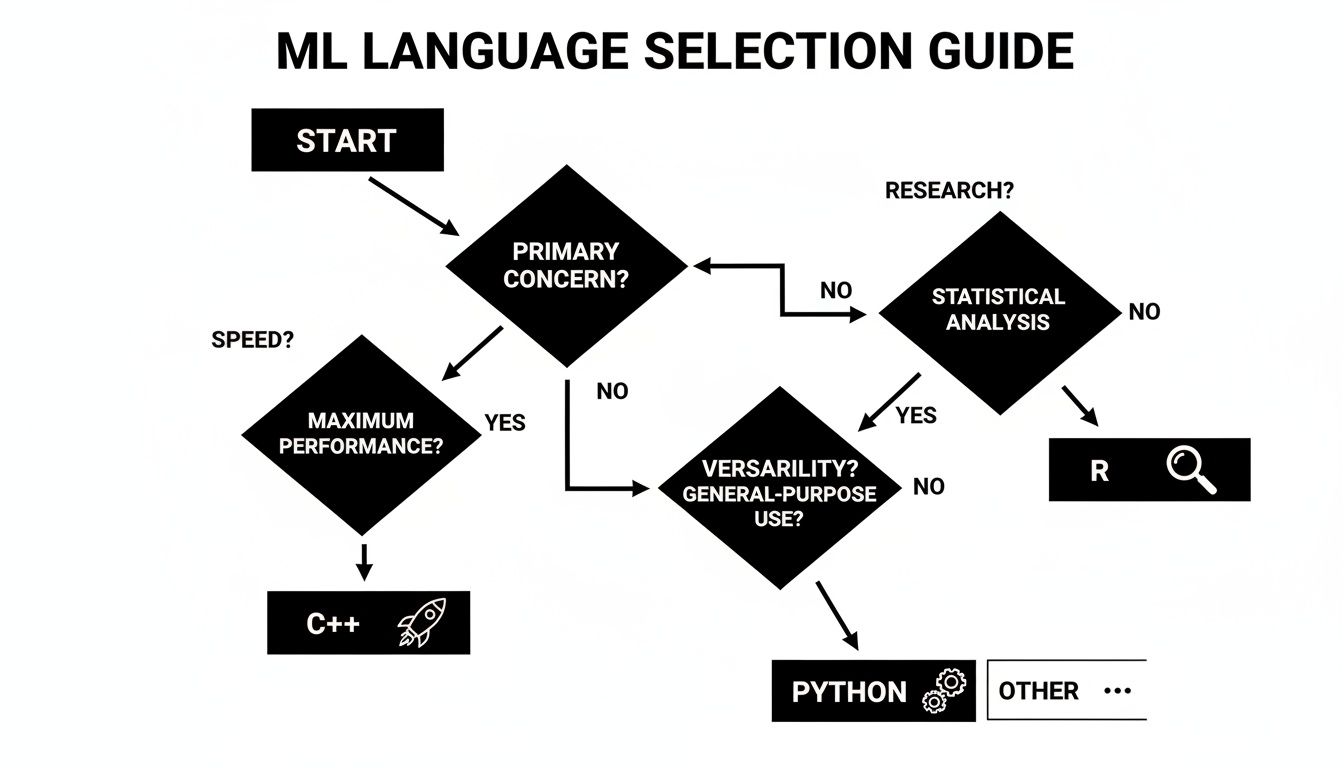
The key takeaway here is simple: your core objective points you directly to a different language. Let that guide your choice.
Fintech and High-Stakes Environments
In the world of finance, there's no room for error. Security, compliance, and integration with legacy systems are absolutely non-negotiable. This is precisely why enterprise languages like Java and Scala are so common in this space. They are mainstays in the big data world, plugging seamlessly into tools like Apache Spark to process enormous datasets in real time.
These languages are designed to build robust, scalable, and maintainable systems that can handle the intense pressure of financial services. Think real-time fraud detection, algorithmic trading, and credit risk modeling. In these areas, a single mistake can have massive consequences. The strong typing and mature tooling of the Java ecosystem provide the stability these high-stakes applications demand.
Healthcare and Data-Driven Diagnostics
The healthcare industry is a different beast entirely. It operates under incredibly strict data privacy regulations like HIPAA, which puts compliance front and center. At the same time, the field is bursting with innovation, especially in diagnostic imaging and predictive analytics.
Python is a natural fit here. Its rapid prototyping capabilities allow data science teams to quickly build and validate models for tasks like spotting tumors in medical scans or forecasting patient outcomes. But often, the story doesn't end there. While Python is great for modeling, a language like Java is frequently brought in to build the final, production-grade application, ensuring security and compliance are locked down tight.
This two-language approach is a perfect example of how machine learning for businesses often requires a hybrid strategy, playing to the strengths of each tool.
Ecommerce, Media, and Personalization
For ecommerce and media companies, the entire game revolves around user engagement. Personalization engines, content recommenders, and dynamic pricing models are the lifeblood of the business. Python absolutely dominates this space. Why? Its incredible libraries and the sheer speed at which developers can ship new features.
A huge part of this is driven by natural language processing (NLP). The NLP market, which is the backbone of so much modern AI, is exploding—it's projected to hit $791.16 billion by 2034. This growth is what allows retail virtual assistants to boost conversions by 18% and improve retention with smarter recommendations.
Building a Modern and Manageable AI Stack
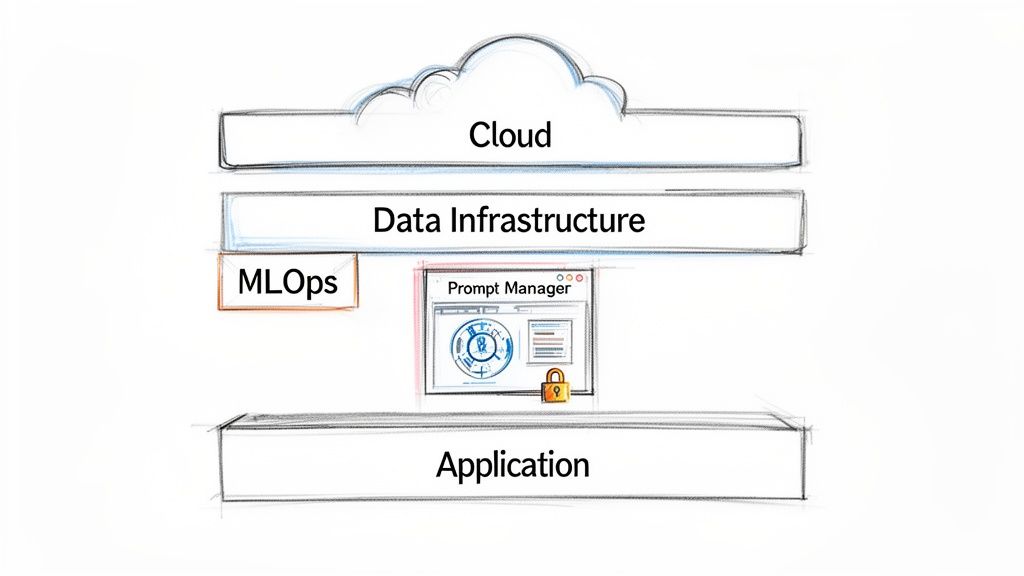
Successfully bringing AI into your app is about way more than just picking a language for machine learning. Honestly, the language is just one piece of a much bigger puzzle. To build something powerful that can actually scale and won't give your engineers nightmares, you have to think about the entire tech stack supporting it.
This means looking at the bigger picture: the cloud platforms you'll run on, the MLOps tools needed to automate deployments, and the data infrastructure that's constantly feeding your models. Pulling this all together into a cohesive ecosystem is a serious undertaking. One of the biggest hurdles we see is managing the constant back-and-forth between an app and its AI models—a process that can lead to runaway costs if you're not careful.
Taking Control of Your AI Integration
This is exactly why a dedicated prompt management system is so critical. Think of it as the central control panel for your entire AI operation. It gives you the oversight needed to innovate quickly without losing your grip on costs and complexity. For a deeper dive into creating a solid foundation, check out our guide on software architecture best practices.
At Wonderment Apps, we built our own administrative toolkit to provide this precise level of control. It’s packed with features designed to make your AI initiatives both powerful and profitable:
- Prompt Vault with Versioning: Securely store and manage all your prompts. You can easily track changes over time and roll back to a previous version if something doesn't work out.
- Parameter Manager: Safely handle sensitive parameters your AI models might need, like internal database access credentials.
- Unified Logging System: See what's happening across all your integrated AI services from one single dashboard. No more jumping between different platforms.
- Comprehensive Cost Manager: Get a crystal-clear view of your cumulative AI spending. This helps you manage your budget and find opportunities to optimize usage.
A modern AI stack isn't just about powerful models; it's about the tools and processes that make those models reliable, cost-effective, and easy to manage at scale.
This kind of centralized approach frees up your development team to focus on what they do best: building great features, not wrestling with chaotic AI integrations. The stakes are high—the global machine learning market is projected to hit $503.40 billion by 2030. With that kind of growth, having a manageable stack isn't just nice to have; it's non-negotiable. Discover more insights about the growing AI market.
Bringing Your AI Vision to Life
Choosing a language for machine learning and building your stack are huge first steps. But let's be honest, that's where the real work begins. A brilliant technical strategy is just an expensive experiment until it's executed perfectly and turned into a product people can actually use.
This is the moment where picking the right developers for your project becomes your most critical asset. You need more than just coders; you need a team that gets your business vision and knows exactly how to translate that into a scalable, resilient application that will last.
Finding the Right Partner for Your AI Project
A great partner doesn't just build what you ask for. They challenge your assumptions, poke holes in your logic, and guide you toward the best possible outcome—even if it's not what you originally had in mind. A team like Wonderment Apps, for example, comes to the table with deep experience in both complex AI systems and user-focused design, ensuring the final product is as smart as it is easy to use.
As you map out your AI strategy, it's smart to consider bringing in expert help. You can start by exploring resources for finding the right machine learning consulting firm to see what kind of support is out there.
When you're talking to potential partners, here are a few key questions to ask:
- Can you show me a portfolio of scalable apps you've built in my industry?
- How do you run your projects and how will you keep me in the loop?
- What’s your game plan for long-term maintenance and keeping our models up-to-date?
Speed Up and De-Risk Your Investment
The goal isn't just to launch a piece of software. It's to build something that can grow and adapt for years. That takes more than just smart programming; it demands smart tools that put you in control of your entire AI ecosystem.
Think about a comprehensive toolkit, like our own prompt management system. It's designed to dramatically speed up your project while cutting down the financial risk. By giving you one place to handle prompt versioning, track costs, and review logs, it provides the kind of oversight you need to manage your AI initiatives without flying blind.
This is how you innovate with confidence—when you have a crystal-clear view of performance and spending.
Ready to see how the right tools can completely change your app development process? We invite you to see a demo of our prompt management system and find out how we help teams build, manage, and scale their AI-powered software.
Frequently Asked Questions
When you're diving into the world of machine learning languages, a lot of questions pop up. Here are some straightforward answers to the things business leaders and developers ask us most.
Which Machine Learning Language Is Easiest To Learn?
Python is hands-down the easiest language to pick up for machine learning. Its syntax is incredibly clean and reads a lot like plain English, which really flattens the learning curve for anyone new to coding.
On top of that, the Python community is massive and incredibly supportive. That means you'll find an endless stream of tutorials, detailed documentation, and active forums, making it much easier to solve problems and get your first projects off the ground.
Can I Use More Than One Language For An ML Project?
Absolutely, and you probably should. It's actually a common practice to mix languages in a single machine learning project to get the best of all worlds. This is often called a polyglot approach.
For instance, a team might use Python for all the early-stage work—think data exploration, model training, and quick prototyping. But once the model is ready for the real world, they might deploy it using a language like Java or C++ to handle the heavy lifting required in a production environment demanding top-tier speed and scalability.
How Important Is Community Support When Choosing A Language?
Community support is not just important; it's a critical piece of the puzzle and should be a major factor in your decision. A big, active community directly translates into a richer ecosystem of tools, libraries, and ready-to-use frameworks.
An active community acts as a force multiplier for your development team. It accelerates problem-solving, provides access to a vast talent pool, and ensures the language continues to evolve with cutting-edge tools and best practices.
This means your team won't have to reinvent the wheel and can find solutions much faster. For business leaders, a strong community also simplifies hiring, as it’s easier to find skilled developers ready to contribute from day one.
At Wonderment Apps, we help you move beyond language selection to build a complete, scalable, and manageable AI-powered application. Our administrative toolkit gives you the control you need over prompts, costs, and performance.
Schedule a demo to see how our platform can accelerate your AI modernization efforts.