


Dealing with tech debt means rolling up your sleeves to refactor and clean up the codebase. It's about fixing the shortcuts, outdated tech, and clunky architecture that are slowing you down. This isn’t a one-off fix; it's a strategic commitment to set aside time for cleanup, striking a balance between shipping new features and maintaining the long-term health of your systems. A smart way to jumpstart this is by using a modernization project, like integrating AI, as the catalyst for change. With the right tools, you can plug advanced features into your existing software, delivering immediate value while paying down debt.
Confronting the Hidden Costs of Technical Debt
Technical debt is way more than a headache for developers. It's a quiet, relentless drag on your company’s ability to move fast and innovate. Think of it as the invisible interest payment on past development shortcuts. Every delayed feature, frustrating bug, and hour spent on tedious maintenance is a direct hit from this accumulating debt. It’s why your best engineers are stuck patching old systems instead of building the next big thing.
This isn't a small problem—it's a massive financial drain. Globally, the top 2000 enterprises are wrestling with an estimated $1.5 to $2 trillion in technical debt. To get a handle on it, companies are now funneling an average of 30% of their entire IT budgets into tech debt management. On top of that, another 20% of resources are just spent fighting fires in legacy systems. The problem is especially bad in critical sectors; for instance, nearly 78% of financial services firms say tech debt is seriously holding back their innovation. You can explore the full research on the worldwide impact of technical debt to see just how big this challenge has become.
Recognizing the Early Warning Signs
Spotting tech debt before it cripples your operations is key. It might be buried in lines of code, but its symptoms are visible across the business if you know where to look. Ignoring these signs is like ignoring the check engine light in your car—the fix only gets more expensive the longer you wait.
Keep an eye out for these tell-tale signs:
- Slowing Development Velocity: When adding a simple feature starts taking weeks instead of days, that's a classic symptom. It means your codebase has become a tangled mess, and developers are spending more time fighting complexity than shipping value.
- Increasing Bug Frequency: Seeing a sudden spike in bugs, especially in parts of the app you haven't touched? That often points to fragile, tightly-coupled code where one change creates a domino effect of unintended problems.
- Mounting Maintenance Costs: Is your team constantly pulled into unplanned work and hotfixes? When maintenance starts to overshadow new development, tech debt is almost always the culprit.
- Team Morale Takes a Hit: Good developers want to build great things, not just plug leaks. Constant firefighting with a brittle system leads to burnout, frustration, and turnover. This creates a "people debt" that's even harder to repay.
Shifting to a Proactive Mindset
Getting a handle on tech debt starts with a mental shift. You have to move from reactive firefighting to proactive, strategic management. The goal isn't a perfect, debt-free codebase—that's a fantasy. It's about making conscious decisions, paying down the high-interest debt that kills growth while maybe taking on some low-interest debt to learn fast or grab a market opportunity.
Modernizing your application is a great way to tackle deep-seated architectural debt, but it doesn't always mean a full rewrite. For instance, you could use a project like integrating AI as a catalyst for targeted improvements. By using smart tools like an AI-native prompt management system, you can plug advanced features directly into your existing software. This is an approach we specialize in at Wonderment Apps. It allows you to modernize incrementally, delivering business value right away while building a more resilient foundation for whatever comes next.
A Practical Framework for Measuring Tech Debt
You can’t fix what you don’t understand, and tech debt is no different. It's easy to throw around phrases like "the code is a mess," but moving from vague complaints to real action requires a structured way to measure the problem. To get a real handle on your tech debt, you have to first identify its different "flavors" lurking in your system and then quantify the impact in a way that resonates with everyone, from engineers to the C-suite.
The key is to blend the qualitative with the quantitative. The full picture only emerges when you combine the boots-on-the-ground insights from your team with hard numbers pulled from your tools. This is how you transform developer frustration into a prioritized, data-driven action plan.
Combining Qualitative and Quantitative Insights
First things first: talk to the people on the front lines. Your developers know exactly where the digital quicksand is. Run a few structured interviews or workshops to pinpoint which modules are a nightmare to modify, take forever to test, or are a constant source of bugs. This human intelligence provides invaluable context that no tool can give you.
Once you have that, it's time to layer in the hard data. This is where you bring in the machines to validate and expand on what your team is feeling. The goal here is to gather objective metrics that shine a light on the hotspots in your codebase.
A few key metrics you’ll want to track are:
- Code Complexity: Use static analysis tools to measure Cyclomatic Complexity. A high score for a specific function is a major red flag, pointing to code that’s tough to understand, test, and maintain.
- Code Churn: This metric tracks how often a file is changed. High churn in one area often signals unstable requirements or a fundamentally flawed design that needs constant patching.
- Technical Debt Ratio (TDR): Tools like SonarQube can calculate a TDR, which estimates the cost to fix existing issues versus the cost of building the codebase from scratch. A TDR of 5% or less is what you should aim for.
- Bug Density: Simply track the number of bugs per thousand lines of code. If bug reports are clustering in one area, it’s a clear sign of underlying debt that’s hurting the user experience.
Getting a handle on these numbers is essential. You can see how tracking similar agile performance metrics can give your team a clearer picture of development velocity and any hidden roadblocks.
The first warnings often show up as slowdowns, an uptick in bugs, and missed timelines—all direct results of debt piling up.
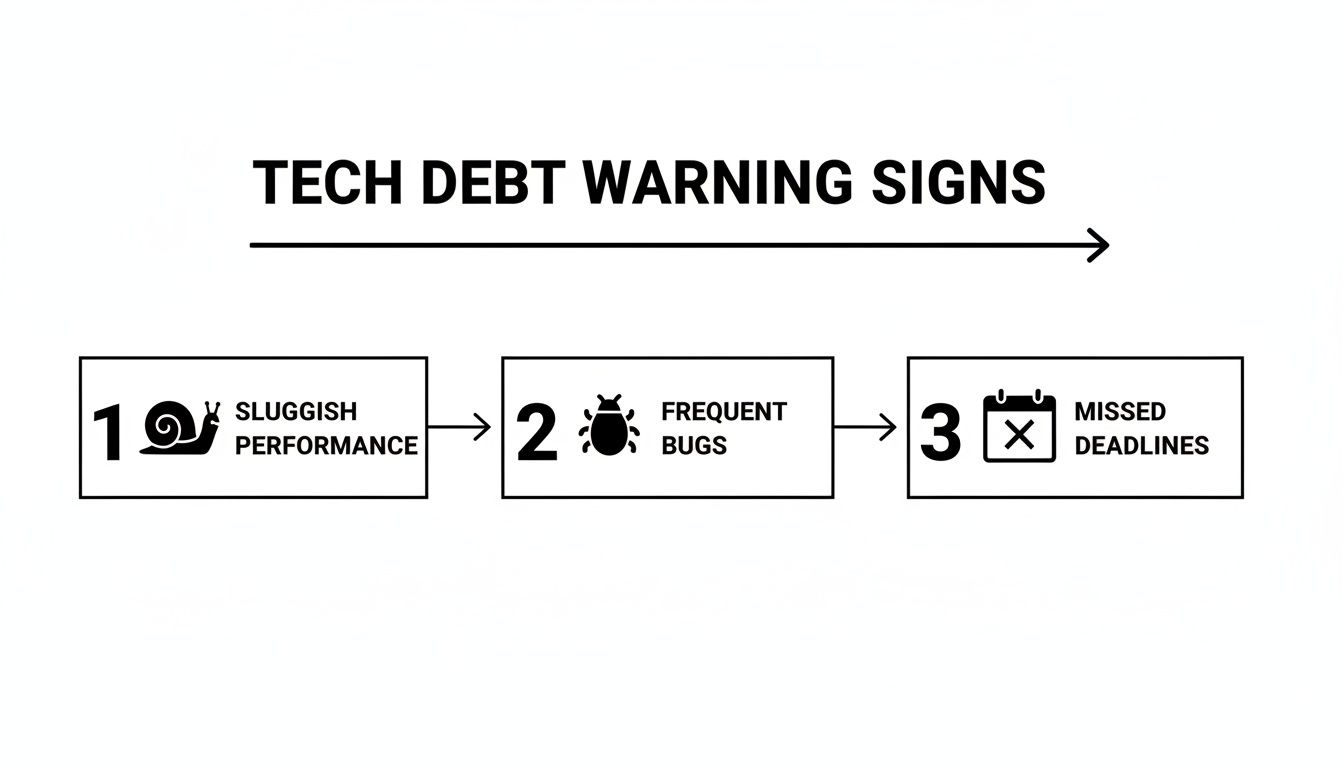
As you can see, sluggish performance is often the canary in the coal mine, leading to more frequent bugs and, eventually, missed deadlines that directly impact the business.
Categorizing Your Findings
Not all technical debt is created equal. A long, messy list of issues isn't actionable. The next step is to start categorizing your findings so you can actually understand the nature of the problems you're dealing with.
"A mess is not a technical debt. A mess is just a mess. Technical debt decisions are made based on real project constraints." – Martin Fowler
This distinction is crucial. Some debt is intentional—a shortcut you knowingly took to hit a deadline. Other debt is the unintentional kind that creeps in from evolving standards or a simple lack of knowledge.
To make sense of it all, it helps to group the debt into distinct categories. This table breaks down the common types, their symptoms, and how you can measure them.
Types of Technical Debt and How to Spot Them
| Debt Category | Common Symptoms | Measurement Method |
|---|---|---|
| Code Debt | "Code smells" like long methods, duplicate logic, and low test coverage. | Static analysis tools (e.g., SonarQube, CodeClimate), code coverage reports. |
| Architectural Debt | Tight coupling between modules, monolithic designs that hinder independent deployment. | Dependency mapping tools, architectural reviews, code churn analysis. |
| Process Debt | Inefficient build pipelines, slow code reviews, lack of automated testing. | Cycle time metrics, developer feedback, CI/CD pipeline analytics. |
| Knowledge Debt | Critical system knowledge is held by only one or two developers; poor documentation. | Team interviews, documentation audits, identifying "knowledge silos." |
By categorizing the debt this way, you can start to see the bigger patterns. You might realize your biggest problem isn't just messy code, but a huge architectural bottleneck that’s slowing everyone down.
For more on building out a complete strategy, it’s worth learning how to manage technical debt effectively, especially in complex data and AI environments. This kind of framework gives you the clarity to stop firefighting and start making smart, strategic improvements.
Smart Prioritization for Maximum Impact
So you've got a backlog of identified tech debt. The first impulse is always to jump in and start fixing everything at once. You have to fight that urge. Treating every piece of debt like a five-alarm fire is a surefire way to get bogged down and accomplish next to nothing.
The real game-changer is smart prioritization. It's what separates the teams that are just spinning their wheels from the ones making real, tangible progress. The goal isn't to get to zero tech debt—it's to pay down the highest-interest items first, just like you would with financial debt.
This is where the conversation has to shift from a purely technical cleanup job to a strategic business decision. Not all debt is created equal. A slightly clunky admin interface used by two people once a month? That's an annoyance. A brittle payment processing module that slows down every single transaction? That’s a direct threat to your bottom line. Learning to spot the difference is absolutely essential.
Introducing the Tech Debt Matrix
One of the most powerful tools I’ve seen for this is the tech debt matrix. It’s a beautifully simple model that helps you categorize every task by plotting it on two axes: Business Impact and Engineering Effort. This framework forces you and your team to have an honest conversation about the ROI for each fix, moving beyond gut feelings to a more data-driven approach.
When you visualize your backlog this way, the priorities become crystal clear.
- High Impact, Low Effort (Quick Wins): These are your crown jewels, the top of your list. Fixing these issues delivers noticeable value to the business or your users without eating up a ton of dev time. A great fintech example is optimizing a single database query that makes customer account pages load instantly. It's a small change with a huge impact on user experience.
- High Impact, High Effort (Major Projects): These are the big, strategic moves that demand serious planning. Think about migrating a monolithic e-commerce checkout system over to microservices. The effort is huge, but so is the payoff—better scalability, faster feature releases, and a more resilient system.
- Low Impact, Low Effort (Fill-in Tasks): These are the small cleanups you can knock out between larger projects. It could be refactoring a small utility function or beefing up the documentation in a non-critical part of the codebase. Good hygiene, but not a top priority.
- Low Impact, High Effort (Reconsider or Defer): These are the time sinks you need to avoid at all costs. Embarking on a massive refactor of a legacy feature that only a handful of customers use is a terrible investment. Your best bet is to leave these alone unless they start creating bigger problems down the line.
By focusing your energy on the high-impact quadrants, you guarantee that every hour spent on debt reduction is actually pushing the business forward, not just tidying up code for the sake of it.
Aligning Debt Reduction with Business Goals
The most successful tech debt programs I've seen are the ones woven directly into the business roadmap. Instead of treating debt reduction as a separate, competing priority, you need to frame it as a strategic enabler for what's coming next.
The narrative completely changes. It’s no longer, "we have to pause feature work to fix old code." Instead, it becomes, "we need to fix this module so that we can launch the new product on time and without issues."
For instance, if an e-commerce platform is gearing up for a huge holiday sales event, that's the perfect time to prioritize debt related to site performance and scalability. Suddenly, refactoring a slow product search API isn't just a "cleanup task"—it's a critical step to ensure the site can handle the traffic spike and maximize revenue.
When you frame it this way, getting buy-in from product managers and other stakeholders becomes infinitely easier. They can now see a straight line from the engineering work to the business outcomes they care about. You’re no longer just talking about "fixing code"—you’re talking about unlocking business velocity and heading off risk at the pass. This is how you make tackling tech debt a shared responsibility for the entire organization.
Proven Methods for Actively Reducing Debt
Alright, you've got your prioritized list. Now it's time to roll up your sleeves and move from planning to action. This is where the real work begins, but it doesn't mean you have to slam the brakes on all new development. Far from it.
The most effective strategies I've seen involve weaving debt reduction right into the fabric of your team's daily workflow. It becomes a continuous habit, not a dreaded one-off event you have to brace for. The key is to think incrementally. You wouldn’t try to pay off a mortgage in a single month, and you shouldn't try to erase years of tech debt in one sprint. The goal is consistent, measurable progress that strengthens your codebase over time without derailing your product roadmap.
Embrace Incremental Refactoring
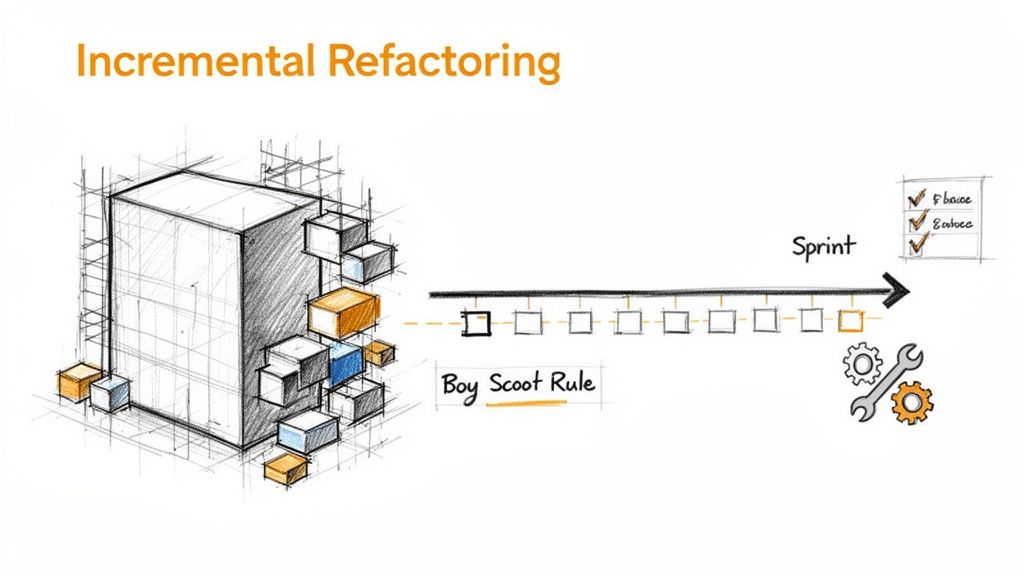
Small, consistent improvements are your best weapon against tech debt. Instead of planning a massive, risky rewrite, focus on chipping away at the problem piece by piece. This approach minimizes disruption and starts delivering value almost immediately.
One of the most powerful philosophies here is the Boy Scout Rule, and it’s beautifully simple: always leave the code better than you found it. When a developer dives in to fix a bug or add a feature, they should also take a few extra minutes to clean up the surrounding code. This could mean renaming a confusing variable, breaking down a long function, or adding a missing unit test. These small acts of hygiene compound over time, significantly improving the health of your codebase.
Dedicate a Slice of Each Sprint
While the Boy Scout Rule is great for opportunistic cleanup, some debt requires a more focused effort. A proven strategy is to formally allocate a percentage of each sprint’s capacity specifically to paying down tech debt.
Many successful teams I've worked with dedicate 10-20% of their development cycle to items pulled directly from the tech debt backlog. Doing this makes progress predictable and turns debt reduction into a measurable part of your velocity. It also prevents emergencies by steadily paying down debt so you can avoid that "all hands on deck" crisis when something critical finally breaks.
Safely Modernize with the Strangler Fig Pattern
For those larger, more intimidating chunks of legacy code, the Strangler Fig Pattern is a game-changer. Inspired by a type of vine that slowly envelops and eventually replaces its host tree, this pattern allows you to modernize a system piece by piece without a high-risk "big bang" rewrite.
You start by building new functionality as separate microservices that run alongside the old monolith. A facade then intercepts incoming requests, routing them to either the new service or the old system. Over time, you migrate more functionality to new services until the original monolith is fully "strangled" and can be safely retired. Our guide on legacy system modernization strategies dives deeper into patterns like this one.
Strengthen Your Processes and Automation
Finally, you can cut down on future debt by building guardrails to maintain quality from the start. This is all about strengthening the processes that govern your code in the first place.
Start with your code review standards. A good code review isn't just about spotting bugs; it's a critical tool for sharing knowledge and preventing sloppy code from ever getting merged. It’s also non-negotiable to invest in robust automated testing and a solid CI/CD pipeline. Automation acts as a safety net, giving your team the confidence to refactor aggressively without the fear of breaking something.
These process improvements are crucial across all industries, as technical debt is a major innovation killer. In fact, nearly 70% of organizations view tech debt as a major blocker to their innovation capabilities. That burden is felt even more acutely in specialized sectors; for example, 82% of biotech firms and 81% of telecom companies report that debt severely limits their ability to innovate.
Using AI to Accelerate Modernization
Sure, paying down existing tech debt is a critical battle. But the real war is won by preventing it from creeping back in. This is where artificial intelligence can completely change the game, shifting from just another feature to a powerful reason for modernization. When you strategically bring in AI, you can finally justify the very refactoring your systems desperately need, turning a cleanup project into an innovation initiative.
Instead of seeing AI and legacy systems as being in conflict, think of AI as the Trojan horse for improvement. Proposing a project to add intelligent automation or a personalized recommendation engine is a much easier sell to leadership than simply asking for time to "fix old code." The business value is immediate and tangible. The refactoring needed to support the new AI feature? That just becomes a natural, justifiable part of the process.
This approach completely flips the script. Tech debt is no longer a cost center; it's an investment in a smarter, more resilient future.
Overcoming the AI Integration Barrier
Of course, plugging advanced AI into aging infrastructure isn't exactly a walk in the park. The intersection of tech debt and AI integration is where many projects hit a wall. In fact, research shows that 41% of organizations point to the difficulty of integrating AI with legacy systems as a major barrier, and 55% blame a shortage of skilled talent.
It’s not just about the code, either. Poor data quality (40%), regulatory concerns (39%), and an uncertain ROI (31%) also add layers of complexity.
This is where the right tooling becomes your secret weapon. You need a way to bridge the gap between your existing application and the powerful AI models available today—without getting stuck in a multi-year, high-risk rewrite. The key is finding solutions that dramatically lower the barrier to entry for AI adoption. To get a better sense of the possibilities, you can explore specialized AI Automation solutions.
The smartest way to modernize is to make the process of adding new, intelligent capabilities so simple that it becomes the path of least resistance. This encourages incremental updates that naturally pay down debt over time.
By focusing on tools that simplify integration, you give your existing development team the power to start building with AI now. They can deliver value quickly, building momentum for those larger modernization efforts down the road. You can learn more about this approach in our article on how to leverage artificial intelligence for your business.
Lowering the Barrier with a Prompt Management System
This is precisely the problem we set out to solve here at Wonderment Apps. We saw countless entrepreneurs and developers eager to modernize with AI but completely stuck with their legacy apps and software.
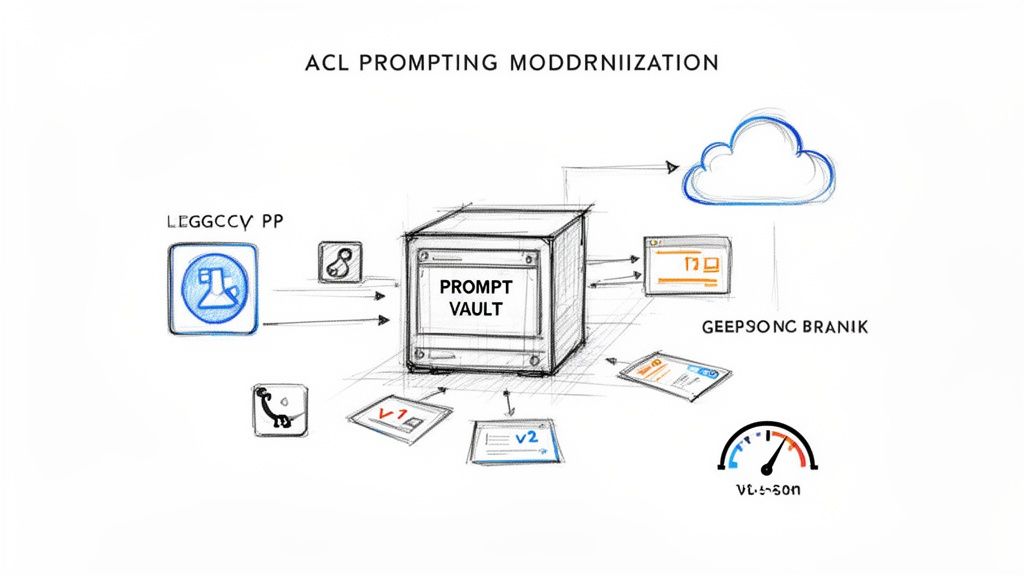
That’s why we developed our AI Prompt Management System. It's an administrative tool designed to slash the complexity of AI integration. It acts as a central nervous system, allowing your team to plug advanced AI capabilities directly into your existing applications, modernizing them for the AI era.
This creates a practical, low-risk path to modernization. Instead of a daunting rewrite, your team can start delivering immediate value while chipping away at tech debt at the same time.
Our system gives you a suite of powerful tools to manage the entire AI interaction lifecycle:
- Prompt Vault with Versioning: A central library for all your AI prompts. This lets your team iterate, test, and roll back prompt versions just like they do with code, giving you consistency and control.
- Parameter Manager: Securely connect your prompts to your internal databases. You can dynamically inject relevant, real-time data into your AI requests without exposing sensitive information.
- Logging System: Get a unified log of all interactions across every AI model you use (OpenAI, Anthropic, Gemini, etc.). This data is invaluable for debugging, auditing, and optimizing performance.
- Cost Manager: A real-time dashboard showing your cumulative AI spend. This transparency helps you manage budgets, track ROI, and make smarter decisions about your AI strategy.
By providing these foundational pieces out of the box, we free up your team to focus on what they do best: building great features, not wrestling with complex infrastructure. This speeds up innovation, reduces project risk, and makes it much easier to get that crucial executive buy-in for your ongoing tech debt initiatives.
Common Questions About Taming Tech Debt
Let's be honest, navigating the complexities of technical debt brings up some tough questions that go way beyond the code. When you're trying to figure out how to actually reduce tech debt, you're not just managing a backlog—you're managing people, priorities, and business expectations. Here are some direct answers to the challenges I see teams wrestle with most often.
Getting everyone on the same page, from your engineering team all the way up to the C-suite, is often the biggest hurdle. The conversation has to shift from technical jargon to tangible business outcomes.
How Do I Convince Leadership to Invest in Tech Debt?
The key is to speak their language: risk, cost, and opportunity. You have to stop talking about "refactoring the database schema" and start talking about what that hard work actually unlocks for the business.
Frame it in terms they understand. For instance, "If we tackle this, we can speed up customer report generation by 40% and cut our monthly server costs by 15%." Use the data you've gathered to build a compelling business case. Show them exactly what tech debt is costing the company right now in lost productivity, hours burned on bug fixes, and delayed feature releases.
Connect your proposed fixes directly to their strategic goals. Something like, "To hit our European market launch next quarter, we have to fix the debt in our internationalization module. Otherwise, we're looking at costly delays and a terrible user experience."
By translating technical problems into business impact, you're no longer asking for a favor. You're presenting a strategic investment with a clear, measurable return. This reframing is absolutely essential for getting the buy-in you need.
What Is the Difference Between Good and Bad Tech Debt?
It’s a common misconception that all tech debt is a mistake. The truth is, some debt is a calculated risk you take to gain a strategic advantage. The real distinction comes down to intent and planning.
-
Good Tech Debt: This is a conscious, strategic tradeoff made to hit a critical deadline or test a market hypothesis quickly. The team understands the shortcuts being taken and has a clear plan to repay the debt soon. A perfect example is launching an MVP with a simplified algorithm to get user feedback fast, knowing full well you'll replace it with a more robust version next quarter.
-
Bad Tech Debt: This is the unintentional kind that accumulates from sloppy practices, a lack of knowledge, or just plain neglect. It's the messy, undocumented code that has no repayment plan and quietly makes your system fragile, unpredictable, and a nightmare to change.
In short, good debt is a deliberate loan you plan to pay back. Bad debt is like letting your credit card balance spiral out of control with no plan to stop it.
Should We Dedicate an Entire Sprint to Tech Debt?
While a dedicated "cleanup sprint" can feel like a great way to make a big dent, it’s often more effective to integrate debt reduction into your regular workflow. The problem with a full cleanup sprint is that it halts all feature development, which can be a tough sell to the business. It can also create a "feast or famine" cycle where debt is ignored for months and then suddenly becomes a five-alarm fire.
A much healthier practice is to allocate a fixed percentage of each sprint—say, 20% of your capacity—to items from the tech debt backlog. This approach creates a sustainable, predictable pace of improvement. More importantly, it builds a habit of continuous improvement into your team’s culture, ensuring that you're consistently making the codebase healthier.
A full sprint might be necessary for a large, self-contained architectural change, but for most issues, the incremental approach is far less disruptive and delivers more predictable, long-term results.
At Wonderment Apps, we help businesses transform their legacy systems into modern, AI-powered applications. If you're ready to accelerate your modernization efforts and turn your tech debt into a competitive advantage, schedule a demo of our AI Prompt Management System today.