

Picking the right ecommerce platform is more than a line item on a project plan; it's the engine that will either power your growth or hold you back. A real ecommerce platform comparison has to go deeper than a simple feature checklist. You need to look at how each system handles scale, how it plays with your existing tech, and whether it’s ready for what's next, like AI-driven personalization. This guide is designed to give you that deeper analysis, helping you choose a platform that’s built for the long haul.
Choosing the Right Ecommerce Engine for Your Business
Let's be clear: selecting an ecommerce platform is a foundational business decision, not just an IT one. The right system makes your operations smoother and opens up new ways to make money. The wrong one, however, creates constant friction, lost sales, and eventually, a painful and expensive migration you wish you'd avoided.
This comparison won't just skim the surface. We're going to get into the criteria that actually matter in the real world. Too many businesses get locked into an ecosystem that eventually stifles their growth. At Wonderment Apps, we don't just help companies pick the right platform; we help them supercharge it with powerful AI capabilities to stay ahead. In fact, we’ve developed a powerful prompt management system that entrepreneurs and their developers can plug into any app to modernize it for AI integration. It’s the kind of tool that helps you build an excellent app experience that can scale to meet any audience size. We’ll dive a little deeper into that later, but just know that adding AI to your software isn’t some far-off dream—it’s very achievable today.
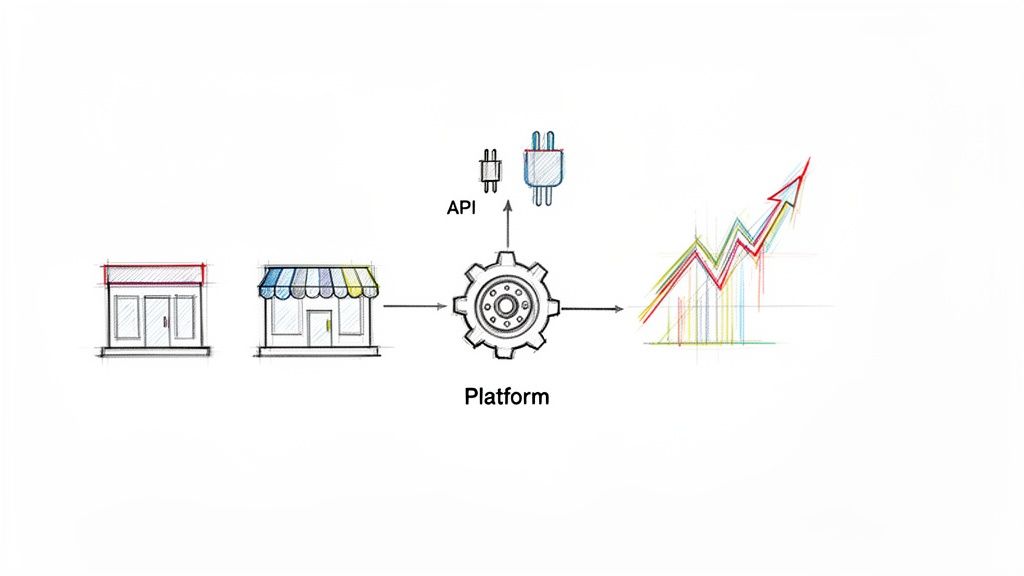
Key Factors for Your Platform Comparison
Before you even start looking at platforms, you have to know what you're looking for. Every business has different priorities, and nailing yours down is the first step to making a smart choice. If you want to get a broader sense of the landscape, you can discover various ecommerce platforms and find the best fit for your specific business needs.
No matter your industry, your evaluation should always include these core criteria:
- Scalability and Performance: How does the platform hold up during a flash sale? Can it handle your product catalog doubling in size overnight?
- Total Cost of Ownership (TCO): Don't just look at the monthly fee. You have to factor in transaction costs, essential apps, and the potential need for developer support.
- AI and Personalization Readiness: Does the platform have native AI tools ready to go, or are you looking at a complex web of third-party integrations to create those personalized customer journeys?
The central tension in any ecommerce platform comparison boils down to simplicity versus control. Fully hosted platforms give you ease of use and security right out of the box, while open-source options offer total flexibility—but you're on the hook for all the technical heavy lifting.
Modernization and Future-Proofing
Even the perfect platform today needs a plan for tomorrow. Technology moves fast, and your ability to plug in modern tools is non-negotiable. This is where thinking about AI integration from the start can give you a massive leg up, helping you modernize your application and build it to last.
Before we jump into the platform-by-platform breakdown, it’s good to have the basics down. For a primer, take a look at our guide on how to launch an online business from the ground up.
Now, let's put today's top platforms head-to-head to see how their capabilities line up with your strategic goals.
| Business Profile | Top Recommendation | Key Reason |
|---|---|---|
| Startups and DTC Brands | SaaS Platforms (e.g., Shopify) | Unmatched ease of use, a vast app store, and a reliable, all-in-one system that lets you launch quickly. |
| WordPress Site Owners | Open-Source (e.g., WooCommerce) | Seamlessly integrates commerce into an existing WordPress site, offering maximum control and customization. |
| B2B or Complex Catalogs | Flexible SaaS (e.g., BigCommerce) | Provides powerful, built-in features for B2B sales and managing complex product variations without extra apps. |
Understanding the Modern Ecommerce Landscape
The world of online retail isn’t just growing—it’s changing the very DNA of how businesses operate. Choosing an ecommerce platform today isn't about just listing products online anymore. It’s a foundational decision. The platform you select dictates your agility, your control, and your ability to meet ever-evolving customer expectations. This choice will define how you compete for years.
This isn’t just a trend; it's an explosion. The ecommerce platform market was valued at an impressive USD 9.40 billion in 2024 and is projected to climb to USD 10.46 billion in 2025. With a compound annual growth rate of 20.2%, the market is on a trajectory to hit USD 45.60 billion by 2033. These numbers show just how critical these systems are to modern commerce. To pick the right engine for your business, you have to understand the major shifts happening right now, like the rise of AI shopping platforms that are completely reshaping customer interactions. For a deeper dive into these market dynamics, you can check out this detailed industry report.
Differentiating the Core Platform Models
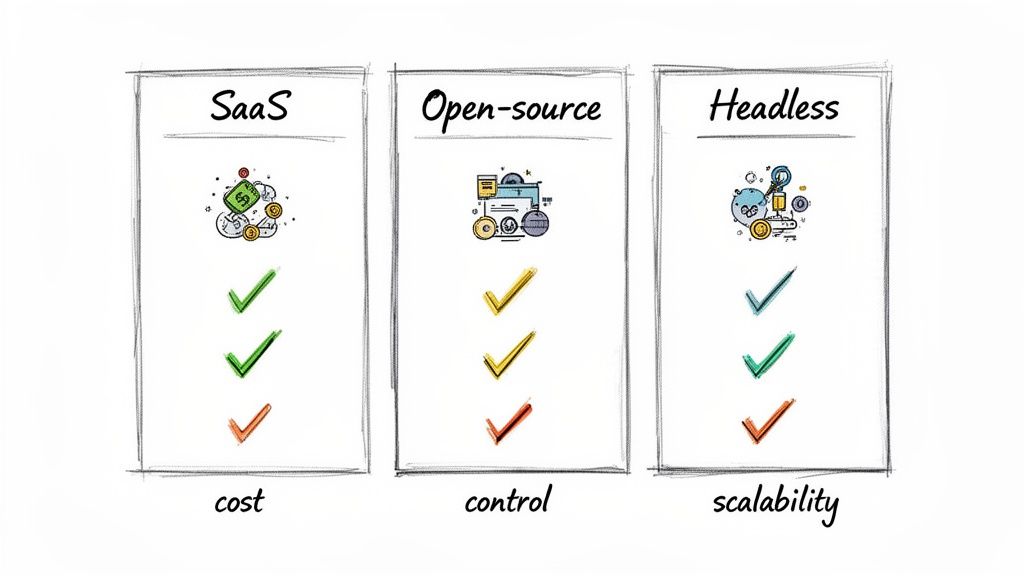
When you boil it down, ecommerce platforms really fall into three main buckets: SaaS (Software-as-a-Service), open-source, and headless. Each model strikes a different balance between convenience, control, and cost. Getting a handle on these differences is the first real step toward making the right call.
- SaaS (e.g., Shopify, BigCommerce): Think of this as the all-in-one, subscription model. You pay a monthly fee that covers the software, hosting, security, and support. It's the fastest way to get your store up and running, but it also gives you the least control over the core code.
- Open-Source (e.g., WooCommerce, Adobe Commerce/Magento): With open-source platforms, the software itself is free. The catch? You’re on the hook for everything else—hosting, security, maintenance, and all the updates. This route offers total customization but demands serious technical muscle.
- Headless Commerce: This is a more advanced, API-first approach. It separates the front-end "head" (what your customers see) from the back-end commerce engine. It gives you complete creative freedom to build unique experiences across any channel, but you'll need a sophisticated development team to pull it off.
The central decision in any platform evaluation comes down to a simple question: Do you want to rent a highly reliable, managed solution (SaaS), or do you want to own and build upon a completely customizable framework (open-source)?
Establishing Our Comparison Criteria
To give you a genuinely useful ecommerce platform comparison, we’re going to analyze the top contenders—Shopify, WooCommerce, BigCommerce, Adobe Commerce, and Salesforce Commerce Cloud. We'll look at them through the lens of what actually impacts your business's success.
These criteria go beyond a simple feature checklist to assess how each platform holds up under the pressures of the real world.
Core Evaluation Pillars:
- Scalability & Performance: How well does it handle a sudden traffic spike or a massive product catalog?
- AI & Personalization Readiness: What can it do out-of-the-box to create smart, personalized experiences for your customers?
- Total Cost of Ownership (TCO): What’s the true cost when you factor in subscription fees, transaction charges, apps, and maintenance?
- Security & Compliance: How strong are its security features, and can it meet standards like PCI compliance without a ton of extra work?
- Extensibility & Integrations: How easily does it plug into your existing tech stack and the third-party apps you rely on?
By looking at each platform this way, you can cut through the marketing noise and find the solution that truly lines up with your operational needs and long-term goals.
A Detailed Ecommerce Platform Comparison
Choosing an ecommerce platform is about more than just a features checklist. The real test comes when you look at how each one performs under the pressure of real-world business demands—from surviving a viral flash sale to integrating the next wave of AI-driven personalization. This is where you uncover the true cost and value of your investment.
We’re going to break down the top contenders across the criteria that actually matter to a growing business: scalability, AI readiness, total cost of ownership (TCO), and extensibility. This isn't a theoretical exercise; it's a head-to-head analysis of where each platform shines and where its limits might hold you back.
Scalability and Performance Under Pressure
Scalability isn’t just about handling more traffic. It's about how gracefully a platform supports your growth without forcing you into a corner and demanding a complete technical overhaul.
Shopify Plus is practically engineered for this. Its SaaS architecture means that when your Black Friday campaign blows up, the infrastructure automatically handles the surge. You don't have to touch a single server setting. That peace of mind is a massive reason why high-growth DTC brands flock to it.
On the other hand, Adobe Commerce (formerly Magento) offers almost limitless power, but it puts the responsibility for performance squarely on your shoulders. It can handle enormous, complex catalogs and staggering transaction volumes, but only if you have the expert dev team and rock-solid hosting to back it up. Scaling here is a hands-on, resource-intensive job that involves constant monitoring and server optimization.
The core difference in scalability comes down to managed versus unmanaged growth. Shopify Plus offers a predictable, "it just works" experience, while Adobe Commerce provides limitless potential for businesses with the technical resources to build and maintain a high-performance environment.
AI and Personalization Readiness
Delivering a personalized customer experience isn't a "nice-to-have" anymore; it's a baseline expectation. Ecommerce platforms are responding, but with vastly different levels of native AI integration.
Salesforce Commerce Cloud really stands out with its embedded Einstein AI. It gives you out-of-the-box product recommendations, predictive sorting, and deep customer insights. This native integration is a powerful head start for any business ready to get serious about data-driven personalization.
Platforms like Shopify and BigCommerce lean more on their third-party app ecosystems. You can absolutely achieve sophisticated personalization, but it often means stitching together several different apps for recommendations, targeted promos, and customer segmentation. This gives you flexibility, but it can also create data silos and add a lot of complexity.
This is often where a partner like Wonderment Apps can make all the difference. We help businesses integrate custom AI models directly into their chosen platform, moving beyond the limits of off-the-shelf apps to create truly unique, intelligent shopping experiences. If you're exploring how to take your store to the next level, check out our insights on customizing ecommerce platforms for modern capabilities.
To make these differences clearer, let's look at a direct comparison of the leading platforms.
Ecommerce Platform Feature and Scalability Matrix
This table cuts through the marketing noise to give you a direct comparison of the major players across critical business criteria. From the ideal company size and pricing models to their inherent scalability and readiness for advanced AI integration, here’s how they stack up.
| Platform | Ideal Business Size | Pricing Model | Scalability | AI & Personalization Readiness |
|---|---|---|---|---|
| Shopify Plus | Mid-Market to Enterprise | SaaS Subscription + % of Sales | Excellent; automated, hands-off infrastructure | Good; relies heavily on a robust third-party app ecosystem |
| Adobe Commerce | Enterprise | License Fee or Open-Source (Self-hosted) | Excellent; highly customizable but requires significant developer resources | Very Good; powerful native features and extensibility for custom AI |
| BigCommerce | SMB to Enterprise | SaaS Subscription | Very Good; open SaaS model with strong API access | Good; flexible API supports custom solutions and app integrations |
| Salesforce Commerce Cloud | Enterprise | GMV-based % of Sales | Excellent; built for high-volume, global brands | Excellent; native Einstein AI for out-of-the-box personalization |
| WooCommerce | SMB to Mid-Market | Open-Source (Free plugin) | Good; performance depends entirely on hosting and developer expertise | Fair; requires multiple plugins and custom development |
This matrix highlights the fundamental trade-offs you'll need to consider. A platform like Salesforce offers incredible built-in intelligence but comes at an enterprise price point, while WooCommerce provides a low-cost entry but places the burden of performance and advanced features on your team.
Total Cost of Ownership Unpacked
That monthly fee you see advertised? It’s just the tip of the iceberg. The real TCO includes hosting, maintenance, security, transaction fees, and the cost of all those essential third-party apps.
SaaS platforms like Shopify and BigCommerce give you predictable, subscription-based pricing. Their fees are transparent, and while costs go up as you add apps or upgrade plans, you’re less likely to be hit with surprise expenses for infrastructure or security updates.
Open-source platforms have a completely different financial model. WooCommerce, for instance, is a free plugin, but that’s just the starting line. You are responsible for everything else: hosting, security patches, performance optimization, and buying premium extensions for critical features. It can be cost-effective for teams with deep technical skills, but the TCO can easily eclipse a SaaS subscription once you factor in developer hours and ongoing maintenance.
Market distribution really highlights this trade-off. WooCommerce is the global leader, holding a massive 37% market share with over 6.5 million active stores. Its appeal is its low barrier to entry and deep integration with WordPress. Trailing with a 21% share, Shopify dominates by offering a user-friendly, all-in-one solution that scales seamlessly, making it a favorite for brands focused on growth.
Extensibility and Integration Potential
Your ecommerce platform has to play nice with your entire tech stack, from your ERP and PIM to your marketing automation tools.
- BigCommerce is often praised for its "open SaaS" approach. It provides more generous API access and fewer restrictions than Shopify, making it a strong contender for businesses needing to build deep, custom integrations with back-office systems.
- WooCommerce, being open-source, offers truly limitless extensibility. If you have the development talent, you can customize every single aspect of the platform and connect it to virtually any system imaginable.
- Shopify boasts the largest app store by a wide margin, offering plug-and-play solutions for thousands of common business needs. The trade-off is that its API has more limitations, which can sometimes be a roadblock for complex, enterprise-level integrations.
Ultimately, choosing the right platform means carefully weighing these factors against your company's specific needs, budget, and in-house technical capabilities.
Which Platform Wins for Your Business Model?
A side-by-side platform comparison is a good starting point, but it doesn't tell the whole story. The real question is how a platform's strengths align with your specific business model. What’s a must-have feature for a direct-to-consumer (DTC) brand might be totally useless for a B2B enterprise. Let's move past the feature checklists and get into clear recommendations for how you actually operate.
Making the right call means knowing the landscape. Amazon is the benchmark, capturing between 37.6% and 40.9% of the US market with a sophisticated AI recommendation engine that drives conversion rates of 4-5%. That sets a high bar. While independent stores on Shopify might see conversions between 2.5-4.2% even with personalization apps, the right platform choice can absolutely help close that gap. For a deeper dive into these market dynamics, you can discover more insights about ecommerce statistics on tekrevol.com.
For the Fast-Growing DTC Brand
DTC brands have to move fast, build an unforgettable brand experience, and scale without hitting a technical wall. Speed to market and rock-solid reliability during a Black Friday sale aren't just nice-to-haves; they're everything.
For this model, Shopify Plus is the hands-down winner. Its managed SaaS infrastructure means you’ll never get a 3 a.m. call about servers crashing during a flash sale. The platform is built for simplicity, letting your marketing team launch campaigns and drop new products without waiting on a developer. The app ecosystem is also massive, offering plug-and-play solutions for social commerce, influencer marketing, and subscriptions—all the essential growth levers for a modern DTC brand.
Recommendation: Shopify Plus. It hits the perfect sweet spot of usability, scalability, and a rich app ecosystem. This lets DTC brands do what they do best: focus on marketing and product, not server maintenance.
For the Complex B2B Enterprise
B2B ecommerce is a completely different beast, built on a foundation of complexity. We're talking client-specific pricing, bulk order forms, custom catalogs, and deep integrations with ERP and CRM systems. Your average B2C platform just can't handle this without a ton of expensive, custom work.
In this space, Adobe Commerce (Magento) and BigCommerce are the two heavyweights. Adobe Commerce gives you unmatched power and flexibility, but only if you have the in-house technical muscle to tame it. You can literally build any custom B2B function you can dream up.
But if you want powerful B2B features without the heavy lift of open-source, BigCommerce is often the smarter move. Its "Open SaaS" model provides robust, native B2B functionality—like customer groups and purchase orders—right out of the box, while its strong APIs still allow for custom integrations.
Recommendation: BigCommerce. It delivers enterprise-grade B2B features without the headaches, offering a more streamlined and cost-effective path to a powerful B2B portal than a full-blown Adobe Commerce build.
For the Content-Driven Retailer
For businesses where content is king—think media companies, publishers, or influential bloggers—the platform needs to blend content and commerce into one seamless experience. The goal is to make shopping feel like a natural part of the story, not a clunky afterthought.
Here, WooCommerce is the clear frontrunner. As a native plugin for WordPress, the world's most popular CMS, it provides the tightest possible integration between your articles and your store. You can embed "buy" buttons directly into your posts, create beautiful, highly customized landing pages, and tap into the entire WordPress plugin ecosystem to build a truly content-first shopping journey.
Recommendation: WooCommerce. Its native connection to WordPress makes it the no-brainer choice for any business that uses content marketing as its core strategy. It offers unparalleled flexibility to weave commerce directly into your editorial.
Future-Proofing Your Store with Custom AI
Picking the right ecommerce platform is a huge first step, but it's really just the foundation. The kind of competitive advantage that lasts comes from building a modern, intelligent application on top of that base. The real opportunity for growth isn't just in the platform itself, but in future-proofing your investment with custom AI that turns a standard site into a powerful, data-driven experience.
This completely changes the conversation from a simple platform comparison to a discussion about building a unique competitive edge. Your platform is the engine, but custom AI is the intelligent navigation system, guiding every single customer to exactly what they need.
Moving Beyond Off-the-Shelf Solutions
Sure, many platforms have marketplaces full of third-party AI apps for things like personalization. These tools are great for getting started, but they often operate within a pretty rigid box. They can't always grasp the unique quirks of your business model or the specific behaviors of your customers. Real innovation happens when you build custom AI capabilities designed from the ground up for your operational needs and strategic goals.
This is where Wonderment Apps comes in. We focus on integrating sophisticated AI to power features that don't just look cool—they actually boost conversion rates and build real customer loyalty.
- Advanced Personalized Recommendations: We go way beyond "customers who bought this also bought." Our systems analyze deep behavioral patterns to predict what a customer will want next.
- Dynamic Pricing Models: Imagine adjusting prices in real-time based on demand, inventory, and competitor actions, all without lifting a finger. That's what AI can do.
- Intelligent Anomaly Detection: Our tools can automatically flag weird sales patterns or potential fraud, protecting your business and keeping things running smoothly.
The decision tree below gives you a sense of how different business models might approach their initial platform selection. Think of this as the first step before layering on these kinds of advanced, custom features.
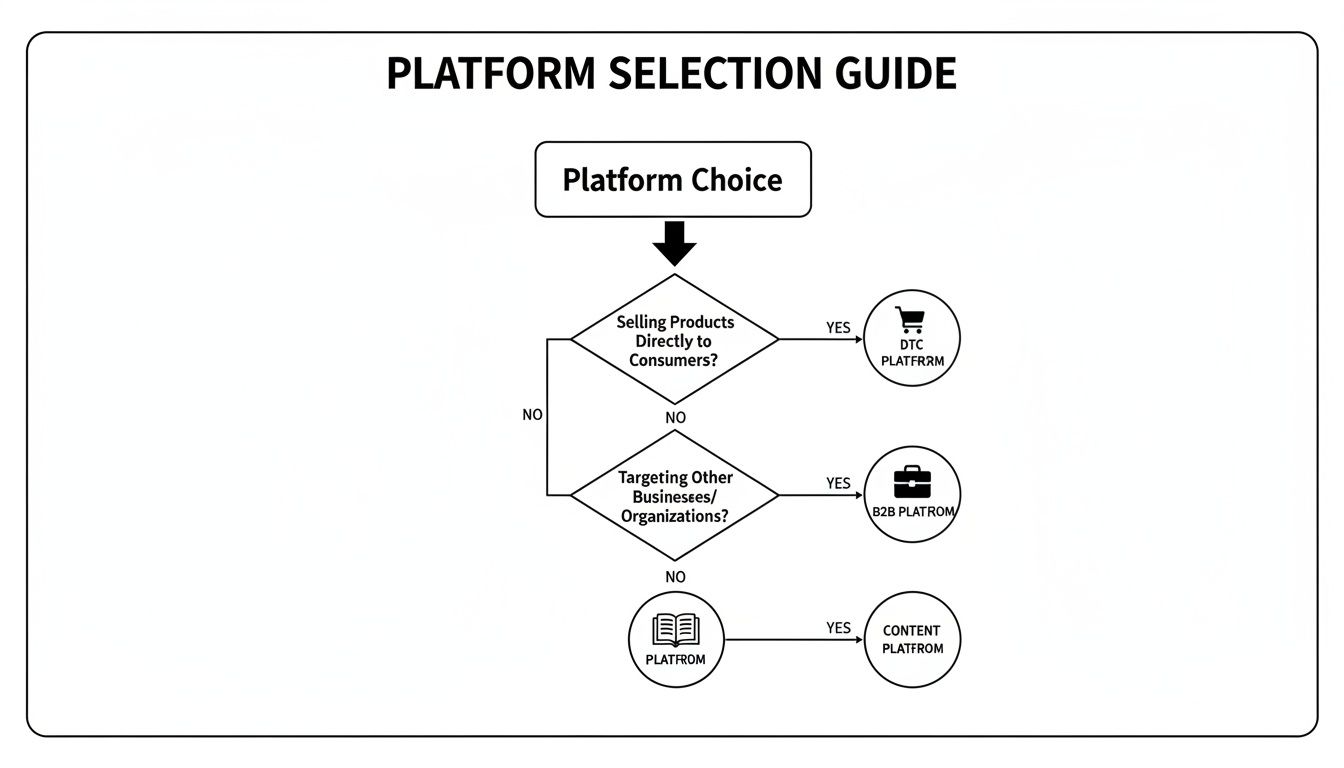
As you can see, the initial choice is guided by your core model. But the journey to market leadership demands building intelligence right on top of that foundation.
The Power of a Prompt Management System
We get it—integrating custom AI can sound daunting, especially when you're trying to manage multiple AI models and get consistent, high-quality results. To solve this, we've developed a centralized prompt management system. It's an administrative tool that developers can plug into any application to streamline and control every part of the AI integration. It’s built to give entrepreneurs and their technical teams complete command over their AI operations.
Our system is built to empower developers, not restrict them. It provides the structure needed to manage AI at scale while giving them the freedom to innovate and build truly unique customer experiences that drive measurable business results.
This tool makes the whole development lifecycle simpler by providing a solid framework for managing every single AI interaction. For a deeper dive into how these applications create real value, you can learn more about the specific benefits of AI in ecommerce in our dedicated article.
Core Features that Empower Your Team
Our prompt management system isn't just an organizational tool; it’s a complete command center for your AI initiatives. It gives your development team the features they need to build, deploy, and manage AI-powered functionalities with confidence.
Here are the key components of our system:
- Centralized Prompt Vault with Versioning: Store, manage, and track every version of your AI prompts in one secure place. This ensures consistency and lets your team easily roll back to previous versions or test new ones without breaking anything.
- Parameter Manager for Database Access: Securely link your AI models to your internal databases. This lets the AI pull real-time data—like inventory levels or customer history—to generate incredibly relevant and accurate responses.
- Comprehensive Logging System: Keep a detailed log of every interaction across all of your integrated AI models. This is absolutely critical for debugging, monitoring performance, and staying compliant.
- Integrated Cost Manager: Get a clear picture of your AI spending. The cost manager tracks your cumulative spend across all models, helping you manage your budget and avoid any nasty surprises as you scale up.
Using these tools, our expert developers build robust, scalable applications that fit perfectly with your chosen ecommerce platform. This approach doesn't just modernize your store—it builds a sustainable technological advantage that will serve you for years to come.
Planning a Successful Platform Migration
Moving your ecommerce store to a new platform is one of the highest-stakes projects you can undertake. Get it wrong, and you’re looking at lost sales, broken customer trust, and a devastating hit to your search engine rankings.
But when a migration is planned and executed correctly, it's a game-changer. It’s the strategic move that sets your business on a more modern, scalable foundation for long-term growth.
This process is so much more than just flipping a switch. It demands meticulous planning, from mapping every piece of customer and order data to preserving the SEO authority you’ve worked so hard to build. Even a tiny oversight can snowball into major headaches that stick around for months. This is exactly why the partner you choose to lead the project is just as crucial as the platform you're moving to.
Choosing the Right Migration Partner
Honestly, selecting an experienced development partner is the single most critical decision you'll make. You need a team that has been in the trenches with these complex projects before and truly gets the unique challenges of ecommerce. Their expertise is the difference between a smooth launch and a chaotic, stressful disaster.
When you're vetting potential partners, you have to ask the right questions—the ones that cut through the sales pitch:
- Platform Expertise: How many migrations have you actually completed on these specific platforms? Show me examples.
- Project Management: What’s your methodology for a project this big? How will you keep us in the loop and ensure we hit our deadlines?
- AI Modernization: It's not just about moving what we have. How do you approach integrating modern AI capabilities during the migration to make sure this investment lasts?
A managed project gives you a dedicated, accountable team—engineers, project managers, and QA specialists—all focused on one thing: a successful outcome. This structure ensures every single base is covered, from the nitty-gritty technical work to the high-level strategic planning.
The goal of a migration isn't just to replicate your old store on a new platform. It's an opportunity to rebuild smarter, clean up legacy data, and integrate the modern tools you need to compete and win.
Key Migration Considerations
A rock-solid migration plan has to address several critical areas to prevent any disruption to the business. First and foremost is data integrity. You absolutely must ensure every customer account, order history, and product detail is transferred with 100% accuracy. This takes careful data mapping and validation before you even think about going live.
Just as important is SEO preservation. Your partner has to implement a comprehensive 301 redirect strategy to pass authority from your old URLs to the new ones. Skipping this step is a surefire way to watch your search rankings tank.
Finally, rigorous testing of every single integration—from your payment gateways to your ERP—is non-negotiable. This is how you guarantee that on launch day, your business runs without a single hitch.
A Few Final Questions
When you're this deep in a platform comparison, a few nagging questions always seem to surface. Getting clear answers to these is the last step before you can make a choice you’ll be happy with for the long haul. Let's tackle the common sticking points we see business leaders wrestle with before they sign on the dotted line.
How Hard Is It to Switch Platforms Later On?
Let's be honest: migrating your ecommerce store is a major undertaking. But it's a well-trodden path for businesses that have outgrown their first home. The real complexity—and the final price tag—boils down to the size of your catalog and which two platforms you're moving between.
Think of it like moving to a new house. You can hire a team to move the boxes (your product, customer, and order data), but you’re still the one who has to redecorate and get the utilities turned on (your theme, apps, and integrations). You absolutely have to budget for both the technical data migration and the redesign to ensure everything goes smoothly, without tanking your SEO or rattling customer trust.
Why Does the App Ecosystem Matter So Much?
A platform's out-of-the-box features are just the starting point. The real magic, the thing that separates a good platform from a truly great one, is its app ecosystem. This is what lets you bolt on sophisticated functionality—like advanced loyalty programs, niche marketing tools, or slick subscription models—without writing a huge check for a custom build.
If a platform has a tiny or low-quality app store, you’re basically painting yourself into a corner. You either learn to live without critical features, or you get ready to spend a fortune on custom development.
A thriving app marketplace, like the ones you'll find on Shopify or BigCommerce, gives you thousands of battle-tested, affordable solutions right at your fingertips. It’s one of the biggest factors in keeping your store agile and a step ahead of the competition.
How Do I Actually Future-Proof My Choice?
"Future-proofing" isn't about gazing into a crystal ball. It’s about choosing a platform that's fundamentally built for change. Your best bet is to go with a solution that has a proven track record of staying ahead of the technology curve.
Look for these signs of a forward-thinking platform:
- Headless Capabilities: The option to decouple your back-end commerce engine from the front-end customer experience is huge. This API-first approach gives you complete freedom to build new customer touchpoints on any device or channel imaginable.
- A Steady Stream of Updates: A platform that regularly ships new features and polishes existing ones is clearly investing in its own future—and by extension, yours.
- A Strong Developer Community: When you see a large, active community of developers building apps and integrations, it's a powerful signal that the platform is healthy, growing, and that smart people are betting on it.
Picking a platform that checks these boxes ensures your business can evolve right alongside technology, protecting your investment for years to come.
At Wonderment Apps, we don't just help businesses choose the right platform. We specialize in modernizing it with the custom AI solutions that actually drive growth. Our unique prompt management system makes integrating sophisticated AI into your app simpler and more powerful than ever before. We love helping entrepreneurs and developers design excellent app experiences that are built to last.
Ready to see how our AI tools can transform your business? Schedule a demo with us today!