

Data analytics and the Internet of Things (IoT) aren't just buzzwords; they're a dynamic duo turning raw data from connected devices into real business intelligence. This pairing allows companies to shift from simply reacting to problems to proactively making data-driven decisions. The core idea is simple: use device data to understand what's happening now and predict what's next. For business leaders looking to make their software initiatives successful, mastering this synergy is a game-changer.
The Unstoppable Synergy of Data and Devices
Welcome to the new frontier of business intelligence, where IoT and data analytics come together to create some serious value. This is about more than just connecting smart thermostats or factory sensors; it's about making sense of the tidal wave of data they produce and turning it into clear, actionable insights that fuel growth. For any business leader, this combination is the key to unlocking new efficiencies and building smarter applications that can scale to meet the size of any user audience.
The sheer scale of this data explosion is hard to wrap your head around. The growth in connected IoT devices is completely reshaping analytics, with 16.6 billion devices active globally by the end of 2023. That number is set to jump to 18.8 billion by the end of 2024 and hit a staggering 40 billion by 2030. This massive fleet of devices generates petabytes of real-time data from sensors everywhere—factories, retail stores, smart cities—all demanding advanced analytics to find the signal in the noise. You can find out more about the explosive growth of connected devices and its impact on the industry.
Why This Combination Matters Now
Bringing data analytics and IoT together is critical for staying competitive. It allows organizations to build intelligent, responsive systems that can adapt to changing conditions on the fly. Think about the impact across the business:
- Operational Efficiency: Predictive maintenance alerts can flag potential equipment failures before they happen, saving a fortune in downtime and repairs.
- Customer Experience: In-store sensors can analyze foot traffic to optimize layouts or trigger personalized offers right when they're most relevant.
- Strategic Planning: Looking at long-term data trends can provide the insights needed to guide new product development or identify the next market to enter.
For modern businesses, integrating IoT data streams with AI is no longer a "nice-to-have"—it's essential for survival and growth. The ability to master this synergy is the foundation for building intelligent, scalable, and future-proof software applications.
At Wonderment Apps, we've seen firsthand how a well-managed AI integration can turn this raw data into a decisive competitive advantage. The real challenge often isn't the data itself, but effectively managing the interaction between your application and the AI models that process it. That’s why we built a robust prompt management system—an admin tool that lets developers and entrepreneurs seamlessly plug AI capabilities into their existing desktop or mobile apps, modernizing them to last for years to come. By simplifying the technical hurdles, business leaders can focus on what really matters: using data to create value. In this guide, we’ll demystify how this powerful duo works and show you how to put it into action.
Decoding the IoT Data Analytics Pipeline
Before you can pull real value from your connected devices, you need to understand the journey their data takes. The data analytics and IoT pipeline is the structured path that turns raw sensor readings into strategic business insights. It helps to think of it like a farm-to-table supply chain.
Your IoT devices are the farm, constantly producing a harvest of raw data. This data is then collected, processed at different stages, and finally served up to your business leaders as a valuable meal—actionable intelligence. This journey isn’t a single, straight road; it's more like a network of pathways with different processing locations, each with its own unique strengths.
The flow below gives you a high-level picture of how raw data from devices gets transformed into useful insights.
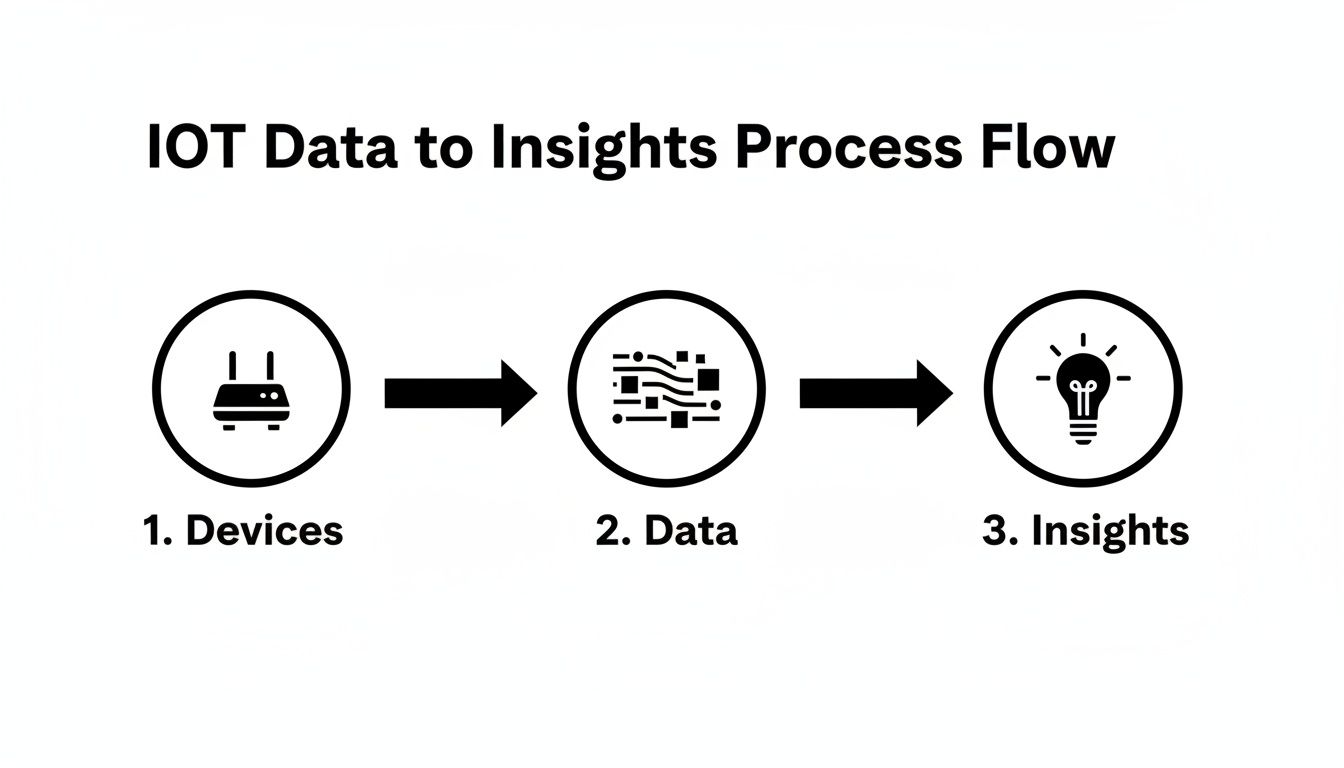
As you can see, this isn't an instant event. It's a multi-step process where each stage refines the data, adding more value as it moves toward the final analysis.
The First Stop: Edge Computing
The first and fastest processing stop is right where the action is—this is edge computing. Instead of shipping every last data point to a central server, the device itself (or a gateway right next to it) does some of the initial analysis. This is non-negotiable for any application that needs split-second decisions.
Picture a robot on a factory floor with a sensor that spots a potential malfunction. Edge computing lets that robot shut down immediately to prevent damage, all without waiting for a command from a server miles away. To make this work at scale, following modern data engineering best practices is absolutely essential.
So, why process at the edge?
- Reduced Latency: Decisions happen in milliseconds, which is critical for real-time control.
- Lower Bandwidth Costs: You're only sending important or summarized data to the cloud, which can save a fortune.
- Improved Reliability: The system keeps running even if its connection to the main network goes down.
The Middle Ground: Fog Computing
Sitting between the local edge and the distant cloud is fog computing. This middle layer brings some of the cloud's power closer to the devices that need it. Fog nodes—think powerful routers or local servers—can gather data from multiple edge devices in a defined area, like a single retail store or a city block.
This regional approach is perfect for tasks that need more muscle than a single edge device can offer but still demand a faster response than the cloud can deliver. A smart traffic grid, for instance, could use fog computing to analyze data from all intersections in a neighborhood to optimize traffic lights, cutting down congestion without sending every car's data to a national data center.
The choice of where to process data—at the edge, in the fog, or in the cloud—is a strategic one. It directly impacts your application's speed, cost, and ability to scale. There is no one-size-fits-all answer here.
The Final Destination: Cloud Analytics
The last stop on this journey is the cloud. This is where the heavy lifting happens and deep analysis takes place. Cloud platforms offer virtually unlimited storage and computing power, making them the perfect place to run complex machine learning algorithms on massive historical datasets. You can see how this works in practice by applying data pipelines to business intelligence and learning the core principles.
In the cloud, you can aggregate data from thousands or even millions of devices over months or years. This is where you spot long-term trends, train predictive models, and generate the high-level business intelligence that guides major strategic decisions. An e-commerce company, for example, might use cloud analytics to study years of customer behavior data to forecast future demand.
This combination of edge, fog, and cloud creates a flexible and powerful architecture, ready for any IoT initiative you can dream up.
Comparing IoT Data Processing Architectures
To make the right choice, it's helpful to see these architectures side-by-side. Each has its place, and the best solution often involves a mix of all three.
| Architecture | Processing Location | Best For | Pros | Cons |
|---|---|---|---|---|
| Edge Computing | On the IoT device or a local gateway | Real-time decisions, low-latency applications (e.g., industrial automation, autonomous vehicles) | Extremely fast response times, reduces data transmission costs, works offline | Limited processing power and storage, complex to manage many distributed devices |
| Fog Computing | A local network node (e.g., router, LAN server) | Regional data analysis, time-sensitive tasks that need more power than the edge (e.g., smart city grids, retail analytics) | Faster than the cloud, handles more data than the edge, better scalability for local operations | More complex infrastructure than pure edge or cloud, can introduce security vulnerabilities |
| Cloud Computing | Centralized remote data centers | Big data analytics, machine learning model training, long-term data storage | Virtually unlimited scalability and power, centralized management, deep analysis capabilities | Higher latency, dependent on internet connectivity, can be expensive for high data volumes |
Ultimately, choosing between edge, fog, and cloud isn't an either-or decision. It's about designing a smart, layered system that processes data at the right place and the right time to meet your specific business goals.
Real-World IoT Analytics in Action
Theory and architecture are great starting points, but the real magic happens when you see IoT and data analytics driving actual results. When you move from concepts to concrete examples, you start to see just how powerful this combination can be. Businesses across every industry are using connected devices and smart analytics to solve tough challenges and uncover new opportunities.
These aren't just futuristic ideas; they're practical applications delivering real returns right now. By looking at how different sectors are putting IoT data to work, you can start to see how these solutions could fit your own business. The trick is to connect the stream of data to a specific, meaningful outcome.
E-commerce and Retail Get Personal
The retail world is the perfect laboratory for IoT analytics. Brick-and-mortar stores are being reborn as intelligent environments that can understand and react to customer behavior in the moment.
Picture a retail store outfitted with smart shelves and overhead sensors. These devices do more than just track inventory—they analyze foot traffic, see which displays grab the most attention, and even measure how long shoppers linger in a particular aisle. This flood of data lets the store:
- Optimize Layouts: By mapping out high-traffic "hot zones" and dead spots, managers can rearrange products to maximize visibility and drive sales.
- Trigger Dynamic Offers: Imagine a customer who browsed a specific product online walks past it in the store. A beacon can instantly push a personalized discount to their phone through the store's app.
- Improve Staffing: Analytics can predict peak shopping times with startling accuracy, making sure there are always enough employees on the floor to help customers and keep checkout lines moving.
This kind of insight transforms a standard shopping trip into a highly personal and smooth experience, which is a surefire way to boost sales and build loyalty.
Fintech Fights Fraud with Device Data
In financial technology, it's all about speed and security. Fintech firms are using IoT data to spot and shut down fraud faster than ever before. Every single transaction—whether it's from a card reader, an ATM, or a mobile payment app—is a data point coming from a connected device.
By feeding this constant stream of transaction data into machine learning algorithms, fraud detection systems can spot oddities in milliseconds. The system looks at everything at once—the device's location, the transaction amount, the time of day—and compares it against the user's normal patterns.
A fintech platform can instantly flag a transaction if a purchase is attempted in another country just minutes after a local one. This real-time anomaly detection, fueled by IoT device data, can stop millions in losses and secure customer accounts before the damage is done.
This ability to react instantly is a game-changer. It shifts fraud prevention from a reactive process of cleaning up messes to a proactive one that stops criminals in their tracks.
Healthcare Delivers Proactive Patient Care
Perhaps the most life-changing application of IoT analytics is in healthcare. Wearable devices like smartwatches, continuous glucose monitors, and other remote sensors are completely changing how we care for patients, especially those with chronic illnesses.
Think about a patient sent home after surgery with a wearable that constantly tracks vitals like heart rate, oxygen levels, and activity. That data streams to a central platform where AI-powered analytics are always watching for any deviation from the patient's baseline. If the system spots a worrying trend that might signal a complication, it immediately alerts the care team.
This allows doctors and nurses to step in before a small issue becomes a serious medical event, potentially preventing a dangerous outcome and a costly trip back to the hospital. It’s a move away from scheduled check-ups toward continuous, data-driven monitoring that leads to better patient outcomes and eases the strain on the healthcare system.
The growth here is explosive. The broader data analytics market is projected to skyrocket from USD 69.54 billion in 2024 to USD 302.01 billion by 2030, and this blend of AI and IoT is a huge driver of that growth. You can learn more about the data analytics market forecast to get a sense of just how big this opportunity is.
Building Your IoT Analytics Technology Stack
Picking the right tools for your data analytics and IoT project is a lot like putting together a championship team. Every single player needs a specific skill set, but more importantly, they all have to work together perfectly. Building a solid technology stack is the only way you're going to turn that raw flood of IoT data into game-changing insights.
This isn't about chasing the latest shiny object or the trendiest software. It's about making smart, deliberate choices to ensure your system can grow, stay secure, and play nicely with the infrastructure you already have. From the first drop of data coming in to the final chart that tells the story, every layer of your stack has a critical role to play.
Core Components of Your IoT Stack
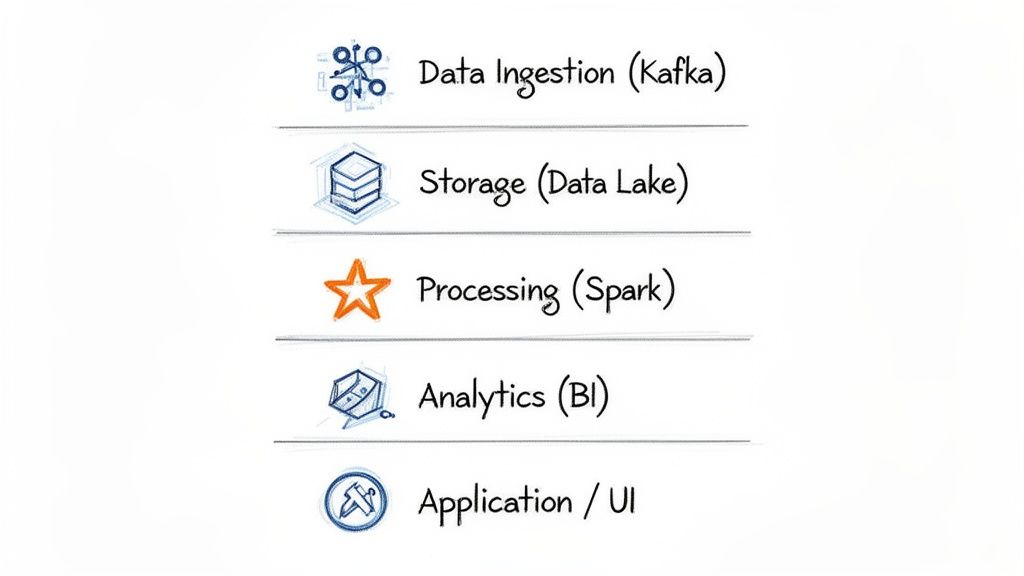
A well-designed stack usually has several distinct layers, each with tools built for a specific job. Think of it as a factory assembly line, but for your data.
- Data Ingestion: This is the front door. Tools like Apache Kafka or cloud services like AWS Kinesis are the heavy-duty receptionists, built to handle massive, non-stop streams of information from thousands of devices without blinking.
- Data Storage: Once the data is in, it needs a place to live. Traditional databases just can't handle the sheer volume and variety of IoT data. This is where cloud data lakes (like Amazon S3 or Azure Data Lake Storage) shine, offering a place to dump vast amounts of raw data. For sensor readings, specialized time-series databases like InfluxDB are a perfect fit.
- Data Processing: Here's where the magic happens. Raw data gets cleaned up, transformed, and prepped for its big debut. Frameworks like Apache Spark are the powerhouses of this stage, capable of chewing through enormous datasets at incredible speeds.
- Analytics and Visualization: The last step is making sense of it all. This is where you turn processed data into something a human can actually understand. Platforms like Tableau and Power BI help you build interactive dashboards and reports, making it easy to spot trends and share what you've found with your team.
Making the Right Technology Choices
Choosing your tools is a balancing act. You have to consider your team's skills, your budget, and where you see this project going in the long run. A big decision you'll face early on is whether to go with open-source or proprietary software.
Open-source tools like Kafka and Spark give you incredible flexibility and have massive communities for support, but they often demand more technical know-how from your team to manage. On the flip side, managed services from cloud providers can make setup and maintenance a breeze, but you risk getting locked into a single vendor.
The best IoT analytics stacks are almost never built with a single vendor. The goal is to piece together a flexible, best-of-breed solution where every component is chosen because it’s the absolute right tool for that specific job.
Ultimately, your stack has to support the entire lifecycle of your project, from the first line of code to scaling up to millions of devices. For a deeper dive into the development side, check out our guide on Internet of Things applications development.
The Unsung Heroes Powering the Stack
Of course, none of this works without the real MVPs of the IoT world: the sensors. The IoT sensor market is seeing unbelievable growth, projected to skyrocket from USD 23.9 billion in 2025 to USD 99.2 billion by 2030.
This explosion means that by 2025, an estimated 21.1 billion connected devices will be out there generating data, which can easily overwhelm older systems. But modern analytics platforms are built for this, using prescriptive tools that can turn this data tsunami into decisions that are 30% faster.
Choosing the right technologies for your stack is what ensures you can ride this data wave instead of getting swamped by it. It’s how you process it all efficiently and squeeze every last drop of value out of it to push your business forward.
Navigating Critical Security and Compliance Challenges
With great data comes great responsibility. The sprawling network of IoT devices that powers your analytics also creates new vulnerabilities and tricky compliance hurdles. For sensitive fields like fintech and healthcare, nailing security isn't just a good idea—it's the bedrock of customer trust.
Every single connected device is a potential doorway for attackers. The risks are everywhere along the data pipeline, from a compromised sensor on a factory floor to data being intercepted on its way to the cloud. One breach can spiral into devastating data loss, operational chaos, and serious damage to your reputation. Ignoring these threats is simply not an option when your system is built on data analytics and iot.
A Checklist for Securing Your IoT Ecosystem
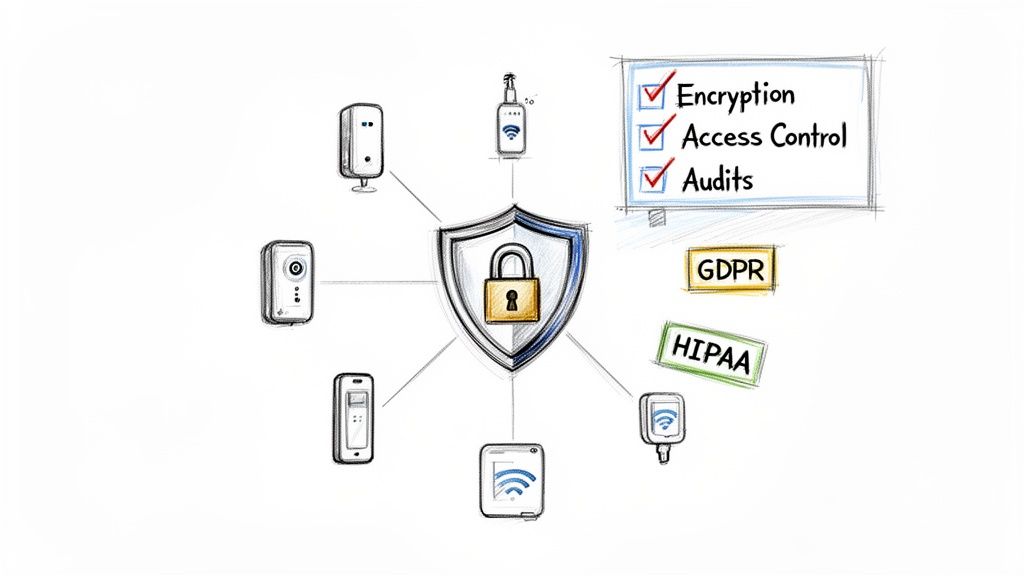
Protecting your IoT infrastructure demands a defense-in-depth strategy. You have to secure the devices themselves, the network they use to communicate, and the cloud platforms where all that data is ultimately stored and analyzed. Anything less is leaving a door wide open.
To properly handle the unique security and compliance challenges that come with IoT, you need a solid cyber risk management framework that can keep up with new threats. Here’s a practical checklist to get you started:
- End-to-End Encryption: All data needs to be encrypted, period. That means both when it's sitting on a device (at rest) and while it's being sent across the network (in transit). This ensures that even if someone manages to intercept your data, it’s just unreadable garbage to them.
- Strong Access Control: Stick to the principle of least privilege. Every user and device should only have permission to access the specific data and functions they absolutely need to do their job. And for any human users, multi-factor authentication is a must.
- Regular Security Audits: Security isn't a "set it and forget it" task. You should be running frequent penetration tests and vulnerability scans to find and fix weak spots before they can be exploited.
- Secure Device Lifecycle Management: Good security starts before a device is even switched on. This means having a secure process for setting up new devices, pushing over-the-air updates, and properly taking them offline at the end of their useful life.
Designing for Compliance from Day One
Dodging cyberattacks is only half the battle; navigating the web of regulations is just as crucial. Rules like GDPR in Europe and HIPAA in the U.S. come with massive fines for non-compliance, particularly when you're dealing with personal or health information. For a deeper dive into the core principles, our guide on data security concepts offers some great context.
Compliance shouldn't be an afterthought. Building your IoT analytics system with privacy and data protection principles from the ground up is far more effective and less costly than trying to bolt them on later.
This approach is often called "privacy by design." Key things to think about include anonymizing data to remove personally identifiable information wherever you can, setting clear data retention policies so you aren't holding onto data forever, and using transparent consent forms that give users real control over their information.
By tackling these critical security and compliance challenges head-on, you can build a system that’s not only powerful and insightful but also secure and trustworthy.
Modernize Your App with AI Powered IoT Analytics
Connecting the dots between raw sensor data and a real business strategy is where the magic happens. Modernizing your software with AI and IoT analytics isn't just a tech upgrade; it’s a strategic pivot that can give you a serious competitive edge. This is how you translate the potential of data analytics and IoT into smart, powerful application features that actually serve your customers and your bottom line.
At Wonderment Apps, we walk businesses through this exact transformation. We know that plugging sophisticated AI models into your application can feel like a massive, risky undertaking. That’s why we built a prompt management system designed specifically to simplify the process and take the fear out of it. Think of it as an administrative toolkit that lets you weave AI into your app with far more control and confidence.
A Toolkit for Intelligent Integration
Our system gives your team the framework it needs to experiment, iterate, and roll out AI-driven features quickly and safely. It provides the essential guardrails for turning that flood of IoT data into tangible business results.
The toolkit is built around four core pillars, each designed for maximum control and efficiency:
- Prompt Vault with Versioning: This keeps every AI interaction consistent and effective. You can easily track changes, test new prompts, and roll back to previous versions, creating a stable foundation for all your AI features.
- Parameter Manager: This component securely links your AI models to your internal databases. It allows the AI to pull the specific information it needs to deliver relevant insights without ever putting your data security at risk.
- Comprehensive Logging System: We capture a complete record of every interaction across all your integrated AIs. This is absolutely critical for debugging problems, monitoring performance, and making sure your AI is behaving exactly as you expect.
- Cost Manager: Get a crystal-clear, real-time view of your token spend. You can see your cumulative costs across every AI model, which means no more budget surprises and much smarter resource allocation.
Modernizing your application is really about empowering your team with the right tools. When you simplify AI integration, you can focus on building innovative features that drive real business value from your IoT data, rather than getting buried in complex technical overhead.
This system is your command center for AI integration, turning what could be a chaotic mess into a managed, scalable operation.
See the Transformation for Yourself
We’ve walked through the pipeline, the use cases, and the security needed to build a solid IoT analytics platform. Now, it's time to put it all into action. This toolkit empowers your team to move faster, experiment with more confidence, and ultimately build a smarter, more responsive application.
We invite you to see exactly how our prompt management system can accelerate your journey to a more competitive and intelligent application. Request a demo today and discover how to turn your IoT data into your most valuable asset.
IoT & Data Analytics FAQs
Diving into IoT and data analytics can feel complex, and naturally, a lot of questions pop up. Getting straight answers is often the key to moving a project from the whiteboard to the real world. Let's tackle some of the most common questions we hear from leaders looking to make their move.
What's the First Step in an IoT Project?
Before you even think about sensors or code, the real first step is to lock down the business problem you're trying to solve. Seriously. Are you aiming to slash operational downtime? Maybe you want to understand how customers move through your retail space or track high-value assets across a supply chain.
When you start with a specific, measurable goal, every decision that follows—from the tech you choose to the data you collect—lines up to deliver actual value. Without that sharp focus, projects tend to drift, costs balloon, and you're left wondering what the ROI was supposed to be.
How Do You Ensure IoT Data Quality?
Data quality is non-negotiable. The old saying "garbage in, garbage out" is amplified in the world of IoT. You can't trust insights built on a shaky foundation. A solid data quality strategy has a few layers:
- Data Validation: Set up rules right at the source (the edge) or in the cloud to flag weird readings, missing values, or anything that's way out of bounds before it pollutes your dataset.
- Sensor Calibration: Your physical sensors aren't "set it and forget it." They need regular calibration to make sure their measurements stay accurate over time.
- Data Cleansing: Think of this as automated housekeeping. These processes scrub and standardize your data, making sure everything is in a consistent format before it's stored for analysis.
What Are the Biggest Hurdles in Implementing Data Analytics and IoT?
While the payoff can be huge, getting there has its challenges. We consistently see the same three hurdles trip people up: security, scalability, and integration. First, figuring out how to secure thousands (or even millions) of devices scattered across different locations is a massive undertaking.
Then there's the scalability puzzle. Building a system that works for a 100-device pilot is one thing; designing it to handle millions without breaking a sweat requires some serious architectural foresight. Finally, connecting your shiny new IoT platform to the systems you already rely on—like your CRM or ERP—is often a thorny integration challenge that needs a smart strategy and the right people on the job.
At Wonderment Apps, our specialty is helping businesses clear these hurdles to build intelligent, secure applications that scale. Our background in AI modernization and custom software development gives you the framework and control needed to turn raw IoT data into a genuine competitive edge. Learn more about how we can help you build the future.