

Custom software development is the craft of designing, building, and maintaining software for a specific group of users or a unique business need. Instead of wrestling with a one-size-fits-all solution, you’re partnering with a team to build a digital tool that perfectly fits your company’s challenges and goals—much like commissioning a tailor for a bespoke suit. At Wonderment Apps, we find that the most successful business leaders are the ones looking to integrate AI into their software to modernize it and build it to last. The trick is knowing how to do it without a massive, ground-up rebuild.
What Are Custom Software Development Services
Think of off-the-shelf software like buying a suit from a department store. Sure, it gets the job done, but it might be tight in the shoulders or a bit long in the sleeves. It serves a general purpose but almost never fits perfectly. Custom software development, on the other hand, is the tailor taking your precise measurements to craft a suit that fits you and only you. It’s a strategic process focused on building a competitive asset, not just writing code.
This approach goes far beyond basic features. It's about delivering a solution that understands your specific operational workflows, customer needs, and long-term business plans. The goal is to create software that feels like a natural extension of your team, making everything smoother, faster, and more intuitive.
Beyond the Basics: Future-Proofing with AI
Modern custom software development isn’t just about building an app for today; it’s about creating an intelligent, adaptable system that can grow with your business. This is where Artificial Intelligence (AI) has become a game-changer, acting as a critical component for future-proofing your investment.
Modernizing an existing application doesn't always mean a complete teardown. Instead, strategic AI integration can unlock powerful new capabilities without starting from scratch. For instance, businesses can integrate a specialized tool, like the prompt management system we've developed at Wonderment Apps, to:
- Introduce intelligent features like automated customer support, predictive analytics, or personalized user recommendations.
- Streamline complex processes by automating tedious data entry, analysis, and reporting.
- Enhance user experiences by making the software more intuitive and responsive to how people actually use it.
This approach is key to building software that not only solves today's problems but is also prepared for tomorrow's opportunities. By integrating specialized tools, businesses can adapt and innovate without starting from scratch, ensuring their digital assets deliver long-term value.
A Market Driven by Specific Needs
The demand for these specialized services is undeniable. The global custom software development market is seeing explosive growth, projected to surge from USD 43.21 billion in 2024 to an incredible USD 334.49 billion by 2034. This trend points to a clear market shift: businesses increasingly recognize that generic solutions just can't deliver the competitive edge needed to truly succeed.
Ultimately, custom development offers a pathway to true digital ownership and control. You get a secure, scalable, and highly personalized tool that integrates seamlessly with your other systems. By understanding the core benefits of custom software development, you can make a more informed decision about building a strategic asset that will power your business for years to come.
Navigating The Custom Software Development Lifecycle
Starting a custom software project isn't a chaotic scramble into the unknown; it's a structured journey with a clear roadmap. Think of it like building a custom home. You wouldn’t just show up with a hammer and start putting up walls. First, you'd work closely with an architect and a builder, moving through distinct phases to make sure the final house is sound, functional, and exactly what you envisioned.
The path to creating custom software follows a similar, methodical process.
Understanding this lifecycle is empowering. It turns you from a bystander into an informed collaborator who can actively steer the project toward success. When you know what’s happening at each stage, you can ask the right questions, give feedback when it matters most, and ensure the final product is perfectly aligned with your business goals.
Discovery and Strategy: The Blueprint Phase
This is where your idea starts to take shape. The discovery and strategy phase is arguably the most critical step because it lays the foundation for everything that comes next. Your development partner will dive deep into your business, asking the tough questions to truly understand your goals, target audience, operational challenges, and what success actually looks like for you.
The main goal here is to translate your business needs into a technical blueprint. This usually involves:
- Stakeholder Workshops: Getting all the key players from your team in a room to gather insights and make sure everyone is on the same page from day one.
- Market and Competitor Analysis: Sizing up the existing digital landscape to spot opportunities and sidestep potential pitfalls.
- Defining Scope and Features: Prioritizing what's essential for a Minimum Viable Product (MVP) and creating a clear roadmap for future enhancements.
The key deliverable from this phase is often a detailed project plan or a product requirements document. This document becomes the single source of truth, outlining the project's scope, tech specs, user personas, and success metrics. It’s all about eliminating expensive guesswork down the line.
This visual shows how a project can evolve from a standard off-the-shelf solution to a more advanced, AI-integrated custom application.
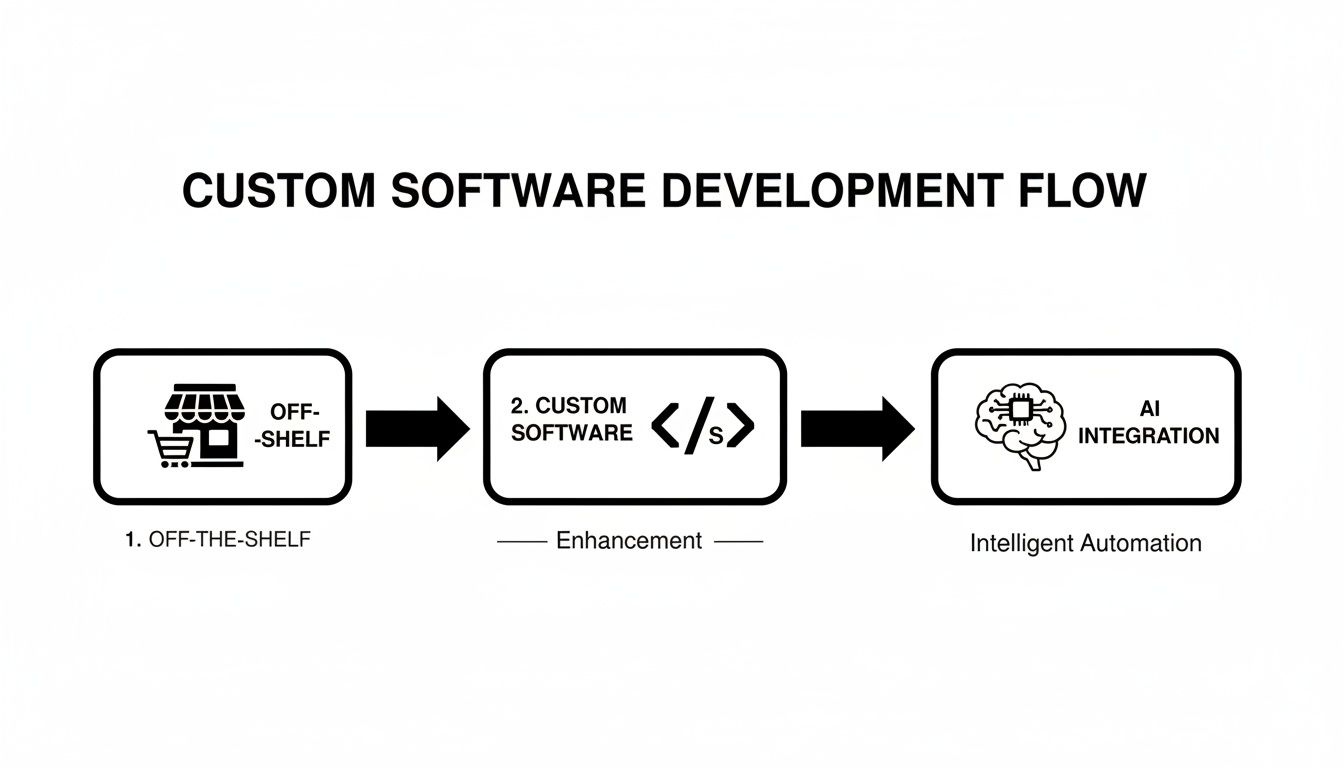
This flow highlights that custom software isn't just an alternative to pre-built tools—it’s a launchpad for integrating powerful, forward-thinking AI capabilities.
Design, Engineering, and Quality Assurance
With a solid blueprint approved, the hands-on creative and technical work begins. First up is the User Experience (UX) and User Interface (UI) design phase. This is all about crafting an application that not only looks great but feels intuitive and effortless to use. Designers will create wireframes, mockups, and interactive prototypes to map out the user journey from start to finish.
Next, the engineering phase brings those designs to life. Developers write the actual code, structure the database, and connect any third-party services. Most modern teams do this using agile methodologies, breaking the project into small, manageable cycles called "sprints." This approach keeps things flexible and allows for continuous feedback, ensuring the project stays on track and on budget.
Quality Assurance (QA) isn't just a final check; it's woven into the entire engineering process. QA testers are working alongside developers from the get-go, rigorously testing the application to find and squash bugs, identify performance bottlenecks, and patch security vulnerabilities early.
A huge part of this is understanding and managing every software bug, from the moment it's found to its final resolution. Properly mastering the software bug life cycle is absolutely essential for delivering a high-quality, reliable product that users will love, without suffering from costly delays.
Deployment and Ongoing Support
The final phase is deployment, where the fully tested and approved software is released into the wild for your users. This isn't as simple as flipping a switch. It involves careful planning to ensure a smooth launch, whether that means submitting to app stores or deploying to a cloud server.
But the journey doesn't end there. Post-deployment support and maintenance are vital for long-term success. This includes monitoring performance, fixing any new bugs that pop up, and rolling out updates with new features. A good development partner sticks around, providing the ongoing support needed to ensure your application remains secure, scalable, and competitive for years to come.
To give you a clearer picture, here’s a breakdown of how these phases typically look in a custom software project.
| Phase | Primary Goal | Key Activities | Deliverable Example |
|---|---|---|---|
| Discovery & Strategy | Validate the idea and define a clear project plan. | Stakeholder interviews, market research, requirements gathering, scope definition. | Product Requirements Document (PRD) |
| UX/UI Design | Create an intuitive and visually appealing user experience. | Wireframing, prototyping, user flow mapping, visual design. | Interactive Prototypes |
| Engineering | Build the functional software based on the design and requirements. | Front-end and back-end coding, database setup, API integration. | Working Software Increments |
| Quality Assurance (QA) | Ensure the software is bug-free, secure, and performs well. | Manual testing, automated testing, security audits, performance testing. | Test Reports & Bug Logs |
| Deployment | Release the finished application to users. | Server configuration, app store submission, data migration. | Live Application |
| Support & Maintenance | Keep the application running smoothly and adapt it to future needs. | Performance monitoring, bug fixes, feature updates, security patches. | System Health Dashboard |
Each stage builds on the last, creating a structured process that minimizes risk and maximizes the chances of a successful outcome that truly moves the needle for your business.
Choosing The Right Development Partner
Picking a custom software development provider is less like hiring a contractor and more like bringing on a long-term business partner. The entire success of your project, from the first line of code to its ability to scale in the future, really hangs on this one decision. It's a choice that has to go way beyond a slick sales pitch or a flashy website; you need to take a hard look at a firm’s actual technical skills, their experience in your industry, and how they communicate.
Think of it this way: you wouldn't hire an architect who only designs single-story homes to build your skyscraper. It’s the same with software. You need a development partner whose expertise is a perfect match for your vision. That means digging into their technical skills with modern tools, looking through their portfolio for successful projects in your space, and making sure they're committed to a transparent, collaborative relationship.
Evaluating Technical Expertise and Portfolio
A potential partner's portfolio is the first real window you have into what they can do. Don't just glance at the pretty designs—dig into the case studies. What specific business problems were they trying to solve? What were the measurable results? A solid portfolio will show a clear history of delivering tangible outcomes, not just apps that simply "work."
Beyond their past projects, you have to gauge their technical depth. Ask them direct questions about their experience with scalable architecture, cloud infrastructure, and—this is a big one—AI integration. A partner who is truly thinking ahead should be able to talk not just about how they build software today, but how they build it to be ready for the technologies of tomorrow. This is where you can start to separate the generalists from the real specialists.
For a deeper dive, check out our guide on the top questions you should ask before hiring an outsourcing company.
Understanding Engagement Models
Not every partnership is built the same way. How you work with a development firm should align with your own internal resources, the scope of your project, and what you’re trying to achieve long-term. Getting familiar with the main models is the key to finding the right fit.
- Managed Projects: This is your all-in-one solution. The partner takes full ownership of the project, from discovery all the way through deployment and ongoing support. It’s perfect if you need a dedicated, self-sufficient team to run the whole show, freeing you up to focus on your core business.
- Curated Staffing (Staff Augmentation): This model is ideal when you already have a team but need to fill some specific skill gaps. Your partner provides specialized talent—like a senior mobile developer or a QA automation engineer—who slots right into your existing team and workflow.
The right model comes down to what you need. Are you looking for a team to build and manage your vision from the ground up? Or do you just need some expert reinforcement to get your current efforts over the finish line faster? A great partner will help you figure out the most effective and cost-efficient path forward.
The market for custom software development is blowing up. While big companies still make up most of the market, small and medium-sized businesses (SMEs) are where the real growth is happening. This is partly because new platforms are making development more accessible. In fact, Gartner predicts that by 2025, a whopping 70% of new business applications will be built using low-code or no-code technologies. You can find more insights on the growth of the custom software development market.
The Importance of Communication and Culture
Finally, never, ever underestimate the importance of cultural fit and clear communication. You could have the most technically brilliant team in the world, but if they don’t understand your vision or can't communicate their progress clearly, the project is doomed.
As you evaluate potential partners, pay close attention to how they communicate. Are they upfront about potential roadblocks? Do they ask smart questions that show they’re actually listening? The ideal partner isn’t just a group of coders waiting for instructions; they act as a proactive advisor. By focusing on technical skill, relevant experience, and strong communication, you can forge a partnership that doesn’t just deliver a great product but becomes a lasting strategic asset for your business.
How AI Is Modernizing Custom Software
Let's be honest: integrating artificial intelligence into your business apps isn't some far-off dream for Silicon Valley giants anymore. It's happening right now, and it's a practical, strategic move for building software that's smart, adaptive, and genuinely helpful. For any company in the market for custom software development services, AI is what unlocks a whole new level of performance, turning a standard application into a business asset that actually learns and evolves.
This isn't just about bolting on a chatbot and calling it a day. It's about fundamentally rethinking what your software can do for you. With AI, you can create deeply personalized experiences for your users, automate complex workflows that used to eat up hours of manual work, and uncover predictive insights buried deep in your data. All of a sudden, your software can anticipate what a customer might need, spot an operational bottleneck before it causes a problem, and serve up data-driven recommendations in real time.
Making AI Integration Manageable and Cost-Effective
The thought of adding AI can feel overwhelming, especially if you're running on established, legacy software. The good news? You don’t have to tear everything down and start from scratch. A smart way to modernize is by integrating specialized admin tools that act as a bridge between your existing systems and the power of AI.
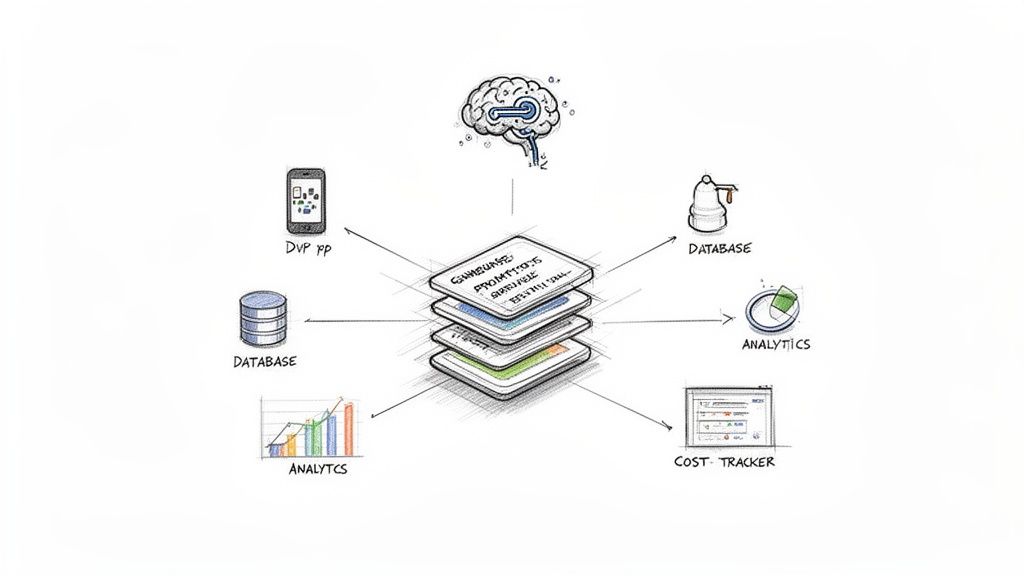
At Wonderment Apps, we developed our prompt management system for this exact reason. It’s an administrative tool that developers and entrepreneurs can plug into their existing app or software to modernize it for AI integration without the headache of a total rewrite.
A solid system like this usually comes with a few key features that give you total control over how AI works in your app:
- Prompt Vault with Versioning: This is your secure library for storing, testing, and managing all the different prompts you use to talk to AI models. Version control is huge here—it means you can track every change, roll back to a previous version if you need to, and keep everything consistent.
- Parameter Manager for Database Access: This feature lets you securely connect your internal databases to your AI models. It allows the AI to pull in relevant, real-time data to give sharp, context-aware answers without ever putting your security at risk.
- Comprehensive Logging System: You get a detailed record of every single interaction with all your integrated AIs. This is absolutely critical for troubleshooting, keeping an eye on performance, and making sure you’re compliant.
- Cost Management Dashboard: Watch your spending on AI services in real time. This dashboard lets you see your cumulative spend, set budgets to avoid surprises, and maintain complete financial oversight of your AI operations.
The Power of Intelligent Interactions
A huge part of how AI is shaking things up is through more natural, intelligent user interactions. Technologies like Conversational AI are leading the charge, enabling applications to understand and respond to human language with incredible accuracy. We're talking about way more than a simple, scripted chatbot; this is about creating dynamic, helpful dialogues that solve real customer problems.
Imagine an e-commerce app that uses conversational AI to walk a customer through a purchase, answer nuanced questions about a product, and even process a return—all without a human employee lifting a finger. That doesn't just make for a better customer experience; it frees up your team to focus on bigger-picture tasks.
By using a dedicated administrative tool to manage these AI integrations, businesses can add sophisticated capabilities to established applications without the massive overhead of a complete rebuild. It makes true modernization an achievable goal for companies of any size.
Ultimately, bringing AI into your software is about making it work smarter, not just harder. Whether you're looking to automate workflows, personalize the customer journey, or get deeper insights from your data, these tools offer a structured, controlled path forward. To get a better sense of what’s possible, you can see how to leverage artificial intelligence and create smarter, more effective applications.
Custom Software Solutions Across Industries
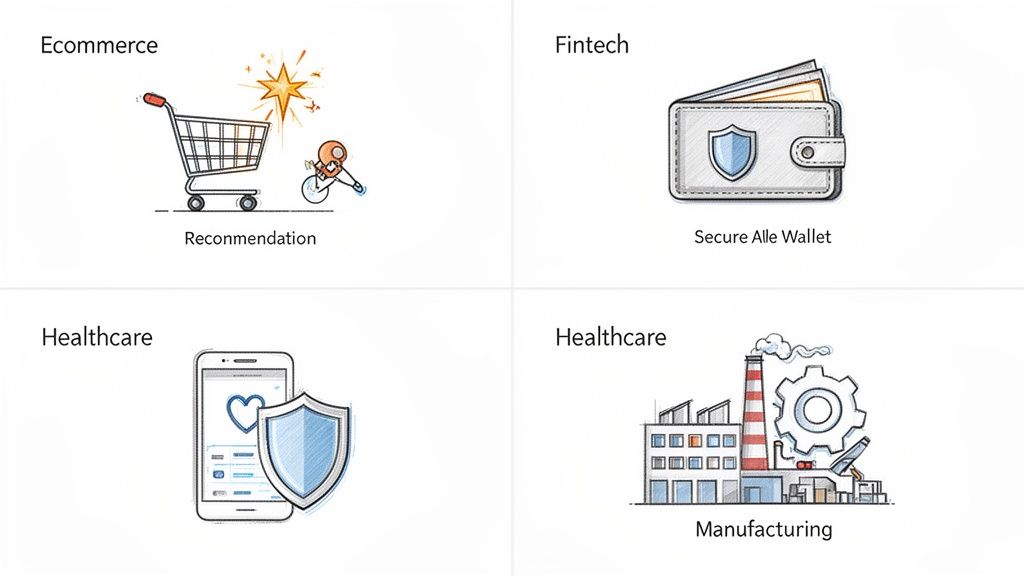
The real power of custom software development services becomes crystal clear when you see them solving specific, real-world problems. Off-the-shelf software often misses the mark because it can't possibly account for the unique regulations, customer habits, and workflows that define an industry.
A custom approach flips the script. It builds solutions designed for a particular context, turning software from a simple tool into a genuine business driver. Let’s look at how this plays out in some of today’s most demanding sectors, where a custom build delivers an edge that generic products just can't touch.
Ecommerce: Fueling Growth with Personalization
In the crowded world of ecommerce, personalization is everything. Any generic online store can list products, but a custom platform creates an intelligent shopping experience that actually drives sales and builds loyalty. The big challenge is turning a mountain of user data—clicks, views, purchase history—into something truly useful.
This is where custom development changes the game. Ecommerce businesses are building smart, AI-powered recommendation engines that go way beyond a simple "customers also bought" widget. These systems can:
- Analyze behavior in real-time to adjust product suggestions on the fly.
- Create dynamic user groups for incredibly targeted marketing campaigns.
- Personalize the entire journey, from the homepage to checkout offers.
By building a system fine-tuned to their products and customers, online retailers see a real impact. It’s not uncommon for personalization to boost revenues by 5-15% and make marketing spend 10-30% more efficient.
Fintech: Securing Trust with Compliance
For fintech companies, security and compliance aren't just features; they're the entire foundation. The industry operates under a microscope of intense regulation, handling sensitive data and high-stakes transactions that demand bulletproof security. Off-the-shelf software is rarely up to the task.
Custom software lets fintech firms bake security and compliance into their platforms from day one. This means things like:
- Multi-layer encryption for data, whether it's sitting on a server or moving across the web.
- Advanced fraud detection algorithms that learn and adapt to new threats.
- Automated compliance checks to ensure every transaction follows rules like PCI DSS and KYC.
A custom-built platform gives a fintech company complete control over its security architecture. This not only protects their customers but also builds the institutional trust necessary to scale in a high-stakes industry.
Healthcare: Improving Outcomes with User-Centric Design
The healthcare industry has a tough job: follow strict data privacy laws like HIPAA while creating tech that patients and doctors can actually use. Clunky, confusing software leads to frustration, medical errors, and patients who just give up. A great user experience isn't a luxury here—it's essential for better health outcomes.
Custom solutions in healthcare focus on intuitive, HIPAA-compliant apps that make critical tasks easier. This could be a patient portal that simplifies scheduling or a mobile app that gives clinicians instant access to electronic health records (EHR). The whole point is to design software that cuts down on administrative work so medical professionals can focus on caring for patients.
A well-designed custom healthcare app can help patients stick to their treatment plans, enable secure communication between doctors and patients, and guarantee that sensitive health information stays protected. It’s proof that the right technology, built for a specific purpose, can have a direct, positive impact on people's lives.
The challenges and solutions vary, but the core idea is the same: custom software addresses the specific pains and unlocks the unique opportunities within an industry.
Here’s a quick look at how this plays out across different sectors:
Custom Software Solutions by Industry
| Industry | Common Challenge | Custom Software Solution Example | Key Benefit |
|---|---|---|---|
| Ecommerce | High cart abandonment & low conversion rates | AI-powered recommendation engine with personalized user journeys | Increased sales and customer loyalty |
| Fintech | Stringent security requirements & regulatory compliance | Platform with built-in fraud detection and automated compliance reporting | Enhanced security and institutional trust |
| Healthcare | Data privacy (HIPAA) & poor user adoption | Intuitive, HIPAA-compliant patient portal and EHR mobile app | Better patient outcomes and operational efficiency |
| Media | Managing vast digital assets & delivering content seamlessly | Digital Asset Management (DAM) system with automated transcoding | Streamlined content workflows and faster delivery |
| Public Sector | Outdated legacy systems & complex citizen services | Modernized citizen-facing portal for permits and payments | Improved public access and reduced administrative load |
Ultimately, no matter the industry, a custom approach ensures the technology is built to serve the business strategy, not the other way around.
Measuring The Success Of Your Software Investment
So, how do you actually know if your big investment in custom software development services is working? The real answer isn't buried in lines of code or server uptime reports. It’s all about measurable business outcomes. A truly successful project doesn't just check the box of being "done"—it becomes a powerful asset that fuels real growth and carves out a lasting competitive edge for you.
To get a true measure of success, you have to look past the tech-speak and zero in on the key performance indicators (KPIs) that directly impact your bottom line. These numbers tell the story of your software's value in a language everyone understands, offering undeniable proof of its return on investment (ROI). It's like the difference between knowing your new car has a V8 engine versus knowing it gets you to your destination 30% faster while using less fuel.
Key Metrics That Matter to The Bottom Line
When you track the right outcomes, you can draw a straight line from the software to its impact on the business. The goal is to connect every single feature and function back to a specific business objective. This brings incredible clarity for stakeholders and easily justifies any ongoing investment in the software’s future.
Here are a few core areas where you can see and measure real-world results:
- Improved User Engagement: Are people spending more time in the application? Are they actually using those key features you built? A jump in engagement is a fantastic sign that the software is hitting the mark with its audience.
- Higher Conversion Rates: For any sales-focused or e-commerce platform, this is the big one. A well-designed custom solution should make the user’s journey smoother, remove friction, and directly lead to more sales, sign-ups, or whatever your conversion goal is.
- Reduced Operational Costs: Automation is one of the most powerful benefits of custom software. By tracking the decrease in manual hours or the complete elimination of repetitive tasks, you can calculate direct, hard-dollar cost savings.
- Faster Manual Processing Times: How much quicker can your team get through critical workflows now? Shaving hours—or even days—off processes like order fulfillment or data analysis is a direct boost to your team's productivity and your company's efficiency.
By focusing on these concrete outcomes, you shift the conversation from "Is the software working?" to "How is the software working for us?" It reinforces the idea that your investment is actively fueling growth, improving efficiency, and building a stronger, more resilient business. This data-driven approach proves the value of your custom solution.
A Few Common Questions
Diving into custom software development can feel like exploring new territory. It's only natural to have questions. We've put together answers to some of the most common ones we hear from business leaders, helping you navigate your options with confidence.
What's the Real Cost of Custom Software?
There's no simple sticker price on a custom application, and that's a good thing. The final cost is a direct reflection of what you're trying to build—its complexity, the number of features you need, the makeup of your development team, and how you choose to work with them. A streamlined app with a few core functions will naturally cost far less than a sprawling enterprise platform loaded with AI capabilities.
How Long Until My Software Is Ready?
Just like cost, your project's timeline is tied directly to its scope. A focused application or a Minimum Viable Product (MVP) can often come to life in just 3 to 6 months. For bigger, more complex systems, especially those that need to pull in a lot of existing data or connect with other tools, you might be looking at 6 months to a year or more. We use agile development to manage this, delivering working pieces of your software in stages so you see progress sooner.
The most reliable cost and time estimates always come out of a solid discovery phase. Think of it as creating a detailed project blueprint. This initial work clarifies the scope and helps you avoid costly surprises later on.
Is Custom Software a Better Choice Than an Off-the-Shelf Product?
It really comes down to what you're trying to achieve. Off-the-shelf software can be a fantastic choice if you need a quick, budget-friendly fix for a standard business problem and you're okay with adjusting your workflow to fit the software.
But when your business has unique ways of working, needs to integrate with specific systems, or is aiming to build a serious competitive edge, custom software is the smarter investment. It gives you total ownership, scales with you as you grow, and lets you align the technology perfectly with your vision. For any business focused on serious growth and setting itself apart, it's the clear path forward.
Ready to modernize your application with powerful, manageable AI features? See how Wonderment Apps can help. Schedule a demo of our prompt management system today!