

It’s easy to get tangled up in the “Agile vs. DevOps” debate, but that framing misses the point entirely. The real difference is simple: Agile is a project management philosophy focused on building the right product, while DevOps is a cultural and engineering practice for building and releasing that product right.
Instead of a battle, think of them as a powerful partnership. Agile gets your team building in iterative, collaborative cycles, and DevOps takes those principles and extends them across the entire software delivery pipeline with automation. For any business leader looking to modernize their software, especially with AI, understanding this synergy is the key to success. In fact, we've seen how crucial it is to have the right tools to bridge this gap—which is why we developed a prompt management system at Wonderment Apps to help teams integrate AI features with both agility and operational control.
Untangling Agile and DevOps: A Partnership, Not a Battle
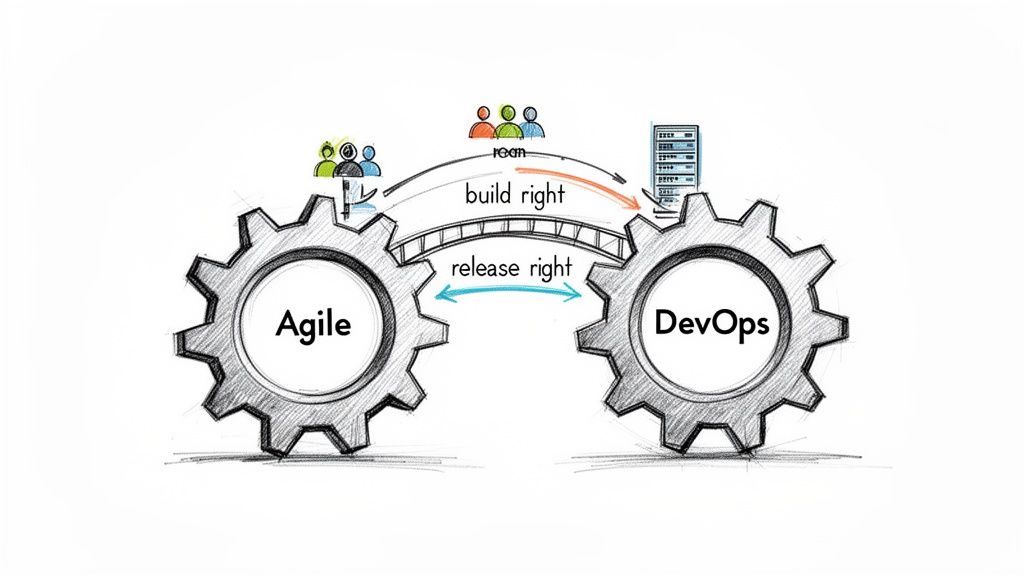
Many leaders mistakenly see Agile and DevOps as competing methodologies, forcing an "either/or" choice that just doesn't exist. They solve different, yet overlapping, challenges in the software lifecycle. Agile is all about organizing how teams plan and execute development work. Its goal is to stay nimble, adapt to changing requirements, and deliver value to customers in short bursts.
DevOps, on the other hand, is a much broader cultural shift. It’s about knocking down the traditional walls between the development (Dev) and IT operations (Ops) teams, creating a culture of shared responsibility from start to finish. It takes the collaborative spirit of Agile and stretches it over the whole value stream—from the first line of code to deployment and live monitoring. The endgame is a seamless, automated pipeline that ships software faster and more reliably.
Bridging the Gap in Modern Software Development
The industry is clearly moving toward this integrated mindset. In a telling shift, DevOps has now overtaken Agile in adoption, with 49% of IT organizations using it as their primary framework compared to just 36% for Agile. This isn't just a trend; it's driven by real-world results. A staggering 99% of IT leaders say DevOps has had a positive impact on their organization, pointing to better quality and faster release cycles. You can dive deeper into these DevOps adoption statistics and their business impact.
Here at Wonderment Apps, we see how critical this partnership becomes when modernizing applications with AI. Building great AI features requires the rapid experimentation that Agile champions. But it also demands the operational stability and scalability that DevOps delivers.
Think of it this way: Agile helps your team build innovative AI features in focused sprints. DevOps ensures those features can be deployed, monitored, and scaled securely and efficiently without disrupting the user experience.
Our own administrative toolkit, which includes a sophisticated prompt management system, was designed to bridge this exact gap. It gives developers the freedom to innovate (an Agile goal) while providing the business with the control and visibility needed for stable operations (a core DevOps principle). This synergy is the key to building software that isn't just smart, but built to last.
To put it all into perspective, here's a quick breakdown of where each methodology shines.
Quick Look: Agile vs. DevOps Core Focus
| Attribute | Agile | DevOps |
|---|---|---|
| Primary Goal | Adaptability and rapid feature development | Speed and stability of software delivery |
| Core Philosophy | Project management and team collaboration | Cultural and engineering practice |
| Scope of Work | Primarily focused on the development phase | Spans the entire software delivery lifecycle |
| Key Output | Working software at the end of each iteration | A streamlined, automated delivery pipeline |
Ultimately, Agile provides the "what" and "why" for development, and DevOps provides the "how" for getting it into the hands of users smoothly and safely. They work best when they work together.
Inside the World of Agile Development
To really get the full picture of the "Agile vs DevOps" conversation, we have to start with Agile itself. It’s so much more than just another tech buzzword; it’s a whole philosophy built around collaboration, listening to customer feedback, and—most importantly—being ready to adapt on the fly. Agile was created to escape the old, rigid ways of managing projects where long-term plans would often lead to software that was already outdated or off-target by the time it finally launched.
The soul of this philosophy is summed up in the Agile Manifesto, a document that has been the north star for software teams for over two decades.
This isn't about throwing away processes and documentation entirely. Instead, it's a fundamental shift in priorities: it values people working together, creating software that actually works, partnering with customers, and being able to respond to change. For any business, from a fresh startup to an established player, staying lean, agile, and flexible is the key to not just surviving, but thriving.
Common Agile Frameworks Scrum and Kanban
Agile is the big-picture philosophy, but teams need practical ways to put it into action. That's where frameworks come in. The two most common ones you'll run into are Scrum and Kanban, and they each bring a different flavor to the table.
Scrum is probably the most famous Agile framework. It breaks down all the work into fixed-length cycles called sprints, which usually last two to four weeks.
- Structure: Every sprint kicks off with a planning meeting where the team pulls a chunk of work from the backlog.
- Goal: The team’s mission is to deliver a functional, potentially shippable piece of the product by the sprint's end.
- Example: Imagine an e-commerce team using a two-week sprint to build and roll out a new "one-click checkout" feature.
Kanban, on the other hand, is all about continuous flow. The main focus here is on visualizing work as it moves and limiting how much is in progress at any one time (WIP).
- Structure: You’ve probably seen a Kanban board—tasks flow visually from a "To Do" column to "In Progress" and finally to "Done."
- Goal: Instead of hitting a fixed deadline, the aim is to maintain a smooth, consistent workflow. This makes it perfect for teams dealing with a steady but unpredictable stream of tasks.
- Example: A fintech app’s support team might use a Kanban board to manage all the bug fixes and user-reported issues that come in daily.
Roles Within a Typical Agile Team
At their core, Agile teams are small, cross-functional, and built to manage themselves. While the exact job titles can change, a classic Scrum team boils down to three essential roles that have to work in lockstep to bring an idea to life.
The magic of Agile lies in its structure—it creates a system where a small, empowered team can consistently deliver value by focusing on what matters most to the user, sprint after sprint.
These roles provide the clear ownership and tight collaboration needed to make it all work:
- Product Owner: This is the voice of the business and the customer. They own the product backlog, decide what features get built next, and make sure the development team is always working on the most valuable stuff.
- Scrum Master: Think of the Scrum Master as a facilitator and a coach. Their job is to help the team live and breathe Agile principles, clear any roadblocks that get in the way of progress, and champion a culture of constant improvement.
- Development Team: This is the group of people who actually build the product—the engineers, designers, and QA specialists. They are self-organizing, meaning they decide how to get the work done, and they share collective responsibility for delivering a high-quality product increment in every sprint. Of course, knowing if they're on track is vital, which is why understanding agile performance metrics is so critical for their success.
The DevOps Culture of End-to-End Ownership
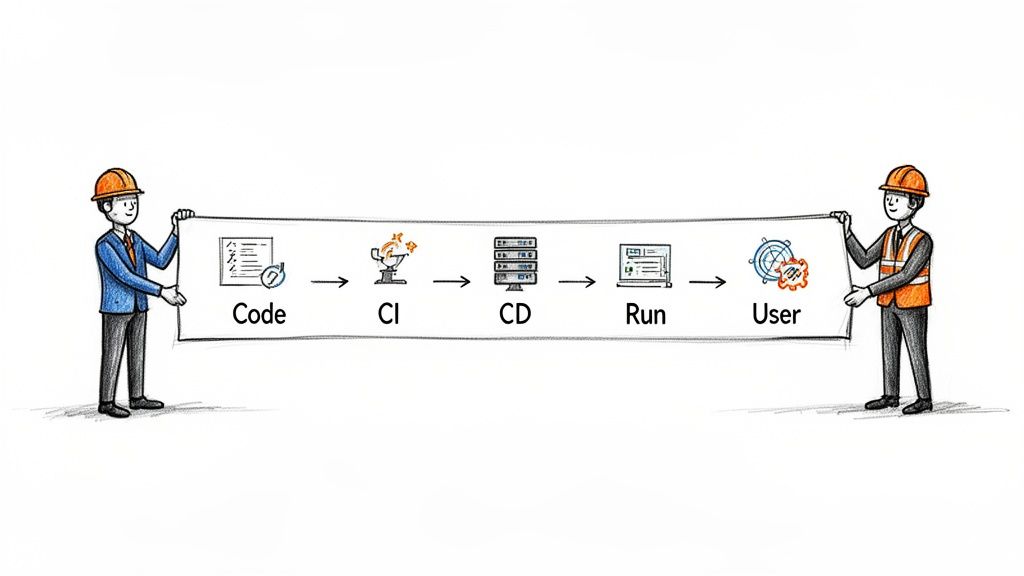
If Agile changes how teams build software, DevOps completely overhauls how they deliver it. This isn't just about a new set of tools; it's a deep cultural shift that breaks down the old, adversarial walls between development and operations teams. At its heart, DevOps is built on shared goals and a collective promise to get value into the hands of users.
The entire point is to create a frictionless path from a great idea to a running application. Forget developers "throwing code over the wall" to the Ops team. In a DevOps world, you have one unified team responsible for the application's entire lifecycle. This is how you get the speed and rock-solid reliability that today's users demand.
Core Practices of the DevOps Lifecycle
To make this culture a reality, DevOps leans on a handful of technical practices that bring automation and consistency to the delivery pipeline. Think of these as the engine that drives high-performing teams, taking what used to be manual, risky tasks and turning them into predictable, repeatable processes.
These practices all lock together to create a powerful, automated workflow:
- Continuous Integration (CI): Developers merge code changes into a central repository multiple times a day. Every merge automatically kicks off a build and a battery of tests, catching integration bugs almost immediately.
- Continuous Delivery/Deployment (CD): Taking CI a step further, CD automatically deploys every validated code change to a testing or production environment. Continuous Delivery means the code is always ready to ship, while Continuous Deployment actually pushes it live.
- Infrastructure as Code (IaC): Servers and environments are no longer configured by hand. Teams define and manage their entire infrastructure using code, making it version-controlled, repeatable, and consistent—just like the application itself.
- Monitoring and Logging: Teams build comprehensive monitoring into their applications to get a live feed on performance and health. This isn't just for catching errors; it's about understanding how new features behave in the wild.
These aren't just items on a technical checklist; they are the bedrock of the DevOps mindset. This culture is all about end-to-end ownership, giving teams a proven roadmap from prototype to product that ensures value is delivered consistently.
The "You Build It, You Run It" Mindset
Maybe the single most important idea in the DevOps world is "you build it, you run it." It sounds simple, but this phrase signals a monumental shift in accountability. The engineers writing the code are the same people responsible for deploying it, keeping it stable in production, and waking up in the middle of the night if it breaks.
This principle completely transforms a team’s priorities. When a developer is on the hook for operational stability, they instinctively start writing code that is more resilient, observable, and easier to test. They're thinking about scalability and security from the very first line of code, not as an afterthought.
Shared ownership breaks down the blame game. When a production issue arises, the question is no longer "whose fault is it?" but "how do we fix it and prevent it from happening again?"
This level of responsibility sparks a powerful feedback loop. Teams become obsessed with automation and building for reliability because it has a direct impact on their own quality of life and on-call schedules. For businesses in regulated industries like healthcare or government, this culture isn't a luxury—it's essential for survival. It allows them to ship secure, compliant features faster and with far less risk, empowering them to keep any modern application competitive.
Comparing Daily Workflows, Tools, and Team Dynamics
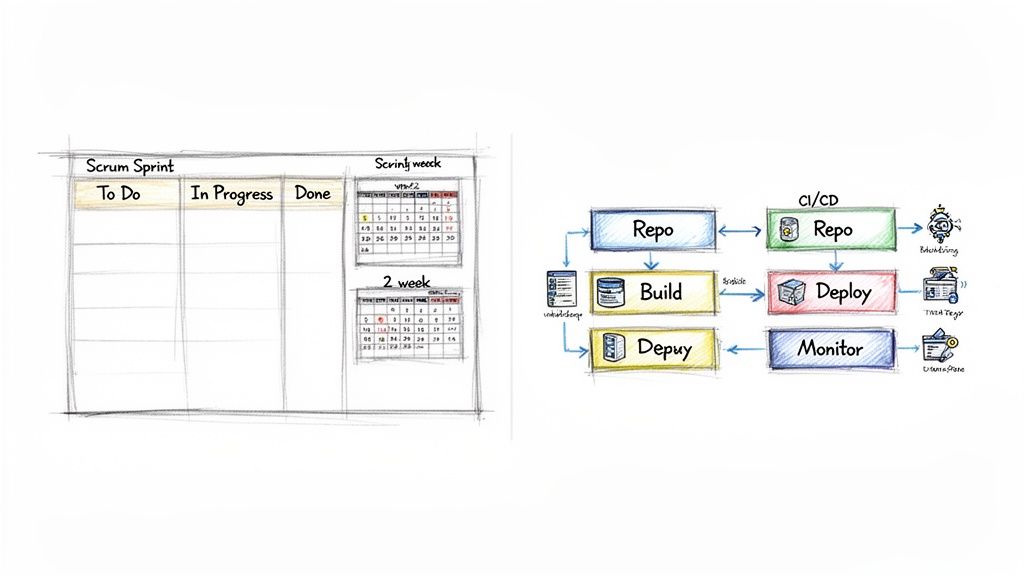
This is where the rubber meets the road. Abstract ideas about methodology give way to the daily grind of building software, and it’s here that the differences between Agile and DevOps become crystal clear. You can see it in their distinct work rhythms, the tools they lean on, and how their teams are built.
An Agile team’s day is paced by the sprint—a structured, time-boxed cycle focused on shipping a specific set of features. DevOps, on the other hand, lives in a state of continuous flow. The ultimate goal isn't just to finish a sprint, but to make every single code commit a potential release candidate.
This core difference in cadence shapes daily routines and priorities. Agile teams are deep in sprint planning meetings, daily stand-ups, and sprint reviews. Their world revolves around completing the work promised for that iteration. A DevOps team, however, is obsessed with the health of the entire delivery pipeline, from automated builds and tests all the way to deployment and production monitoring.
The Contrast in Team Structure
How teams are organized is one of the most obvious tells. Agile teams are typically self-contained units laser-focused on development. They pull together product owners, developers, and QA specialists to build features, but their ownership often wraps up once the code is written and tested.
DevOps blows this structure up by stretching ownership across the entire application lifecycle. It champions cross-functional "pods" where developers, operations engineers, and security specialists are all in the same boat. This setup gets rid of the traditional handoffs that kill momentum and create friction between teams.
In an Agile world, a development team’s success is measured by the working software they produce. In DevOps, success is measured by the value that software delivers to users once it's running reliably in production.
This shift fosters a powerful sense of shared responsibility. Developers start caring a lot more about the operational stability of their code, and operations folks gain a much deeper insight into the application’s architecture. It’s this collaborative glue that holds complex systems together.
A Tale of Two Toolchains
The tools each methodology favors perfectly mirror their core philosophies. An Agile team's toolkit is all about project management and collaboration—it’s built to manage backlogs, track sprint progress, and keep everyone aligned.
- Jira: The quintessential tool for managing user stories, sprints, and backlogs.
- Trello: A simple, visual Kanban board perfect for tracking task progress at a glance.
- Asana: A project management powerhouse that helps teams organize and plan their work.
DevOps, true to its nature, relies on a much broader and more technical suite of tools designed to automate the entire software delivery pipeline. This toolchain is the connective tissue linking every step, from code commit to production deployment and beyond.
- CI/CD Tools (Jenkins, GitLab CI): This is the engine of the DevOps pipeline, automating the build, test, and deployment processes. For teams just starting, getting familiar with CI/CD pipeline best practices is the perfect first step.
- Infrastructure as Code (Terraform, Ansible): These tools let you define and manage infrastructure with code, guaranteeing that environments are consistent and reproducible.
- Monitoring & Observability (Prometheus, Datadog): Platforms for gathering the metrics, logs, and traces you need to get deep visibility into how your application is performing in the wild.
To make these differences even clearer, here’s a head-to-head breakdown.
Detailed Comparison of Agile and DevOps
This table cuts through the noise to show you exactly how Agile and DevOps stack up in practice.
| Criterion | Agile | DevOps |
|---|---|---|
| Primary Goal | Feature completion and adaptability | Delivery speed and operational stability |
| Team Structure | Self-contained development teams (Dev, QA, Product) | Cross-functional teams (Dev, Ops, Security) |
| Key Metrics | Velocity, Story Points, Burndown Charts | Deployment Frequency, Mean Time to Recovery |
| Common Tools | Jira, Trello, Asana (Project Management) | Jenkins, GitLab, Terraform, Prometheus (Automation) |
At the end of the day, Agile tools help you manage the what and when of development, while DevOps tools automate the how of delivery. For any business leader, understanding how these methodologies shape daily work offers a clear roadmap for where to invest—whether it’s in sharpening your project planning or supercharging your release automation.
How Agile and DevOps Create a Powerful Synergy
The most successful teams know the conversation isn't about Agile vs. DevOps. It's about how these two methodologies combine to create a powerhouse for delivering software. They're really two sides of the same coin, with each one solving a critical piece of the software delivery puzzle.
Think of it this way: Agile is all about perfecting the process of building the software, while DevOps perfects the process of releasing it. One without the other leaves a massive gap in your ability to deliver value. An Agile team can churn out flawless features every two weeks, but if those features just pile up waiting for a manual, high-risk deployment, the business sees zero benefit.
DevOps as the Natural Extension of Agile
DevOps doesn’t replace Agile—it’s the next logical step. It takes the core Agile principle of collaboration and stretches it across the entire software lifecycle. While Agile broke down the walls between business folks and developers, DevOps comes in and smashes the final barrier between development and operations.
The whole flow just becomes seamless. A completed sprint in an Agile team doesn't just end with code being marked as "done." Instead, that code flows straight into an automated DevOps pipeline.
- Sprint Completion: A developer merges the code for a new feature into the main branch.
- CI Kicks In: This merge instantly triggers a build and a whole suite of automated tests.
- CD Takes Over: Once all the tests pass, the feature is automatically pushed to a staging environment for final checks.
- Release to Production: With a simple button push (or even fully automatically), the new feature is live for customers.
This continuous movement eliminates the clumsy manual handoffs and long delays that used to plague software releases. The work from a sprint goes from a developer's machine into the hands of real users without any friction.
Agile gets you to a potentially shippable increment at the end of every sprint. DevOps is the engine that actually ships it—safely, reliably, and whenever you need to.
Achieving Speed with Stability
This synergy creates an incredibly powerful feedback loop. When developers are involved in the release and monitoring process (a key DevOps idea), they get instant visibility into how their code is behaving in the real world. This insight feeds directly back into the next Agile sprint planning meeting, letting the team make smarter, faster decisions based on actual user data and system performance.
This combination is the secret to achieving both rapid innovation and the operational stability your customers count on. Teams that nail this partnership don't have to choose between moving fast and staying reliable. They get both, which is the ultimate competitive edge when you're trying to build and scale modern software.
Choosing the Right Strategy for Your Modernization Journey
So, where do you start? The Agile vs. DevOps debate can feel overwhelming, but the right entry point really hinges on where your biggest headaches are. There's no universal answer here; the best strategy is the one that targets your most critical problems first, especially when you're dragging legacy systems into the modern era.
If you’re wrestling with managing the development process itself—constantly reacting to market changes, struggling to ship valuable features, and just trying to get a handle on the chaos—then starting with an Agile adoption is your best move. Agile is designed to bring order to development by organizing work into predictable sprints, getting teams to collaborate effectively, and making sure you’re building something customers actually want.
On the other hand, if your developers are churning out features but the release process feels like a recurring nightmare of manual handoffs, failed deployments, and operational logjams, it's time to prioritize a full DevOps transformation. DevOps directly attacks the friction between writing code and running it in production, automating the pipeline to make releases faster and far more reliable.
Pinpointing Your Starting Point
To cut through the noise, ask yourself one simple question: Where does the work slow down the most?
- Is it during development? If your team is bogged down by vague requirements, blown deadlines, and a lack of clear focus, Agile frameworks like Scrum will introduce some much-needed structure.
- Is it during deployment? If finished features collect dust for weeks before a risky, "all-hands-on-deck" release, you desperately need the CI/CD, automation, and shared ownership that DevOps brings to the table.
This decision is all about prioritizing either rapid idea generation with Agile, stable releases with DevOps, or—ideally—blending them for maximum impact.
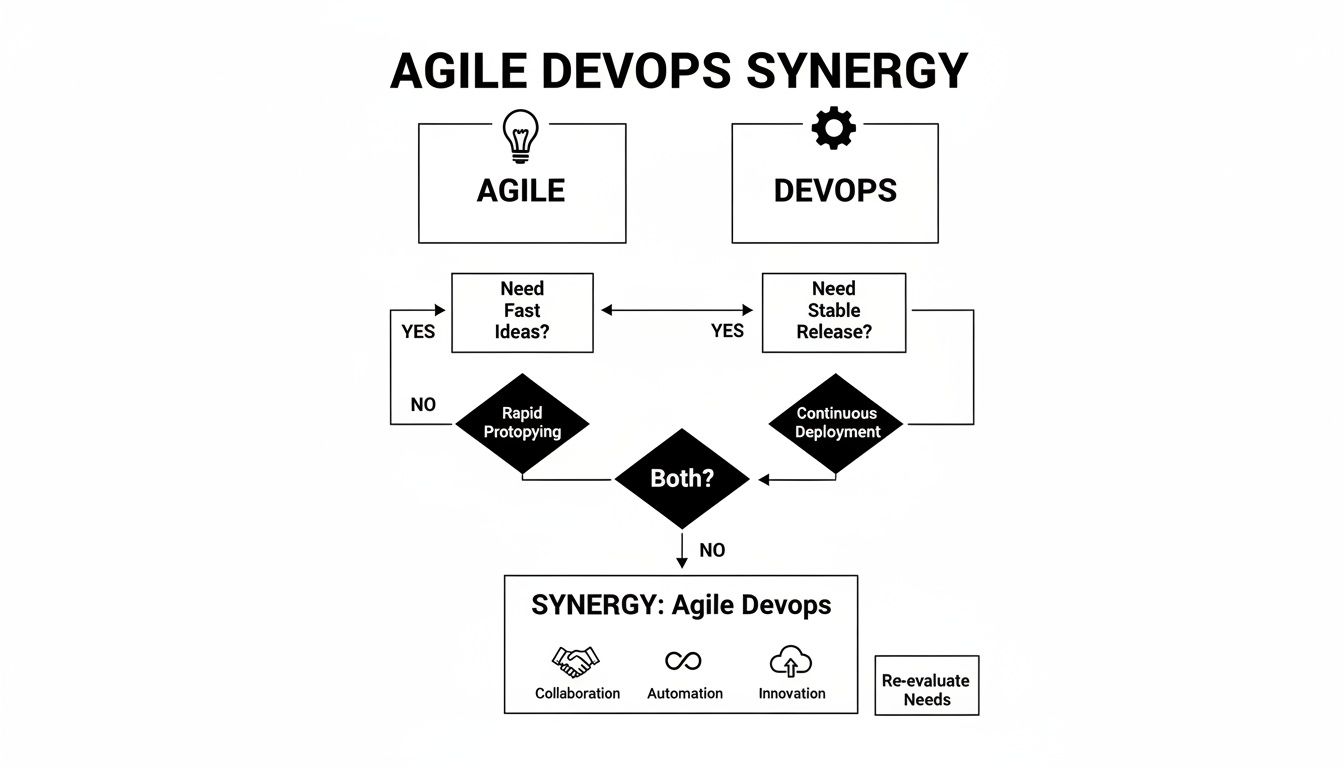
As the visual shows, while each approach solves a different problem, the real magic happens when they work together.
Accelerating Modernization with the Right Tools
This choice becomes even more crucial when you're modernizing legacy software with AI. You need the freedom of Agile to experiment with new models and the operational rigor of DevOps to deploy those AI features reliably and at scale.
This is exactly where Wonderment Apps' AI toolkit can make a huge difference. Our platform was built to bridge the gap between these two worlds. It's an administrative tool that developers and entrepreneurs can plug into their existing app to modernize it for AI integration.
With our tool, your Agile teams can rapidly experiment with new AI capabilities using a secure prompt vault with full versioning. At the same time, your operations side gains the control and visibility required by DevOps through a built-in cost manager, a parameter manager for database access, and a centralized logging system across all integrated AIs.
This setup allows you to integrate powerful AI features without compromising the stability and control that enterprise applications demand. For teams looking to put these ideas into practice, exploring proven legacy system modernization strategies can light the path forward.
Ultimately, you can't have true business agility with just one piece of the puzzle. Agile makes you fast in development, and DevOps makes you fast in delivery. By picking the right starting point and giving your teams tools that support both innovation and stability, you can get your transformation on the fast track and build software that truly lasts.
Frequently Asked Questions About Agile and DevOps
As teams start digging into the worlds of Agile and DevOps, a lot of practical questions pop up. Getting these details right is the difference between a smooth adoption and a frustrating one. Here are some of the most common questions we hear from business leaders navigating this space.
Can You Have DevOps Without Agile?
Technically, yes, but you really wouldn't want to. It's like having a high-performance engine in a car with no steering wheel. You could automate your entire delivery pipeline (the core of DevOps) without using an Agile framework, but you’d be missing the entire point.
DevOps gets its power from a culture of collaboration and lightning-fast feedback loops—these are ideas pulled directly from the Agile playbook. Without Agile guiding the development process, your fancy automated pipeline might just end up deploying massive, infrequent batches of code. This just reintroduces the huge risks and slow pace that DevOps was created to solve in the first place. Using them together creates a steady, reliable flow of small, well-tested features from a developer's keyboard to the customer.
What Is DevSecOps and How Does It Fit In?
DevSecOps is the logical next step for any mature DevOps practice. It’s all about weaving security into every single stage of the software delivery lifecycle. The old way of treating security as a final checklist before launch just doesn't work anymore; DevSecOps makes security a shared responsibility from day one.
In practice, this means:
- Automated Security Scanning: Building tools directly into your CI/CD pipeline that automatically hunt for vulnerabilities in your code and its dependencies.
- Threat Modeling: Thinking like an attacker during the design phase to identify and plug potential security holes before a single line of code is written.
- Continuous Monitoring: Keeping a vigilant eye on your live production environment for any signs of security threats.
Essentially, DevSecOps ensures that you don't have to choose between moving fast and staying secure.
The big idea with DevSecOps is to "shift left"—pulling all those security checks and considerations as early into the development process as possible. Security stops being a reactive bottleneck and becomes a proactive part of building great software.
How Do You Measure the Success of an Implementation?
Measuring success means looking past vanity metrics. For Agile, success isn't just about how many story points you completed; it's about the actual business value you shipped. The real metrics that matter here are things like customer satisfaction, product usage rates, and the time-to-market for valuable new features.
For DevOps, the focus shifts to the health and speed of your delivery pipeline. The industry-standard metrics, often called the DORA metrics, are the most critical:
- Deployment Frequency: How often can your team successfully release to production? Elite teams do it on-demand, multiple times a day.
- Mean Time to Recovery (MTTR): When something breaks in production, how fast can you fix it? This is a true test of your system's resilience.
- Change Failure Rate: What percentage of your deployments result in a failure or require a hotfix? This measures the quality and stability of your releases.
Looking at these metrics together gives you a complete picture. You can see how well your team delivers high-quality software that customers love, perfectly balancing speed with the stability that keeps your business running.
At Wonderment Apps, we specialize in helping businesses navigate their modernization journey by blending Agile innovation with DevOps stability. Our AI toolkit, featuring a sophisticated prompt management system, empowers your teams to build cutting-edge features while maintaining operational control. See how we can accelerate your transformation by booking a demo today.