

The most popular advice on Node.js vs Ruby on Rails is also the least useful. Pick the faster one, pick the popular one, or pick the one your lead developer likes. That's how teams end up rewriting a healthy product or forcing a great tool onto the wrong workload. Judge this pair by workload boundaries and five-year organizational risk instead, and the answer gets clearer, and usually cheaper.
A Runtime and a Framework Are Not Twins
A marketplace where sellers manage listings, orders, and payouts through multi-step forms has different needs from a live operations dashboard handling frequent updates. Asking which stack wins across both workloads is like asking whether a stage beats a play. They are different kinds of tools, and the distinction shapes what your team must build and maintain.
Node.js is a JavaScript runtime that you assemble into a backend. Your team chooses the HTTP framework, data layer, job runner, and authentication approach. Ruby on Rails is a full web framework with an established application structure. That difference affects both initial setup and the boundaries your organization must own over time.
Why the Origins Still Matter
Ruby on Rails was introduced in 2004 and helped popularize convention over configuration, automated database migrations, scaffolding, and the Model-View-Controller pattern. Node.js arrived in 2009, when Ryan Dahl presented a server-side JavaScript runtime built around Google Chrome's V8 engine and an event-driven, nonblocking I/O model.
Rails was designed to help a team build a complete, database-backed product within a shared structure. Node.js makes JavaScript available on both browser and server, and its event-driven model suits concurrent network work. Those starting points still shape a practical choice: Rails supplies more application conventions, while Node.js lets a team select and maintain more of its own pieces. The right fit depends on the workload and on which boundaries your team can support over time.
For AI features, the same boundary question applies: keep prompts and related controls manageable rather than scattering hard-coded strings through application code. Wonderment AI plugs into the admin backend of any app, giving teams an administrative tool for managing prompt integration in existing software.
For a broader framework for weighing business needs alongside technical choices, see how to choose the right technology stack for your project.
Node.js and Rails Side by Side
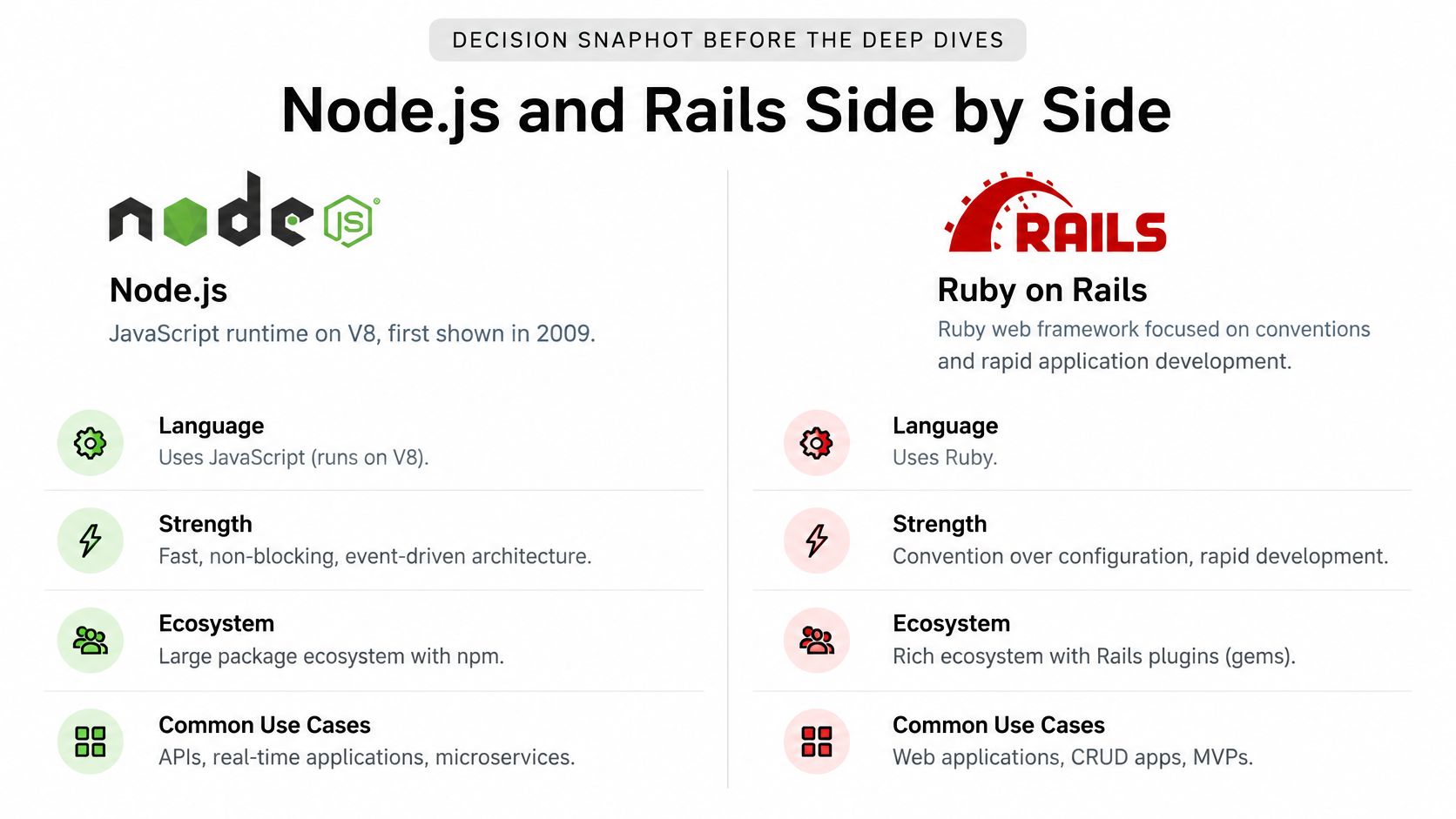
Scan this snapshot first. Each row is a design choice you'll live with, not a trivia answer.
Node.js and Ruby on Rails at a glance
| Criterion | Node.js | Ruby on Rails |
|---|---|---|
| Kind of tool | JavaScript runtime on V8 | Full web framework on Ruby |
| First released | 2009, Ryan Dahl | 2004, convention over configuration |
| Application shape | Assemble HTTP framework, data layer, jobs, and auth | MVC, migrations, scaffolding, and generators included |
| Concurrency | Single-thread event loop with nonblocking I/O | Worker processes plus fragment and low-level caching |
| Strength | Concurrent APIs, streaming, realtime, shared JavaScript | Fast CRUD delivery inside a stable monolith |
| Main risk | Blocking the event loop and dependency sprawl | Smaller hiring pool and costly rewrites |
Node.js is the stage, Rails is the play.
How to Read These Rows
The application shape row drives your early velocity. In Node, you pick Express or Fastify, an ORM, a queue, and an auth library, then you define conventions your team will follow. In Rails, those decisions arrive made. New hires who know Rails can find their way around your app on day one because the layout is standard.
The concurrency row drives your ceiling. Node keeps application callbacks on one JavaScript thread and hands nonblocking I/O to the operating system, so one process can hold many open connections. Rails typically runs several worker processes and makes repeated work cheap through fragment caching and low-level caching.
The risk row is the one leaders skip. Node's freedom means your dependency tree and your async discipline are your problem. Rails' maturity means your hiring market is narrower, and leaving later is expensive if business rules are woven through the monolith.
Mark the row that matches the product you're about to fund. If two rows pull in opposite directions, that's a signal you may need a split, which we'll cover near the end.
Concurrency Speed and What Benchmarks Hide
Start with the headline number, then put it in a cage. In TechEmpower Round 23's Fortunes workload, a database-backed test involving framework routing, ORM/database access, and server-side rendering, Express on Node.js achieved approximately 78,100 requests per second, while Ruby on Rails achieved about 42,500 requests per second, as reported in the Rollbar comparison of Ruby on Rails and JavaScript. That's roughly a 1.8x throughput difference in Node's favor.
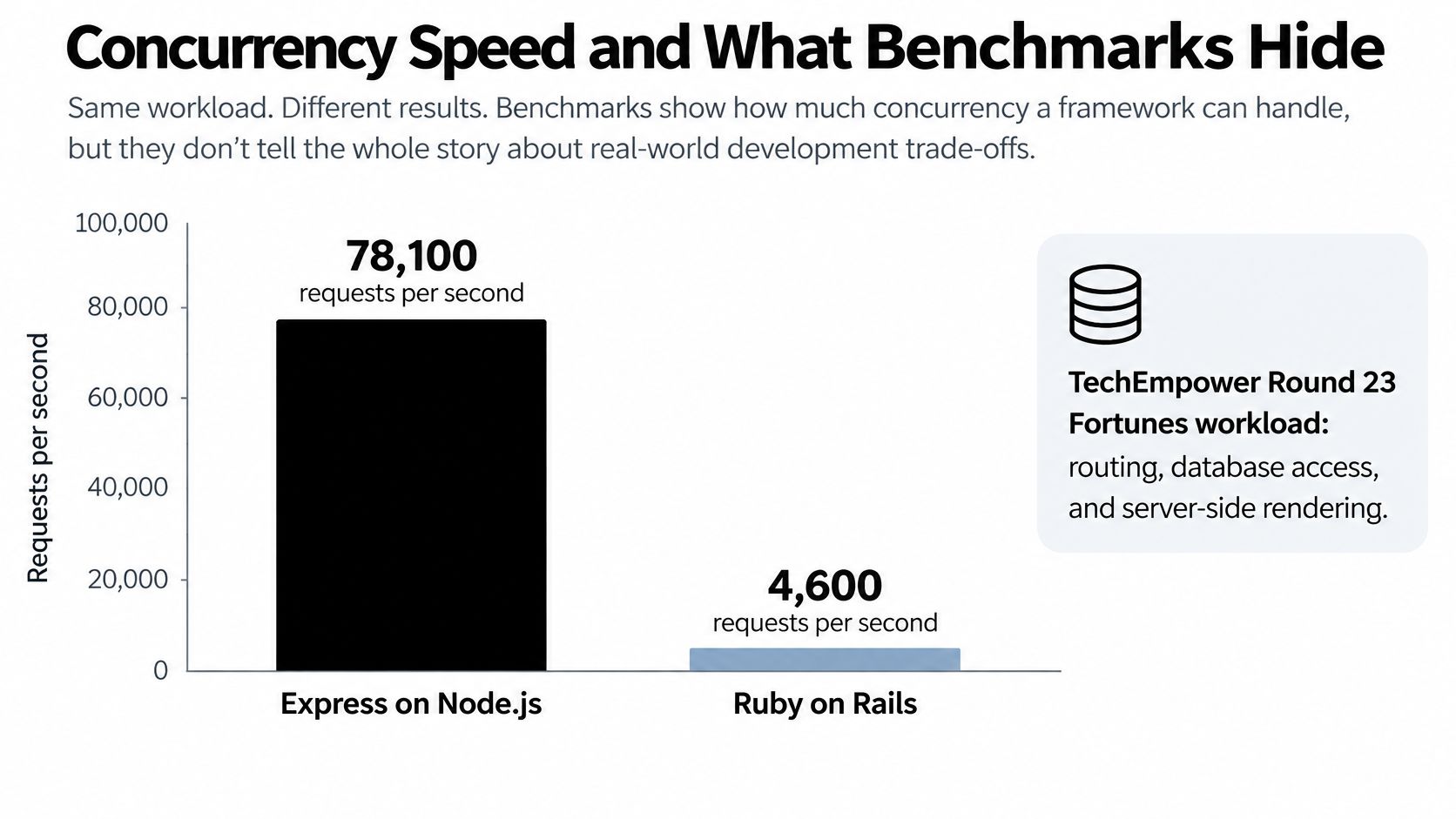
Don't treat 1.8x as a production promise. Database configuration, serialization, process counts, runtime versions, and application architecture all move that gap. A benchmark server isn't running your authorization rules, your third-party calls, or your messy catalog queries.
Practical rule: Latency on a synthetic test is a weak proxy for total product cost.
The Mechanism Behind the Gap
Node's model explains its edge. As the Node.js guide to the event loop describes, a single JavaScript thread handles application callbacks while non-blocking I/O is offloaded to the operating system. That suits API aggregation, realtime updates, and streaming, where the server spends most of its time waiting on networks and databases rather than computing.
The same model creates Node's classic failure. Put CPU-heavy work, such as image processing, large report generation, or synchronous cryptography, on that thread and every other request waits. Your concurrency advantage evaporates because one slow job stalls the loop for everyone.
Rails plays a different card. It's an integrated platform with built-in caching, including fragment and low-level caching through Rails.cache. When repeated responses or computations are cacheable, a single server and database can sustain thousands of concurrent users because most requests never redo the expensive work. Cacheable transactional pages can shrink or erase the headline benchmark gap.
Our practical notes on caching in Node.js cover the same principle from the Node side, because caching strategy matters more than stack loyalty on both.
What to Validate Before You Decide
Replay your own traffic shapes instead of borrowing a lab ratio. For ecommerce and SaaS, that means representative cart, catalog, authentication, and personalization workloads under realistic data volumes. Measure p95 latency, error rate, and database load, not just requests per second.
Either stack in fintech or healthcare still needs explicit controls, and no benchmark supplies them for you:
- Database pooling: Size connection pools so a traffic spike doesn't queue every request behind the database.
- Background jobs: Move email, exports, webhooks, and model calls off the request path.
- Observability: Track queue depth, event-loop lag on Node, and worker saturation on Rails.
- Authorization and blocking protection: Enforce access checks per request and keep slow, synchronous work away from user traffic.
Uncached, I/O-heavy concurrency leans Node. Cacheable, transactional work can favor Rails in practice. Run your four core workloads, compare the results, and only then believe a number.
Shipping Speed Libraries and Who You Can Hire
Popularity is not a delivery plan, but it affects the hiring pool and the choices your team can sustain. The 2025 Stack Overflow Developer Survey reports Node.js at 48.7% of respondents and Ruby on Rails at 5.9%. That is an 8.25-to-1 ratio, or a 42.8-percentage-point gap.
Developer survey reach for Node, Rails, and neighbors
| Technology | Reported share | Survey context |
|---|---|---|
| Node.js | 48.7% | 2025, all respondents |
| Ruby on Rails | 5.9% | 2025, all respondents |
| Express | 19.9% | 2025 web frameworks |
| ASP.NET Core | 19.7% | 2025 web frameworks |
| Django | 12.6% | 2025 web frameworks |
| Laravel | 8.9% | 2025 web frameworks |
These figures are a labor-market signal, not a count of production systems. Node.js respondents may use it for broader JavaScript work, including front-end tooling, rather than backend services alone. Still, the larger reported share points to a wider pool when you recruit.
Two Different Kinds of Fast
Rails can shorten the path to a first release when the product centers on CRUD, or creating, reading, updating, and deleting records through forms and admin screens. Generators, migrations, and conventions settle many routine decisions. A small team can build accounts, permissions, and a working back office without first designing every project convention from scratch.
Node.js can also support rapid delivery, but the team must make more choices about its framework, ORM, validation, authentication, and job runner. Set those choices as a house standard and document them. Teams can then reuse the same patterns across services; leaving each decision open invites repeated debate and inconsistent maintenance.
The package ecosystems reflect a related trade-off. npm offers broad coverage, but that breadth can mean several packages for the same task, with differing maintenance needs. Rails gems often provide deeper support for admin, payments, and database workflows within Rails conventions. Broad package choice helps when integrating varied services; framework-aligned tools can make routine business features more consistent.
Hiring Tests That Actually Predict Success
For ecommerce, fintech, SaaS, healthcare, and public-sector teams, assess whether senior maintainers are available in your hiring market and whether a six-person team can own upgrades over time. Software developer recruitment advice can help structure the search.
- Pair product ownership with the scarcer skill: If Rails expertise is the hiring constraint, give the senior Rails developer direct access to product decisions. That helps protect their time from avoidable churn.
- Assign an owner for Node dependencies: Set a regular cadence for reviewing npm updates and security advisories, rather than treating upgrades as an occasional cleanup.
- Test for senior asynchronous-systems skill: Ask Node candidates to explain event-loop blocking and how they would trace a stalled process. Familiarity with JavaScript alone does not demonstrate this experience.
A larger pool does not guarantee experienced maintainers; a smaller pool does not automatically make Rails the riskier choice. Compare the skills your product needs with the team you can hire and retain. Over a five-year horizon, workload boundaries matter too: a Node.js or Rails application can coexist with a separate AI service, using the language best suited to each job rather than forcing every component into one stack.
Workloads That Favor Each Stack
Pick by the shape of your requests, not by brand preference. The summary below turns product situations into a first lean, including the option leaders forget, which is not rewriting at all.
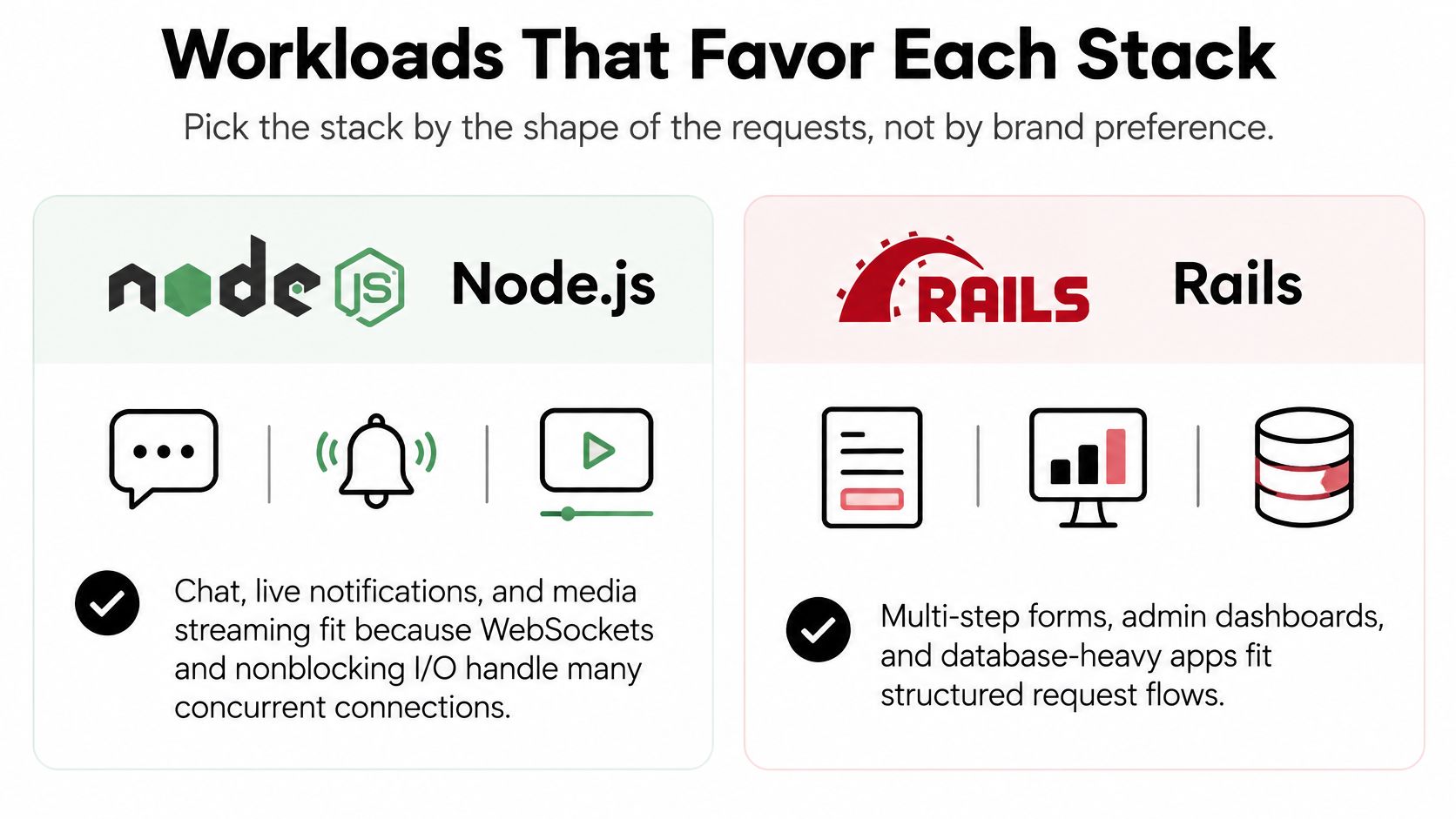
Which stack fits the workload
| Product situation | Lean toward | Why it fits |
|---|---|---|
| Chat, notifications, or streaming media | Node.js | WebSockets and nonblocking I/O for many concurrent connections |
| New CRUD SaaS or marketplace admin | Ruby on Rails | Conventions and migrations shorten the first release |
| Rails app with embedded business rules | Keep Rails | A full rewrite can add more risk than it removes |
| TypeScript product orchestrating model calls | Node.js | Shared language for streaming interfaces and inference traffic |
| Personalization or data-science models | Polyglot, often Python beside the app | Model services do not require a framework rewrite |
| I/O-heavy ecommerce catalog APIs | Node.js at the API edge | Concurrent reads and integrations dominate the request path |
| Regulated fintech or healthcare core | Either, with explicit controls | Pooling, jobs, auth, and observability matter more than the logo |
Request latency alone is a weak proxy for total cost.
Reading the Scenarios in Product Language
Chat, live notifications, and media streaming fit Node because thousands of connections sit mostly idle, waiting for events. Node holds those connections cheaply, and a TypeScript client can share types with the server so a renamed field breaks the build instead of breaking production.
A new SaaS back office, marketplace admin, or content workflow fits Rails because the hard part is business logic, not connection count. Pricing rules, approval chains, and audit trails benefit from conventions and a mature ORM. You'll reach the first paying customer sooner.
An existing Rails product deserves special respect. If pricing, claims, or enrollment rules live inside that monolith and it performs acceptably, keep it. Rewriting to chase a trend spends a year recreating behavior you already own, including edge cases nobody documented.
AI features redraw the boundary rather than replacing the stack. Use Node at the edge to orchestrate model calls, stream tokens to the browser, and fan out notifications. Put personalization, recommendation, and heavier model work in a Python service beside either stack, since that ecosystem owns the data tooling.
The menu is wider than two items, too. FastAPI's share in the Stack Overflow web-framework survey nearly doubled from 7.42% in 2023 to 14.8% in 2025, while Express remained nearly flat at about 19.9% in 2025, according to a backend frameworks comparison. Draw your first boundary between synchronous business transactions and concurrent event traffic, then assign each side the tool built for it.
Scaling Patterns and Daily Operations
Scaling is mostly the same discipline on both stacks, applied with different knobs. The patterns below are the ones that carry products from launch to serious traffic without drama.
On Node, run several processes per host behind a load balancer so you use every CPU core, since one process uses one thread for your code. Put slow work in a queue such as BullMQ and watch event-loop lag as your early warning signal. Rising lag means something is blocking, long before users complain.
On Rails, run Puma worker processes behind a proxy and move background work to Sidekiq or Active Job. Back Rails.cache with a shared store so every worker sees the same cached fragments. Cache hit rate becomes a number your whole team learns to read.
Four Moves Both Stacks Need
- Pool database connections: Put connection pooling in front of the database so a deploy or spike doesn't open a connection stampede.
- Push slow work to jobs: Move email, exports, and third-party calls into background jobs with retries and dead-letter handling.
- Cache what repeats: Start with the most-read pages and API responses, then measure before caching anything clever.
- Split services only on evidence: Extract a service when a boundary has a measured reason, such as independent scaling or a different team owning it.
Daily operations need the same attention either way. Use structured logs with request IDs so you can trace one user's journey across services. Add distributed tracing, and alert on queue depth and error rates, not just server CPU.
Set a fixed schedule for runtime and framework upgrades so security patches never wait for a crisis. A small upgrade every quarter beats a terrifying one every three years.
Rehearse rollbacks before launch, not during an incident. Keep the signals you watch in one dashboard so product and engineering leaders read the same numbers and argue about the same facts.
Five Year Cost for Regulated Growth
License cost won't decide this pair, since both stacks are open source. The five-year bill is senior maintainers, upgrade work, dependency governance, observability, incident skill, and the cost of leaving a codebase you no longer love.
Rails' smaller footprint doesn't mean it's disappearing. The 2026 survey still recorded Ruby on Rails use by 5.7% of respondents, showing continuing production relevance rather than disappearance, according to a 2026 web frameworks survey summary. Plenty of profitable systems run on a stack that conference talks have moved past.
Five-year risk by organization
| Risk question | Node.js pressure | Rails pressure |
|---|---|---|
| Senior maintainers | Broad market, uneven async skill | Smaller pool of monolith specialists |
| Upgrades and dependencies | Large npm surface to govern | Framework upgrades inside a mature app |
| Incident response | Event-loop stalls and callback failures | Worker saturation and cache misses |
| Rewrite cost | Lower on a true greenfield build | High when domain logic is embedded |
| 2026 relevance | Dominant contemporary survey share | Still 5.7% of respondents, not gone |
Score Your Organization, Not the Logo
A small Rails market hurts if you can't hire people who understand a mature monolith, including its callbacks, scopes, and background jobs. A large Node market hurts if nobody on your team can explain the event loop, trace a stalled process, or govern npm updates. Both failures look like "the stack is slow" right up until they become an outage.
The contrarian case is specific. Migrating off Rails raises risk when domain logic is embedded in a stable monolith, because you're rewriting tested behavior under deadline pressure. Choosing Node for a new system raises risk when async discipline, runtime observability, or dependency controls are missing.
Fintech, healthcare, government, and enterprise SaaS teams often do best keeping Rails for the transactional core and introducing Node selectively where concurrency or a JavaScript edge is real. Our breakdown of the cost of software development helps you model those people and maintenance costs against build cost.
Use a simple risk total. If rewrite cost is high and the monolith is healthy, don't pay that cost to win a benchmark.
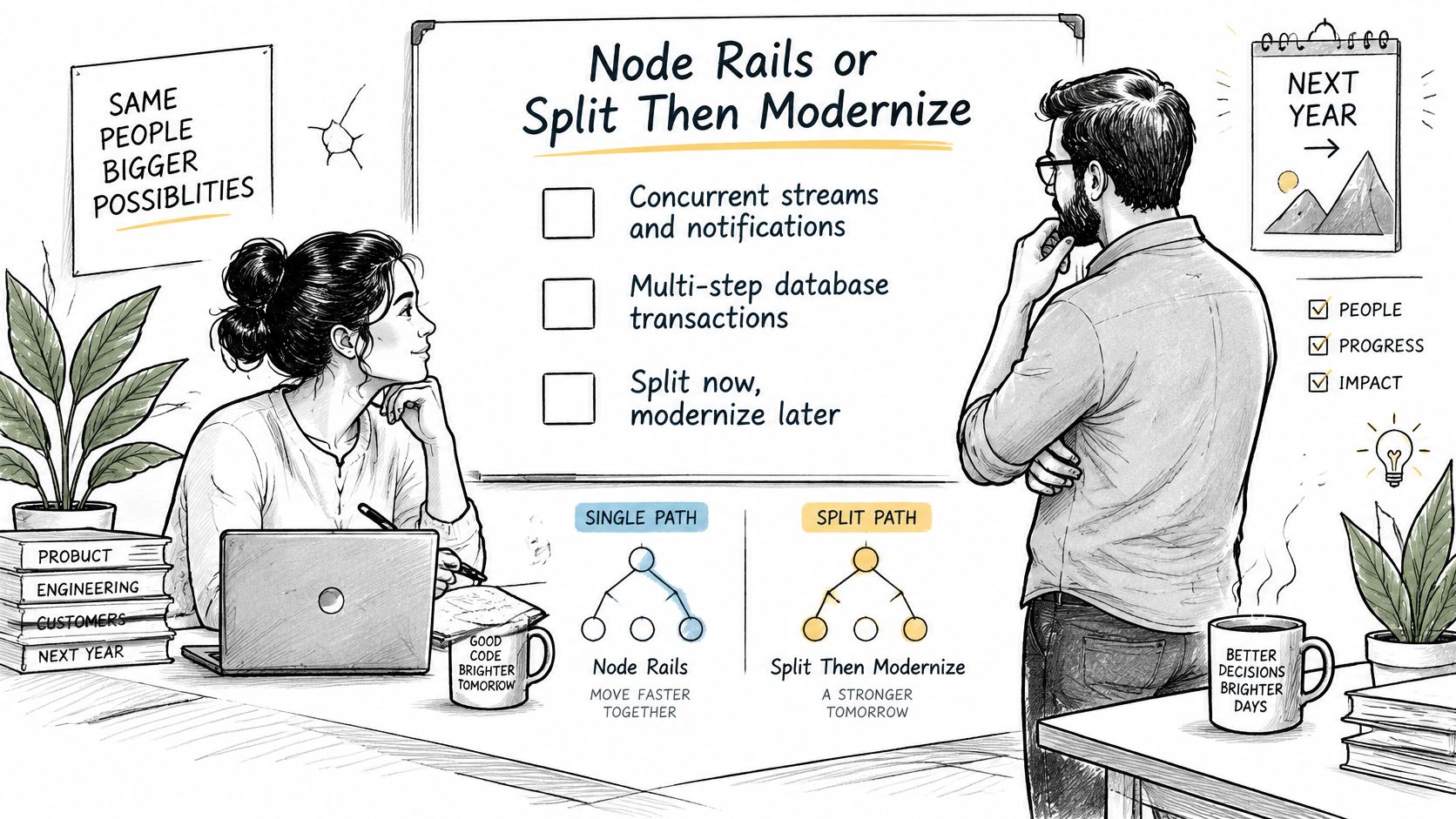
Choose Node Rails or a Split Then Modernize
The best choice is often not Node or Rails. It is a clear boundary between workloads, with a path to modernize without turning a healthy application into a rewrite project.
Start with three questions:
- What work will dominate? Concurrent streams and notifications may suit Node at the edge. Multi-step database transactions may fit Rails or a Rails-like core.
- Who owns the incidents? Name the senior engineers who would handle a failure for each option. If no one can own it, the staffing plan is incomplete.
- Where should the boundary sit? Keep a healthy Rails core, adopt Node for a new I/O-heavy edge, or split out model and data services when they need independent boundaries.
These answers connect architecture to five-year organizational risk: who can maintain each part, where changes are safest, and which workloads justify a separate service. Treat a stack choice like drawing a property line. Put each responsibility where the team can build and operate it well.
Don't fund a framework-wide rewrite to win a benchmark. Fund the boundary that's failing.
AI services can add another boundary without forcing every part of the application onto one stack. Wonderment's administrative toolkit covers prompt management, integrations, and token cost control, and plugs into an app's admin backend. This offers a polyglot path: retain the Rails or Node components that fit existing workloads while connecting AI capabilities where they serve the product.
For implementation, Wonderment Apps' Technology Services include Backend Architecture, API & Database Development, Frontend Interface Development, Server Side Development, Manual + Automated Quality Assurance, and Tech Consulting and Staffing Services. Its server-side work spans .NET, Java, PHP, Python and Ruby. Managed Projects builds technology designed to support up to millions of users per day, with teams shaped around the project.
If you're weighing Node.js vs Ruby on Rails for a new build, modernization, or AI upgrade, visit Wonderment Apps to learn about its managed teams and AI services. Contact the team with your workload and five-year constraints to discuss which stack and boundaries fit.