

Your roadmap is expanding, but your hiring pipeline isn't moving at the same speed. A mobile release needs another engineer, the web platform needs a data specialist, QA coverage is stretched, and your product lead is spending more time coordinating work than making product decisions. Bringing in people can solve the capacity problem, but adding headcount alone won't solve unclear ownership, scattered context, or slow approvals.
Extended development teams offer a different approach. External engineers, designers, QA specialists, DevOps professionals, and AI experts work inside your existing delivery system, while your internal leaders retain control of the product vision. That operating model can support desktop and mobile applications, platform modernization, and AI features, provided you treat governance as seriously as staffing.
AI makes that discipline even more important. A prompt management system, for example, can give teams a controlled place for prompt versions, AI activity logs, database parameters, and cumulative spend. Those controls help turn AI integration from a collection of clever experiments into a maintainable product capability.
Why Scaling Product Teams Feels Harder Than Hiring
A growing company often reaches the same uncomfortable moment. Sales has promised a new customer experience, leadership wants AI-assisted workflows, and the engineering team is already committed to reliability work. Recruiting is underway, but the roadmap can't wait for every role to be filled and onboarded.
An extended team can add capacity without transferring product ownership away from the people closest to the business. Your product owner still decides which customer problem matters most. Your internal technical lead still approves architectural tradeoffs. External specialists contribute implementation capacity, domain expertise, or delivery support within those boundaries.
The distinction matters because a product team isn't a bucket of interchangeable coding hours. It has context, decisions, relationships, and technical memory. Hiring more people can increase output, but it can also create more conversations, more handoffs, and more chances for two teams to interpret the same requirement differently.
Capacity is only half the equation
The right question isn't, “How many developers can we add?” It's, “Which capability is limiting delivery, and how should that capability connect to the team we already have?”
You may need:
- Mobile expertise: Engineers who understand iOS or Android patterns while your internal team focuses on backend services.
- Quality coverage: Automated and manual QA specialists who protect release confidence as feature volume grows.
- Product design: UX support that turns complicated workflows into usable desktop and mobile experiences.
- AI modernization: Data scientists, AI engineers, or integration specialists who can add intelligent features without destabilizing the core application.
- Platform reliability: DevOps expertise for deployment pipelines, infrastructure, observability, and scaling decisions.
Outsourcing has become a mainstream way to access these capabilities. Recent industry summaries report that 76% of companies outsource IT functions and 64% of IT leaders globally outsource software development, while several 2026 industry reports project the IT outsourcing market at roughly $617 billion. These figures indicate the maturity and scale of external delivery as a talent strategy, not proof that every outsourcing arrangement will succeed. (Industry outsourcing data and market summary)
Governance determines whether extension works
Success looks like a coherent product team, not two disconnected groups passing tickets over a wall. The external members should understand the product goals, follow the same engineering standards, and know who makes the final call when priorities conflict.
That principle becomes especially valuable when AI enters the roadmap. A team may prototype a support assistant quickly, but long-term operation requires prompt ownership, access controls, evaluation practices, logging, and cost visibility. Capacity gets the feature started. Governance keeps it safe and useful.
What Extended Development Teams Are and How They Work
Think of an extended development team as an extension cord for your engineering organization. The cord doesn't replace the appliance, and the external team doesn't replace your company's product leadership. It connects additional capability to the power source you already have.
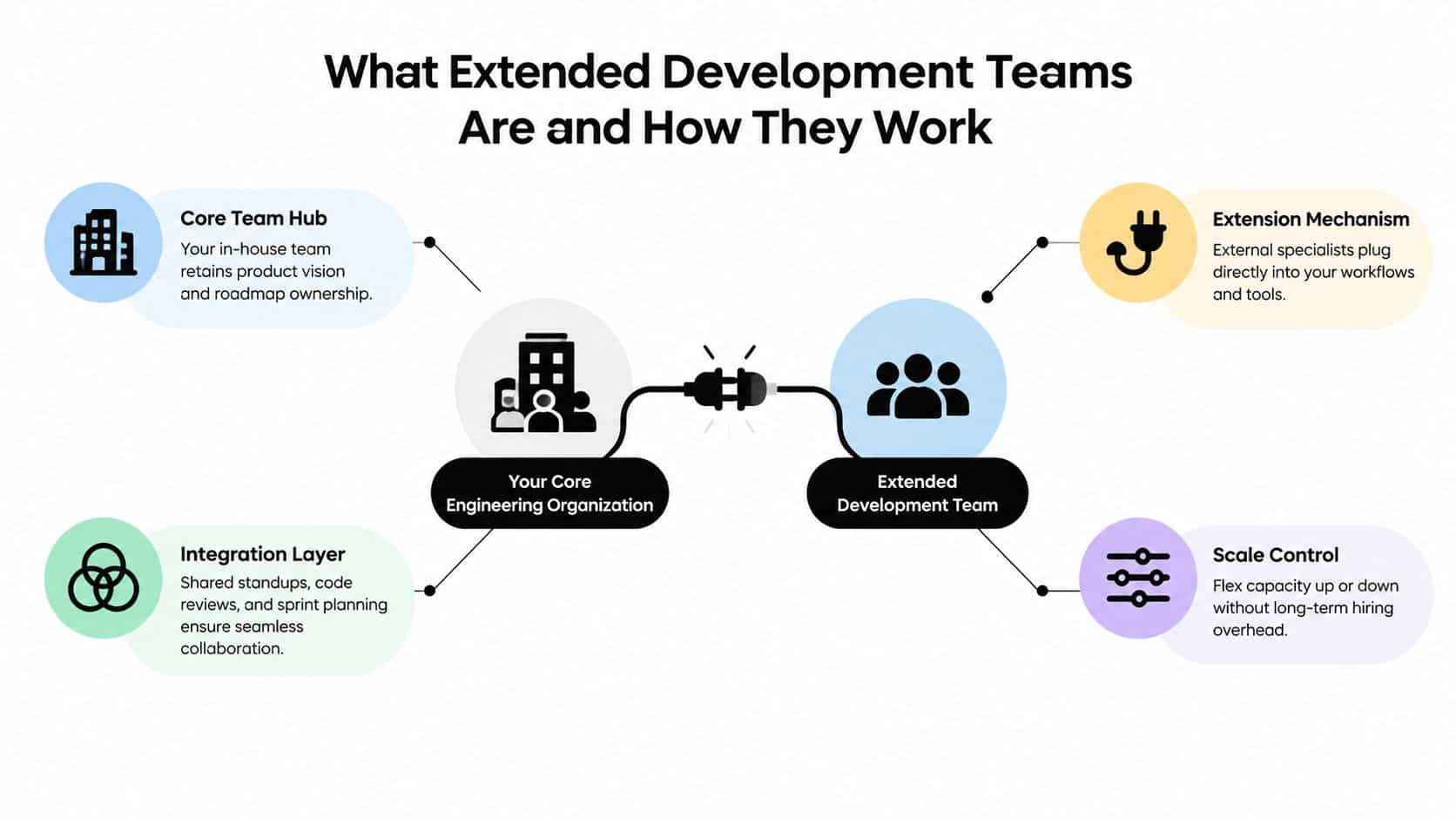
The practical model works through integration:
- Start with your internal hub. Your company keeps the product vision, roadmap, customer knowledge, and strategic priorities. An internal product owner or technical lead should remain available to resolve ambiguity.
- Define the extension. External specialists join a specific product area or delivery stream. They might build a mobile feature, improve test automation, modernize a legacy service, or support an AI integration.
- Connect the workflows. The team uses your repositories, issue tracker, documentation standards, communication channels, environments, and review process. The goal is shared execution, not parallel delivery with occasional updates.
- Control the scale. You can adjust the mix of skills as the roadmap changes, while preserving clear responsibility for architecture, security, and product decisions.
Daily work should feel familiar. A designer may refine a user flow in Figma, an engineer may submit a pull request in the same repository used by internal developers, and QA may report failures through the same issue workflow. Sprint planning should assign outcomes and ownership, not merely distribute isolated tasks.
Embedded collaboration matters more than geographic proximity. A distributed team can work well when people share context, tools, decisions, and feedback loops.
Cultural alignment doesn't mean every contributor must work identically. It means the group agrees on what “done” means, how disagreements are resolved, how risks are raised, and how technical decisions are recorded. Leaders looking for practical guidance on asynchronous communication, documentation, and distributed rituals can use this HiredBySkill distributed team guide as a complementary resource.
The model breaks down when external contributors receive vague tickets, delayed reviews, or access to systems without enough context. In that situation, the company hasn't extended its team. It has created a second team and connected the two with hope.
How Extended Teams Compare to Staff Augmentation and Outsourcing
These labels often overlap, which creates avoidable confusion. Staff augmentation usually adds individual specialists under the client's day-to-day direction. Project-based outsourcing assigns a vendor responsibility for defined deliverables. An extended development team sits between those models in integration depth, because external members operate as part of the client's product team while the engagement can still provide a broader, managed capability.
| Model | Ownership and Integration | Best Fit |
|---|---|---|
| Extended development team | External specialists work inside the client's repositories, ceremonies, tools, and review flow. The client retains product and technical authority. | Product organizations that need flexible capacity while preserving roadmap and architecture ownership. |
| Staff augmentation | Individuals join an existing team and typically follow internal management, processes, and priorities. | A focused skills gap, temporary workload increase, or specialist role. |
| Project-based outsourcing | A vendor owns delivery for an agreed scope, with the client managing outcomes, acceptance, and relationship governance. | A well-defined project where the buyer wants a packaged delivery responsibility. |
The choice depends on the work's ambiguity and the level of control you need. A fintech company changing a payment workflow may benefit from embedded engineers who can participate in architecture and compliance discussions. A company commissioning a contained marketing website may prefer project-based delivery. A SaaS business that needs a temporary .NET specialist may choose staff augmentation.
Externalized delivery is frequently motivated by efficiency rather than cost alone. One 2026 industry summary reports that 60% of companies outsource software development to reduce operational costs, while 78% had engaged with an outsourcing provider in the last six months. The same source reports a 20% higher on-time delivery rate for outsourced projects than in-house teams and a 15% to 20% lower defect rate, suggesting that integrated external delivery can support reliability when governance and sprint participation are strong. (Outsourcing efficiency and delivery statistics)
Commercial structure also changes by model. Staff augmentation can be straightforward, but internal managers carry more coordination responsibility. Project outsourcing may reduce daily management but requires precise acceptance criteria. Extended teams share the management load, so the contract must define both the vendor's responsibilities and the client's decision rights.
For a deeper examination of the individual-contributor model, see this practical guide to IT staff augmentation pros and cons. Leaders comparing legal, administrative, and commercial considerations can also consult this overview of UK umbrella company outsourcing advantages.
Team Models Roles and Industry Use Cases That Scale
Team composition should follow the product constraint, not a generic staffing template. A platform upgrade may need backend engineers and DevOps support. A mobile redesign may need UX, iOS, Android, and QA specialists. An AI feature may require data expertise, integration engineering, prompt operations, and product judgment.
Match the model to the work
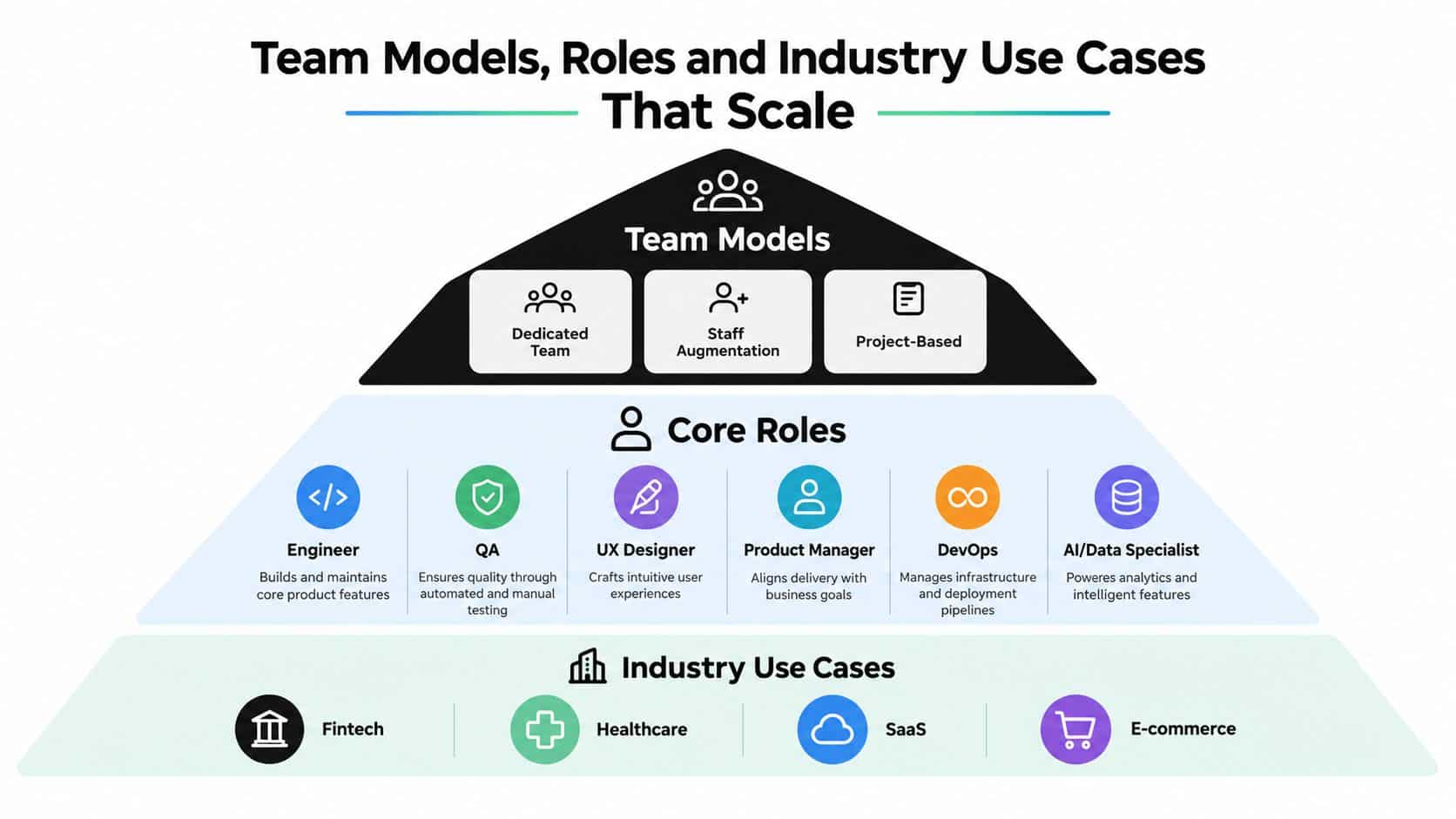
A dedicated team suits a continuing product stream where the same group needs to build context over time. Staff augmentation works when your internal team can manage the work but lacks a specific skill. Project-based delivery fits a defined outcome with clear boundaries.
The roles inside those models can include:
- Engineers: Build and maintain product features across web, desktop, mobile, backend, and integration layers.
- QA specialists: Combine automated and manual testing to identify regressions before release.
- UX designers: Shape information architecture, interaction patterns, accessibility, and user research outputs.
- Product managers: Translate business objectives into priorities, acceptance criteria, and roadmap decisions.
- DevOps specialists: Maintain deployment pipelines, environments, monitoring, and operational readiness.
- AI and data specialists: Support analytics, recommendation systems, anomaly detection, natural language features, and model-connected workflows.
The mix changes by industry. Ecommerce and retail teams may prioritize personalization, search, recommendations, inventory workflows, and mobile conversion. Fintech products require careful attention to secure architecture, auditability, reliability, and user trust. Healthcare and wellness applications need compliant data handling and accessible experiences. Media and entertainment products often combine high-performance content delivery with rich discovery and personalization. SaaS teams may focus on multi-tenant architecture, integrations, and administrative controls, while public-sector and nonprofit organizations often need clear digital services that work for broad and varied audiences.
Scale the workstream, not just the headcount
Software engineering research shows why adding people to one large unit can backfire. An empirical study across more than 200 projects found that increasing team size raises development effort, with the relationship influenced by software size, programming language, and tooling. An ISBSG-based report found that teams of nine or more are significantly less productive than smaller teams, while projects above roughly 515 function points tend to be more productive than smaller efforts. (Software project team-size research)
The practical response is to divide substantial work into semi-autonomous streams with explicit interfaces. One group might own account services, another the mobile experience, and another quality automation. Each team needs a clear boundary, but the architecture must still provide shared standards and integration points.
How to Select Onboard and Run an Extended Team Well
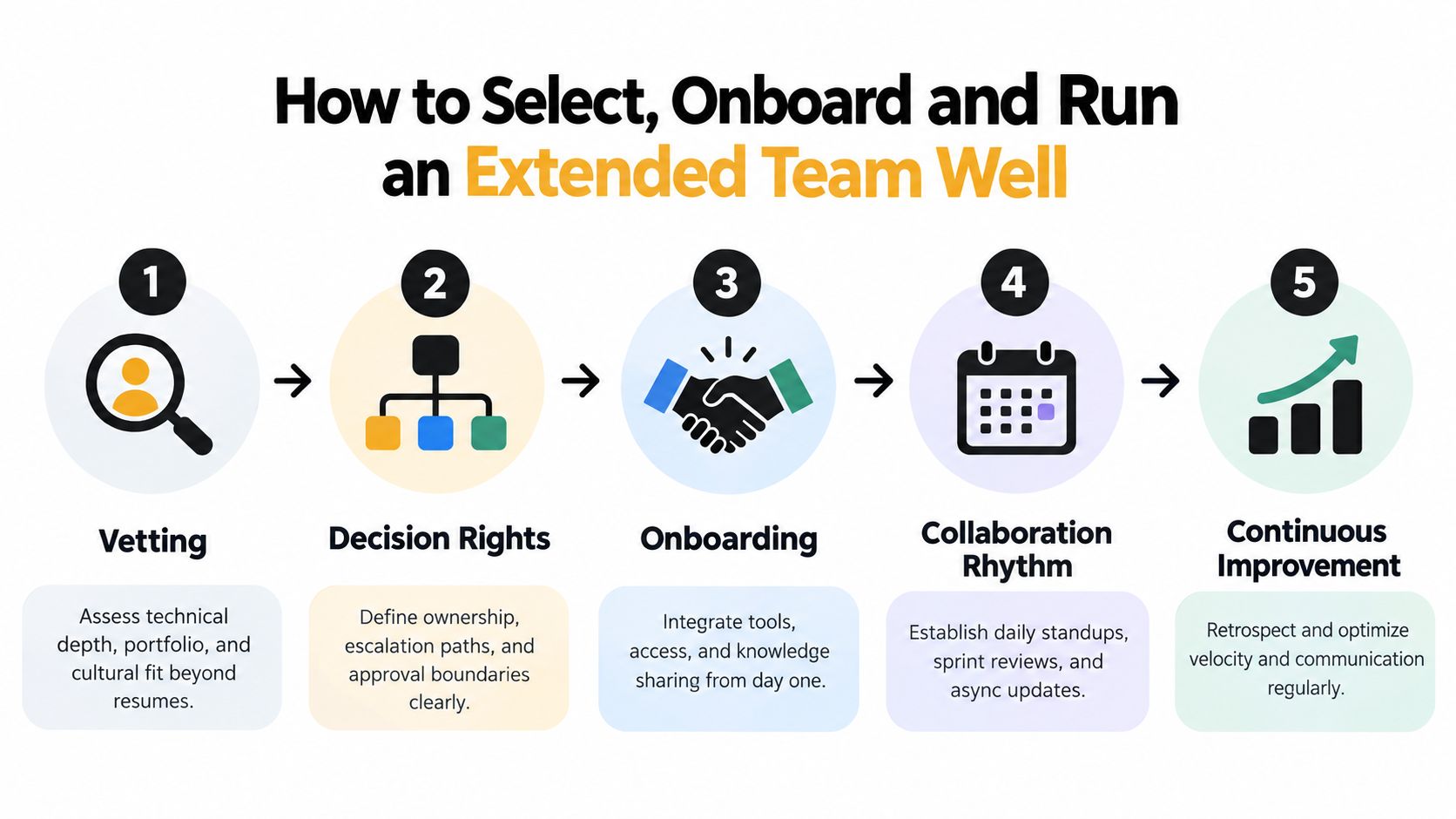
Selection should test how a team thinks, communicates, and handles incomplete information. Resumes can confirm technical exposure, but they won't show whether an engineer can explain a tradeoff clearly or raise a delivery risk early.
Vet for delivery behavior
Ask candidates to review a representative product problem, not just answer framework questions. Look for evidence that they can:
- Understand context: Connect a technical decision to user needs, business constraints, and operational risk.
- Work visibly: Describe how they track work, document decisions, and communicate blockers.
- Protect quality: Explain testing strategy, code review habits, and how they handle a failed release.
- Collaborate across roles: Show how they work with product managers, designers, QA, security, and internal engineers.
Give the selected team a bounded first assignment. A small but meaningful feature reveals more about collaboration than a polished sales presentation.
Establish decision rights before onboarding
Extended teams work best when the internal company keeps a technical lead or product owner who serves as the single decision-maker for priorities, tradeoffs, and approvals. One practical guide recommends appointing an in-house PM or tech lead as the single point of contact and routing all change requests through one channel. (Guidance on internal ownership and change control)
Write down who owns product priority, architecture, security approval, release approval, hiring changes, and incident response. Without that map, external contributors may wait for approval on routine work while several internal stakeholders independently redirect the backlog.
Use a staged ramp
A staged 90-day onboarding workflow can move the team from Foundation to Contribution and then Independence. During the first 14 days, a pairing buddy can transfer architectural and cultural knowledge before the team moves toward weekly check-ins. (Staged extended-team onboarding workflow)
Start with repository access, local setup, architecture notes, product vocabulary, security rules, and examples of acceptable work. Then assign production-adjacent contribution with close review. Independence should mean the team can deliver within its boundary, not that internal leaders stop owning decisions.
Use shared standups when they add value, asynchronous updates for routine progress, sprint reviews for outcomes, and retrospectives for process issues. The best practices for working with offshore teams provide useful context for communication rhythms, time-zone differences, and collaboration discipline.
Pricing Contracts and KPIs That Keep Delivery Accountable
The commercial model should match the uncertainty of the work. Time and materials suits evolving product discovery, because the team can change priorities without pretending that every requirement is known. Fixed price can work for a well-defined deliverable, but vague scope turns every clarification into a negotiation. A dedicated-team arrangement provides continuity for an ongoing product stream and makes capacity easier to plan.
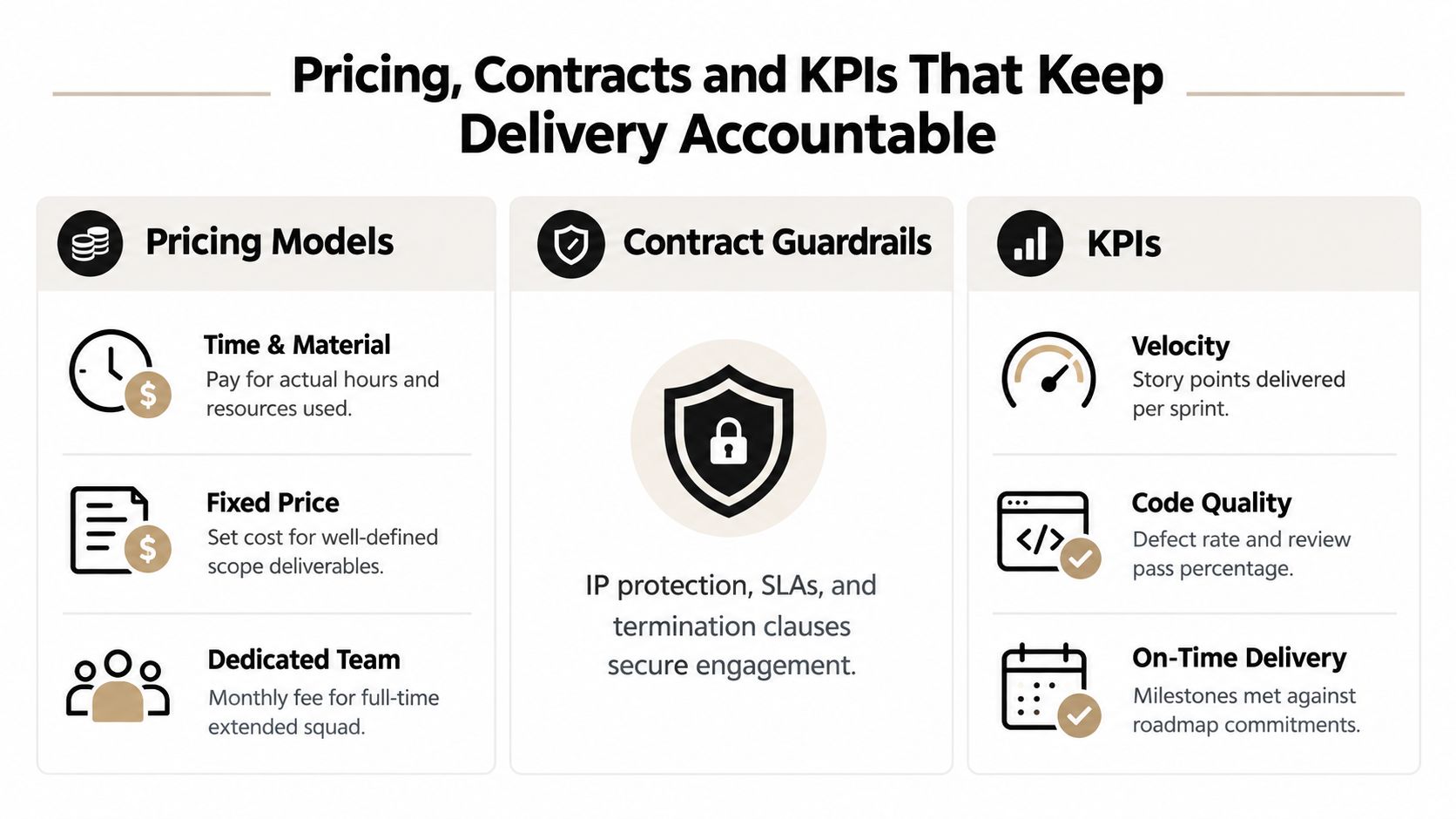
A strong contract addresses more than rates. Include:
- Intellectual property: Define ownership of source code, designs, documentation, prompts, evaluation assets, and other project outputs.
- Security responsibilities: Specify access approval, credential handling, data restrictions, vulnerability reporting, and incident ownership.
- Service expectations: Document review practices, response expectations, release responsibilities, and escalation routes.
- Change control: State how scope changes enter the backlog, who approves them, and how they affect timing or capacity.
- Exit and continuity: Cover termination, knowledge transfer, repository access, documentation, and transition support.
Measure the system, not just developer activity
Useful KPIs reveal whether work moves safely through the system:
- Cycle time: How long work takes from ready to released.
- Defect rate: The number and severity of defects reaching testing or production.
- On-time delivery: Whether agreed milestones arrive when expected.
- Review latency: How long pull requests wait for useful review.
- Access scoping: Whether each contributor has only the permissions required for their role.
- Incident ownership: Whether the team knows who responds, communicates, and leads recovery.
Distributed delivery has a hidden coordination bill. Research synthesis has estimated coordination overhead at roughly 25% to 70% of total development effort, and one synthesis reports about 7 hours 45 minutes per week in scheduled meetings plus 8 hours 54 minutes in unscheduled coordination, totaling about 16.5 hours weekly per developer. (Distributed software coordination research synthesis)
Those figures make coordination a capacity issue, not a soft cultural concern. Partition the backlog by ownership, document interfaces, favor asynchronous handoffs, and establish a predictable integration cadence. Track meeting load and review delays alongside velocity, because a team can appear busy while losing build capacity to alignment work.
For broader commercial planning, use this guide to the cost of software development as a reference point, then build your own estimate around scope, risk, roles, and governance needs.
Pitfalls to Avoid and How Wonderment Helps You Modernize for AI
The most expensive failure usually isn't choosing the wrong country or framework. It's creating an operating model where nobody can answer who owns the decision, the data, or the long-term consequences.
Unclear ownership causes stalled approvals and conflicting priorities. Keep an internal product owner or technical lead accountable for roadmap tradeoffs, architecture, and release risk. Weak onboarding creates fragile contributions and repeated questions. Give new members a pairing partner, accessible documentation, and a bounded first assignment.
Broad repository access increases the blast radius of mistakes. Scope permissions by role, separate sensitive environments, review access regularly, and make security expectations part of onboarding. Silent compliance drift appears when teams add data flows, AI services, or infrastructure changes without updating documentation and approval records. Require explicit review for changes involving customer data, regulated workflows, model providers, and production access.
AI introduces another layer of operational responsibility. A team modernizing a custom desktop or mobile application may connect several models to different workflows, use internal database parameters, and pass sensitive business context through prompts. NDAs and basic access controls don't explain which prompt produced an output, which model handled the request, how usage accumulated, or who should investigate an unexpected result.
Treat prompts as product assets
A vendor-neutral guide to AI integration operations highlights the need for a prompt vault, versioning, logging across integrated AIs, and token-spend tracking. Those mechanisms let organizations manage prompts, audit usage, and control cumulative cost as AI features grow. (AI integration operations guidance)
Wonderment Apps' prompt management system is one example of this administrative approach. It includes:
- A prompt vault with versioning: Teams can organize prompts and preserve changes instead of leaving important behavior inside scattered code or chat messages.
- A parameter manager: Developers can manage internal database access parameters for AI-connected workflows.
- A logging system across integrated AIs: Leaders can review activity across connected AI services rather than treating each integration as an isolated black box.
- A cost manager: Entrepreneurs can see cumulative spend and monitor how usage changes as AI features expand.
The same principle applies to AI-assisted development. Give contributors explicit product requirements, technical constraints, security rules, and acceptance criteria before asking an AI tool to generate or modify code. Review the output like any other contribution, test it against real workflows, and record decisions that affect maintainability.
Extended development teams can help modernize software for the long term, but only when the company preserves ownership of the product, architecture, data, and AI operations. Capacity is useful. Accountable capacity is what lasts.
If you're planning an AI modernization project, a mobile or desktop application upgrade, or a broader product delivery initiative, Wonderment Apps can provide right-sized engineering, UX, QA, product, and AI capabilities alongside your internal team. Visit Wonderment Apps to explore a practical path from extended-team planning to governed AI integration, and request a demo of its prompt management system.