

A recommendation widget can occupy a small rectangle on a product page and still influence a surprisingly large share of an ecommerce business. In one Salesforce shopping-session benchmark, visits where shoppers clicked a recommendation represented only 7% of traffic but generated 26% of revenue (Clerk's summary of the benchmark). That gap changes the engineering question. Personalized product recommendations aren't decorative merchandising. They're a revenue system that must balance relevance, latency, privacy, experimentation, and operating cost.
The strongest teams treat the recommendation layer as part of the product architecture. They connect behavioral data to the catalog, choose models that fit the audience, test business outcomes rather than leaderboard metrics, and add governance before AI touches production. A governed prompt management layer can also help teams modernize existing desktop and mobile applications without scattering fragile prompts and model calls throughout the codebase. Wonderment Apps' approach to AI modernization is relevant here because recommendation experiences need the same discipline as any scalable application, clear integrations, observable behavior, and a path for long-term maintenance. For broader context on personalization patterns, review these Grumspot ecommerce personalization tips alongside the practical guidance below.
Why Personalized Product Recommendations Drive Disproportionate Revenue
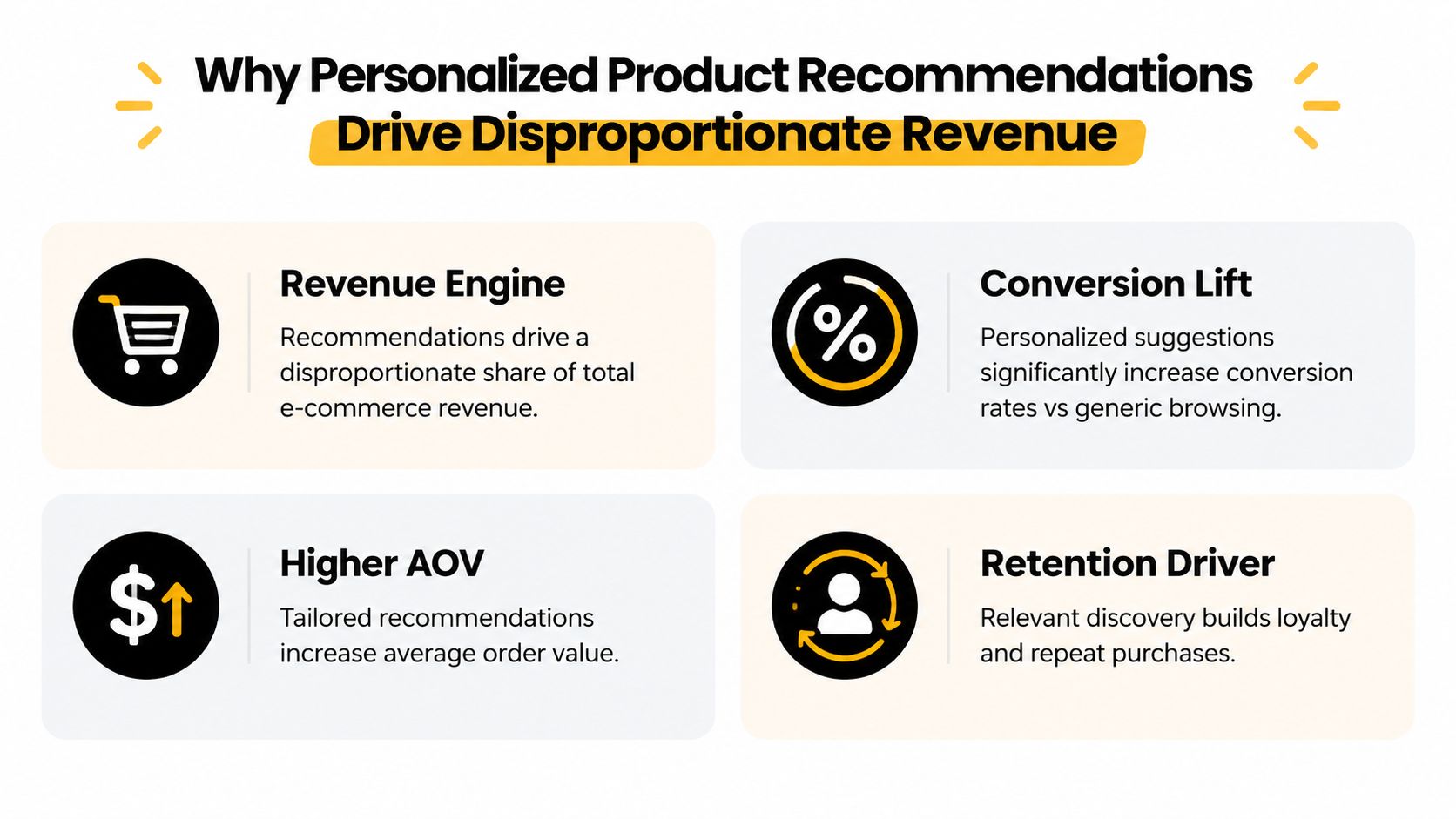
Recommendation engagement matters because it happens close to a purchase decision. A shopper who selects “similar items,” “frequently bought together,” or “complete the look” has shown stronger intent than someone scrolling a homepage. The system reduces discovery effort and offers another buying path while the shopper is already comparing products.
The same Salesforce benchmark found that recommendation clicks represented about 7% of traffic and roughly 26% of online revenue (BizTech Magazine's coverage). That result is a benchmark, not a forecast. It does show why teams should report recommendation-engaged sessions separately from overall page performance.
Placement follows intent
Product detail pages work well because the shopper has already identified an item or category. Cart pages can suggest complementary products, while checkout may support low-friction additions that do not disrupt the main purchase. Each surface needs its own suppression rules. A “similar products” rail may fit a detail page, but a purchased item should not reappear just because it remains popular.
Revenue impact also depends on operations. A recommendation that arrives after the page is usable has little value, and a model that repeatedly promotes unavailable or low-margin products can increase support costs while weakening trust. Serving logic therefore needs inventory checks, business rules, latency budgets, and a fallback for missing or delayed signals.
Benchmarks report substantial gains in revenue and order value from recommendation engagement, but those figures do not establish causation. Use them to frame the opportunity, then measure an internal baseline by placement, audience, device, and product type. Holdout tests are needed to distinguish recommendations that create incremental purchases from recommendations that merely receive credit for shoppers who were already ready to buy.
Practical rule: Optimize for useful next actions, not maximum widget interaction.
Track whether recommendations help shoppers find relevant products, improve basket quality, reduce dead-end browsing, and support repeat visits. A system can earn clicks with sensational but unsuitable items, then lose margin and retention. Prompt governance matters when generative components write explanations or select candidates. Keep prompts versioned, constrain outputs, and log the inputs used for each response so teams can audit relevance, privacy exposure, and inference cost.
For an existing store or mobile app, stable APIs should separate recommendation serving from individual screens. The same service can support search, product pages, cart flows, email triggers, and native app surfaces, while real-time calls remain measurable and controllable. Teams planning that broader transition can consult this guide to the benefits of AI in ecommerce and these Grumspot ecommerce personalization tips when mapping personalization to application modernization.
Designing Your Data Foundation and Pipeline for Personalization
A recommendation model cannot compensate for missing events, inconsistent identities, or stale inventory. Start by auditing the signals that describe shopper behavior, available products, and the context around each interaction. The data foundation determines what the serving system can personalize, how quickly it can react, and what the business can verify later.
Start with event quality
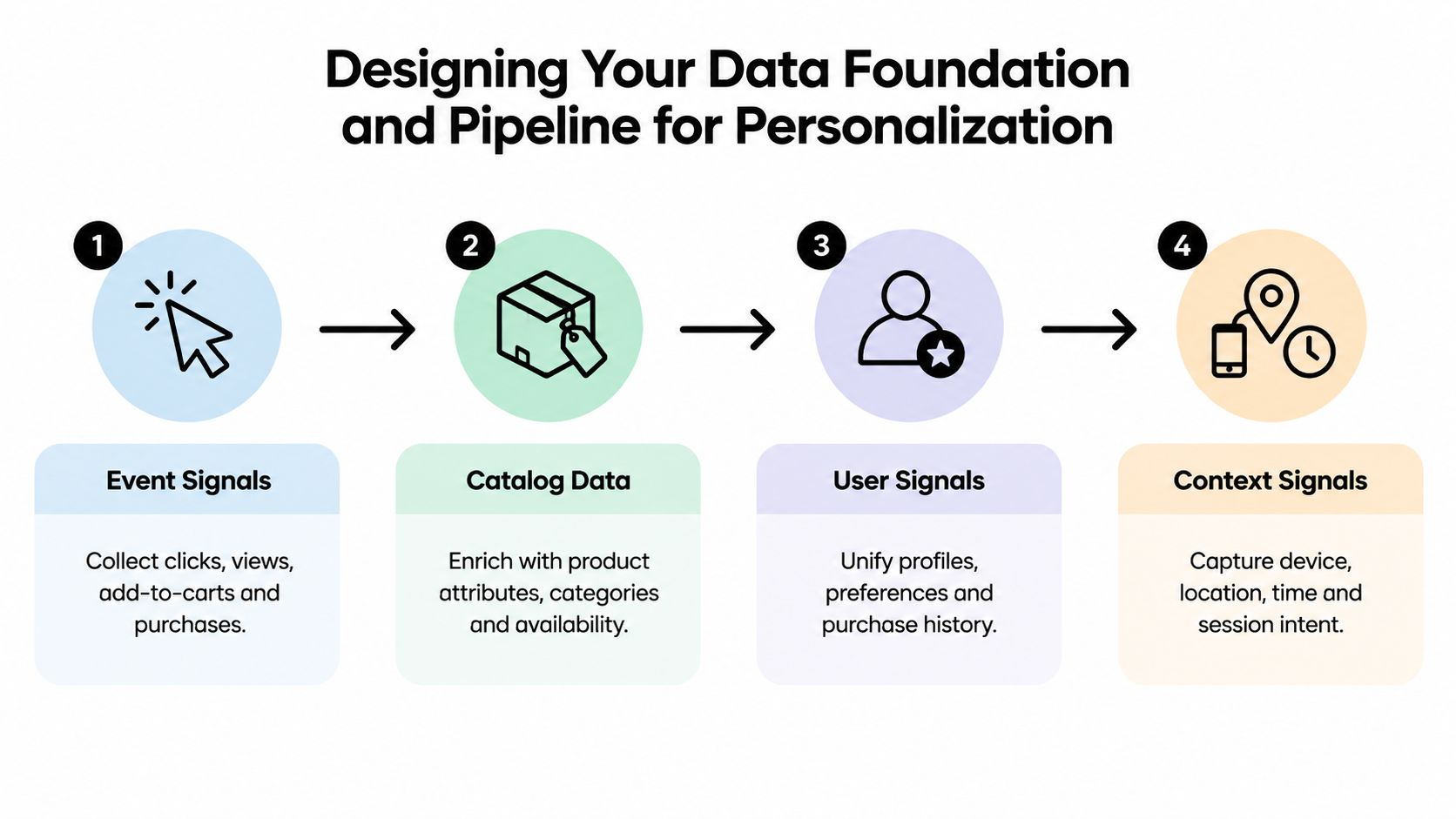
Capture impressions alongside actions. A click is easier to interpret when the system records which alternatives the shopper saw and ignored. Useful event categories include:
- Behavioral events: Record views, clicks, add-to-carts, purchases, removals, searches, filters, and wishlist actions.
- Catalog events: Track price, category, brand, attributes, stock status, fulfillment constraints, and product lifecycle changes.
- Identity events: Connect authenticated profiles with anonymous sessions through a consent-aware identity strategy.
- Context events: Preserve device type, location where appropriate, time, referrer, session depth, and current page intent.
Purchase data is valuable, but it is only one feedback signal. Views and skips provide implicit evidence, while returns, cancellations, and out-of-stock exposures can show that a recommendation produced a poor experience. Keep event timestamps and schema versions. Without them, offline evaluation may train on information that was unavailable when the recommendation was served.
Separate freshness from completeness
Use streaming or near-real-time updates for signals that reflect immediate intent, including the current session, inventory, and recent cart activity. Batch jobs remain suitable for heavier transformations, historical aggregates, and catalog enrichment. A feature store or equivalent serving layer can expose both types of data without making every request query operational databases directly.
Cold-start handling needs an explicit design. New users have no history, and new products have no interaction record. Use contextual signals, product attributes, editorial rules, and popularity baselines as fallback inputs, then introduce behavioral evidence as it becomes available. Popularity bias also requires monitoring. A system trained only on previous clicks can keep promoting already visible products while starving the rest of the catalog.
Review text and structured attributes can enrich profiles when the privacy and operational costs are acceptable. They may expose preferences that clicks miss, but richer profiles increase storage, processing, governance, and debugging demands. See this data-driven personalization guide for implementation patterns. A practical sales-data perspective appears in this Ruit sales analysis report, which can help teams define the business questions their pipeline must answer.
Run a readiness audit this week:
- Confirm every recommendation impression has a timestamp, placement, user or session key, candidate set, and outcome.
- Compare catalog availability with the items returned by the serving layer.
- Measure anonymous-to-known identity continuity without bypassing consent.
- Check that new users and new items have explicit fallback paths.
- Document which features update continuously and which arrive through batch processing.
The target is a dependable data contract, not a set of scripts attached to the first model selected. For legacy systems, place an event gateway and versioned schemas in front of older services. This approach keeps application changes contained while giving the recommendation pipeline cleaner inputs, clearer ownership, and a traceable basis for latency and cost decisions.
Choosing the Right Recommendation Model for Your Catalog and Audience
Model selection should follow the shape of the problem, not the popularity of a technique. A large catalog with dense interaction history can support collaborative methods, while a new marketplace with sparse activity may get more value from product metadata and carefully designed heuristics. Latency, catalog turnover, explainability, and cold-start rates matter as much as predictive quality.
| Approach | Best Fit | Strengths | Watch Outs |
|---|---|---|---|
| Collaborative filtering | Audiences with meaningful interaction history and repeated behavior | Learns patterns that product metadata may not capture | Struggles with new users, new items, and popularity bias |
| Content-based filtering | Catalogs with rich attributes, descriptions, categories, or specifications | Handles item cold start and makes matches easier to explain | Can over-specialize around what a user already viewed |
| Hybrid systems | Stores with mixed data quality, varied audiences, and both new and established products | Combines behavioral relevance with attribute coverage | Requires clear feature weighting and more involved debugging |
| Embedding-based retrieval | Large catalogs, semantic discovery, and products described in rich language | Finds relationships across text, attributes, and behavior | Adds serving, indexing, refresh, and governance complexity |
A sensible first release often uses strong heuristics. “Frequently bought together,” category compatibility, availability, margin rules, and recent popularity create a baseline that stakeholders understand. That baseline also gives the team something honest to beat. Launching a complex model without a credible comparator makes it difficult to tell whether engineering effort produced business value.
Collaborative filtering becomes attractive when users generate enough shared behavior to identify meaningful neighborhoods. Content-based ranking is safer when product metadata is trustworthy and the catalog changes faster than users can accumulate interactions. Hybrid systems generally make the best production compromise because they can use behavioral evidence where it exists and fall back to attributes where it doesn't.
Embeddings can improve retrieval for products with nuanced descriptions or implicit relationships, but they aren't a free upgrade. You need an indexing strategy, refresh rules, access controls, and a way to explain or audit surprising matches. If the main bottleneck is poor inventory data, embeddings will make the wrong foundation more complex, not more accurate.
A useful internal review asks four questions:
- What happens for a first-time visitor?
- How quickly must results reflect a cart change or stock update?
- Can the merchandising team understand why an item appeared?
- What is the simplest baseline that can be tested immediately?
Teams evaluating algorithm families can use this practical overview of recommendation algorithms as a starting point, then validate the choice against their own catalog and serving constraints.
Training Evaluation and Guardrails That Predict Real Business Impact
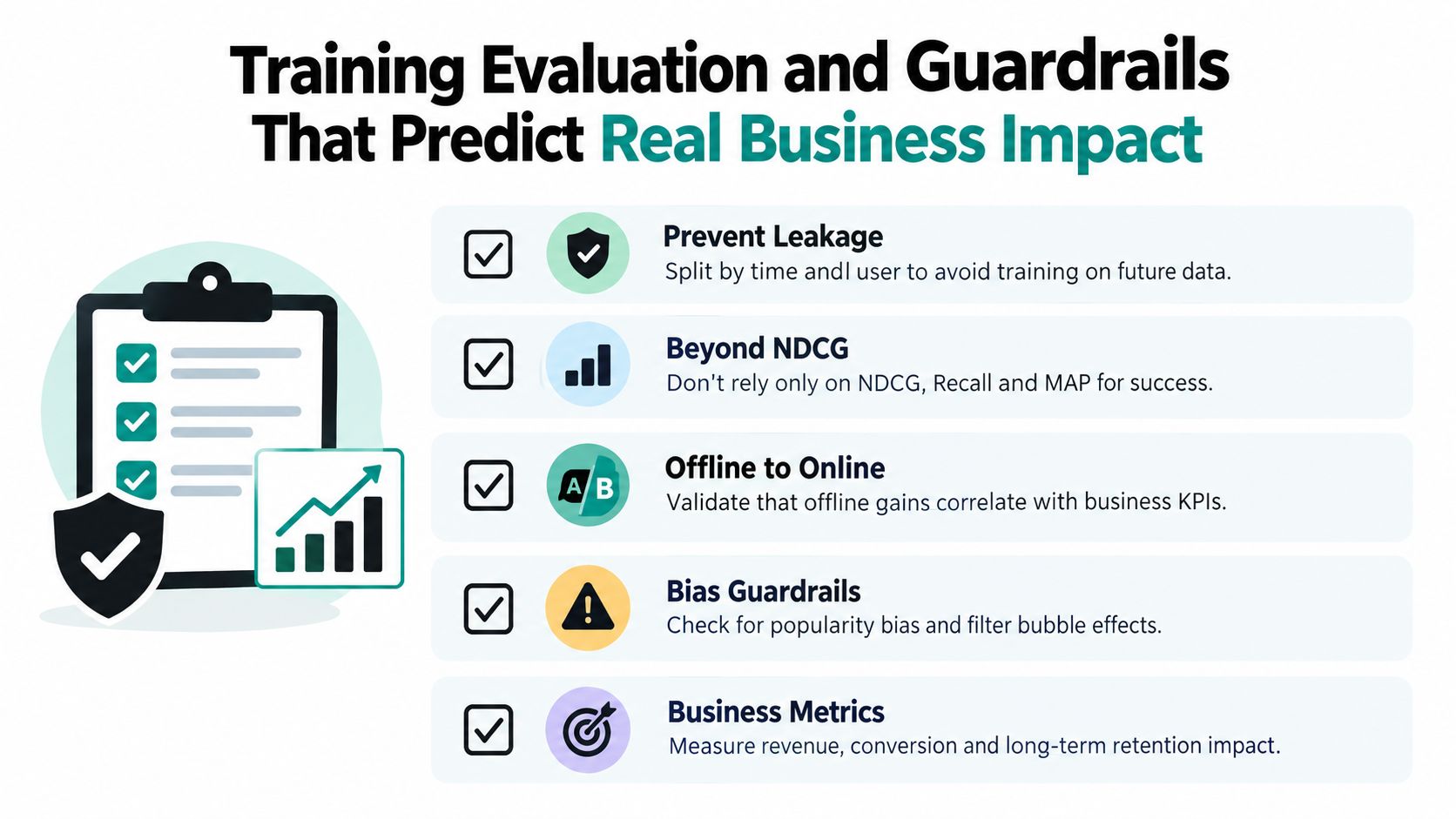
A model can score well on NDCG@10, Recall@50, or MAP@10 and still fail in production. Training logs may reflect old placements, biased exposure, or features unavailable when a request arrives. Evaluation should reproduce the serving conditions, business constraints, and privacy decisions that shape the live experience.
Build the split before the score
Use time-aware holdouts so future interactions never enter training. Where identity data permits, separate users as well, particularly when measuring behavior for people absent from the training history. Audit every derived feature for leakage. Aggregates calculated across a window that includes the target event can make an offline score look stronger than the deployed system.
Popularity bias creates a second trap. If the logging policy mostly displayed popular products, the model may learn popularity rather than relevance. Counterfactual or randomized-exploration data provides evidence about alternatives that the existing system rarely exposed. Exploration has a cost, including weaker short-term clicks and additional serving complexity, but without it the catalog can narrow around products that already receive attention.
Evaluate the whole experience
Keep a holdout baseline representing the current non-personalized experience, then compare the candidate with strong heuristics such as category popularity and co-purchase rules. A more complex model should earn its additional training, inference, and monitoring cost by improving the outcome that matters, not by beating a weak comparator.
Track a dashboard covering:
- Engagement: Click-through rate, impressions per session, and meaningful downstream actions.
- Commercial results: Conversion rate and revenue per session, with attribution windows defined before launch.
- Catalog health: Coverage, diversity, availability compliance, and exposure concentration.
- Audience slices: New-user and new-item performance, returning customers, devices, regions, and traffic sources.
- Experience quality: Latency, error rates, empty responses, repeated items, and unsuitable recommendations.
Offline metrics should remain diagnostic rather than becoming revenue forecasts. Results can vary sharply with the model, baseline, candidate set, and evaluation design. The reported comparisons referenced earlier show why headline uplift figures should not be transplanted into a forecast. They are useful reminders to document metric definitions, exposure rules, and the path from offline ranking to online purchase behavior.
Offline wins are hypotheses. Randomized online tests decide whether the hypothesis survives contact with shoppers.
Run experiments with assignment rules that prevent inconsistent variants within a session. Define primary and guardrail metrics before launch, including novelty, diversity, conversion, revenue per session, and customer trust signals. Set limits for latency, unavailable inventory, sensitive personalization, and recommendation cost. Stop or investigate when interaction rises while commercial outcomes or experience quality weaken. Production status belongs to a system that improves the complete journey, respects its data boundaries, and stays within its operational budget.
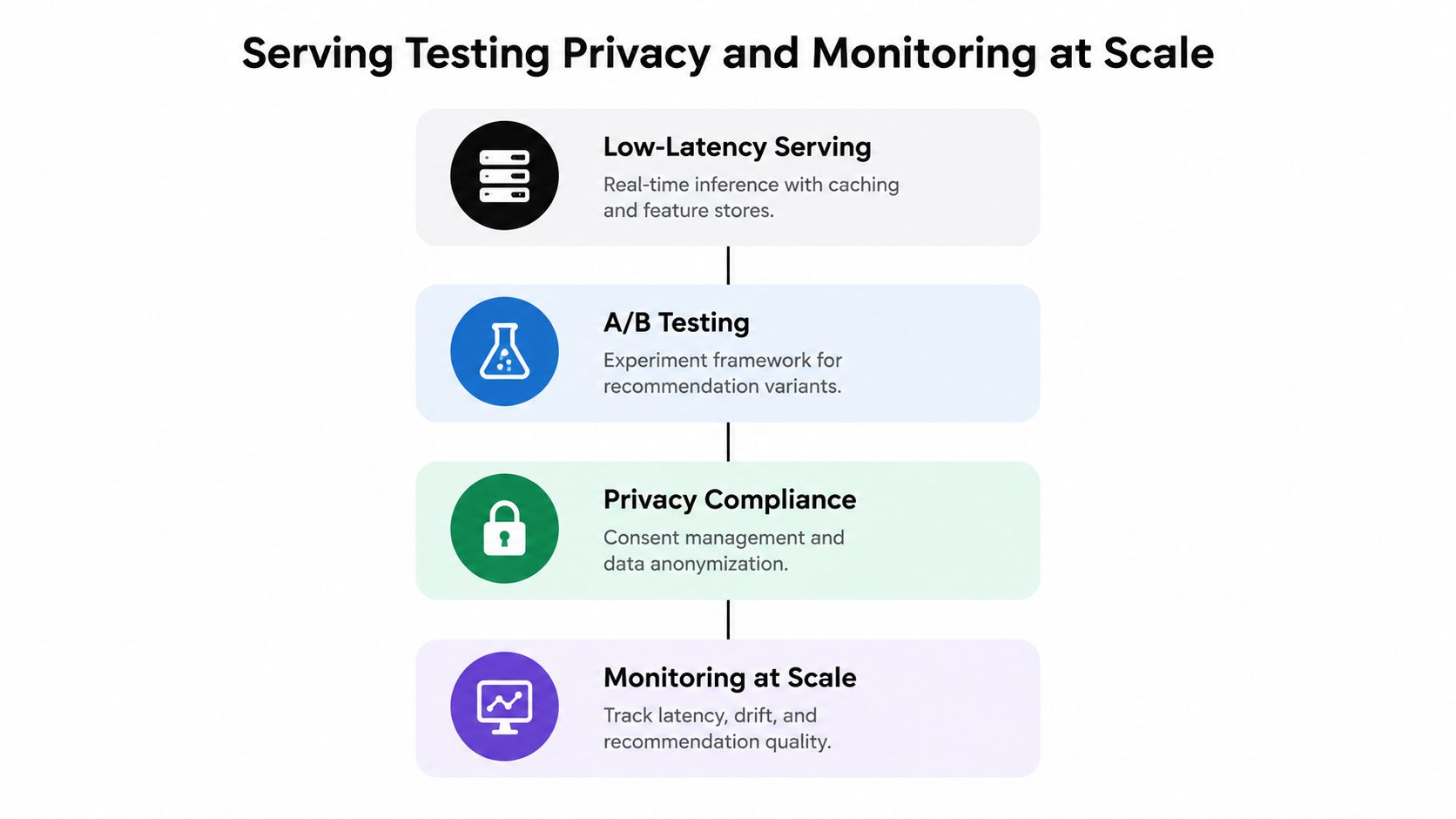
Serving Testing Privacy and Monitoring at Scale
A useful model can still fail if it arrives too slowly, ignores a changed cart, or exposes data the shopper never agreed to share. Production recommendations are an operational system with four connected responsibilities: serve quickly, test safely, personalize transparently, and monitor continuously.
Keep the request path small
Separate candidate generation from ranking. Candidate generation can use cached popular items, co-purchase relationships, content indexes, or embeddings, while a lighter ranker applies current context. Cache stable results, but don't cache inventory-sensitive decisions so aggressively that unavailable products remain visible. Feature stores or low-latency key-value layers can keep recent session signals out of slow transactional queries.
A real-time paper focused on fashion retail and large ecommerce platforms frames the challenge around real-time personalized product recommendations at platform scale (the academic paper on large-scale ecommerce recommendations). The engineering implication is straightforward. Streaming signals are valuable only when the serving path can consume them within the experience's latency budget.
A/B testing needs more than a random assignment flag. Preserve the variant in event logs, distinguish recommendation impressions from clicks, and account for interference when a shopper encounters the same recommendation logic across web, mobile, and email. Watch operational metrics alongside revenue metrics. A slower page can erase the value of a more relevant list.
Personalize without spending trust
More data isn't automatically better. Research summarized by Rivo's privacy and personalization discussion reports that a long privacy policy reduced trust compared with a short or absent policy, while asking for more data reduced willingness to share. The same body of work connects perceived customization and transparency with trust, while privacy concerns can weaken purchase intent even when recommendations are relevant.
Use data minimization as a product requirement. Explain what signals influence recommendations, offer meaningful controls, avoid collecting sensitive attributes unless the use is justified and consented, and keep notices concise at the moment of choice. An anonymous session can often receive useful contextual recommendations without immediately requiring a full profile.
Monitoring should cover:
- Performance: p95 latency, cache hit behavior, timeouts, and fallback frequency.
- Freshness: Inventory age, feature update delay, and stale-session exposure.
- Quality: Coverage, diversity, repetition, popularity concentration, and empty-result rate.
- Governance: Consent state, data access, prompt or model version, and audit records.
- Economics: Compute usage, embedding refresh cost, model inference cost, and any token consumption from AI-assisted ranking or explanation.
Real-time profiling from reviews and attributes can improve relevance, but it also increases processing and compute complexity. Keep that enrichment asynchronous where possible, version the outputs, and create rollback paths. The scalable system isn't the one with the most signals. It's the one operators can explain, measure, and repair without taking the storefront offline.
Scaling What Works and Modernizing for the Long Term
Recommendation programs last when teams treat them as products rather than isolated machine learning projects. Start with a clear baseline, launch one high-intent placement, instrument the full funnel, and expand only after the serving path and measurement are reliable. A small, explainable system with clean fallbacks is more valuable than an ambitious model that nobody can debug.
Roadmap decisions should reflect the constraint in front of you. If relevance is weak, improve events and catalog attributes. If results are stale, fix streaming and cache invalidation. If costs are unpredictable, add usage budgets and model-level accounting. If the team lacks production experience, bring in specialists who can design APIs, data contracts, experimentation, QA, and observability together instead of handing the problem from one silo to another.
AI modernization also needs governance outside the model repository. Wonderment Apps' prompt management system provides a prompt vault with versioning, a parameter manager for internal database access, logging across integrated AI systems, and a cost manager that shows cumulative spend. Those controls are useful when recommendation workflows include prompt-driven profiling, product explanation, merchandising assistance, or multiple AI providers. Versioning makes changes reviewable, logs make failures diagnosable, and cost visibility keeps experimentation from becoming an untracked operating expense.
The broader delivery model matters too. Wonderment Apps offers Managed Projects with right-sized engineering, design, QA, and project management support, along with curated staffing across roles including React, .NET, Java, iOS, Android, WordPress, automated and manual QA, product management, and UX design. That mix is relevant when recommendations must work consistently across a legacy desktop application, responsive web experience, and native mobile app.
Use this launch checklist:
- Define a non-personalized and heuristic baseline.
- Validate event, catalog, identity, and consent data.
- Add cold-start and availability fallbacks.
- Test relevance alongside conversion, revenue per session, coverage, diversity, and latency.
- Monitor new-user and new-item behavior separately.
- Version models, prompts, parameters, and feature definitions.
- Review cost, privacy, and rollback controls before expanding traffic.
A recommendation system should become more dependable with every iteration, not more mysterious. Build the operating controls early, and the product can keep improving as catalogs, models, devices, and user expectations change.
If you're modernizing an ecommerce, SaaS, fintech, healthcare, or media application, Wonderment Apps can help design the recommendation architecture, integrate governed AI tooling, and assemble the right engineering team for delivery. Visit Wonderment Apps to discuss a scalable path from clean data and tested recommendations to a maintainable product experience.