

You're staring at dashboards full of clicks, scrolls, and repeat visits, and the homepage still greets every visitor like they're the first person to arrive. The CEO wants to know why the experience hasn't changed, the growth team wants a faster path to conversion, and engineering wants to know whether the answer is a new model, a new data layer, or a new process. That's the starting point for data-driven personalization. It's no longer a campaign trick tucked inside marketing, it's an operating capability that has to work across product, data, engineering, design, and governance.
The scale of that shift is already visible. By 2024, 92% of businesses were using AI-driven personalization to drive growth, and 73% of business leaders said AI would reshape personalization strategies (Contentful). Fast-growing companies also generate 40% more revenue from personalization than slower-growing competitors, which is why this has become a business system, not a nice-to-have (Contentful). If you're building or modernizing an app, a control plane matters, because once personalization touches AI prompts, content assembly, and spend, you need something more disciplined than a few experiments in notebooks.
The Moment Personalization Stopped Being Optional
A lot of teams reach the same awkward moment. The data warehouse is full, the event pipeline is healthy enough, the CRM has segments, and the homepage still looks identical for a new visitor, a returning customer, and someone who's clearly shopping for something very specific. Someone in leadership asks a reasonable question, why aren't we using what we know?
That question matters because personalization stopped being a side campaign and became part of the product's operating rhythm. It now influences what a user sees, which offer they get, when a message appears, and whether the system responds in the same session or the next day. Once that happens, the work stops belonging to just one team. Product has to decide what should change, engineering has to move the data and serving logic, design has to build reusable components, and analytics has to prove the system isn't just louder.
Why the old model breaks
The old model assumed personalization meant swapping a banner or sending a targeted email. That approach still exists, but it's too shallow for systems where users expect the product to recognize context in real time. Modern users respond to relevance, yet they're also wary of being watched too closely, which means a personalization system has to do two things at once, improve the experience and protect trust.
That tension is why the rest of this guide exists. Teams don't just need ideas for targeting. They need the muscle to design the stack, govern the inputs, and measure whether the experience is helping or creeping people out. A useful mental model is to treat personalization like an engine with four connected parts, data, decisioning, design, and distribution, rather than a single feature request.
Practical rule: if a personalization idea can't be traced from data source to decision logic to content variation to delivery channel, it isn't ready to ship.
The rest of the article keeps coming back to five operational components, behavior analysis, segmentation and targeting, machine learning, real-time adaptation, and privacy and ethics (IJSRCSEIT). That's the stack underneath the buzzword.
What Data-Driven Personalization Means
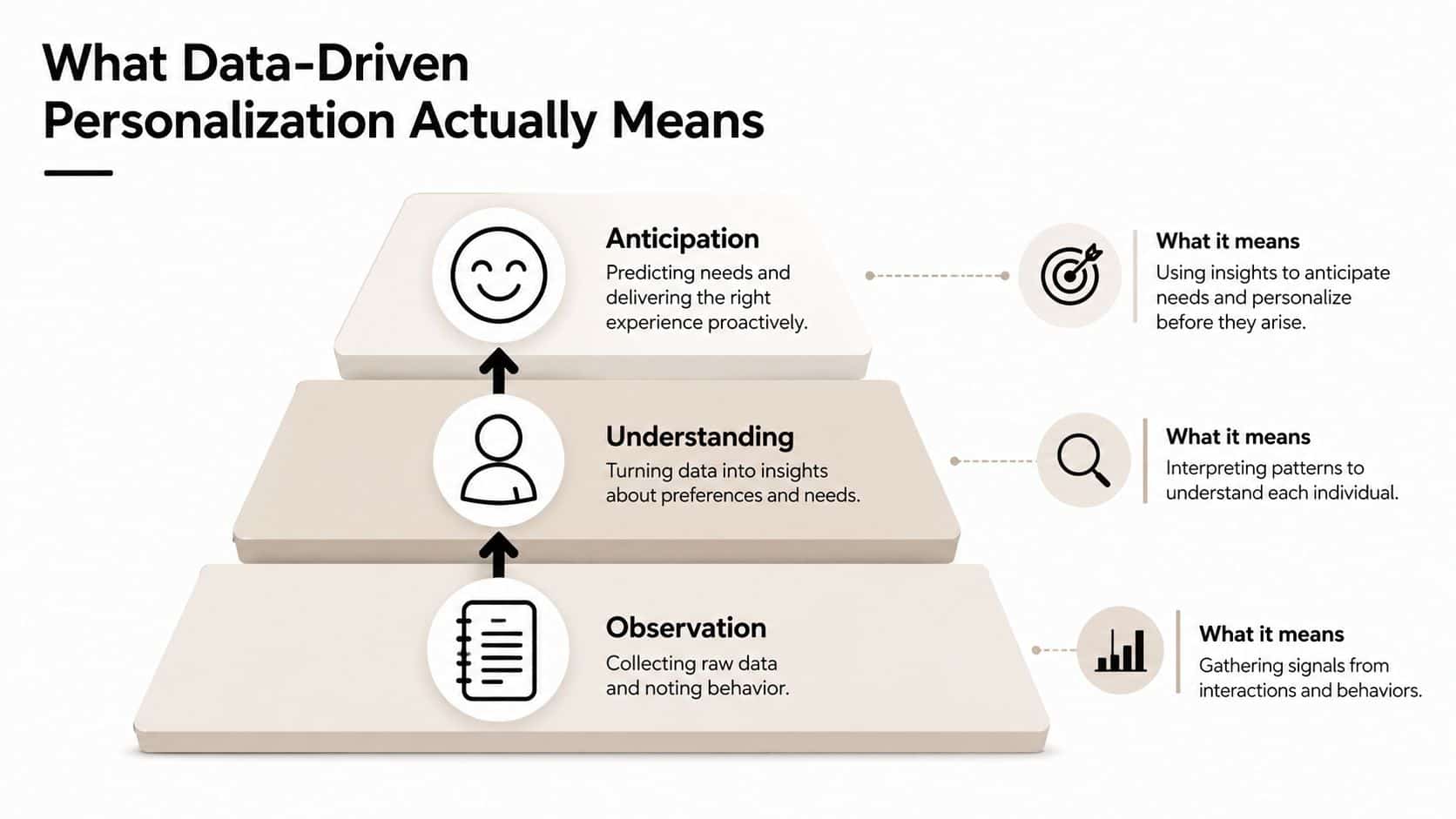
A good restaurant server does not ask you to repeat your preferences every time you walk in. They notice what you ordered before, remember the allergy you mentioned, and adjust the conversation if you seem rushed. That is personalization by observation. In a digital system, the same pattern comes from customer data, behavior signals, and model-driven predictions rather than memory and intuition.
The goal is not to collect more data for its own sake. The goal is to turn signals into decisions. McKinsey's four-layer blueprint is a clean way to frame that work. Data is the unified view of the customer, decisioning is the logic that chooses what should happen, design is the content system that can show different experiences, and distribution is the channel layer that delivers the right version in the right moment (McKinsey).
The four layers in plain language
Data answers, who is this person, and what have they done?
Decisioning answers, what should we show them next?
Design answers, what do we need to assemble on screen or in email?
Distribution answers, how do we send it fast enough to matter?
That last layer catches many teams off guard. Personalization fails if the system waits for the next batch job. Real-time personalization depends on streaming ingestion, low-latency processing, and fast segment lookup, using tools like Kafka, Kinesis, Pub/Sub, Flink, Spark Structured Streaming, Redis, or DynamoDB to react within the session (Minerva Creative). If the user clicks, browses, or abandons a cart, the system has to notice quickly enough to matter.
The same pattern shows up in recommendation logic. The model can rank products, articles, or offers, but the value depends on whether the surrounding system can serve the choice before the moment passes. A useful overview of that logic is in Wonderment Apps' guide to recommendation algorithms, which helps separate the scoring layer from the delivery layer.
There is also a business truth underneath the architecture. Contentstack reports that people want personalized digital experiences, and many also describe personalization that feels too invasive or creepy (Contentstack). So the winning definition of personalization is not more custom by default. It is more relevant, with restraint.
Personalization works when the system understands context and still knows when to stop.
For the website side of the problem, scalable personalization with WebinOne DXP shows how the idea becomes a site experience instead of a theory document.
The Engineering Stack Behind Every Personalization Win
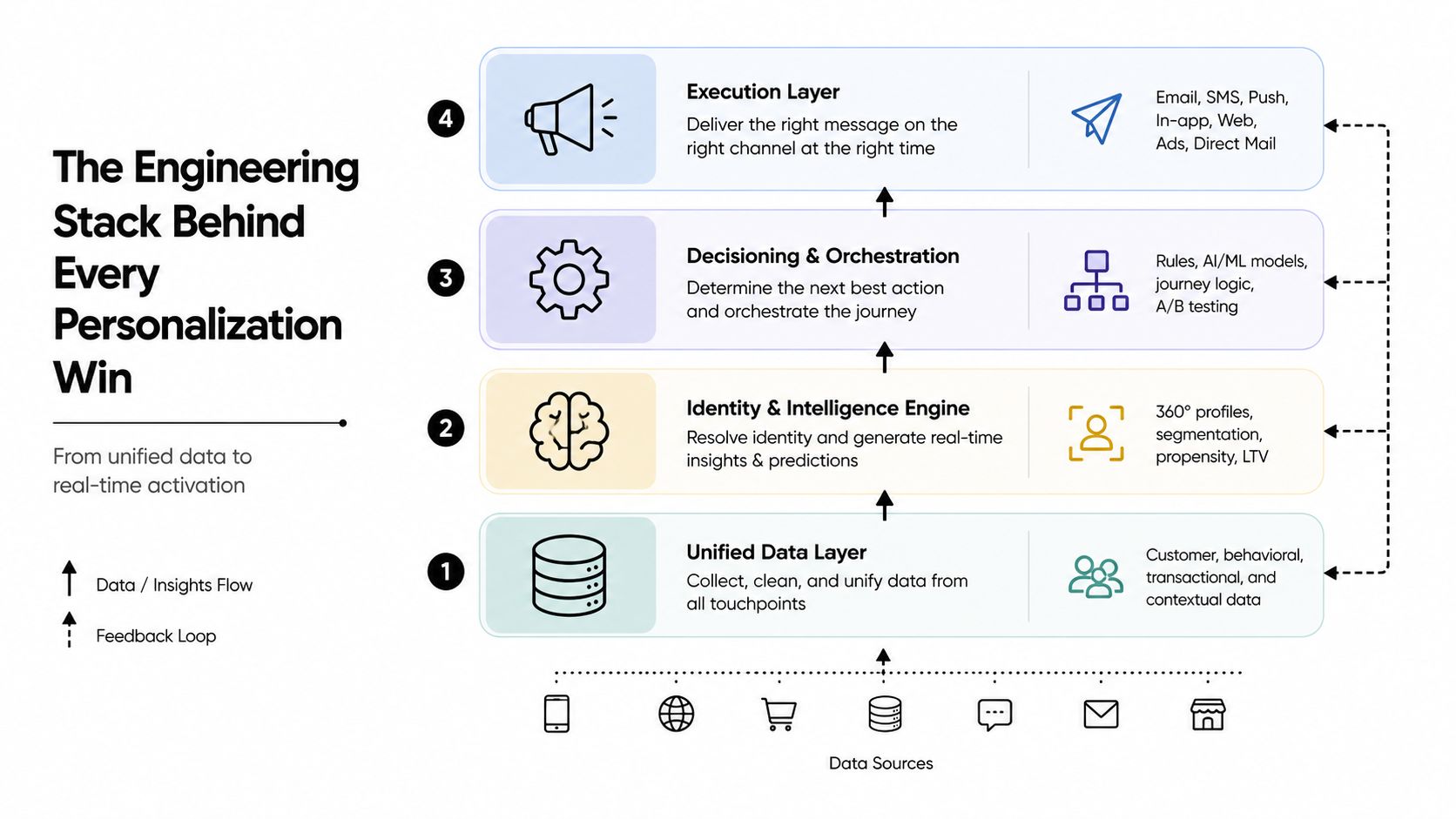
Many teams underestimate the plumbing. They imagine the hard part is deciding whether to recommend Product A or Product B, but the decision logic is usually the easiest piece. The effort sits in the data model, the content system, and the serving path that keeps everything aligned when a user is moving fast.
The data layer has to do more than centralize records
A CDP helps, but it's not enough by itself. The data layer now needs identity resolution so profiles unify across devices and channels, plus promotions history, content engagement history, and a shared universal metadata and taxonomy so the system can interpret what people clicked, ignored, or returned to. The messy part is reconciling fragmented first-party sources, because customer behavior often lives in different tools, different schemas, and different timestamps.
That's where many projects slow down. Teams want to personalize with confidence, but the underlying records are incomplete or inconsistent. Independent research still points to data quality and accuracy, fragmented sources, security concerns, and budget limits as common barriers in personalization work (ICUC State of Data-Driven Personalization). If the foundation is shaky, the model just makes confident mistakes faster.
Decisioning now includes AI context, not just audience rules
In the decisioning layer, models score propensity, likely value, and sometimes discount sensitivity. The newer challenge is that this logic increasingly sits alongside feature stores, MLOps, prompt stores, and vector databases, so generative AI can reason over a customer's context instead of just matching a segment rule. That changes personalization from static branching into context-aware orchestration.
The design layer has its own discipline. Instead of hand-building every audience variation, teams need modular components, headlines, hero images, cards, offers, and calls to action that can be assembled dynamically. That gives product and marketing room to test combinations without asking engineering to rebuild each variant from scratch.
The distribution layer is the last mile, and it's where timing becomes visible. The system has to ingest events continuously, process behavior as it happens, and update the segment or decision state fast enough to affect the current experience. That's why streaming tools and low-latency stores matter, they reduce the gap between action and response.
For teams thinking about recommendation logic specifically, the internal overview at https://www.wondermentapps.com/blog/recommendation-algorithms/ is a useful companion. It sits downstream of the architecture, where scoring and serving become practical.
The simplest way to say it is this, personalization logic is the easy part. The plumbing is the product.
How Personalization Plays Out Across Industries
The same personalization stack behaves differently depending on the rules of the industry. A retail team can push harder on product discovery, while a healthcare team has to optimize around safety, consent, and continuity of care. The architecture is shared, the constraints are not.
Ecommerce and retail
Retail is the clearest example because the value is easy to see. Product detail pages can shift based on browsing history, recommendation carousels can react to what a shopper just viewed, and lifecycle offers can change with inventory and price sensitivity. The experience works best when the catalog, the pricing rules, and the customer context move together.
That's also where a lot of teams first notice the difference between “personalized” and “useful.” If the offer is relevant but the item is out of stock, the system has failed. If the product is available but the message arrives too late, the system has failed differently.
Fintech and SaaS
In fintech and SaaS, personalization has to stay inside regulatory and risk rails. A model may personalize onboarding, next-best-action prompts, or in-app education, but it can't ignore fraud signals, access controls, or compliance boundaries. The smartest systems here don't just optimize for engagement, they optimize for safe guidance.
Healthcare and wellness
Healthcare personalization is usually about adherence nudges, patient engagement, and clinician-facing decision support. The obvious advantage is relevance, but the core requirement is governance. Data handling has to respect sensitive information, and the data layer has to be designed with privacy constraints from the start, not patched on later.
Media, entertainment, nonprofit, and government
Media teams often treat each feed as a recommendation surface, because retention depends on whether the next piece of content feels worth the user's attention. Nonprofits and government agencies use personalization differently. They personalize outreach for fundraising, benefits navigation, or civic simulation, where the audience may be harder to reach and the cost of a bad message can be public and immediate.
A more detailed ecommerce-focused example is covered in Wonderment Apps' guide to ecommerce personalization software, which is a helpful way to see the retail version of the same ideas in practice.
The useful takeaway across every vertical is simple. The layers stay the same, but the failure modes change. The system that works in retail can be reckless in healthcare, and the system that works in media may be too noisy for fintech.
Privacy, Consent, and the Trust Ceiling
More personalization is not automatically better. Every brand runs into a trust ceiling, and once the experience starts to feel surveillance-coded, the user stops seeing relevance and starts seeing overreach. That's why privacy has to be a design surface, not a legal afterthought.
The safest systems make consent visible. They also give people a way to steer the experience without forcing them into an all-or-nothing choice. That can mean explicit consent flows, granular preference centers, and clear explanations of what value the customer gets in exchange for their data.
Guardrails that keep relevance from becoming creepy
A few design moves matter a lot:
- Explicit consent flows: Don't bury consent inside generic terms. Ask for it in context, where the user can understand the value.
- Granular preference controls: Let people tune topics, frequency, and channel choices instead of forcing one blanket setting.
- Frequency caps on sensitive offers: If a message touches pricing, health, financial stress, or any other sensitive area, throttle it.
- Visible audit trails: Keep logs for AI-generated messages so teams can explain why a user saw a specific variation at a specific time.
- Shared accountability: Product, design, and engineering should own the experience together, because privacy shapes the architecture, not just the footer.
Practical rule: if your team can't explain the reason for a personalized message in one sentence, the system is too opaque to trust.
The regulatory side matters because regimes like GDPR, CCPA, and HIPAA affect how data is collected, stored, and used. That doesn't just change policy language, it changes the data model, the opt-in flow, and the serving rules. Teams that take this seriously usually find that trust improves the quality of the data too, because people share more when they understand why.
The best personalization programs can prove what happened. They can show logs, surfaces, and decision records that explain who saw what and why, without leaving the team to guess after the fact. For a complementary design lens, the privacy-by-design overview at Wonderment Apps' privacy by design principles is a useful reference point.
Measuring Personalization Without Fooling Yourself
The easiest mistake is to look at a dashboard after launch and call any improvement a win. That's dangerous, because personalization can cannibalize itself, audiences overlap, and seasonality can make a weak change look smarter than it is. If you're serious about this capability, measurement has to be as deliberate as the stack.
Start with the obvious business metrics, conversion rate, revenue per user, retention, and churn. Then tie each one to the decision you're trying to improve. If the goal is to improve recommendations, track recommendation click behavior. If the goal is onboarding, track response to in-app messages. If the goal is lifecycle engagement, watch email engagement lift and downstream retention.
Tests that reduce false confidence
Holdout groups are the cleanest defense against self-deception. A portion of users keeps seeing the baseline, and the rest see the personalized version, so you can compare outcomes against a real control. Switchback tests help when traffic or conditions vary by time, and long-horizon incrementality measurement matters when the effect of personalization doesn't show up immediately.
A before/after chart is a story. A holdout is evidence.
The 2026 review of seven cases found that data-driven personalization was associated with better retention outcomes across retail, subscription services, and digital platforms, with reported gains of about 5 to 15 percentage points in retention and 8 to 14% reductions in churn over observation windows of 90 days to 12 months (IJCRT). That kind of result is useful, but only when your own measurement design can distinguish signal from noise.
A lot of teams stop at growth metrics and miss the downside. Add an intrusion score that blends opt-out behavior, complaint volume, and survey sentiment, because trust decay often shows up before revenue does. If that score trends the wrong way, the personalization system may be working mechanically while damaging the brand socially.
The point of measurement isn't to flatter the model. It's to tell you whether the experience is more useful.
Pitfalls, Decisions, and Your First Thirty Days
The same failure modes show up again and again. Teams collect more data without naming the decision it enables. They ship a model before they have a content supply chain. They treat personalization like a launch instead of a learning loop. And they hide prompt work in notebooks instead of versioning, logging, and cost-tracking it like any other production asset.
That last one matters more now. If your app uses AI to generate or adapt experiences, prompts are part of the product surface. They need change control, traceability, and spend visibility. A prompt vault with versioning, a parameter manager for internal database access, logging across integrated AIs, and a cost manager for cumulative spend turns scattered experiments into something a product team can operate.
Build, partner, or modernize
The build-versus-buy question usually comes down to three signals. Fragmented data means the team may spend too long stitching systems together. Legacy monoliths can make iteration painfully slow. Rising AI spend without governance is a sign that experimentation is outrunning control. When those show up together, outside help can be the faster way to establish an operating model.
Wonderment Apps is one option in that category. It provides an administrative toolkit for prompt management, integrations, and token cost control, which lets a team plug AI into an existing application without losing sight of prompts, parameters, logging, or spend. For teams modernizing a personalization stack, that kind of control plane can sit alongside the data and decision layers instead of fighting them.
A practical 30-day checklist
- Instrument one journey: Pick a single path, like homepage to product detail or onboarding to activation, and make the events visible.
- Pick one metric: Use one primary success measure so the team isn't arguing over five dashboards.
- Run one holdout: Keep a baseline group untouched so you can see whether the change is real.
- Modernize one prompt workflow: Move one AI prompt from an ad hoc file into a managed, versioned, logged process.
- Review one trust signal: Check for opt-outs, complaints, or confusing behavior that suggests the experience is too aggressive.
Do those five things well, and you've got the beginnings of a personalization capability, not just a campaign. That's enough to ship something real this quarter without pretending the whole stack has to be perfect first.
Wonderment Apps helps teams modernize legacy software with AI, build personalization systems that can scale, and put the right controls around prompts, integrations, and token spend. If you're planning a personalization initiative, or trying to make AI features safer and easier to manage inside an app, visit Wonderment Apps and see how their team approaches product and engineering delivery.