


Choosing the right partner for app development isn't just a logistical decision—it fundamentally defines your project's entire dynamic, from day-to-day management to who is ultimately accountable for the results.
Figuring out whether to go with managed services vs. staff augmentation is one of the most important calls you'll make.
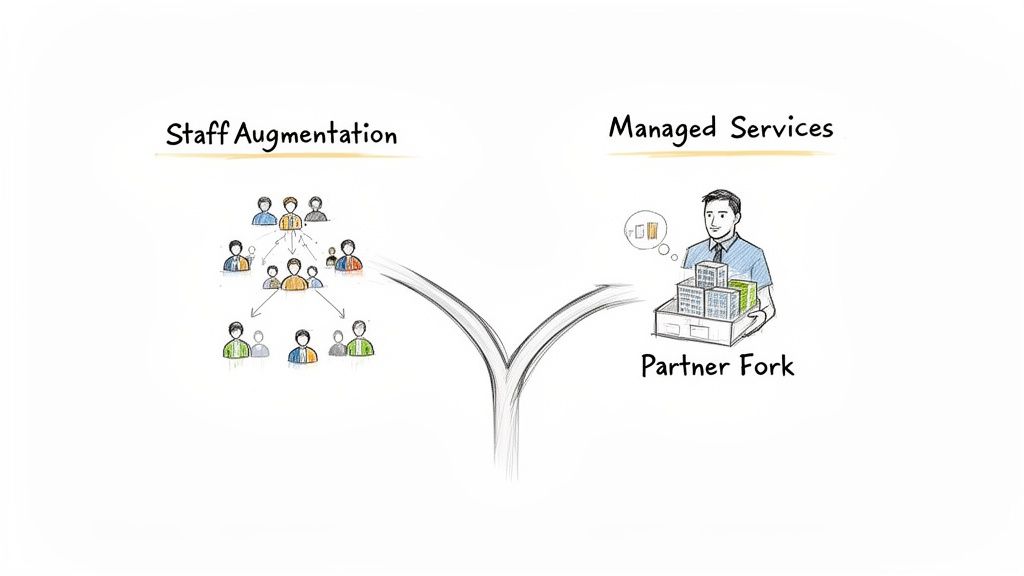
This guide will give you a clear framework for making that call, especially when you're weaving in complex technologies like AI. For example, modernizing your app for AI integration requires more than just developers; it requires the right tools. At Wonderment Apps, we've developed a powerful prompt management system that acts as an administrative toolkit developers can plug into your existing software. It streamlines AI integration regardless of the development model you choose by giving you a centralized way to manage prompts, control data access, and track costs. We'll dive into more detail on that later, but if you're curious, feel free to book a demo.
Let's dig into the core differences to help you find the right path.
Breaking Down The Basics
At its heart, the debate over managed services vs. staff augmentation boils down to a single question: do you need more hands, or do you need a guaranteed outcome?
Staff augmentation is a tactical move. You bring in skilled professionals—say, a React developer for a three-month sprint or a QA specialist for a critical launch—who join your team, report to your managers, and follow your internal processes. You're essentially "renting" expertise to fill a specific role.
Managed services, on the other hand, is a strategic partnership. You hand over an entire function or project to an external provider who takes full ownership of the process and the result. They bring their own team, tools, and methodologies, all governed by a Service Level Agreement (SLA). You define what you need, and they figure out how to deliver it.
To put it simply, here’s how they stack up:
| Feature | Staff Augmentation | Managed Services |
|---|---|---|
| Control | High (Direct supervision of individuals) | Low (Focus on outcomes, not process) |
| Responsibility | Rests with your internal management | Rests with the external provider |
| Cost Model | Variable (Typically hourly or daily rates) | Fixed (Predictable monthly or project fees) |
| Integration | Individuals slot into your existing team | The provider's team operates as a separate unit |
| Ideal For | Short-term projects and filling skill gaps | Long-term projects and outsourcing entire functions |
Getting these distinctions right is the first step. For a deeper look at making smart outsourcing choices, our guide on the 5 rules for outsourcing development lays out some essential principles. Each model has its place, and the best fit depends entirely on your project's goals, your team's bandwidth, and how much control you want to keep.
How Staff Augmentation Works
Think of staff augmentation as a tactical move to bring specialized expertise directly into your team for a set period. It’s like surgically inserting a specialist where you have a gap, but without the long-term commitment and overhead that comes with a permanent hire. The key difference here is that you keep full project management control. These augmented team members integrate directly into your existing workflows and report to your managers.
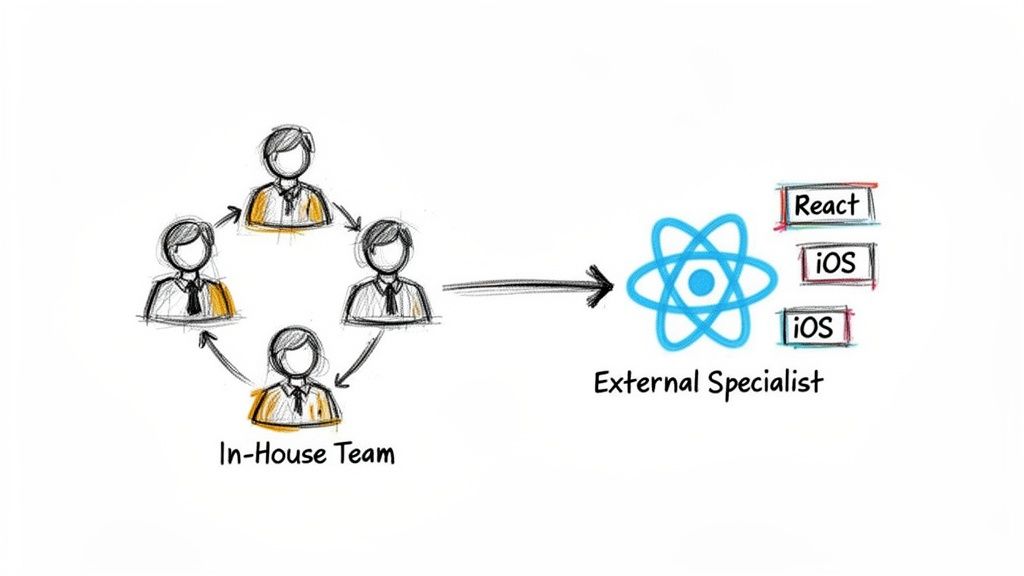
This approach is a perfect fit for companies with strong internal leadership who just need specific skills—like React, .NET, or mobile development—to push a project over the finish line. You get the exact talent you need, precisely when you need it, while your own project managers and tech leads continue to steer the ship.
The Core Process of Augmenting Your Team
The process behind staff augmentation is refreshingly straightforward and built for speed. It’s designed to help you bypass the long, drawn-out traditional hiring cycle and bring in qualified pros who can start contributing almost immediately.
The typical steps look something like this:
- Identify the Skill Gap: First, you pinpoint the specific expertise your team is missing. Maybe it’s a Python developer with AI experience or a manual QA tester for a big pre-launch bug hunt.
- Define the Role: You then outline what the role entails, how long you’ll need them, and the technical skills required. Getting this right ensures your partner finds the perfect person.
- Partner Sourcing and Vetting: The augmentation firm steps in and gives you a curated list of pre-vetted candidates who tick all your boxes.
- Final Interviews and Selection: Your team handles the final interviews. This is your chance to assess not just their technical abilities but also how well they’ll fit with your team culture, just as you would with any direct hire.
- Onboarding and Integration: Once you’ve made your choice, the new professional is onboarded into your team’s systems and communication channels, becoming a seamless extension of your workforce.
The popularity of this model is clear when you look at the numbers. In 2023, the global outsourcing market hit a massive $280 billion, with staff augmentation playing a huge role as businesses scrambled for top talent. In fact, research shows that 74% of companies worldwide plan to use IT staff augmentation in 2024 to fill gaps in hot areas like AI and mobile development. Think e-commerce platforms personalizing shopping experiences or fintech firms building secure new apps.
When Staff Augmentation Is the Right Choice
This model really shines in specific situations where you need both flexibility and control. It’s not about handing off responsibility; it’s about adding targeted firepower to your existing crew. For a deep dive into making this model work for you, a good staff augmentation services playbook can be an invaluable resource.
Staff augmentation is the ultimate tactical advantage. It allows you to scale your team's expertise on-demand, tackle immediate challenges, and accelerate your roadmap without disrupting your core organizational structure.
Consider leaning on staff augmentation when you’re facing scenarios like these:
- A project demands niche expertise that your current team just doesn't have, like integrating a new AI model or developing for a specific mobile OS.
- You’re dealing with a temporary spike in workload, maybe right before a major product launch, and you need extra hands on deck to hit your deadlines.
- A key team member is out on extended leave, and you need a qualified professional to step in and keep things moving without missing a beat.
- You want to test out a new technology or approach without committing to a full-time specialist until you’ve proven it’s the right direction.
Understanding the specific pros and cons of IT staff augmentation will help you decide if it’s the right call for your project. At its core, this approach gives you direct command over talent, making it a powerful tool for leaders who need to precisely fill skill gaps and maintain project momentum.
How Managed Services Works
The managed services model is a strategic shift. You’re not just hiring extra hands; you’re delegating an entire function or project to an external provider who takes full ownership. It's an outcome-focused partnership where you're buying a result, not just billing hours.
Think of it this way: instead of adding individual developers to your team, you engage a partner who assumes complete responsibility for delivering what you agreed upon.
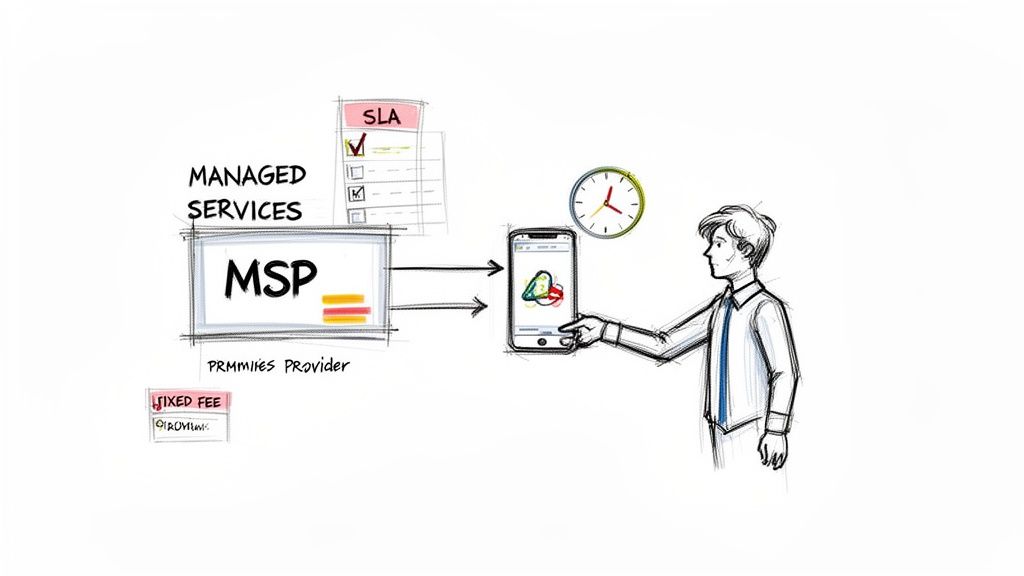
The managed services provider (MSP) comes with its own team, processes, and tools. This entire relationship is built around a Service Level Agreement (SLA), a critical document that spells out the performance metrics and deliverables in black and white. This setup gives you some serious strategic advantages, like taking a huge operational load off your team, getting predictable costs with a fixed-fee model, and tapping into a whole ecosystem of expertise you could never hire in-house.
The Lifecycle of a Managed Services Partnership
Bringing on an MSP is less about recruiting and more about building a long-term relationship. The whole process is designed to make sure you're aligned from the get-go, focusing on the big picture goals rather than the day-to-day tasks.
Here’s how the journey usually plays out:
- Discovery and Goal Alignment: It all starts with deep-dive sessions. The MSP needs to get inside your head and understand your business objectives. What are you actually trying to accomplish? What does a "win" look like for you?
- Solution Design and SLA Creation: With your goals in mind, the provider architects a complete solution. This is where the SLA gets hammered out, defining everything from uptime guarantees to response times and key performance indicators (KPIs).
- Implementation and Transition: The MSP takes the driver's seat, handling the entire implementation. Whether it's building a new application from scratch or taking over an existing IT function, they manage the whole transition.
- Ongoing Management and Reporting: Once everything is live, the provider proactively manages the service, handles maintenance, and jumps on any issues. You get regular reports showing exactly how they're performing against the SLA metrics.
- Strategic Reviews and Optimization: A solid partnership involves regular check-ins. You’ll review performance together and align on future needs, making sure the service keeps delivering value as your business grows and changes.
This model is a true powerhouse for sustainable growth. It's not just a buzzword; Gartner reports that over 60% of enterprises now lean on managed services for long-term IT mastery, getting solid operations without the recruiting headaches. The market itself was a massive $270 billion in 2023 and is on track to hit $878 billion by 2031. CompTIA stats back this up, showing that companies can cut IT operational costs by 45% and boost productivity by 50%.
For our clients at Wonderment Apps in e-commerce and retail, this means seamless autoscaling for millions of users and fine-tuned cost controls for AI integrations—all handled end-to-end by us. You can find more details on how this model is reshaping IT needs on tsd.com.
Ideal Scenarios for a Managed Services Approach
This model isn’t for everyone. It shines when you have a clearly defined outcome in mind but either lack the internal resources or simply don't want to get bogged down in the execution details.
With managed services, you stop managing people and start managing results. It frees your internal leaders to focus on core business strategy while your technology partner guarantees the outcome.
This is your go-to option when:
- You need to build and maintain a complex system, like a HIPAA-compliant patient portal, and want a single partner to handle all development, security, and ongoing support.
- Your goal is to modernize a legacy application with AI, but you don't have the specialized in-house talent to run that project from start to finish.
- You want predictable, fixed costs for an entire IT function like network security or cloud infrastructure management, all backed by a performance guarantee.
So, you're weighing your options between managed services and staff augmentation. To really get to the bottom of which is right for you, we need to move past the simple pros and cons and look at how they stack up on the things that actually matter to product and engineering leaders.
Let's break it down by looking at control, cost, scalability, accountability, and the kind of expertise you get with each. This isn't just a features list; it's about understanding the core difference: are you hiring skilled people to direct yourself, or are you buying a guaranteed business result?
Control: Direct Vs. Delegated
This is probably the biggest fork in the road. With staff augmentation, you are in the driver's seat. The people you bring on board slot right into your existing team structure. They report to your managers and follow your project management playbook. You’re directing their daily work, setting their priorities, and managing their workflow from top to bottom.
Managed services, on the other hand, is all about delegated control. You set the destination—the outcome you need, the metrics for success, and the final deliverables—but you let the provider navigate the route. They manage their own team, use their own processes, and bring their own tools to hit the targets laid out in your Service Level Agreement (SLA). Your job shifts from managing tasks to managing outcomes.
Staff augmentation gives you direct control over people; managed services gives you guaranteed control over outcomes.
Cost Structure: Variable Rates Vs. Fixed Fees
The way you pay for each model is completely different, and it has a major impact on your budget.
Staff augmentation almost always runs on a variable, time-and-materials basis. You pay a set hourly or daily rate for each person you bring in. This makes it a flexible operational expense (OpEx) that you can scale up or down as needed. The flip side? That flexibility can create unpredictable costs if a project drags on longer than expected.
Managed services are built around predictable, fixed fees. You pay a recurring price—usually monthly or per project—for a clearly defined scope of work. This model makes budgeting a breeze and provides a stable financial forecast, which is a huge plus for ongoing needs like cybersecurity monitoring or application support.
Scalability: Tactical Additions Vs. Strategic Growth
Both models help you scale, but they do it in very different ways.
Think of staff augmentation as tactical scalability. It’s the perfect play when you need to quickly plug a skills gap on your team to hit a deadline, push a feature out the door, or cover for someone who's out. Its biggest advantage is the speed at which you can add or remove specific talent.
Managed services offer strategic scalability. Here, the provider shoulders the responsibility of having enough resources—people, tech, and processes—to meet your changing needs as outlined in the SLA. If your user base suddenly doubles, the managed services provider is on the hook to handle that increased load without you having to frantically interview more engineers. For a direct comparison and guidance on selection, refer to this detailed guide on Staff Augmentation vs. Managed Services.
Accountability: Client-Led Vs. Provider-Owned
Where does the buck stop? In a staff augmentation model, the ultimate accountability for the project’s success or failure rests squarely on your shoulders. The augmented staff are responsible for their individual tasks, sure, but your internal project manager is the one who owns the final outcome.
With managed services, you transfer accountability for the outcome to the provider. The SLA is your enforcement tool. If the service doesn’t meet the agreed-upon metrics—like system uptime or bug-fix times—the provider is responsible for making it right. This can take a massive management load off your internal leaders.
Expertise: Filling Gaps Vs. Accessing a Team
Finally, let's talk about the expertise you're tapping into.
Staff augmentation is surgical. It’s designed for filling specific skill gaps. Need a senior DevOps engineer with deep Kubernetes experience for the next six months? You can go out and find that exact person. It’s a highly targeted way to bring in specialized knowledge.
Managed services, by contrast, give you access to an entire team of specialists. You’re not just getting a couple of developers. You're getting the benefit of the provider's whole ecosystem—their project managers, QA testers, security analysts, and solution architects. This collective brainpower is often far broader and deeper than what most companies can afford to keep on the payroll.
Staff Augmentation Vs Managed Services: A Quick Comparison
To make things even clearer, here’s a table that breaks down the fundamental differences across the key criteria we just discussed.
| Criterion | Staff Augmentation | Managed Services |
|---|---|---|
| Control | Direct & Granular. You manage the talent and their daily tasks. | Delegated. You define the outcomes, the provider manages the process. |
| Cost Model | Variable. Based on hourly/daily rates (Time & Materials). | Fixed. Predictable, recurring fees based on scope (SLA). |
| Scalability | Tactical. Quickly add or remove individuals to fill short-term needs. | Strategic. The provider is responsible for scaling to meet demand. |
| Accountability | Client-Owned. You are ultimately responsible for the project's success. | Provider-Owned. The provider is accountable for meeting SLA metrics. |
| Expertise | Specific Skills. Hire individuals to fill precise knowledge gaps. | Team-Based. Access a wide range of specialists and collective knowledge. |
| Best For | Projects needing tight integration, short-term skill boosts, or direct oversight. | Defined, ongoing functions, outcome-based projects, or non-core operations. |
Ultimately, the right choice depends entirely on your specific project goals, your company's operational style, and whether you need more hands on deck or a guaranteed result.
When To Choose Each Model
Deciding between managed services and staff augmentation really boils down to your specific business context. What are your project goals? What does your internal team look like right now? Theory is great, but the real clarity comes when you apply these models to actual business scenarios. Let's get past the definitions and look at concrete situations where one is the clear winner.
This decision tree gets to the heart of the matter: do you need to control the people doing the work, or do you need to guarantee the final outcome?
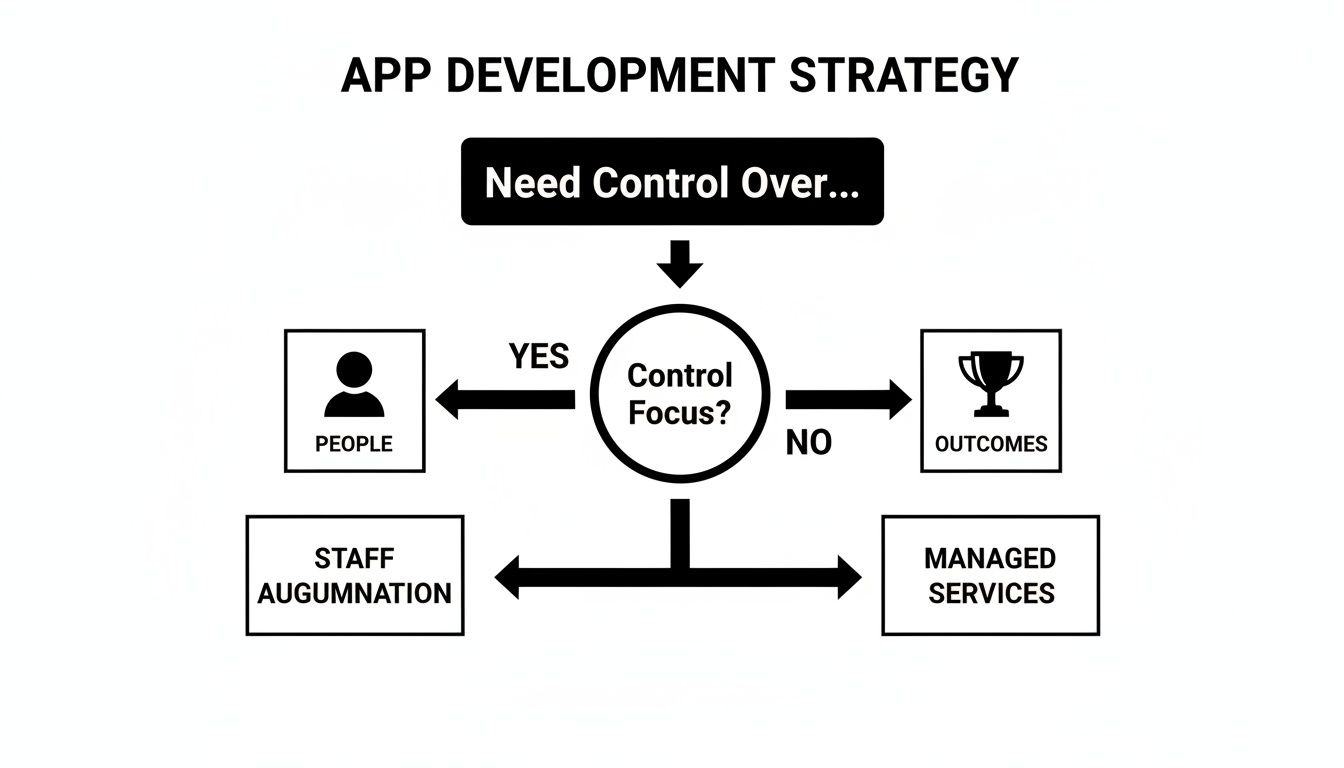
This visual simplifies the choice down to its core, guiding you toward the model that best fits your management style and what you need to achieve.
Prime Scenarios for Staff Augmentation
Staff augmentation is your best bet when you have strong internal leadership but need to fill specific, temporary gaps. Think of it as a surgical strike—adding targeted expertise or capacity exactly where you need it, without the overhead of a full-time hire.
You should choose staff augmentation when:
- You need niche skills for a defined project. Imagine your fintech startup has a great CTO, but you need two senior .NET developers for a four-month sprint to lock down security compliance. The leadership is there, the plan is solid; you just need specialized coding firepower.
- You're facing a temporary workload spike. A media company is about to launch a huge new feature for its Android app. Bringing on two temporary Android developers for a three-month contract ensures you hit the launch date without burning out your core team.
- A key team member is on extended leave. A crucial back-end engineer is taking a five-month parental leave. Augmentation provides a skilled replacement to keep development moving forward without the long-term commitment of a permanent hire.
Staff augmentation is perfect when you can confidently say, "We have the 'what' and the 'how,' we just need the 'who' to get it done." You're adding horsepower to a machine you already know how to drive.
When Managed Services Is The Clear Choice
Managed services is the right call when you need to hand off an entire function to a partner who can own the outcome from start to finish. This is the model for complex, long-term initiatives or non-core functions that demand specialized, ongoing management you don't have in-house.
Opt for a managed services partner when:
- You're building a new, complex system from scratch. An e-commerce brand wants to build a sophisticated AI-powered recommendation engine. A managed services provider can own that entire lifecycle—from design and development to long-term maintenance and model updates.
- You lack the internal expertise to manage a critical function. A nonprofit wants to launch a digital services platform for its community. Partnering with an MSP gives them a team that handles development, security, and ongoing support, letting the nonprofit focus on its mission.
- You need predictable costs and guaranteed performance. A SaaS company needs 24/7 monitoring and support for its cloud infrastructure. An MSP can provide this under a fixed-fee SLA, ensuring high uptime and freeing your internal team to focus on new product features.
The Power of a Hybrid Approach
The debate over managed services vs. staff augmentation doesn't have to be an either-or decision. Blending the two can be an incredibly powerful strategy, and it’s a growing trend. Research shows 74% of enterprises already use augmentation to deal with talent shortages, while 68% turn to managed services for operational excellence. Combining them gives you the best of both worlds.
A hybrid model could look something like this:
- Phase 1 (MVP): Use staff augmentation to bring in two mobile developers. They'll work directly with your in-house team to quickly build and launch a Minimum Viable Product.
- Phase 2 (Scale & Support): Once the MVP is validated, you transition the application's ongoing development, maintenance, and support to a managed services provider for long-term stability and growth.
This approach gives you direct, hands-on control during the critical early stages and then shifts to strategic, outcome-based support as the product matures. As you weigh your options, it's also helpful to explore the differences between in-house hiring vs bringing in burstable partners to make the most informed decision for your company.
Modernize Your App With Wonderment
Figuring out the right approach between managed services and staff augmentation is a critical first step. The next is finding a partner who not only gets your chosen model but also has the technical craftsmanship and strategic vision to build software that actually lasts. At Wonderment Apps, we bring that deep expertise to the table, ensuring your project is a success no matter which path you take.
Whether you need to slot in specialized talent or hand off an entire project, we’ve designed our services to fit your goals, not the other way around. Our approach is built to be flexible, delivering exceptional results in either context.
Curated Staffing And End-to-End Projects
For teams that need direct control and very specific skills, we offer curated staffing for those hard-to-fill roles. We can embed highly skilled React, .NET, and mobile developers right into your team, giving you the exact talent you need to push past technical hurdles and speed up development. You get the expertise without the recruiting headache.
On the other hand, if you're looking for a partnership focused purely on outcomes, our end-to-end managed projects offer a complete, turnkey solution. We put together a perfectly sized team of engineers, designers, and project managers to take your vision from an idea to a fully launched product. We take on full responsibility for delivering a high-performance application ready to scale for any audience.
Partnering with Wonderment means you're not just hiring developers; you're gaining a strategic ally dedicated to building software that is intelligent, scalable, and built for the future.
Our Advantage: AI Modernization Made Simple
Our unique edge is helping entrepreneurs and developers modernize their applications with AI. We don't just build software; we build intelligent systems. To make this straightforward for our partners, we’ve developed a proprietary prompt management system—a powerful admin toolkit you can plug into your existing app or software to simplify even the most complex AI integrations.
This tool is a game-changer for any team looking to build AI-powered features. It empowers your developers and gives you, as a business leader, complete control over your AI initiatives.
The system includes:
- A Prompt Vault: A central, version-controlled library for all your AI prompts, which keeps everything consistent and easy to update.
- A Parameter Manager: Easily connect prompts to your internal database, letting AI models securely tap into your proprietary data.
- Comprehensive Logging: Track every interaction across all integrated AIs for easier debugging, auditing, and performance analysis.
- A Cost Manager: Get a clear, cumulative view of your AI spend to manage budgets and see your spend across all your integrated AI's effectively.
This toolkit takes the guesswork out of AI integration. It gives your team the power to build sophisticated, scalable applications that deliver real business value. Whether we're augmenting your team or managing the project for you, we bring the tools and expertise to make your software modernization a massive success.
Ready to see how our administrative tool can plug into your app and modernize it for AI integration? Schedule a demo today to see our prompt management system in action.
Frequently Asked Questions
Even after a detailed comparison, a few questions always seem to pop up. Let's tackle the most common ones that leaders ask when weighing managed services against staff augmentation. Getting these right will help you make a final, confident choice.
Is One Model Cheaper Than The Other?
It really depends on your project's timeline and complexity. Staff augmentation often looks cheaper on paper with a lower upfront cost per person, but those hourly rates can add up and get expensive on long-term projects.
Managed services usually have a higher fixed monthly fee, but they give you a predictable budget. They often deliver more value for complex, ongoing work because you're paying for bundled expertise, tools, and outcomes, not just hours. For short-term needs, augmentation is often cheaper; for long-term strategic functions, managed services provide better value.
How Do Contracts Differ Between These Models?
The contracts for staff augmentation and managed services are built around completely different goals.
- Staff Augmentation Contracts: These are almost always time-and-materials agreements. They lock in hourly or daily rates, outline the roles you're filling, and set a contract duration. They're designed for flexibility and usually involve shorter commitments.
- Managed Services Contracts: This type of agreement is all about the Service Level Agreement (SLA). The contract focuses on specific outcomes and performance metrics, like system uptime or ticket response times. It details the full scope of work and a fixed fee, typically for a term of one year or more.
Can I Use Both Models At The Same Time?
Absolutely. In fact, a hybrid approach is often the smartest way to go. It's very common for companies to use staff augmentation to bring in niche expertise for a new product build while leaning on a managed services provider for ongoing IT infrastructure support or cybersecurity.
This strategy lets you keep direct control over your most innovative projects while offloading the day-to-day management of stable, essential functions. For example, you could bring on a freelance React developer for a feature launch and have an MSP manage your entire cloud environment at the same time.
Which Model Is Better For Integrating AI?
Both can get the job done, but the right choice hinges on your team's internal capabilities. If you already have a strong in-house AI strategist who can map out the project, staff augmentation is a great fit. You can bring in developers with specific machine learning or data engineering skills to execute that vision.
But if you want to modernize an application with AI and don't have the leadership to drive the entire process, managed services is the way to go. A specialized partner can take care of everything from model selection and data pipeline construction to prompt engineering and long-term performance tuning.
At Wonderment Apps, we're experts in both models, whether you need curated talent to join your team or an end-to-end managed project. Our edge comes from our proprietary prompt management system, which makes AI modernization simple by giving you a version-controlled prompt vault, a parameter manager, and clear cost controls.
Ready to build an intelligent, scalable application that stands the test of time? Schedule a demo today and see how our tools and expertise can accelerate your path to success.