

Software development management is the strategic art of guiding a team to build and deliver a successful software product. It’s less about writing code yourself and more about conducting an orchestra of developers, designers, and testers. The goal? To ensure everyone works in harmony to create something valuable—on time and within budget. This role is the critical link between a business vision and the technical execution that brings it to life. For business leaders looking to modernize their software, especially with AI, mastering this process is non-negotiable.
Orchestrating Success in Software Development
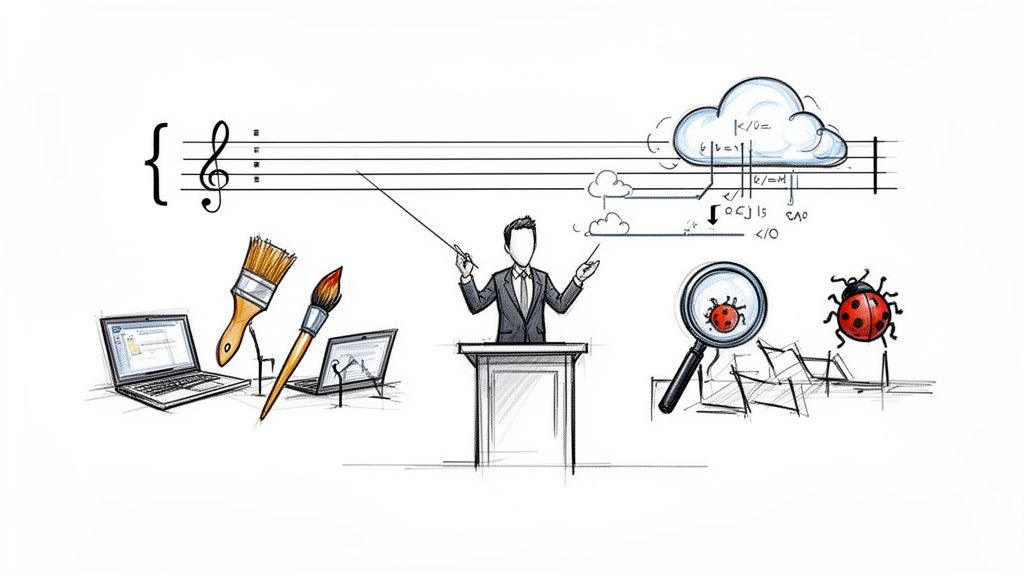
Think of a software project as a complex symphony. You have brilliant violinists (front-end developers), powerful percussionists (back-end engineers), and meticulous woodwind players (QA testers). Each is a master of their craft, but without a conductor, you just get noise.
Effective software development management is that conductor. It’s the force ensuring every instrument plays in sync, follows the same sheet music, and contributes to a beautiful, cohesive performance.
This job moves far beyond simply tracking tasks on a project board. It's about translating high-level business goals into actionable technical requirements, managing resources, heading off risks before they become disasters, and fostering an environment where creativity and problem-solving can actually happen.
The Modern Manager's Expanding Role
Today's software development world is more dynamic than ever. Managers aren't just overseeing a single project from start to finish; they're navigating a constantly shifting technical and business environment. That means their responsibilities have grown significantly.
- Integrating New Technologies: The rise of AI, for example, has introduced a whole new section to the orchestra. Managers must figure out how to weave AI capabilities into existing applications without disrupting the entire performance.
- Scaling for Growth: Building an app for 1,000 users is a completely different beast than building one for one million. Management involves making strategic decisions about architecture and infrastructure to ensure the software can scale seamlessly as the user base grows.
- Choosing the Right Tools: The right tools can make or break a project. When modernizing an app with AI, a specialized toolkit is essential. A prompt management system, like the one offered by Wonderment Apps, gives teams real control over AI interactions, versioning, and costs, preventing chaos.
A great manager doesn't just manage the project; they manage the process. They create a system where the team can consistently deliver high-quality work, adapt to change, and innovate. This focus on process is what separates successful projects from those that spiral out of control.
Why It Matters for Business Leaders
For business leaders, understanding software development management isn't just a technical concern—it's a core business competency. A well-managed development process directly impacts your bottom line. It reduces wasted effort, gets your product to market faster, and ensures the final result actually solves the problem it was designed for.
Poor management is a recipe for disaster. It leads to missed deadlines, shocking budget overruns, and a final product that falls flat with users. Strong leadership, on the other hand, transforms a development team from a cost center into a powerful engine for business growth and innovation.
To learn more about structuring these efforts, check out our guide on modern IT project management processes. As we'll continue to explore, this orchestration is absolutely key to success.
Wearing the Many Hats of a Modern Software Manager
A great software development manager is a master of versatility, constantly shifting roles to meet the needs of the project, the team, and the business itself. Far from being someone who just assigns tasks and checks boxes, they wear several distinct "hats" every single day. Each hat is crucial for steering the project toward a successful launch.
This ability to fluidly shift perspectives and priorities is what truly defines exceptional leadership in the fast-paced world of software creation. Understanding these roles helps clarify the real scope of software development management—it’s a dynamic job that demands a blend of technical insight, interpersonal skill, and sharp business acumen.
The Architect and The Coach
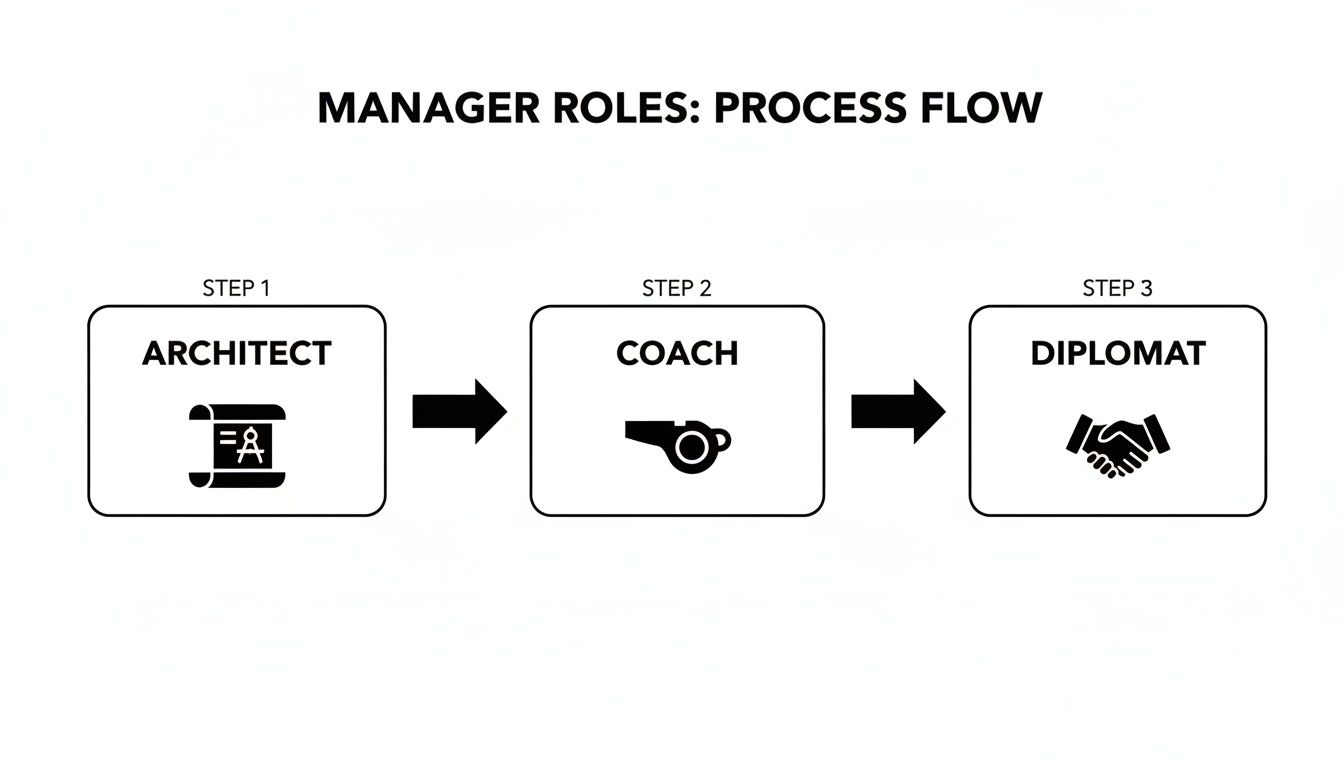
First and foremost, the manager often wears the Architect's hat. In this role, they are responsible for translating a high-level business vision into a tangible technical blueprint. They work closely with senior developers to map out the system's structure, choose the right technologies, and ensure the foundation is solid enough to support future growth. This isn't about micromanaging every line of code; it's about setting the strategic technical direction for the entire project.
At the same time, they must be an effective Coach. A manager's success is directly tied to their team's performance and growth. As a coach, they focus on unlocking each developer's potential through mentorship, providing direct and constructive feedback, and clearing away any obstacles that are blocking productivity. They are responsible for fostering a culture of continuous learning and psychological safety, creating an environment where team members feel empowered to experiment, take calculated risks, and sharpen their skills.
The most challenging part of management isn't just making decisions; it's creating an environment where the team can make great decisions on their own. The best managers build capability, not just software.
The Diplomat and The Accountant
Another critical role is that of the Diplomat. Software projects don't exist in a vacuum; they're part of a complex ecosystem of stakeholders, including executives, product owners, marketing teams, and, of course, end-users. The manager has to navigate these relationships with skill, translating dense technical jargon into clear business impact and managing expectations with grace. When conflicts arise—and they always do—the diplomat steps in to find common ground and keep everyone aligned.
For example, a common dilemma is choosing between shipping a new, revenue-generating feature quickly or pausing to pay down technical debt (the long-term cost of choosing an easy solution now instead of a better, more sustainable one). An architect might advocate for refactoring, while a sales leader pushes hard for the new feature.
- The Diplomat's Role: The manager facilitates a conversation to weigh the pros and cons. They might negotiate a compromise, such as launching a simplified version of the feature while allocating the very next development cycle to address the most critical technical debt.
- The Accountant's Role: Finally, every decision is viewed through the lens of the Accountant. This hat involves rigorous budget management, smart resource allocation, and tracking project costs. They make sure the project stays financially on track, justifying expenses and making the tough calls needed to deliver maximum value within the available budget.
This constant balancing act is at the very heart of effective software development management. To bring it all together, a manager must expertly orchestrate the efforts of various team members, each with their own specialized role.
Key Roles in a Software Development Team and Their Interactions
To truly appreciate the manager's role, it helps to see how they interact with the key players on their team. The table below outlines the primary roles in a typical software project, their core responsibilities, and how a software development manager coordinates their efforts to keep everything moving in the right direction.
| Role | Core Responsibilities | Manager's Interaction and Coordination |
|---|---|---|
| Product Owner | Defines features, prioritizes the backlog, and represents stakeholder interests. | The manager collaborates to ensure the product roadmap is technically feasible and aligns with team capacity. |
| Lead Developer | Oversees technical architecture, mentors junior developers, and ensures code quality. | The manager empowers them to make technical decisions and provides support for team development and training. |
| UX/UI Designer | Creates user flows, wireframes, and visually appealing interfaces for the application. | The manager facilitates communication between designers and developers to ensure designs are practical to implement. |
| QA Engineer | Develops and executes test plans to identify bugs and ensure software quality. | The manager integrates QA into the entire development lifecycle, advocating for a "quality-first" mindset. |
Ultimately, the manager's job is to create a cohesive unit where each person can do their best work, ensuring that the combined effort produces a result that is greater than the sum of its parts.
Understanding Agile, DevOps, and CI/CD Frameworks
To get a real handle on software development management, you have to understand the modern frameworks that high-performing teams live and breathe. These aren’t stuffy, bureaucratic processes. Think of them more as flexible mindsets and workflows built for speed, quality, and the ability to pivot on a dime. They’re the engines that power today's most successful software projects.
Imagine you're building a massive, intricate LEGO masterpiece. You wouldn't dump all the pieces on the floor and try to build the whole thing in one go, hoping it all fits together at the end. That’s a recipe for disaster. Instead, you'd take an Agile approach.
Agile is all about iterative development. You build and test small, functional pieces—like one turret of a LEGO castle—in short cycles called "sprints." This lets you get feedback early and often, making it a piece of cake to adjust your plan without having to tear down the entire project. Each sprint delivers a tangible, working part of the software, which cuts down on risk and keeps the project perfectly aligned with what the business actually needs.
DevOps: The Superglue of Software Delivery
So, if Agile gives you the flexible building blocks, DevOps is the superglue holding it all together. It connects the two most critical teams in the entire process: Development (Dev) and Operations (Ops). Historically, these two groups might as well have been on different planets, often working in silos with completely opposite goals. Developers were pushed to ship new features fast, while the Ops team prioritized stability, which usually meant pushing back against change.
DevOps shatters those walls. It fosters a culture of shared responsibility and automates the clunky handoff between building the software and actually running it.
- Shared Ownership: Both Dev and Ops teams are on the hook for the software's performance, from the very first line of code to how it behaves in a live environment.
- Automation: All the manual, error-prone tasks like testing, configuring servers, and deploying code get automated. This doesn't just speed things up; it makes the whole process dramatically more reliable.
- Continuous Feedback: Operations provides a constant stream of data back to developers on how the software is performing, which means bugs get squashed faster and improvements happen in near real-time.
This tight collaboration ensures that new features are not only built quickly but are also stable, secure, and ready for real-world traffic the second they go live. If you want to get into the weeds on current trends, you can explore concepts like DevOps Integration Modernization.
CI/CD: The High-Speed Assembly Line
Agile is the method, and DevOps is the culture. But Continuous Integration and Continuous Delivery/Deployment (CI/CD) is the automated assembly line that truly brings it all to life. This is where the magic of rapid, reliable software delivery really happens.
Continuous Integration (CI) is the practice of developers frequently merging their code changes into a central repository. Every time they do, an automated build-and-test sequence kicks off, catching any integration bugs almost immediately. This completely avoids the nightmare of waiting weeks to combine everyone's work, only to find nothing is compatible.
Continuous Delivery (CD) pushes this even further. Once the CI phase passes all its automated checks, the code is automatically packaged and prepped for release to a production environment. The final step—actually pushing it live to users—is usually a manual button-push, giving the business precise control over release timing. An even more advanced flavor, Continuous Deployment, automates that final step, too.
A well-oiled CI/CD pipeline turns software delivery from a high-stress, high-risk event into a boring, routine activity. That’s a good thing! It empowers teams to release updates multiple times a day instead of just a few times a year.
By embracing these frameworks, software development management moves away from policing deadlines and toward enabling flow. You stop just managing people and start managing a system designed for continuous improvement and value creation. For business leaders, this translates directly to a faster time-to-market, higher-quality products, and the agility to respond to market changes. To really nail this part of the process, it helps to understand the core principles, which is why we put together a detailed guide on CI/CD pipeline best practices.
The Big Challenges: Security, Talent, and Developer Experience
Even the best-laid plans for a software project can hit some serious turbulence. Managing software development today isn’t about steering a ship in calm waters. It’s about navigating the perfect storm of evolving security threats, a brutal fight for talent, and constant pressure to ship faster without breaking things.
The reality is, the landscape is more complicated than it’s ever been. From locking down sensitive user data to simply finding and keeping great engineers, the hurdles are huge. Getting over them takes a smart mix of technical know-how, a real understanding of your team, and a clear eye on the business goals.
The Ever-Present Threat of Security Breaches
Security isn't a feature you tack on at the end anymore. It's the very foundation of trust, compliance, and your brand's reputation. It’s no surprise that 51% of tech leaders point to security as their number one worry, especially for apps in fintech, healthcare, and e-commerce that are swimming in sensitive data. With information security spending expected to hit $212 billion this year, it's clear that defending against cyber threats is top of mind for everyone. You can get a deeper look at the numbers by exploring these software development statistics.
To get ahead of threats, you have to build security into your process from the very beginning. This "shift-left" approach means security isn't an afterthought; it’s part of the conversation from day one.
- Secure by Design: Bring security experts into the room during the initial design phase. This lets you spot and fix potential weak spots before a single line of code is even written.
- Automated Security Scanning: Plug automated scanning tools into your CI/CD pipeline. These tools act as a constant watchdog, checking for common vulnerabilities every time code is committed.
- Regular Penetration Testing: Pay ethical hackers to try and break your application. They simulate real-world attacks to find holes in your defense before the bad guys do.
When you make security a team-wide responsibility and weave it into your daily workflow, it stops being a bottleneck and starts becoming a serious competitive edge.
Bridging the AI and Cybersecurity Talent Gap
Another massive challenge is the dog-eat-dog competition for specialized talent. The demand for true experts in AI and cybersecurity is blowing past the available supply, creating a talent crunch that can stall innovation and leave companies exposed. This puts a ton of pressure on your existing teams and makes strong project leadership absolutely essential.
But you don't always need a roster of superstars to win. Smart staffing and strategic leadership can close those skill gaps. Think about a hybrid model: your core in-house team gets a boost from specialized external experts or a managed projects partner. This gives you access to critical skills right when you need them, without the cost and hassle of hiring for a niche, full-time role.
An effective manager doesn’t just find talent; they create an environment where talent can thrive. By providing clear direction, the right tools, and a supportive culture, you can empower a lean team to achieve extraordinary results.
This is especially true for complex projects like AI modernization, where you need ongoing model updates and integrated QA to see any long-term success.
Prioritizing the Developer Experience
Finally, let's talk about one of the most overlooked but powerful levers in software management: the Developer Experience (DevEx). This is all about how developers feel when interacting with the tools, platforms, and processes they use every day. A bad DevEx—think slow builds, confusing docs, and endless red tape—is a recipe for frustration, burnout, and mediocre work.
A great DevEx, on the other hand, is a secret weapon. When your developers are happy and in the flow, they build better software, faster. They feel empowered to be creative and are far more likely to stick around.
You can actually measure this. The DORA metrics are a fantastic way to quantify team performance and pinpoint where you can improve the DevEx:
- Deployment Frequency: How often does your team successfully ship code?
- Lead Time for Changes: How long does it take for committed code to make it to production?
- Change Failure Rate: What percentage of your deployments cause problems?
- Time to Restore Service: How quickly can you recover when things go wrong?
Improving these numbers is a direct investment in your team's sanity and efficiency. A smooth, automated workflow frees up your developers to do what they do best: solve hard problems and create amazing things for your users. In today's market, a superior Developer Experience might just be the ultimate advantage.
Modernizing Your Application with Smart AI Integration
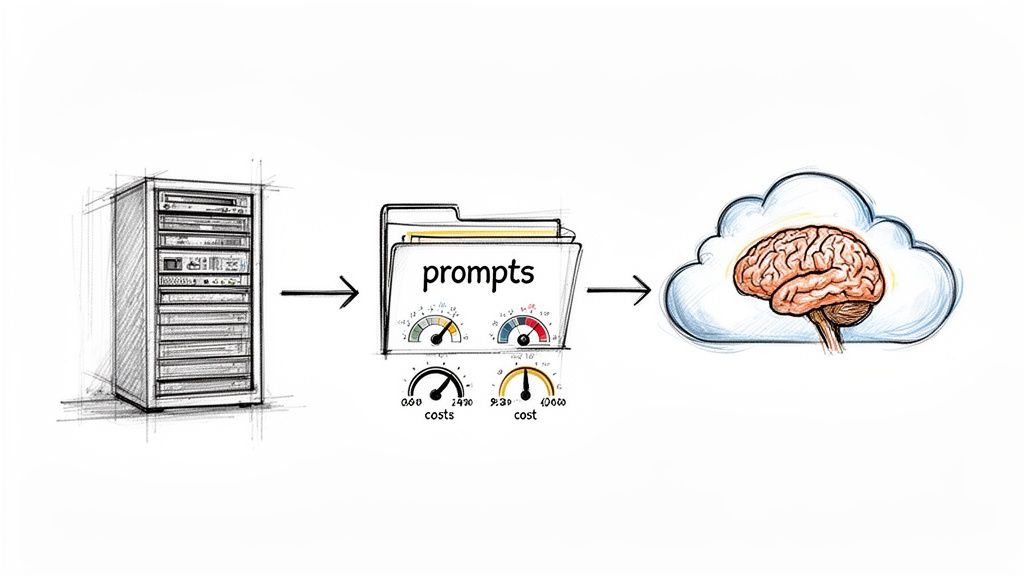
Weaving AI into your app is one of the most powerful ways to modernize it and build for the future. But many business leaders find that after an exciting proof-of-concept, things grind to a halt. They get bogged down in "prompt sprawl," runaway costs, and a lack of control over how the AI interacts with their data. Without a solid governance plan, AI experiments can quickly become a tangled, expensive mess.
This is where Wonderment Apps’ prompt management system comes in. It’s an administrative tool that developers and entrepreneurs can plug into their existing app to modernize it for AI. It brings order to the chaos, giving you a single dashboard to manage every aspect of your AI integration.
Here’s what our tool brings to the table:
- Prompt Vault with Versioning: Store every prompt and its full history, so you can track changes and roll back to previous versions in a snap.
- Parameter Manager: Control exactly how your AI accesses internal databases, ensuring security and data integrity.
- Unified Logging System: Get a complete audit trail of every interaction across all your integrated AI models.
- Cost Manager: See your cumulative spend in real-time and set alerts to avoid budget surprises.
A Tip for Smart Integration
Before writing a single line of code, define exactly what success looks like. Instead of a vague goal like "improve engagement," set a specific, measurable target. A great example would be aiming for a 20% lift in click-through rates from a new AI-powered recommendation engine. With a clear metric, you can fine-tune your prompts and parameters to achieve a real business outcome.
“Version control isn’t just for code. When you modernize with AI, your prompts are just as critical. Treat them with the same discipline.” – Senior Engineer, Wonderment Apps
Challenges to Anticipate
Integrating AI isn't like installing a simple plugin. Many teams underestimate the need for ongoing security reviews, data compliance checks, and the continuous work of refining prompts as your business evolves.
Without proper management, you risk inconsistent AI performance, security gaps, and audit nightmares. And unchecked token spending can blow through your budget in hours, not days.
Overcoming Integration Hurdles with the Right Tools
A powerful prompt management system tackles these challenges head-on. It helps you lock down access to sensitive data and ensures every prompt change is reviewed, versioned, and tracked.
For organizations looking to bring intelligent solutions into their applications, validating governance practices is critical before you scale. Using a dedicated AI Audit Center helps confirm that your systems are reliable and compliant.
| Feature | How It Helps Your Business |
|---|---|
| Prompt Vault with Versioning | Ensures a consistent user experience and allows for easy A/B testing. |
| Parameter Manager | Enforces data security and gives you granular control over AI access. |
| Unified Logging System | Simplifies audits and provides a single source of truth for troubleshooting. |
| Cost Manager | Prevents budget overruns and tracks the ROI of your AI initiatives. |
The first step to building a scalable and excellent app experience is taking control. By managing your AI integrations from a central hub, you can move from scattered experiments to a coherent, long-term strategy for modernizing your application.
Ready to see how it works? Wonderment Apps makes it easy to get started. Book a live demo of our prompt management tool and let us show you how to turn your AI ambitions into scalable, reliable features that will last for years to come.
How to Build and Scale a High-Performing Development Team
Great software is built by great teams. But putting that dream team together is one of the toughest parts of software development management. Your success isn’t about just filling seats; it’s about strategically matching the right skills and team structure to what you’re trying to accomplish, whether that’s launching a scrappy MVP or scaling an enterprise app for millions of users.
This kind of strategic team-building is more important than ever. The global software development market is set to hit a staggering $570 billion in 2025, on its way to $1.04 trillion by 2030 with a healthy 13% annual growth rate. This boom shows just how much businesses rely on custom software to modernize, bring in AI, and scale up—the very work we do here at Wonderment Apps through our Managed Projects. You can discover more insights about the state of software development on Clutch.co.
Choosing Your Team Model
Your first big decision is figuring out the right team structure. Each model has its own trade-offs when it comes to cost, control, and access to specialized talent. A startup’s needs are a world away from a Fortune 500 company’s, so it’s critical to pick the model that fits your project.
- In-House Team: This approach gives you the most control and ensures everyone is aligned with your company culture. It’s perfect for core, long-term product development. On the flip side, it’s also the most expensive and time-consuming path, especially when you’re hunting for specialists in high-demand fields like React or .NET.
- Outsourced Team: Outsourcing can dramatically cut costs and give you quick access to a huge talent pool. It works well for clearly defined, non-core projects. The main downside is a potential loss of direct control and the risk that communication gaps or cultural differences could affect the final product.
- Hybrid / Managed Projects: This model strikes a powerful balance. When you partner with a firm like Wonderment Apps, you get a hand-picked, dedicated team of specialists—from mobile developers to QA engineers—all guided by a seasoned project manager. You get the specialized expertise of an outsourced model with the focus and clear communication of an in-house team, ensuring the work is tied directly to your business goals.
Cultivating a Culture of High Performance
Just getting talented people in the door isn’t enough. You have to create an environment where they can actually do their best work. A high-performing team is built on a foundation of psychological safety, open communication, and solid leadership. Innovation blossoms when developers feel safe enough to experiment, ask questions, and even fail without pointing fingers.
A team's performance is a direct reflection of its culture. If communication is murky and goals are unclear, even the most brilliant engineers will struggle to deliver value. Strong leadership clarifies the "why" behind the "what," empowering the team to make smart decisions autonomously.
To build this kind of culture, start by establishing clear communication channels and transparent processes. Regular, structured meetings, well-kept documentation, and a shared understanding of project goals are absolutely non-negotiable. For a deeper dive into this, check out our guide on how to create and maintain effective tech teams.
At the end of the day, a well-led team doesn’t just build software; it delivers real business results.
Questions We Hear All the Time
Stepping into the world of software development management can feel like learning a new language. For business leaders and new managers, a lot of questions pop up. Getting clear, straightforward answers is the key to making smart decisions that keep your projects moving in the right direction.
Here are a few of the most common questions we get asked.
What Is the Single Biggest Mistake to Avoid?
Without a doubt, the biggest mistake is poor communication that leads to unclear requirements. It's the silent project killer.
When stakeholders, managers, and developers aren't perfectly aligned on what's being built and why, it's a recipe for disaster. This disconnect almost always leads to scope creep, blown deadlines, and a final product that just misses the mark entirely. Great management is built on a foundation of crystal-clear communication channels, established from day one, with detailed documentation that ensures everyone shares the same vision for the project's goals.
How Do I Know If My Team Is Actually Successful?
Success is more than just hitting a deadline. It’s about measuring the right things, using a smart blend of hard numbers and human factors. The best teams keep a close eye on a few key quantitative data points, often called the DORA metrics:
- Deployment Frequency: How often is your team actually shipping code to users?
- Lead Time for Changes: How long does it take for a code commit to make it into production?
- Change Failure Rate: What percentage of your deployments cause a failure that needs a fix?
- Mean Time to Recovery (MTTR): When things do break, how quickly can the team bounce back?
But numbers don't tell the whole story. You also have to look at the qualitative side of things. Is your team's morale high? Are your stakeholders happy? And most importantly, what is the software's real business impact? Things like user adoption rates or measurable cost savings are just as critical.
How Can I Start Integrating AI Without a Huge Upheaval?
Start small. Find a specific, high-value business problem you can solve. Instead of trying to boil the ocean with a massive overhaul, pinpoint one single area where AI could make a tangible difference—think a recommendation engine for an ecommerce site or an intelligent chatbot for customer service. From there, run a small-scale proof-of-concept (PoC) to see if the idea has legs.
This is where tools like Wonderment Apps' prompt management system come in. They’re designed to make this process much simpler by providing the administrative backbone to manage AI models, keep costs in check, and log every interaction. It's a way to modernize your application without having to rebuild everything from scratch.
Ready to build a high-performing team and bring your application into the modern era? Wonderment Apps is your dedicated engineering partner. We specialize in AI integration, custom app development, and building systems that scale for millions of users. Book a demo with us today and let's talk about turning your vision into a reality.