

A truly successful product launch is more than just a go-live date on a calendar. It's a carefully choreographed effort, a plan that pulls every part of the business—from engineering to marketing and sales—into perfect sync. Think of it less like a checklist and more like a campaign, covering everything from the first whisper of an idea to post-launch analysis and support.
What Goes Into a Modern Product Release Strategy?
Launching a product today isn't about flipping a switch and hoping for the best. It’s a meticulously planned journey where every piece, technical and commercial, has to work together. A modern product release strategy is the framework that connects the code your team writes to real, tangible business results. The magic happens when engineering, marketing, sales, and support are all reading from the same playbook, creating a seamless experience for customers from day one.
A critical part of that modern strategy is building for scale and future-proofing your tech stack. This is especially true when integrating AI, where managing prompts, parameters, and costs can quickly become a major headache. Having a robust administrative tool to manage your AI integration isn't just a "nice-to-have"; it's foundational for building a scalable, modern application. If you're looking to modernize your software, we'll touch on how a dedicated prompt management system can be your secret weapon.
If you're in the B2B space, understanding how to launch a new product for B2B success is especially critical for making a real impact.

Core Components Of A Winning Plan
Every effective strategy is built on a solid foundation. Before you get lost in the weeds of timelines and tasks, you need to define the pillars that will guide every decision you make.
A winning plan absolutely must include:
- Clear Objectives: What does success actually look like? Get specific with measurable KPIs. Are you aiming for 10,000 sign-ups in the first month? Or maybe a 15% user activation rate?
- Audience Definition: You have to know who you're building for. Detailed user personas are non-negotiable; they ensure your messaging, features, and marketing hit the right notes with the right people.
- Go-to-Market Approach: How will you introduce your product to the world? This could be a quiet soft launch to a select group or a full-blown public release. You need to nail down the channels you'll use to get the word out.
- Cross-Functional Alignment: This is huge. You need a single source of truth—a shared plan that keeps every team synchronized on milestones, responsibilities, and messaging. No silos allowed.
The Strategic Advantage Of Early AI Integration
In today’s market, AI isn't just a shiny add-on; it's a foundational piece of any forward-thinking release strategy. But modernizing your app with AI is more than just plugging into an API. It demands control, consistency, and a sharp eye on costs, right from the very beginning.
This is where a sophisticated administrative toolkit becomes your secret weapon. Take a prompt management system, for instance. It's not just a developer tool; it’s the control center that ensures your AI features deliver consistent, on-brand, and reliable responses every single time.
For business leaders, this is all about de-risking your AI initiatives. A tool like Wonderment Apps, with its prompt vault for versioning, parameter manager, and integrated cost manager, gives you the governance you need to innovate with confidence. You can literally see your cumulative AI spend in real-time and manage prompts without needing a new code deployment.
By building this level of control into your release process from the start, you empower your teams to create incredible, AI-driven experiences that are both scalable and predictable. This sets the stage for everything that follows, turning a good launch into a great one.
Defining Your Release Goals And Go-To-Market Approach
Before a single line of code is written or a timeline is drafted, every great product release strategy kicks off with a simple question: What does winning actually look like for us? If you can't answer that, you're just shipping features into the void. This first phase is all about setting that North Star your entire team can navigate by.
This isn't the time for fluffy goals like "boost user engagement." We're talking about tangible, measurable targets that connect directly to the business's bottom line. These goals become the filter for every decision you make down the line, ensuring that all the technical effort translates into real-world results.
Setting Clear And Measurable Objectives
A solid plan is built on a foundation of well-defined Key Performance Indicators (KPIs). This is how you turn abstract ambitions into concrete targets. Are you trying to stop customers from leaving, break into a new market, or just make the whole system run faster?
Let's look at how to sharpen broad goals into specific KPIs:
- Business Goal: Increase user retention.
- KPI: Hit a 15% reduction in 30-day churn for new users within the first three months after launch.
- Business Goal: Capture a new market segment.
- KPI: Onboard 5,000 new users from the North American small business sector within six months.
- Business Goal: Enhance product performance.
- KPI: Cut the average API response time by 30% during peak usage.
Having these kinds of sharp, numbers-driven targets is crucial for keeping everyone on the same page. They're a core part of the planning process, and if you're looking for a great way to map all this out, our guide on how to create a product roadmap provides a fantastic framework for turning goals into a plan of attack.
Deciding Your Initial Market Entry
Once you know what you're trying to achieve, the next big question is where you'll start. Your go-to-market approach will shape your initial focus, how you spend your budget, and the stories you tell in your marketing. It’s critical to build out a B2B Go-to-Market Strategy Framework to make sure these big decisions are guided by a coherent plan.
This usually boils down to one of a few proven models:
- Geographic-First Launch: This is all about picking a specific country or region to test your product. A US-first launch is a classic move for tech companies looking to prove themselves in a huge, competitive market before taking on the world.
- Segment-First Launch: With this approach, you zero in on a very specific type of customer or industry. Think of a fintech app launching only to certified financial advisors to build trust and gather feedback before opening the floodgates.
- Global Day-One Launch: This is the big one—launching to a worldwide audience right from the start. It’s a bold move best saved for digital-first SaaS products that don't need much localization and have already built up a ton of hype.
The choice of where to launch first has massive ripple effects. It dictates everything from your legal and compliance headaches to your marketing budget and the languages your support team needs to speak. A wrong move here can burn through cash and kill your momentum before you've even gotten started.
In the world of tech launches, your market entry can absolutely make or break you. The data doesn't lie: a US-first strategy is dominant, making up 67% of global launches as of 2025. This focus on North America is driven by a strong track record, with a 43% success rate compared to 39% in Europe and 36% in the Asia-Pacific region. It’s clear that many companies see the US as the ultimate proving ground.
At the end of the day, defining your goals and GTM approach is about being deliberate. It’s about making sure that every engineer, every marketer, and every salesperson is pulling in the same direction toward a clearly defined win. That alignment is what separates a product release that just happens from one that truly makes an impact.
Choosing The Right Release Model For Your Product
Once your goals are locked in, you’ve hit your next major decision point: how are you actually going to get this product out into the world? The release model you pick isn't just a technical detail; it fundamentally shapes risk, market perception, and your team's ability to learn on the fly. This is not a one-size-fits-all scenario. The right move depends entirely on your product’s maturity, how much risk your team can stomach, and what you’re trying to learn from your audience.
Figuring this out early helps frame your entire timeline and communication strategy. This decision tree is a great way to visualize whether your main goal is to grab market share fast or to validate your ideas with less exposure.
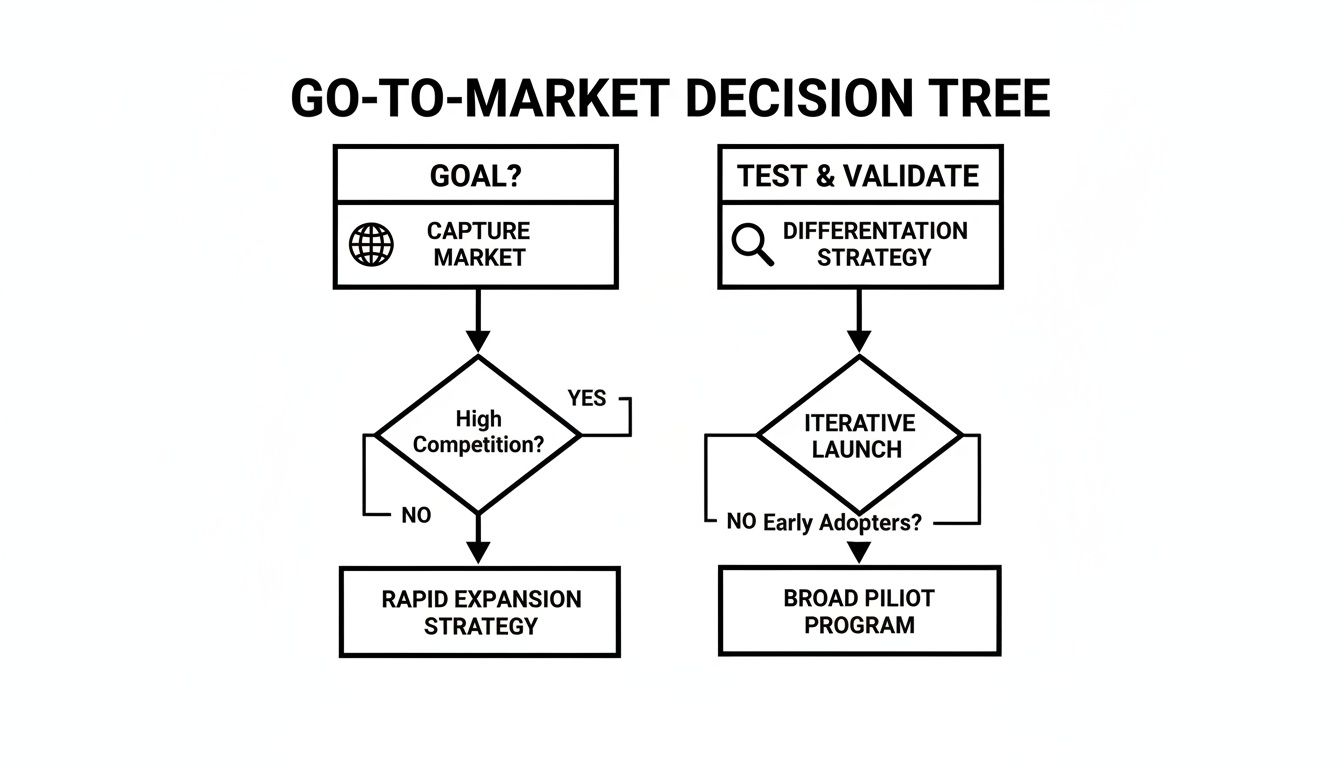
As you can see, the path forks pretty quickly. You're either gearing up for a 'Big Bang' launch to make a huge impact or planning a more controlled, iterative rollout to test the waters and manage risk.
Picking the right release model is a critical strategic decision. It’s about balancing speed and impact with safety and learning. To help you weigh your options, here’s a breakdown of the most common approaches we see in the field.
Comparison Of Product Release Models
| Release Model | Best For | Key Benefit | Primary Risk |
|---|---|---|---|
| Big Bang | Products needing maximum market impact and hype, like a new consumer app or streaming service. | Generates massive initial buzz and momentum. | "All or nothing." A single critical bug can lead to a catastrophic public failure. |
| Phased Rollout | Entering new geographic markets or launching features with high compliance needs (e.g., fintech, healthcare). | Allows for controlled testing, feedback gathering, and risk mitigation in isolated segments. | Slower time-to-market and can dilute the initial "launch moment" excitement. |
| Feature Flags | Iterative development in mature products and A/B testing new functionality with minimal disruption. | Decouples deployment from release, enabling safe, targeted testing in a live environment. | Adds complexity to the codebase and requires robust flag management processes. |
Each of these models serves a different purpose. Let's dig into what they look like in practice.
The Big Bang Launch: Maximum Impact, Maximum Risk
The Big Bang launch is exactly what it sounds like—a single, explosive event where the product goes live for everyone, everywhere, all at once. This model is engineered to make a massive splash and is almost always backed by a significant marketing and PR blitz.
Think about a major media company launching a new streaming service. They've spent months building hype, inking content deals, and lining up a huge ad campaign. The goal is to create an unmissable cultural moment and drive millions of sign-ups on day one. For that, only a Big Bang will do.
But the risk is just as massive. If a critical bug surfaces or the servers can't handle the traffic, the failure is immediate, public, and incredibly damaging. There's no turning back once you flip that switch.
Phased Rollouts: Playing It Safe To Win
A phased rollout is a much more deliberate and cautious approach. Instead of dropping your product on everyone at once, you introduce it to smaller, specific segments of your audience over time. This is the perfect strategy for cutting down risk, gathering real-world feedback, and ironing out the kinks before going wide.
This approach is particularly essential in highly regulated industries. For instance, a fintech app looking to expand across Europe simply can't launch everywhere at the same time due to the patchwork of compliance standards in each country. Their rollout might look something like this:
- Phase 1: Launch in Ireland to test core features and gather initial user feedback in a controlled, English-speaking market.
- Phase 2: Roll out to Germany and France after incorporating that feedback and completing all the necessary regulatory checks for those specific regions.
- Phase 3: Continue expanding, country by country, using the lessons learned from each phase to make the next one even smoother.
This methodical expansion ensures the app is fully compliant and stable in every new market, saving the company from potential legal and technical nightmares.
Continuous Delivery With Feature Flags: Ultimate Control
The most flexible and modern approach is continuous delivery, supercharged by tools like feature flags and canary releases. This model brilliantly decouples deployment from release, which means you can push new code to production without anyone even seeing it.
Feature flags are basically light switches for your code. You can turn a new feature on for just 1% of your users, a specific group of beta testers, or even just your internal team to see how it performs in a live environment.
A SaaS platform testing a new AI-powered analytics dashboard is a perfect example. They can enable the feature for a small group of power users who are typically more forgiving of bugs and can provide high-quality feedback. The team gets to monitor performance, track usage, and fix issues without disrupting the experience for the other 99% of their customer base.
And the best part? If something goes wrong, they can instantly turn the feature off with a single click. No frantic code rollbacks required. It gives you ultimate control and seriously de-risks the entire innovation process.
Orchestrating A Flawless Technical Rollout
This is where the rubber meets the road. All the planning, strategy, and late-night whiteboard sessions become real the moment you start the technical rollout. It’s the process of taking months of hard work and putting it into the hands of your users. A seamless technical launch isn't about luck; it's the result of building a repeatable, reliable process that ensures every release is stable and scalable right out of the gate.
Forget manual deployments. They’re slow, riddled with potential for human error, and just don't work in a modern development environment. The aim here is to build a well-oiled machine that can push a minor bug fix or a massive new feature with the same level of confidence.
Building A Robust CI/CD Pipeline
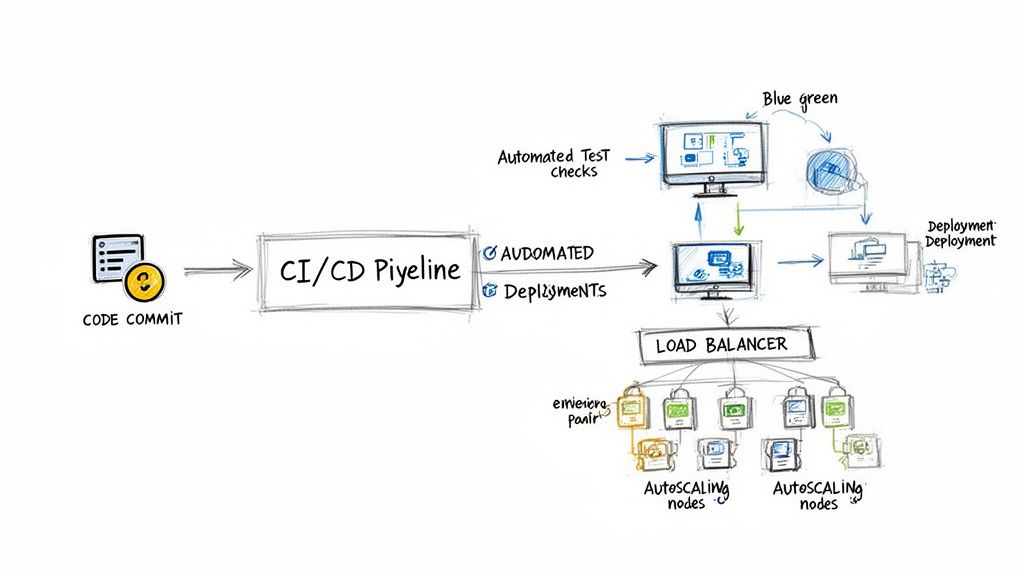
The heart of any modern technical release is a solid Continuous Integration and Continuous Deployment (CI/CD) pipeline. This automated workflow is your best friend, handling everything from building the code to running tests and deploying it to production. It’s what allows you to move fast without breaking things.
Instead of a developer manually pushing code and crossing their fingers, the CI/CD pipeline makes the entire sequence automatic and, more importantly, predictable. It enforces quality at every step. You can take a closer look at what goes into a great setup in our deep dive into CI/CD pipeline best practices.
Advanced Deployment Techniques For Zero Downtime
For high-traffic applications, downtime isn't an option. Whether you're in e-commerce or media, every second your site is down costs you. This is where you need more sophisticated deployment techniques that make updates totally invisible to your users.
- Blue-Green Deployments: Picture having two identical production environments, "Blue" and "Green." If Blue is live, you deploy the new code to Green. After it’s been fully tested in a live setting, you just flip a switch at the router level to send all traffic to Green. If something goes wrong, you can flip it right back to Blue in an instant. No muss, no fuss.
- Canary Releases: This is like a phased rollout but for your infrastructure. You expose the new version to a tiny subset of users first—maybe just 1% of your traffic. You watch the metrics like a hawk, and if everything looks good, you gradually dial it up to 100%. It’s your early warning system for any hidden issues.
These methods aren't just fancy tech talk; they're essential for maintaining customer trust and protecting revenue. A zero-downtime release is the gold standard, ensuring your users never even know an update happened.
Handling The Launch Day Traffic Spike
One of the biggest launch day nightmares is seeing your system crumble under the weight of its own success. A sudden flood of users can bring even the most well-designed application to its knees if you aren’t prepared. This is why autoscaling is non-negotiable.
Autoscaling dynamically adjusts your server capacity based on real-time traffic. When a surge hits, it automatically spins up more servers to handle the load. When traffic dies down, it scales back to save you money. This elasticity is what keeps your app snappy and responsive, no matter how many people show up to the party.
Comprehensive QA And Compliance Checks
Finally, no technical rollout is truly ready without passing through rigorous Quality Assurance (QA) and compliance checks. This is your final line of defense against bugs, security holes, and potential legal headaches.
Your checklist must include:
- Automated Testing: Unit tests, integration tests, and end-to-end tests should be baked into your CI/CD pipeline to catch any regressions before they ever see the light of day.
- Security Audits: A thorough security scan is a must. For major releases, a full penetration test is a wise investment to protect user data and maintain their trust.
- Compliance Verification: This is absolutely critical in regulated industries like fintech and healthcare. Before you go live, you have to be 100% certain the new release adheres to all relevant standards, whether it's GDPR, HIPAA, or PCI DSS.
By weaving these technical practices into your release strategy, you’re not just launching a product; you're building a foundation of reliability and quality that will support every launch to come.
Getting The Word Out And Arming Your Teams
A powerful product with a flawless technical rollout can still completely miss the mark if nobody knows it exists. Worse yet, it can fail if your own teams are caught off guard and can't support it. This is where the human side of your product release strategy truly shines—turning a technical milestone into a company-wide victory lap through sharp communication and smart enablement.
It’s all about creating a single, powerful story that clicks with customers externally and empowers your people internally.
When every department—from marketing and sales to customer support—is prepped and confident, they become incredible champions for the new release. Getting this right means that on launch day, there’s no chaos or confusion, just a coordinated push that drives adoption from the very first click.
Building a Unified Communications Plan
The secret to powerful launch communication is consistency. You need one core narrative, one compelling story that you then tailor for different audiences and channels. This helps you dodge that classic launch-day disaster where marketing is shouting about one feature while the support team is fielding questions about a totally different one. That kind of disconnect just confuses customers and weakens your impact.
Your plan needs to nail down:
- External Messaging: This is your story for the world—the press releases, social media blitzes, blog posts, and ad campaigns. It needs to be exciting, focused on benefits, and speak directly to your customers' problems.
- Internal Messaging: This is for your own crew. It should go deeper, explaining not just what is launching but the why behind it. Cover the business goals, key talking points, and how it fits into the bigger picture.
- Channel Strategy: Map out exactly where and when your messages will drop. This covers everything from a pre-launch email teaser to the big blog announcement on launch day and the follow-up customer check-ins.
A launch is just a story you're telling the market. If the story is disjointed, your audience gets confused. The goal is to make your product's value so clear and consistent that every touchpoint reinforces the same powerful message.
Equipping Your Teams For Success
A single, company-wide email just won't cut it for enablement. Each team has a unique role to play, and they need specific tools and knowledge to nail it. You have to arm them for success proactively.
For instance, your enablement plan should be specific:
- Sales Enablement: Give the sales team everything they need to close deals. Think compelling value propositions, detailed competitor battle cards, slick demo scripts, and clear pricing info. They have to walk into any conversation ready to articulate exactly how the new release solves real-world problems.
- Support Team Training: Your support folks are your front line. They need in-depth documentation, comprehensive FAQs, troubleshooting guides, and a well-defined process for escalating tricky issues. On day one, they need to be the most knowledgeable people in the company about the new release.
Product innovation is the engine driving modern business. Recent data shows that 95% of consumer products executives are making new products a priority, and 80% are planning to boost their innovation spending. This push includes newer tech like VR/AR, with a predicted 23% adoption rate, and voice integration, which is set to grow by 34%.
When you're launching specialized features like these, a standard training deck isn't enough. Your teams need hands-on experience to truly grasp and communicate their value. You can dig deeper into these consumer product trends on deloitte.com.
Ultimately, when you invest properly in communication and enablement, you're not just deploying code. You're orchestrating a high-impact business event where every single person is aligned and ready to make it a massive success.
Monitoring Performance And Planning For The Unexpected
The champagne’s been popped and the launch-day high-fives are done, but the real work has just begun. A solid product release strategy doesn't end when the product goes live; in fact, it’s entering its most critical phase. This is where you pivot from executing a plan to actively learning from it, keeping a close eye on performance, and staying ready for whatever comes next.
Those launch goals and KPIs weren't just for the planning stage—they now form the backbone of your monitoring dashboard. Think of this as your mission control, giving you a real-time pulse on both the technical and business health of your product.
Establishing Your Post-Launch Dashboard
This dashboard needs to give you a clear, at-a-glance summary of how your release is performing against the objectives you originally set. And it’s not just for the engineering team; it’s a crucial tool for product managers, marketers, and leadership to understand what’s actually happening out in the wild.
Your dashboard has to track a mix of metrics:
- Technical KPIs: These are the vital signs of your application. Think uptime percentage, API error rates, and average response times. A sudden spike in any of these is your earliest warning that something's wrong under the hood.
- Business KPIs: These metrics tell you if the launch is hitting its business goals. You'll want to track user engagement (like daily active users), feature adoption rates, and conversion funnels to see if customers are using the product as you hoped.
The Inevitability of Incidents
Let's be real: no matter how perfect your rollout was, things will go wrong. A server will fail, a third-party API will go down, or users will discover some bizarre edge-case bug. The difference between a minor hiccup and a full-blown crisis is having a clear, rehearsed incident response plan.
This is about more than just setting up an on-call rotation. It’s about defining roles, communication channels, and escalation paths before you need them. Who has the authority to declare an incident? How are key stakeholders notified? What’s the protocol for customer communication? For a deeper dive, check out our guide on preparing your app for outages and disruptions.
A robust rollback strategy is your ultimate safety net. Whether it's reverting to a previous version with a blue-green deployment or just flipping a feature flag to "off," the ability to instantly undo a change is non-negotiable. It buys your team precious time to diagnose the root cause without impacting every single user.
AI Integration as Mission Control
When your application is woven together with multiple AI models, this post-launch monitoring becomes even more critical—and way more complex. Each AI service has its own performance profile, error patterns, and, most importantly, cost structure. This is where an administrative AI toolkit goes from being a helpful tool to an absolute necessity.
Think of it as your AI-specific mission control. A centralized platform like Wonderment's gives you immediate oversight into this complex ecosystem. For entrepreneurs and developers looking to modernize an existing app with AI, this control layer is indispensable.
- Prompt Vault with Versioning: Tweak, test, and roll back AI prompts without a full code deployment. This gives you unparalleled agility to refine your AI's behavior post-launch.
- Parameter Manager: Securely manage access to your internal database, allowing your AI to pull relevant, real-time data while maintaining strict security protocols.
- Centralized Logging: Instead of digging through logs from three different AI providers, you get one unified view. This dramatically speeds up diagnostics when an AI-powered feature starts acting up.
- Real-Time Cost Manager: The cost of AI can spiral out of control fast. A cost manager that shows your cumulative, real-time spend across all models lets you spot anomalies and make data-driven decisions to optimize performance and prevent budget overruns long after the launch party is over.
Got questions about putting together a solid product release strategy? You're not alone. Even with the best-laid plans, a few common uncertainties always seem to pop up. Let's tackle some of the ones we hear most often.
How Far In Advance Should I Plan A Launch?
This is the classic "how long is a piece of string?" question, but there are some solid rules of thumb. For a major product launch, you really want to give yourself a runway of 3-6 months. That sounds like a lot, but it disappears fast once you factor in aligning on goals, doing your market homework, building the GTM plan, creating marketing assets, and—crucially—training your sales and support folks.
If you're just shipping a smaller feature or an update, a 4-6 week cycle is a much more realistic and common timeframe. The trick is to match your planning horizon to the release's complexity and potential market splash.
Honestly, the biggest mistake I see teams make is underestimating how long it takes to get everyone on the same page. When you rush cross-functional alignment, you're practically guaranteeing a chaotic launch day for both your internal teams and your customers.
What's The Most Common Point of Failure?
It’s almost never a technical bug that sinks a launch. The most common culprit is a breakdown in internal communication and team enablement. Think about it: if your sales team can't articulate the value prop or your support crew doesn't have the right documentation, the customer experience falls apart instantly. It doesn't matter how flawless the code is.
Coming in at a close second is the failure to define clear, measurable KPIs right from the start. If you don't know what success looks like, you can't measure it, and you're just guessing your way through post-launch decisions.
How Can We Manage The Risk Of A Bad Reception?
No one wants to launch to the sound of crickets… or worse, angry customers. The good news is you can dramatically lower that risk long before you hit the "go live" button. It's all about releasing iteratively and gathering feedback early.
Here are the strategies that work best:
- Soft Launches: Roll out your product to a small, friendly audience first. This is your chance to get honest feedback and stomp out any glaring issues behind closed doors.
- Feature Flags: This is a game-changer. Use flags to turn on new features for just a tiny segment of real users. You get to see how it performs in a live environment before you commit to a full-scale rollout.
- A Clear Rollback Plan: Hope for the best, plan for the worst. Always have a tested, well-rehearsed plan to quickly undo the changes if something goes seriously wrong.
Taking this kind of phased approach means you're launching something that's already been stress-tested and validated. It takes the guesswork out of launch day and helps you avoid any nasty surprises.
We've walked through some of the common questions that pop up when planning a product release. To make things even clearer, here’s a quick-reference table summarizing the key points and a few other frequent queries.
| Question | Answer |
|---|---|
| How far in advance should we plan a launch? | For significant launches, plan 3-6 months ahead to allow for proper alignment, GTM strategy, and team enablement. For smaller feature releases, a 4-6 week timeline is more typical. |
| What's the most common reason a launch fails? | It's rarely a technical issue. The most common failure point is a breakdown in internal communication and team enablement. If your sales and support teams aren't prepared, the customer experience suffers immediately. |
| How can we reduce the risk of a negative launch? | Use an iterative approach. A soft launch to a limited audience, using feature flags to test with real users, and having a solid rollback plan are essential for gathering feedback and mitigating risk before a full release. |
| What's the difference between a product launch and a product release? | A release is the technical act of making the product available to users (shipping the code). A launch is the coordinated go-to-market effort around that release, including marketing, sales, and support activities to drive adoption and success. |
| Who should be involved in release planning? | It's a cross-functional effort. Key players include Product Management (strategy), Engineering (development), Marketing (GTM), Sales (enablement), Customer Support (readiness), and QA (quality). For larger launches, add Legal and Finance to the list. |
Hopefully, these answers provide a clearer picture of what it takes to build a successful and repeatable release process. The key is to be deliberate, communicate constantly, and always have a backup plan.
Ready to modernize your application and de-risk your AI integration strategy? Wonderment Apps has developed a prompt management system that developers and entrepreneurs can plug into their existing software to modernize it for AI. This administrative toolkit includes a prompt vault with versioning, a parameter manager for database access, a unified logging system, and a cost manager to give you full control.
Book a demo of our AI toolkit today and see how we can help you build and launch with confidence.