

Let's cut through the noise. A hybrid cloud is all about connecting your private, on-premise infrastructure with a public cloud, making them work together as one cohesive unit. A multi-cloud strategy, on the other hand, means you’re picking and choosing services from several different public cloud providers.
Getting this choice right is a foundational decision for any modern application, especially when AI is in the mix. It directly shapes everything from performance and security to what you’ll be spending down the road. This isn't just an IT decision; it's a strategic move that dictates how you integrate AI, how you scale your app, and ultimately, how successful your software initiatives will be. This guide will give you the tips and tricks you need to make the right call.
Choosing Your Cloud Strategy
Picking the right cloud model is easily one of the most critical decisions a business leader will make for their software. This isn't just about where your data sits; it dictates how your application scales, its security posture, and its ability to keep up with future demands. The whole Multi Cloud vs Hybrid Cloud discussion is really about building a resilient, efficient foundation for your software.
Modern applications, particularly those running AI, need an architecture that gives them both flexibility and control. This is where having a smart administrative toolkit becomes non-negotiable. Wonderment has developed a prompt management system that acts as an administrative tool for developers and entrepreneurs to plug into their existing app or software, modernizing it for AI integration. This unified governance layer simplifies how you manage AI and control costs, no matter which cloud architecture you ultimately land on. We'll dive into more detail on that later, but it's the key to making any cloud strategy a success.
Understanding the Core Differences
The strategic need for a flexible cloud model is undeniable. Hybrid cloud adoption has absolutely surged, with 54% of organizations now blending on-premise infrastructure with public clouds. They're chasing that perfect balance between control and scalability—a figure that completely overshadows the mere 9% of enterprises sticking with a single provider.
This trend is especially strong in sectors like ecommerce, fintech, and healthcare, where sensitive data and massive growth demands collide.
A hybrid cloud acts as a bridge, connecting your private data center to the public cloud to create a single, managed environment. In contrast, a multi-cloud strategy is about picking the best-of-breed services from multiple public cloud vendors and running them side-by-side.
To really grasp the practical implications, it helps to see the core concepts laid out clearly.
Hybrid Cloud vs Multi-Cloud At a Glance
This table breaks down the fundamental distinctions between the two approaches, giving you a quick reference for their primary goals and operational realities.
| Attribute | Hybrid Cloud | Multi-Cloud |
|---|---|---|
| Core Concept | A mix of private infrastructure (on-premise or private cloud) and at least one public cloud, connected to operate as a single entity. | Using services from two or more different public cloud providers (e.g., AWS, Azure, Google Cloud) without necessarily connecting them. |
| Primary Goal | To extend on-premise infrastructure with public cloud scalability, balancing security and flexibility. | To avoid vendor lock-in, optimize costs, and leverage the unique strengths of different cloud providers for specific tasks. |
| Interoperability | High level of orchestration is required between private and public environments to manage workloads seamlessly. | Environments are typically siloed; interoperability is a significant challenge unless specific integration tools are used. |
Ultimately, this comparison isn't about which one is "better" in a vacuum. It's about which architecture provides the right tools and trade-offs for your specific business needs, technical requirements, and long-term vision.
A Deep Dive Into Hybrid Cloud Architecture
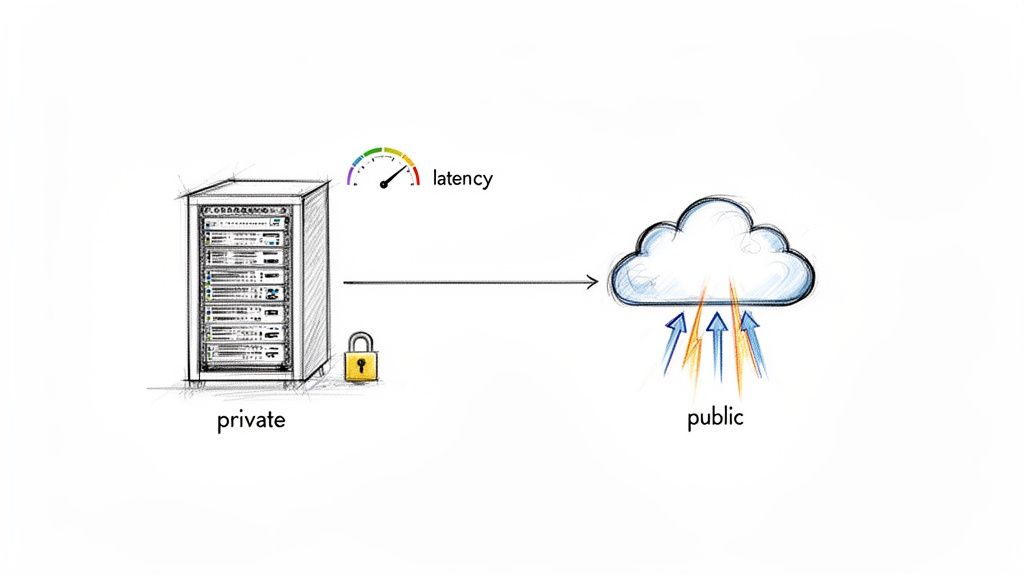
Let’s move past the basic definitions. At its core, a hybrid cloud architecture is all about creating a seamless, interconnected environment between your private infrastructure and a public cloud. It's where tight control meets massive scalability.
This model is built on a simple truth: not all workloads are created equal. Some demand the fortress-like security of a private data center, while others thrive on the on-demand resources of a public provider. The real goal is to make these two distinct environments operate like a single, well-oiled machine, which requires serious planning and rock-solid connectivity.
Common Architectural Patterns in Practice
Engineers and architects lean on a few established patterns to make hybrid cloud work effectively. One of the most common is cloud bursting.
Think about an e-commerce platform bracing for a massive holiday sale. Instead of overprovisioning its on-premise servers year-round just for that peak, it can "burst" into a public cloud to handle the temporary surge. This pattern is incredibly cost-effective because you only pay for that extra muscle when you absolutely need it.
Another popular pattern is workload segmentation. A fintech app, for example, might keep its highly sensitive transaction database on-premise to satisfy strict regulatory compliance. At the same time, it can use public cloud services for development, testing, and its customer-facing website. This approach smartly isolates critical data while still taking advantage of the public cloud’s agility.
A hybrid cloud isn’t just about having one foot in the private cloud and one in the public. It's about building a deliberate, strategic bridge between them to optimize specific business processes, from handling unpredictable traffic to safeguarding regulated data.
The Benefits and Challenges of a Hybrid Approach
The advantages of a hybrid model are powerful, especially for organizations with existing infrastructure or heavy compliance burdens.
- Enhanced Security and Compliance: By keeping sensitive data within a private environment, businesses in sectors like healthcare and finance can more easily meet stringent regulations like HIPAA or PCI DSS.
- Lower Latency: For applications needing near-instant response times—think manufacturing floor systems or financial trading platforms—keeping critical workloads on-premise slashes latency.
- Leveraging Existing Investments: A hybrid model lets companies get more mileage out of their on-premise hardware, maximizing their initial investment while gradually migrating workloads to the cloud.
But this strategy isn't a walk in the park. The main challenge is integration complexity. Getting two fundamentally different environments to talk to each other smoothly requires specialized expertise and tooling. For a deeper look at the technical side of things, you can find valuable insights by exploring best practices for developing in the cloud.
Unified management is another major hurdle. Without a centralized control plane, trying to oversee security policies, governance, and resource allocation across both environments can quickly become chaotic. This operational overhead is a critical factor to weigh when deciding if a hybrid cloud truly fits your long-term goals.
Digging into the Multi-Cloud Ecosystem
While hybrid cloud is all about bridging private and public infrastructure, a multi-cloud ecosystem follows a completely different playbook. It’s a strategy rooted in flexibility, where you deliberately use services from two or more public cloud providers. The goal isn’t to create one big, connected environment. It’s about dodging vendor lock-in and hand-picking the absolute best tool for every single job.
This approach gives you the freedom to assemble a tech stack that’s perfectly tailored to your application's needs. You’re not stuck with what a single provider offers. Instead, you get to mix and match to build a real competitive advantage.
The Power of Best-in-Class Services
Think of a multi-cloud strategy like building an all-star team, where every player is a specialist. A media company building a cutting-edge streaming platform is a perfect example. They might use:
- Amazon Web Services (AWS) for its mature and powerful machine learning services to create a sophisticated content recommendation engine.
- Google Cloud Platform (GCP) for its top-tier data analytics and BigQuery to chew through massive datasets on user engagement.
- Microsoft Azure for its smooth integration with existing enterprise tools like Active Directory for user authentication or Office 365 for internal collaboration.
In this scenario, the company isn't just spreading out its workloads for the sake of it. It's strategically playing to each provider's strengths to build a far superior product. This lets development teams work with the best tools on the market, which can seriously speed up innovation and improve the final user experience.
Multi-cloud architecture is fundamentally about choice. It empowers an organization to select premier services from a diverse market, ensuring that every component of their application is powered by the most effective technology available, rather than settling for a one-size-fits-all solution.
Key Benefits and Inherent Challenges
The most immediate benefit of going multi-cloud is greater resilience. If one cloud provider has an outage, it won’t necessarily crater your entire operation. By spreading critical workloads across different vendors, you build in a layer of redundancy that’s tough to replicate with a single provider. It’s no surprise that a reported 76% of multi-cloud adopters point to reduced vendor lock-in as a massive advantage, giving them huge negotiating power and flexibility.
Cost optimization is another major driver. A multi-cloud setup lets you shop around for the best prices on specific services. You can run compute-heavy jobs on whichever provider has the lowest spot prices at the moment or shift massive data archives to a vendor with more competitive storage rates. Over time, this flexibility can add up to substantial savings.
But all this freedom comes with a price, and that price is operational complexity. Managing multiple vendors—each with its own APIs, billing cycles, and security quirks—demands a highly skilled team and sophisticated management tools. Without a unified dashboard, just tracking costs and enforcing consistent security policies across a fragmented infrastructure can become a nightmare. The security risks also multiply, as a wider attack surface can introduce new vulnerabilities if you don't have a cohesive governance strategy. This is why the hybrid cloud vs. multi-cloud debate so often boils down to a trade-off between flexibility and complexity.
Comparing Key Decision Criteria Side-by-Side
Deciding between a hybrid cloud and a multi-cloud strategy isn't just a technical choice; it's a core business decision that directly affects your budget, security, and how quickly you can operate. To make the right call, you need to look past the buzzwords and compare these models based on what really matters to your organization.
Let's dig into the details across four critical areas: cost management, security and compliance, performance, and operational complexity. This isn’t about picking a universal "best" but about finding the right fit for your specific goals.
Cost Management and Optimization
When it comes to the hybrid cloud vs. multi-cloud debate, cost is always a huge factor, but the way you optimize spending is completely different for each. A hybrid model is all about getting the most value out of your existing investments. By keeping some workloads on-premise, you can continue using hardware you’ve already paid for, which is a major financial win for companies with established data centers.
A multi-cloud strategy, on the other hand, is built around optimizing your operational budget. It essentially creates a competitive market for your workloads, letting you shop around for the best price on specific services. For example, a SaaS app might run its main compute on one cloud while moving its data archiving to another that offers cheaper long-term storage. When done right, this approach can cut operational expenses by up to 30%.
Security and Compliance Posture
On the security front, the two models offer a clear trade-off between centralized command and distributed risk.
- Hybrid Cloud: This is the go-to for organizations with strict data residency rules and compliance mandates. A fintech company, for instance, can keep sensitive customer financial data on a private, air-gapped server to meet PCI DSS requirements while running its public-facing marketing site on a public cloud. Security is simpler to centralize and audit because your most critical assets never leave your direct control.
- Multi-Cloud: In a multi-cloud setup, your security perimeter is spread across multiple vendors. While this can boost resilience by diversifying your risk, it also makes governance much harder. You have to enforce consistent security policies across different platforms, each with its own tools and quirks, which demands powerful, overarching security management tools to maintain a solid defense.
This decision tree illustrates how businesses often choose a multi-cloud path to tap into specialized capabilities for things like machine learning, advanced analytics, or unique enterprise integrations.
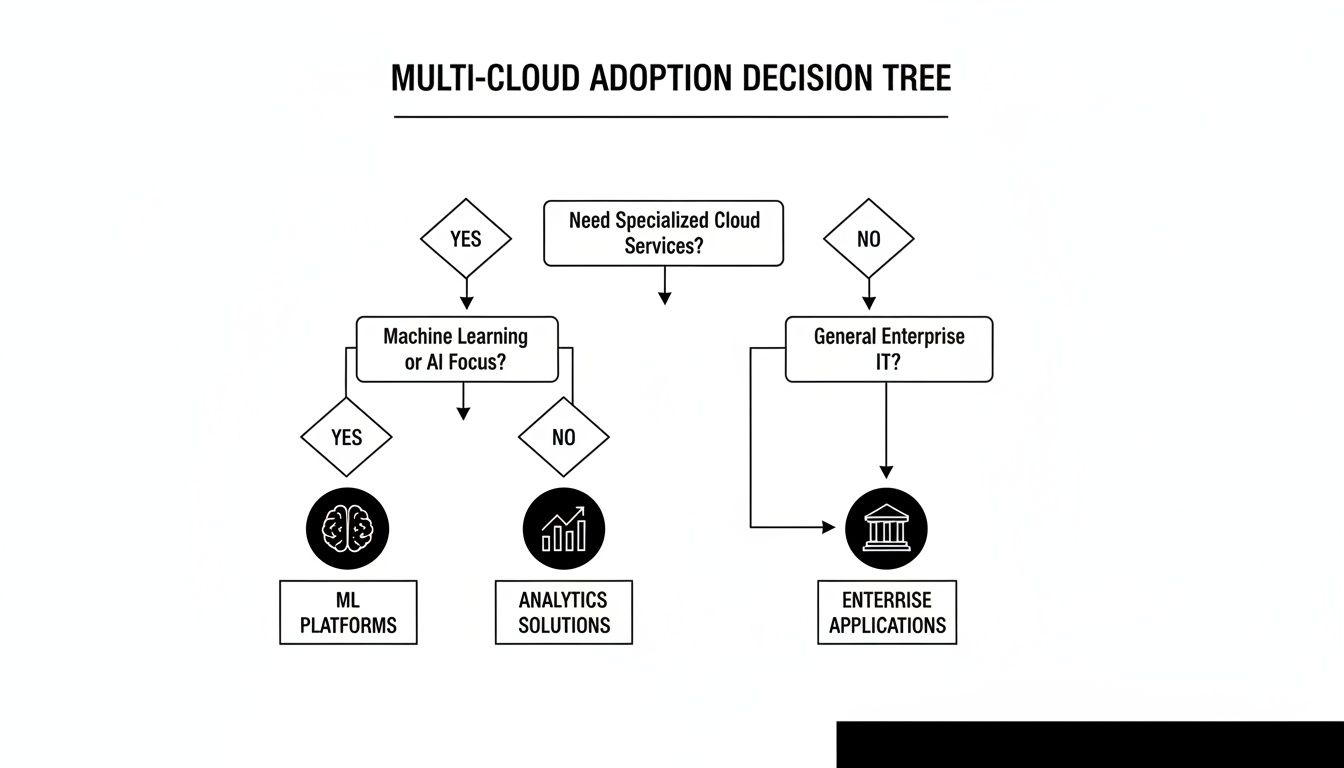
As the visual shows, going multi-cloud is rarely an all-or-nothing move. It’s a strategic choice to access best-of-breed services for specific business needs.
Performance and Latency
Performance is another area where your choice has immediate consequences. A hybrid cloud gives you a definite edge for applications that can't tolerate delays. If an e-commerce platform needs to process inventory updates in real-time, keeping the inventory database on-premise, physically close to the warehouse, guarantees the lowest possible latency.
Multi-cloud can introduce latency issues, especially if data has to travel between different cloud environments. However, it shines when you need to deliver high performance to a global audience. By deploying workloads in data centers from different providers that are geographically closer to your users, you can dramatically cut down on lag for a distributed customer base.
Operational Complexity and Management
Finally, think about the day-to-day operational headache. A hybrid cloud introduces the challenge of managing two distinct environments—private and public—and making sure they communicate flawlessly. This usually requires specialized skills and dedicated tools for orchestration and networking.
A multi-cloud architecture doesn't just add to this complexity; it multiplies it. Juggling different billing systems, APIs, and support channels for each vendor creates a massive operational load. Without a solid centralized management platform, teams can get bogged down fast, completely wiping out the potential cost and performance gains.
The table below offers a detailed look at these criteria, helping you connect your business priorities to the cloud model that makes the most sense.
Detailed Feature Comparison Hybrid vs Multi-Cloud
Here's a detailed breakdown comparing the two cloud models across key technical and business criteria, designed to help you see which approach aligns better with your organization's needs.
| Decision Criteria | Hybrid Cloud Approach | Multi-Cloud Approach | Best For |
|---|---|---|---|
| Cost Management | Optimizes capital expenditure by leveraging existing on-premise hardware. | Optimizes operational expenditure by enabling price competition for services. | Hybrid: Companies with significant on-premise investments. Multi-Cloud: Startups and businesses seeking granular cost control. |
| Security Posture | Centralizes security for sensitive data by keeping it on-premise. | Distributes risk but requires complex, overarching governance tools. | Hybrid: Fintech, healthcare, and government agencies with strict compliance needs. Multi-Cloud: E-commerce and media companies prioritizing resilience. |
| Performance | Excels at low-latency for applications tied to physical locations. | Delivers high performance for globally distributed user bases via regional data centers. | Hybrid: Manufacturing and real-time processing. Multi-Cloud: Global SaaS platforms and streaming services. |
| Complexity | Involves managing the integration between private and public environments. | Requires managing multiple vendors, APIs, and security policies simultaneously. | Hybrid: Organizations with mature IT teams. Multi-Cloud: Businesses with specialized talent and advanced management tools. |
Ultimately, this comparison isn't about finding a single "winner." It's about understanding the trade-offs and choosing the architecture that gives your business the right balance of control, flexibility, and performance.
Industry Use Cases: When to Choose Each Strategy
Theory only gets you so far. The real test of any cloud strategy is how it holds up in the wild, solving specific problems for specific industries. The right choice in the hybrid cloud vs. multi-cloud debate often boils down to your sector’s unique demands for compliance, performance, and user experience.
Looking at how these models work in practice gives you a much clearer roadmap. By breaking down how businesses in fintech, media, and healthcare use these strategies, you can start to connect your own operational needs to the right cloud architecture.
Fintech: Securing Transactions with Hybrid Cloud
The financial technology world operates under an intense microscope of regulatory scrutiny. For any fintech company handling sensitive transaction data, a hybrid cloud model is less of a choice and more of a baseline requirement. It all comes down to control.
To satisfy strict regulations like PCI DSS (Payment Card Industry Data Security Standard), these companies must prove an unbroken chain of custody for financial data. By keeping their core transaction engines and customer financial databases on private, on-premise servers, they maintain direct control over their most critical assets. This approach makes audits much simpler and eases the overall compliance burden.
At the same time, they can tap into the public cloud for less sensitive workloads, like:
- Customer-facing mobile apps: Running the user interface and non-critical backend services on a public cloud that can scale easily.
- Development and testing environments: Giving developers the flexibility of cloud resources without putting production data at risk.
- Marketing websites: Handling high-traffic, public-facing content that never touches financial information.
This deliberate segmentation allows fintech firms to move fast and innovate while still upholding the non-negotiable security standards their industry demands.
Media and Entertainment: Optimizing Global Delivery with Multi-Cloud
For a global media streaming service, the entire game is about performance, scalability, and cost-efficiency on a massive scale. A multi-cloud strategy is a natural fit here because it allows the company to pick the best services from different providers for very specialized jobs.
A typical setup might involve using three major cloud providers to engineer a superior, more cost-effective platform. For instance, they could use AWS for its best-in-class video transcoding services, lean on Google Cloud for its powerful BigQuery analytics to process viewer data, and use another provider known for its competitive pricing on global content delivery network (CDN) services.
By diversifying their infrastructure, media companies avoid getting locked into a single vendor's pricing or feature set. This gives them the flexibility to optimize both performance and cost across their entire workflow, from content ingestion to final delivery.
This approach also builds in a critical layer of resilience. If one provider's CDN has regional problems, traffic can be dynamically rerouted through another, ensuring subscribers get an uninterrupted viewing experience. That's a level of high availability that's incredibly difficult to pull off with just one provider.
Healthcare: Prioritizing Compliance and Innovation with Hybrid Cloud
The healthcare industry is constantly juggling a dual challenge: protecting incredibly sensitive patient data under strict HIPAA (Health Insurance Portability and Accountability Act) regulations while simultaneously pushing for innovation in digital health. A hybrid cloud creates the perfect framework to balance these competing priorities.
A healthcare platform can host its Electronic Health Records (EHR) system—which contains Protected Health Information (PHI)—on a secure private cloud or on-premise data center. This ensures the most sensitive data stays under the organization's direct control, making it far easier to enforce access controls and maintain a clean audit trail for HIPAA compliance. It's a foundational move for any team looking to modernize legacy systems in a regulated field.
Simultaneously, the public cloud is perfect for a wide range of other applications that don't handle PHI, such as:
- Telehealth video conferencing: Using the global scale of a public cloud for reliable, high-quality video streams.
- Anonymous data analytics: Tapping into powerful cloud-based machine learning tools to analyze anonymized patient data for research.
- Patient scheduling portals: Building scalable, friendly web applications that make the patient experience better.
This balanced strategy allows healthcare organizations to confidently embrace new technologies and improve patient care without ever compromising the security and privacy of sensitive health information.
Unify Your Cloud with Intelligent AI Management
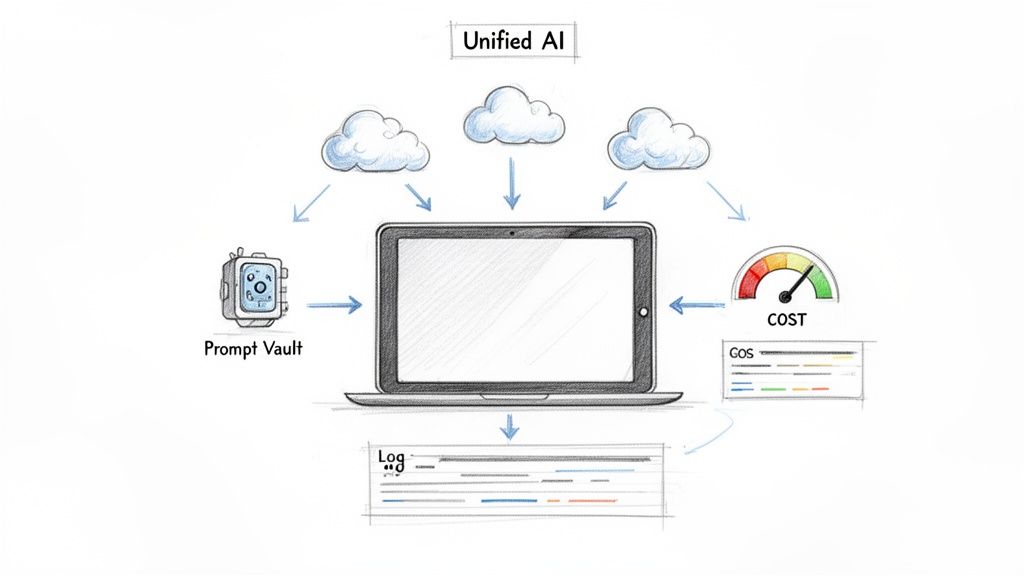
Whether you land on a hybrid or multi-cloud strategy, a new challenge pops up the second you begin weaving AI into your applications. All of a sudden, you're not just managing infrastructure. You're trying to wrangle a chaotic mix of AI models, each with its own costs and quirks. This is where AI initiatives often get bogged down.
Without a single layer of control, managing prompt libraries, keeping costs in check, and getting consistent performance across different AI models turns into a massive headache. This gap in governance can quickly erase the very advantages you were trying to gain with your cloud strategy.
Taming AI Complexity with Centralized Control
This is precisely where an intelligent admin tool adds a much-needed governance layer to your cloud architecture. Instead of trying to juggle a half-dozen dashboards and APIs, you need one command center for your application's AI. A dedicated management system cuts right through the noise, giving you clear visibility and control no matter how your underlying cloud is set up.
A centralized approach directly tackles several key problems that crop up in both hybrid and multi-cloud AI deployments. It makes prompt engineering far more straightforward and gives you a direct line of sight into both performance and spending.
The real problem in a complex cloud environment isn't just managing servers; it's about governing the intelligent layer built on top. An AI management tool acts as the brain for your application's brain, ensuring every piece works together to deliver actual innovation.
Introducing a Command Center for Your AI
Wonderment has developed a prompt management system to solve this exact problem. This administrative tool can be plugged into your existing desktop or mobile app to modernize it for AI, creating a single source of truth and transforming a fragmented process into a streamlined one.
It’s built with several key features designed for modern AI applications:
- Prompt Vault with Versioning: Stop hunting for the right version of a prompt. Our vault lets you manage, test, and deploy prompts with full version control, which guarantees consistency and makes rolling back changes simple.
- Parameter Manager: Securely hook up your AI models to internal databases. This feature simplifies passing dynamic information into your prompts without putting data security at risk—a critical step for any meaningful AI integration.
- Logging System: Get a single, consolidated log of every interaction across all your integrated AI models. This makes debugging, performance monitoring, and auditing a breeze, no matter how many clouds you're using.
- Cost Manager: See your cumulative spend across all integrated AI services in one dashboard. This gives entrepreneurs and business leaders the financial clarity they need to manage budgets and measure ROI effectively.
This solution provides the essential command center for your application’s AI. By simplifying how you manage prompts, monitor performance, and control costs, you can ensure your cloud strategy truly delivers innovative results. To see how this fits into a broader strategy, explore our guide on enterprise application integration best practices for more insights.
Frequently Asked Questions
When you're sorting through the details of hybrid cloud vs. multi-cloud, a few questions always seem to pop up. Here are some straight answers to the most common queries we hear from business leaders and their tech teams.
Can You Use Hybrid and Multi-Cloud Together
Yes, you absolutely can. In fact, it's a popular strategy for larger companies, often called a "hybrid multi-cloud" environment. It’s all about mixing and matching to get the best of both worlds.
For instance, a company might run a hybrid model by linking its private data center to a main public cloud for its essential day-to-day operations. At the same time, they could adopt a multi-cloud strategy by tapping into specialized AI or data analytics services from a different cloud provider. This approach creates an incredibly flexible and powerful infrastructure tailored to specific needs.
What Are the Biggest Multi-Cloud Security Challenges
The single biggest headache in a multi-cloud setup is maintaining a consistent security posture. When you're juggling different security tools, policies, and access controls from multiple vendors, you create complexity and, worse, potential blind spots.
To get a handle on this, you have to invest in a centralized security management platform. This means using tools that can apply the same policies everywhere, watch for threats across all your clouds from one screen, and manage user permissions universally. Without that central oversight, you're just trying to secure a fragmented and vulnerable environment.
How Do You Migrate from On-Premise to a Hybrid Cloud
Moving from a traditional on-premise setup to a hybrid cloud should be a careful, step-by-step process—not a frantic "lift-and-shift."
A smart first move is to do a deep dive into your workloads to figure out which applications are good candidates for the public cloud. Start with something low-risk, like your dev and test environments, to get your feet wet and iron out the kinks in your process. Before you even think about moving mission-critical systems, make sure you have rock-solid, secure network connectivity between your data center and your chosen cloud provider. This gradual approach keeps disruptions and risks to a minimum.
Ready to unify your AI management across any cloud environment? Wonderment Apps provides the essential toolkit to control costs, streamline prompt engineering, and gain clear visibility over your AI integrations. Schedule a demo today to see how our administrative platform can modernize your application.