


The real cost of building a healthcare app isn't a simple number you can pull from a hat. A basic app might run anywhere from $50,000 to $100,000, but if you're building a sophisticated platform with features like telehealth and AI, the investment can easily climb north of $300,000. The final price tag is a direct reflection of the features, compliance hurdles, and technology you choose to pack in. At Wonderment Apps, we've seen that the most successful projects don't just plan for features; they plan for intelligence and scalability from day one, often using modern toolkits to integrate AI without breaking the bank.
Your Guide to Healthcare App Development Costs
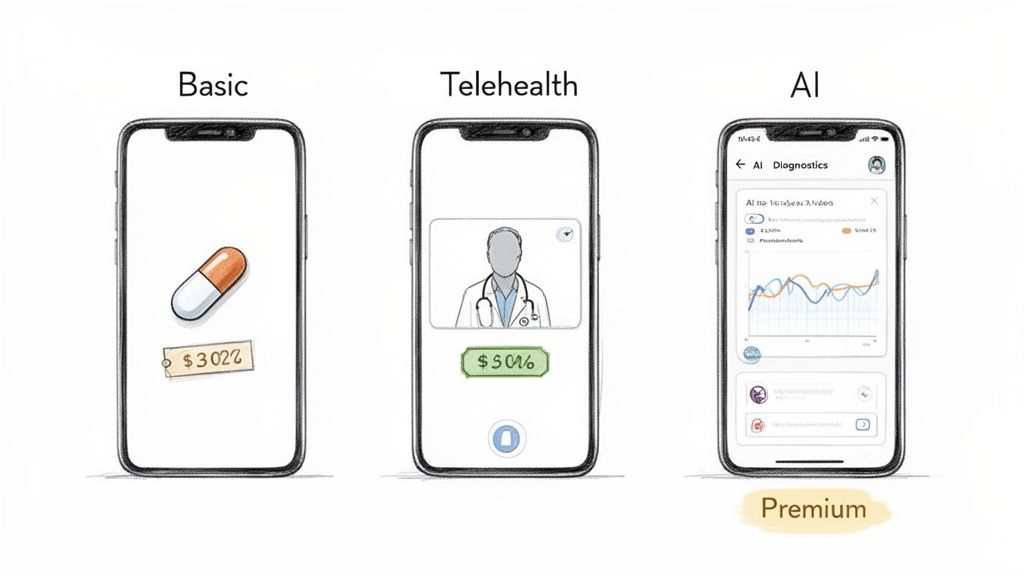
Trying to pin down a single price for a healthcare app is a bit like asking for the cost of a new building without knowing if it's a small clinic or a major hospital. The components you add—from a simple medication reminder to a complex telehealth suite—directly shape the final investment. Every feature adds another layer of complexity, and with it, cost.
This guide gives you a clear, no-nonsense breakdown of the financial commitment required. We want you to be able to build a realistic budget from the ground up, so we'll start with typical cost ranges before diving into the specific factors that make those numbers go up or down.
Setting a Realistic Budget
Before you can get a ballpark estimate, you need a clear vision. Are you building a simple tool for a very specific audience, or are you creating a comprehensive platform designed to grow with your user base? The scope of your project is the single biggest driver of cost.
For instance, a basic healthcare app like a symptom tracker or medication reminder generally falls in the $50,000 to $100,000 range. This covers the essentials: user logins, simple data entry, push notifications, and a basic analytics dashboard. These apps don't need heavy-duty backend infrastructure or real-time data processing, which helps keep the budget in check. You can find more healthcare app cost estimates on pi.tech to get a broader perspective.
Integrating AI from Day One
In today's market, you can't just build an app; you have to build an intelligent, future-proof one. That means thinking about AI from the very beginning. Many entrepreneurs get nervous here, worrying that adding AI will send their budget spiraling. It's a valid concern, but with the right approach, it's entirely manageable.
At Wonderment Apps, we developed a prompt management system that works like an administrative toolkit for your application. You can plug it directly into your software, giving you total control over how AI is integrated. This system includes:
- A Prompt Vault: Comes with versioning so you can manage, test, and refine AI interactions over time.
- A Parameter Manager: Provides secure access to your internal database.
- A Unified Logging System: Lets you track performance across all your AI models from one place.
- A Cost Manager: Keeps a running tab on your cumulative token spend in real time.
By bringing a tool like this into the project from the start, you can equip your application with powerful AI capabilities while keeping a firm grip on the budget. It’s a strategic move that ensures your app is not just smart but also sustainable for the long haul.
What Really Drives the Cost of Your App?
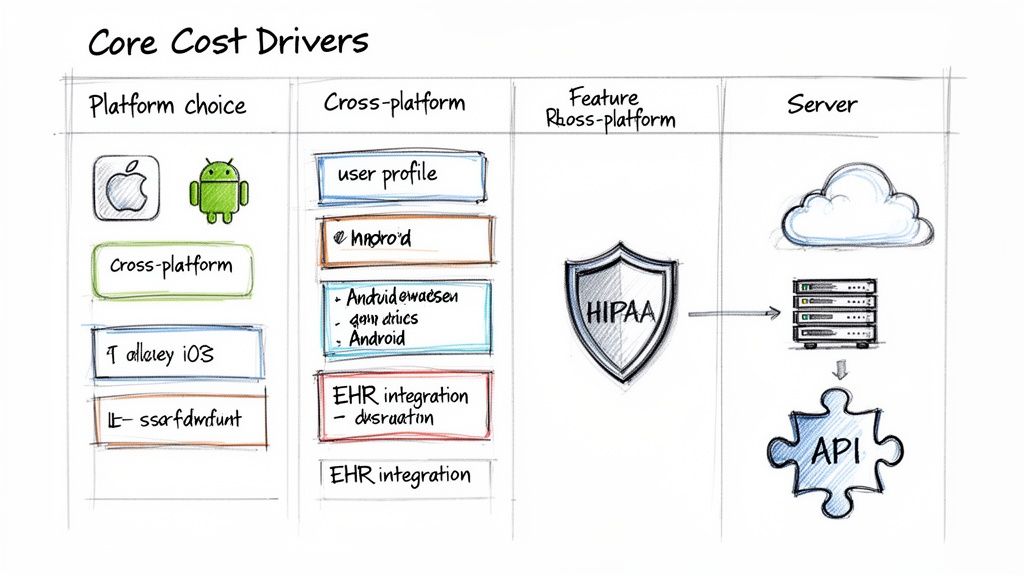
While a ballpark figure is a good start, the final healthcare app development cost comes down to a handful of key decisions. Think of it like building a house: the number of rooms, the quality of the materials, and the type of security system you install all directly impact the final price tag.
Understanding these core drivers is the only way to build a realistic budget and sidestep surprise expenses. Every choice, from the technology you pick to the features you include, adds another line item to the quote. Let's break down what will actually influence your investment.
Platform Choice: iOS, Android, or Both?
One of the first big forks in the road is deciding which platform to build for. This choice doesn't just shape your initial development bill; it also affects your long-term maintenance budget.
-
Native (iOS or Android): Building native means creating two separate apps from the ground up—one for Apple’s App Store and another for Google Play. This approach delivers the absolute best performance and user experience, but it’s also the most expensive route. You're essentially paying for two parallel development projects.
-
Cross-Platform: Frameworks like React Native or Flutter allow developers to write a single codebase that runs beautifully on both iOS and Android. This dramatically cuts down upfront costs and development time, making it a fantastic option for startups or any organization aiming for a wide reach on a tighter budget.
The right path really depends on your app's specific needs. If you need silky-smooth animations or heavy-duty device processing, native might be non-negotiable. For many healthcare apps, though, a cross-platform approach strikes a smart balance between cost, speed, and performance. For a deeper dive into how these choices impact finances in general, check out our guide on the cost of software development.
Feature Complexity and Integrations
Here it is: the single biggest factor in your app's cost is the depth and complexity of its features. A simple user profile is one thing. A sophisticated, real-time integration with an Electronic Health Record (EHR) system is an entirely different beast.
Just consider the difference. A basic medication reminder app might land in the $50,000 range. But a full-fledged telehealth platform with live video, EHR syncing, and e-prescribing features can easily soar past $300,000. Each of those advanced features demands specialized expertise and adds hundreds, if not thousands, of hours to the project timeline.
One of the most common budget-killers is feature creep—the temptation to add too many "nice-to-have" functions right out of the gate. A much smarter, more budget-friendly strategy is to start with a Minimum Viable Product (MVP) that solves one core problem exceptionally well. This lets you launch faster, get feedback from real users, and then add new features incrementally.
On top of that, integrating with third-party services—think payment gateways, mapping APIs, or lab testing services—adds another layer of complexity. Every API has its own documentation and rules, not to mention potential subscription fees, all of which need to be baked into the project's scope and budget.
Security and HIPAA Compliance
In healthcare, security isn't just a feature; it's the absolute foundation of your app. Protecting sensitive patient data is everything, which brings the Health Insurance Portability and Accountability Act (HIPAA) front and center. Getting this right is a major—and necessary—investment.
Building a HIPAA-compliant app means taking several very specific steps:
- Data Encryption: All patient data must be encrypted, both when it's stored on a server (at rest) and when it's being sent over a network (in transit).
- Secure Backend: The server infrastructure needs to be locked down with robust security protocols to prevent any unauthorized access.
- Tough User Authentication: Implementing things like multi-factor authentication and strict access controls is a must.
- Audit Trails: Your app has to log every single time protected health information (PHI) is accessed or changed. This is crucial for accountability.
To build an accurate budget, you have to understand what does HIPAA compliant mean and how it impacts development. Skimping on compliance from day one can lead to crippling fines, legal nightmares, and a total loss of user trust. It's one of the most important costs to plan for, not around.
Why Smart AI Integration Is a Modern Necessity
In healthcare's fast-moving world, an app without intelligence is already a relic. Just offering up information or basic functions isn't enough to compete anymore, and it certainly isn't enough to deliver real value. Smart AI integration has gone from a "nice-to-have" feature to a core strategic need, directly impacting patient outcomes, operational efficiency, and the overall healthcare app development cost.
Think of a standard healthcare app like a static library. It holds information, but the user has to do all the work—finding what they need, figuring out what it means, and deciding how to use it. An AI-powered app, on the other hand, is like having an expert librarian who not only finds the right book but also analyzes it for you, offers personalized recommendations, and anticipates your next question. That’s the fundamental shift modern healthcare tech is built on.
Moving Beyond Buzzwords to Real-World Value
The real power of AI in healthcare isn’t about some far-off futuristic idea; it’s about solving tangible, everyday problems with a level of speed and accuracy we’ve never seen before. The applications are practical and are already changing how we deliver care.
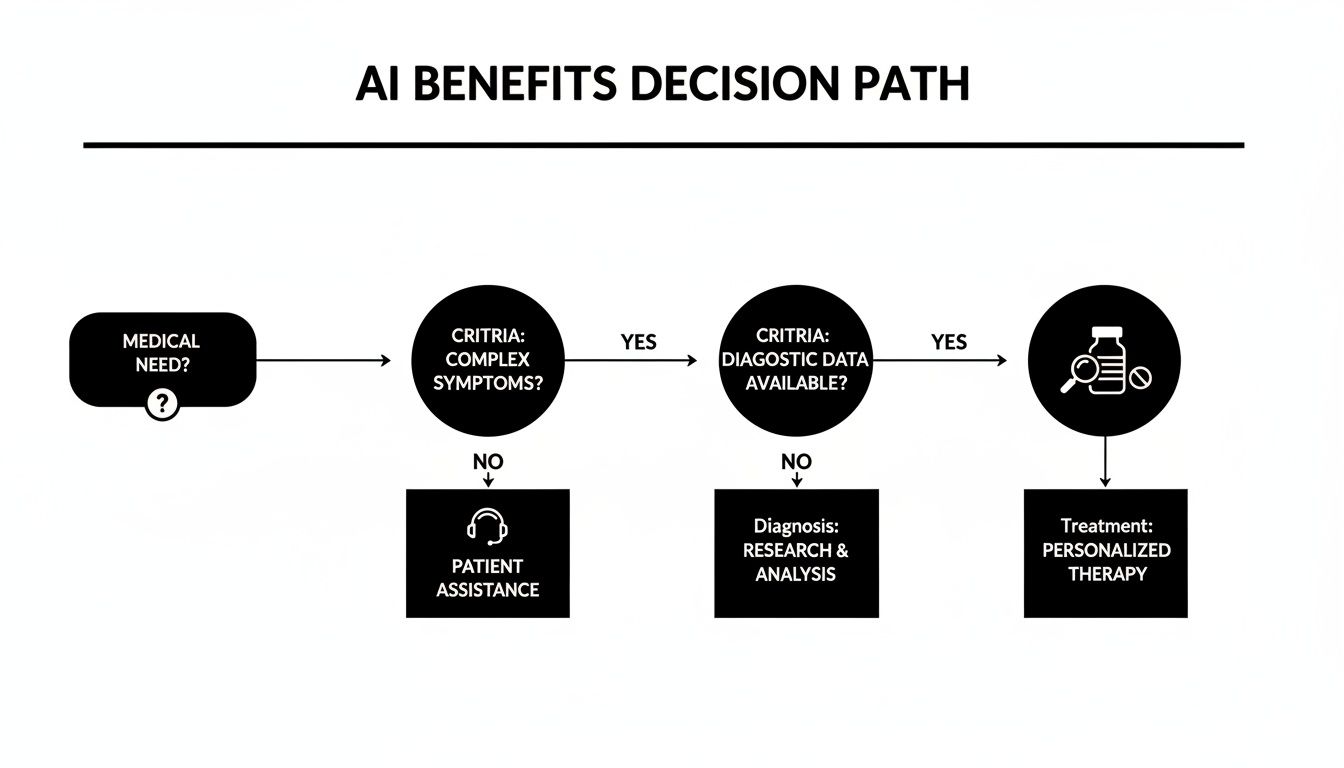
- AI-Powered Diagnostics: Machine learning models can analyze medical images like X-rays or MRIs with incredible precision, often spotting tiny anomalies the human eye might miss. This doesn't replace a clinician but supercharges their ability, leading to earlier, more accurate diagnoses.
- Personalized Treatment Plans: Instead of a one-size-fits-all approach, AI can process a patient’s entire health history, genetic data, and lifestyle to suggest tailored treatment plans. This is the heart of precision medicine, driving better engagement and outcomes.
- Predictive Risk Analysis: By crunching massive datasets, algorithms can flag patients at high risk for conditions like sepsis or heart failure long before symptoms become obvious. This opens the door for proactive intervention, saving lives and cutting down on hospital readmissions.
These aren't just theories. For instance, Ochsner Health's digital medicine programs found that 79% of patients got their blood pressure under control within 180 days by using AI-driven tools. That’s a clear, measurable link between smart software and better health.
Enhancing Both Patient and Provider Experiences
When you integrate AI smartly, it creates a win-win. For patients, it means a more responsive, personalized healthcare journey. For providers, it means less time buried in administrative tasks and more time focused on what they do best—caring for patients.
Integrating AI isn't just about adding a feature; it's about building an application that learns, adapts, and actively participates in the care process. It transforms a simple tool into an indispensable partner for both patients and clinicians, delivering a clear and measurable return on investment.
Think about AI-driven chatbots available 24/7. They can handle common patient questions, help schedule appointments, or send medication reminders, freeing up staff for more complex issues. Behind the scenes, AI can optimize hospital workflows by predicting admission rates or managing operating room schedules, leading to serious cost savings. If you’re thinking about how to bring these capabilities to life, it’s worth exploring the full range of AI solutions for healthcare.
Ultimately, building a healthcare app today without a plan for AI is like building a new hospital with an outdated electrical system. It might work for a little while, but it’s missing the foundation needed for modern, essential technology. Planning for AI from day one ensures your app is not only relevant now but also ready for whatever comes next.
Choosing the Right Development Pricing Model
How you decide to pay for your app is just as critical as the final number on the invoice. The pricing model you land on with your development partner sets the rules for the entire project. It's the financial framework that dictates everything from budget predictability and flexibility to the overall vibe of your partnership.
Picking the right model isn’t about finding the “cheapest” option; it’s about aligning your project’s real-world needs with a financial structure that just makes sense. A project with a rock-solid, completely defined scope is a totally different beast than an innovative, complex build where the requirements are bound to evolve. Let's dig into the most common models to see which one fits your situation.
The Fixed Price Model
The Fixed Price model is as straightforward as it gets. You and your development agency agree on one single, unchanging price for a very specific scope of work. It’s perfect when your project requirements are buttoned up, crystal clear, and not expected to change. Think of it like buying a pre-designed kit home—you know exactly what you’re getting and what it will cost from the very beginning.
Best for:
- Minimum Viable Products (MVPs) with a tightly defined, no-frills feature set.
- Smaller projects where the specifications and wireframes are already completely mapped out.
- Organizations needing absolute budget certainty for their financial planning.
But that rigidity can also be its biggest weakness. If you suddenly need to add a feature or pivot based on early feedback, get ready for a formal change request process. That almost always means more cost and added time. There's just not much room to get creative or make adjustments on the fly.
The Time and Materials Model
On the complete opposite side of the spectrum is the Time & Materials (T&M) model. Here, you pay for the actual time developers spend working on your project, plus the cost of any third-party services or tools. It’s more like hiring a contractor to build a custom home; you have the freedom to make changes as you go, refining the design based on new ideas and what you learn along the way.
This model is the go-to for complex, long-term projects where the full scope just can't be known upfront. It’s built for agility, allowing your team and the developers to collaborate and shape the product iteratively. The secret to making T&M work is maintaining fantastic communication and transparent hour-tracking to keep the budget on track. You can explore different team setups that pair well with this model by comparing managed services vs staff augmentation.
The T&M model offers superior flexibility, making it the preferred choice for innovative healthcare apps where requirements can evolve. It fosters a collaborative partnership, allowing the product to adapt to user feedback and market changes without being constrained by a rigid, upfront contract.
The Milestone Based Model
Looking for a happy medium? The Milestone-Based model offers a hybrid approach that blends predictability with a healthy dose of flexibility. The project gets broken down into distinct phases or "milestones," each with its own set of deliverables and a pre-agreed payment. You only release funds for each stage after it's been completed to your satisfaction.
This model is fantastic for keeping everyone accountable and the project transparent. You get a clear line of sight into the project's progress, and payments are tied directly to tangible results. For example, milestones could be completing the UI/UX design, finishing the core backend functionality, and launching the beta version. It provides the security of defined goals while still allowing for tweaks and adjustments between phases.
How to Modernize and Control Your AI Integration
Building an AI-powered healthcare app is one thing; controlling it is something else entirely. After you get through the initial build, you’ll start hitting new operational walls. Reliability, security, and the ever-present anxiety over runaway AI costs become your new reality. The secret to long-term success isn't just about bolting on AI features—it's about managing them with precision and foresight.
This is exactly where a dedicated management system becomes essential. At Wonderment Apps, we saw this critical gap and built our own proprietary prompt management system. Think of it as an administrative toolkit that plugs right into your application, giving you the controls you need for a seamless, sustainable AI integration.
Gaining Command Over Your AI Interactions
Effective AI is never a "set it and forget it" technology. The quality of what it produces is a direct reflection of the quality of your instructions, or prompts. As you start refining your app's AI capabilities, you absolutely need a way to manage these prompts, test different versions, and quickly roll back to a previous one if something goes wrong.
Our system is built around four core pieces, all designed to give you complete control. It turns AI from a potential black box into a transparent, manageable asset.
- Prompt Vault with Versioning: Picture this as a library for all your AI prompts. It lets you track every single change, experiment with new instructions, and keep a clear history of what works best. This ensures you're always getting consistent, high-quality responses from your AI.
- Parameter Manager for Secure Database Access: This component is like a secure gatekeeper, controlling exactly how the AI talks to your internal database. It makes sure the AI only gets the specific data it needs to do its job, protecting sensitive patient information and keeping you compliant.
- Unified Logging System: When you're juggling multiple AI models or services, trying to track their performance can get messy. Our logging system pulls all AI-related activity into one easy-to-read dashboard, giving you a crystal-clear view of performance, errors, and usage patterns.
- Powerful Cost Manager: This is your financial command center for everything AI. The cost manager gives you a real-time, running total of your token spend across all your AI models. No more surprise bills. You can set budgets and fine-tune usage to keep your healthcare app development cost under control for the long haul.
This kind of integrated approach is about more than just "adding AI." It gives you the tools to manage your AI integration as a core business function—one that is predictable, secure, and financially sound.
Building a Scalable and Secure AI Foundation
Bringing AI into your app introduces new kinds of complexity, especially when it comes to security. A huge part of controlling your AI integration is safeguarding sensitive access points. You need to implement solid strategies for preventing LLM key leaks to protect both your application and your user data. An administrative toolkit helps enforce these security rules by managing how and when API keys are used.
Ultimately, the goal is to build an AI ecosystem that can grow with your user base without becoming a management nightmare or costing a fortune. By putting a control layer like our prompt management system in place from the start, you create a foundation that's built to last. It ensures your app can adapt to new AI advancements, scale up to meet demand, and deliver reliable, intelligent experiences for years to come.
Budgeting for Long-Term App Success
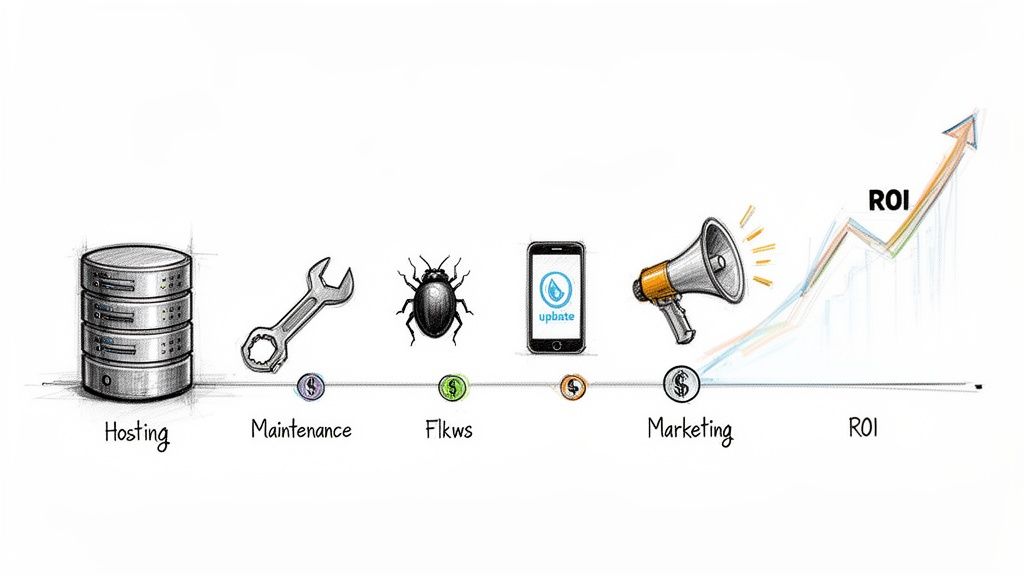
Launching your app is a huge milestone, but it’s the starting line, not the finish. The initial development cost gets your app into the hands of users, but a forward-thinking budget is what keeps it there. Too often, organizations pour everything into the initial build, leaving nothing for the crucial journey that follows.
A successful healthcare app is a living product that needs continuous care and feeding. Thinking about the entire application lifecycle from day one is the only way to ensure your investment truly pays off. This means planning for the predictable—and sometimes unpredictable—costs that pop up long after launch day.
Factoring in Post-Launch Operational Costs
Once your app is live, a whole new set of expenses kicks in. These aren't optional extras; they're the absolute essentials for keeping your app functional, secure, and relevant. A good rule of thumb is to budget an additional 15% to 20% of the initial development cost for maintenance every single year.
This ongoing investment typically covers several key areas:
- Server and Hosting: Your app’s data needs a secure place to live. Whether you use a cloud service like AWS or a dedicated server, this is a recurring monthly or annual expense that grows as your user base expands.
- Routine Maintenance and Bug Fixes: No software is perfect. As users interact with your app, bugs will inevitably surface. A dedicated maintenance budget ensures you can squash them quickly before they tarnish the user experience.
- OS and Security Updates: Apple and Google release new operating system versions every year. Your app must be updated to stay compatible, which requires development time. Likewise, security patches are non-negotiable to protect patient data.
The Investment in Growth and User Acquisition
The greatest app in the world is useless if nobody knows it exists. Marketing and user acquisition aren't afterthoughts; they are a fundamental part of your overall healthcare app development cost. Building an audience requires a strategic and sustained financial commitment.
Your marketing budget will need to cover activities designed to attract and retain users, such as:
- App Store Optimization (ASO): This is the SEO of the app world. It involves fine-tuning your app’s listing with the right keywords and visuals to climb the rankings in search results.
- Digital Advertising: Targeted ads on social media or search engines can be a powerful way to reach specific patient demographics.
- Content Marketing: Creating valuable blog posts, videos, or guides that address your audience's health concerns can build trust and drive organic downloads.
Planning your post-launch strategy is just as important as planning the initial build. A well-funded maintenance and marketing plan is the difference between an app that thrives and one that fades into obscurity after a few months.
Measuring Your Return on Investment (ROI)
Ultimately, you’re making this investment to get a positive return. In healthcare, ROI isn't just about revenue; it’s about measuring the app's real-world impact on patient care, operational workflow, and health outcomes. Defining your key performance indicators (KPIs) upfront helps you track success and justify the ongoing spending.
Look beyond simple download numbers and focus on metrics that truly matter. For a hospital's app, ROI might be measured by a reduction in patient no-show rates. For a chronic disease management app, success could be a measurable improvement in how well patients stick to their medication schedules.
Consider tracking these valuable ROI metrics:
- Patient Engagement: How often are users opening the app? Are they actively using features like appointment scheduling or messaging their providers?
- Operational Efficiency: Has the app cut down on administrative work? Are call volumes lower because patients can find answers inside the app?
- Improved Health Outcomes: Are patients with chronic conditions showing better vitals? Are readmission rates for certain procedures dropping?
By framing your budget around these long-term goals, you transform your app from a simple line-item expense into a strategic investment in better healthcare.
Frequently Asked Questions
Planning the budget for a new healthcare app naturally brings up a lot of questions. It's a significant investment, and you want to get it right. Here are a few of the most common queries we hear from founders and healthcare leaders as they map out their projects.
What Is the Typical Timeline for Developing a Healthcare App?
There's no one-size-fits-all answer here; the timeline really hinges on the app's complexity. But to give you a ballpark idea:
- Simple App (MVP): You can expect a timeline of about 3 to 6 months. This usually covers the essential features needed to launch, like user profiles, some basic health tracking, and maybe an appointment booking system.
- Complex App: For a more sophisticated application—think telemedicine capabilities, full EHR integration, or custom AI-powered diagnostics—you're looking at 9 to 18 months, and sometimes longer. Properly building, testing, and launching these systems just takes time.
What Are the Most Expensive Components of a Healthcare App?
While every project has its own unique cost drivers, a few key areas consistently account for a major slice of the budget.
- HIPAA Compliance and Security: This is a big one, and it's completely non-negotiable. Building in robust encryption, securing the backend infrastructure, and creating audit trails for data access requires a serious, upfront investment.
- Third-Party Integrations: Getting your app to "talk" to other complex systems, especially Electronic Health Records (EHRs), demands specialized know-how and a ton of testing to ensure everything works seamlessly and securely.
- Advanced AI/ML Features: If you're building custom algorithms for things like diagnostic support or highly personalized treatment plans, be prepared for a resource-intensive process. Developing, training, and fine-tuning these models is a significant undertaking.
How Can I Reduce Development Costs Without Sacrificing Quality?
Budgeting smart is the name of the game. A great strategy is to start with a Minimum Viable Product (MVP). Focus on solving one core problem for your users, and do it exceptionally well. This approach gets you to market faster, lets you collect invaluable real-world feedback, and helps you prioritize what to build next before you pour more capital into features that might not be necessary.
Another practical tip is to consider a cross-platform development framework like React Native. Building for both iOS and Android from a single codebase can dramatically lower your initial development costs. For most apps, this saves a ton of time and resources without any noticeable compromise in the user experience.
At Wonderment Apps, we specialize in building secure, scalable, and intelligent healthcare applications that deliver real-world value. Our unique prompt management toolkit gives you full control over your AI integration, ensuring your app is both powerful and cost-effective for the long run.
Ready to build an app that's modern and built to last? Schedule a demo today!